INTRODUCTION
Termites are social insects of the order Isoptera with about 3000 known species, of which 75% are classified as soil-feeding termites (Rajeev & Sanjeev Reference RAJEEV and SANJEEV2011). Soil-dwelling termites are the only insects that depend on nutrient uptake from the direct ingestion of organic material mixed with clay minerals (Brauman Reference BRAUMAN2000). They collect organo-mineral soil material from different depths and deposit it in termite mounds, at or near the surface, creating a strong chemical and physical contrast with the surrounding soil. With time and abandonment, termite mounds are eroded, and their material is redistributed on the soil surface, potentially creating a soil environment more favourable to plant establishment and development (Black & Okwakol Reference BLACK and OKWAKOL1997, Dangerfield et al. Reference DANGERFIELD, MCCARTHY and ELLERY1998, Konaté et al. Reference KONATÉ, LE ROUX, TESSIER and LEPAGE1999). In addition, termites promote changes in soil structure by termite mound, channel and gallery building, usually resulting in increased soil porosity and aeration (Lee & Wood Reference LEE and WOOD1971, Wood & Sands Reference WOOD, SANDS and Brian1978).
Soil transformations by termite disturbance processes can be demonstrated by the differences in attributes of termite mound and adjacent soil (Dangerfield et al. Reference DANGERFIELD, MCCARTHY and ELLERY1998, Kaschuk et al. Reference KASCHUK, SANTOS, ALMEIDA, SINHORATI and BERTON2006, Lobry de Bruyn & Conacher Reference LOBRY DE BRUYN and CONACHER1990, Sarcinelli et al. Reference SARCINELLI, SCHAEFER, LYNCH, ARATO, VIANA, ALBUQUERQUE FILHO and GONÇALVES2009). Due to soil physical and chemical modification, termites can be considered as ecosystem engineers, with a broad influence in the functioning and processes of tropical systems (Jones et al. Reference JONES, LAWTON and SHACHAK1994).
There are several studies on the role of termites on nutrient cycling and soil physical improvements in the tropics (Coventry et al. Reference COVENTRY, HOLT and SINCLAIR1988, Dangerfield Reference DANGERFIELD1991, Dangerfield et al. Reference DANGERFIELD, MCCARTHY and ELLERY1998, Jones et al. Reference JONES, LAWTON and SHACHAK1994, Kaschuk et al. Reference KASCHUK, SANTOS, ALMEIDA, SINHORATI and BERTON2006, Lavelle et al. Reference LAVELLE, BLANCHART, MARTIN, SPAIN and MARTIN1992, Lee & Wood Reference LEE and WOOD1971, Lobry de Bruyn & Conacher Reference LOBRY DE BRUYN and CONACHER1990, Reference LOBRY DE BRUYN and CONACHER1995; Sarcinelli et al. Reference SARCINELLI, SCHAEFER, LYNCH, ARATO, VIANA, ALBUQUERQUE FILHO and GONÇALVES2009, Wood & Sands Reference WOOD, SANDS and Brian1978), but little is known on the role of termites in sandy soils within the Atlantic rain forest, one of the global hotspots for bioversity and conservation.
In this research, we investigated the alterations in soil chemical and physical properties promoted by pedobioturbation during mound building by termites, in different sandy-soil vegetation physiognomies in the Brazilian Atlantic rain forest. Additionally, the differences on termite-mound density and soil volume turnover in contrasting studied areas, forming a pedological and vegetational gradient, were assessed. We hypothesized that the termitosphere effectively improves properties of surface soil of sandy textures through mound-building activity, reducing Al toxicity and increasing organic matter and nutrient concentrations. Also, we postulated that, with greater sand concentration and dystrophy, the greater is the role of termites in soil particle selection. This latter postulate may indicate that their action is not accidental, but an extended phenotype effect of long-lasting consequence for resource availability.
METHODS
Studied site
The studied patch of sandy-soil vegetation is in Caravelas district, southern Bahia, Brazil. It has an area of approximately 150 ha and represents one of the few well-preserved remnants in the region.
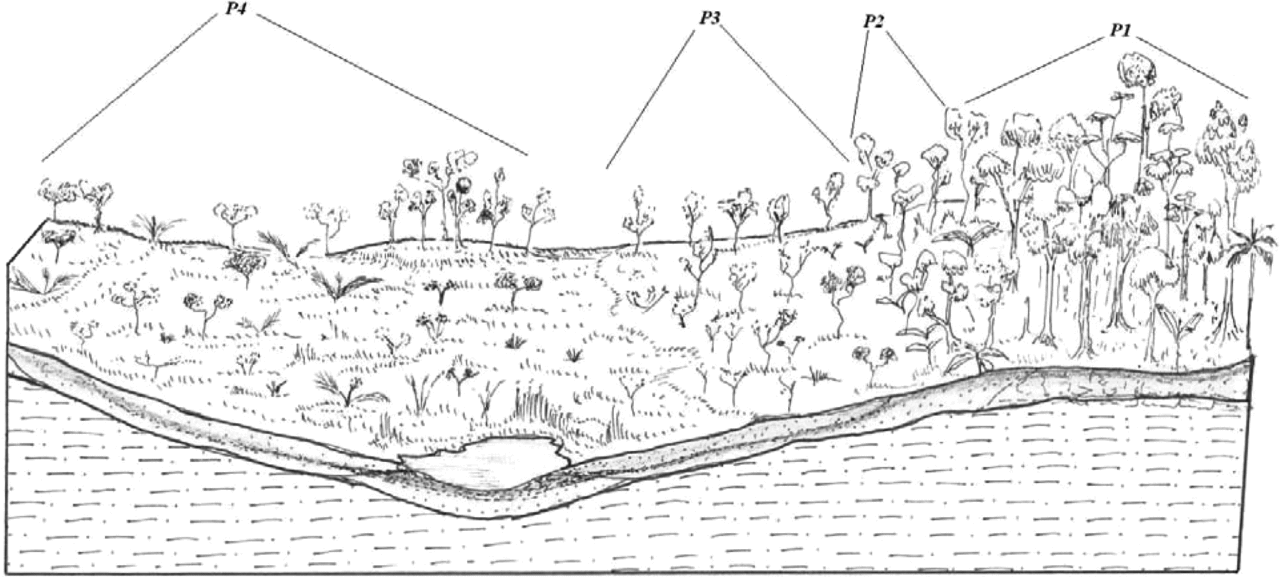
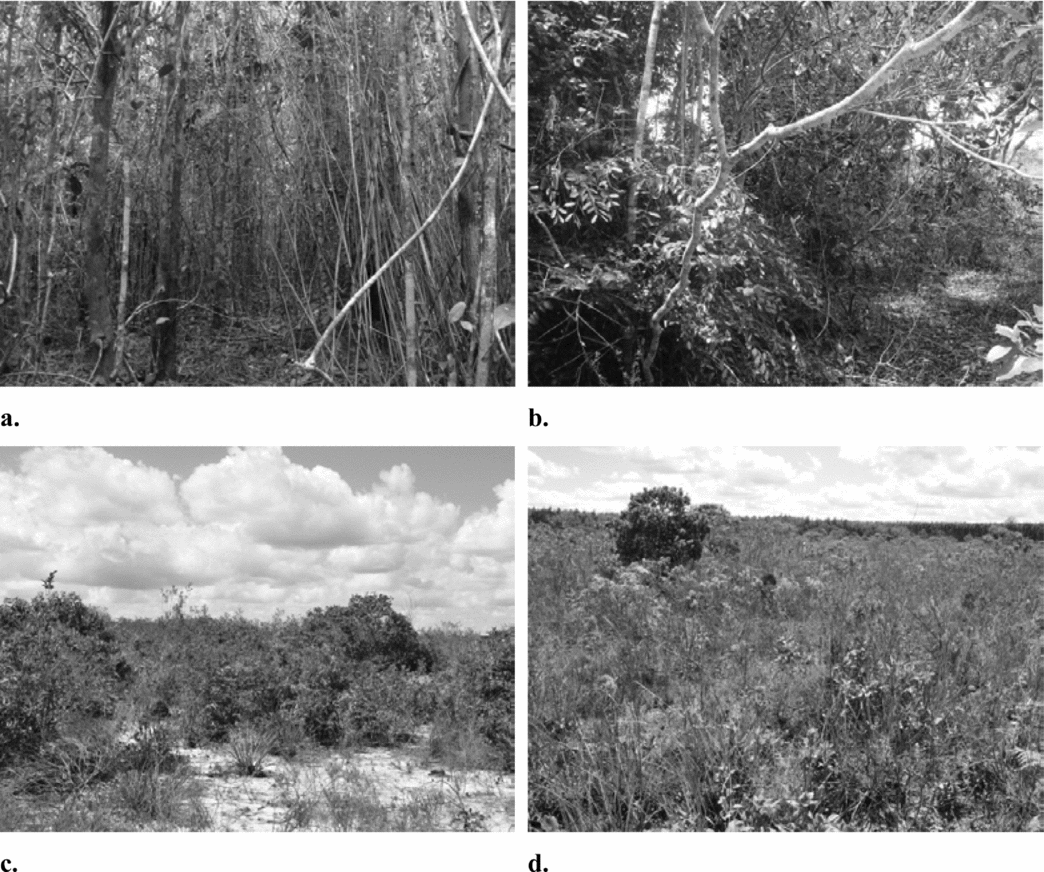
The site is on flat terrain on sandstones of the Barreiras Group from the Tertiary period (c. 16 million y bp). The patch is located in the evergreen rain-forest vegetation realm (Breckle Reference BRECKLE2002), and the main soils range from highly weathered Red-Yellow Ultisols to sandy Spodosols (Corrêa Reference CORRÊA2005). According to the Köppen classification, the climate is classified as Am, humid tropical, with mean rainfall around 1750 mm y−1 (Saporetti et al. Reference SAPORETTI, SCHAEFER, DE SOUZA, SOARES, ARAÚJO and MEIRA-NETO2011). November is the wettest month (>230 mm) and August the driest (<90 mm) (Embrapa 2000). The sandy-soil vegetation under study presents different physiognomies and is surrounded by the Atlantic rain forest. In the studied site, we identified and separated four different areas in three vegetation physiognomies (P1–P4): P1: woodland; P2: woodland border; P3: savanna; P4: grassland (Figures 1 and 2).
Diagram showing the studied areas of the sandy-soil vegetation under study in Caravelas district, south Bahia, Brazil. P1 = typic, cemented Gley Ultisol (woodland); P2 = orthic, thickened Ferrocarbic Spodosol (woodland border); P3 = duric, Ferrocarbic Spodosol (savanna); P4 = orthic, thickened Ferrocarbic Spodosol (grassland).

Photos showing the studied areas of the sandy-soil vegetation under study in Caravelas district, south Bahia, Brazil: woodland (a); woodland border (b); savanna (c); grassland (d).
The classification of the native vegetation was based on the proposal by Saporetti et al. (Reference SAPORETTI, SCHAEFER, DE SOUZA, SOARES, ARAÚJO and MEIRA-NETO2011), who established six basic forms in the sandy-soil vegetation, regionally known as mussununga, following the classification system of Veloso et al. (Reference VELOSO, RANGEL FILHO and LIMA1991). The physiognomic forms varied according to soil particle size and nutrient status, as well as water-table depth and soil physical constraints (Meira Neto et al. Reference MEIRA NETO, SOUZA, LANA and VALENTE2005, Saporetti et al. Reference SAPORETTI, SCHAEFER, DE SOUZA, SOARES, ARAÚJO and MEIRA-NETO2011). The woodlands have closed, touching tree canopies, showing the highest structural similarity to the Atlantic rain forest, whose life forms are dominated by phanerophytes (Saporetti et al. Reference SAPORETTI, SCHAEFER, DE SOUZA, SOARES, ARAÚJO and MEIRA-NETO2011).
Soil and termite-mound sampling and analysis
We described a soil profile for each area (P1–P4) and collected samples from all genetic soil horizons to perform soil classification, according to Embrapa (2006). Also, we collected random samples from the 10-cm external layer of termite mounds and composite samples of surface soil (five separate soil subsamples, thoroughly homogenized and treated as a single sample) at 0–10 cm depth and a maximum distance of 1.5 m from the termite mounds. Five paired samples (termite mound and adjacent surface soil) were collected in each area, totalling 40 samples. The spatial distance between samples was at least 20 m. All samples were air dried and passed through a 2-mm sieve, and then submitted to soil chemical and physical analysis, following Embrapa (1997) procedures.
Chemical analysis comprised soil pH in water (determined potentiometrically in a 1:2.5 soil:water solution), organic C (Walkley–Black method), exchangeable Ca, Mg and Al (extractant KCl 1 mol L−1) and available K, P, Fe and Na (Mehlich-1 extractant). The remaining phosphorus in the equilibrium solution (P-rem) was determined after shaking 5 cm3 of soil sample with 50 mL of a solution 10 mmol L−1 CaCl2, containing 60 mg L−1 of P, during 1 h (Alvarez et al. Reference ALVAREZ, NOVAIS, DIAS and OLIVEIRA2000). We calculated the sum of bases (SB = ∑ Ca, Mg, K and Na) and aluminium saturation (m = 100 Al/(∑ Ca, Mg, K, Na and Al)). We also quantified the amounts of coarse sand, fine sand, silt and clay, summing up 100% of the < 2-mm fraction (Embrapa 1997).
Physical and chemical soil variables were compared between surface soil and termite mound through a paired t-test for independent samples within each area (Zar Reference ZAR1999). The statistical analysis were performed by Statistica (version 6.0, StatSoft Inc., Tulsa, OK, USA), at a significance level of 5%.
The relative increase (RI) of a given soil variable was determined considering the samples collected in the termite mounds and surface soil, as follows:
RI (%) = (value of the variable in the termite mound − value of the variable in the surface soil) × 100/value of the variable in the surface soil
The calculation of RI was made for the following soil variables: clay concentration, organic carbon, total exchangeable bases, available phosphorus and exchangeable aluminium (Al3+). After that, we adjusted statistical models, using the software CurveExpert (version 1.3, Hyams Development, http://curveexpert.software.informer.com/1.3/).
Termite sampling, identification and feeding group
Three plots of 100 m2 (10 × 10 m) were randomly assigned in each area (P1–P4) placed at least 20 m apart. Inside each plot we chose one termite mound from which termites were collected for taxonomic identification to the generic level. The termite voucher specimens were preserved in 80% ethanol, and the population recorded was classified at generic level using a taxonomic key (Constantino Reference CONSTANTINO1999), and also through comparisons with the collections at the Entomology Museum of the Federal University of Viçosa-Termite Section.
Termites were classified into feeding groups based on information from the literature (Davies Reference DAVIES2002, DeSouza & Brown Reference DESOUZA and BROWN1994, Donovan et al. Reference DONOVAN, EGGLETON and BIGNELL2001, Freymann et al. Reference FREYMANN, BUITENWERF, DESOUZA and OLFF2008). Wood-feeders are those termites that feed on sound wood or moderately decayed wood; litter-feeders feed on leaf or grass-litter on the surface; soil-feeders or humivores feed on soil, with organic matter, ingesting large quantities of mineral soil (Calderon & Constantino Reference CALDERON and CONSTANTINO2007).
Number and volume of termite mounds
We quantified the number of termite mounds and determined the height and diameter of the base of termite mounds. We used three replicates of 100 m2 for each area (P1–P4), comprising 12 samples. The volume of soil brought to the surface for the construction of the aerial part of termite mounds was calculated considering each termite mound a half prolate spheroid, as follows:
V = (4 / 3 a b c п) / 2, where a = termite mound height, b = half termite mound length, c = termite mound half width.
In order to compare termite mound density and volume among the areas, a global ANOVA F-test was employed (Zar Reference ZAR1999).
RESULTS
Soil gradients
Most soil horizons were dystrophic, acid and sandy in texture (Tables 1, 2). The studied site presented a pedological gradient that began with woodland (P1) on a typic, cemented Gley Ultisol. The soil in the woodland border was an orthic, thickened Ferrocarbic Spodosol (P2). Downslope, it changed to a duric, Ferrocarbic Spodosol under savanna (P3), followed by an orthic, thickened Ferrocarbic Spodosol under grassland vegetation (P4). The impervious duripan (ortstein) was found only in soil at the savanna (Figures 1 and 2).
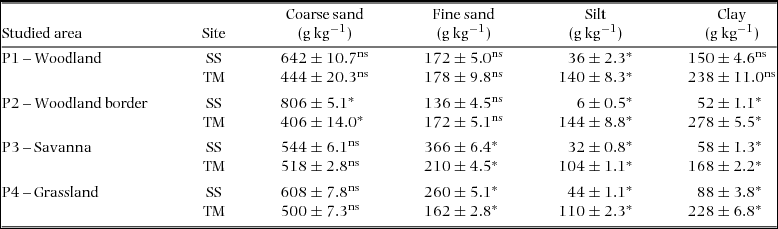
Comparison of physical characteristics of surface soils and termite mounds (mean ± SD) in different studied areas of the sandy-soil vegetation under study in Caravelas district, south Bahia, Brazil. SS = Soil surface (0–10 cm); TM = Termite mound soil. Paired t-test for comparisons in physical characteristics between surface soil and termite mounds: nsNot significant (P > 0.05); *Significant (P ≤ 0.05).
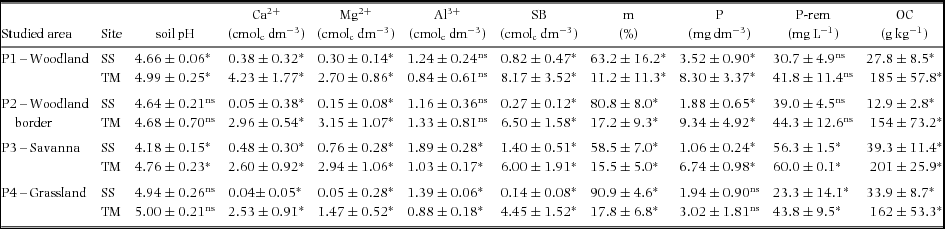
Comparison of chemical characteristics of surface soils and termite mounds (mean ± SD) in different studied areas of the sandy-soil vegetation under study in Caravelas district, south Bahia, Brazil. SB = sum of exchangeable bases; m = aluminium saturation index; P-rem = phosphorus in the equilibrium solution; OC = Organic carbon; SS = Soil surface (0–10 cm); TM = Termite mound soil. Paired t-test for comparisons in chemical characteristics between surface soil and termite mounds: nsNot significant (P > 0.05); *Significant (P < 0.05).
Soil and termite mound granulometry
For all physical properties studied, differences were significant between soil surface and termite-mound soils at any given area (P1–P4). We noticed that the amount of fine sand was significantly greater in the surface soil compared with termite mounds on the woodland and woodland border (P3 and P4). On the other hand, termite mounds had larger amounts of clay than adjacent surface soils, reaching values up to 5.3 times higher in the woodland border. The difference in clay concentration was not different for the taller woodland vegetation, due to natural higher clay concentration in the soil surface in this area. In all studied areas, the silt concentration was significantly higher in the termite mounds compared with surface soil. Most of the soil had a coarse sand texture, and a difference between termite mound and surface soil for this texture was found only for the woodland border (Table 1).
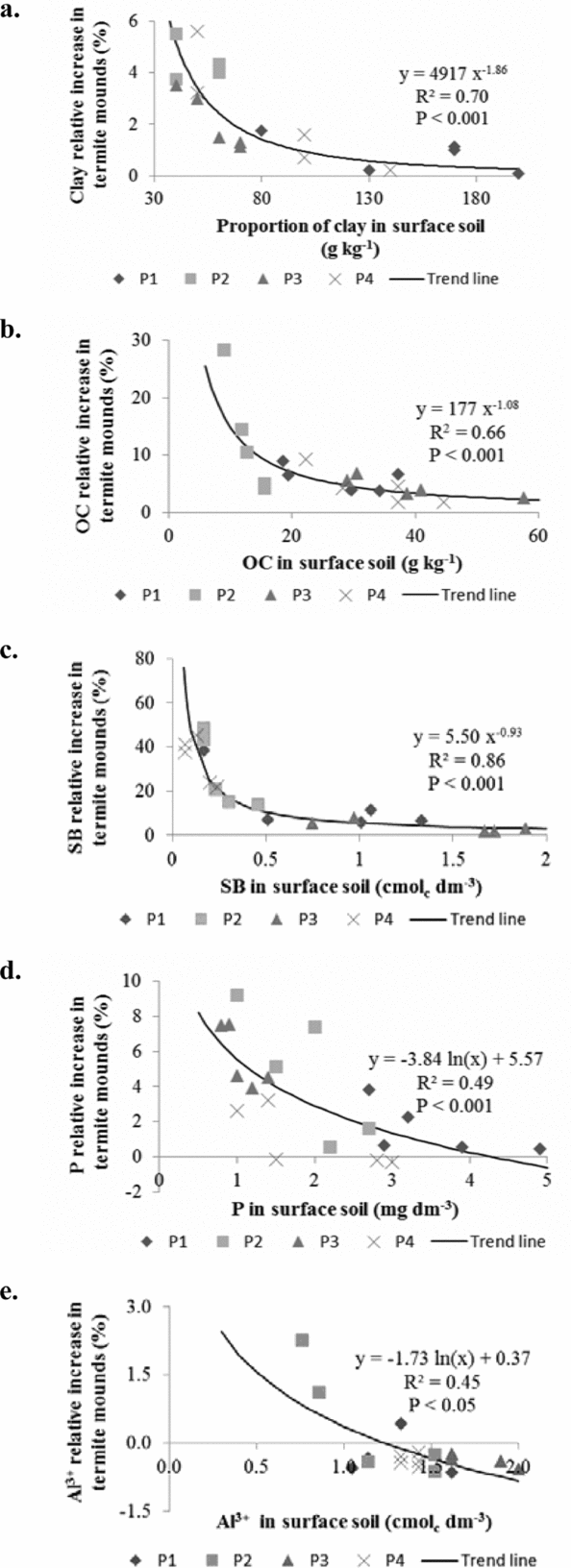
The relative increase (RI) of clay in termite mounds dropped with increasing clay concentration in the soil surface. This indicates that the higher the clay concentration of soils, the lower the soil particle selection by mound-building termites. From the value of around 80 g kg−1 of clay concentration, which was the midpoint in the curve, any increasing clay in surface soil did not substantially affect the corresponding clay relative increase in termite mounds (Figure 3a).
Relationship between clay concentration (a), organic carbon (OC) (b), sum of bases (SB) (c), phosphorus (P) (d) and exchangeable aluminium (Al3+) (e) in termite mounds in relation to the surface soil (delta) and its amount in surface soil in the sandy-soil vegetation under study in Caravelas district, south Bahia, Brazil. P1 = Woodland, P2 = Woodland border, P3 = Savanna and P4 = Grassland.
Chemical characteristics of soils and termite mounds
Soil chemical properties between surface soil and termite mounds were significantly different at a level of 5%, for two or more areas (P1–P4). Termite mounds had more organic carbon (OC) concentration than adjacent soils. Areas with lower biomass and open vegetation (savanna and grassland) presented greater OC concentration at the surface soil. On the other hand, these low biomass areas showed smaller increases in OC in termite mounds, compared with other areas (Table 2). Termite mounds concentrated up to 11.9 times more OC than adjacent soils (Table 2). The regression model showed a decrease in OC in termite mounds compared with surface soil (RI) where soil is richer in OC. The geometric regression was chosen for its good adjustment and for being better known in similar studies. We noted that from the value of around 24 g kg−1 OC only a small increase in OC in termite mounds accompanied the increasing OC in the soil surface (Figure 3b).
The concentration of exchangeable Ca2+ and Mg2+ was significantly higher in termite mounds compared with adjacent soils (Table 2). We observed the same trend for the sum of bases (SB) and OC of decreasing relative increase (RI) in termite mounds with increasing SB in the surface soils, and geometric regression was also used (Figure 3c).
The amounts of available P were significantly lower in surface soils compared with termite-mound soils, except for the grassland, which showed the lowest value for P in termite mounds. These mounds had up to 6.4 times higher P concentration compared with adjacent sandy soils (Table 2). The statistical model showed that the higher P concentration of soils, the lower the P relative increase in termite mounds (Figure 3d). Termite mounds had an overall significantly lower P retention, based on consistently higher remaining phosphorus in the equilibrium solution (P-rem) compared with surface soils, with a few exceptions (Table 2).
We observed an overall trend of very acid soil pH. In the forested environments (P1 and P2), exchangeable Al3+ concentrations were not different between termite mounds and surface soil. Consistently, in the grassland and savanna areas, the Al3+ concentration was higher at the soil surface, where organic matter was also greater (Table 2). Aluminium toxicity was apparently reduced by mound-building activity, and no termite mound had more than 50% Al saturation (Table 2, Figure 3e).
Termite diversity and termitaria (termite mound) volume
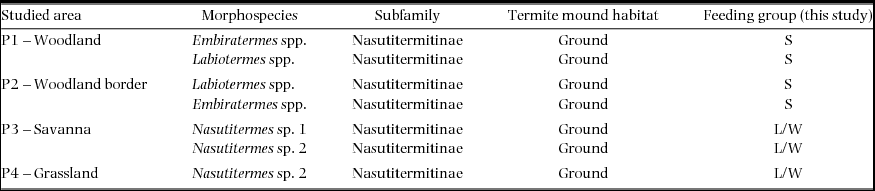
Termites collected in different studied areas (P1–P4) belonged to four species and three genera, all being from subfamily Nasutitermitinae and family Termitidae. Soil-feeding termites (Embiratermes spp. and Labiotermes spp.) and litter-and-wood-feeding termites (Nasutitermes spp.) were dominant. In some cases, we collected more than one termite species occupying the same termite mound (Labiotermes spp. and Embiratermes spp.), indicating inquilinism (Table 3).
Morphospecies and subfamily of termites, habitats and feeding groups of the termite mounds in the sandy-soil vegetation under study in Caravelas district, south Bahia, Brazil. Termite mound habitat: place where the termite mound is found, on the ground or on trees or shrubs; Feeding group: L = litter, S = soil, W = wood.
There was no significant difference between termite-mound density and the studied areas (F3,8 = 3.21, P = 0.083) and between termite-mound soil volume and the areas (F3,8 = 0.389, P = 0.764) (Table 4). Based on the current data, we estimated that termites can bring up to 14.2 m3 ha−1 of soil from deeper layers to the surface during their mound-building activity (Table 4). On average, nearly 10.5 m3 ha−1 of soil were accumulated in termite mounds, considering all areas examined.
Estimated termite mound density and the amount of soil material cycled by termites in each studied area of the sandy-soil vegetation under study in Caravelas district, south Bahia, Brazil.

DISCUSSION
Increased particle selection by termites in sandy soils
Greater amounts of clay and silt particles in termite mounds than in surface soil are consistent with the seminal and broad study of Lee & Wood (Reference LEE and WOOD1971), who postulated that the size of soil particles used must be limited by the maximum size that a worker can carry. In the case of sandy soils, most of these fine particles are, in fact, comminuted clay-sized soil organic matter, assembled in termitaria by termite detritivory, allowing for greater resistance of termite mounds.
The accumulation of clay and silt in termite mounds indicates an efficient and widespread particle selection of less than 0.05 cm diameter for mound building. Consistently, other authors demonstrate that termites prefer fine particles for mound building (Jouquet et al. Reference JOUQUET, LEPAGE and VELDE2002, Lavelle et al. Reference LAVELLE, BLANCHART, MARTIN, SPAIN and MARTIN1992, Lee & Wood Reference LEE and WOOD1971, Lobry de Bruyn & Conacher Reference LOBRY DE BRUYN and CONACHER1990).
Given the sandy nature of the soil surface, termites are presumably taking up organic-rich fine fractions from deep subsurface layers, following the increasing clay and organic matter concentration with depth, in Spodosols. Thus, there is an interesting association between soil formation and termite activity, since organic-matter uptake from the subsurface certainly retards the complete leaching of organic carbon. This effect goes far beyond the generally accepted idea of simple termite concentration of fine particles at the surface, but rather changing altogether the soil formation pathway, by adding more stable and reactive forms of organic matter near the roots, that would, otherwise, be removed from the soil system.
The clay increase in termite mounds can be explained by: (1) particle sorting during gallery excavation and its upward transport; or (2) combined physical breakdown of soil particles by termite ingestion (Donovan et al. Reference DONOVAN, EGGLETON and BIGNELL2001, Lee & Wood Reference LEE and WOOD1971). It is postulated that the termite preference for finer particles may facilitate termite-mound stability and better organic cementation.
The process of soil particle selection by termites in sandy soils has a profound ecological consequence, since clay illuviation in these naturally impoverished Spodosols can lead to a virtually complete removal of charged colloids. This process is permanently buffered by termite mound building activity, and organic matter uptake from deep layers.
Soil chemical amelioration by termites
The higher accumulation of organic carbon (OC) in soils under savanna and grassland vegetations is due to hydromorphic and reducing soil conditions, associated with high water-table level. However, the sandy texture does not favour OC protection, and carbon is lost by erosion or leaching out in dark drainage waters, usually associated with the podsolization process (Reeve & Fergus Reference REEVE and FERGUS1982, Schaefer et al. Reference SCHAEFER, AMARAL, MENDONçA, OLIVEIRA, LANI, COSTA and FERNANDES FILHO2008).
According to Dangerfield (Reference DANGERFIELD1991), greater OC concentration in termite mounds compared with adjacent soils is attributed to pelletization during mound building, through soil ingestion and excreta production. Brauman (Reference BRAUMAN2000) states that, compared with the control soil, the soil organic matter in the termitosphere is more stable and protected from the intense mineralization, which occurs in the tropics.
Due to its affinity to forming organic-matter-bound complexes, Al is selectively complexed by termitaria, since organic matter colloids are preferably taken for mound building, and subsurface organic matter in Spodosols is particularly rich in Al-OM complexes (Benites et al. Reference BENITES, MENDONÇA, SCHAEFER, NOVOTNY, REIS and KER2005), thus reducing Al toxicity. The lower Al toxicity and high organic matter strongly suggests that the amplitude of termite influence is not an ephemeral factor, but rather a long-term effect of extended phenotypes (sensu Jouquet et al. Reference JOUQUET, MATHIEU, BAROT, CHOOSAI and Muñoz2007) and capable of creating patch mosaics of vegetation. This is consistent with the physiognomic gradient observed in the studied sandy-soil vegetation.
Sarcinelli et al. (Reference SARCINELLI, SCHAEFER, LYNCH, ARATO, VIANA, ALBUQUERQUE FILHO and GONÇALVES2009) reported a maximum of 1.3 times more OC in termite mounds in comparison with soil surface, in pasture on clay soils. This difference is 11.9 times greater in the woodland border, which can be ascribed to selective ingestion of organic particles in sandy soils, whereas in clay soils both mineral and organic colloids are used for mound building.
The fact that the lower the OC concentration in surface soils, the higher the increase of OC in termite mounds, may indicate that termites actively select OC-rich materials from sandy soils for nest building. However, organic matter ingested by termites is subjected to chemical processes, such as alkaline hydrolysis, microbial degradation and pelletization, becoming more stable and protected from mineralization than common soil organic matter in tropical soils (Brauman Reference BRAUMAN2000). Thus, incorporation of OC into termite pellets may enhance organic carbon chemical and physical protection, allowing organic matter accumulation.
A greater part of the termite mound walls is constituted by larger aggregates cemented by saliva (fraction > 2 mm), rapidly transformed into smaller particles of less than 0.5 mm (Sarcinelli et al. Reference SARCINELLI, SCHAEFER, LYNCH, ARATO, VIANA, ALBUQUERQUE FILHO and GONÇALVES2009). According to Schaefer (Reference SCHAEFER2001), these smaller aggregates form the majority of the stable micro-aggregates in Oxisols (Latosols), and this microstructure is basically inherited from abandoned and dismantled termite mounds. The formation and stabilization of OC-rich aggregates can be attributed to electrochemical reactions and hydrogen bonds formed by cations and organic compounds during the passage of ingested soil through the gut during humus digestion (Garnier-Sillam & Harry Reference GARNIER-SILLAM and HARRY1995), as well as to the soil handling in the oral and hypopharyngeal tract, mixed with saliva (Jungerius et al. Reference JUNGERIUS, VAN DEN ANCKER and MÜCHER1999).
It is well known that termites can concentrate nutrients in their mounds (Coventry et al. Reference COVENTRY, HOLT and SINCLAIR1988, Dangerfield et al. Reference DANGERFIELD, MCCARTHY and ELLERY1998, Kaschuk et al. Reference KASCHUK, SANTOS, ALMEIDA, SINHORATI and BERTON2006, Lobry de Bruyn & Conacher Reference LOBRY DE BRUYN and CONACHER1990, Sarcinelli et al. Reference SARCINELLI, SCHAEFER, LYNCH, ARATO, VIANA, ALBUQUERQUE FILHO and GONÇALVES2009), however we also proved that such concentration is even more marked for more dystrophic and sandier soils.
In a review of various studies, Brauman (Reference BRAUMAN2000) reported that P can be as much as 35 times richer in termite mounds compared with control soils. In the sandy soils studied, P concentration in termite mounds was up to 6.4 times greater than in surface soil. This difference can be attributed to nutrient release during termite soil ingestion, under extremely alkaline soil pH (Wood Reference WOOD1988). In areas with low clay and nutrient contents, the main P source is the organic pool, so organic matter and P are closely related (Sarcinelli et al. Reference SARCINELLI, SCHAEFER, LYNCH, ARATO, VIANA, ALBUQUERQUE FILHO and GONÇALVES2009).
Greater P-rem concentrations in termite mounds are attributed to their higher organic matter concentration, reducing the P adsorption by clay minerals and Fe-oxides (Corrêa Reference CORRÊA2005), even though mounds are richer in clay than adjacent soils. In this case, it must be stressed that the clay mineralogy is basically kaolinite, with low P-adsorption capacity.
Termites and pedobioturbation
Although no significant difference was found among the studied areas for termite-mound density and volume, previous results show that soil physical and chemical modifications by termites are greater for more dystrophic and sandier soils. This possible contradiction can be due to the sampling of termite mounds only, whereas many other habitats (litter, subsurface and arboreal) were not sampled (DeSouza et al. Reference DESOUZA, ALBUQUERQUE, TONELLO, PINTO and REIS2003, Gonçalves et al. Reference GONÇALVES, DESOUZA, REIS and RIBEIRO2005).
In sandy environments, termite mound building and active soil particle selection can result in chemical enrichment at the surface, following the erosion and redistribution of soil after termite-mound abandonment. Also, this can lead to higher water availability for plants, as suggested elsewhere by Konaté et al. (Reference KONATÉ, LE ROUX, TESSIER and LEPAGE1999). However, the uptake and removal of nutrients by termites imply a varying time elapsed between mound building and nutrient release and bioavailability, after termite-mound erosion (Coventry et al. Reference COVENTRY, HOLT and SINCLAIR1988).
The significant pedobioturbation, represented by the soil volume kept in termite mounds, can certainly contribute to nutrient cycling in the sandy-soil vegetation under study, especially concerning exchangeable Ca, Mg and available P, far superior in termite mounds than in adjacent soils. It may also contribute to podzolization, since the organic matter is poorly preserved in a sandy soil matrix, thus enhancing its mobility and formation of underlying spodic horizons (Bh, Bhs), all common in the studied site.
Termites can have a prominent role in the formation of forested islets within the sandy-soil vegetation, since virtually all dense islands of trees and shrubs were associated with active or inactive termitaria in the centre, as observed for the savanna. It indicates that nutrient and a gentle higher relief can contribute to taller and denser vegetation. Consistently, Saporetti (Reference SAPORETTI2009) described a relationship between a sandy-soil vegetation dominated by the phanerophytes Bonnetia stricta, Humiria balsamifera and Ocotea lobbii and the formation of microsites on inactive termitaria. This is very similar to the role of termite mounds of the Central plateau of Brazilian savanna, described by Oliveira-Filho (Reference OLIVEIRA-FILHO1992).
We conclude that the soil-feeding termites of the sandy-soil vegetation select soil particle sizes and organic-rich substrates during mound building. Termite mounds have higher clay and organic matter concentrations, associated with greater nutrient concentrations and lower acidity, compared with adjacent surface soils distant from termitaria. Selection on sandy soils is higher compared with clayey soils.
Overall, the greatest particle selective role of termites was observed with decreasing nutrient status and clay concentration in soils, so that the ecological benefits would be relatively greater in a more depleted soil, therefore representing a trade-off for the extreme leaching attained in Spodosols. Termites are truly ecosystem engineers in sandy soils, by creating chemically and physically favourable soil islands with distinct borders, allowing for tree and shrub development in these patchy sandy domains.
The role of termites as ecosystem heterogeneity drivers, or keystone species, should be considered in future ecological studies on Atlantic rain-forest ecosystems, to overcome the traditional bias in research of viewing above-ground and below-ground systems as separate entities.
ACKNOWLEDGEMENTS
Thanks are due to Fibria Celulose and to the Soil Science Department (University of Viçosa-UFV), for the logistic and financial support. The authors also thank Karoline Delpupo, Maurílio de Amaral, Sebastião da Fonseca, Marcelo Nunes, Edmundo Rangel, Carlos Forechi, Carlos Eduardo Scárdua and Paulo Roberto Mendes, for helping in termite and soil sampling and preparation; Bibiana Rubini and Tania Massoquete, for the English review; and Og de Souza for termite identification.