This article is the first academic study of the reception of rabbinic literature in South Korea, where a series of books titled Talmud (T'almudŭ) consistently appears on best-seller and suggested reading lists for elementary school students, fills university library stacks, and has become the topic of national and diplomatic conversations. We begin with an introductory history of how rabbinic texts first appeared in Korean translation. Based on a survey of dozens of volumes published between 1979 and 2016, we provide a close analysis of the Korean Talmud, focusing on the different subgenres that have been produced, individual editions that exemplify the development of the editions, and the interesting religious traditions—Jewish, Confucian, and Christian—with which these books engage and that they ultimately merge. We further suggest some reasons for why the books, in their specific iterations, might have become so popular specifically in South Korea, and the impact that they have had on Jewish-Korean relations. We conclude by reflecting on the place and significance of the Korean Talmud in the long reception of rabbinic literature, both how it fits into larger trends of the Talmud's transmission and transformation as well as the ways in which this story is unique and new in the life of the Talmud.
As will become clear below, the Korean books that bear the title Talmud are not Korean translations of the entire Babylonian Talmud. The Babylonian Talmud, redacted in antiquity in the Sasanian Empire, is an extensive Jewish compilation of legal and narrative discussions organized as commentary on the Mishnah, and continues to be studied in traditional Jewish and academic settings. In its standard printing, the Babylonian Talmud is around 6,000 pages. The editions published in Korean entitled Talmud are shorter anthologies of stories and sayings collected from the Babylonian Talmud as well as other rabbinic texts, including midrash. In this article we have chosen to use the term “Talmud” to refer to the Korean books because that is the title they bear; we also use the term “Korean Talmud,” to distinguish these books from the Palestinian and Babylonian Talmuds. Indeed, the Korean collections of rabbinic stories titled Talmud challenge us to reconsider the flexibility of the term “Talmud” and how it is used in new contexts.
Even as the content of the various editions of the Korean Talmud remains largely identical, the books are best understood not as a single genre, but rather as a series of related and overlapping genres that serve a variety of interrelated purposes. We have identified four primary ways in which the books are presented to readers; some editions combine two or three of these primary features.
(1) Many of the earliest editions of the Korean Talmud are framed as books of ancient Jewish wisdom, encapsulating Jewish ideas relevant—and even essential—for living a meaningful life or being a moral and educated person.
(2) Some editions of the Talmud present the text as “self-help” and “how-to” guides particularly relevant to business endeavors but also for other purposes.
(3) As a children's book, the Talmud transforms into a playfully illustrated text with wisdom especially relevant for the effective intellectual and emotional education of children. Prenatal Talmuds, a subgroup of this genre, aim at cultivating the moral development of fetuses.
(4) Most recently, the Korean Talmud has also become a Christian text that presents the ancient Jewish text as a channel through which to return to more authentic versions of Christianity.
This study focuses on the books themselves: their contents (covers, text, images, front and end matter), the presentation of each book's purpose and anticipated readership, and the transformation of rabbinic materials in the various editions. We hope that this initial examination will lead other scholars to investigate additional dimensions of the books as well as further to contextualize the diversification and valorization of the books within the contemporary South Korean cultural, literary, religious, educational, economic, and publishing spheres.Footnote 1
Talmudic Wisdom from New York to Korea
In a 2015 article, Ross Arbes traces the origin of Korean books titled Talmud to a Japanese anthology of rabbinic stories compiled by Rabbi Marvin Tokayer.Footnote 2 On the recommendation of Rebbe Menachem Schneerson of the Chabad-Lubavitch movement, Tokayer served as a rabbi for American Jews in Japan.Footnote 3 Tokayer, who received rabbinical ordination from the Jewish Theological Seminary and then served as a US Air Force chaplain in Japan and Korea from 1962 to 1964, moved to Tokyo in 1968, where he and his wife, Mazel, spent many years serving the community.Footnote 4 Before his move, the rebbe encouraged Tokayer: “You're moving to Tokyo, but you'll be the only rabbi from India to Japan—look at the big picture, and be a friend to everyone.”Footnote 5
During his time in Tokyo, Tokayer met the Japanese writer and controversial revisionist historian Hideaki Kase, who had originally come to Tokayer with questions about Jews in Japanese territories during World War II.Footnote 6 As Tokayer tells the story, in one of their meetings, Kase overheard Tokayer taking calls about a wide range of matters—marital counseling, business disputes, travelers, other issues related to the local bet din (Jewish court of law)—and asked the rabbi how he was trained to handle these different topics. When Tokayer answered that his rabbinical training consisted of studying the Talmud, Kase's curiosity was piqued and he suggested that Tokayer write an introductory book about the Talmud for Japanese readers. According to Tokayer, the National Diet Library, Japan's national library, did not have a single entry in its catalogue for “Talmud” at the time, and Kase responded by declaring, “We don't have a Talmud! We need a Talmud!”
Over the course of a few weeks, Tokayer prepared an initial manuscript. When we asked Tokayer about his writing process, he told us that he had two primary criteria as he compiled his manuscript. First, the book would be universal rather than particular. Tokayer decided that he would exclude all particularistic features of the Talmud (“yarmulkes,” “kashrut,” and the “thirty-nine melaʾakhot,” as he put it), and focus on rabbinic narratives and legal material to which Japanese readers might best relate. Second, Tokayer wanted to portray the Talmud in a positive way, with “honor, respect, and dignity to the Jewish people, their scholarship, and their wisdom.”Footnote 7 During his years as rabbi in Tokyo, Tokayer had seen, on the one hand, how little Japanese people knew about Judaism and Jewish texts, and on the other hand, recognized how genuinely interested and curious those who contacted him had been about learning more. As a result, Tokayer wanted the book to portray Jews and their traditions in a respectful manner, to serve as a positive introduction to the Talmud for a non-Jewish audience, and to convey universal themes and values that Japanese readers would appreciate.
Once Tokayer had compiled “biographies of Talmudic rabbis, proverbs, puzzles, parables, Aesop's Fables–like stories, legal issues, and Jewish ethics,” he met with the publisher and translator, who chose excerpts they found to be most appropriate, accessible, and captivating for a Japanese audience.Footnote 8 The publisher's instincts were correct: according to Tokayer (in his interview with Arbes), the book, titled 5,000 Years of Jewish Wisdom: Secrets of the Talmud Scriptures, was presented as a foreign classic, went through seventy printings, and sold 750,000 copies. The market for books about Judaism and Jewish texts increased significantly thereafter.Footnote 9 Tokayer's books about the Talmud are still in print.Footnote 10
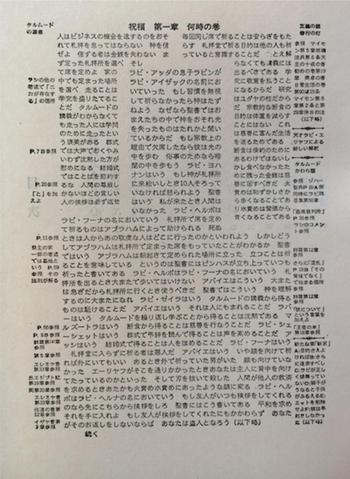
First page of Marvin Tokayer's 5,000 Years of Jewish Wisdom: Secrets of the Talmud Scriptures, 1st ed. (Tokyo: Jitsugyo no Nihonsha, 1971); Japanese text formatted as the page of a Vilna Shas

When one opens the first edition of Tokayer's original Japanese book of talmudic stories, students of the Babylonian Talmud encounter a familiar sight. The first page of tractate Berakhot, as it appears in the Vilna edition—initially printed in the 1880s and still the form in which the text is studied in traditional Jewish settings today—appears alongside an identically arranged text in Japanese.Footnote 11 This image lends authority and authenticity to the pages that follow, and also allows readers to see what a traditional talmudic page looks like. Though the book itself is not a translation of the opening tractate of the Talmud, nor a sustained translation of any other section of the Babylonian Talmud, the volume's first page is presented to its Japanese readers as a book unlike any other they might previously have read. With Hebrew and Aramaic on the right and Japanese on the left, the book explicitly evokes the talmudic page, and along with it the long tradition of the Babylonian Talmud's composition, transmission, and study.
It is unknown when exactly the Japanese edition of the book was translated into Korean and Chinese.Footnote 12 By 1974, though, the Tae Zang publishing house had printed a Korean translation, and by the end of the 1970s, there were several different editions.Footnote 13 A decade later, in 1984, this same publisher claimed to have sold over two million copies of the book, which was then in its seventh edition.Footnote 14 It seems that these were not official translations but copies translated and printed without permission from Tokayer and his Japanese press.Footnote 15 In his article, Arbes details the pervasiveness of these books in South Korea.Footnote 16 Even if these statistics are somewhat exaggerated by publishers or booksellers, the abundance of editions published in Korea suggests that the series of Talmud books is widespread and popular.Footnote 17
Inspired by Arbes's investigation, we examined over one hundred different editions from a variety of sources. We analyzed fifty-four editions held at the Yonsei University Library, all of which were listed under “Talmud” (T'almudŭ) in the library's catalogue and were housed together on five shelves in the “Religion” section. We also studied the editions in Tokayer's private collection, which consists of copies given to him by friends who have found them throughout South Korea in the last few decades. We purchased several recently published editions from Korean booksellers via Amazon,Footnote 18 and we located about ten different editions of the Talmud in Aladdin Books in Los Angeles's Korea Town.Footnote 19 Finally, we found an edition at the Seoul Animation Center, inside the Cartoon Museum's Cartoon Library, where we spent a quiet Sunday afternoon reading comics alongside a dozen children and adults.
All of the editions we examined were some variation of Tokayer's original text, and most of them bore the title Talmud or included “Talmud” (in transliterated Korean characters) in their title. Unlike the Japanese books that we examined, many of the Korean editions contain illustrations or photographs, and they are marketed not only to adults but also to children. Approximately half of them are attributed to Tokayer directly, either on the cover or the title page, while the other half list a Korean author or translator and make no mention of Tokayer. For the latter set of books, we compared the tables of contents and other features of the books to determine that they were based on Tokayer's original book. Many of these editions, for example, divide the book into the following chapters, or some variation thereof: “Talmud's Soul,” “Ears,” “Eyes,” “Head,” “Hands,” “Feet” (“T'almudŭ ŭi yŏnghon,” “kwi,” “nun,” “mŏri,” “son,” “pal”). Some editions also include parts of Tokayer's other books in subsequent chapters. In Yonsei University's collection, we also found a number of additional Korean books about the Talmud—unrelated to Tokayer's text—that were published in the early 1990s and thereafter, but we will not address these here.Footnote 20
The Korean Talmuds
Korean Talmud as Book of Wisdom
The Korean Talmud is presented as a book of Jewish wisdom, and many of the books retain the original Japanese title or a variation of it, for instance, Talmud: 5,000 Years of Lessons and Wisdom, the Guidebook for Jews.Footnote 21 The covers and introductions of these editions also present the anthology as a collection of Jewish wisdom. This framing aligns with Tokayer's original aim of presenting rabbinic sources as accessible and universal Jewish wisdom. One edition, titled The Talmud: The Powerful Wisdom of the Jews, introduces the text as follows: “This book is based on the Jewish text, the Talmud. The Talmud is a 5,000-year-old collection of reports of wisdom, Jewish Law, traditional customs, festivals, folklore, etc. It is the mental and cultural legacy of the Jewish people written by Jewish rabbis and sages throughout history. In Jewish society the Talmud is the second most important text after the Torah. Although the Talmud is the guideline for life in Jewish communities, the never-changing and universal truths that are in its pages have made the Talmud universally read.”Footnote 22 The back cover of another edition, Talmud: The Book That Teaches the Ways Jewish People Think, markets the volume enthusiastically as follows: “What is the significance of human life? What is the meaning of human dignity? What is happiness? What is love? The answers to all of these questions are found in the 5,000-year-old Jewish text, the Talmud. The Talmud is not a book you read, rather a book you study. If you truly understand and analyze the Talmud, life experiences will become more abundant.”Footnote 23 The introduction also explains that “every morning, before going to work, Jewish people study the Talmud. The Talmud is studied after lunch and dinner and also in the buses or subways. On the Sabbath, the Talmud can be studied for many hours. Even if only one of the twenty books of the Talmud are read completely, Jews will have a celebration with close friends and family to celebrate this achievement.”Footnote 24 This edition frames the text in two important ways: first, it highlights the importance of the Talmud for Jews, and second, it presents the Talmud as a text that is studied and thus provides a window into forms of Jewish education.
One of the unique features of some of the Korean Talmuds, in contrast to the Japanese text on which they are based, is the addition of aphorisms and moral lessons that are often listed at the end of each story, offset in a different color. These aphorisms appear in editions published after the year 2000 that target an adult readership. (The children's editions, as we will see below, do not contain them.)Footnote 25 These quotations and morals emphasize that the Talmud is a universal book of wisdom, and that generalized wisdom can be attained through studying it.Footnote 26 The quotations themselves are carefully curated from multiple sources that vary immensely by time period, country of origin, and primary language. The authors of these quotations include Aristotle, Seneca, Lessing, the Brothers Grimm, Morales, Henry James, Pascal, Rilke, Rousseau, Francois VI, Goethe, Kierkegaard, Voltaire, Simone de Beauvoir, Duc de La Rochefoucauld, and Khalil Gibran. Other quotes are excerpted from the Talmud itself, biblical and qur'anic passages, and “old sayings” from different cultures around the world. A pocket-sized Korean Talmud, for example, pairs rabbinic passages with quotations about wisdom: “To understand wisdom one must have wisdom. What point would it be to listen to great music without ears?” (Walter Ripman); “If pain makes humans think, and thought makes humans wise, then wisdom makes life bearable” (John Patrick); “A fool from time to time thinks too lightly of a difficult subject and fails while a genius thinks too deeply of a light subject and fails” (Collins); “Do not think lightly of the book. All of history to this point has been controlled by it” (Voltaire).Footnote 27
These editions not only pair rabbinic stories with wisdom from the Western tradition, but also include sayings from Chinese and Korean sources. These aphorisms thus put the Talmud in dialogue with Asian, and specifically Korean, wisdom. In one edition, a story about the reconciliation between a man and his wife is paired with a Korean saying, “It is said to end fights and dry fires. If you cannot be a slight liar, you cannot receive great recognition.”Footnote 28 Another edition quotes Won Hyo, “To do a wise deed is to make rice out of uncooked rice. To do a foolish deed is to cook rice out of sand. Like the two wheels of a wheelbarrow, wisdom and action must work together.”
One edition is particularly intriguing in its framing of the Talmud's wisdom. This book, titled Talmud/Caigentan: The Most Powerful Wisdom to Win Over the World, sets Tokayer's talmudic anthology alongside the Caigentan, a book of Chinese wisdom.Footnote 29 The Caigentan (translated into English as “Vegetable Roots Discourse”), authored by the late sixteenth-century Ming-dynasty philosopher Hong Zicheng, is a collection of aphorisms that draw on Confucian, Taoist, and Buddhist ideas, and that has become popular again in China, Japan, and Korea.Footnote 30 Provocatively, this book's cover poses a series of questions: “Is the Talmud the Appendix? Is the Caigentan the Appendix?” (“T'almudŭ ka purok ilkka? Ch'aegŭndam i purok ilkka?”) The book is divided into two halves; the first contains rabbinic stories and the second lessons and stories from the Caigentan. At least in this edition, the Talmud is regarded as a book of short ideas about wisdom, similar and comparable to the Caigentan.Footnote 31
Another book serves a didactic function by making explicit each story's moral lesson at the end of each talmudic excerpt.Footnote 32 For example, a reader would learn the following lessons, among many others, by reading the book: “Do not try to take what does not belong to you”; “Don't tell lies. Liars will always be discovered no matter how clever they think they are”; “Those who do good deeds will be rewarded”; “Even animals are able to tell what is right and what is wrong”; “We always get what we want. But what we want might not always be good for us”; and so on.Footnote 33 These morals simultaneously instruct the reader and highlight the Talmud's universally applicable wisdom, despite its origins as a Jewish text. This edition of Tokayer's Talmud is part of a larger series of world literature, and thus the book is presented as part of the Western canon that includes The Little Prince, Animal Farm, The Great Gatsby, Aesop's Fables, The Old Man and the Sea, Daddy Long Legs, as well as works by Edgar Allan Poe, Daisy Miller, and biblical stories—a feat yet to be achieved in most other contexts, in which the Talmud is rarely included in courses or lists of classic Western texts!Footnote 34
Korean Talmud as Self-Help
One of the popular subgenres of the Korean Talmud, and an extension of the idea of a book of wisdom, is self-help. Consider, for example, these titles: Talmud: My Guidebook for a Happy Life; Change Your Life with the Wisdom of the Talmud; The Talmud's Lifeline: Creating a Brighter Future; The Talmud's Proverbs: To Open the Doors to Success, You Must Push or Pull; and The Talmud's Laughter: To Overcome Adversity, You Must Laugh.Footnote 35 One book's cover pictures a key with the following words of encouragement: “Open the doors of success with stories from 5,000 years of wisdom.” Another book, devoted to the Talmud's humor, declares that “the moment you read this book, your life will change.”
We found a bilingual Korean-English edition, marketed for native Korean speakers living in English-speaking contexts, at Aladdin Books in Los Angeles's Korea Town, where it was shelved not in the “Religion” section of the bookstore, but in “Self-Help.”Footnote 36 The front matter is written exclusively in Korean, but the rabbinic stories appear in both English and Korean, with an accompanying English-Korean glossary. It is a book intended to teach English to Korean speakers.Footnote 37
Some of the self-help books are more narrowly focused on financial or career success.Footnote 38 One book, titled The Talmud's Return Home, with a big Jewish star on its cover, promotes the Talmud as capable of teaching the reader business skills. In a brief paragraph printed on the front of the book, we learn:
Although it is the Jewish people who made the Talmud, it is the Talmud that changed the Jewish people. Talmudic teaching has changed the Jewish people from an isolationist people to a worldly people. Localism to universalism. The Jewish people made the Talmud and the Talmud made the Jewish people into geniuses. Even after countless accounts of persecution, they have protected the Talmud. This book that has made the Jewish people a worldly people has been studied by over 2,000 scholars and sages in the past 1,500 years. If the Torah has made the Jewish people a religious people, the Talmud has made them a scientific and rational people.Footnote 39
Another book, titled From the Talmud to Mark Zuckerberg: Relearn the 78 Types of Jewish Wisdom, lists names of accomplished Jews, in English, on its cover.Footnote 40 The book suggests a direct link from the Talmud's wisdom to Zuckerberg's success. The themes of the transformational power of education, the creation of a worldly and universal nation, the maintenance of a tradition even in the face of persecution, and economic advancement evoked in these books resonate particularly well in a contemporary Korean context, to which we return below.
Korean Talmud as Children's Literature
The Korean Talmud's popularity in South Korea gained significant international press outside of Korea when the ambassador of the Republic of Korea, Young-sam Ma, appeared on Israeli television in 2011, and declared that “each Korean family has at least one copy of the Talmud. Korean mothers want to know how so many Jewish people became geniuses.”Footnote 41 He was actually on air to discuss a Korean film being shown in Israel, but in the middle of the interview he pulled out a copy of a Korean Talmud to advertise the fact that, in his estimation, more Korean families own a copy of the Talmud than do Jewish families in Israel.Footnote 42 The ambassador added: “Twenty-three percent of Nobel Prize winners are Jewish people. Korean women want to know the secret. They found the secret in this book.”Footnote 43 In his brief explanation, the ambassador described one way in which the Talmud is used: as an educational guide for creating successful and accomplished people—geniuses.
As the ambassador suggested in the interview, the largest subgenre of the Korean Talmud is children's literature. There are dozens of beautifully illustrated editions with playful covers aimed at children and young adults.Footnote 44 Titles include Talmud for Children; 111 Talmud Stories for Elementary School Students; Talmud Stories: Every Story Is Fun and Full of Wisdom; The Very Special Talmud: Easily Read, Easily Understood; Mom and Dad Read Me the Talmud; and Baby's First Talmud.Footnote 45 Some are more didactic in their framing: Talmud: Fostering Leadership; Young Ho Jun's Talmud: Wisdom Wow Wow Grade Up Up; Talmud for Children: Step into the Doors of Advancement Now, Be Surprised by the Ocean of Wisdom; The Talmud: Smart Problem Solving; Talmud: Writing Exercises; and Talmud: The Text to Raise a Successful Child.Footnote 46 There are several editions that transform the Talmud into Manhwa, popular Korean comics.Footnote 47
Baby's First Talmud (left); The Talmud: More Wise than Solomon, 100 Stories (right)

The Children's Cartoon Talmud (2001) contains over three hundred pages with dozens of talmudic stories converted into funny comic strips.Footnote 48 On the cover, a little girl asks a boy, who is holding a book titled Talmud, “What book is that?” The boy answers, “Yeah. The Talmud.” A third child asks, “Tal? What tal? Bridal mask?” In response, a passing dog exclaims “Errrg sim ignorant! It's a mood book.” The children's confusion about the Talmud in this vignette is based on puns associated with Korean words that sound like parts of the word “Talmud,” and plays with the idea that the Talmud is such a popular book that everyone, even a puppy, surely knows (or should know) what it is.Footnote 49 On the back cover, the book entices children with the following description: “I hope that many children will read this Talmud and have a good laugh afterwards—after fighting with friends or being disciplined by parents or after a hard test. … My hope is that this book will stay close and bring wisdom to children.”
The Children's Cartoon Talmud contains stories about Solomon, Honi, Alexander the Great's encounter with a rabbi, a woman enduring a devastating labor in which she must choose between saving her life and the life of her unborn child, and others, all based on rabbinic narratives or halakhic principles. Most intriguing are the two stories with which the compiler concludes the collection, illustrating the book's focus on education and the value of diligent study. First, we read about Hillel, who, as a poor boy, had such a desire to study that, unable to afford tuition, he forgoes food to read books and climbs to the attic of the study house to listen in on the rabbi's lesson.Footnote 50 Exhausted, he falls asleep by the window, blocking the light into the study house. As the study house darkens, the students notice that Hillel is sleeping and mumbling, “I just want to study, I just want to learn.” Shocked at his devotion to learning, the rabbi allows Hillel to join the class and commits to stop charging for classes, so as not to prevent any child from receiving an education. One student remarks about his guilt for having neglected his own studies when Hillel showed such dedication to his. This story, based on B. Yoma 35b, models for its young readers true dedication to study through Hillel's commitment. It also advocates the value of universal, accessible education for all. This cartoon is not just entertaining, but a didactic lesson that emphasizes the value of education, even at great personal and communal sacrifice.
The last story of the collection, based on B. Shabbat 31a, features a grown Hillel, who is asked by the emperor to explain the entire Talmud on one foot.Footnote 51 Hillel answers, “One should not do unto others what one would not want done unto oneself,” a version of the Golden Rule.Footnote 52 Again, this story serves a pedagogical function, to teach its readers to act in ways that are respectful and kind to others. It also emphasizes that when one devotes one's life to study, one learns how to act appropriately towards others, and that even a student from the humblest of backgrounds can become a counsel to the most powerful of emperors. That is, the story teaches its young readers that education has the power to transform and empower.Footnote 53
Michael Seth, in his study of South Korean schooling, writes about “education fever” (kyoyuk yŏlgi), in which “elementary, middle, and high school students study late into the evening and on weekends. Every neighborhood has a store selling textbooks, supplementary readings, and guides to the [university] entrance examinations. Adults, too, study at night schools, attempting to advance their education.”Footnote 54 Seth documents the dramatic transformation of a mostly illiterate population in a country with only a single university following Japanese colonial rule in 1945 to almost full literacy and a vibrant educational landscape, with close to two hundred colleges and universities by the end of the twentieth century.Footnote 55 Seth and others identify a strong link between the goals of educational advancement (especially at the university level), national economic development, and personal social mobility, particularly during times of slow economic growth.Footnote 56 Focus on education as a prerequisite for economic success and social mobility, coupled with limited spots at the best universities, motivates teachers and parents to find new strategies for their students to succeed in classes and exams. They often turn to supplemental academic resources, a phenomenon that has created a powerful market for the proliferation of educational materials, including specialized Talmud editions. These children's Talmuds are thus best understood in this broader context of Korean educational practices, in which educational and economic factors play an important role in the promotion of the Talmud texts to students and their parents, which helps explain the popularity of this particular genre and the market forces that drive sales.
The ambassador, in the interview discussed above, mentioned that Korean mothers turn to the Talmud to cultivate success in their children and to promote values of study and education. Arbes reports that, in the Gangnam neighborhood of Seoul, the Talmud Wisdom Education School, founded by Geum Sun Kim, offers Talmud tutoring sessions each week, and Kim told Arbes that many editions of the Talmud are part of elementary schools’ suggested reading lists.Footnote 57 Recent criticism of rote memorization in the Korean education system might also lie behind the turn to study of rabbinic literature.Footnote 58 New pedagogical models of “cooperative learning” (ḥevrutaʾ) associated with talmudic study as it is practiced in traditional Jewish academies (yeshivot), which promote dialectical argumentation between students rather than frontal instruction primarily by a head teacher, have gained some popularity as modes of education for Korean children. Institutions of supplementary education that teach Talmud along these pedagogical lines have been established.Footnote 59 Finally, some parents also read these children's Talmuds to teach basic ideas about morality, which is considered part of the role of education.Footnote 60 The Talmud is, on occasion, compared to Aesop's Fables on parenting blogs, which evokes Tokayer's own view of his project when he first compiled the set of stories decades earlier.Footnote 61
Prenatal Talmuds
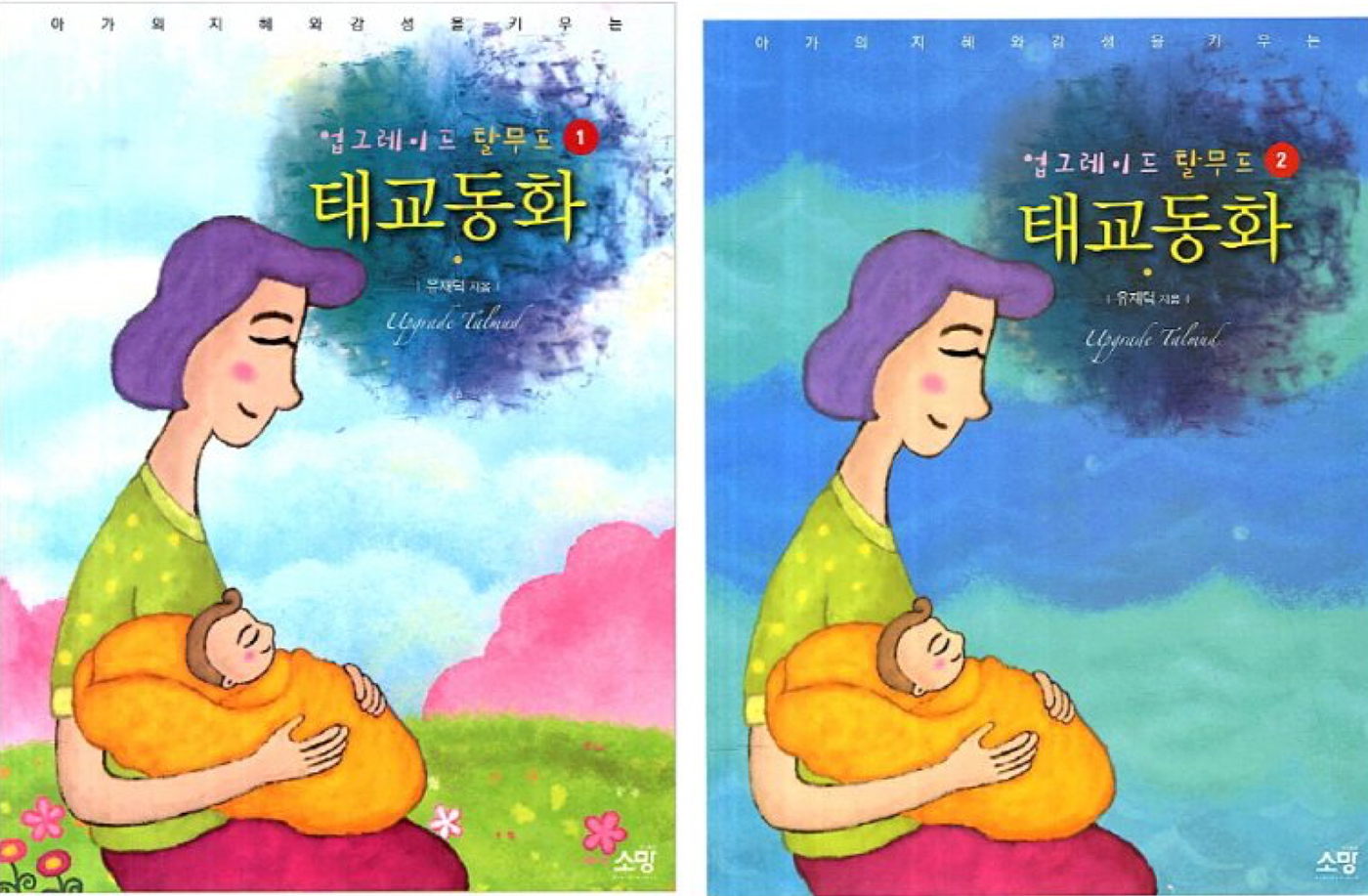
We also found “prenatal Talmuds” marketed specifically to pregnant women and their developing fetuses. These books promise to assist in the intellectual and emotional development of a child who is growing in a mother's womb. One edition proclaims that it contains “talmudic stories that are necessary to boost the creativity and emotions of your baby!”Footnote 62 These prenatal Talmuds all emphasize the twin themes of wisdom (chihye) / intelligence (chisŏng) and emotional well-being (kamsŏng).
Talmud: Prenatal Stories, Fostering the Wisdom and Emotions of your Baby, part 1 (left) and part 2 (right)Footnote 63
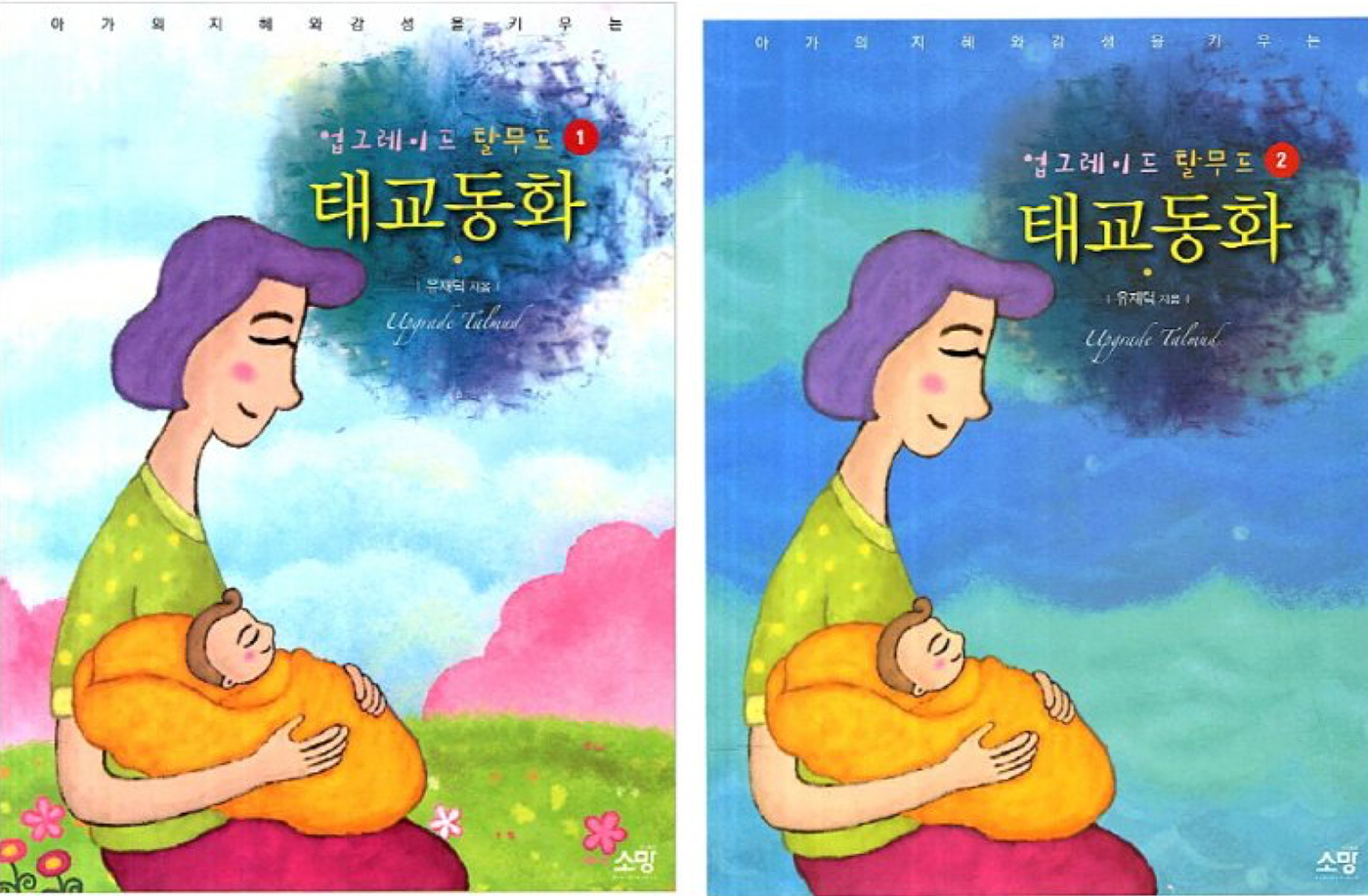
These books are a fascinating example of the blending of Confucian and talmudic ideas about fetal development, and illuminate a cultural sphere in which the Korean Talmud operates as a specifically East Asian book. The idea that prenatal environments shape the growing child before its birth and continue to affect that person's life in the long term is a defining feature of Confucian philosophies of moral development. Erin M. Cline writes that “Confucian philosophers maintain that the prenatal period, infancy, and early childhood represent a unique and irreplaceable opportunity for moral cultivation, and they offer detailed accounts of the specific role that each of these stages has.”Footnote 64 These ideas can be traced back to Liu Xiang's Lienü zhuan, a Han Dynasty text about the education of women and women as educators, and Zisi's Zhongyong, a central work of Confucian thought.Footnote 65 Such fetal instruction entails, according to Anne Kinney, “a radical view of the environment's effect on both the spiritual and corporeal constitution of human beings. In this case, the environment is the womb, and the sensory stimuli that affect the mother simultaneously affect the fetus.”Footnote 66 The ideas and stories to which mothers are exposed during pregnancy thus have a direct impact on the children they are carrying. Given the importance attributed to the Talmud in South Korea, reading the Talmud during pregnancy is thus a way—consistent with Korean Confucian ideas of moral development—of imparting the Talmud's wisdom to one's children.Footnote 67
There is a talmudic dimension that complements Confucian prenatal instruction. Bavli Niddah 30b suggests that a fetus looks like an ancient chain of writing slats: “What does an embryo resemble when it is in the bowels of its mother? Folded writing tablets. Its hands rest on its two temples respectively, its two elbows on its two legs and its two heels against its buttocks. Its head lies between its knees, its mouth is closed and its navel is open, and it eats what its mother eats and drinks what its mother drinks.”Footnote 68 The passage develops an association between a fetus and the process of learning and textual production that becomes central when we learn that this fetus also spends its time studying Torah—“from beginning to end”—in its mother's womb.Footnote 69 A Jewish baby is imagined as learning Torah while still gestating in a mother's womb as preparation for that child's life as a member of the Jewish community.Footnote 70
Confucian philosophies of fetal development and the role of an expectant mother's behavior and habits during pregnancy, on the one hand, and midrashic ideas about Torah instruction in utero, on the other, are merged in this subgenre. More than any of the other editions, it is the Korean prenatal Talmuds that epitomize how culturally embedded in Korean culture these books have become. The Jewish rabbinic and Korean Confucian traditions overlap and make for a particularly comfortable cultural and intellectual fusion. These books, then, may be added to scholarly conversations on how different religions in Korea operate in relation to one another.Footnote 71 They demonstrate that Judaism, or Jewish texts, plays some role in religion and culture in contemporary Korea, especially as it is understood alongside other traditions.
Korean Talmud as Christian Literature
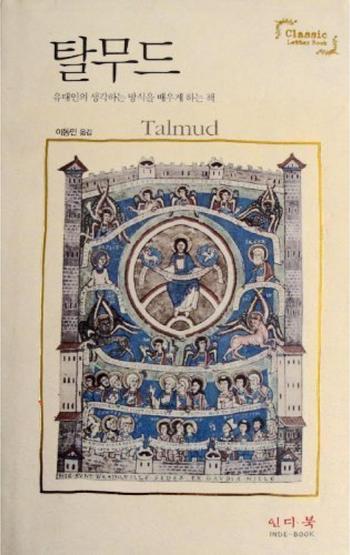
The integration of Judaism and Confucianism is not the only hybrid present in these Korean books of talmudic sources. Many editions also incorporate Christian themes alongside rabbinic texts, merging Jewish and Christian symbols between the bindings of a single book. One edition contains a reproduction of a medieval painting of the Trinity on its cover.Footnote 72 God appears in the center of the painting, flanked by the Holy Lamb on his right and the Holy Dove on his left, surrounded by images of the Evangelists, enclosed within medieval European city walls and guard towers. Other editions also contain Christian art on their covers—one depicts the Virgin Mary carrying the Christ Child, and another illustrates a haloed angel carrying a Talmud scroll.Footnote 73
Cover of Talmud: The Book that Teaches the Ways Jewish People Think, with an image of the Trinity from MS. A. VII, f.1v from the Prague Cathedral.

Why do these Christian images appear on covers of Jewish texts? South Korea has one of the largest and fastest-growing Christian populations among its East Asian counterparts. American Protestant—primarily Presbyterian—missionaries arrived in Korea in the late nineteenth century and became popular and more tolerated than their Catholic predecessors.Footnote 74 By 1995, over a quarter of South Korea's population identified as either Protestant or Roman Catholic, and these numbers have risen in the two decades since.Footnote 75 It is perhaps not surprising, therefore, that several of the Talmuds allude to Christian themes and are marketed to Korean Christians in particular. We suggest that these editions do not only assume Korean Christian readers, but that these books of Jewish rabbinic sources are themselves presented as Christian texts, not replacing their Jewishness, but supplementing it. That is, an anthology of ancient Jewish sources first compiled for Japanese readers was eventually reframed to cater to a Christian (and specifically Protestant) Korean readership.
One Talmud, published by the Korean Christian Society, is explicit about this association in its title, Talmud: Korean Christianity's Guide.Footnote 76 This edition presents the Talmud as a book essential for Christians in Korea, who ought to study this Jewish book of wisdom. Another edition explains that “this book discusses the Jewish people's lifestyle, religion, childrearing, education, of course also discussing morals, philosophy, finances.… If the Old Testament is a book we should forever have, the Talmud is the modern person's companion full of wisdom.” In this brief description of the book's contents, the Old Testament is described as a book for eternity, and the Talmud as an update of its contents; both are presented as continuously relevant for living a Christian life of wisdom.
A large portion of the introduction of one edition focuses on Jewish devotion to talmudic study, and urges its readers likewise to study its wisdom because study leads to pious devotion to God: “For Jews, education is the highest goal in life. For these people, the most important task in life is to follow the teachings of God. The exact text that holds these teachings of God is the Talmud, and so it is impossible to live without studying this Talmud. The Talmud is not a text that adds knowledge to the reader, rather a text that praises God. This is the greatest form of education for a Jew.” Here, the Talmud and its study are given a decidedly theological reading, in which following God's teachings, as contained in rabbinic sources, represents religious devotion to the divine.
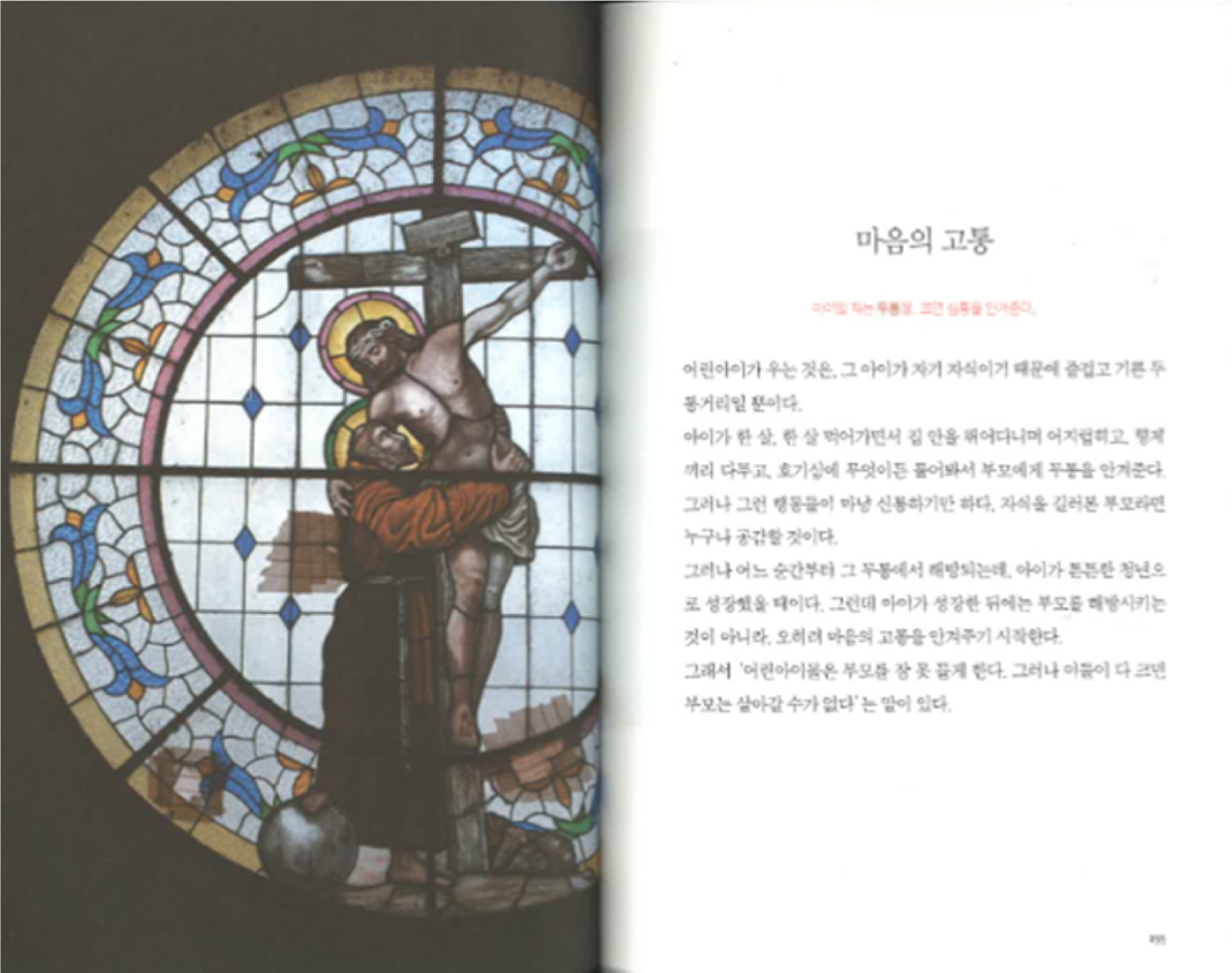
The intersection of Judaism and Christianity in these books is particularly evident in the images incorporated throughout. One book features photographs from contemporary lifeFootnote 77 alongside those with Christian images: churches and crucifixes; a painting of Jesus with Mary and Joseph; a Christmas present; rosary beads; a statue of the Virgin Mary; and so on.Footnote 78 Another book contains a particularly evocative image: ancient Jewish and Christian oil lamps, one with a menorah and the other with a cross, juxtaposed on a single page.Footnote 79 These photographs placed alongside rabbinic texts transform the Korean Talmud into a Jewish-Christian book.
Stained-glass image of Jesus on the cross from Talmud: The Text to Place at the Bedside of Your Life, pp. 154–55.

Some of the editions explicitly acknowledge Christianity's vexed relationship to the Talmud. The introduction to Talmud: The Book That Teaches the Ways Jewish People Think discusses episodes of Christian persecution of the Talmud in medieval Europe in its history of the Talmud's reception.Footnote 80 This history appears as an apologetic directed at Christians today, explaining that although Christians in times past and in distant lands had often sought to destroy the Talmud, the Talmud is actually a holy book of wisdom that would not have faced such violence had Christians read the text. The introduction begins with a basic summary of the Talmud's material history: “The Talmud first began to be compiled in 500 AD. The handwritten copy of the Talmud from 1334 is the oldest Talmud that has been discovered, and it first began to be printed in 1520 in the city of Venice.” The introduction then proceeds to detail the burning, banning, and censorship of the Babylonian Talmud by the Catholic Church in medieval Europe:Footnote 81 “In 1244, all of the copies of the Talmud that were located in Paris were collected and burned by the Christian Church. In 1415, it became illegal for Jews to read the Talmud, and in 1520 all copies of the Talmud in Rome were collected and burned.… Later in history, in 1533, 1555, 1559, 1566, 1592, and 1596, the Talmud continued to be collected and burned.”Footnote 82 The text explains that the reason for this abuse of the Talmud was ignorance:
The reason why these people and organizations did such deeds was because they did not read the Talmud, therefore they did not know what this book was. They disliked this text without knowing what the text was. … In 1562, the Catholic Church ripped out all information about Jews and all of the pages that held text that went against the church. Therefore, the current Talmud is not equal to the original Talmud. There have been many discoveries of pages and texts that were lost in the many hundreds of years, but there are still portions that have not been found.
Not only was the Talmud burned and scorned, the introduction explains, but the Talmud itself is incomplete because of its history of persecution.
This introduction dispels any preconceptions of the Talmud as a dangerous, conspiratorial, or blasphemous work, insisting instead that if the Talmud were read, these accusations would have been abandoned. Given that this text is aimed at a primarily Christian audience—its cover depicts the Trinity, after all—it first makes the case that, contrary to the way in which Christians of the past have often viewed rabbinic literature, the Talmud is not an anti-Christian work, but rather a book of wisdom that is Jewish in origin and relevant to contemporary Christians as well. This extended apologetic seems odd in a text for Christians in Korea, who are not implicated in European Christian persecutions of the Talmud, and whose views about Jews and Judaism often depart from those of Christians in European contexts.Footnote 83 It is possible that this material was found in Tokayer's original Japanese edition, and was therefore included in these editions as well, or that European Christian narratives and apologetics independently found their way into these books.
The end of the introduction turns to a feature of Catholicism to explain how important the Talmud is for Jews: “The Jewish people, unlike the Catholics, do not have a greatest authority figure (the pope), but the Talmud is considered to be this great authority. Authority is given to people who study the Talmud the most, and those who study the Talmud a lot and have a firm understanding of the Talmud are given the title of ‘rabbi.’ Therefore, a rabbi is the greatest authority in Jewish society.” We thus learn that each person, through intense study, can become as important as the pope. This comparison, which draws on the readers’ familiarity with Catholic hierarchical structures, serves to highlight the status of the Talmud and of its study for Jews through a familiar religious analogy.
Recently, a revised Korean translation of Tokayer's text was produced by Yong Soo Hyun, a Presbyterian minister who splits his time between Seoul and Los Angeles. Trained at the Claremont Graduate School, Hyun began visiting the Los Angeles Yeshiva and learning about Jewish rituals and sources.Footnote 84 In 1992, Hyun founded the Shema Education Institute, which trains Koreans living in South Korea as well as those living in the Korean diaspora (China, Russia, South America, Canada, and the United States) in Jewish texts, rituals, and lifestyles. The program consists of three semesters of study, and culminates in a trip to Los Angeles, where graduates visit Jewish schools and synagogues, attend Friday night services, and share meals at the homes of Jewish families.Footnote 85 According to Hyun, four hundred students annually participate in the courses he offers, and he has authored over twenty books about Judaism, which have sold well in South Korea.Footnote 86
Hyun's perspective is a decidedly Christian one. The Jewish people have been able to survive and thrive through many periods of persecution because of their focus on rituals, community, and learning. The early church's focus on theology, according to Hyun, overlooked other important aspects of religious community—the ability to sustain its values and traditions from generation to generation. Hyun found guidance in his observation of Jewish communities and thus seeks to introduce Jewish ideas and rituals into the practices of his Christian students. In a 2010 article by Julie Gruenbaum Fax, Hyun explains: “Jews successfully conveyed the Torah, the traditions, the history—especially the history of suffering—and the family values based on Torah for 3,000 years with no generation gaps. … The Christian people lost the value of how to raise children who are holy. We are recovering that history to spread it all over the world.”Footnote 87
Noticing that existing Korean Talmud translations often stray far from the original rabbinic text, Hyun worked with Tokayer by phone and email on a more authentic multivolume retranslation for use in his programs.Footnote 88 Each volume contains an introductory note, in Korean, by Hyun, along with a letter, in English, from Rabbi Tokayer, which reads:
I remember so favorably my years in Korea when I was with the U.S. Air Force. I am now so honored that the Rev. Dr. Yong-Soo-Hyun will be translating my books on Judaica into the Korean language. The Korean people and the Jewish people have so much in common, and share so many similar values, and have much to be learned from each other. I trust that the spirit of Jewish ideas, and the message of Jewish history and survival, will be of value to Koreans. I look forward to receiving messages from Korea sharing reactions from the voice of the Jewish experience.Footnote 89
While the editions discussed in the previous sections view rabbinic texts as containing global wisdom and universalizing moral lessons, Hyun's Talmuds, as well as other Talmuds marketed to Christian readers, offer an additional perspective: important life lessons for Christians about how to live a proper Christian life and how to transmit Christian values to one's children. Hyun's Talmuds represent an attempt to return not only to a more authentic version of the talmudic text, but to a more authentic form of Christianity that incorporates early Jewish wisdom, with the mission of creating stronger and more sustainable Korean Christian communities, in Korea and around the world.
Contextualizing the Korean Talmud in Jewish-Korean Relations
The Talmud's popularity in Korea as well as the implications and consequences of its ubiquity must be placed within a longer history of Korean encounters with Jews, Judaism, and Jewish texts. Before Tokayer's Japanese Talmud was translated into Korean, some Koreans would have encountered references to Jewish texts, and in particular the Talmud, in religious and cultural settings. Such prior exposure surely impacted the ways in which the various versions of the Korean Talmud were eventually presented to and received by readers. Moreover, the Korean Talmud's popularity might also be seen as shaping Korean perceptions of Jews and actively fostering Jewish-Korean relations.
The first Jews in Korea were American troops stationed there during the Korean War. Before Chaim Potok became a best-selling author and a prominent voice of American Jewry, he served in the American military in Korea in the mid-1950s. The experience moved him and, as he later noted, deeply impacted how he viewed his place as a Jew in the world and the conflict between modernity and tradition that later occupied the majority of his literary works.Footnote 90 Several of his novels, including The Chosen and The Promise (in which the critical study of Talmud is a running theme), were widely read and discussed in South Korea following their translation in the 1960s.Footnote 91 In 1992, shortly after Potok's final novel (I Am the Clay, set in Korea) was released, Potok returned to South Korea with the American government's “Arts in America” Information Service to participate in the rededication of the US Cultural Center in Seoul and to lecture throughout the country about the themes of his novels, connecting the Jewish and Korean experiences.Footnote 92
In the American Jewish Committee's report Koreans and Jews, published two years after Potok's lecture tour, Cherie Lewis provides a “study of the past and present links between Jews and Koreans … intended to enhance dialogue between these two ancient peoples.”Footnote 93 She begins by addressing the “dramatic changes in the cultural, political, and economic circumstances of Jews and Koreans, especially in our century,” and suggests that these shared experiences, especially for Jews and Koreans living as immigrants and minorities in the United States as well as between South Korea and Israel, provide “unprecedented opportunities for collaboration” between these two communities.Footnote 94 Lewis's publication, in the AJC's International Perspectives series, was one attempt of many to promote the idea that Jews and Koreans are similar, and that they can thus form partnerships politically and culturally, despite considerable tension between South Korea and Israel in the second half of the twentieth century.Footnote 95
Indeed, the small percentage of Jews in South Korea notwithstanding, Jews and Koreans have developed an affinity for one another that is often explained by pointing to their similar histories (those of ancient Israel and of modern Jews) and present circumstances. Resonances between the histories of the Korean and Jewish people appear in many of the Talmud editions we examined, and reinforce existing ideas about similarities between the Koreans and Jews. One Talmud edition refers, for example, to Roman oppression of Jews and the suppression of talmudic study during the Roman period. The explanation continues by praising the extent to which Jews protected the Talmud “even in the face of death.”Footnote 96 This text might have been written with Japanese colonialism in mind, when Korean language and culture, too, were suppressed by occupiers. Some of the other points of intersection commonly evoked include: the division of the northern and southern kingdoms of Israel and Judah as parallel to the currently divided Korea; the histories of persecution during World War II; the revival of a new national language; the constant fear of nearby enemies and nuclear threats; the rapid development of new countries in the late twentieth centuries, including their lack of access to natural resources and success in technological fields; and shared values of education and family.Footnote 97 Regardless of the accuracy of these comparisons, they are often made and impact the affinity with which Koreans view Jews, and by extension their Talmud.Footnote 98
Guy Podoler has argued that Israelis’ exposure to Korean society, through sports and other modes of cultural exchange, from the 1940s through the 1970s, functioned as a form of “cultural diplomacy” that fostered Israeli awareness of and empathy with Korea, and helped facilitate full diplomatic relations between the two nations.Footnote 99 Shifting the setting of inquiry from Israel to Korea, we might make a similar argument about Korea: Koreans’ exposure to Jewish and Israeli culture, including their study of Jewish texts, likewise functions as “cultural diplomacy.” It is both predicated on perceived similarities between Koreans and Jews, but also fosters such perceived confluences and lays the groundwork for more sustained collaborations and relations (those Lewis seems to have promoted in the AJC's pamphlet). This would have been especially the case in the 1970s, when diplomatic relations between the two countries cooled but interaction was maintained through cultural channels. Podoler mentions the broadcasting of a popular Korean folktale on Israeli radio in 1976. Such Korean folktales were shared with Israeli audiences in order to promote cultural exchange, and we would argue that Jewish folktales were simultaneously transmitted to Korean readers through the translations of rabbinic stories found in Korean Talmuds.Footnote 100 The Korean ambassador's appearance on a cultural program on Israeli television in 2011 represents the culmination of this overlap between cultural and political diplomacy—and by then the Korean Talmud was literally on the table, at the center of the discussion.Footnote 101 We might thus view the Korean Talmud's popularity in Korea as simultaneously a result of efforts to promote Jewish-Korean relations, and as a contribution to efforts aimed at warming those relations.
The Far Reach of Rabbinic Literature: Conclusions about Translation, Transmission, and Reception
The story of the Korean Talmud challenges us to think about the limits of “Talmud,” generically and semantically. One of the conclusions we have drawn from our analysis is that the “Korean Talmud” is its own genre. It is not a Korean translation of the Babylonian Talmud, nor a summary or synopsis of rabbinic sources. Rather, it is a collection of traditions that originated in and was inspired by the talmudic corpus but that has taken on a textual life of its own and is best understood as a unique textual tradition currently circulating in dozens of slightly different versions. The Palestinian Talmud as we now have it is a text that developed over the course of several generations, eventually redacted in Roman Palestine in the fourth century CE; the Babylonian Talmud, likewise, came into its current form through a decades-long (or centuries-long) process of editing in the fifth, sixth, or seventh centuries in the Sasanian Empire; and the Korean Talmud has been circulating in numerous editions since the 1970s throughout South Korea and the Korean diaspora in California, New York, and elsewhere.
As a story about the life of a single text, it is remarkable, and might allow us to theorize in new ways about the redaction and transmission of texts in general and about the redaction and transmission of rabbinic texts in particular. The Korean Talmud stands in a long line of anthological works that compiled rabbinic materials in different ways, both in the medieval and modern periods—Jacob ibn Habib's ‘ En Ya‘akov (fifteenth- to sixteenth-century Salonica), Ḥayim Naḥman Bialik's Sefer ha-’aggadah (published in Odessa, 1908–11), Louis Ginzberg's The Legends of the Jews (published by the Jewish Publication Society in Philadelphia, 1901–38), and Yocheved Segal's Koh ‘asu ḥakhamenu (published by Moreshet in Tel Aviv starting in the 1970s, and later in numerous translations including English, German, and Japanese).Footnote 102 We see in Tokayer's description of his own anthologizing process that it was rabbinic stories that he chose, because they were most accessible and universal in theme and style. We might understand better, for instance, how rabbinic stories embedded in the Yerushalmi and Bavli's legal discussions or incorporated into the exegeses of classical midrashim might have been repurposed in sermons and later midrashic compilations in which rabbinic teachers sought to share their values and communal expectations with lay audiences.Footnote 103 In all these cases, rabbinic narratives become the vehicle through which the “wisdom of Talmud” is communicated.
We can also observe the process of redaction. Tokayer was the “compiler” or “editor” of the Japanese text that served as the basis for the Korean Talmud, and the original text took shape in conversation with his Japanese publisher, whom he describes as “censoring” the text. Tokayer's choices of inclusion and organization were particular to his geographical and cultural context and his imagined audience. The process of the Mishnah's redaction was obviously different from that of the Korean Talmud, but might we learn about ancient redactors of rabbinic compilations by studying contemporary ones? For example, classical rabbinic sources are replete with stories about rabbis’ lives and their families. Academic readers are careful not to assume uncritically the historical accuracy of such narratives, because the stories as they are told in rabbinic sources are literary artifacts and serve legal and textual purposes (whether or not they narrate events that took place), but the relationship between the narratives and social history is still a question. The Mishnah begins with such an example, about Rabban Gamliel's sons forgetting to recite the Shema because they were out late one night. This story serves numerous purposes in the Mishnah—it models the father-son transmission of rabbinic Torah and reinforces a legal extension for the Shema's recitation. But it is also possible (and is indeed assumed by some) that, alongside these literary and contextual reasons, the anecdote might reveal something about Rabban Gamliel, or about the human process of transmission. We might consider, for example, how stories about rabbis’ lives entered into talmudic discourse, even if, once in the tradition, they serve a variety of halakhic, literary, or rhetorical purposes (reinforcing laws, subverting opinions, highlighting exceptions, etc.). After all, real people edited our ancient sources, and they left their personal traces. Rabbi Tokayer also left his. The Japanese edition of his book includes a story about two brothers who took a trip in a rowboat. That story is about Rabbi Tokayer and his older brother. When Tokayer sat with his editor and stenographer, he told them that the Talmud never has a first page, and explained that this convention signals that everyone is always already in the middle of the story. Likewise, he explained, the last page of a Vilna Shas Talmud is also empty, symbolizing that Jews, wherever they live, always add to the Talmud as they live its words. The stenographer turned to Tokayer and asked: “So what are you going to add to the Talmud?” Tokayer responded with a story from his childhood, about a small good deed performed by a stranger that saved him and his brother when they went out on a rowboat one sunny afternoon. This story was incorporated into the Japanese text, and then transmitted in Korean and Chinese versions as a talmudic story alongside all of the other narratives.Footnote 104 Rabbi Tokayer's story is now one of the many stories about rabbis and their families in the talmudic corpus—it has become a part of the tradition. This case also pushes us to think about the Talmud as an open and evolving text.
One particularly surprising difference between rabbinic literature and the Korean Talmud is the politics of gender in the process of transmission. The beginning of Mishnah Avot begins with a chain of transmission that excludes women.Footnote 105 The Mishnah's first tractate begins with a story about Rabban Gamliel transmitting halakhic knowledge to his sons, and the tannaitic midrashim interpret the biblical command to “repeat them [the commandments] to your children” in Deuteronomy 6:7 as requiring fathers to teach their sons—explicitly marginalizing mothers and daughters from the process.Footnote 106 These gendered dynamics of transmission and reception are amplified further in amoraic literature, especially in the Babylonian Talmud.Footnote 107 Only recently have women studied Talmud in significant numbers, and not without controversy.Footnote 108 In the Korean Talmud's transmission, however, it is mothers who bear primary responsibility for transmitting the rabbinic text to their children, both boys and girls. Korean Talmuds are marketed to mothers, even of the unborn, because mothers are considered the transmitters of the wisdom contained therein. A mother who teaches her children Talmud is regarded as a great Korean mother.Footnote 109 The role of mothers in the transmission of these Korean books must also be understood, however, as a product of traditional gender roles in Korean society, in which mothers are regarded as those responsible for the education of their children. As Jennifer J. Jung-Kim explains, “The primary role of women was still thought to be in the home, but that role was reformulated to highlight the importance of women as the primary educators of their children, helpmates to their husbands, and general managers of their households.”Footnote 110 The promotion of the power of mothers, especially as educators of their children, thus maintains patriarchal social structures while simultaneously empowering women by promoting mothers’ devotion to the development of their children.Footnote 111 Women's roles as mothers and wives are idealized and elevated as important contributions to society, a phenomenon known as “good wife, wise mother” (ryōsai kenbo), to which the prenatal and children's editions of the Korean Talmud allude in their appeal to women as mothers.Footnote 112 Indeed, both gendered framings of the transmission of these traditions, Jewish and Korean, effectively perpetuate patriarchal norms.
The Korean Talmuds are translations of a translation of a translation—from Hebrew and Aramaic, to English, to Japanese, to Korean. Historically, translations of the Talmud have often been undertaken by those wishing to uncover the secrets and conspiracy theories regarding the Jews. In the early thirteenth century, Nicholas Donin, a Jewish convert to Christianity, translated sections of the Babylonian Talmud to reveal blasphemous passages about Jesus and Mary; in the wake of these accusations, Pope Gregory IX called on a number of rabbis to defend the Talmud in the Disputations of Paris (1240), which eventually led to the burning of hundreds of talmudic manuscripts.Footnote 113 Later in the thirteenth century, Ramon Martí’s Pugio fidei (Dagger of faith) translated sections of rabbinic sources, also to highlight the error of Judaism.Footnote 114 Johann Andreas Eisenmenger's Entdecktes Judentums (Judaism uncovered, 1700), which drew on a wide array of Jewish sources that are translated in the book, “claimed to explore the secrets hidden in the books of the Jews and thereby uncover their true image.”Footnote 115 Even Shimon Moyal's attempt to translate the Talmud into Arabic in At-Talmud: ʾAṣluhu wa-Tasalsuluhu wa- ʾAdabuhu (The Talmud: Its origins, transmission, and ethics, 1909) was written at the request of a Christian editor in Beirut who sought to dispel blood-libel rumors that were circulating among the readers of his Arabic journal, by showing, through translation, that the Talmud did not contain such secret rituals.Footnote 116 Not all translations (especially in the last half century), of course, were motivated by polemics or apologetics.Footnote 117 And yet many of them were in fact made to expose Jewish “secrets”—hidden blasphemies, theological fallacies, illicit instructions for the murder of Christian children, and so on. On the one hand, the Korean Talmud seeks to expose Jewish secrets—one edition is explicitly titled Secrets of the Talmud. On the other hand, the endeavor is motivated not by antisemitism and a spirit of disputation but rather by philosemitism and a spirit of emulation.Footnote 118 That the Jews are stereotyped as successful and adept at handling money is not presented as a reason to distrust them, it seems, but rather a motivation to learn their strategies and attain comparable levels of achievement.
Throughout this study, we have discussed religious and interreligious dimensions of the Korean Talmud. The text itself is, most basically, about Judaism and Jewish stories and practices. But the Korean Talmud also draws on other religious texts and discourses, for example in its reframing of the Talmud as a text for the moral development of the fetus in light of Confucian ideas, or in its quotations of Jesuit, Confucian, and Islamic texts placed alongside the rabbinic material. Most strikingly, some translators and readers of the Korean Talmud regard it as an important Christian text—a text that has become part of a new Korean Christian curriculum, no longer seen as an exclusively Jewish text. Images of a crucified Jesus placed alongside Jews praying at the Western Wall highlight the hybridity of some of these editions. The Korean Talmud is thus also a religious text, one that aligns well—at least in certain contexts—with Confucian and/or Christian perspectives, and is used to redefine and transform these forms of practice and belief.
The turn to the Talmud as a book of Western wisdom in Japan, Korea, and China is reminiscent of a similar interest in and fetishizing of Eastern wisdom in the West. On a visit to any major bookstore in the United States, one is struck by how many “self-help” books appeal to popular notions of Buddhist meditation and fêng shui, for example, not to mention Marie Kondo's bestsellers.Footnote 119 Yoga in the West likewise departs from the practice of yoga in India, and is sometimes regarded as inauthentic by traditional practitioners.Footnote 120 The Korean Talmud and its outsized popularity can thus also be understood as a form of Occidentalism.Footnote 121 This dimension of the Talmud's reception is in part ironic, because the Babylonian Talmud is situated between East and West, and often regarded as “Eastern” from the perspective of Western scholars. Nonetheless, as a central Jewish text, it is categorized in Korea with other Western classics, and the Korean Talmud promises to impart Judaism's exotic Western wisdom to its readers.
It is important to mention in this context the diversity of illustrations and photographs found in the books. In most of the editions we analyzed, the people depicted are not ethnically Korean—that is, Jews are imagined to be ethnic and racial Others. The illustrations highlight that the books include the wisdom of Others, the Jews. The one exception we found is in some of the books that include Christian images and themes. In these, photographs of Korean children are placed alongside other ethnicities, and the book is consciously inclusive and diverse. This makes sense, as it is in these books that the Talmud is presented as a Korean Christian book, rather than an exclusively Jewish text.
We have approached the Korean Talmud, in its many versions, as a textual tradition that is still developing and evolving; we have tried to understand some of the ways in which it is read and used; and we have placed it into a longer reception history of rabbinic sources and of the Babylonian Talmud. We end with a brief reflection on the malleability of texts and audiences, and how the Korean Talmud, in some ways, is an inversion of the Babylonian Talmud—a radical example of “reception.” Classical rabbinic texts from late antiquity (Mishnah, Tosefta, the Palestinian and Babylonian Talmuds) were composed as expert literature, products of rabbinic discussions in study houses and academies, composed and compiled by religious and cultural elites, transmitted only to those with proper education, and written in a style and form that requires years of careful training and study to comprehend. Still today, in order to be conversant in the Talmud, students spend years studying the texts in great detail—even a cursory study of a single page each day, known as daf yomi, takes seven and a half years to complete. The Babylonian Talmud is also insider literature, with rulings and discussions about how Jews ought to conduct their personal, communal, and ritual affairs, rather than explanations about Jewish practices for those beyond Jewish society. Its transmission was explicitly limited to fathers and sons, and its focus is on legal, civil, and ritual matters. One of the interesting twists in the Talmud's reception in Korea is that the Korean Talmud has become, in altered form, a paradigmatic text for outsiders (rather than insiders), for those with no prior expertise (rather than for textual experts), transmitted from mothers to children (rather than fathers to sons), and primarily narrative and sapiential (rather than legal and ritual). The Korean Talmud is a text that is used to teach people about Judaism. There is much history between the Babylonian Talmud's redaction and the first edition of the Korean Talmud that helps explain these radical transformations, and much more to be explored in the books and in their study. Our hope is that others will continue to analyze and explain this unexpected chapter in the Talmud's history.