1 Phonotactic restrictions on prosodic domain edges
The set of segments occurring in word-initial onsets and word-final codas is often different from that occurring in medial onsets and codas. Some languages allow more segments and structures in initial onsets or final codas than in word-internal ones. Word-initial syllables in Axininca Campa may either have onsets or be onsetless, but onsets are required in all non-initial syllables (Payne Reference Payne1981, McCarthy & Prince Reference McCarthy and Prince1993). Similarly in Kamaiurá, codas are permitted only in word-final syllables (Everett & Seki Reference Everett and Seki1985, McCarthy & Prince Reference McCarthy and Prince1986). The opposite pattern, where a word-edge inventory is a subset of the medial inventory, is also attested. Initial syllables in Madi must have onsets, while medial syllables may have onsets or be onsetless (Tucker Reference Tucker1967); in Chamicuro, codas are banned in word-final syllables but may occur non-finally (Parker Reference Parker2001: 365–366).
Instances of the first sort of restrictions – superset inventories at word edges – are often discussed in the literature; analyses of these patterns typically involve either extraprosodicity or positional faithfulness. This paper will focus on cases of the second sort, where the inventory of segments or structures in the initial onsets or final codas of a word or larger prosodic domain is a subset of those in domain-medial onsets or codas.
The typology of these subset-at-edge restrictions leads to the central descriptive claim of this paper: any markedness restriction which can be imposed on syllable onsets or codas can also be imposed on initial onsets or final codas of any larger prosodic domain. All prosodic domains can be subject to the same edge restrictions. Onsets, for example, can be required at the left edge of any prosodic domain. In Klamath, all syllables must have onsets (Blevins Reference Blevins and Goldsmith1995). Onsets are required only word-initially in Madi (Tucker Reference Tucker1967), while in Selayarese only utterance-initial syllables must have onsets: hiatus is tolerated within words, and words may begin with vowels, but glottal stops are epenthesised before word-initial vowels when they fall in utterance-initial position (Mithun & Basri Reference Mithun and Basri1986: 242). The set of possible utterance-initial onsets in Selayarese is thus a subset of the possible utterance-medial onsets.
Domain-edge inventories can be restricted to subsets of medial inventories in other ways as well. Marked onsets such as [ŋ] can be banned from all syllables (Mongolian; Poppe Reference Poppe1970), only from word-initial syllables (Yamphu; Rutgers Reference Rutgers1998: 33) or only from utterance-initial syllables (Kunwinjku; Evans Reference Evans2003: 94–95). Similarly, Mascaró & Wetzels (Reference Mascaró and Wetzels2001) demonstrate that voiced obstruents can devoice at the ends of syllables, words or other domains; codas can also be banned in all syllables, or in word-final, phrase-final or utterance-final syllables.
In order to show that an optimality-theoretic grammar (Prince & Smolensky Reference Prince and Smolensky1993) can capture these parallel restrictions, two questions must be addressed. First, which constraints must be present in the universal constraint inventory Con in order to account for the restrictions? Positional markedness provides a ready answer, allowing markedness constraints to be relativised to positions where particularly strict restrictions apply. Onset, which requires onsets of all syllables, can in this way target specifically word-initial syllables (Ons/Wd), utterance-initial syllables (Ons/Utt), and so on.
Positional markedness alone, however, offers no explanation for the parallels among domain-edge markedness restrictions. It imposes no inherent requirement that parallel position-specific versions of Onset, for example, must target initial onsets of each prosodic domain. In order to account for this parallelism, this paper argues that Con must contain domain-edge markedness constraint schemata in which each onset or coda requirement targets the initial onset or final coda of each prosodic domain: Onset is necessarily part of a family of constraints which penalise initial onsetless syllables in each prosodic domain (Ons/σ, Ons/Wd, Ons/Utt, etc.).
The paper is structured as follows. §2 describes the proposed constraint schemata and outlines the predictions of this theory. §3 presents typological evidence demonstrating that the markedness parallels among domain edges predicted by these constraint schemata are attested. §4 turns to the factorial typology predicted by these constraints, focusing on cases where edge inventories are not subsets of medial inventories. In one case, an attested class of superset-at-edge patterns is predicted by the interaction of domain-edge markedness constraints with positional faithfulness. Prosodic strict layering may also be violated; this also correctly predicts exceptions to the subset-at-edge generalisation.
2 Domain-edge markedness constraints
If markedness restrictions on syllable onsets and codas are paralleled by corresponding restrictions on initial onsets and final codas of larger prosodic domains, the universal OT constraint inventory Con should contain structure of the following kind: any markedness constraint on syllable onsets or codas is part of a family of constraints, defined by constraint schemata, which impose the same restriction on the initial onsets or final codas of each prosodic domain. This proposal builds on the insights of Selkirk (Reference Selkirk, Beckman, Dickey and Urbanczyk1995) and Truckenbrodt (Reference Truckenbrodt1999), among others, who have observed that the edges of prosodic domains behave in fundamentally similar ways and who have thus proposed constraint schemata which refer to these domain edges in unified ways.
This section will propose domain-edge markedness constraint schemata of this type. The generalised form of the schemata is described in §2.1, along with a discussion of the domain-edge positions targeted by these constraints. The specific families of constraints predicted by the schemata are then explored in §2.2.
2.1 Schemata for domain-edge markedness constraints
The constraint schemata in (1) define constraints of the general form MOns(Ons/PCat) and MCoda(Coda/PCat).
(1) Domain-edge markedness constraint schemata
a. MOns(Ons/PCat)
Where MOns is some markedness constraint which targets onsets, and PCat is some prosodic domain, assign one violation for each instance of PCat whose leftmost onset violates MOns.
b. MCoda(Coda/PCat)
Where MCoda is some markedness constraint which targets codas, and PCat is some prosodic domain, assign one violation for each instance of PCat whose rightmost coda violates MCoda.
These schemata generate families of constraints on prosodic domain-initial onsets and domain-final codas, which together impose parallel markedness restrictions (MOns and MCoda) on the edges of each prosodic domain (PCat), as in (2). The ranking among constraints in these schemata is free, rather than fixed, as will be shown in §4.3.1.
(2) Constraint types generated by domain-edge markedness schemata


This paper will focus on the prosodic domains syllable, word, phrase and utterance. The proposal, however, claims that the edge restrictions discussed here hold at the edges of all domains, including feet and the various phrasal domains between word and utterance (e.g. clitic groups, major and minor phrases, intonational phrases). This discussion sets feet aside, as purely foot-oriented phonotactic restrictions are extremely difficult to distinguish from stress-based phonotactic restrictions (see Smith Reference Smith2002: 97–115 for discussion). The phrase-edge restrictions discussed here could presumably be more accurately characterised as holding at edges of major phrases, intonational phrases, etc. However, as phonotactic descriptions typically don't provide sufficient evidence to make these distinctions, this discussion makes no such specific claims. The constraint schemata by definition include constraints on the edges of each existing prosodic level; it is predicted that additional descriptive work will reveal these phonotactic distinctions.
If parallel markedness restrictions can hold on initial onsets or final codas of any prosodic domain, the constraint schemata responsible for these restrictions must refer to domain-initial onsets and domain-final codas. The schemata above use ‘Ons/PCat’ and ‘Coda/PCat’ to refer to these classes of positions; these terms are explicitly defined in (3).
- (3)
a. Ons/PCat: The onset of the leftmost syllable of PCat
Where PCat is some prosodic domain, all consonants in PCat which belong to the leftmost syllable of PCat and which precede that syllable's head.
b. Coda/PCat: The coda of the rightmost syllable of PCat
Where PCat is some prosodic domain, all consonants in PCat which belong to the rightmost syllable of PCat and which follow that syllable's head.
‘Onset of a prosodic domain’ (Ons/PCat) is defined with respect to the initial (leftmost) syllable in that domain. In this sense, the onset of a prosodic word is the onset, if any, of the prosodic word-initial syllable, assuming that this onset is not extrametrical, but falls within the prosodic word. Examples of the onsets of various domains are given in (4). Similarly, the coda of a word is the (prosodic word-internal) coda, if any, of the word-final syllable.Footnote 1
- (4)
a. Ons/σ: All consonants in a syllable which (belong to the leftmost syllable of the syllable and) precede the syllable's head.
b. Ons/Wd: All consonants in a word which belong to the leftmost syllable of the word and precede that (leftmost) syllable's head.
c. Ons/Phr: All consonants in a phrase which belong to the leftmost syllable of the phrase and precede that (leftmost) syllable's head.
d. Ons/Utt: All consonants in an utterance which belong to the leftmost syllable of the utterance and precede that (leftmost) syllable's head.
The constraint schemata proposed here refer to onsets and codas of prosodic domains in imposing parallel restrictions on domain-initial onsets and domain-final codas. The suggestion that constraints treat these positions similarly should not, however, be taken as an argument that these positions have any sort of novel representational structure. This discussion assumes standard prosodic structures in which onset segments are dominated by syllables, syllables are dominated by prosodic words, and so on.Footnote 2 Because domain-edge markedness constraints refer to domain-initial onsets and domain-final codas, these categories emerge from traditional structures.
2.2 Predicted constraints
By definition, domain-edge markedness constraint schemata impose all attested syllable onset and coda restrictions on the initial onsets and final codas of all other prosodic domains as well. Thus this section will survey a variety of restrictions on syllable onsets and codas in order to identify predicted sets of domain-edge markedness constraints.
Considering first familiar restrictions on syllable onsets, languages often require all syllables to have onsets; this ban on onsetless syllables holds in Cairene Arabic, Sedang and Klamath, among others (Blevins Reference Blevins and Goldsmith1995). This requirement is enforced by the markedness constraint Onset: ‘Each syllable must have an onset’. The MOns(Ons/PCat) schema in (5a) predicts parallel constraints requiring initial onsets in all prosodic domains, as in (5b).
- (5)
a. Ons/PCat (Exist(Ons/PCat))
‘PCat must have an (initial) onset.’
Where PCat is some prosodic domain, assign one violation for each instance of PCat which lacks an onset.
b. Ons/Utt
Ons/Phr
Ons/Wd
Ons/σ
Languages may also block particular segments from occurring in onset position; these marked onsets include [h ʔ ŋ].Footnote 3 In Macushi (Abbott Reference Abbott, Derbyshire and Pullum1991), for example, the restriction on syllable onset [h] can induce metathesis. As shown in (6), [h] metathesises with [i] or [u] where [h] would otherwise be syllabified as an onset in a morphologically complex word. Syllable-onset [h] is also banned in Chamicuro (Parker Reference Parker2001) and Wiyot (Teeter Reference Teeter1964).
(6) Macushi
Similarly, [ʔ] and [ŋ] are banned in all syllable onsets in the languages listed in (7).
(7)
These restrictions on marked syllable onsets can be captured by constraints of the general form *X(Ons/σ); again, the MOns(Ons/PCat) schema predicts that each such constraint should belong to a family of parallel constraints banning that marked onset initially in all prosodic domains. The general form of *X(Ons/PCat) constraints is given in (8a), and the predicted constraints of this form in (8b).
(8)
Turning to syllable codas, languages such as Mazateco (Pike & Pike Reference Pike and Pike1947) and Cayuvava (Blevins Reference Blevins and Goldsmith1995), among others, ban codas in all syllables (NoCoda), and languages such as Italian restrict the size of codas to only a single segment (*ComplexCoda). Particular segments may also be marked in coda position: voiced obstruent codas are consistently devoiced in German (*VoiObsCoda). Japanese severely restricts the place and manner of coda segments, allowing only geminates and nasals which are homorganic with following onsets; this is frequently accounted for within OT under the cover constraint CodaCond (Itô & Mester Reference Itô, Mester, Merchant, Padgett and Walker1994). The domain-edge markedness constraint schemata associated with these restrictions are defined in (9a) and (9c). Each schema gives rise to a set of constraints imposing the restriction on the final coda of each prosodic domain, as in the NoCoda example in (9b).
(9)
3 Phonotactic parallels across prosodic domains
Each of the syllable onset and coda restrictions mentioned in §2.2 can also target initial onsets or final codas of any larger prosodic domain. That is, each restriction which can be imposed on all of some language's onsets can be imposed on only word-initial onsets in another language, only phrase-initial onsets in a third and only utterance-initial onsets in a fourth. Similar cross-linguistic, cross-domain parallels are found for coda restrictions. Crucially, as long as strict layering is obeyed, the positions targeted by for example word-edge restrictions are a subset of those targeted by syllable-edge restrictions: if onsets are required in all Klamath syllables, then of course initial syllables in Klamath words, phrases and utterances will be among those which must have onsets. In languages where a phonotactic restriction targets only word edges, however, medial syllables may either have onsets or be onsetless, creating a subset-at-edge phonotactic pattern. This section will present data illustrating restrictions on the onsets and codas of words, phrases and utterances which parallel each of the syllable-edge restrictions described above. §4 will then explore the factorial typology of these constraints, demonstrating that constraints in each schema are freely rankable, and that we can correctly predict their effects in languages where strict layering is violated or where positional faithfulness is highly ranked.
3.1 Prosodic word edge restrictions
As Bell (Reference Bell1971), McCarthy (Reference McCarthy1998) and Smith (Reference Smith2002: 126–131), among others, have observed, languages can tolerate onsetless syllables in word-medial position (that is, they can allow medial hiatus) while requiring all word-initial syllables to have onsets. Examples of languages requiring word-initial onsets are listed in (10); this pattern is predicted by, and so provides evidence for, the domain-edge markedness constraint Ons/Wd.Footnote 4
(10) Onsets are required of (all and only) word-initial syllables
Bininj Gun-wok (Evans 2003: 94–95)
Guaraní (Gregores & Suárez 1967(
Guhang Ifugao (Newell 1956: 536)
Hausa (Greenberg 1941)
Leti (van Engelenhoven 2004)
Madi (Tucker 1967)
Northwest River Montagnais (Clarke 1982)
Wiyot (Teeter 1964)
Woleaian (Sohn 1975)
See also many of the examples in Bell (1971: 36).
Given an underlyingly vowel-initial word, the languages in (10) prevent words from surfacing with onsetless initial syllables in various ways. While most languages epenthesise [ʔ] before word-initial vowels, other processes are also attested. In Madi (Tucker Reference Tucker1967: 107), underlyingly vowel-initial words can surface with initial epenthetic [h], as in [ini~hini] ‘black’.Footnote 5 Glides are epenthesised before underlying initial vowels in Woleaian (Sohn Reference Sohn1975: 33–34), while initial short vowels in Northwest River Montagnais (Clarke Reference Clarke1982) are deleted.
The marked onset segments [ŋ h ʔ] may also be banned in strictly word-initial onsets, while surfacing in medial onsets (and often in codas as well). These word-initial marked onset restrictions, described below, motivate the constraints *ŋ(Ons/Wd), *ʔ(Ons/Wd) and *h(Ons/Wd). Languages in which word-initial [ŋ] is banned are listed in (11).
(11) [ŋ] in codas and medial onsets; *[ŋ] in word-initial onsets
Gumbaiŋgar (Smythe 1948: 7)
Ijo (Williamson 1969)
Koɳɖa (Krishnamurti & Benham 1998: 243)
Sri Lankan Portuguese Creole (Hume & Tserdanelis 2002: 445)
Tümpisa Shoshone (Dayley 1989: 388)
Wori (Hagège 1967: 25)
Yamphu (Rutgers 1998: 33)
In a number of these languages, underlying word-initial /ŋ/ can surface as [n]. In Yamphu, ‘the velar nasal /ŋ/ occurs in word-initial position only in a small number of words, especially in the speech of elderly people. In word-initial position, the velar nasal /ŋ/ may always be replaced with the apico-alveolar nasal /n/’ (Rutgers Reference Rutgers1998: 33). Words with this variation between underlying initial [ŋ] and [n] in (12a) contrast with the invariant underlyingly /n/-initial words in (12b); [ŋ] does not alternate with [n] when it occurs in non-word-initial position, as in (12c).
(12) Yamphu
Like [ŋ], [ʔ] and [h] can be permitted in medial onsets (and often in codas as well), but banned in word-initial onsets, as shown in (13).
- (13)
a. [ʔ] in medial onsets; *[ʔ] in word-initial onsets
Barua (Lloyd & Healey 197: 11)
Djinang, Djinba (Waters 1989)
Feʔfeʔ Bamileke (Hyman 1978)
Koɳɖa (Krishnamurti & Benham 1998: 243)
Nahuatl (Sullivan 1988)
Timugon Murut (Prentice 1971)
Western Shoshoni (Crum & Dayley 1993: 233)
b. [h] in medial onsets; *[h] in word-initial onsets
Carib (Peasgood 1972: 36)
Sierra Nahuat (Key & Key 1953: 54)
Ura (Crowley 1998: 4)
To demonstrate conclusively that languages can allow [ŋ], [ʔ], and [h] in medial onsets while banning them word-initially, these segments must occur in medial positions which are unambiguously onsets, such as the final position of an intervocalic consonant cluster. Evidence for the prosodic position of medial glottal stop is found in Koɳɖa, where [ʔ] is banned word-initially. Medial [ʔ] can occur at the end of an intervocalic sequence of consonants, as in (14a); this is canonically an onset, rather than a coda or ambisyllabic position. Similarly in Gumbaiŋgar, [ŋ] occurs freely word-medially but can be dropped from word-initial onsets. As in Koɳɖa, medial [ŋ] can be the second of two non-homorganic intervocalic consonants, as in (14b), indicating that it too is an onset rather than ambisyllabic.
(14)
Coda restrictions can also exclusively target word-final codas. Broselow (Reference Broselow2003) discusses a number of languages which allow medial codas to surface freely, licensing their own place and voicing features, but ban codas in word-final syllables. This occurs in Chamicuro (Parker Reference Parker2001: 365–366), Italian and Telugu (Harris & Gussmann Reference Harris, Gussmann and Cyran1998) and many Australian languages (Dixon Reference Dixon2002: 644–648, Hamilton Reference Hamilton1996: 228), providing evidence for NoCoda/Wd. Marked coda segments may also be banned exclusively word-finally. Word-final obstruents are devoiced in languages such as Russian, Polish, Walloon and Mideastern (Polish) Yiddish. This restriction is discussed in detail by Mascaró & Wetzels (Reference Mascaró and Wetzels2001), and can be enforced by the constraint *VoiObs(Coda/Wd).
Further restrictions on the place and manner of word-final codas similar to the restrictions on syllable codas in Japanese motivate the constraint CodaCond/Wd. In Garawa (Furby Reference Furby1974, Hamilton Reference Hamilton1996: 257) [ʈ c n ɳ ɲ l ɭ ɾ] may occur in medial codas as the first members of heterorganic clusters like [ʈ.c c.p n.k ɳ.m ɲ.p l.w ɭ.w ɾ.ŋ]. Word-finally, however, only [n l ɭ ɾ] may occur. Word-final codas thus ban low-sonority stops (*[ʈ], *[c]) and also restrict the place of nasals ([n], *[ɳ], *[ɲ]).
Finally, languages can allow complex medial codas while limiting the size of final codas to only a single consonant, providing evidence for the predicted constraint *Complex(Coda/Wd). In Dongolese Nubian (Armbruster Reference Armbruster1960: 43, 48–49), complex medial codas are attested, as in (15a), while underlying word-final codas are simplified via [ɪ]-epenthesis, as in (15b).
(15) Dongolese Nubian
3.2 Phrase-edge restrictions
The preceding discussion has demonstrated a number of parallels between markedness restrictions targeting syllable onsets and codas and those targeting word-initial onsets and word-final codas. These parallel restrictions offer support for the theory proposed here – that every markedness constraint on syllable onsets or codas belongs to a domain-edge markedness constraint schema imposing the same restriction on initial onsets or final codas of all prosodic domains. As this hypothesis is argued to hold for all prosodic domains, the following sections examine evidence for additional parallels among prosodic domain edges above the word level.
The typology of these larger prosodic domains is more difficult to examine, primarily because most language descriptions are concerned with word phonology. As a result, there are very few reports of phonotactic restrictions in domains larger than the word. This section and the next examine some of the reported restrictions on phrase and utterance edges, demonstrating that these parallel the attested restrictions on syllable and word edges.
Wiltshire (Reference Wiltshire, Féry and Vijver2003: 258–260) observes that a ban on phrase-final codas in Leti is similar to more common bans on word-final and syllable-final codas. Leti codas are banned only phrase-finally (Hume Reference Hume1998, van Engelenhoven Reference Engelenhoven2004), motivating the constraint NoCoda/Phr. Consonants at the ends of phonological phrases (described by Hume as being roughly equivalent to major syntactic XPs) metathesise with preceding vowels. Syllables and words may thus end in consonants, but phrases may not; examples of this are shown in (16).
(16) Leti
Marked coda segments may also be banned only phrase-finally. In the variety of Yiddish described by Birnbaum (Reference Birnbaum1979: 211), voiced obstruents are devoiced phrase-finally, when they are ‘followed by a break in speaking, even a short one, and, of course, at the end of a sentence’, as illustrated in (17). Note that underlyingly voiced obstruents which are word-final but not phrase-final, like the [z] in [er iz miit, bin ex], remain voiced. This pattern provides evidence for *VoiObs(Coda/Phr).
(17) Yiddish
Finally, Koromfe restricts the place and manner of phrase-final coda segments. ‘Phrase-medially, word-final consonants can occur freely; in phrase-final position only the consonants [m, n, ŋ, l] are permitted; after all other consonants an ‘epenthetic’ vowel must be ‘inserted’' (Rennison Reference Rennison1997: 422). These place and manner restrictions support the proposed constraint CodaCond/Phr.
These correspondences between phrase edges, word edges and syllable edges lend support to the claim that all prosodic domain edges are subject to parallel restrictions. While only a subset of the attested syllable-edge restrictions have phrase-edge parallels (notably, there are no known reports of restrictions on phrase-initial onsets), this is most likely a consequence of the fact that such restrictions are simply rarely observed or described.
3.3 Utterance-edge restrictions
Finally, languages can impose onset and coda restrictions on only utterance-initial or utterance-final syllables. A number of languages, including those in (18), require only utterance-initial syllables to have onsets, tolerating hiatus within words and across word and phrase boundaries.
(18) All utterance-initial syllables have onsets
Anejo
(Lynch 2000)Hawaiian (Elbert & Pukui 1979: 10)
Koya (Tyler 1969)
Kunjen (Sommer 1969: 28)
Lango (Noonan 1992)
Menomini (Bloomfield 1962: 3)
Sanuma (Borgman 1990: 223)
Selayarese (Mithun & Basri 1986: 242)
Tuvalu (Milner 1958: 370)
 (Lynch 2000)
This requirement for utterance-initial onsets (Ons/Utt), like the requirement for word-initial onsets, can be satisfied in a variety of ways. In Selayarese, [ʔ] is epenthesised before vowel-initial words only when they occur in isolation or otherwise in utterance-initial position, as in (19) (Mithun & Basri Reference Mithun and Basri1986: 242). The requirement that utterances have initial onsets can also be satisfied via initial epenthesis of [h], as in Menomini, or of a homorganic glide, as in Koya. In Kunjen, utterance-initial vowels are deleted.
(19) Selayarese
Like these restrictions on onsetless syllables, restrictions on marked onsets can also hold in only utterance-initial position; these patterns are predicted by, and so motivate, the constraints *ʔ(Ons/Utt), *h(Ons/Utt) and *ŋ(Ons/Utt). In Kaiwa, for example, [ʔ] is reportedly licensed word-medially and initially, but banned in strictly utterance-initial position (Bridgeman Reference Bridgeman1961: 332). West & Welch (Reference West, Welch and Waterhouse1967: 14) similarly describe the distribution of [h] in Tucano as failing to appear only utterance-initially.
Onset [ŋ] is dispreferred utterance-initially in the Kunwinjku dialect of Bininj Gun-wok. Evans (Reference Evans2003: 94–95) observes that word-initial [ŋ] is optionally deleted in Kunwinjku, and that this deletion occurs most frequently in utterance-initial position: there are a ‘large number of words which freely drop the initial ng found in their cognates in other dialects, particularly when coming at the beginning of a breath-group’ (2003: 94; emphasis added). This appears to be a case of [ŋ]-deletion, rather than epenthesis, as the [ŋ]-initial pronunciations are generally preferred: ‘I have heard Kunwinjku speakers also make this vowel-initial pronunciation, but then correct my repetitions by restoring the ng-. They also standardise toward the ng-initial spelling when writing in Kunwinjku’ (2003: 94).
(20) Kunwinjku
Turning to the ends of utterances, codas may be banned in only utterance-final syllables (NoCoda/Utt). Utterance-final consonants are deleted in Western Shoshoni (Crum & Dayley Reference Crum and Dayley1993: 235, 248); they are followed by epenthetic vowels in Arrernte (Tabain et al. Reference Tabain, Breen and Butcher2004: 178) and Sardinian (Ferrer Reference Ferrer1994: 43). Examples of utterance-final pronunciations of otherwise consonant-final Sardinian words are given in (21).
(21) Sardinian
3.4 Summary
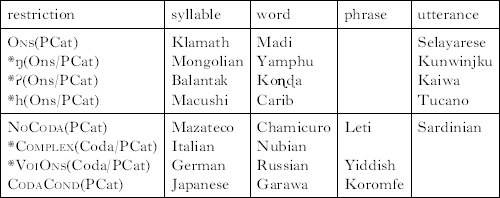
This section has shown that any markedness restriction which can target syllable onsets or codas can also target strictly the initial onsets or final codas of any larger prosodic domain. That is, any restriction which one language can impose on all syllable onsets can be imposed on all and only word-initial onsets in another, on all and only phrase-initial onsets in a third and on all and only utterance-initial onsets in a fourth; coda restrictions are similarly parallel across prosodic domains. These correspondences are summarised in Table I.
Attested phonotactic restrictions on prosodic domains.

The parallels among these domain-edge markedness restrictions suggest that they are general prosodic domain phenomena, rather than strictly syllable phenomena: onset restrictions can apply to initial onsets in any domain, and coda restrictions can apply to final codas in any domain. These parallels are formally captured in the MOns(Ons/PCat) and MCoda(Coda/PCat) constraint schemata defined in §2. The schemata generate sets of parallel constraints imposing each onset or coda restriction on the initial onset or final coda respectively of each prosodic domain (PCat). Despite relatively scarce reports of phonotactic restrictions on the edges of prosodic domains above the word, Table I shows that the parallel restrictions predicted by these schemata are attested.
The discovery of these constraint schemata enriches our understanding of the structure of prosodic domains and of OT's universal constraint inventory Con. Specifically, this shows that Con is highly structured: it cannot contain arbitrarily different sets of constraints targeting the edges of different prosodic domains; instead, these positions are subject to parallel sets of markedness constraints.
4 Factorial typology
Because domain-edge markedness constraints assess violations based on the location of prosodic domain edges, they also interact with the constraints determining the location of those edges. There are two possible ways to avoid violating a positional markedness constraint: either the marked structure itself may change, as in the languages described so far, or else the marked element may surface in a position not targeted by the constraint. §§4.1 and 4.2 address situations where violations are avoided by changing the marked structures themselves; this happens when constraints demanding prosodic strict layering (Selkirk Reference Selkirk, Beckman, Dickey and Urbanczyk1995, Truckenbrodt Reference Truckenbrodt1999) dominate faithfulness constraints. §4.1 looks at basic faithfulness constraints, and §4.2 adds positional faithfulness constraints such as Faith/σ1. §4.3 then examines cases in Banawá and Tzutujil where strict layering constraints are crucially dominated by faithfulness and Ons/Wd, allowing initial onsetless syllables to surface outside prosodic words. As a result, these are cases where morphological (though not prosodic) words avoid phonotactic subset-at-edge patterns, despite the activity of domain-edge markedness constraints. Violations of strict layering also allow Banawá to thwart the typical within-language implicational relationship among prosodic domain edges: while words must have onsets, this restriction does not extend to utterances, as utterances may surface without initial onsets. This pattern further shows that domain-edge markedness constraints must be freely rankable. §4.4 presents a comprehensive factorial typology.
4.1 Subset-at-edge patterns: basic faithfulness
In an OT grammar, interactions among faithfulness constraints and domain-edge markedness constraints give rise to phonotactic restrictions at various prosodic domain edges. This section illustrates these rankings using examples where the marked onset [ʔ] is banned initially in syllables, words and utterances. Other domain-edge restrictions follow from similar rankings of the appropriate markedness and faithfulness constraints.
First, when all of the relevant faithfulness constraints (here, simply Ident) are ranked below *ʔ(Ons/σ), the Chamicuro pattern of total avoidance of all onset [ʔ] emerges.Footnote 6
(22) Chamicuro: no syllable-onset [ʔ]
Tableaux in this section follow the convention of arranging domain-edge markedness constraints such that those on larger domains dominate those on smaller domains – here, *ʔ(Ons/Utt)≫*ʔ(Ons/Wd)≫*ʔ(Ons/σ). This ranking, however, is not crucial. When prosodic strict layering holds, as is assumed here (that is, when the constraint StrictLayer is ranked highly enough to be consistently obeyed; see §4.3 for discussion), all word-initial onsets are also syllable-initial onsets. In this sort of implicational prosodic structure, *ʔ(Ons/σ) bans syllable-initial [ʔ], and as a result also bans initial [ʔ] in words and larger domains. Generally, given strict layering, a marked onset or coda is banned at the edge of the smallest prosodic domain targeted by a domain-edge markedness constraint which dominates relevant faithfulness constraints, and also at edges of all larger prosodic domains. Here, [ʔ] onsets are banned initially in all syllables because *ʔ(Ons/σ) is the most specific domain-edge markedness constraint dominating Ident. They are also banned initially in words and utterances, regardless of the ranking of *ʔ(Ons/Wd) and *ʔ(Ons/Utt), due to the implicational nature of a typical prosodic structure.
When faithfulness constraints are ranked below *ʔ(Ons/Wd) but above *ʔ(Ons/σ), as in (23), the Nahuatl pattern emerges: [ʔ] can surface in medial but not word-initial or utterance-initial onsets. Again, the ranking of *ʔ(Ons/Utt) is not crucial: utterance-initial [ʔ] will be banned by the ranking *ʔ(Ons/Wd)≫Ident as long as strict layering is obeyed. Ident must dominate *ʔ(Ons/σ), however, in order for medial onset [ʔ] to surface.
(23) Nahuatl: no word-onset [ʔ]
Utterance-initial [ʔ] is banned when faithfulness is ranked below *ʔ(Ons/Utt) but above *ʔ(Ons/Wd) and *ʔ(Ons/σ) – that is, when *ʔ(Ons/Utt) is the most specific domain-edge markedness constraint dominating Ident. This occurs in Kaiwa.
(24) Kaiwa: no utterance-onset [ʔ]
Finally, when faithfulness constraints dominate all of the constraints against domain-initial glottal stop onsets, the language (e.g. Arabic) allows glottal stop in all onsets.
(25) Arabic: no restrictions on onset [ʔ]
4.2 Superset-at-edge patterns: positional faithfulness
Languages may also license a wider variety of onsets and codas at the edges of prosodic domains. In these superset-at-edge languages, marked onsets and codas may be licensed only at domain edges. This occurs in Lango, where [ŋ] can be an onset word-initially, as in (26a), but not medially (Noonan Reference Noonan1992: 10, 16–17). When a morphologically complex word would be expected to have a medial onset [ŋ], as in (26b), where an [ŋ]-final word is followed by a vowel-initial suffix, [ŋ] deletes and the flanking vowels are nasalised.
(26) Lango
The languages in (27) similarly license the marked onset [h] only in word-initial position.
(27) Marked onset [h] word-initially, not medially
Lamani (Trail 1970)
Lele (Frajzyngier 2001)
Mbay (Keegan 1997)
Songhay (Prost 1956)
Tsisaath Nootka (Stonham 1999)
Wiyot (Teeter 1964)
Yan (Sapir & Swadesh 1960)
These superset-at-edge phonotactic patterns, which reverse the distribution of marked onset and coda segments seen in earlier sections of this paper, occur when positional faithfulness constraints dominate domain-edge markedness constraints. While domain-edge markedness constraints penalise marked segments or structures at the edges of prosodic domains, positional faithfulness constraints penalise unfaithful mappings in positions including word-initial syllables (Beckman Reference Beckman1999). In OT terms, there can be a direct conflict between a domain-edge markedness constraint like *ŋ(Ons/Wd) and a positional faithfulness constraint like Ident/σ1.
The distribution of [ŋ] in Lango can be accounted for by the ranking Ident/σ1≫*ŋ(Ons/Wd), *ŋ(Ons/σ)≫Ident in (28). The result of this ranking is a superset-at-edge pattern where the marked onset [ŋ] is banned in medial onsets, due to *ŋ(Ons/σ)≫Ident, but permitted in word-initial onsets, because of Ident/σ1≫*ŋ(Ons/Wd).
(28) Lango: marked onsets are only licensed word-initially
Other superset-at-edge patterns involving marked onsets and codas emerge from similar rankings. In Axininca Campa, onsetless syllables are licensed only word-initially (Payne Reference Payne1981, McCarthy & Prince Reference McCarthy and Prince1993b). This follows from a ranking similar to (28): Ident/σ1≫Ons/Wd, Ons/σ≫Ident. Similarly, Ident/σ1≫NoCoda/Wd, NoCoda/σ≫Ident predicts that codas are licensed only in word-final syllables, as in Kamaiurá (Everett & Seki Reference Everett and Seki1985, McCarthy & Prince Reference McCarthy and Prince1986). Beckman (Reference Beckman1999) and Broselow (Reference Broselow2003) discuss additional patterns of this type.
4.3 Strict-layering violations
This discussion has focused so far on cases where prosodic strict layering holds: all segments are syllabified, all syllables are in prosodic words, all prosodic words are in prosodic phrases, etc. (Selkirk Reference Selkirk, Myers, Laver and Anderson1981, Reference Selkirk1984, Nespor & Vogel Reference Nespor and Vogel1986). In these structures, an utterance-initial segment is also always phrase-initial, word-initial and syllable-initial. Considering only prosodic structures of this sort has allowed us to assume the within-language implication that any language which bans a marked onset word-initially also bans it utterance-initially, as is typical.
Strict layering is not, however, always obeyed. Syllables can be attached directly to prosodic words rather than to feet, and clitics and function words can be attached directly to phrases rather than to prosodic words (Selkirk Reference Selkirk, Beckman, Dickey and Urbanczyk1995, Ito & Mester Reference Ito, Mester, Honma, Okazaki, Tabata and Tanaka2003). Domain-edge markedness constraints are crucially sensitive to details of prosodic structure: the assessment of Ons/Wd violations incurred by a form depends on the precise location of prosodic word edges in that form. Thus in a language where strict layering can be violated, restrictions are no longer necessarily implicational: a restriction which holds on a smaller domain does not necessarily hold on a larger domain as well.
This section will explore two ways in which domain-edge markedness constraints can interact with constraints governing the positions of prosodic domain edges (Selkirk Reference Selkirk, Beckman, Dickey and Urbanczyk1995, Truckenbrodt Reference Truckenbrodt1999). First, faithful realisation of marked onsets can result in prosodic structures which violate strict layering. In Banawá, underlyingly word-initial onsetless syllables surface outside prosodic words. Second, structures which are banned at domain edges can be tolerated when they are extraprosodic for other reasons, as in Tzutujil, where extraprosodic proclitics may lack initial onsets despite the fact that lexical (and prosodic) words must have initial onsets.
4.3.1 Banawá: marked structures become extraprosodic
Constraint rankings like the one in the hypothetical tableau in (29), where Ons/Wd and faithfulness constraints dominate the constraint enforcing prosodic strict layering, predict that violations of Ons/Wd could be avoided by allowing initial onsetless syllables to surface outside prosodic words.Footnote 7
(29)
The winning structure in (29), with an extraprosodic initial vowel, is very similar to structures proposed by Spring (Reference Spring1990) to account for the fact that onsetless initial syllables in Axininca Campa do not participate in reduplication. Downing (Reference Downing1998) also proposes similar structures for a number of languages in which onsetless word-initial syllables fail to bear stress or high tone, or do not participate in reduplication.
The present analysis builds on the central insight of Spring's and Downing's proposals: initial onsetless syllables can be extraprosodic and thus exceptional.Footnote 8 In Banawá, prosodic words must have initial onsets; structures where onsetless (underlyingly) word-initial syllables surface outside prosodic words follow from a desire to avoid violating high-ranking Ons/Wd.
The extraprosodic position of initial onsetless syllables is indicated by the fact that they cannot be stressed, unlike other initial syllables (Everett Reference Everett1990, Buller et al. Reference Buller, Buller and Everett1993, Downing Reference Downing1998). The default Banawá stress pattern is illustrated in (30). Initial syllables, and every second syllable thereafter, are stressed; feet are trochaic and start at the left edge of the word. Main stress is typically (though not consistently) on the penultimate foot; for the purposes of the present discussion, the distinction between primary and secondary stress is irrelevant.
(30)
Banawá syllables are either CV or V. Medial onsetless syllables may be either unstressed (as in (31a)) or stressed (as in (31b)). Postvocalic word-final [i] is extraprosodic and is never stressed.
(31)
The only initial syllables which are not stressed are those which are onsetless, as in (32). When a word has an initial onsetless syllable, its second syllable and every second syllable thereafter is stressed. That is, these words are stressed according to the normal pattern, but the first stress occurs on the second syllable.
(32)
The avoidance of stress on initial onsetless syllables can be accounted for by the constraint ranking in (33), which forces such syllables to fall outside the prosodic word.Footnote 9 The winning candidate, (33a), is a word in which the initial [u] is attached directly to some larger prosodic constituent, e.g. a phonological phrase, in order to avoid violating Ons/Wd, though at the cost of violating lower-ranked StrictLayer. Losing candidates (33b, c) surface with initial onsetless syllables, thus violating Ons/Wd; (33b) also violates Align-L(Wd, Ft), because the initial [u] is unfooted. Finally, (33d) has an epenthetic initial onset [ʔ], violating high-ranking Faith. Ons/Wd can therefore account for Banawá's avoidance of prosodic word-initial onsetless syllables.
(33)
An alternative explanation for languages’ avoidance of stressed onsetless syllables is proposed by Smith (Reference Smith2002: 97ff) and de Lacy (Reference de Lacy2001). They suggest that these patterns are due to a constraint penalising stressed syllables without onsets: Ons/ . Given the ranking in (34), undominated Ons/ and StrictLayer cause feet to be displaced from the left edge of the prosodic word, leaving the initial onsetless syllable inside the prosodic word but unfooted and thus unstressed. Under this analysis, Ons/ must penalise onsetless syllables with either primary or secondary stress in order to explain both the avoidance of *[ˈu.fa.ˌbu.ne] in favour of [u.ˈfa.bu.ˌne] and also the avoidance of *[ˌa.ti.ˌke.i.ˈja.ri.ne] in favour of [a.ˌti.ke.ˈi.ja.ˌri.ne] ‘happy’.
(34)
In Banawá, however, only initial onsetless syllables avoid stress; medial onsetless syllables may be stressed, as in [ˈba.du.ˌe] ‘species of deer’ and [a.ˌti.ke.ˈi.ja.ˌri.ne]. As Ons/ does not distinguish between initial and medial onsetless syllables, the ranking from (35) incorrectly leaves initial CV syllables unfooted (and thus unstressed) when doing so prevents stress from appearing on medial onsetless syllables. This is illustrated in (35), where candidate (35b) is incorrectly chosen as the winner; the actual winner is (35c), where the final onsetless syllable is stressed.Footnote 10
(35)
Because of its direct reference to word-initial onsets, Ons/Wd straightforwardly explains the difference between initial and medial onsetless syllables in Banawá. As shown in (36), a medial stressed onsetless syllable does not incur a violation of Ons/Wd, and thus does not disrupt the normal pattern of stress assignment. The repair chosen in Banawá, where onsetless initial syllables are removed from prosodic words and stress is therefore shifted away from these initial syllables, is a consequence of this domain-edge markedness constraint's ranking, with faithfulness, above StrictLayer.
(36)
Finally, because strict layering is not consistently observed in Banawá, the relationship among phonotactic restrictions at different prosodic levels is atypical. When a form like [ufabune] occurs utterance-initially, the initial [u] is utterance-initial but not word-initial. The word is pronounced as it is utterance-medially, without an initial onset, in the prosodic structure Utt[u Wd[ˈfa.bu.ˌne]. Utterances are therefore unlike words, in that they license initial onsetless syllables, indicating that the typical within-language implication regarding the distribution of marked domain-edge structures does not hold: onsetless syllables are banned word-initially but tolerated syllable-initially and, atypically, utterance-initially.
This reveals that domain-edge markedness constraints must be freely rankable, as follows. The general discussion of Banawá stress above shows that Faith and Ons/Wd must dominate StrictLayer. For the correct utterance-initial surface form in (37) to win, StrictLayer must dominate Ons/Utt. By transitivity, then, Ons/Wd dominates Ons/Utt in Banawá. §4.1 showed that the typical case, where a marked onset is banned utterance-initially but licensed word-initially, follows from a ranking like *X(Ons/Utt)≫Faith≫*X(Ons/Wd). Thus in order for both *X(Ons/Utt)≫*X(Ons/Wd) and *X(Ons/Wd)≫*X(Ons/Utt) to be possible, constraints in the MOns(Ons/PCat) schema must be freely rankable.
(37)
4.3.2 Tolerance of marked ‘initial’ structures: Tzutujil clitics
When phonological material surfaces outside prosodic words for independent reasons, as can be true of clitics, it is not evaluated by domain-edge markedness constraints. In these cases, clitics can begin with structures which are never initial in lexical words, as the left edge of a lexical word always aligns with the left edge of a prosodic word, and thus lexical word edges are subject to domain-edge markedness constraints. This occurs in Tzutujil (Dayley Reference Dayley1985), where prosodic words (and thus all roots) must have initial onsets while proclitics may be onsetless.
Underlyingly vowel-initial Tzutujil roots receive epenthetic [ʔ] onsets, satisfying Ons/Wd.Footnote 11
(38)
The only Tzutujil words which regularly surface without initial onsets are the vowel-initial absolutive and ergative proclitics given in (39).Footnote 12
(39)
As shown in (40), [ʔ] is never epenthesised before these clitics.
(40)
This difference between roots and clitics emerges if, following Selkirk (Reference Selkirk, Beckman, Dickey and Urbanczyk1995), Tzutujil clitics surface outside of prosodic words, attaching directly to phonological phrases or higher prosodic constituents. Ons/Wd requires all and only prosodic words to have initial onsets and so is indifferent to the presence of onsets in extraprosodic clitics in candidates (41a) and (b). Ons/Wd thus rules out only candidate (41c), where the clitic is fully incorporated into an onsetless prosodic word. Dep prefers candidates without epenthesis, eliminating candidates (41b) and (d) and allowing the StrictLayer-violating candidate (41a) to win. Thus Tzutujil clitics, unlike roots, may surface with initial onsetless syllables.
(41)
In the winning candidate (41a), the final consonant of the clitic resyllabifies, providing an onset to the root. Allowing this, while preventing other unattested misalignments of root and prosodic word edges, is crucial to a full analysis of Tzutujil clitics. Two types of undesirable outputs must be avoided: those in which onsetless root-initial syllables surface outside the prosodic word (as in Banawá), e.g. *a[xq'iːx] rather than [ʔaxq'iːx] ‘diviner’, and those in which clitics fully incorporate into prosodic words (thus satisfying StrictLayer), e.g. *[aːw=ak'], *[ʔaːw=ak'] instead of aː[w=ak']. A traditional alignment constraint like Align-L(Rt, PrWd) (McCarthy & Prince Reference McCarthy and Prince1993), which demands that the left edge of each root co-occur with the left edge of a prosodic word, would prevent both of these undesirable results. Problematically, however, it would also rule out surface structures in which clitic-final consonants resyllabify to satisfy Ons/Wd, as in (42), where the actual output is (42a); bare roots with epenthetic word-initial onset [ʔ] would also be wrongly eliminated.
(42)
Something weaker than Align-L(Rt, PrWd) must therefore mediate the relationship between Tzutujil root and word edges. The necessary constraint must force the beginning of the root to fall inside the prosodic word, and must allow epenthetic or clitic consonants but not clitic vowels to intervene between root and word edges. A constraint which aligns the edges of root-headed syllables with edges of prosodic words, RootHd-L, can account for this pattern.Footnote 13
(43) RootHd-L
The left edge of the leftmost syllable whose morphological domain is the root must be aligned with the left edge of a prosodic word.
This constraint crucially refers to the notion of ‘morphological domain’ introduced by van Oostendorp (Reference Oostendorp2004) in a discussion of differences in the syllabification of Dutch prefix and suffix segments. A segment's morphological domain is the smallest word containing the segment, and a syllable inherits its morphological domain from its head; in Tzutujil, the morphological domain of a syllable is that of its vowel.
If alignment constraints can refer to morphological domains, RootHd-L can therefore require the leftmost vowel in a root to surface in the leftmost syllable of a prosodic word, while failing to penalise non-head material in that leftmost syllable with non-root morphological affiliations. Clitic and epenthetic consonants can thus appropriately appear before root-initial vowels inside Tzutujil prosodic words in order to satisfy Ons/Wd, while clitic vowels must remain outside prosodic words and root vowels must remain inside them. These results are shown in (44).
(44)
Without reference to segments' morphological affiliation, it is impossible to force all clitic vowels (but not all clitic consonants) to surface outside prosodic words and thus allow these clitic-initial vowels to escape from prosodic requirements on prosodic word-initial onsets. In general, morphologically mediated alignment constraints like RootHd-L firmly link edgemost vowels to prosodic domain edges, while allowing consonants to enter or leave prosodic domains without penalty. RootHd-L thus captures consonants' tendency to be freer than vowels in terms of prosodic alignment and resyllabification across word boundaries. De Lacy (Reference de Lacy2002) argues that in Maori, a single prosodic word must contain all vocalic elements of a root, but not necessarily all consonantal elements; final consonants surface in a distinct prosodic word when suffixes are added (and are otherwise deleted). Similarly, Cairene Arabic allows the initial consonant of a complex onset to resyllabify and become a coda to a preceding word, though vowels can never change their prosodic affiliations.
Given the formal parallels among domain-edge markedness constraints, all such constraints are predicted to interact in similar ways with candidates' prosodic structures. For example, *X(Ons/PCat) constraints should be able to license marked onsets only in extraprosodic clitics, or force root-initial marked onsets into extraprosodic positions. Coda constraints should also be sensitive to prosodic structure, licensing (marked or all) codas only in clitics or forcing them to surface outside the prosodic word. More specifically, a ranking like Faith, NoCoda/Wd≫StrictLayer should force underlying word-final consonants to surface faithfully but in a position outside prosodic words, rather than as word-final codas. In other words, this ranking accurately predicts that languages may require final consonants to be extrametrical.
4.4 General factorial typology
This paper has discussed cases where the onset or coda inventory at a prosodic domain edge is a subset of the comparable domain-medial inventory. In most cases, languages enforce these restrictions by epenthesising, deleting or changing the features of initial onsets or final codas. The constraint rankings under which these restrictions typically emerge are of the general type in (45a). When Faith dominates StrictLayer, on the other hand, as in (45b), prosodic structure rather than segmental content is modified in order to avoid marked onsets in word-initial syllables. In Banawá and Tzutujil, prosodic (though not morphological) words must have onsets while utterances may be onsetless, thwarting the typical implicational relationship among prosodic domain edges within a particular language. Finally, in a language where both Faith and StrictLayer dominate a domain-edge markedness constraint as in (45c), the restriction is not imposed on the language's surface forms.
(45) Basic factorial typology of repair types
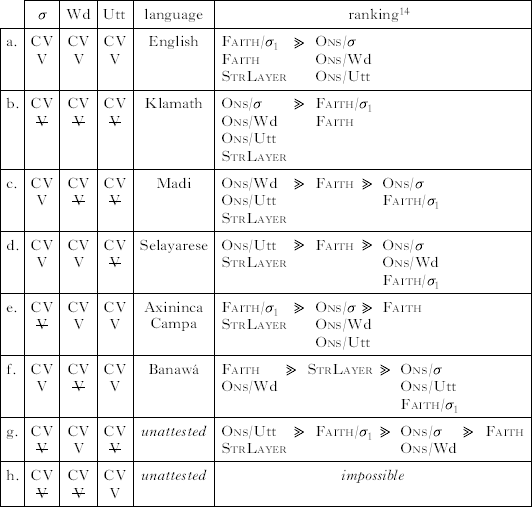
The schematic rankings in (45a, b) illustrate the two basic ways that languages can achieve the subset-at-edge patterns discussed throughout this paper. However, as discussed in §4.2 and elsewhere, other patterns are also attested. Table II gives each logically possible within-language combination of restricted and unrestricted initial onsets in the domains syllable, word and utterance. These are illustrated using Ons/PCat constraints, but comparable patterns of within-language restrictions are predicted for all marked onsets and codas. Phrases are ignored here, because there is so little data on attested phrase-initial restrictions.
Possible patterns of onset requirements across prosodic domains.  indicates a restriction on initial onsetless syllables.
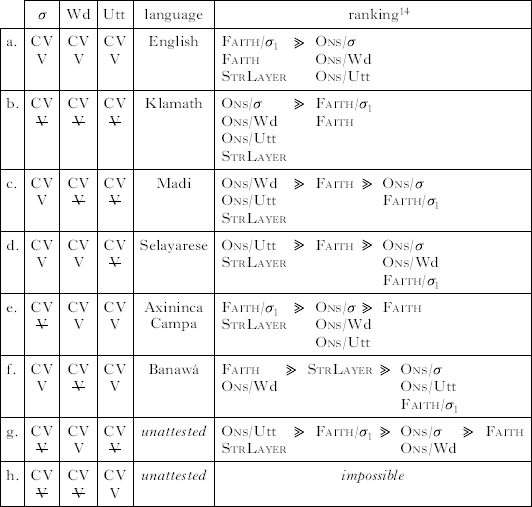
Most of the predicted languages in Table II are attested. An English-type language, in which faithfulness constraints and StrictLayer dominate all domain-edge markedness constraints, never requires onsets in any domain. Klamath, Madi and Selayarese were discussed at length in §3, and the corresponding rankings (with StrictLayer and some or all domain-edge markedness constraints dominating faithfulness) were illustrated in §4.1. Axininca Campa is an example of the positional faithfulness pattern discussed in §4.2, where Faith/σ1 licenses marked onsets only word-initially and high-ranking StrictLayer ensures that they surface utterance-initially as well. Finally, as shown in §4.3.1, Banawá requires onsets only prosodic word-initially, and violates StrictLayer in order to satisfy Ons/Wd via a prosodic repair; onsetless syllables may occur medially and utterance-initially.
The final two patterns appear to be unattested. First, the ranking in (g) predicts a second type of positional faithfulness pattern where onsets would be required of all but word-initial syllables. The ranking is illustrated in (46); to my knowledge, it does not occur.
- (46)
a. Both utterance-initial and word-medial syllables must have onsets
b. Utterance-medial word-initial syllables may surface without onsets
Finally, the language in (h) requires onsets in all syllables except those occurring utterance-initially, where underlyingly onsetless vowels may surface. This is predicted to be unattested, as the comparative tableau in (47) shows that it is not possible under any constraint ranking.Footnote 15 In a language where all medial and word-initial syllables have onsets, onsetless utterance-initial syllables can surface only if they are extrametrical, in structures like Utt[VWd[CV.CV]], the desired winner in (47). For this candidate to win, the constraints must be ranked such that it is more harmonic than both candidates (47a), where no onsets are epenthesised, and (47b), where onsets are epenthesised to both medial and utterance-initial syllables. Candidate (47a) loses to the desired winner only if Ons/σ≫Faith, while the reverse ranking Faith≫Ons/σ must hold in order for (47b) to lose. As no constraint ranking can give rise to this language, it is appropriately predicted to be unattested.
(47) No constraint ranking requires onsets everywhere except utterance-initially
Overall, while a diverse set of languages is predicted by the interactions of domain-edge markedness constraints and faithfulness constraints (both general and position-specific), this section has shown that this typology is more restricted than the set of all logically possible phonotactic patterns, and further, that nearly all of the predicted patterns are attested.
5 Conclusion
This paper has argued that the universal inventory of OT constraints must include domain-edge markedness constraint schemata of the form MOns(Ons/PCat) or MCoda(Coda/PCat). These schemata give rise to families of parallel markedness constraints on the initial onsets or final codas of each prosodic domain, such as Ons/σ, Ons/Wd, Ons/Phr, Ons/Utt and *VoiObs(Coda/σ), *VoiObs(Coda/Wd), *VoiObs(Coda/Phr), *VoiObs(Coda/Utt). While the familiar positional markedness framework allows each markedness constraint on onsets or codas to be relativised to each such domain-edge position, the inclusion of these schemata in Con accounts for the observation that restrictions on prosodic domain edges may not be arbitrarily different; rather, each attested restriction on syllable onsets and codas is also attested at the edges of words, phrases and utterances.
Domain-edge markedness constraint violations are most frequently avoided via epenthesis, deletion or some other featural change, resulting in an inventory of domain-edge onsets or codas which is a subset of the medial onset or coda inventory. These constraints may also interact with constraints demanding prosodic strict layering or positional faithfulness, accurately predicting languages where marked onsets surface only extrametrically, or even where marked onsets or codas are licensed only at domain edges. As the factorial typology of domain-edge markedness constraints accurately predicts a wide range of attested languages while generally not predicting unattested languages, these constraint schemata must be part of the universal OT constraint inventory Con. The findings presented here thus further our understanding of both the structure of prosodic domains and the internal structure of Con.