Early language development plays a crucial role in children’s literacy, social skills, and academic performance (Dickinson & McCabe, Reference Dickinson and McCabe2001; Kendeou, van den Broek, White, & Lynch, Reference Kendeou, van den Broek, White and Lynch2009; Sun, Reference Sun2019; Sun, Yussof, et al., Reference Sun, Yussof, Mohamed, Rahim, Cheung, Cheong and Bull2018). For instance, kindergarten children’s receptive vocabulary knowledge was found to have a lasting effect in predicting children’s vocabulary performance and reading ability through fourth grade (Storch & Whitehurst, Reference Storch and Whitehurst2002; Sun, Steinkrauss, Wieling, & de Bot, Reference Sun, Steinkrauss, Wieling and de Bot2018). Teachers’ high-quality language practice is considered vital to promote such development (Barnes, Reference Barnes2013; Dickinson, Reference Dickinson2011). In Singapore, the Ministry of Education views kindergartners’ language and literacy learning as one of the six major areas of development (Ministry of Education, 2013), expecting teachers to effectively evaluate children’s talk and demonstrate the use of language as a tool for communication and thinking (Tang, Reference Tang2015). However, it might not be easy for teachers to achieve that goal. It was found that many preschool programs “have failed to help teachers’ language-enhancing practices that are needed to bolster language learning” despite great efforts (Dickinson, Reference Dickinson2011, p. 964). Such failure is at least partially due to the lack of an effective framework to provide feedback to teachers, leaving them unable to understand how to improve, adapt, and customize their language practices to children (Dickinson, Hofer, Barnes, & Grifenhagen, Reference Dickinson, Hofer, Barnes and Grifenhagen2014). Before effective language interventions can be created, it is important to understand what an effective teachers’ language practice consists of and how a teacher’s background is related to the effective language practice.
This study focuses on teachers’ language practice during shared book reading (SBR), an interaction whereby an adult reads and discusses a book with young nonreading children (van Kleeck, Gillam, Hamilton, & McGrath, Reference van Kleeck, Gillam, Hamilton and McGrath1997) or reading children (Blewitt & Langan, Reference Blewitt and Langan2016; Walsh & Hodge, Reference Walsh and Hodge2016). SBR has been found to be effective for children’s language and vocabulary growth (Gerde & Powell, Reference Gerde and Powell2009; Whitehurst et al., Reference Whitehurst, Arnold, Epstein, Angell, Smith and Fischel1994). We have adopted a fine-grained research methodology to examine teachers’ language practice (Dickinson, Freiberg, & Barnes, Reference Dickinson, Freiberg, Barnes, Neuman and Dickinson2011), as such close observation assessing teachers’ language quality utterance by utterance allowed us to pinpoint the language components that influence children’s language growth (Dickinson & Porche, Reference Dickinson and Porche2011; Huttenlocher, Vasilyeva, Cymerman, & Levine, Reference Huttenlocher, Vasilyeva, Cymerman and Levine2002; Vasilyeva, Huttenlocher, & Waterfall, Reference Vasilyeva, Huttenlocher and Waterfall2006). To date, only a few studies have adopted nuanced descriptions on kindergarten teachers’ language practice, and those who have performed a detailed examination of instructional strategies (e.g., use of high/medium/low cognitive load comments; Barnes, Reference Barnes2013) and linguistic features (e.g., lexical diversity; Bowers & Vasilyeva, Reference Bowers and Vasilyeva2011), respectively, have yielded fruitful results. Our study uses an adapted coding scheme to simultaneously analyze both kindergarten teachers’ instructional strategies and linguistic features during English SBR sessions in Singapore. We intend to use the teachers’ instructional strategies and linguistic features to predict children’s early vocabulary development and word reading skills after 1 school year and to explore which of the teachers’ characteristics (e.g., teaching experience) are associated with the variation in the teachers’ language practices. To our knowledge, this would be the first study that explores kindergarten teachers’ language in SBR in such a comprehensive and detailed manner in the Singaporean context. The results could bring us insight on whether findings from Western countries could be useful in an Asian bilingual context, where the pedagogical traditions are substantially different from the West probably due to cultural reasons. If the relationship between certain language features and children’s language outcome could be confirmed in this Asian context, language interventions for better SBR sessions could be promoted more widely.
Literature Review: SBR in early childhood education in Singapore
As early as 1985, the Ministry of Education has commissioned an extensive research study in 30 primary schools and introduced the Reading and English Acquisition Program to Year 1 classes (Ng & Sullivan, Reference Ng and Sullivan2001). The Reading and English Acquisition Program is aimed at improving language learning and involved elements of SBR. The success of the program has led to its incorporation into a new program, the Strategies for English Language Learning and Reading (STELLAR) in Singapore primary schools (Curriculum Planning and Development Division, 2010). The SBR instruction in the STELLAR program is aimed at developing students’ decoding and comprehension skills (Curriculum Planning and Development Division, 2010).
Although the STELLAR program has been widely adopted in Singapore primary schools, little quantitative research has been conducted on SBR and children’s early language and literacy development, particularly from the perspective of teachers’ language practice in teacher–child interaction. A qualitative study on the implementation of STELLAR in lower grades in Singaporean primary schools found that there were limited opportunities for pupils to interact and engage in productive exchanges with teachers (Curdt-Christiansen & Silver, Reference Curdt-Christiansen and Silver2013). Although the Singapore Ministry of Education (2013) highly recommend the class to be learner centered, teachers were found to be persistently dominant in class, seeking predetermined “correct” answers from children (Curdt-Christiansen & Silver, Reference Curdt-Christiansen and Silver2013). Such limited opportunities for children’s engagement in interaction are probably due to cultural influence and curriculum constrains in Singapore. The traditional Asian culture (e.g., Confucian values) highly valued teachers’ authority and children’s conformity in class (Curdt-Christiansen & Silver, Reference Curdt-Christiansen and Silver2012; Lam, Reference Lam2015; Tan, Reference Tan2006), leaving little chance for children to participate in an extended conversation with their teachers. Besides, the constraints on literacy curriculum due to syllabus demands, exam focused learning, and the assessment of teachers’ competence and efficiency by students’ exam performance further limit the time for extended conversation in class (Bautista, Moreno-Núñez, Bull, Amsah, & Koh, Reference Bautista, Moreno-Núñez, Bull, Amsah and Koh2018). Due to these cultural and curriculum reasons, the teachers’ instructional strategies in language class were found to be limited to “sentence completion,” “linguistic accuracy,” and “management talk” for disciplinary control (Curdt-Christiansen & Silver, Reference Curdt-Christiansen and Silver2013).
As SBR unfolds in relation to the established norms, societal expectations, and ideologies of the cultural context, the cultural and curriculum reasons mentioned above can substantially influence the book reading process (Ellis, Reference Ellis2014; Lim-Ratnam, Reference Lim-Ratnam2013; Sripathy, Reference Sripathy, Gopinathan, Pakir, Kam and Saravanan1998). Because SBR is culturally foreign to Singaporean early educators, they would uncritically adopt a scripted approach and conduct the lessons by using mainly closed questions. Thus, students did not engage in a sustained talk that may be beneficial for literacy development (Sripathy, Reference Sripathy, Vaish, Gopinathan and Liu2007). It has also been found that there is a discrepancy between teachers’ pedagogical beliefs and their real classroom practices (Aman, Reference Aman, Elaine and Bokhorst-Heng2016): those claiming to have involved the children in SBR were only observed to have read to children and rarely engaged them in the process. Above all, SBR has been widely used in early English education in Singapore. However, to our knowledge, there has been no study that adopted a microstructure analysis to systematically analyze Singaporean teachers’ language practices during SBR, particularly in the kindergarten context.
The Singapore Kindergarten Impact Project is the first large-scale longitudinal study targeted at childcare and kindergarten contexts in Singapore, aiming to provide us with an understanding of how home and school may influence children’s development. The Singapore Kindergarten Impact Project is designed to track Singaporean kindergarteners’ development in language, numeracy, and other cognitive domains, exploring how kindergarten and family may influence such growth. Samples are drawn from different kindergarten and childcare education providers, including 24 PAP (People’s Action Party, which is the ruling political party of Singapore) Community Foundation childcare centers and kindergartens (who are the most established early education providers in Singapore), 10 Ministry of Education kindergartens, 18 not-for-profit kindergartens, and 2 commercial kindergartens. Many children who attend PAP kindergartens tend to be from lower socioeconomic families as the policy of the PAP kindergartens is to provide affordable services and facilities that were needed by, and therefore popular with, the population (Dixon, Reference Dixon2004; Hill & Lian, Reference Hill and Lian1995). Children in Singapore typically attend 2 years of kindergarten, and the current study focuses on data collected in classrooms over the first kindergarten year. The language of instruction used in classrooms is English (Dixon, Reference Dixon2004) due to the Singaporean government’s adoption of a bilingual education policy (Chua, Reference Chua2011) that requires all students to study their subject matter in English, and their ethnic heritage language (i.e., Mandarin, Malay, and Tamil) as a single school subject only (Dixon, Reference Dixon2009). Our participants are bilingual language learners and English is the societal dominant language (Pakir, Reference Pakir1991; Sun, Yin, Amsah, & O’Brien, Reference Sun, Yin, Amsah and O’Brien2018).
The current study uses data from this project to explore Singaporean kindergarten teachers’ variation in SBR strategies and linguistic features, and to reveal the potential influences, reasons, and effects of such variation. The contribution of our study is in making the process of teaching transparent and establishing a direct relationship between teachers’ language practices, children’s word knowledge, and teachers’ backgrounds. The following section will provide a review on types of instructions and linguistic features found to be effective in promoting children’s early language development in the Western countries.
Teachers’ language practice in SBR: Instructional strategy and linguistic complexity
SBR has been commonly used in kindergartens as an activity to facilitate children’s comprehension, vocabulary expansion, print knowledge, and oral language skills (Morrow, Reference Morrow2007; Whitehurst & Lonigan, Reference Whitehurst and Lonigan1998). During SBR in class, an adult reads a book to a group of children, scaffolds comprehension with structured interactive techniques, and directs children’s attention to the illustrations and printed texts in the book (van Kleeck et al., Reference van Kleeck, Gillam, Hamilton and McGrath1997). SBR may provide children with richer linguistic input compared to other activities as the texts of the stories are more complex and diverse than the language used in spontaneous utterances (Montag, Jones, & Smith, Reference Montag, Jones and Smith2015). There are 16.3 sophisticated words per 1000 words on average in children’s books (Hayes & Ahrens, Reference Hayes and Ahrens1988), five times the amount of sophisticated vocabulary words that are used in oral conversations (Snow, Reference Snow1983). SBR could bring children lasting benefits, as approximately 8% of the variance (d = 0.59) of children’s later language and reading comprehension was found to be related to SBR at home (Bus, van IJzendoorn, & Pellegrini, Reference Bus, van IJzendoorn and Pellegrini1995; Scarborough & Dobrich, Reference Scarborough and Dobrich1994), and 12% of the variance of children’s oral language skills was associated with the early print exposure in SBR (Mol & Bus, Reference Mol and Bus2011).
Teachers’ language quality during SBR is considered critical to such a promotional effect on children’s early language development (Dickinson, Reference Dickinson2011). A typical SBR session includes three components from the teachers’ perspective, namely, reading aloud the text, providing comments and questions for children, and producing other types of utterances such as management talk. Dialogic interaction during SBR is driven by teachers’ comments and questions, which serve to promote the co-construction of meaning in a shared context with children (Dickinson & Smith, Reference Dickinson and Smith1994) and create an environment for students to process novel vocabulary words at a deeper level (Zimmerman et al., Reference Zimmerman, Gilkerson, Richards, Christakis, Xu, Gray and Yapanel2009; but see Mol, Bus, & de Jong, Reference Mol, Bus and de Jong2009). The quality of teachers’ language practice in SBR has been examined via instructional strategies and the linguistic complexity of the teachers’ utterances. These two perspectives will be discussed respectively.
Instructional strategies
Teacher-led SBR strategies have been shown to be among the most powerful techniques an adult can use to develop children’s language and literacy (Gerde & Powell, Reference Gerde and Powell2009; Landry et al., Reference Landry, Zucker, Williams, Merz, Guttentag and Taylor2017; Neuman & Kaefer, Reference Neuman and Kaefer2018; Whitehurst & Lonigan, Reference Whitehurst and Lonigan1998). While reading the story, teachers might define and discuss new words, ask questions, respond to children’s comments, and expand the plot with additional information. Such questions and comments are increasingly considered best practices in promoting early vocabulary and reading skills (Neuman, Copple, & Bredekamp, Reference Neuman, Copple and Bredekamp2000). Questions are used to assess children’s knowledge and comprehension (Massey, Pence, Justice, & Bowles, Reference Massey, Pence, Justice and Bowles2008), to challenge children cognitively (DfEs, 2004), to establish an extended conversation (van Kleeck, Vander Woude, & Hammett, Reference van Kleeck, Vander Woude and Hammett2006), and to provide opportunities for children’s engagement (Dickinson & Smith, Reference Dickinson and Smith1994; Massey et al., Reference Massey, Pence, Justice and Bowles2008; Wasik & Hindman, Reference Wasik, Hindman, Leander, Rowe, Dickinson, Hundley, Jimenez and Risko2009). Comments are used as instructional tools to direct children’s attention, to provide explanations, to respond to children’s inquiries, and to expand on what the child has said (Barnes, Reference Barnes2013). Comments place less pressure on children than questions as they do not necessarily require a response from the listener and allow more creative and diverse responses from the learners (Hockenberger, Goldstein, & Haas, Reference Hockenberger, Goldstein and Haas1999). During SBR, questions and comments are combined to constitute an interactive manner of reading (Reese, Reference Reese, Kümmerling-Meibauer, Meibauer, Nachtigäller and Rohlfing2015).
Following Sigel’s (Reference Sigel1986) distancing model, which is based on research with 3.5- to 5.5-year-olds (Sigel, Reference Sigel1986, pp. 55–56), questions and comments can be classified into high-, medium-, and low-level strategies (Barnes, Reference Barnes2013), according to the cognitive demands that are imposed on a child (Sigel, Reference Sigel2002). High-level strategies (e.g., inference, prediction, and reflection) depend heavily on the use of decontextualized language skills to construct word meanings based on lexical and syntactic cues and to understand extended periods of connected discourse (Dickinson & Smith, Reference Dickinson and Smith1994). Medium-level strategies (e.g., explanation, recall, and definition) do not require as much prior language knowledge as high-level strategies, but the child is required to think beyond the story text (Sigel, Reference Sigel1986). Low-level strategies (e.g., description, enumeration, demonstration, and sequence) are more contextualized and the child can rely on textual cues such as visual illustrations and gestures to understand the words and the plot (Sigel, Reference Sigel1986). Studies have shown that the extent of psychological distancing (i.e., contextualization and de-contextualization) can influence children’s reasoning abilities, behavior, memory skills, and long-term cognitive changes (Harris & Almutairi, Reference Harris and Almutairi2016). To categorize comments and questions into high-, medium-, and low-level strategies based on a distancing model would provide a fine-grained lens to assess children’s language performance.
Prior research has found that different types of comments and questions benefit children with different levels of language abilities differently. For instance, Reese and Cox (Reference Reese and Cox1999) found that low-level strategies (e.g., simple questions eliciting description) were more beneficial for 4-year-old children with less vocabulary, while high-level strategies (e.g., inferential questions) were more effective for those with larger vocabularies. They argued that highly contextualized instructional strategies might provide concrete representations that benefit children with smaller funds of vocabulary knowledge (Elley, Reference Elley1989; Justice, Meier, & Walpole, Reference Justice, Meier and Walpole2005). Teachers who use a more tailored approach during reading instruction (Otaiba et al., Reference Otaiba, Folsom, Wanzek, Greulich, Wasche, Schatschneider and Connor2016) were found to promote children’s development in word reading better. Specifically, children who received more tailored instructions that took into account their vocabulary and word reading skills have shown greater reading skill gains than children in a control group (Connor et al., Reference Connor, Morrison, Schatschneider, Toste, Lundblom, Crowe and Fishman2011). For 4- to 5-year-old children, medium-level strategies might be useful in particular, as children at this age have a decent command of language but are still at the phase of comprehensively developing their language proficiency. Barnes (Reference Barnes2013) found that medium-level comments promoted the vocabulary development of both children with typical language ability and children with low language ability; similarly, Barnes and Dickinson (Reference Barnes and Dickinson2017) found medium-level comments promoted the receptive vocabulary growth of children with low and moderately low language ability across 1 year of Head Start preschool instruction. The current study will follow this tripartite division of comments and questions, and explore the effects of different levels of strategies on Singaporean children’s development in word knowledge (operationalized as receptive vocabulary and word reading skills), taking into account the children’s initial language ability.
Linguistic complexity
Teachers’ utterances may be further investigated for their linguistic features. The use of sophisticated words (Dickinson & Porche, Reference Dickinson and Porche2011), a diversified lexicon (Treviño, Varela, Romo, & Núñez, Reference Treviño, Varela, Romo and Núñez2015), and complex syntax (Huttenlocher et al., Reference Huttenlocher, Vasilyeva, Cymerman and Levine2002; Vasilyeva et al., Reference Vasilyeva, Huttenlocher and Waterfall2006) by teachers has been found to be associated with children’s vocabulary and reading skills. For instance, Dickinson and Porche (Reference Dickinson and Porche2011) followed a group of 4-year-olds in the United States from kindergarten to primary school and examined the impact of the language environment on these children’s language development. Among various environmental factors, the authors have highlighted teachers’ vocabulary sophistication, as it “may be especially important because later reading comprehension requires knowledge of abstract and complex word meanings” (p. 872). The results demonstrated that teachers’ vocabulary sophistication was significantly correlated to children’s emergent literacy and vocabulary skills in kindergarten. By Grade 4, teachers’ vocabulary sophistication was still influential and indirectly affected children’s comprehension and decoding skills. They argued that teachers’ vocabulary sophistication might be an indicator of teachers’ willingness to speak, and their conceptual and instructional orientation. A meta-analysis of the effects of vocabulary intervention (e.g., dialogic reading, direct instruction of words, and interactive reading-alouds) on young children’s word learning has found gains for combined measures of receptive and expressive vocabulary (Marulis & Neuman, Reference Marulis and Neuman2010). Similar findings have been observed with regard to teachers’ syntactic complexity. Huttenlocher et al. (Reference Huttenlocher, Vasilyeva, Cymerman and Levine2002) noticed that the syntactic complexity of teachers’ utterances could predict 4-year-old children’s development of grammatical comprehension over a kindergarten year.
Similar to the results found in studies using different instructional strategies, different types of children may benefit differently from the different linguistic features of the teachers’ utterances. Bowers and Vasilyeva (Reference Bowers and Vasilyeva2011) compared the growth of receptive lexical skills in relation to teachers’ linguistic complexity (i.e., lexical frequency, lexical diversity, and syntactic complexity) between English-learning children and their monolingual English-speaking peers. They found that for English language learners who have a limited initial language proficiency, their increases in vocabulary were positively correlated with the total number of words the teachers produced, but negatively correlated to the lexical diversity of each utterance. For monolingual speakers, however, vocabulary growth was positively associated with both teachers’ vocabulary amount and lexical diversity. The authors called for special attention to the variations in children’s early language development when studying teachers’ linguistic features.
Teachers’ background and effective SBR practice
The majority of existing studies on teachers’ language practice in SBR have stopped at the identification of the effective teaching components in promoting children’s language development, and few have continued to explore the potential reasons behind the teachers’ variation in using effective teaching components. However, the study conducted by Gerde and Powell in Reference Gerde and Powell2009 is an exception. After finding out children’s receptive vocabulary gains were positively related to the quantity of teachers’ book-focused utterances, they continued to examine the effect of the teachers’ education and training on their book-focused language practice. The results demonstrated that teachers with a higher degree level or more formal preparation in large-group book-reading sessions tended to use more book-focused utterances, revealing an indirect pathway between teachers’ educational background and children’s language development.
Does the indirect relationship also apply to other crucial characteristics of the teachers, such as years of teaching experience (Goe & Stickler, Reference Goe and Stickler2008)? A teacher’s certification, experience, and subject-matter knowledge are considered essential to teacher quality (Goe & Stickler, Reference Goe and Stickler2008). Some national agendas, such as the No Child Left Behind Act in the United States, have listed these characteristics as the core components to define the “highly qualified teacher.” Having more knowledge on these core components is crucial, as they are all malleable during the teachers’ preparation and training, leaving room for intervention that aims for better instruction (Schachter, Spear, Piasta, Justice, & Logan, Reference Schachter, Spear, Piasta, Justice and Logan2016).
The crucial characteristics of the teachers have been explored in order to understand their relationship with children’s language competence; however, the relationship between these characteristics and students’ language competence seems hard to define. Taking teaching experience as an example, some studies found it produced negative effects on students’ achievement (Haider & Hussain, Reference Haider and Hussain2014), while others demonstrated mixed relationships (Goe & Stickler, Reference Goe and Stickler2008). Large-scale studies (e.g., Early et al., Reference Early, Bryant, Pianta, Clifford, Burchinal, Ritchie and Barbarin2006, Reference Early, Maxwell, Burchinal, Alva, Bender, Bryant and Zill2007) and meta-analyses (e.g., Falenchuk, Perlman, McMullen, Fletcher, & Shah, Reference Falenchuk, Perlman, McMullen, Fletcher and Shah2017) have found mixed or very weak relationships between teachers’ background characteristics (e.g., education, training, and credentialing), and children’s academic gains/language outcomes (specifically vocabulary and letter word identification). The current study will follow Gerde and Powell’s (Reference Gerde and Powell2009) approach and try to establish a link between teachers’ effective language practices and their background characteristics, and thus to gain insight into the indirect pathway between these background characteristics and children’s language development.
The current study
To sum up, prior research demonstrated that the quality of teachers’ input matters. Teachers’ instructional strategies and linguistic features seem to play an important role in promoting children’s early word knowledge. Such language practice may scaffold children to co-construct knowledge and skills with their teachers via dialogue (Boblett, Reference Boblett2012; Pea, Reference Pea2004). When children are still novice language users, teachers may play a prominent role in supporting teacher–child collaborations and may promote children’s emergent expertise with both support and challenge (Hsu & Roth, Reference Hsu and Roth2009). Successful instruction requires teachers to possess a thorough understanding of children’s needs in specific contexts (Pressley, Hogan, Wharton-McDonald, Mistretta, & Ettenberger, Reference Pressley, Hogan, Wharton-McDonald, Mistretta and Ettenberger1996) and an ability to customize the type and level of scaffolding for different tasks (Berk & Winsler, Reference Berk and Winsler1999).
Previous studies have made a substantial contribution to our understanding of the relative benefits of SBR. However, many of them adopted general measures to gauge entire SBR sessions (e.g., Ewers & Brownson, Reference Ewers and Brownson1999), being unable to capture the nuanced distinctions between teachers in their diverse usage of instructional strategies and linguistic features, and resulting in few explicit references to print/literacy (e.g., Zucker, Justice, & Piasta, Reference Zucker, Justice and Piasta2009). As for those studies that have looked into the microstructure of teachers’ language, few have included factors related to instructional strategies (with both comments and questions as targets) and linguistic features simultaneously. We argue that both the teachers’ instructional strategies and the language features may enable the children to have a deeper understanding of the words, and thus facilitate their word comprehension and word reading (Ouellette, Reference Ouellette2006; Wesseling, Christmann, & Lachmann, Reference Wesseling, Christmann and Lachmann2017). Therefore, it is important to code both, to capture the nuanced variation among teachers, and to explore their effects on children’s word comprehension and decoding. The current study will focus on the types of effective teaching components in SBR obtained from Western countries but will reexamine them in the context of Singapore. We would also like to explore the reasons behind teachers’ variation in using effective language components from the perspective of teachers’ characteristics. The current study will address the following three research questions:
1. How do teachers vary from each other in terms of their use of instructional strategies and linguistic features during SBR? Instructional strategies have been operationalized as high, medium and low cognitive load questions and comments while linguistic features have been operationalized as lexical sophistication, lexical diversity, and syntactic complexity. We included both lexical diversity and lexical sophistication as the former reveals how speakers deploy their active vocabulary (Richards & Malvern, Reference Richards and Malvern2000) while the latter demonstrates the extent of their vocabulary complexity (Ishikawa, Reference Ishikawa2015).
2. Which instructional strategy/strategies and what linguistic feature(s) can significantly predict the development of children’s early vocabulary and reading skills? Early language and reading skills have been operationalized as receptive vocabulary size (word comprehension) and word reading (decoding) ability.
3. Which background characteristics of teachers can predict their variation in using effective instructional strategy/strategies and linguistic features? Teachers’ background characteristics have been operationalized as years of teaching experience, and educational level.
Method
Participants
The project video-recorded 37 teachers’ SBR sessions from half-day kindergarten programs. There are mainly two forms of preschool education providers in Singapore: kindergartens and childcare centers (Tan, Reference Tan2017). Childcare centers provide custodial care services for children to support working mothers, while kindergartens were established for educational purposes. Participants included 440 children taught by these 37 teachers, among whom 212 were boys and 228 were girls. The mean age of these children was 4 years and 6 months (SD = 0.29, range = 4–5). These children were diverse in race/ethnicity: 245 Chinese, 55 Malay, 101 Indian, and 18 other (e.g., Japanese). The ethnicity for the remaining 21 children was unknown due to missing information in the parental questionnaire. The composition of the sample reflected the demographics of Singapore in general. The socioeconomic status varied significantly among children. On average, most parents possessed a college or bachelor’s degree as the highest degree (e.g., mother’s education; M = 7.04, SD = 2.68, range = 0–11, ranking from “no qualification” to “doctorate”), with approximately S$5,500 to S$5,999 family income per month (M = 10.89, SD = 5.94, range = 0–19, with S$500 increment for each higher level).
Measures
Children’s receptive vocabulary and word reading skills
Children were assessed on their initial receptive vocabulary size and word reading skills, and were reexamined after 1 year. Children’s English receptive vocabulary size was assessed with the Bilingual Language Assessment Battery (BLAB; Liow, Sze, & Lee, Reference Liow, Sze and Lee2013), which is a locally developed, standardized receptive picture vocabulary task, similar to the standardized Peabody Picture Vocabulary Test II (Dunn & Dunn, Reference Dunn and Dunn1997). This measure consists of 80 trials, and each trial has four response options. After children heard a stimulus via a headphone, they were asked to identify the picture from the iPad screen that best corresponded to the word they heard. The tasks were implemented in English unless children required explanations in their ethnic language. The English version of BLAB receptive vocabulary test is reported to be reliable in the context of Singapore within the original norming sample (αs of .77; Liow et al., Reference Liow, Sze and Lee2013).
Children’s word reading skills were assessed using a subtest of the Wide Range Achievement Test (WRAT; Wilkinson & Robertson, Reference Wilkinson and Robertson2006). The word reading subtest (Blue version) of WRAT has 55 items with words increasing in complexity. The task required children to recognize and read these words. According to the manual of WRAT, the split-half reliability of the WRAT word reading subset is .98, and the validity (median correlation with other measures of word recognition) is .71. Overall, children in this sample had a wide range of language proficiency. In terms of receptive vocabulary, the children’s average was 34.19 (SD = 8.66, range = 12–66) in 2015 and it increased to 42.19 (SD = 8.49, range = 20–68) after a year. Children’s word reading skills were low in 2015 (M = 1.88, SD = 3.70, range = 0–25), but they developed fast (M = 6.97, SD = 7.26, range = 0–41).
Teachers’ background characteristics
The teachers’ background characteristics were derived from a teacher survey for the longitudinal project. Teachers provided information about their teaching experience at kindergarten (in years), and educational background. All these 37 teachers were female and had taught in kindergarten for 6.41 years on average (SD = 5.24). Among them, 19 teachers had obtained a degree in early childhood care or preschool education, 4 possessed a special diploma in early childhood care and education, 13 held a bachelor’s degree, and 1 held a master’s.
Procedure
Timing of the data collection
For the current study, data from three different visits to the children were used. For assessing children’s receptive vocabulary and word reading skills, the children were visited twice, each time approximately between the second and the fourth month in each academic year (at Kindergarten 1: M = 2.75, SD = 1.46; at Kindergarten 2: M = 3.35, SD = 1.30), with 12 months between the two waves of testing on average (M = 12.62, SD = 0.93). The SBR sessions were recorded at another visit in the middle of the first kindergarten year.
Recording the SBR sessions
Each classroom was assigned two research assistants (RAs) from the project to do video recording for 3 to 4 hr, depending on the duration of the kindergarten program. Video recordings only took place after obtaining consent from the teachers. Teachers were asked to wear a microphone clipped to their collar. During the video recording, there was no intervention or any kind of intrusion into the teachers’ instruction. The videos of each classroom were later cut up into short video clips, each lasting approximately 20 min, for further transcription and coding. For example, a recording of 3 hr would yield about nine clips of 20 min each.
Transcribing and coding the SBR sessions
All recorded clips were searched for SBR sessions. In total, 52 SBR sessions were obtained from the recordings, and one classroom might have more than one book being read by the same teacher on the same recording day (i.e., 1 teacher conducted 3 SBR sessions, 13 teachers conducted 2 sessions, and 23 teachers had 1 session). Each reading session ranged from approximately 3 to 19 min (M = 9.3, SD = 4.53), starting with an announcement (e.g., “Today, we are going to read a new book.”) and ending by introducing a new activity (e.g., “Okay, now, let’s review the song we learnt yesterday.”). Each session was transcribed and coded by two RAs, one majoring in psychology and the other in linguistics, both having received training before assuming the duty. They transcribed teachers’ SBR language practices using the Codes for the Human Analysis of Transcripts conventions, parsing teachers’ speech into utterances based on intonation and pausing. Teachers’ utterances—excluding the material read aloud from the books—were further analyzed with the Child Language Analysis software (MacWhinney, Reference MacWhinney2000) for variables related to linguistic features.
Lexical sophistication was estimated by the average number of letters in each word (Verspoor, Schmid, & Xu Reference Verspoor, Schmid and Xu2012; Verspoor & van Dijk, Reference Verspoor, van Dijk, Verspoor, de Bot and Lowie2011). Word length and word frequency are associated (Strauss, Grzybek, & Altmann, Reference Strauss, Grzybek, Altmann and Grzybek2007); longer words are therefore considered to be more complex and sophisticated (Wolfe-Quintero, Inagaki, & Kim, Reference Wolfe-Quintero, Inagaki and Kim1998), and their use has repeatedly been shown to be associated with higher language proficiency (Grant & Ginther, Reference Grant and Ginther2000). The advantage of using word length over word frequency analyses is that the latter (e.g., Laufer & Nation, Reference Laufer and Nation1995) relies on general frequency lists derived from written texts that might not be appropriate for the language investigated here, that is, speech directed toward child bilingual learners.
Lexical diversity was derived from D values, which measure how many new words are introduced in the speech over time while controlling for sample length (Durán, Malvern, Richards, & Chipere, Reference Durán, Malvern, Richards and Chipere2004). The higher the D values, the more diverse lexicon a teacher is considered to have used.
Syntactic complexity was evaluated using mean length of utterance (MLU) in words for each teacher (Dickinson et al., Reference Dickinson, Hofer, Barnes and Grifenhagen2014). MLU, and other general length-based measures of an utterance, are the most common and valid measures for overall syntactic complexity in L2 development and instruction (Bulté & Housen, Reference Bulté, Housen, Housen, Kuiken and Vedder2012; Norris & Ortega, Reference Norris and Ortega2009).
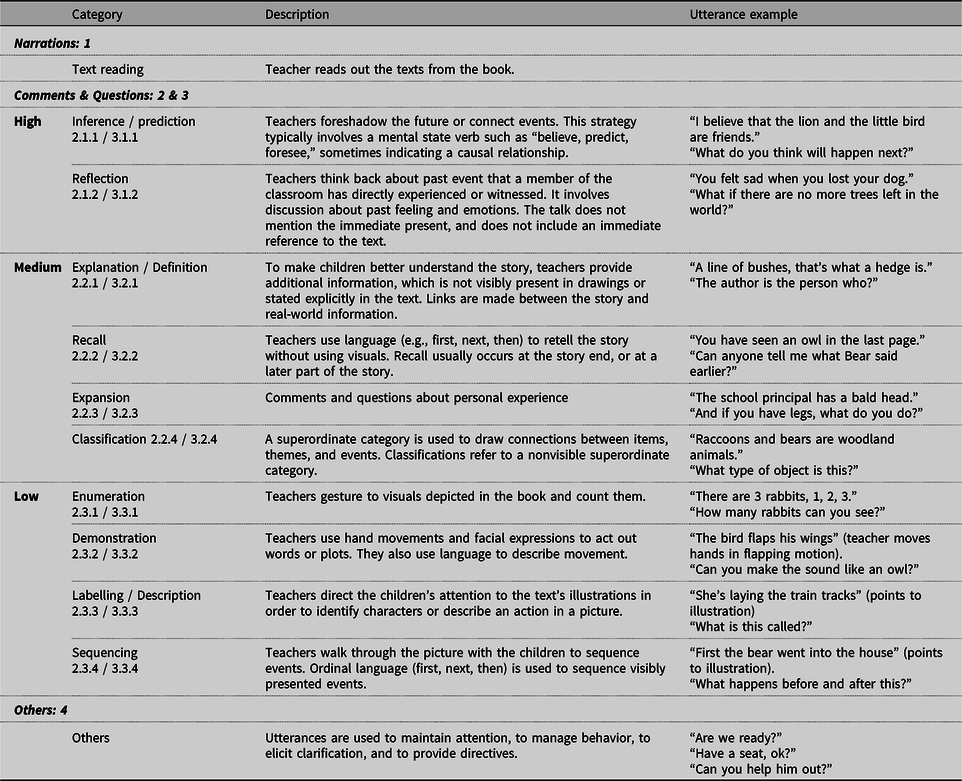
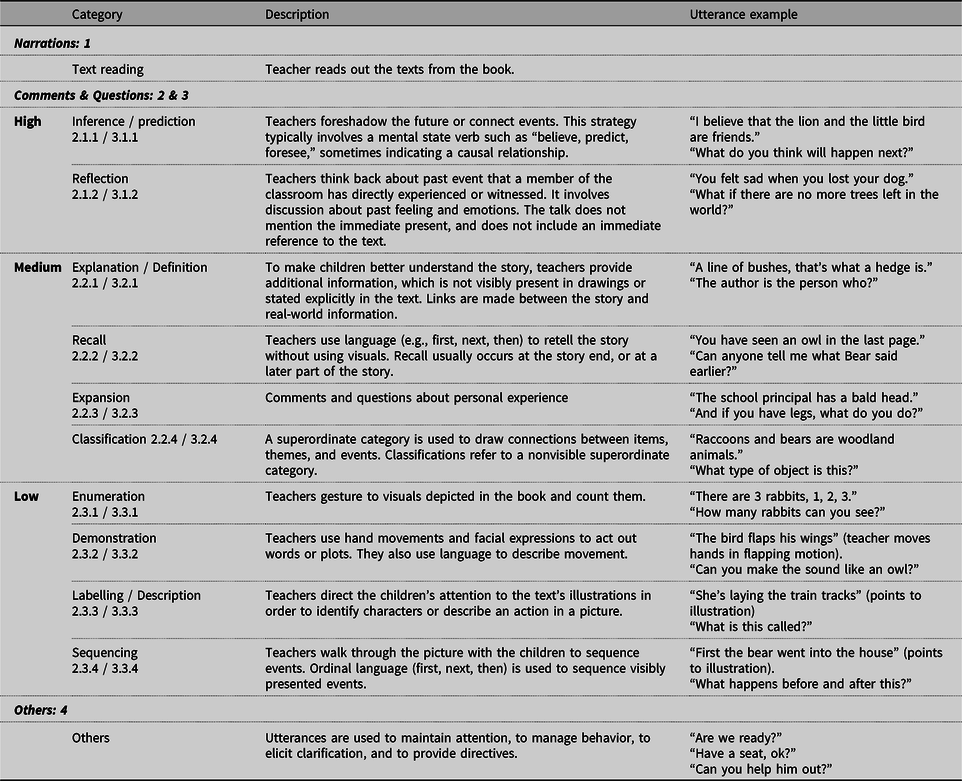
Teachers’ utterances were further coded for the occurrence of instructional strategies. All utterances fell under one of four categories: (a) reading aloud the text, (b) comments, (c) questions, and (d) other (e.g., management talk). In our analyses, we only took into account comments and questions, that is, how teachers used comments and questions to interact with the children during SBR, as only these are considered instructional strategies. Taken together, they were further coded for their level of cognitive load on the children: high, medium, or low, following the modified version of a cognitive distancing framework developed by Sigel (Reference Sigel1986) and the nuanced coding framework of teachers’ comments created by Barnes (Reference Barnes2013). Low-level instructional strategies refer to those comments or questions that made reference to objects visually presented in the story; medium-level strategies refer to comments and questions that extended the story, providing additional information that is not visible in the book; and high-level strategies refer to comments and questions that require abstract thinking and deep understanding from children (Table 1). A consensus was reached to choose the higher level instructional strategy when teachers used multiple instructional strategies in an utterance. Two rounds of 20-min video excerpts were arbitrarily selected for a reliability check, and the sample took approximately 11% of the total amount of videos (i.e., 353.54 min). The percentage of agreement between the raters were 92.9% at the transcription level and 89% at the coding level. The disagreement on the boundary of utterances was solved after the first author and the two RAs listened to multiple examples together. A consensus was reached about using intonation and pauses to define an utterance.
Coding scheme for teachers’ instructional strategies in SBR sessions
Results
Descriptive information
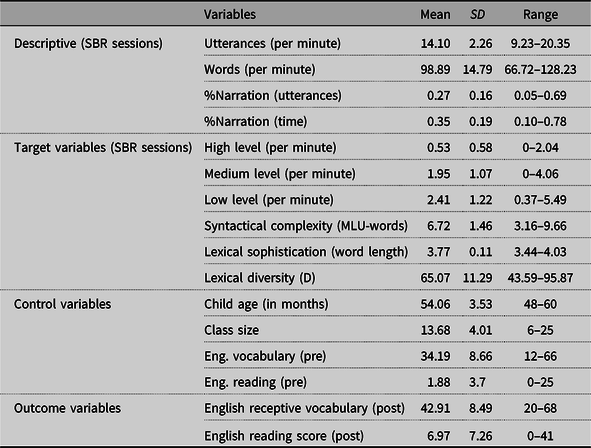
The descriptive statistics of the teachers’ instruction and other relevant variables are summarized in Table 2. As the length of a SBR session influences a teacher’s total production, we have calculated the teachers’ language use as use per minute. It was found that the teachers’ language practice varied substantially: some teachers produced as many as 20.35 utterances and 128.23 words per minute, while others only produced 9.23 utterances and 66.72 words in total, approximately half as many as the former group. Moreover, some teachers only spent 5% of the total utterances and 10% of the time on reading the text, while others spent 69% of the utterances and 78% of the time on this. The overall picture of teachers’ language practice thus shows quite some individual variation.
Raw scores of predictors and outcome variables
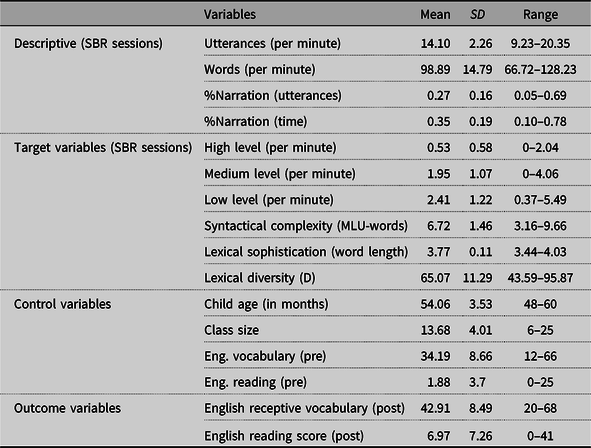
Note: %Narration (utterances) = the percentage of utterances for text reading out of the total number of utterances during the entire SBR session; %Narration (time) = the percentage of time distributed to text reading out of the whole SBR duration.
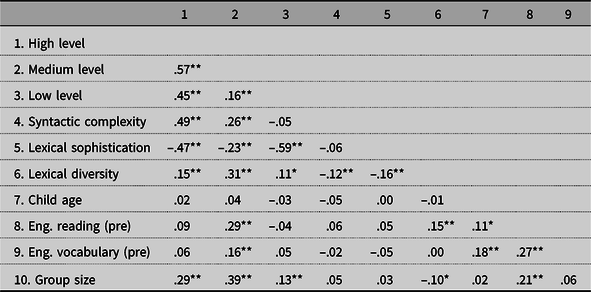
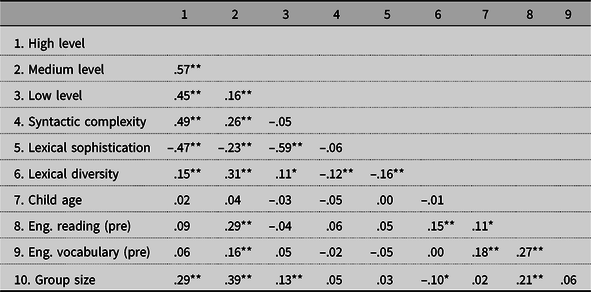
Regarding teachers’ specific instructional strategies and linguistic features, it was found that low cognitive load questions and comments have been used most frequently among the three levels of strategies (M = 2.41, SD = 1.22), followed by medium-level strategies (M = 1.95, SD = 1.07), and high-level strategies (M = 0.53, SD = 0.58). In line with the overall picture, the variation in using these strategies is considerable. In terms of language complexity, teachers used approximately 7 words in each utterance (SD = 1.46), and approximately four letters in each word on average (SD = 0.11). The mean of the D value, which indicates the teachers’ lexical diversity, was 65.07 (SD = 11.29), with substantial variation among teachers (range = 43.59–95.87). Children’s age and initial English scores were taken as control variables in the current study. Children were able to comprehend approximately 34 English words of the BLAB test (M = 34.19, SD = 8.66) and could read 2 English words (M = 1.88, SD = 3.70) at the beginning of the kindergarten year. The outcome variables are children’s two English tests scores measured 1 year after. Children’s receptive vocabulary size had increased to approximately 42 words (M = 42.19, SD = 8.49), and the number of words they could read increased to approximately 7 words (M = 6.97, SD = 7.26). Nonparametric Spearman correlations were computed to check the correlations between the predictors (i.e., target variables and control variables). It revealed that no two predictors were highly correlated (ρ ≥ .7); therefore, all the predictors were kept for the mixed effects modeling analysis (Table 3).
Correlation matrix for target variables and control variables: Spearman’s rho
Note: *p < .05. **p < .01.
Teachers’ SBR language practice and children’s word knowledge
A linear mixed-effects regression model (using the lme4 package in R; Bates, Maechler, Bolker, & Walker, Reference Bates, Maechler, Bolker and Walker2015) was used to explore which factors could significantly predict children’s vocabulary and reading scores on the posttest. Compared to traditional approaches such as analyses of variance, mixed-effects models are more robust for a data set with within-group variation, missing values, and an unbalanced design (Baayen, Reference Baayen2008). In the current study, we had to take into consideration kindergarten class as a random effect due to variations between classes, as children from the same class were taught by the same teacher. Besides, we have missing values in the language measures due to children’s absence or software issues. These two reasons made mixed models a better choice than traditional approaches. Two models were examined with children’s receptive vocabulary and word reading skill as outcome variable, respectively. In both models, children’s age and initial language score were taken as control variables, and teacher’s instructional strategies (high, medium, and low strategies) and linguistic features (i.e., lexical diversity, lexical sophistication, and syntactic complexity) were taken as target variables (Table 2).
Mixed-effects model for children’s English receptive vocabulary
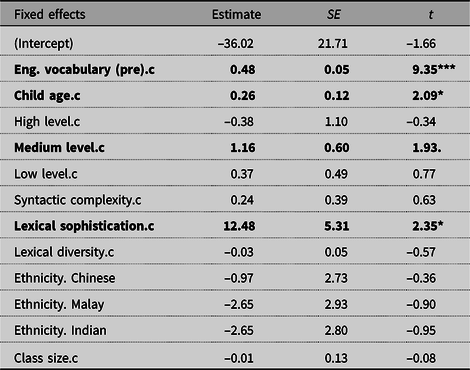
Table 4 demonstrates the model of English receptive vocabulary obtained from the mixed-effects model analysis. The whole model explained 38.6% of the variance in the children’s receptive vocabulary score 1 year after the children’s entry into kindergarten. The use of medium-level strategies was found to influence children’s receptive vocabulary score positively and nearly significantly (B = 1.16, p = .054). The same was found for teachers’ lexical sophistication in their unscripted talk: the longer words the teachers used in their utterances, the better the children’s post–receptive vocabulary scores were (B = 12.48, p = .02). Both control variables (i.e., children’s pre–receptive vocabulary score and chronological age) were found to be positively associated with children’s post–receptive vocabulary score.
Fixed-effects part of the mixed-effects model for post-receptive vocabulary
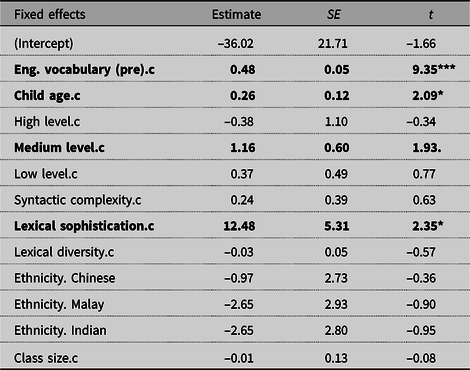
Note: “.c” refers to the particular variable has been centered; p < .1. *p < .05. ***p < .001.
Mixed-effects model for children’s English word reading skills
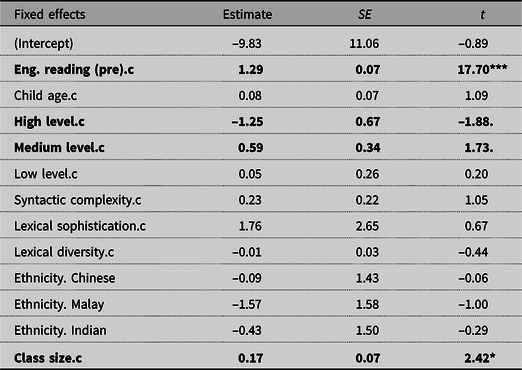
Table 5 demonstrates the model of English word reading skills in the posttest obtained from the mixed-effects model analysis. A total of 54.07% of the variance of children’s post–word reading skills was explained by the whole model. After controlling for children’s initial language score and chronological age, the use of instructional strategies with a medium level of cognitive load was found to facilitate children’s growth in word reading skills positively and nearly significantly (B = 0.59, p = .08), similar to what had been found in the vocabulary model. Nevertheless, the use of instructional strategies with a high level of cognitive load was found to negatively affect children’s growth in word reading skills (B = –1.25, p = .06). Regarding the control variables, children’s initial level of word reading skills was positively associated with their word reading skills 1 year later.
Fixed-effects part of the mixed-effects model for post–word reading performance
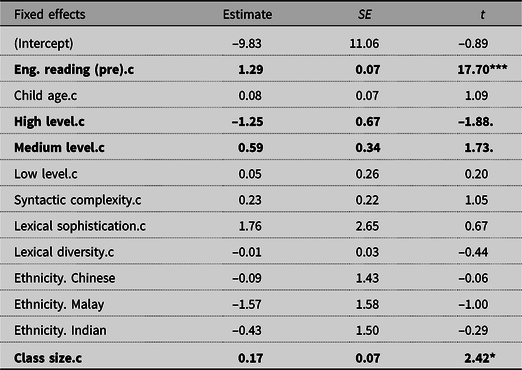
Note: “.c” refers to the particular variable has been centered; p < .1. *p < .05. ***p < .001.
Medium-level strategies, lexical sophistication, and teachers’ characteristics
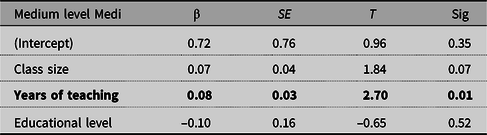
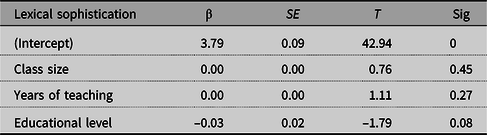
Multiple regressions have been used to explore the relationship between teachers’ characteristics (i.e., teaching experience and education) and the significant (i.e., lexical sophistication) and nearly significant (i.e., use of medium-level strategies) language features of the SBR sessions, while controlling for class size (Tables 6 and 7). Years of teaching experience was found to significantly predict the variation in the teachers’ use of medium-level strategies (β = 0.08, p = .01). The more years of teaching experience the teachers have, the more medium-level instructions they would use per minute. Regarding lexical sophistication, no teacher characteristics were found to be significantly related to it. Results of the regressions are summarized in Table 6 and Table 7.
Best predictors for teachers’ use of medium-level strategies in the multiple regression model
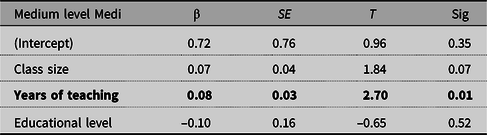
Note: R 2 = 26.5, F (3, 33) = 3.96, p = .02.
Best predictors for teachers’ lexical sophistication in the multiple regression model
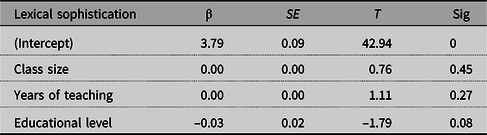
Note: R 2 = 13.43, F (3, 33) = 1.71, p = .18.
Discussion
The current study examined the variability, potential effectiveness, and predictors of teachers’ instructional strategies and linguistic features during SBR sessions. Previous studies have shown the relative benefits of this teaching activity. However, it remains unclear why children profit from the process (Barnes, Reference Barnes2013) and whether the effective components identified in the Western SBR contexts could be applied to the Eastern societies. Moreover, little is known about how teachers’ characteristics influence the effective components of their language practice. Examining the links between the teachers’ language practice and the children’s growth in receptive vocabulary and word reading skills, as well as the relationship between effective practice components and the teachers’ background allowed us to outline the mechanisms underlying teacher–child SBR interactions in promoting early language acquisition.
Variability in teachers’ instructional strategies and linguistic features
Similar to the Western contexts, there were clearly observable differences in teachers’ language practice during SBR: some teachers only spent 10% of the session to read the text, leaving sufficient time to give comments, raise questions, and conduct management talk, while some teachers used as much as 78% of the time to read out the story and produced little in terms of other types of talk. Specifically, some teachers used no comments at all and asked very few questions (0.32 per minute), and some used as many as 4.34 comments and 5.84 questions per minute over the entire SBR session. The quantity of the teachers’ use of high-, medium-, and low-level instructional strategies also varied considerably among teachers: some teachers used no medium-level strategies at all, while some others used 4 medium-level strategies per minute. In terms of teachers’ linguistic features, we have found some teachers used 3.16 words per utterance while some produced 9.66 words per utterance. Such diversity has also been found in teachers’ lexical sophistication and diversity. This variation in teachers’ language practice is in line with the findings of prior studies (Barnes, Reference Barnes2013; Connor, Morrison, & Slominski, Reference Connor, Morrison and Slominski2006; Dickinson et al., Reference Dickinson, Hofer, Barnes and Grifenhagen2014; Dickinson & McCabe, Reference Dickinson and McCabe2001). It is worth noting that despite the diversity, teachers in general used more low-level questions and comments than medium-level ones, and medium-level strategies are more frequently adopted than high-level ones. This may be because the more contextualized low- and medium-level instructional strategies would be easier to fit into the flow of ongoing academic instruction than more decontextualized high-level strategies (Gillam, Gillam, & Reece, Reference Gillam, Gillam and Reece2012). Future studies may interview the teacher to verify our hypothesis on the teachers’ greater use of low-level instructional strategies.
Medium-level strategy, lexical sophistication, and children’s word knowledge
Teachers’ variation in language quality played a crucial role in children’s development of vocabulary size and word reading skills. After controlling for initial language proficiency and chronological age, we found a strong tendency for preschoolers to benefit from more medium-level comments and questions in the teachers’ talk after 1 year of kindergarten education. This finding confirms what has been found by Barnes (Reference Barnes2013) and other researchers (Dickinson et al., Reference Dickinson2011; Gerde & Powell, Reference Gerde and Powell2009) that medium-level comments and questions seem to promote 4- to 5-year-old children’s receptive vocabulary development. The current study extended the beneficial domains from receptive vocabulary size to word reading skills. The consistent findings suggested that medium-level strategies like word elaboration, story recall, text to world connection, and category establishment can promote children’s language development in these respects. With each additional occurrence of these medium-level comments and questions per minute, children could obtain 1.16 more points in word comprehension and 0.59 more points in word reading. These strategies are of an intermediate level regarding the immediacy of the content and abstract notions that related to the story. The medium-level comments and questions are able to scaffold children’s understanding by pushing them to think, to reflect, and to make explicit connections with the here and now of the book reading experience. Such questions and comments seem to fit the bilingual 4- to 5-year-old’s English language proficiency in Singapore, promoting children’s receptive vocabulary and word reading development. These direct, explicit, and elaborated instructions might be able to link the text with the children’s personal life, deepen the children’s conceptual knowledge, and story comprehension, and gradually promote their word knowledge (Justice et al., Reference Justice, Meier and Walpole2005). In contrast, the low-level strategies (e.g., labeling and counting) may not be meaningful or engaging enough for the participants (Hindman, Connor, Jewkes, & Morrison, Reference Hindman, Connor, Jewkes and Morrison2008), thus demonstrated little impact on children’s early word learning. The high-level strategies (e.g., inference and predicting), however, might be too challenging for these 4- to 5-year-old English language learners (Barnes, Reference Barnes2013). Our results show that a more frequent use of the high-level strategies tended to negatively affect children’s word reading, probably due to their emergent English language proficiency.
As for the linguistic features of teachers’ language practice, lexical sophistication was also found to be significantly related to children’s receptive vocabulary, in line with previous studies (Dickinson & Porche, Reference Dickinson and Porche2011; Weizman & Snow, Reference Weizman and Snow2001). In the current study, after controlling for children’s initial vocabulary score and chronological age, whenever a teacher’s average word length increased with one more letter, children would correspondingly get to know 12.48 more words after 1 year. A more sophisticated vocabulary would allow teachers to deliver deeper knowledge both in breadth and in depth (Barnes, Reference Barnes2013). This linkage between early exposure to sophisticated vocabulary and children’s language development has been stated before. According to a corpus study on mother–child conversations (Weizman & Snow, Reference Weizman and Snow2001), the lexicon used in 99% of the maternal input belonged to the 3,000 most frequent words and only the remaining 1% constituted sophisticated words. However, this 1% of sophisticated words could predict children’s vocabulary performance in both kindergarten and second grade at primary school.
To sum up, the current study found that for 4- to 5-year-old Singapore kindergarteners, medium-level strategies and sophisticated words might be beneficial to their word learning. Utterances at this level might be linguistically appropriate and cognitively challenging, being neither too hard nor too easy. Our findings, similar to those in the Western context, revealed a significant variation in teachers’ questioning and commenting strategies, and in linguistic complexity in this teacher-dominant and exam-driven educational context. These variations (i.e., medium cognitive load questions and comments, and lexical sophistication) demonstrated a similar impact on children’s early language learning across continents, probably because of the matching cognitive status and language proficiency between the samples. Both participants in the current study and those in the major citations (e.g., Barnes, Reference Barnes2013) are at the preschool age; therefore, they are comparable in terms of cognitive maturation and language proficiency (Hudspeth & Pribram, Reference Hudspeth and Pribram1990). Cognitively, 4- to 5-year-old children fall into a particular range of performance in executive functions, nonverbal intelligence, and other cognitive aspects at the group level. Linguistically, both the current study and the cited studies in the Western context focused on Germanic languages (English in most cases); therefore, language per se would not affect the effectiveness of the instructional strategy. It is worth noting that, most of cited studies in the current paper focused on monolingual children, while in the current study, the participants were bilingual children. Despite the differences, as English is the societal dominant language and widely used at home (Sun, Yin, et al., Reference Sun, Yin, Amsah and O’Brien2018), our participants may have comparable English proficiency to their monolingual peers in the West. Such similar cognitive status and proficiency level might explain the coherent findings on teachers’ effective language strategies in SBR.
Teachers’ characteristics and the use of medium-level strategy and lexical sophistication
Which teachers have used more medium-level strategies and sophisticated vocabulary? Our exploratory study revealed that those teachers with more teaching experience tended to use more medium-level strategies, which in turn were associated with higher linguistic gains of the children in our sample. However, other previous studies presented mixed correlational relationships between teaching experience and children’s achievement (Goe & Stickler, Reference Goe and Stickler2008; Haider & Hussain, Reference Haider and Hussain2014), and this inconsistency may be due to different career stages that a specific group of teachers belongs to. According to Ferguson (Reference Ferguson1991), a teacher’s contribution to children’s learning increases incrementally over the first 5 years of teaching practice, and afterward, the contribution appeared to stay at that level. “The initial years’ effect” has been also captured by a series of other studies (e.g., Rockoff, Reference Rockoff2004). Early in their careers, teachers may show greater motivation and more improvement when learning the craft of teaching by practice. Gradually, they might make a different kind of effort once they have a stable professional environment (e.g., tenure positions). In a close examination of our data, we could find that 75.7% of our teachers had 6 years of teaching experience or less. This may be the reason why we were able to detect a positive correlation between the teachers’ experience and the use of medium-level strategies in our sample. A larger and more diversified sample in teaching years is needed to examine our speculation.
Limitations
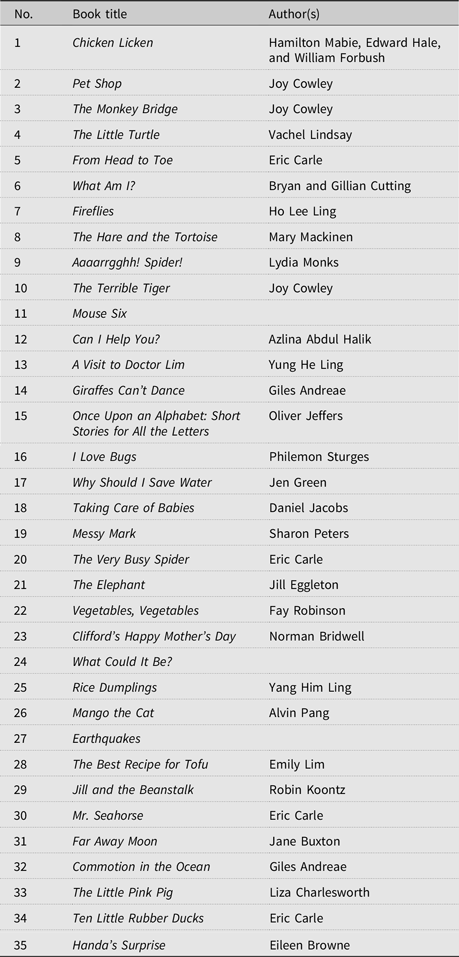
The current study has several limitations. First, no causal relationship could be derived from the data due to their correlational nature. Only natural speech that occurred during SBR sessions was analyzed, and no control conditions were set up with which these data could be compared. Second, each teacher’s language practices were only recorded once, and only a limited portion of the full recording was transcribed, so our data may not holistically reflect teachers’ language behaviors. Teachers may shift their language practice over repeated readings of the same story, and they may also make adjustments to their teaching strategies over a year. A future study might adopt an approach with multiple observations of a teacher’s repeated reading with regular visits over a school year. Their reading frequency should be explicitly documented and taken as a covariate for children’s language outcome. Third, the current study observed an uneven distribution of using high-, medium-, and low-level questions and comments. However, due to a lack of knowledge about the teachers’ rationales for their use of instructional strategies, we could not interpret that variation in a well-grounded manner. The preference for low-level over medium- and high-level strategies might indicate their particular perspective on appropriate pedagogy and the aims of children’s early language learning. Unveiling such assumptions might facilitate our interpretations of their language behaviors and promote the design of professional development materials. Fourth, we have limited our focus to narrative book reading in a large group setting and we were unable to control the specific books teachers chose to read to the class, due to the “no intrusion” agreement we made with the observed classes (Appendix A). Teachers’ language practices and children’s responses (Eleni & Meadows, Reference Eleni and Meadows2005a) may vary in complexity, demand (Eleni & Meadows, Reference Eleni and Meadows2005b), and strategies due to different texts. According to some studies, the discourse surrounding informational book reading is greater in quantity, contains more cognitively demanding questions (high-level strategies), more conditional clauses, and more interactions involving reasoning (Christenson, Reference Christenson2016) and technical terminology such as mathematical talk (Hojnoski, Polignano, & Columba, Reference Hojnoski, Polignano and Columba2015), compared to narrative book reading, which resulted in increased child participation (Pellegrini, Perlmutter, Galda, & Brody, Reference Pellegrini, Perlmutter, Galda and Brody1990; Price, van Kleeck, & Huberty, Reference Price, van Kleeck and Huberty2009; Torr & Clugston, Reference Torr and Clugston1999). However, there are also different findings. For instance, Robertson and Reese (Reference Robertson and Reese2017) found that the relationship between adults’ strategy levels and children’s language and literacy remains the same regardless of whether the book is narrative or expository. Future studies might consider including more types of books with a tighter control of books used to complete the picture. Furthermore, the current study only involved 37 teachers, and a larger sample with more diverse backgrounds (e.g., teaching experience) might be adopted in future studies, in order to better address questions on the relations between effective teaching components and teachers’ profiles. Fifth and finally, the current study has only tested children’s receptive vocabulary and word reading skills. A future study might employ a multidimensional approach to assess children’s language and reading skills, including children’s syntax and storytelling, and comprehensively examine the impact of the teachers’ language behavior in SBR on the children’s early language and literacy development.
Conclusions and implications
Despite its limitations, the current study confirmed the observations by previous studies about variation in teachers’ language during SBR and pinpointed the effective components in teachers’ language practices in the Singaporean context. It highlights the importance of medium-level strategies and lexical sophistication for 4- to 5-year-old Singaporean children’s early English reading and vocabulary development, and extended the insights obtained from Western contexts (mainly in the United States) to an Asian bilingual setting. More important, it expanded our knowledge about the impact of the teachers’ characteristics on these significant predictors of children’s language growth, enabling us to trace them back to the teachers’ experience and education, and it identified the crucial role that teaching experience plays in the characteristics of teacher talk for teachers at the early stages of their careers.
Methodological implications
Previous studies have emphasized the value of using appropriate instructional strategies (i.e., high/medium/low cognitive load questions and comments) and linguistic features (i.e., lexical diversity, lexical and syntactic complexity); however, to date none have investigated these features of teachers’ SBR talk holistically in one model. To the best of our knowledge, the current study is the first that explores teachers’ language in SBR in such a comprehensive and detailed manner in the preschool context. Although each instructional strategy and linguistic feature might make a distinctive contribution to children’s word learning, these strategies and features are not used isolated in class. Teachers should consider how these fine-grained characteristics of utterances would work cohesively for better children’s vocabulary development.
Pedagogical implications
Pedagogically, by imbedding our study in an Asian bilingual context, our study invites the readers to reflect whether findings from Western countries could be directly introduced to another context where culture and the pedagogical traditions are substantially different from the West. In spite of this, our study has confirmed what has been found in the English-speaking countries, and we have addressed the potential reasons for such coherence between the contexts. If the language or children’s age is different, the findings based on the Western countries might be difficult to be directly translated to the East. In general, our results indicate that there is a need to correlate a teacher’s language use, which is guided by the distancing hypothesis, to target children’s zone of proximal development to challenge and develop their literacy and language learning. Before adapting the theory to practice in the Asian context, there might be a need to shift the classroom discourse from a more rigid and teacherdominant approach to another that is more flexible to engage and foster children’s participation in high-quality teacher–child interactions (Downer, Sabol, & Hamre, Reference Downer, Sabol and Hamre2010). This change can be done in two ways. First, professional development courses can train teachers to develop a more co-constructive, reciprocal/responsive, and equal power relationship between teachers and children in the classroom to foster quality talk and open discussions with extended turns. Second, there is a need to shift away from a result-oriented culture in schools to a more authentic, process-oriented (Cabell, DeCoster, LoCasale-Crouch, Hamre, & Pianta, Reference Cabell, DeCoster, LoCasale-Crouch, Hamre and Pianta2013) and holistic learning experience that considers and aligns with children’s interests and out-of-school literacy for lifelong learning (Koh, Tan, & Ng, Reference Koh, Tan and Ng2012; Tzuo, Reference Tzuo2010). In summary, there is a need to consider the issue of cultural appropriateness (Li, Rao, & Tse, Reference Li, Rao and Tse2012) when adapting Western pedagogical teaching approaches to other contexts.
Acknowledgments
This study was funded by Singapore Ministry of Education (MOE) under the Education Research Funding Programmes (SUG 02/16 SH) and administered by the National Institute of Education (NIE), Nanyang Technological University, Singapore. Any opinions, findings, and conclusions, or recommendations expressed in this material are those of the author(s) and do not necessarily reflect the views of the Singapore MOE and the NIE.
Appendix A
Books used in the SBR sessions in the current study