The Human Immunodeficiency Virus (HIV)/ Acquired Immune Deficiency Syndrome (AIDS) and Sexually Transmitted Infections (STIs) are a major threat for humanity in the world, especially in developing countries. Millions of people in the world are suffering with HIV/AIDS and other STIs. According to UNAIDS (Reference Trani, Gnisci, Nobile and Angelillo2011), there are 34 million people living with HIV at present and an estimated 2.7 million people were infected in 2010, 42% of new HIV infections worldwide occurring in the 15–24 year old cohort.
The estimate of UNAIDS (AIDS epidemic update, UNAIDS, Reference Sekirime, Tamale, Lule and Wabwire-Mangen2009) points to about 42,000 infected people in Portugal (about 0.4% of the Portuguese population). Since the first HIV case was detected in Portugal, in 1983, HIV/AIDS has emerged as an important health problem. According to the latest Portuguese report from the national monitoring center of sexually transmitted diseases, 2010 statistics confirm the epidemiological pattern recorded annually since 2000, that is, there is a proportional increase in the number of cases of heterosexual transmission as well as in the 20–49 year old cohort (CVEDT, 2011). Particularly alarming is the fact that the HIV infection rate and AIDS cases are showing a rapid increase among young people.
According to WHO’s recommendations (UNAIDS, Reference Sekirime, Tamale, Lule and Wabwire-Mangen2009), in the absence of a cure for HIV/AIDS, its prevention depends on the adoption and maintenance of safe behaviors, noting that the educational strategies that modify or eliminate risk behavior remain the major interventions to prevent and control the spread of this pandemy. It is crucial that young people realize that their sexuality can be experienced in a healthy and happy way, and that to protect from HIV/AIDS, they have to use condoms in insertive sex practices always (for it is the most effective way of protection against HIV/AIDS) (Reis, Ramiro, Matos, Diniz, & Simões, Reference Petro-Nustas2011).
According to literature, possessing correct knowledge and positive attitudes in relation to sexuality or contraception is enough to ensure that young people may change their attitudes and their behaviors and therefore start using condoms to protect from HIV/AIDS (Ganczak et al., Reference Fisher and Fisher2007; Reis & Matos, Reference Nwezeh2007). As such, it is necessary to educate young people before they are faced with making decisions about their sexuality and sexual behavior, which involves not only working on the acquisition of information but also attitudes , motivation and behavioral skills (Nwezeh, Reference Li, Lin, Gao, Stanton, Fang, Yin and Wu2010; Reis et al., Reference Petro-Nustas2011; Sekirime, Tamale, Lule, & Wabwire-Mangen, Reference Sales, Milhausen and Diclemente2001).
Second, based on the behavioral theory - the model of information-motivation behavioral skills (IMB) - to improve a safer sexual behavior, the first goal must be to improve knowledge, and then foster motivation as well as behavioral skills. According to the model’s authors (Fisher & Fisher, 1992), motivation includes attitudes, behavioral intentions and subjective norms (perceived social support to perform safe sexual behaviors).
There are plenty of studies about knowledge, attitudes and risk behaviors related to HIV/AIDS in young people. Reis et al. (Reference Petro-Nustas2011) conducted a study in Portugal in which 7093 young people participated. They assessed sexual behaviors, knowledge of preventive sexual behavior in Portuguese adolescents, including knowledge and attitudes towards HIV/AIDS, and whether these changed from 2002 to 2006. This study revealed that, overall there was an increase in the age of first sexual intercourse and a decrease in the number of teenagers who reported having had sexual intercourse. As for knowledge about how to protect themselves from becoming infected, there was a reduction of knowledge and an increase in the doubts regarding HIV/AIDS.
Another survey on sexual risk behavior, knowledge and attitudes about contraception and STIs among university students in Portugal showed that men reported more risk behaviors (e.g. casual partners and alcohol and drug use) than women. As for knowledge of contraception and STIs, women demonstrated better knowledge and more preventive attitudes to risk-taking, while men demonstrated bigger risk acceptance (Reis & Matos, Reference Nwezeh2007; Reis, Ramiro, & Matos, Reference Reis and Matos2009).
Similar findings were also reported in other countries. Trani, Gnisci, Nobile, and Angelillo (Reference Schierhourt, Johnson, Dzokoto and Bosu2005) completed a study on knowledge and behavior regarding STIs in Italian adolescents and concluded that only 14.2% of respondents knew about the main STIs. James, Reddy, Taylor, and Jinabhai (Reference Hardy2004) carried out a study with South African adolescents about knowledge regarding HIV/ AIDS/ STI in which 1113 young people participated. The study revealed that the participants’ knowledge was high for causes and ways of transmission of STIs.
Another study, which was performed by Sekirime et al.(2001) in Uganda, revealed knowledge on methods of prevention about STIs was high (> 90%) and that males were three times more likely to contract STIs than females. Wagbatsoma and Okojie’s (2006) survey findings revealed that Nigerian students were aware of AIDS, but had poor knowledge of its etiology and that many young people are poorly informed about sexual issues, reproductive biology and health.
University environment offers great opportunity for HIV high-risk behaviors, mostly due to unsafe sex practices ( Lewis, Miguez-Burbano, & Malow, Reference Labrie, Earleywine, Schiffman, Pedersen and Marriot2009), such as the frequency of occasional partners and inconsistently condom use (Lewis, Malow, & Ireland, Reference Lansky, Sullivan, Gallagher and Fleming1997; Reis, Ramiro, & Matos, Reference Reis and Matos2009).
Ganczak et al., (Reference Fisher and Fisher2007) have noted that universities offer ideal conditions for the spread of HIV. Today, there are several predisposing factors which may engender risky behavior on universities. These factors include: a large number of young students entering university within the age cohort (20–49 years) which is regarded as the most prone to infection with the virus, occasional sexual partners, excessive alcohol consumption and drug abuse. Young sexually active students are a population that is potentially at risk for getting infected with HIV due to their sexual and alcohol/drug activities. The association between sex and drugs, negative peer pressure, economic frustration and family problems leads to behaviors which could cause HIV infection (Labrie, Earleywine, Schiffman, Pedersen, & Marriot, Reference James, Reddy, Taylor and Jinabhai2005).
The studies by Ganczak et al., (Reference Fisher and Fisher2007) and Schierhourt, Johnson, Dzokoto, and Bosu (Reference Robison2003) have shown that although university students are considered a strategic group for HIV-prevention interventions, information on their risk behavior is limited.
Jemmott and Jemmott (Reference Hosmer and Lemeshow1991) found that only 20% of sexually active unmarried African American undergraduates used condoms always. As for African American women, who constitute the population with highest rate of new infections, they are likely to be infected while in university (Ferguson, Quinn, Eng, & Sandelowski, 2006).
The above shows that if the University is to continue its mission of developing world-class human resource to meet the socio-economic needs of the country, then it behooves the leadership of the University to ensure that the young male and female students who seek it are equipped with the requisite skills to be able to protect themselves from being infected with the virus. This means that the University need not focus only on its core competence of teaching, research and knowledge dissemination, but should be able to put in place an effective educational program on HIV/ AIDS prevention. Therefore, for the University to develop this educational program, the authorities need to understand perceptions, attitudes, and knowledge of students through behavioral surveillance studies.
Behavioral surveillance surveys consist of repeated cross-sectional surveys conducted systematically to monitor changes in HIV/STI risk behaviors. Besides monitoring, it is also an evaluation tool designed to track trends in HIV and AIDS-related knowledge, attitudes and behaviors in subpopulations that may be prone to infection (CVEDT, 2011; Lansky, Sullivan, Gallagher, & Fleming, Reference Jemmott and Jemmott2007; , UNAIDS, Reference Sekirime, Tamale, Lule and Wabwire-Mangen2009, Reference Trani, Gnisci, Nobile and Angelillo2011).
The goals of this research were to: (a) analyze differences between genders to knowledge, attitudes, and risk behaviors about HIV/AIDS among university students; and (b) evaluate the association between inconsistent condom use and knowledge, attitudes and risk behaviors about HIV/AIDS in Portuguese university students.
Method
Sample
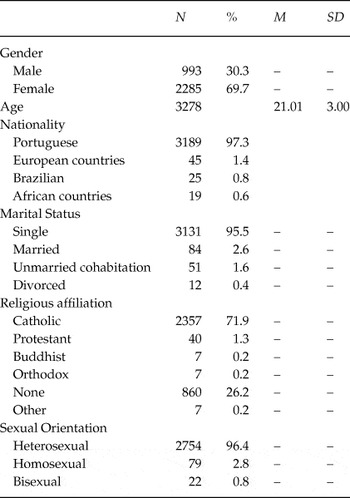
The sample is constituted by 3278 randomly chosen Portuguese university students, between 18 and 35 years old. It provides national representative data from those attending university during the academic year of 2009/2010. Data were collected through a self-administered questionnaire. The sample included 69.7% women and 30.3% men (this percentage is consistent with the gender distribution in the Portuguese university population: DGES/MCTES, 2011). The mean age was 21 years old (standard deviation 3). The majority of students has Portuguese nationality (97.3%), is single (95.5%), catholic (71.9%) and heterosexual (96.4%). The sample was stratified by region (North, Center, Lisbon and Tagus Valley, Alentejo and the Algarve).
Socio demographic characteristics of Portuguese university students in 2010

Procedure
The national survey “Sexual and Reproductive Health in University Students” (SRHUS) – is an extension of the Health Behavior in School-aged Children (HBSC) study for university students. The HBSC study is a collaborative WHO research, undertaken in 43 countries with the aim to study school-aged behavior regarding health and risk behaviors in adolescence. Portugal is part of this group of countries since 1996 (Currie, Samdal, Boyce, & Smith, Reference Currie, Samdal, Boyce and Smith2001).
This cross-sectional study was carried between March and June 2010 with an evaluation protocol that was administered to university students. The 19 universities in the sample were randomly selected from 144 the official national list of universities. The sample was stratified by region: five universities in the North, four in the Centre, five in Lisbon and Tagus Valley, two in Alentejo and three in the Algarve. We established previous contact with the selected universities in order to have authorization for our research. The sampling unit used in these surveys was the class. In each university, classes were randomly selected in order to meet the required number of students for each grade in a total of 124 classes. After having received authorization, we solicited voluntary participants to fill out the questionnaires and explained the study’s aim. There were no refusals. In order to protect participants and their anonymity, no information regarding identity was put on the questionnaires. Participants were sitting in individual desks, at a reasonable distance from other participants, thus guaranteeing confidentiality.
This study had the approval of a scientific committee, the National Ethics Committee and the National Commission for Data Protection and followed strictly all the guidelines for human rights protection.
In the questionnaire, which covers a wide range of questions about sexuality and sexual behaviors, issues that relate to socio-demographic characteristics, sexual behavior, HIV/AIDS – related knowledge, attitudes towards people living with HIV/AIDS and risk behavior were selected.
This nationwide survey was conducted for the Portuguese Ministério da Saúde and for the National Coordination for HIV/AIDS Infection to assess HIV/AIDS-related knowledge, attitudes, and practices among the university population group aged 18–35 years. The purpose of this survey was to determine the prevalence of behaviors that put students at risk of HIV infection, disseminate the findings of the research, translating them into an advocacy tool to mainstream HIV/AIDS prevention programs and mobilize the leadership of the university to play a catalytic role in the fight against the disease and lay down a baseline measurement.
Measures
For the purpose of this study, the following questions / scales were used:
Sexual behavior was assessed through the following behaviors - three questions about first sexual intercourse: age, use of contraceptive method (Yes/No) and which contraceptive method was used; and one question about the contraceptive method usually used.
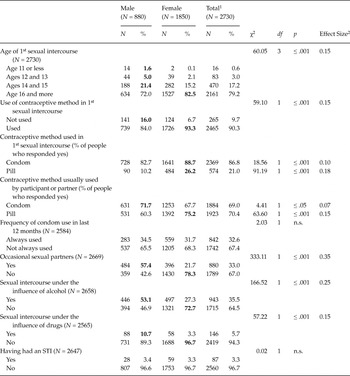
Sexual risk behavior was measured through five behaviors - consistent condom use, occasional partners, having had a sexually transmitted infection and having had sexual intercourse with alcohol and drugs. Consistency of condom use was assessed by the question: “During the past 12 months, did you or your partner use a condom?” Always was scored “0”, any other answer was scored “1” (risky sexual behavior). Regarding the other behaviors, answer option no was scored “0” and yes “1” (risky sexual behavior) (see table 2).
Differences between gender and sexual behavior and risky sexual behavior for the entire sample that mentioned already having had sexual intercourse of the Portuguese university students in 2010 (n = 2730)

1 The total numbers differ considering that some young people have not replied to some parameters.
n.s. = not significant
2 Effect size calculated by Cramer’s V method (Rea & Parker, 1992).
In bold – values that correspond to an adjusted residual ≥ │1.9│
Knowledge regarding HIV/AIDS transmission/prevention
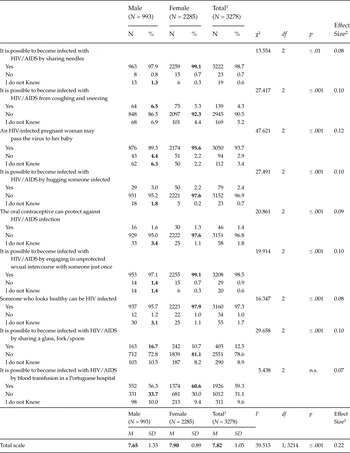
Young people were asked to respond to nine statements about HIV/AIDS transmission/prevention: 1. it is possible to become infected with HIV/AIDS by sharing needles; 2. it is possible to become infected with HIV/Aids from coughing and sneezing; 3. an HIV infected pregnant woman may pass the virus to her baby; 4. it is possible to become infected with HIV/AIDS by hugging someone infected; 5. the oral contraceptive can protect against HIV/AIDS infection; 6. it is possible to become infected with HIV/AIDS by engaging in unprotected sexual intercourse with someone just once; 7. someone who looks healthy can be HIV infected; 8. it is possible to become infected with HIV/AIDS by sharing a glass, fork/spoon; 9. it is possible to become infected with HIV/AIDS by blood transfusion in a Portuguese hospital. Items were rated on a three response options (1 = Yes, 2 = No and 3 = I do not know). Only responses that showed correct information scored and so final scores ranged from 0 to 9, with high scores suggesting more positive knowledge/more information. For this measure, Cronbach’s alpha was .77 (see table 3).
Differences between gender and knowledge regarding HIV/AIDS transmission/prevention of the Portuguese university students in 2010 (N = 3278)

1 The total numbers differ considering that some young people have not replied to some parameters.
2 Effect size calculated by Cramer’s V method (Rea & Parker, 1992).
3 Effect size calculated by Cohen’s d method (Cohen, 1988).
n.s. = not significant / In bold – values that correspond to an adjusted residual ≥ │1.9│
Attitudes towards HIV/AIDS - infected people
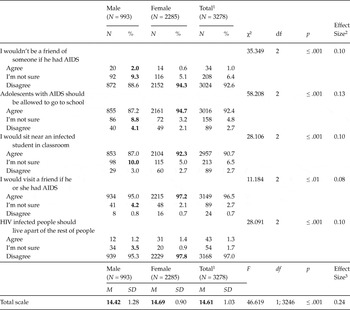
Young people were asked to respond to five statements about attitudes towards HIV-infected people: 1. I wouldn’t be a friend of someone if he had AIDS, 2. Adolescents with AIDS should be allowed to go to school, 3. I would sit near an infected student in classroom, 4. I would visit a friend if he or she had AIDS and 5. HIV infected people should live apart of the rest of people. Items were rated on a 3-point rating scale (1 = disagree to 3 = agree). After recoding items 1 and 5, final scores ranged from 5 to 15, with high scores suggesting more positive attitudes. This scale has an acceptable level of internal consistency (α.= .81) (see table 4).
Differences between gender and attitudes towards HIV- infected people of the Portuguese university students in 2010 (N = 3278)

1 The total numbers differ considering that some young people have not replied to some parameters.
2 Effect size calculated by Cramer’s V method (Rea & Parker, 1992).
3 Effect size calculated by Cohen’s d method (Cohen, 1988).
In bold – values that correspond to an adjusted residual ≥ │1.9│
Data analysis
The data were analyzed using the Statistical Package for Social Sciences (SPSS) version 19 for Windows. Descriptive statistics including frequencies, means and standard deviations were performed to give general descriptions of the data. ANOVA was performed to examine differences in knowledge scores and attitudes scores. The level for statistical significance was set at p < .05. Only significant results were discussed. HIV risk behaviors were compared between the genders using the Chi-square (χ2) tests and adjusted residuals. Effect sizes were calculated according to Cohen’s d-method (1988, p.53) for means and Cramer’s V method for variables with more than two levels (Rea & Parker, 1992, p.203). The associations between several independent variables (age, gender, knowledge and attitudes HIV/AIDS, occasional partners, use of alcohol and drugs, have had STI) and the dependent variables (frequency of condom during sexual intercourse in the last 12 months) were ascertained using multivariate logistic regression analysis. Odds ratios (ORs) and 95% confidence intervals (CIs) were calculated for all independent variables.
Results
Differences between gender and sexual behavior and risky sexual behavior for the entire sample that mentioned already having had sexual intercourse
From the total sample, 2730 young people had already begun their sexual life. Of these, 79.2% referred that they had had their first sexual intercourse at the age of 16 or later and 90.3% had used contraception in their first sexual intercourse, namely the condom (86.8%). The results showed that, although both the majority of men (72%) and women (82.5%) had their first sexual intercourse at the age of 16 or later, men more often claim to have started younger (at 11 or less, between 12 and 13, and between 14 and 15) (p ≤ .001). As for the use or not of a contraceptive method at first sexual intercourse, men (84%) and women (93.3%) used it, but men (16%) more often than women (6.7%) did not (p ≤ .001). Regarding the choice of the contraceptive method at first intercourse, women (88.7%; 26.2%) more often than men (82.7%; 10.2%) report having chosen condoms (p ≤ .001) and the pill (p ≤ .001).
As for usual contraceptive methods, it was also observed that the contraceptive pill (70.4%) and the condom (69%) are the most reported. Significant variation was obtained between genders in relation to both the contraceptive pill and condom (p ≤ .001; p = .036, respectively): women (75.2%) refer using the contraceptive pill usually more often than men (60.3%), while men refer the condom (71.7%) more often than women (67.7%).
Concerning risk sexual behaviors, the results showed men have them more frequently than women. The majority of men have occasional sexual partners (57.4%) and sexual intercourse under the effect of alcohol (53.1%) (p ≤ .001). Though the rates of sexual intercourse under the effect of drugs aren’t as expressive (10.7%) (p ≤ .001) as the other risky sexual behaviors mentioned previously, they still represent a major concern in men’s sexual behaviors (see table 2).
Differences between gender and knowledge regarding HIV/AIDS transmission/prevention
Knowledge regarding HIV/AIDS transmission/prevention: the distribution of each item is shown in Table 3. The majority shows a high level of knowledge. Nevertheless, two items were singled out by the percentage of students who reported not knowing the answer: one concerns the likelihood of being infected with HIV/ AIDS by using silverware and the other on the possibility of getting infected with a blood transfusion in a Portuguese hospital. The mean total score in relation to knowledge about HIV/AIDS was 7.82 (SD = 1.05), with males showing significantly less knowledge (M = 7.65, SD = 1.33) than females [(M = 7.90, SD = .89 (F(1, 3214) = 39.515, p ≤ .001)].
Differences between gender and attitudes towards HIV- infected people
Attitudes towards HIV-infected people: the distribution of each item is shown in Table 4. The majority expressed an attitude of acceptance, since the response rate is above 90% for all claims. The mean total score in relation to attitudes towards HIV-infected people was 14.61 (SD = 1.03), with males showing significantly less positive attitudes (M = 14.42, SD = 1.28) than females [(M = 14.69, SD = .90 (F(1, 3246) = 46.619, p ≤ .001)].
Factors associated with inconsistent condom use
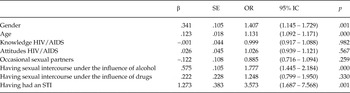
Using a multivariate logistic regression we obtained an adjusted model (Hosmer and Lemeshow χ² = 4,936 (8) p = 764) and the regression equation explained 7% of the variance (Nagelkerke R2 = .068) and 67.3% of cases that showed inconsistent condom use. In this model, the condition of «inconsistent condom use » is explained by the variables gender (men with a 1.4 times greater likelihood of being in this group) [OR 1.41; 95% CI 1.15–1.73; p = .001], age (older university students, with a probability 1.1 times higher to be in this group) [OR 1.13; 95% CI 1.09–1.17; p ≤ .001], having sexual intercourse under the influence of alcohol (who reported having had sexual intercourse under the influence of alcohol with a 1.77 times greater likelihood of being in this group) [OR 1.77; 95% CI 1.45–2.18; p ≤ .001], and having an STI (who reported having had an STI, with a probability 3.6 times higher to be in this group) [OR 3.57; 95% CI 1.69–7.57; p = .001].
Although significant variables in the model only explain 7%, and the association is not very strong to determine the dependent variable (inconsistent condom use), this may be due to influential factors that are not evaluated in this research.
Factors associated with inconsistent condom use of the Portuguese university students in 2010 (N = 2730)

OR: Adjusted odds ratios for all other variables in the table; CI: confidence interval.
Discussion
Findings provided baseline data on knowledge, attitudes, and risk behaviors about HIV/AIDS among university students.
The level of general HIV/AIDS knowledge among young adults was high, as indicated by a total mean score of general HIV/AIDS knowledge of 7.82 out of 9 points. The findings indicated that a majority of the respondents were aware of HIV/AIDS. However, there is a need for improvement as a considerable percentage incorrectly believed it is possible to become infected with HIV/AIDS by blood transfusion in a Portuguese hospital (there aren’t any cases identified since 1996). The data in this study revealed a significant gender difference in general HIV/AIDS knowledge, with females being more knowledgeable than males. Gender differences in AIDS knowledge have been found in other studies (Fisher & Misovich, Reference Ferguson, Quinn, Eng and Sandelowski1990; Hardy, Reference Fisher and Misovich1990); however, a study among university students in China found males to be more knowledgeable than females (Li et al., Reference Lewis, Miguez-Burbano and Malow2004). General HIV/AIDS knowledge also appeared to vary with other demographic characteristics, with the highest knowledge among the Malays, those from urban areas, and the older age group. This finding is consistent with studies in other countries (Li et al., Reference Lewis, Miguez-Burbano and Malow2004) and may reflect differences in the level of HIV/AIDS education. Educational efforts need to be targeted at those who are most misinformed so that it meets the needs of different populations: (1) particular age groups, (2) those in rural geographical locations, and (3) specific ethnic groups.
In general, young people have very positive attitudes about HIV-infected people, they are tolerant and inclusive.
Neither knowledge about prevention and transmission of HIV/AIDS nor attitudes towards people with HIV/AIDS were identified as factors for not having used the condom always. The results showed a gap between what young people know about the disease and their sexual behavior. Thus, we can say that is not knowledge per se, although it is a major prerequisite, which will implement the behavioral changes. Several studies have pointed to the relativization of the amount of knowledge about HIV / AIDS, both in preventive behavioral measures, and formulating judgments about personal risk of infection (UNAIDS, Reference Sekirime, Tamale, Lule and Wabwire-Mangen2009).
The findings confirmed the existence of risky sexual behaviors. Significant differences in high risk sexual behaviors found in this study support the earlier recommendation by Lewis et al. (Reference Lansky, Sullivan, Gallagher and Fleming1997) of the need to conduct cross-sectional studies among diverse student populations in different settings.
Having occasional sexual partners and lacking condom use are recognized HIV risk behaviors (Maswanya et al., Reference Lewis, Malow and Ireland2000; Petro-Nustas, Reference Maswanya, Moji, Aoyagi, Yahata, Kusano, Nagata and Takemoto2000). Therefore, in general, improving the consistency of condom use is a worthwhile HIV prevention aim; and some researchers also advocate the importance of reducing the number of sexual partners. Overall, respondents who reported alcohol or illegal drug use were more likely in all cases to have occasional partners. This once again suggests that individuals with one HIV risky behavior are more likely to exhibit others.
The rate of consistent condom use in the last 12 months is lower than the 37% reported in other studies (Maswanya et al., Reference Lewis, Malow and Ireland2000; Petro-Nustas, Reference Maswanya, Moji, Aoyagi, Yahata, Kusano, Nagata and Takemoto2000; Sales, Milhausen, & Diclemente, Reference Reis, Ramiro and Matos2006) with university students. Females were also more likely than males to report that they or their partners did not use condom in the last 12 months. Low consistent condom use among females is quite troubling because women are more likely than men to be infected with HIV during sexual intercourse. While we did not explore who the sexual partners of the respondents in our study are, we assume they will be mostly other students. Therefore, the tandem of high rates of multiple partnerships among males and low condom use among females are of public health concern.
Alcohol and drug use are believed to increase sexual risk taking. In this study it was found that more than half of men and one out of four women had had sexual intercourse under the influence of alcohol. The prevalence of having had sexual intercourse under the influence of other drugs was lower, although one out of ten men had this type of behavior. This observation is not surprising as previous studies (Robison, Reference Reis, Ramiro, Matos, Diniz and Simões2010) have shown that individuals engaging in HIV risk behaviors often engage in other high risk or illegal behaviors. These findings indicate that more attention needs to be focused on the role of alcohol and drug use in the design and implementation of HIV prevention programs for university students.
In an era in which the use of technology has improved communication and information delivery, university student use of blogs, Twitter and Facebook are approaches that can be considered when designing HIV prevention interventions for students. All these communication channels should emphasize the importance of condom use and minimizing the number of sexual partners. In addition, providing free condoms in university or student residence hall bathrooms can be done. The first should occur mainly after an assessment of HIV prevention needs on the university.
This study has some limitations. First, because of the sensitive nature of the survey, findings are subject to social desirability bias. Second, there is the possibility of recall bias since respondents were expected to provide information on previous behaviors. Third, that it only represents university students, not all 18–35 year olds.
The data from this survey could be a useful guide in the development of campaigns or programs designed to convey accurate information about HIV transmission routes and prevention strategies and to dispel erroneous beliefs about HIV.
The university environment therefore provides opportunities to promote HIV prevention interventions, with specific emphasis on the most disadvantaged and neglected segments of the population.
The findings from our study have several implications for the design and implementation of HIV prevention interventions at university. It is obvious that a “one size fits all” approach cannot be taken. The low rates of consistent condom use among students may be due to poor condom negotiating skills, poor condom use self-efficacy or apathy to the HIV/AIDS epidemic or a combination of several factors and therefore needs further investigation.
The role of communication regarding sex and HIV prevention including HIV testing, skill-building, condom use efficacy, and refusal self-efficacy related to incidental sex and alcohol/drug use in the context of sex need further study. Interventions designed specifically for older students that focus on condom promotion and education need to be implemented and evaluated. Condom education that focuses on condom negotiation skills and self-efficacy should be implemented and evaluated for university students. In addition, given the importance of our findings on correlation of alcohol and drugs with unsafe sexual practices, further research regarding the context of substance use behaviors is recommended.