In 1906 Appleton's Magazine published John Philip Sousa's most celebrated—and vitriolic—article, “The Menace of Mechanical Music.” Having already written two novels and dozens of magazine articles, the celebrated composer and bandmaster was no stranger to the written word. This time, however, Sousa was not interested in charming his audience; instead he meant to warn them of an impending disaster: “Sweeping across the country with the speed of a transient fashion in slang or Panama hats, political war cries or popular novels, comes now the mechanical device to sing for us a song or play for us a piano, in substitute for human skill, intelligence, and soul.”Footnote 1 The new technologies of player pianos and recordings were so dangerous that Sousa felt compelled to spur his public to action before music was reduced to a mere “mathematical system of megaphones, wheels, cogs, disks, cylinders, and all manner of revolving things.” Should he fail in this missionary quest, it would be “simply a question of time when the amateur disappears entirely.”
Reactions to this prediction of amateur extinction were swift, and several publications ran editorials reflecting on Sousa's view of modern sound-reproducing technologies. Shortly after publishing “The Menace of Mechanical Music,” Appleton's Magazine ran a reply from Paul H. Cromelin, vice president of the Columbia Phonograph Company. Cromelin argued that it was unlikely “mediocre piano players” would vanish, but if they did there was no reason to lament their departure because it would “abolish from our houses and flats the horrors of scales and exercises.”Footnote 2 In any case, recorded sound was far more likely to promote amateur performance by giving “gifted persons in remote places and of slender means the extraordinary advantage of singing lessons from the greatest living artists.”Footnote 3 The inventor Nelson H. Genung focused on the benefits player pianos could offer and anticipated later experiments with mechanical instruments by observing that they might be “perfected as to enable an instrument with seventy-six keys to the octave to be constructed” allowing for more precise tuning and “the true diatonic scale.”Footnote 4
Sousa's argument has also provided fodder for recent scholars, the most interesting of whom may be Lawrence Lessig. Lessig argues that twenty-first century user-generated culture signals a new rise of amateur creativity and that the role of sampling in that culture demands a rethinking of intellectual property and copyright law. Lessig draws a parallel with Sousa's argument and even articulates two “Sousarian sensibilities” with which he agrees: a love for “‘amateur’ creativity” and a desire for “limits in the reach of copyright's regulation.”Footnote 5
In his book Capturing Sound, Mark Katz rightly places Sousa within a “sizeable minority” troubled by the new technology.Footnote 6 Given that the bandleader's article marks “a rare moment out of step with his public,” it is hardly surprising that Sousa scholars have largely avoided “The Menace of Mechanical Music” or have explained it away as a side effect of the conductor's preference for “playing to live audiences.”Footnote 7 It is only Charles Fremont Church's nearly forgotten 1942 study of the March King that offers a suitable explanation for “The Menace of Mechanical Music.” Although Church appears not to have had access to the original article, he did recognize that it was a “manifestation of the composer's constant endeavor to protect the rights he considered his due.”Footnote 8 Indeed, “The Menace of Mechanical Music” was just one step in Sousa's lifelong battle for composers' rights, a battle with five distinct phases: (1) the debate over the right of public performance precipitated by the success of Gilbert and Sullivan in the United States, (2) a test of the limits of contractual obligations between performers and managers, (3) the instigation of an international copyright law, (4) the battle over mechanical rights, and (5) the ability of the American Society of Composers, Authors and Publishers (ASCAP) to collect royalties as related to public performance.
The present article explores Sousa's involvement in these matters against the backdrop of a rapidly changing legal and cultural landscape that forced audiences to reconsider the value of live performance. Putting Sousa into this context reveals that, although the bandleader may have been sincere when he expressed his concern for the future of amateur music making, he was also informed by thirty years of experience in front of audiences and on both sides of the law.
Sousa, Sullivan, and Iolanthe
John Philip Sousa is today well known as a bandleader and march composer, but it was his earlier career as a theater conductor and arranger that introduced him to the perils of unsettled law. As a young man growing up in the nation's capital, Sousa found employment in the pits of several theaters, most notably Kernan's Theatre Comique and Ford's Opera House, where he played the violin and sometimes served as a substitute conductor.Footnote 9 It was from these houses that Sousa found his first work as a touring musician, and he was twice engaged with traveling theater companies. During the fall of 1875 he toured with Milton Nobles's play Jim Bludso, or, Bohemians and Detectives (later called The Phoenix), and in the spring of 1876 he joined Matt Morgan's Living Pictures.Footnote 10 Having learned his craft in Washington, D.C., and on the road, Sousa moved to Philadelphia in the summer of 1876 to play for the centennial celebrations and later work at the Chestnut and Arch Street theaters.
Like many U.S. cities, Philadelphia soon found itself in the midst of a craze for all things Gilbert and Sullivan, and Sousa's first efforts at presenting the duo's operettas came when he collaborated with the conductor at the Arch Street Theatre on a production of The Sorcerer. Nineteenth-century stage composers often allowed their works to be published in piano reduction. Such easily available editions were an effective means of advertisement because they allowed potential audiences to familiarize themselves with a work's plot and songs through performance at home, thus encouraging the purchase of theater tickets. By dedicating the work to the public through publication, these reductions effectively voided a composer's exclusive right to public performance under common law. The only way to prevent unauthorized productions was to keep essential elements, such as dialogue, orchestrations, and stage directions, unpublished.Footnote 11
There was, of course, nothing to keep a determined impresario from creating a new orchestration from the published reduction and memorizing everything else. The 1860 case Keene v. Kimball affirmed that any person who had attended a performance and “committed to memory any part or the whole of the play” could “repeat what they heard to others” and that there was “no right of property in gestures, tones, or scenery, which would forbid such reproduction of them by the spectators as their powers of imitation might enable them to accomplish.”Footnote 12 Thus, once an operetta's songs were published, they could be reorchestrated at will, and anyone clever enough to remember an authorized performance could freely reproduce it for his or her own profit.
Given the prevailing circumstances, Sousa almost certainly prepared his orchestration of The Sorcerer from a published piano-vocal score.Footnote 13 The resulting production ran at the Arch Street Theatre between 24 February and 1 March 1879. Whether it was Sousa's orchestration or a poorly remembered libretto that led to the miserable reviews is unknown: “To maltreat a decent opera in such a shameful fashion as Sullivan's Sorcerer was maltreated at the Arch Street Theatre last night ought to be made an indictable offense. . . . The performance was simply the worst we have ever heard.”Footnote 14
Never one to be discouraged, Sousa soon tried again, this time with H.M.S. Pinafore. Sousa was hardly alone in his plundering of Pinafore, and as Charles Odell later noted, “Never was there anything before or since like the craze, the madness, the lunacy for this opera.”Footnote 15 Just weeks after its U.S. premiere there were hundreds of productions crisscrossing the country, and the show was profitably performed by juvenile organizations, blackface minstrel troupes, and church choirs both amateur and professional.
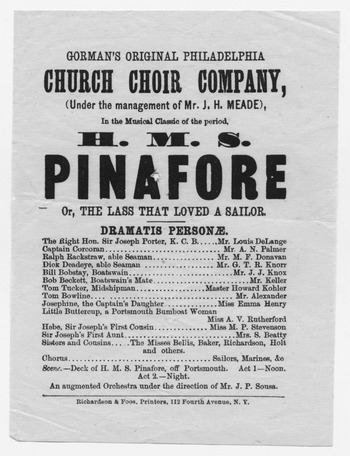
From February to December 1879 Sousa was consumed with H.M.S. Pinafore. He orchestrated for, rehearsed, and conducted an organization consisting largely of amateur church singers that billed itself as Gorman's Original Philadelphia Church Choir Company (Figure 1).Footnote 16 This time Sousa had much greater success. His production opened in Philadelphia on 20 February 1879, after which the company undertook a brief tour. The novelty of church singers led to positive reviews, and the production was soon booked into New York's Broadway Theatre, where it played between 10 March and 26 April. After an additional tour the group returned to the Broadway for much of May, and another excursion brought the season to an end in early July. Audiences were still hungry for this wholesome Pinafore, and the Gorman company returned to the stage in October and landed again in New York on 10 November 1879.
Gorman Church Choir Company program showing Sousa as conductor. Graphic Arts Collection, Musical Programs, Courtesy of the American Antiquarian Society.

Arthur Sullivan was understandably dismayed by the lack of royalties generated from his success in the United States, writing, “It seems to be their opinion that a free and independent American citizen ought not to be robbed of his right of robbing somebody else.”Footnote 17 The only exception to this model of the American robber-impresario was John Ford, the Baltimore-based manager who had earlier employed Sousa as a violinist and conductor. Ford and his son Charles opened H.M.S. Pinafore at the Baltimore Grand Opera House in December 1878 and moved their production to Philadelphia's Broad Street Theatre for the New Year. This run was so rewarding that Ford sent Sullivan five hundred dollars, becoming “the sole manager at present who has offered us any acknowledgement of the success of our piece in America.”Footnote 18
Ford's payment was not philanthropic, but rather meant to grease the wheels on his scheme to bring Gilbert and Sullivan to the United States. After considerable negotiation the duo arrived in New York in November 1879, and along with their soprano Blanche Roosevelt went to examine the competition.Footnote 19 On 11 November they attended the Gorman Company's performance of Pinafore. Naturally curious, Sousa dispatched a staff member to capture the visiting celebrities' opinion: “Sullivan thought the orchestration excellent. (This of course, delighted me, since it was mine!)”Footnote 20
Gilbert and Sullivan had not crossed the Atlantic just to hear pirated performances of their own work, and John Ford must have been ecstatic when H.M.S. Pinafore, now featuring the original, unpublished stage directions and orchestration—conducted by Sullivan himself—opened at New York's Fifth Avenue Theatre where Ford was a lessee. Given the new competition, Sousa's organization simply traded one operetta for another. In mid-December the company opened The Smugglers, a reworking of F. C. Burnand and Arthur Sullivan's The Contrabandista. Sousa again conducted his own orchestration, probably prepared from a published reduction. When The Smugglers closed shortly after Christmas, Sousa's involvement with the Gorman company came to an end.Footnote 21
Gilbert and Sullivan had come to the United States determined to premiere a new work, and when their piece was finished in late December the duo was as concerned with real pirates as they were with those onstage. To protect The Pirates of Penzance they organized a three-pronged defense. As usual, the orchestration was left unpublished and parts were collected after each rehearsal to prevent unauthorized copying. This time, however, they also declined to prepare a reduction; anyone who wished to steal the piece would have to do so solely through memorization. Furthermore, the new operetta would have its official premiere in New York in hopes of securing U.S. copyright.Footnote 22 Finally there would be an all-out assault on piracy. Lawyers vigilantly searched for unauthorized performances and filed local injunctions, while five official companies were dispatched to flood the market. Although these efforts were generally successful at squelching the competition, without a published score to play at home or a local company to cheer, The Pirates of Penzance never achieved the popularity of Pinafore.
By the beginning of 1880 Sousa had arranged several Gilbert and/or Sullivan works for the stage (The Sorcerer, H.M.S. Pinafore, and The Contrabandista/The Smugglers). He had also published potpourris on The Sorcerer, H.M.S. Pinafore, and Trial by Jury for various solo instruments, and he had used Sullivan melodies in two of his collections (The Evening Hours and The Evening Pastime). In August 1880, having seen one of Sousa's performances, Marine Corps Commandant Charles McCawley wrote to the young musician asking him to prepare selections from several stage works for performance by the United States Marine Band: “I would like you to arrange for the Band selections from Paul and Virginia, Trial by Jury, Sorcerer, Little Duke, Royal Middy, Aida, Boccaccio, Camargo, Princess Toto, and Carmen. I enclose the number of instruments, and will thank you to select the best airs from each opera named.”Footnote 23 The Commandant must have been quite pleased with Sousa's work; in October the young musician returned home to become the first native-born leader of the Marine Band.Footnote 24
Meanwhile, a series of lawsuits involving Gilbert, Sullivan, and their impresario Richard D'Oyly Carte perpetuated a state of legal confusion. Despite keeping The Pirates of Penzance unpublished, Sullivan found that it did not take long for his tunes to appear in unauthorized piano reductions, and thus suits were quickly filed. One arrangement, prepared from memory and ingeniously entitled Recollections of the Pirates of Penzance, ended up in a Massachusetts court. There, to everyone's surprise, a judge granted the requested injunction, delivering a remarkable victory to Gilbert and Sullivan, although the ruling was never published.Footnote 25
This Massachusetts triumph would not be repeated in Maryland. In 1881 John and Charles Ford opened Billie Taylor, an operetta by Harry P. Stephens and Edward Solomon for which D'Oyly Carte had been granted exclusive performance rights. The Fords argued that this production had been created from memory and was thus legal. The other side was doubtful and suggested that “a more reliable agent had been employed,” most likely “a little money judiciously administered to some of our under people, and, in return, the surreptitious loaning of our prompt-book to the agents of the enemy.”Footnote 26 Judge Thomas J. Morris of the Maryland Circuit Court, probably unaware of the unpublished Massachusetts ruling, sided with Ford. By publishing the libretto the complainants had “dedicated to the public nearly all the substantial parts of their production,” and there was no evidence that the defendants had used illegal means to reconstruct the script or music. The Fords' production could continue so long as their advertising material did not too closely resemble that used by Carte.Footnote 27
In 1883 a third case added to the confusion. Theodore Thomas had been granted an exclusive right to perform Charles-François Gounod's Redemption in the United States with the Boston Handel and Haydn Society.Footnote 28 The organist Joseph G. Lennon, meanwhile, had decided to mount his own production and hired a musician “intimately acquainted with Gounod and his style” to reconstruct the score from the published piano reduction, which included some orchestral cues.Footnote 29 Under common law there was no question that Lennon had the right to perform the work as published in its piano reduction. At issue was whether or not he could create an orchestral accompaniment. On the one hand, the orchestral parts had not been published and therefore were not dedicated to the public. On the other, the cues in the published reduction seemed to provide for some sort of orchestration.
The Massachusetts court, after considerable education in the art of scoring, noted that “an orchestration can be made from the score by a competent arranger, and several such may be found in Boston, but the precise effects, called by the witnesses ‘color,’ which a composer gives to the orchestral parts cannot be reproduced, because the possible variations which may be produced by slight changes in the use of the several instruments are infinite.”Footnote 30 The court thus ruled that Lennon's orchestration could not continue to be performed, because the published reduction did “not dedicate what it does not contain, and what cannot be reproduced from it.” The work could be performed as published (in reduction), but any attempt to complete an orchestration might lead to an imperfect performance and thus damage the integrity of the original piece.Footnote 31
Thus, by the early 1880s both sides had seen favorable rulings, and the law remained largely unsettled. Emboldened, Charles Ford opened Gilbert and Sullivan's Iolanthe in February 1883. To create the missing orchestration Ford turned to a musician with considerable experience adapting Sullivan's music, his former conductor and current leader of the Marine Band, John Philip Sousa. Sousa took to the task and prepared “an orchestral accompaniment for the published vocal score . . . relying solely upon his own skill as an arranger of orchestral music.”Footnote 32 D'Oyly Carte promptly filed suit alleging two injuries. First, Ford's traveling company was beating his own to many cities, and demand for the authentic operetta was thereby diminished. Furthermore, the “inferior and incomplete” performance was damaging the “reputation and success” of his more genuine production. Following the Redemption case, D'Oyly Carte contended that, as the orchestration had not been printed and orchestra parts were necessary for a successful public presentation, Iolanthe could not practically be performed in the United States without his authorization.
The court quickly dismissed the first part of D'Oyly Carte's objection, noting “that the publication in print of a work . . . is a complete dedication of it for all purposes to the public.” As the orchestration was deemed to be of only secondary value, a violinist might be added to aid the pianist with no loss to the original work. Such a process could continue instrument by instrument until an entire orchestra had been assembled. As Sousa's orchestration had been created “by his independent skill and labor” and not obtained “in any surreptitious or unauthorized manner” it was not only perfectly legal, but it was also such “an original work that it could itself be protected.” By siding with Ford, the Maryland court rejected the earlier Massachusetts rulings and reinforced its own opinion from the Billie Taylor case.
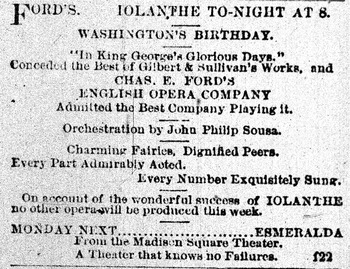
The second part of D'Oyly Carte's complaint argued that a “blundering or mechanical orchestration” might be injurious to a composer's reputation. Here the court substantially agreed, but noted that this argument was not enough to restrict Ford's production, only his advertisements. Ford could continue so long as his notices were “coupled with a reasonably-conspicuous announcement” that the audience would not be hearing Sullivan's orchestrations. Ford was only too happy to comply and advertise the now locally famous John Philip Sousa (Figure 2).
Iolanthe advertisement showing Sousa as orchestrator. Washington Star, 23 February 1883.

This ruling was hardly the end of the legal battles over Gilbert and Sullivan, but for Sousa two lessons were already clear. First, there was a great deal of money to be made from borrowing successful works by other composers; indeed, these orchestrations had enhanced Sousa's reputation as a theater musician and helped earn his employment with the Marine Band. (Sousa would return to Sullivan's melodies in 1885 with his Mikado March.) Second, many of Gilbert and Sullivan's difficulties could be blamed on the unsettled state of case law. Had it been clear where the law lay (something the Massachusetts and Maryland courts had made impossible), Gilbert, Sullivan, and D'Oyly Carte could have better prepared their business plan. Given the legal confusion, it is hardly surprising that as Sousa's fame grew and his own compositions became the target of piracy, he decided to turn not just to the courts, but also to Congress in hopes of clarifying the situation.
Blakely v. Sousa
Sousa's next legal skirmish, Blakely v. Sousa, was far more personal and taught the conductor to defend himself vigorously when it came to matters of law. In 1892 the manager David Blakely convinced Sousa to leave the Marine Corps and form his own commercial ensemble. To a remarkable degree it was Blakely's managerial skills that allowed the Sousa Band to rise rapidly from a risky financial venture to one of the nation's most successful musical organizations.Footnote 33
The June 1892 contract that bound the two men together was to last for five years and guaranteed to Sousa an annual salary of $6,000 as well as a share in the venture's profits (10 percent for the first year and 20 percent thereafter). It assigned to Blakely all financial risk for the venture. In return he would have authority over the band's name, control of the ensemble's library, and a half interest in any profits made from the sale of Sousa's music.Footnote 34
Three years later, on 21 May 1895, Blakely wrote to Sousa and explained that the band had been an “unexpected and gratifying success.”Footnote 35 As a gesture of good will he decided to split the ensemble's profits evenly with his bandmaster. Sousa was told that this alteration should not be considered “a legal amendment or appendage” to the contract, and that Blakely reserved the “power to resume its conditions.” For now, at least, the two men would “share alike in all the revenues which are derived from the enterprise which we undertook together.” Following the band's engagement at the Coney Island resort of Manhattan Beach in 1896, Sousa and his wife traveled to Europe for a much-needed vacation. The bandmaster was in Naples when he read of Blakely's death on 7 November, and he quickly made the journey home.Footnote 36
Upon Blakely's death his business interests were transferred to his wife, Ada, who saw the terms of the contract quite differently from her new bandmaster. Sousa felt that the original contract had depended on the unique gifts that both he and Blakely had brought to the enterprise. As far as Sousa was concerned, when the manager died, the contract terminated. Because he was “feeling under a strong moral obligation to fulfil the dates arranged by her husband,” Sousa agreed to complete the 1897 engagements that Blakely had arranged before his death.Footnote 37 For her part, Ada Blakely believed that the original contract remained in force for its full five-year term. Furthermore, she saw no reason to continue the informal partnership her husband had instigated. Frustrated at not receiving the augmented payments to which he had become accustomed, Sousa unilaterally dissolved the contract on 6 April 1897, hired the band members under his own name, and continued to give concerts without regard to the Blakely estate.
Ada Blakely filed suit against Sousa in Philadelphia on 10 April. She argued that by failing to finish the prearranged tour, Sousa had left her financially responsible to slighted local managers. Sousa replied two weeks later, asserting that without David Blakely's managerial skills, the contract was null and void. As the argument intensified, Blakely demanded the literal terms of the original contract. In addition to compensation for the damage Sousa had caused by failing to perform, she asked that the bandleader turn over to her 50 percent of his royalty earnings, the band's entire music library, and the advertising control of his own name.
The case soon landed with a legal referee, who to a large degree sided with Sousa. Just as the March King's conducting skills could not be transferred to his next of kin, neither could Blakely's “business qualities, ability and reputation.”Footnote 38 It was thus clear that Ada Blakely could not expect Sousa to perform under her management, and advertising his name could only serve to mislead the public. Sousa did not win outright, however. The original contract gave David Blakely an interest in Sousa's compositions, and this property right was not dependant on Blakely's skills. As a result, the referee required Sousa to turn over to Ada Blakely half the profits from all the works he had composed before her husband's death. Furthermore, Blakely's heirs were entitled to the Sousa Band library, which the contract made David Blakely's personal property. Finally, the referee found that Sousa should pay to Ada Blakely one-half of the profits from any concerts he had given between dissolving the contract on 6 April and the last concert arranged before his manager's death (a performance on 23 May). Neither side was happy, and the case was appealed to the Supreme Court of Pennsylvania, which issued its ruling upholding the referee's findings on 8 October 1900.Footnote 39
By the time of David Blakely's death, Sousa must have felt a substantial debt to the manager who orchestrated his national debut. This sense of obligation made the lawsuit a bitter end to a relationship that had been both personally and professionally rewarding. Sousa later explained that the entire ordeal “taught me . . . a salutary lesson—that absolute coöperation and confidence between artists and their management is indispensable to the success of the enterprise.”Footnote 40
Sousa apparently learned more practical lessons as well. As his fame increased during the 1890s, his success came to be rooted not only in his skills as a musician, but also in his perceived good business judgment. In an age when masters of industry were elevated as cultural heroes and massive fairs demonstrated America's managerial promise, reporters often commented on Sousa, the executive. In 1899 a Detroit journalist noted how Sousa created order out of chaos:
To be able to command men is a gift possessed by comparatively few, and the great general is no more difficult to discover than the great conductor. The strict discipline that promotes a wholesome respect for the commander is as necessary in maintaining the standard of a musical organization as it is in promoting the efficiency of a fighting body. Not the least enjoyable thing about a Sousa band concert is the masterly control of the leader over the human instrumentality before him.Footnote 41
This image of absolute control was one that Sousa was only too happy to fuel:
That is what I am constantly trying to do all the time—to make my musicians and myself a one-man band! Only, instead of having actual metallic wires to work the instruments I strike after magnetic ones. I have to work so that I feel every one of my eighty-four musicians is linked up with me by a cable of magnetism. Every man must be as intent upon and as sensitive to every movement of my baton as I am myself.Footnote 42
In some cases the bandleader even drew on the language of business: “The organizing and maintaining of a superior band I regard in the light of a calm, calculative, business proposition, as much as the selection training of men for banking or other commercial duties. . . . As the head of a counting-house exercises powers of selection in gathering about him a staff as nearly perfect as possible, so is the bandmaster untiring in his search for the best available talent. . . . The principle of the survival of the fittest is strong.”Footnote 43
During his time as leader of the Marine Band, however, Sousa had yet to become the savvy businessman later reporters would admire, and he often sold new compositions outright for as little as thirty-five dollars. In the midst of his lawsuit with Ada Blakely, a Wilkes-Barre reporter wondered how anyone could have been taken in by such a “gigantic swindle” that “had practically given the Blakeley [sic] people something like an independent fortune.”Footnote 44 Considering his increased royalties and his improved salary, there is no question that Sousa was in far better hands with David Blakely than he had been on his own.Footnote 45 Nevertheless, he had forfeited considerable autonomy with his new contract, and probably had not thought carefully before signing it. (The legal referee had noted that the agreement “evidently was not written by a lawyer, but by a layman.”)Footnote 46 After the painful lawsuit with Blakely's wife, however, Sousa would never again be so cavalier when it came to business. Along with his previous Gilbert and Sullivan experiences, this suit taught Sousa to be an active agent in the control of his name and work.
International Copyright
With twenty-five years of experience, Sousa was now well aware of the dangers that might confront an unsuspecting musician. Disaster could be avoided, but usually at a price. To thwart piracy, Arthur Sullivan might have retained his music in manuscript, but to do so would have dramatically limited his popularity. To avoid confrontation with Ada Blakely, Sousa might have insisted on a more favorable contract, but only at the cost of diminished profits. In both cases, the injured party had sought refuge in the courts, which failed to fully protect either Sullivan or Sousa. The next step was to turn to the legislature.
David Blakely's careful management had made Sousa a star in the United States, and the March King's compositions were beginning to make him famous in Europe. In May 1900 the Sousa Band made its first European appearance at the Paris Exposition, and a British tour was undertaken in 1901. The band returned to London in January 1903, and this time Sousa discovered that his work was being sold on the street in pirated editions. Furious, he wrote a letter to the London Times, asking simply that the British government enforce existing law:
We have a tradition in America that English law is a model to be emulated by all peoples. You can imagine my astonishment, therefore, on arriving in London to find that pirated editions of my compositions were being sold broadcast [i.e., widely] in the streets of your city.
I have been labouring under the delusion that, as I have complied with the requirements of the international copyright laws, your Government would assume the responsibility of finding a way to protect my property. Apparently no such responsibility exists. There surely must be a remedy to protect a composer from such a deplorable injustice?Footnote 47
Sousa was hardly the only musician to suffer under this state of affairs. In turn-of-the-century England musical piracy was merely a civil offense, and British publishers discovered that their only recourse involved lengthy and expensive litigation. At best, such suits might result in a small fine. To make matters worse, arrests were difficult to make, as existing law did not allow police to forcibly enter known warehouses; thus, a simple locked door could foil any search.Footnote 48
By the time Sousa returned to London in 1905, several music publishers were lobbying to introduce stricter penalties for piracy. The leading spokesperson for the publishers was William Boosey, general manager of the Chappell Publishing Company, and chairman of the Music Publishers' Association. Parliament member James Caldwell had blocked the proposed legislation, prompting Boosey to take the matter public. With Sousa in town Boosey did not need to look far for a celebrity spokesperson, and he asked the March King to write two letters, “one dignified and the other satirical.”Footnote 49 Sousa's works continued to appear in pirated English editions, and so he was happy to comply.
The “dignified” article appeared in the Times. After reminding his readers of the Berne Convention, which was designed to protect foreign authors in signatory countries, Sousa noted that British piracy was depriving at least one composer of a well-earned income:
I have before me a pirated edition of my latest composition, which was printed and hawked about the streets of London, within a few days of the authorized publication of this march, at a price at which my publishers could not afford to print it. And this has been the case with all my compositions in Great Britain for several years. It has had the effect of practically stopping the sale of my genuine publications, thus depriving me of the substantial income from that source that the popularity of my music in this country gives me every reason to expect.Footnote 50
Sousa followed this introduction with an appeal to the public's dignity: “It seems to me that the national honour and pride demand that immediate steps be taken to fulfil the treaty obligations of this country in the matter of international copyright.”Footnote 51
Sousa prepared a second “dignified” article for the Daily Telegraph. This time, rather than hoping to sway the public with stories of his own loss, Sousa demonstrated that piracy not only hurt the composer, but also took wages away from British subjects. Worrying that pirates would cost him sheet music sales, Sousa had canceled a London production of his operetta The Bride Elect. Wondering who would care about his decision, the composer explained that “the singers, actors, chorus people, orchestral players, costumiers, printers, advertising departments of newspapers, stage hands, sandwich men, the various theatrical advertising agents, &c.—they are the ones that will care. A production of the opera, such as I would have liked to make here, affects the well-being of at least 300 people, and they care.”Footnote 52
The opposition's public argument had rested on the idea that music must be made available to the masses at low prices. Sousa's satirical article, which appeared in the Daily Mail, carried this line of reasoning to its extreme: “The music pirate had a philanthropic mission. This mysterious and mercenary Messiah, noticing the dire distress of the tune-starved masses—whoever they may be—said, ‘I will save them. . . . I will gorge them with gavottes, build them up with ballads, and make muscle with marches. They shall become comely with comedy conceits, and radiantly rosy with ragtime rondos—and all at 2d. a throw.’”Footnote 53
These three articles led to considerable press commentary, almost entirely in favor of a new law. Sousa's appeal to national honor was particularly effective. One paper lamented that “Mr. John Philip Sousa suffers a severe shock whenever he pays a visit to these hospitable shores. The land of justice, as we are proud to call it, is to Mr. Sousa a delusion and a snare. For are not barefaced pirates in waiting at every street corner to seize upon his compositions, and sell them under his very nose at a cheap rate, which entirely spoils the sale of the higher-priced copyright editions?”Footnote 54
Another writer thought it bad enough that native composers were swindled, but asserted that when a guest was robbed, something had to be done: “British composers are not the only ones who suffer from the defect in our existing law.”Footnote 55 This journalist went a step further and noticed how Sousa's business venture really worked. His concert tours, while delightful, were a means to an end. By playing his pieces in public he spurred the audience to purchase sheet music for private performance. British piracy interrupted this scheme: “Take the case of Mr. Sousa, whose marches enjoy such enviable popularity. The Sousa concerts given here are to a large extent a means to an end. While they are attractive in themselves, they serve at the same time a second purpose by extending the fame and the sale of Mr. Sousa's compositions. One can realise without difficulty, therefore, that eminent composer's feelings when confronted with the unpleasant fact that, practically speaking, the law of copyright is non-existent so far as he is concerned in this country.”
The efforts of Sousa and Boosey were successful, and in 1906 British publishers persuaded parliament to pass a copyright revision that provided a prison sentence for the possession of pirated music. For Sousa the story had now come full circle. His melodies were as famous as Arthur Sullivan's had ever been, and the March King knew that unscrupulous competitors lay in wait to steal them. Appealing to the courts had been of little use to Gilbert and Sullivan, but Boosey had shown Sousa the importance of a public argument. When he returned home in May 1905, Sousa was primed for one final battle, but this time the foe would be much more powerful than a manager's widow or a British street vendor.
The Menace of Mechanical Music
Before 1909 manufacturers of player piano rolls and recordings were free to hire soloists and ensembles to perform any piece of music that had appeared in print. Performers were always paid for their services, but no remuneration was provided to composers. Similarly, the published writings and speeches of authors and orators could be recorded and sold without permission or control. Several professional organizations had lobbied for a copyright revision to address this problem, and Theodore Roosevelt, himself an aggrieved author, brought presidential authority to bear on the matter in his December 1905 State of the Union letter: “Our copyright laws urgently need revision. They are imperfect in definition, confused and inconsistent in expression; they omit provision for many articles which, under modern reproductive processes, are entitled to protection.”Footnote 56 Indeed, the Librarian of Congress had already sponsored a series of conferences that had led to new language granting to composers and their publishers “the sole and exclusive right . . . to make, sell, distribute, or let for hire any device, contrivance, or appliance especially adapted in any manner whatsoever to reproduce to the ear the whole or any material part of any work published and copyrighted.”Footnote 57
Congressional hearings were held to explore the ramifications of the bill in May, June, and December 1906.Footnote 58 Victor Herbert organized composers on behalf of the new language and, following William Boosey's lead, engaged Sousa as celebrity spokesperson. In June 1906, before the joint Congressional Committees on Patents, Sousa articulated three types of arguments in favor of the bill. The first revolved around the legal issues at stake, primarily the definition of “writing” as used in Section 8 of the constitution, which grants to Congress the power “to promote the progress of science and useful arts, by securing for limited times to authors and inventors the exclusive right to their respective writings and discoveries.” If recorded disks, cylinders, and piano rolls were “writings,” then they could be read and were thus copies of the original work that should be controlled by the author.Footnote 59 Sousa argued that whatever doubt there was regarding a record's readability, it was “simply that no method has been found to read them up to the present time, but there will be. Just as the man who wanted to scan the heavens discovered a telescope to do it. No doubt there will be found a way to read these records.”Footnote 60
Given Sousa's fame, it is no surprise that opponents of the bill often returned to his testimony. George Howlett Davis, the inventor of several machines for the mechanical reproduction of music, challenged Sousa directly on the legal issue: “There is where Mr. Sousa . . . and I are going to lock horns—right here with the Constitution as our battle ground.”Footnote 61 From Davis's point of view, Sousa was too liberal in his understanding of the word “writing”: “Every decision that has ever been made in this country and England, as I read it, has limited that word ‘writing’ to mean some visible and readable writing; not the mere making of a wave in the air.” The constitution may well have granted Sousa an exclusive right over his written work, but it did not grant an “exclusive right to use God's free air and vibrate it.”
Sousa's second argument focused on a vague sense of moral equity. Under the then-current law, a record company could purchase one set of band parts for a Sousa march and from it make thousands of identical records, thus multiplying their profits exponentially. To Sousa each record represented a loss in sales for which he wanted compensation: “If they would buy one copy from my publishers . . . and sell that one copy, I would have no objection”; instead they “take one copy of a copyrighted piece of music and produce by their method a thousand or more disks, cylinders, or perforated rolls.”Footnote 62
S. T. Cameron, representing the American Graphophone Company, articulated the response to Sousa's moral argument. Once they had purchased a copy of the sheet music, which through publication had been dedicated to the public for any use, record companies had every right to record it. There was, after all, very little difference between a singer presenting a song to an audience in a concert hall and a record company presenting the same song to an audience at home. If the law were changed to give composers control over the way in which their music reached audiences, then the same rights would have to be extended to other kinds of inventors:
You ask me if I would use Sousa's march, make that record and sell it, and not pay him any royalty. I answer, “Yes; I would”; because I have paid him royalty. Whenever Mr. Sousa publishes one of his pieces of music and puts it out upon the market and I pay the price of that music, that sheet of music passes from under the monopoly, just as when I patent a cornet and sell the cornet to Mr. Sousa, and he pays the price for it. . . . Suppose I should come here and say to you that every time one of Mr. Sousa's cornet players played the cornet that I had sold to him that he should pay me royalty for having played it! That is what he is asking of you.Footnote 63
As a borrower of Arthur Sullivan's music, Sousa had seen both of these arguments—legal and ethical—fail. A public that loved H.M.S. Pinafore could not be swayed by mere legal or ethical arguments to support measures that might make its favorite tunes more expensive or difficult to obtain. Thus, at the June hearings, Sousa formulated a third argument in which he predicted the demise of amateur musicians: “When I was a boy—I was born in this town—in front of every house in the summer evenings you would find young people together singing the songs of the day or the old songs. To-day you hear these infernal machines going night and day. . . . Last summer and the summer before I was in one of the biggest yacht harbors in the world, and I did not hear a voice the whole summer. Every yacht had a gramophone, a phonograph, an æolian, or something of the kind.”Footnote 64
This line of reasoning fascinated the committee. Senator Reed Smoot (R-UT) wondered about other reasons for the decline in amateur performance: “I think there are other causes besides the general use of the talking machine that account for the fact that there is less singing than there used to be. I think we do not live quite as close to nature as we used to, and that that is what used to make us sing.” Sousa was willing to allow for the possibility, but he quickly turned attention back to the enemy at hand: “That is very true. But the more leeway you give the talking machine the greater encroachments they will make.”Footnote 65
As the June hearings came to a close, the committee's position remained unclear, and there was no indication that Sousa and Herbert enjoyed the support of the public or the press. Many journalists remained unconvinced that amateur music making was on the decline, and some even suggested that talking machines would help to nurture home music making by spreading high-quality performances to smaller communities: “The talking machine will do no harm, but it does impart an infinite amount of pleasure to millions of people who are enabled through its instrumentality to get an idea of the powers and beauties of the voices of great singers whom they otherwise never could have hoped to hear.”Footnote 66 Others suggested that recordings might act as teachers: “In reality the graphophone, so far from supplanting the human singing voice, is a most active agent in its cultivation. In thousands of homes the graphophone takes the place of a vocal instructor. The children gather about the instrument and learn to sing the new songs correctly and with expression.”Footnote 67
Given this response, it is no surprise that Sousa and Herbert were worried about the fate of their bill. Following William Boosey's lead, they took the argument public, and Sousa wrote a series of articles, both serious and satirical, as he had previously done in England. Sousa's reasons for devoting so much time to the effort are clear: working as both composer and performer, his successes in each area reinforced his profits in the other. As they were finished and premiered, new Sousa marches were quickly made available to the public in a wide range of eminently playable editions. Band arrangements, for example, were sold with redundant parts that enabled ensembles large and small, amateur and professional, to successfully present Sousa's latest hits to local audiences.Footnote 68 The March King's publishers did not limit potential profits to bands alone, and most of his works appeared in arrangements for theater orchestra and reduced for piano. The sheet music for The Stars and Stripes Forever indicates that one could purchase the march for piano (two, four, or six hands); zither solo or duet; mandolin solo or accompanied by piano, guitar, or both (or two mandolins accompanied by the same); guitar solo or duet; banjo solo or duet; or banjo with piano. Sousa could safely assume that just as playing Gilbert and Sullivan at home had drawn audiences to the theater, the various editions of his marches would inspire Americans to purchase tickets to his concerts.
This business model relied on a population of amateur players who thus had a two-way street to interacting with Sousa: via sheet music or via concerts. One might purchase sheet music, learn a new march, and thus be tempted to attend a Sousa concert and hear the piece conducted by the composer himself. Conversely, an audience member might leave a concert whistling a Sousa favorite and decide to purchase one of Sousa's marches to play at home for friends and family. Both paths placed money in Sousa's pocket, through either ticket or sheet music sales.
The new player piano and talking machine industries, however, threw this business model into doubt. Sousa's entire career had been spent cultivating a relationship with audiences that consisted of devoted amateurs, but the rise of mechanical music threatened to transform these ticket buyers from active performers into passive listeners. The parallels to Sousa's British experience are clear: mechanical music threatened his profits just as seriously as English piracy had. Whereas the lack of British enforcement had robbed Sousa of extra income, recorded sound threatened his entire profit scheme.
It is in this context that “The Menace of Mechanical Music” must be understood. Recognizing that greed would not be met with sympathy, Sousa quickly admitted that he was “swayed in part by personal interest.”Footnote 69 All too aware of the public's growing fondness for recordings, Sousa was also willing to allow that “where families lack time or inclination to acquire musical technic, and to hear public performances, the best of these machines supply a certain amount of satisfaction and pleasure.” Furthermore, Sousa knew that his public was unlikely to be interested in the constitutional issues, and so he conceded the point: “Let the ambiguities in the text of law be what they may; let there be of legal quips and quirks as many as you please.” Sousa merely asked readers to join him in being “puzzled to know why the powerful corporations controlling these playing and talking machines are so totally blind to the moral and ethical questions involved.”
Sousa's task was to arouse public support, and to do so he focused on the potential loss of amateur culture. As it happened, his efforts could not have been better timed. The early twentieth century was an era of confidence, when urbanization, industrialization, and technological advancement promised to raise all boats. For many, however, this period of change also elicited nostalgia for a less uncertain nineteenth century. Neil Harris has noted that Sousa's regular appearances at the resorts of Manhattan Beach and Willow Grove acted as “symbols of continuity in a civilization where so much else was changing.”Footnote 70 Although Sousa's primary motivation for writing “The Menace of Mechanical Music” was financial, his argument and rhetoric allowed him to tap into the antimodernist sentiments that caused many Americans to “recoil from an ‘overcivilized’ modern existence” and seek out more authentic aesthetic experiences unmediated by technology.Footnote 71
As the decline of agrarian life and the rise of a leisure culture threatened to emasculate the nation, Sousa remained “the very personification of masculine grace,” an image reinforced by his uniform, military bearing, and financial success.Footnote 72 Reviews often noted that, unlike other artists, the March King “does not affect any of the airs of a genius. He is a tall, burly fellow in the prime of life, and, unlike most of his fellows in the wide domain of art, he combs his hair carefully.”Footnote 73 Sousa was happy to repay the compliment, and during a Parisian interview he boasted: “The people who frequent my concerts are the strong and healthy. I mean the healthy both of mind and body. These people like virile music. Longhaired men and shorthaired women you never see in my audience. And I don't want them.”Footnote 74
The need to defend the national physique against the threats of mechanization had appeared during Sousa's congressional testimony: “We will not have a vocal chord [sic.] left. [Laughter.] The vocal chords will be eliminated by a process of evolution, as was the tail of man when he came from the ape. The vocal chords will go because no one will have a chance to sing, the phonograph supplying a mechanical imitation of the voice, accompaniment, and effort.”Footnote 75 Sousa returned to this idea in “The Menace of Mechanical Music.” Knowing that musical practice was an important part of “the curriculum of physical culture,” he questioned the strength of an unmusical country: “Then what of the national throat? Will it not weaken? What of the national chest? Will it not shrink?”Footnote 76
Many citizens concerned with the nation's turn toward urbanization looked to protect or romanticize nature.Footnote 77 Sousa was himself an avid outdoorsmen, expert on a horse and a champion with a gun. In writing “The Menace of Mechanical Music” he must have remembered Senator Smoot's concern about living “close to nature” when he accused record companies of spoiling the escape from modern life provided by outdoor recreation: “The ingenious purveyor of canned music is urging the sportsman, on his way to the silent places with gun and rod, tent and canoe, to take with him some disks, cranks, and cogs to sing to him as he sits by the firelight, a thought as unhappy and incongruous as canned salmon by a trout brook.”Footnote 78
Although the commentaries on mechanical music by Walter Benjamin and Theodor Adorno would come several decades later, Sousa was similarly concerned with recorded music's relationship to the experience of live performance, either heard or made.Footnote 79 For Sousa, a listener who heard The Stars and Stripes Forever on disk was receiving a mere reflection of his band's live performance, just as a player piano could only imitate the act of performing from sheet music. Whatever educational value these machines might have, true music did not spring from mechanical devices, but “from the singing school, secular or sacred; from the village band, and from the study of those instruments that are nearest the people.”Footnote 80 Sousa was sure that the then-current law could not preserve a system that relied on amateurs to purchase sheet music and generate concert sales. He hoped to transfer his concern to his public by feeding on early twentieth-century America's nostalgia for home and family in the face of mechanization: “It is at the fireside that we look for virtue and patriotism; for songs that stir the blood and fire the zeal; for songs of home, of mother, and of love, that touch the heart and brighten the eye. Music teaches all that is beautiful in this world. Let us not hamper it with a machine that tells the story day by day, without variation, without soul, barren of the joy, the passion, the ardor that is the inheritance of man alone.”Footnote 81
Following Boosey's earlier advice to write both serious and satirical articles, Sousa published two additional pieces in 1906. The first appeared in the Christmas issue of The Music Trades and focused only on the legal and ethical arguments. After presenting the legislative history, he simply declared: “Logically and inevitably, then, when the Constitution authorizes Congress to secure ‘to its authors[’] the ‘exclusive’ right to their respective ‘writings,’ it contemplates nothing short of protection to their ‘ideas,’ to their ‘thoughts’ and not merely to the visible record of the thoughts and ideas. And this is the sum and substance of all my claim.”Footnote 82 His satirical article appeared in Town Topics. In it Sousa avoided any legal discussion and instead imagined himself a newspaper columnist asked to summarize a year in music after the takeover of recordings. Following the establishment of “talking-machine conservatories,” Sousa discovered that just as recorded music had weakened the bodies of amateurs, so it also destroyed the minds of performers.Footnote 83 No longer could graduates “tell a barcarole from a boiler explosion, a rallentando from a railroad smash-up.” Instruments that required physical prowess to play and disciplined practice to perfect were “fast becoming archaic,” and, posing as the champion of mechanization, Sousa praised their demise: “When it is considered that a whole man is necessary to manipulate each separate one of these nearly-obsolete instruments, the waste of space and energy seems appalling.”
To what degree Sousa was successful in the press is unclear. At the very least, his amateur argument led to greater sympathy for his ethical position. According to one writer, Sousa explained “with praiseworthy frankness, that part of his distaste for the automatic music producers is caused by the fact that the United States copyright laws do not afford him any means whereby to collect royalties.”Footnote 84 Sousa was also successful in his effort to evoke a sense of musical nostalgia. The same writer continued: “Sousa advances some sound ethical arguments why home music should not be given over entirely to the ubiquitous machines, and his plea for the retention of the older forms of musical pleasure, as practiced by our forefathers and by us in our youth, strikes a vital issue and should be well heeded.”
On the other hand, Sousa's argument left him open to attack; after all, there was a significant gap between what Sousa claimed to fear (the end of amateur music making) and what he wanted from Congress (a right to royalties): “The measure which he desires enacted into law provides, not for the abolishment of the phonograph, but merely for a payment of royalty by phonograph companies.”Footnote 85 Some writers imagined a musical world in which phonograph records and player pianos might spur their owners to seek out Sousa's more authentic experience: “The talking machine . . . will never hurt Sousa's band; on the contrary, it will advertise it, and make people anxious to hear the real thing.”Footnote 86
Sousa's argument also exposed him to charges of hypocrisy, first during the June hearings, and again when he and Victor Herbert returned to Congress in December.Footnote 87 The problem stemmed from Sousa's tenure as leader of the Marine Band. Speaking with a Boston reporter in 1890 he had explained that men from the Columbia Phonograph Company would come “over to the barracks while we were rehearsing and put their machines into operation. We didn't mind it much, but when we discovered that the disks were being used and our names advertised, we put a stop to the business. Then the agent made arrangements with us. He pays each man a dollar an hour for playing selections into the phonographs.”Footnote 88 The new contract meant new income, and as a result, while “the phonograph people were great nuisances to me for a long time . . . I am not complaining much now.” Indeed, a great deal of the Marine Band's national fame rested on the many recordings it made during Sousa's tenure as leader.
In the mid-1890s his civilian band was in even greater demand as a recording ensemble, and by 1905 it had released several hundred cylinders and disks, mostly with the Berliner, Columbia, and Victor companies.Footnote 89 Given that Sousa's early reputation as a composer rested in part on recordings, it is not surprising that the opposition questioned the sincerity of his entire argument. At the June hearings S. T. Cameron of the American Graphophone Company expressed doubt that Sousa the recording artist was as worried about the disappearance of amateurs as Sousa the cultural critic seemed to be:
Mr. Sousa himself does not scorn, as he pretended to the other day, these “infernal talking machines. . . .” He to-day is under contract, and he plays into these “infernal machines” with his band, and he is contributing, as he told you a few days ago, to stifle these “beautiful young voices that now have disappeared throughout our city and our land.” [Laughter.] He does it for the almighty dollar.Footnote 90
Sousa's reply rested on a technicality. True, his band had made recordings, but he had not been personally involved. In fact, out of the some 1,770 Sousa Band recordings, the March King conducted on only three sessions, none of which had occurred before the 1906 hearings. Sousa used this fact to deflect the record industry's charges of hypocrisy: “An organization known as ‘Sousa and his band,’ employed just as any other body of musicians, in which I have no part myself, plays into the instrument. That goes under arrangements made with the management of that organization to play anybody's compositions that these firms may elect; it may be a noncopyrighted piece or a copyrighted piece, or anything else.”Footnote 91 When pressed, the March King was forced to admit, “I am the director of that band, but I have no personal part in the performance of those pieces.” His next sentence has caused endless speculation over whether Sousa ever led a Marine Band recording session: “I have never been in the gramophone company's office in my life.”Footnote 92
Even after the hearings had concluded in December 1906, Sousa's work was not finished. In late 1907 Representative Frank Currier (R-NH) introduced a bill that would expressly deny the protections Sousa and Herbert had sought. Senator Alfred Kittredge (R-SD) meanwhile introduced competing legislation that contained the language vital to copyright holders.Footnote 93 Sousa, as treasurer of the newly formed Authors and Composers Copyright League of America, wrote on behalf of the Kittredge bill arguing that composers “are justified in demanding this measure as an act of justice, because they have been and are being despoiled by the manufacturers of the automatic devices.”Footnote 94
All the while, Sousa and Herbert had been hoping for a positive outcome in White-Smith v. Apollo, a case in which the publisher White-Smith sued the Apollo piano roll company for copyright infringement. The dispute had made its way to the Supreme Court, and in February 1908 a final ruling was issued. Bound by existing law, the court found for Apollo, noting that perforated rolls could not be considered “copies within the meaning of the copyright act.”Footnote 95 Although this decision was a blow to Sousa and Herbert, all was not lost. Justice Oliver Wendell Holmes concurred with the court's opinion, but added, “If the statute is too narrow” it might benefit from “a further act.”
The pressure generated in the press, Holmes's opinion, and some well-timed lobbying by songwriter Charles K. Harris tipped the scales in the composers' favor.Footnote 96 The bill that was finally signed into law on 4 March 1909 granted to composers the exclusive right to control their music. This victory was balanced by language favorable to the industry, which guaranteed compulsory licensing: Once permission had been granted to make a recording, “any other person may make similar use of the copyrighted work upon the payment to the copyright proprietor of a royalty of two cents on each such part manufactured.”Footnote 97
Sousa and Herbert had prevailed, but the March King was not quite finished. During the December hearings he had been asked if he had any contracts with talking-machine companies, and the composer replied, “I have not yet, but I will.”Footnote 98 Horace Pettit of the Victor Talking Machine Company had been the most sympathetic industry representative during this legal battle. As a result, the vast majority of Sousa Band recordings made after the 1909 act were with Victor.
Epilogue: Sousa, ASCAP, and Broadcast Rights
The American Society of Composers, Authors and Publishers was formed in 1914 to collect the royalties promised by the 1909 act. One of the new organization's first tests came the following year when Sousa's publisher John Church filed suit against the Hilliard Hotel Company. The orchestra leader at New York's Vanderbilt Hotel had played Sousa's march From Maine to Oregon in the dining room, and Church petitioned for an injunction. The 1909 law had extended to copyright holders the ability to control “for profit” public performances of their works. At issue in Church v. Hilliard was the meaning of “for profit.” The New York court sided with Church, assuming that “the hotel would not have paid for the playing of the piece, unless it were to gain something thereby.”Footnote 99 When Hilliard appealed to the Second Circuit this ruling was overturned, because the court assumed that people patronized the dining room “for refreshment and pay for what they order, and not for the music.” The hotel, therefore, had not used Sousa's march “for profit within the meaning of those words in our Copyright Act.” It was not until Victor Herbert's triumph in Herbert v. Shanley (1917) that this issue would be clarified in favor of the composer.Footnote 100
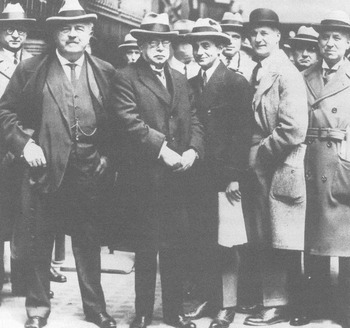
In 1924 Senator Clarence Dill (D-WA) introduced legislation to exempt radio broadcasters from the royalty payments required by the 1909 act. Victor Herbert and John Philip Sousa returned to Washington as representatives of ASCAP to oppose the bill (Figure 3). Sousa, now nearly seventy, was both brief and blunt when he appeared before the Committee on Patents: “My interest here is this, that they want to take my right away from me and give it to this corporation, absolutely taking my interest away from me so that I have nothing to say about it. I do not think that is good sense. I can not for the life of me understand it.”Footnote 101
Members of ASCAP at Pennsylvania Station, New York City, on their way to Washington, D.C., in 1924. In the front row are Victor Herbert, John Philip Sousa, Irving Berlin, Harry von Tilzer, and William Jerome (photographer unknown). Courtesy of Herbert Jacoby.

The composers were back again in May to oppose similar legislation (the Johnson-Newton bill). This time Sousa chastised Congress for having twice taken money out of his pocket, first with the compulsory licensing required by the 1909 act and again with Prohibition, which “hurt us very much, because that killed our writing drinking songs.” To take away potential profits from radio would be a third injustice.Footnote 102
Victor Herbert died shortly after these hearings, and Sousa took his place as ASCAP vice-president. Despite the organization's success in defeating both bills, broadcasters continued to seek exception from the 1909 act. In May 1926 the magazine Singing, in an attempt to represent both sides of the dispute, published articles by W. E. Harkness, assistant vice-president of the American Telegraph and Telephone Company, and Gene Buck, then ASCAP president.Footnote 103 In his article, Harkness claimed that free use of copyrighted music was necessary for the fledgling radio industry to survive, but that ASCAP had accumulated a virtual monopoly on new material: “It is generally conceded that ninety percent of the modern American music covered by copyrights is under the control of the American Society of Composers, Authors and Publishers. . . . Therefore it would appear that this group has virtually a world-wide monopoly on the public performance rights of modern music.”Footnote 104
A month after Harkness's article, Sousa added his own voice in the press. When the bandmaster had signed his contract with David Blakely in 1892 he was still a novice when it came to business. But at seventy-one, the March King was a force with which to be reckoned. A millionaire many times over, Sousa was a senior statesman of U.S. culture, and in 1926 his band showed no signs of slowing down (it played 531 concerts that year).Footnote 105 From the comfort of success, Sousa could be certain that his readers would see the irony when he wondered who exactly had the power of monopoly: “Ordinarily, I feel that as a musician I would be at a great disadvantage in entering into a discussion with a captain of industry. I would hesitate to pit myself against that keen, acquisitive type of mind which is able to go even the United States Government one better in its control of legal technicalities when suits in restraint of monopoly are entered against the corporations it represents.” But Harkness's charges were “so basically unsound, that I do not feel at a loss.”Footnote 106 Sousa went on to explain that just as composers desired only a small fraction of the profits from recordings, they needed but a tiny percentage of the money made by broadcasters.
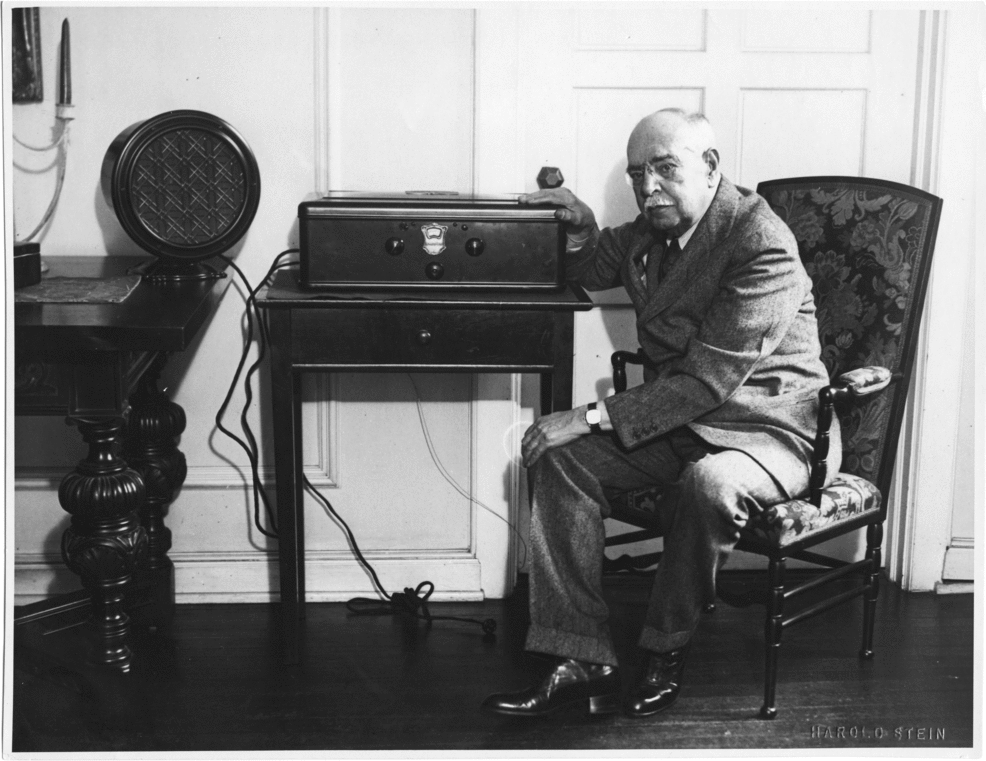
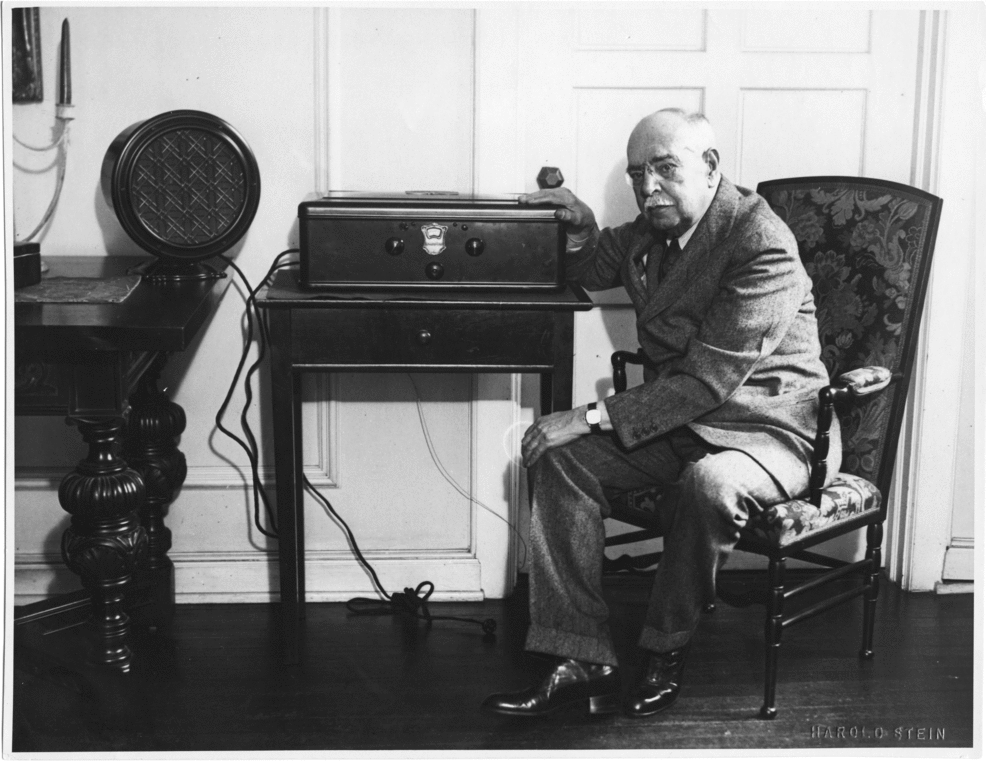
Sousa followed this article with a brief letter to the New York Times in which he praised radio's ability to educate, but noted that without a visual dimension it could not compete with live performance. Although he was now willing to embrace radio (Figure 4), his final sentence is clearly a warning to broadcasters: “Radio's power to educate and entertain the public is without limit. For an invention that cannot give visual personality[,] its achievements are remarkable. In my opinion it has come to stay forever. If it pays a proper reward to the composers whose works it uses its life will not only be long but merry.”Footnote 107
Sousa with his first radio in June 1929 (photograph by Harold Stein, New York). Courtesy of the United States Marine Band.
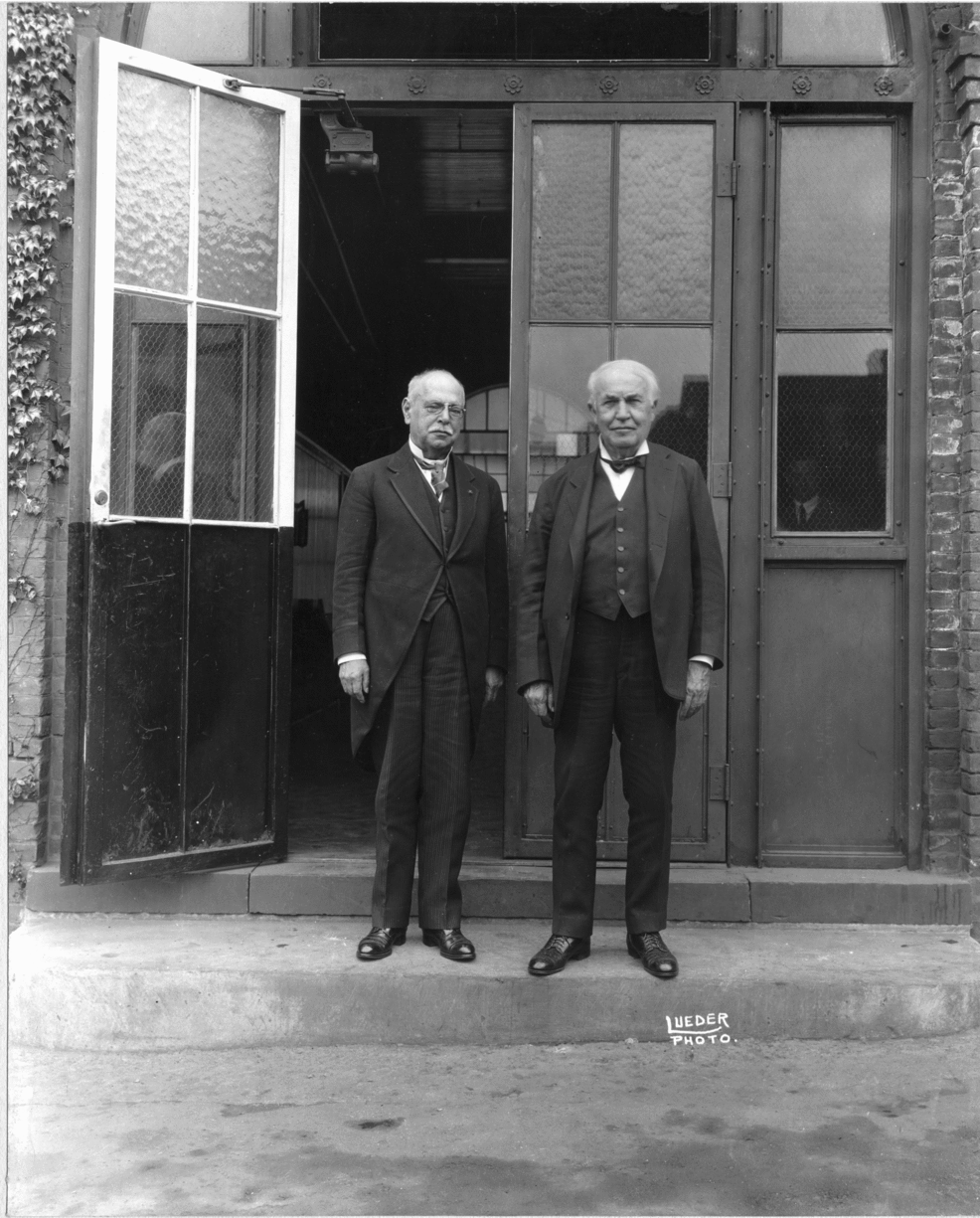
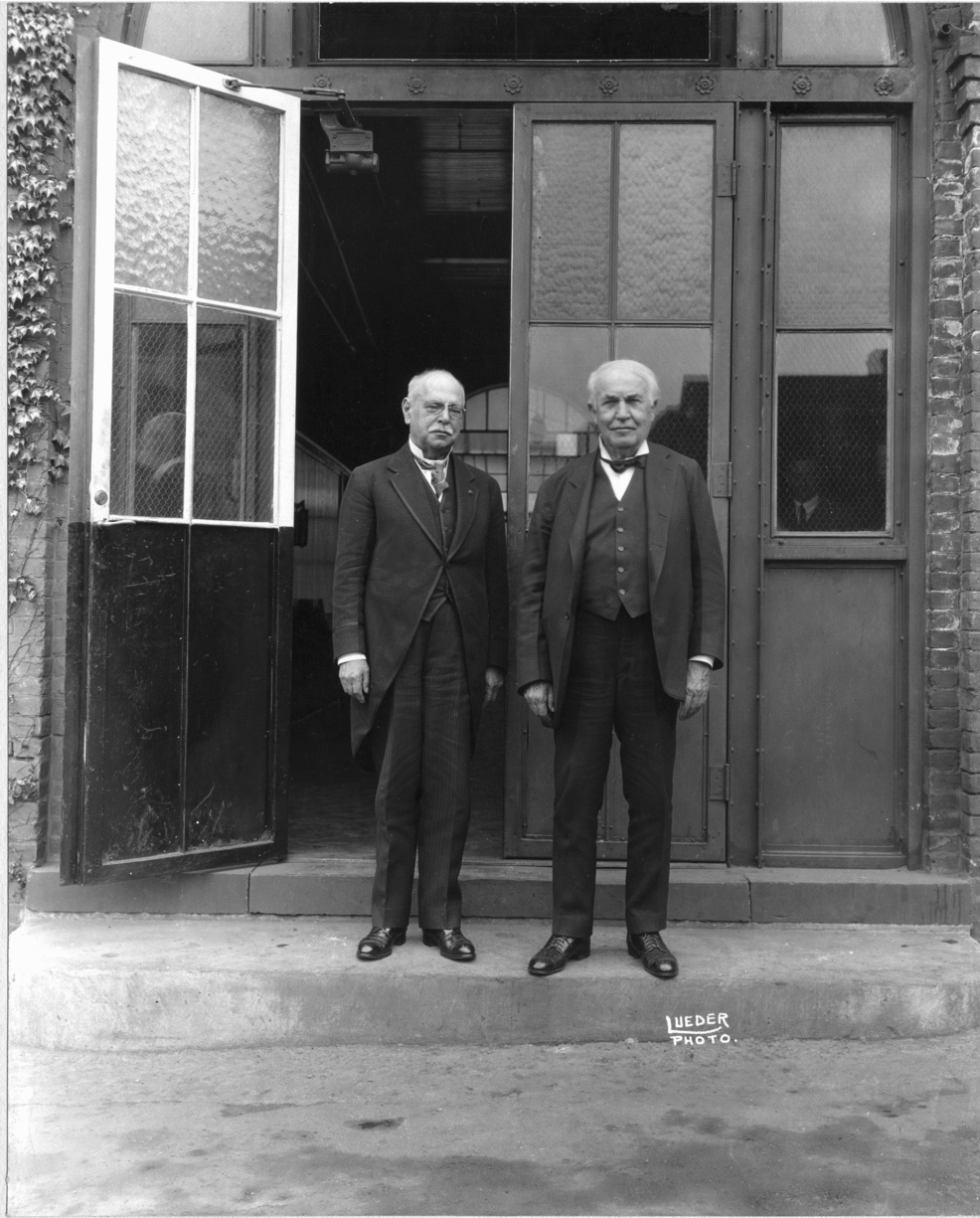
In 1923 Etude magazine arranged for a meeting between Sousa and the man whose invention had led to “The Menace of Mechanical Music” (Figure 5). This joint appearance between the March King and Thomas Edison was widely covered in the press. With a satisfactory legal framework in place and a professional organization capable of collecting royalties, Sousa was finally ready to sing the inventor's praises. In his comments the bandleader echoed the sentiments of Paul Cromelin, who had challenged him twenty years earlier in Appleton's Magazine. Now the talking machine has become a positive force for music appreciation, and concern for amateur performance is entirely absent from his remarks:
It must not be forgotten that Edison thru the invention of the talking machine has done more to promote good taste in music than any other agency in the world. I have found this particularly emphasized in my own work. Wherever I go with my band, I find that the phonograph has created a lively sense of musical appreciation. People in isolated communities who have never heard a grand opera company, or a symphony orchestra in their lives, thru talking machines and talking machine records, have been able to familiarize themselves with good music.Footnote 108
Sousa with Thomas Edison in 1923 (Lueder Photography). Courtesy of the United States Marine Band.
In an age of file sharing, iPods, and YouTube, Sousa's “The Menace of Mechanical Music” continues to seem relevant. Yet it is all too easy to misunderstand the March King. Over the course of his half-century career, John Philip Sousa found himself working as both a pirate and a champion of copyright. He struggled to protect amateur culture from the evils of mechanical reproduction and praised records for encouraging musical involvement. Certainly his actions were self-serving. He was a pirate when needed and a proponent of copyright when his own works were threatened; he was willing to condemn recordings to protect sheet music sales and praise them for educating his audience.
In the end, however, it is more useful to recognize Sousa's long legal education and his shifting place in U.S. culture than to condemn him as a hypocrite. When he borrowed the music of Arthur Sullivan, Sousa was a young musician willing to overlook ethical concerns to earn a paycheck and begin a career. In the process, he saw firsthand the courts' inability to protect the intellectual property of composers. This lesson was reinforced when he lost his performance library and nearly forfeited control over his name because of a poorly designed contract with David Blakely. While working with William Boosey to strengthen English enforcement of copyright law, Sousa learned the value of encouraging public support for potential legislative action. He used this lesson during the 1909 battle for mechanical rights, and although his amateur argument may have been overzealous, it reflected on a musician well tuned to the anxieties of his audience. Finally, as a respected national icon, Sousa worked to protect his earlier legal accomplishments from the destructive interests of broadcasters.
Today Sousa is remembered as the March King, and our awareness of him tends to be limited to a handful of three-minute works for ensembles of winds alone. But John Philip Sousa was in fact a much richer and more multifaceted figure than this title implies. He was, of course, a bandsmen and march composer, but also a successful operetta writer, conductor, and arranger. He was a critic of mechanical music, but also an early recording artist. Most importantly, Sousa was an entrepreneur whose business needs required an understanding of his public. “The Menace of Mechanical Music” offers one window into the complex relationship he built across the podium and through the press.