




No CrossRef data available.
Article contents
Long-term neuropsychological outcomes following mild traumatic brain injury
Published online by Cambridge University Press: 04 May 2005
Abstract
Mild traumatic brain injury (MTBI) is common, yet few studies have examined neuropsychological outcomes more than 1 year postinjury. Studies of nonreferred individuals with MTBI or studies with appropriate control groups are lacking, but necessary to draw conclusions regarding natural recovery from MTBI. We examined the long-term neuropsychological outcomes of a self-reported MTBI an average of 8 years postinjury in a nonreferred community-dwelling sample of male veterans. This was a cross-sectional cohort study derived from the Vietnam Experience Study. Three groups matched on premorbid cognitive ability were examined, those who (1) had not been injured in a MVA nor had a head injury (Normal Control; n = 3214), (2) had been injured in a motor vehicle accident (MVA) but did not have a head injury (MVA Control; n = 539), and (3) had a head injury with altered consciousness (MTBI; n = 254). A MANOVA found no group differences on a standard neuropsychological test battery of 15 measures. Across 15 measures, the average neuropsychological effect size of MTBI compared with either control group was −.03. Subtle aspects of attention and working memory also were examined by comparing groups on Paced Auditory Serial Addition Test (PASAT) continuation rate and California Verbal Learning Test (CVLT) proactive interference (PI). Compared with normal controls, the MTBI group evidenced attention problems in their lower rate of continuation to completion on the PASAT (odds ratio = 1.32, CI = 1.0–1.73) and in excessive PI (odds ratio = 1.66, CI = 1.11–2.47). Unique to the MTBI group, PASAT continuation problems were associated with left-sided visual imperceptions and excessive PI was associated with impaired tandem gait. These results show that MTBI can have adverse long-term neuropsychological outcomes on subtle aspects of complex attention and working memory. (JINS, 2005, 11, 228–236.)
Information
- Type
- Research Article
- Information
- Journal of the International Neuropsychological Society , Volume 11 , Issue 3 , May 2005 , pp. 228 - 236
- Copyright
- © 2005 The International Neuropsychological Society
INTRODUCTION
The annual incidence of mild traumatic brain injury (MTBI), that is, only brief loss or alteration of consciousness, is estimated at 1.2 million people in the United States (Kraus & Nourjah, 1988; Sosin et al., 1996). Although most cases of MTBI recover completely within the first 3 months (Binder et al., 1997; Dikmen et al., 1986; Dikmen et al., 1995; Levin et al., 1987; Rutherford et al., 1979), a significant minority continue to report distressing symptoms for months (Alves et al., 1993; Dikmen et al., 1986; Hartlage et al., 2001; Powell et al., 1996) or years postinjury (Alexander, 1992; Deb et al., 1999). The prevalence of persistent symptoms varies across studies from 7–8% (Binder et al., 1997) to 10–20% (Alexander, 1995) to 33% (Rimel et al., 1981).
There is no doubt that a MTBI causes acute disruption of brain functioning. The individual who sustains a MTBI initially is at best dazed, confused, and temporarily disoriented, and often has memory gaps for the injury itself and some period of time thereafter (seconds to hours). Initial cognitive difficulties including cognitive slowing, poor concentration, attention difficulties, and impaired memory, are common but generally short-lived (Binder et al., 1997; Dikmen et al., 1986; Dikmen et al., 1995; Levin et al., 1987; Rutherford et al., 1979). Decreased reaction time has been documented to occur up to 4 days after injury in a group of individuals sustaining a Grade I or II concussion (no loss of consciousness, symptoms lasting up to 24 h) (Warden et al., 2001), and up to 35 days following emergency care for an uncomplicated MTBI (McAllister et al., 1999).
Three meta-analytic reviews have been published on neuropsychological findings in MTBI. The first, by Binder and colleagues (1997), included only studies utilizing adult patients at least 3 months postinjury who had been selected due to a history of mild head trauma rather than symptom complaint. These authors calculated a total of 11 effect sizes from eight different studies and found the sample-size weighted overall effect to be quite small (d = −.12). When effect sizes were calculated for specific neuropsychological domains, it was found that only attention had an effect size significantly greater than zero (d = −.20). In contrast, a subsequent meta-analysis by Zakzanis et al. (1999) included 12 studies and reported significantly larger effect sizes. Effect sizes were reported for specific neuropsychological tests and then for those tests grouped into seven cognitive domains. The largest effect size was found for cognitive flexibility/abstraction (d = −.72) and the smallest for manual dexterity (d = −.44). However, it is impossible to know whether these larger effect sizes reflect the inclusion of more acute studies or the addition of the clinic-based samples, as there is no indication regarding study selection criteria and time since injury was not reported. This study differed from the Binder et al.'s study (1997) by including both clinic-based/referred samples and prospective studies.
A recent meta-analysis (Schretlen & Shapiro, 2003) attempts to clarify these disparate results by examining separately both MTBI studies and moderate-to-severe traumatic brain injury (TBI) studies, and including only prospective studies. Overall effect size for MTBI was −.24, while the effect size for moderate/severe TBI was −.74. These MTBI effect size findings suggest that it was the inclusion of studies with clinic-based symptomatic patients that resulted in the larger effect sizes in the Zakzanis and colleagues (1999) meta-analysis. Further, these investigators grouped studies of MTBI into four time-since-injury intervals: <7 days, 7–29 days, 30–89 days, and >89 days, and found significant effect size differences across these intervals (d = −.41, −.29, −.08, and −.04, respectively). Overall effect sizes of MTBI were not significantly different from zero by 30–89 days postinjury. However, these investigators did not report effect sizes by different neuropsychological domains, and it is certainly possible that some domains may show residual effects not captured by the overall effect size (e.g. the Binder et al., 1997 findings of a significant effect size only for the attention/concentration domain).
The results of these three meta-analytic studies are somewhat inconsistent because of different study inclusion criteria and different approaches to the calculation of effect sizes (by test versus cognitive domain versus overall effect across domains). Nevertheless, they consistently indicate acute cognitive problems, and at least in the attention/concentration domain, problems remain up to one or more years postinjury (Binder et al., 1997). However, there is limited confidence that no long-term residual problems exist or that problems remain only in attention/concentration because few studies examine neuropsychological outcomes more than 1 year postinjury.
We present here analyses of the long-term neuropsychological outcomes of MTBI an average of 8 years postinjury in a large nonreferred, population-based sample. The present study has the unprecedented opportunity of matching control and MTBI groups on preinjury levels of intellectual functioning. In addition to reporting overall performance on measures, additional analyses were conducted specifically to examine aspects of complex attention (i.e. cognitive flexibility and aspects of working memory), areas in which the literature suggests there may be mild residual problems (Binder & colleagues, 1997) at least up to 1 year following MTBI.
METHODS
Data
Data utilized were those of the Vietnam Experience Study (Centers for Disease Control, 1988a, 1988b). They were collected in the mid-1980s as part of an investigation of the effects of the Vietnam experience on veterans. The available sample consisted of 4462 randomly selected, male US Army veterans who had entered the military between January 1965 and December 1971. Participants were flown from their city of residence to Albuquerque, New Mexico for a 3-day comprehensive evaluation. Evaluations gathered information regarding health-related events that may have occurred during the time interval from military discharge to study date, which was approximately 16 years.
Participants were asked, among many others, the following three questions: (1) Since your discharge from active duty, have you been injured in a motor vehicle accident (MVA)?; (2) Since your discharge from active duty, have you injured your head (HI)?; and (3) Did you lose consciousness as a result of the head injury? If participants were unclear if they had lost consciousness, they were asked if they had “blacked out” in the accident. Thus, this question captured any period of disturbed consciousness or posttraumatic amnesia, not just unconsciousness. Of the 4462 participants, 38 had missing data for one or more of these questions and were excluded from the current sample. Individuals who required hospitalization following their head injury also were excluded (n = 40) in order to capture only those with minor or mild uncomplicated head injuries. This resulted in a subsample of 4384 for the present study.
Participants
Each of 4384 individuals was categorized into one of three groups: those who: (1) had not been injured in a MVA nor had a HI (Normal Control; n = 3214; 73%), (2) had been injured in a MVA but did not have a HI (MVA Control; n = 539; 12.3%), and (3) had a HI with altered consciousness (MTBI; n = 254; 5.8%). Those who reported having had a HI but without any alteration in consciousness (n = 377; 8.6%) were excluded from further analyses because it was unclear if they had sustained a MTBI or only superficial head injuries.
The three remaining groups were compared on the demographic characteristics of age, education, race, and General Technical Test (GTT; Montague et al., 1957) preenlistment score. The GTT is a verbal/arithmetic aptitude test administered at enlistment in the Army (GTT-pre) and again at the time of data collection for the current study (GTT-current). Results are reported in the same metric as a standard Intelligence Quotient (IQ) score. The GTT has been shown to be a measure of general intellectual ability (Centers for Disease Control, 1989). The 45 participants missing GTT-pre scores were excluded from further analyses.
Equating groups on GTT-pre scores
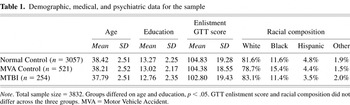
Groups differed significantly on age, education, and GTT-pre, with the MTBI group being about half a year younger and less educated, and having a GTT-pre score about 4 points lower than the other two groups. Given that this study was examining neuropsychological outcomes highly correlated with GTT performance, we sought to equate groups based on their GTT-pre scores. Examining the frequency distribution of the three groups on GTT-pre score revealed that the Normal Control and the MVA Control groups had a higher proportion of scores at the upper end of the distribution than did the MTBI group. By eliminating participants who were above the maximum score in the MTBI group (GTT-pre = 140), we were able to equate groups on GTT-pre performance. The group demographic characteristics and sample sizes of the remaining participants used in all subsequent analyses are shown in Table 1. The differences on age (less than 1 year) and education (half a year) remained statistically significant because of the power afforded by the large sample sizes, but group membership accounted for only .4% of the variance in both age and education.
Demographic, medical, and psychiatric data for the sample

Measures
Details of the data collection and original study methodology have been published elsewhere (Centers for Disease Control, 1988a, 1988b). Measures included a medical history, physical and neurological examinations, visual examination, and neuropsychological testing.
Neuropsychological measures
All participants completed a comprehensive neuropsychological battery, of which the following scores were used in the current study: (1) preenlistment (GTT-pre) and current (GTT-current) scores of the General Technical Test (Montague et al., 1957); (2) dominant hand Grooved Pegboard Test (Matthews & Klove, 1964) performance; (3) Paced Auditory Serial Addition Test (PASAT; Gronwall, 1977); (4) Information and Block Design subtests of the Wechsler Adult Intelligence Scale–Revised (WAIS–R; Wechsler, 1981); (5) Controlled Oral Word Association test (COWA; Benton & Hamsher, 1976); (6) Animal Naming test (Goodglass & Kaplan, 1983); (7) the copy and delayed free recall of the Rey-Osterrieth Complex Figure (Rey, 1993); (8) California Verbal Learning Test (CVLT; Delis et al., 1983) indices of Total Correct Words trials 1–5; Long-Delay Free Recall, and Recognition Hits; and (9) Wisconsin Card Sorting Test (WCST; Berg, 1941; Heaton et al., 1993) Number of Categories Completed, total Perseverative Responses, and Failures to Maintain Set scores. Neuropsychological tests were administered by trained examiners, blind to group membership, under the supervision of doctoral-level psychologists and neuropsychologists.
Additional complex attention/ working memory measures
Because the PASAT, a difficult measure of concentration and working memory, is a frustrating task for many, participants were allowed to discontinue the test if they became particularly upset or frustrated and the examiner feared that participation in further assessment would be compromised. This procedure allowed us to compare the continuation rates among groups across the four PASAT trials, perhaps a more sensitive measure of attention than trial one PASAT performance, the only PASAT score available for most participants.
Proactive interference (PI) occurs when previously learned information reduces the ability to acquire new, related information (De Rosa & Sullivan, 2003). One hypothesis is that PI is a consequence of difficulty suppressing irrelevant information due to defective inhibitory attentional mechanisms (Van der Linden et al., 1993). Excessive PI is believed to be responsible for the working memory difficulties associated with aging (Bowles & Salthouse, 2003). Frontal lesions can increase PI effects (Smith et al., 1995), particularly if the frontopolar cortex is involved (Henson et al., 2002). For the present study, a measure of PI was calculated from the CVLT by subtracting List B performance from that of List A, trial 1.
Neurological measures
In a previous study using these same data, we examined the long-term medical outcomes associated with MTBI (Vanderploeg et al., under review). In that study MTBI was associated with poorer performance on two neurologic outcomes—tandem gait and peripheral visual attention. Impaired gait has been associated with frontal dysfunction (Nakamura et al., 1997; Rossor et al., 1999) as have problems with hemispatial attention (Heilman et al., 1994; Mesulam, 1990). Therefore, those two measures were selected for examination as potential external correlates of any cognitive difficulties found in the current study.
Board-certified neurologists completed the neurological examinations. Examiners were unaware of the TBI status of participants in the current study. Tandem gait was assessed by having participants walk barefoot, heel to toe, the length of the examination room and make at least two 180-deg turns. This was repeated until the neurologist was satisfied, and gait was then clinically rated as either normal or abnormal. Peripheral vision was assessed on the horizontal plane at 85, 70, and 55 deg temporally and 35 deg nasally, using an OPTEC 2000 Vision Tester.
Statistical Analysis
Group comparisons on demographic variables were examined using analysis of variance (ANOVA) and contingency table analysis, depending on the variable's level of measurement. To determine whether the four groups differed on cognitive functioning, we compared 15 neuropsychological test scores using a multivariate analysis of variance (MANOVA). Type III sums-of-squares were calculated to adjust for differences in group sizes. PASAT continuation rate across the four trials by group membership was examined using contingency table analysis, while PI was examined with univariate ANOVA.
RESULTS
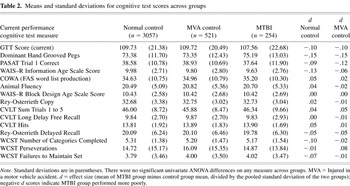
This sample represented the general population of males from this cohort (see Table 1). Results of a MANOVA revealed no overall differences in neuropsychological functioning across groups, Wilks' lambda = .99, F(30,7620) = 1.28, p = .14, eta squared = .005. Table 2 shows the means and standard deviations for the 15 neuropsychological measures across the three groups, none of which were significant. The average effect size of the difference between the MTBI and the two control groups was −.03. On average, the MTBI group performed .03 of a standard deviation more poorly than either control group.
Means and standard deviations for cognitive test scores across groups

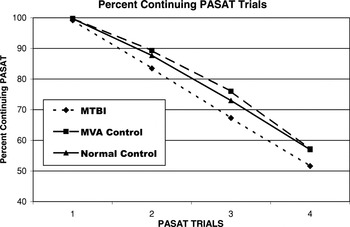
To examine potential subtle problems with attention, concentration, and working memory, the PASAT rate of continuation across the four trials was compared across groups. The three groups did not differ on continuation rates across trial 1 or 2, but did differ significantly on trial 3 [χ2(2, N = 3832) = 6.55, p < .04]. The MTBI group had a significantly lower rate of PASAT continuation than did either of the two control groups (odds ratio compared with Normal Control = 1.32, CI = 1.00–1.73; odds ratio compared with MVA Control = 1.53, CI = 1.10–2.13). As seen in Figure 1, PASAT trial 4 continuation rate was parallel with trial 3, but was not significantly different across groups.

Continuation rate across the four trials of the PASAT by group. All participants completed trial 1 and the rate of continuation dropped across subsequent trials. On trial 3, the MTBI group had a significantly lower continuation rate than either the Normal or MVA Control groups.
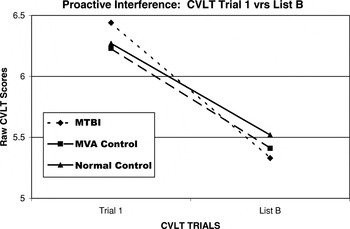
The influence of MTBI on working memory PI effects also was examined. The ANOVA yielded a significant PI difference across groups [F(2,3829) = 4.39, p < .02], and follow-up analyses revealed that the MTBI group had a larger PI effect than the Normal Control group (p < .01), with the MVA Control group falling at an intermediate level (see Figure 2).

Proactive interference as assessed by the drop in CVLT raw score performance from List A trial 1 to List B. The MTBI group had significantly higher rate of proactive interference than the Normal Control group, while the MVA Control group fell at an intermediate level.
Neurological External Correlates
Follow-up analyses were conducted to determine whether PASAT discontinuation and PI effects had external neurologic correlates that were unique to MTBI. Previous analyses with these same data (Vanderploeg et al., under review) revealed an increased frequency of visual imperception in the MTBI group for left-hemispatial stimuli 85 deg from midline, despite comparable rates of left-sided imperception across groups at fewer degrees off midline (70 deg or 55 deg) and all right-sided stimuli. In addition, tandem gait was impaired more than three-fold in the MTBI group. Therefore, the relationship between far left-sided visual imperceptions and tandem gait difficulties were compared across the three participant groups by PASAT trial 3 discontinuation and excessive PI. As shown in Figure 3, the MTBI group showed a differentially higher rate of far left-sided imperceptions [χ2(1, N = 212) = 4.42, p < .04] by PASAT trial 3 discontinuation while the two control groups did not. Similarly, Figure 4 shows that the MTBI group had a differentially higher rate of impaired tandem gait [χ2(1, N = 228) = 10.13, p < .001] with excessive PI while the two control groups did not. Excessive PI was defined as a trial 1 minus List B difference score more than 1.5 standard deviations larger than the overall PI difference for the entire sample (i.e. Excessive PI = a drop of more than 3 words recalled from trial 1 to List B; Normal PI = a drop of 3 or less). The MTBI group had significantly higher rates of excessive PI than both Normal Controls (odds ratio = 1.66, CI = 1.11–2.47) and MVA Controls (odds ratio = 1.81, CI = 1.10–2.99). Although 16% of the MTBI group showed a PASAT discontinuation from trial 2 to trial 3, and 12% showed excessive PI, the overlap between these two anomalous findings was only 2%.

Frequency of left-sided visual imperceptions related to PASAT continuation rates (continued on PASAT trial 3 versus discontinued PASAT after trial 2). Within the MTBI group those who discontinued the PASAT had significantly higher rates of left-sided visual imperceptions. The two control groups had low rates of visual imperceptions regardless of PASAT performance.

Frequency of impairment in tandem gait related to CVLT proactive interference (PI). Excessive PI was defined as a drop of more than three words recalled from CVLT trial 1 to List B. The two control groups had low rates of impaired tandem gait regardless of level of PI (overall frequency of impaired tandem = 1.5%). For the entire MTBI sample the frequency of impaired tandem gait was 3.9%. However, within the MTBI group those with excessive PI also had a significantly higher rate of impaired tandem gait (15.4%).
DISCUSSION
The existing literature on long-term neuropsychological outcomes following a MTBI is limited, but suggests that no adverse long-term effects are present (Binder et al., 1997; Belanger et al., in press; Dikmen et al., 1986; Dikmen et al., 1995; Levin et al., 1987; Rutherford et al., 1979; Schretlen & Shapiro, 2003), perhaps with the exception of mild attention/concentration problems (Binder et al., 1997). The current findings are entirely consistent with this literature. When we examined long-term neuropsychological outcomes in the traditional group comparison manner, no significant neuropsychological ability differences were found. In fact, the average overall effect size was −.03 (range = .08 to −.15), essentially the same as that reported in a meta-analytic study for group differences 90 or more days postinjury (average weight d = −.04; Schretlen & Shapiro, 2003). However, when nontraditional ways of examining specific and sensitive measures of complex attention and working memory were utilized, subtle problems were identified in the MTBI group. Specifically, problems with continuation to completion of the PASAT and excessive PI were identified in the MTBI group.
Traditionally, PASAT performance is compared across groups by number of correct responses. If individuals refuse to continue after one or more of the four PASAT trials, groups are compared using only those who complete a trial or by imputing scores of “0 correct” for trials in which participants discontinue the task. When we examined our data using each of these approaches, no group differences were found. The MTBI group performed comparably to both control groups. However, when we examined group differences in the ability of participants to continue with each PASAT trial, we found that more participants in the MTBI group (16%) discontinued the PASAT after trial 2 than those in either control group. Although this across-group discontinuation difference is minimal (4 to 6 percentage points), it reflects something unique about those MTBI participants who discontinued their PASAT performance after trial 2. They had more problems with left-sided visual imperceptions. Both difficulty on the PASAT and left-sided visual imperception are consistent with an underlying deficit in direction and control of attentional resources (Mesulam, 1990).
An additional set of findings also supports an underlying deficit in attentional resources after MTBI. The MTBI group in our study demonstrated a significantly larger amount of PI on their CVLT performance than either control group. Further, those individuals with MTBI who had excessive PI also had an increased frequency of impaired tandem gait, a relationship not found in the two control groups. Excessive PI is associated with frontal lobe dysfunction (Smith et al., 1995; Henson et al., 2002) is increased in the elderly in whom it is believed to be responsible for increased working memory difficulties (Bowles & Salthouse, 2003), and is seen as the result of defective inhibitory attentional mechanisms (Van der Linden et al., 1993). The association between tandem gait and PI in MTBI patients may be attributable to a subtle disruption of frontal systems.
Although 16% of the MTBI group showed a PASAT discontinuation from trial 2 to trial 3, and 12% showed excessive PI, the overlap between these two anomalous attention findings was only 2%. In addition, they had divergent external neurological correlates—left-sided visual imperceptions versus tandem gait difficulties. Thus, although both patterns suggest problems with aspects of attention and working memory, they may be distinct findings representing different neuroanatomical circuits. Further, these longstanding subtle difficulties with aspects of attention following MTBI cannot be attributed to preexisting differences in general cognitive abilities. MTBI and control groups were matched on preexisting levels of cognitive functioning. The question arises whether these subtle difficulties with attention following MTBI may be secondary to coexisting conditions which may adversely affect attention. However, post-hoc analyses revealed no differences within the MTBI sample between those with and without subtle attention problems on current diagnoses of alcoholism, depression, or hypertension; average number of drinks per day; problems with sleep; or headaches.
A limitation of the current study was that, because we relied on archival data that were collected for another purpose, details of the severity, exact time post-onset, and compensation status related to MTBI are uncorroborated or unknown. Also lacking in the current data is any information about additional head injuries during or prior to military service. However, the self-reported head injuries in the current study were clearly mild because no postinjury hospitalization was required, even in an era of nonmanaged health care (1966–1986). In addition, it is likely that reliance on self-report would increase random error and hence render it more difficult to find adverse outcomes related to head injury. Thus, the current findings may reflect an underestimate of adverse cognitive outcomes.
Whether or not these subtle problems with attention following MTBI have functional consequences is also an important consideration. We retrospectively examined whether, within the MTBI sample, those with subtle attention problems differed from those who did not on employment status, income level, or disability status. No differences were found. However, these functional outcomes may be too gross. More subtle outcomes, such as relinquishing prior activities like reading, woodworking, or balancing the checkbook that require sustained attention, may be better measures of potential adverse functional consequences. Unfortunately, we were unable to examine such functional outcomes in this study.
Given the subtle nature of the attentional difficulties found in this study, on a case-by-case basis the findings have limited clinical significance. However, the presence of excessive PI or significant problems with PASAT performance in conjunction with either gait difficulties or peripheral visual imperceptions would be suggestive of residual impairments rather than normal variance.
Despite these limitations, an important advantage of these data is that the set of variables was obtained in a nonclinic, nonreferred, population-based randomly selected sample and without regard to MTBI status. At the time of evaluation, participants and examiners did not know that findings would ever be examined in relation to MTBI. Therefore, the data likely are free of MTBI-attributable reporting bias. Further, because of the large sample size and random selection of this sample, the MTBI and control groups were able to be matched on overall preinjury cognitive ability levels. Thus, differences found in the MTBI group cannot be attributed to preinjury differences in functioning.
ACKNOWLEDGMENTS
The research reported here was supported by the Department of Veterans Affairs, Veterans Health Administration (VHA). Further support was provided by the Defense and Veterans Head Injury Program, Uniformed Services University of the Health Sciences, Bethesda, MD, James A. Haley Veterans' Hospital where the study was completed, and a grant (#MDA 905-03-2-0003) through the Henry Jackson Foundation.. The views expressed in this article are those of the authors and do not necessarily represent the views of the Department of Veterans Affairs.
References
REFERENCES
Alexander, M.P.
(1992).
Neuropsychiatric correlates of persistent postconcussive
syndrome.
Journal of Head Trauma Rehabilitation,
7,
60–69.Google Scholar
Alexander, M.P.
(1995).
Mild traumatic brain injury: Pathophysiology, natural history, and
clinical management.
Neurology,
45,
1253–1260.Google Scholar
Alves, W.,
Macciocchi, S.N., &
Barth, J.T.
(1993).
Postconcussive symptoms after uncomplicated mild head injury.
Journal of Head Trauma Rehabilitation,
8,
48–59.Google Scholar
Benton, A.L. &
Hamsher, K.
(1976).
Multilingual aphasia examination.
Iowa City, IA:
University Hospital, Department of Neurology.
Belanger, H.G.,
Curtiss, G.,
Demery, J.A.,
Lebowitz, B.K., &
Vanderploeg, R.D.
(in press).
Factors moderating neuropsychological outcomes following mild
traumatic brain injury: A meta-analysis.
Journal of the International Neuropsychological Society.
Berg, E.A.
(1941).
A simple objective treatment for measuring flexibility in
thinking.
Journal of General Psychology,
39,
15–22.Google Scholar
Binder, L.M.,
Rohling, M.L., &
Larrabee, G.J.
(1997).
A review of mild head trauma, Part I: Meta-analytic review of
neuropsychological studies.
Journal of Clinical and Experimental Neuropsychology,
19,
421–431.Google Scholar
Bowles, R.P. &
Salthouse, T.A.
(2003).
Assessing the age-related effects of proactive interference on
working memory tasks using the Rasch model.
Psychology and Aging,
18,
608–615.Google Scholar
Centers for Disease Control.
(1988a).
Health status of Vietnam veterans: I. Psychosocial characteristics.
The Centers for Disease Control Vietnam Experience Study.
Journal of the American Medical Association,
18,
2701–2707.Google Scholar
Centers for Disease Control.
(1988b).
Health status of Vietnam veterans: II. Physical health. The Centers
for Disease Control Vietnam Experience Study.
Journal of the American Medical Association,
18,
2708–2714.Google Scholar
Centers for Disease Control.
(1989).
Health status of Vietnam veterans: Vol. IV. Psychological and
neuropsychological evaluation.
Atlanta, GA.
Deb, S.,
Lyons, I., &
Koutzoukis, C.
(1999).
Neurobehavioural symptoms one year after a head injury.
British Journal of Psychiatry,
174,
360–365.Google Scholar
Dikmen, S.S.,
Machamer, J.E.,
Winn, H.R., &
Temkin, N.R.
(1995).
Neuropsychological outcome at 1-year post head injury.
Neuropsychology,
9,
80–90.Google Scholar
Dikmen, S.,
McLean, A., &
Temkin, N.
(1986).
Neuropsychological and psychosocial consequences of minor head
injury.
Journal of Neurology, Neurosurgery, and Psychiatry,
49,
1227–1232.Google Scholar
Delis, D.C.,
Kramer, J.H.,
Kaplan, E., &
Ober, B.A.
(1983).
California Verbal Learning Test, Research Edition.
San Antonio, TX:
The Psychological Corporation.
De Rosa, E. &
Sullivan, E.V.
(2003).
Enhanced release from proactive interference in nonamnesic alcoholic
individuals: Implications for impaired associative binding.
Neuropsychology,
17,
469–481.Google Scholar
Goodglass, H. &
Kaplan, E.
(1983).
Boston Diagnostic Aphasia Exam.
Philadelphia, Pennsylvania:
Lea and Febiger.
Gronwall, D.M.A.
(1977).
Paced Auditory Serial-Addition Task: A measure of recovery from
concussion.
Perceptual and Motor Skills,
44,
367–373.Google Scholar
Hartlage, L.C.,
Durant-Wilson, D., &
Patch, P.C.
(2001).
Persistent neurobehavioral problems following mild traumatic brain
injury.
Archives of Clinical Neuropsychology,
16,
561–570.Google Scholar
Heaton, R.K.,
Chelune, G.J.,
Talley, J.L.,
Kay, G.G., &
Curtiss, G.
(1993).
Wisconsin Card Sorting Test Manual: Revised and Expanded.
Odessa, Florida:
Psychological Assessment Resources.
Heilman, K.M.,
Watson, R.T., &
Valenstein, E.
(1994).
Localization of lesions in neglect and related disorders.
In
A. Kertesz (Ed.),
Localization and neuroimaging in neuropsychology (pp.
495–524).
New York:
Academic Press.
Henson, R.N.,
Shallice, T.,
Josephs, O., &
Dolan, R.J.
(2002).
Functional magnetic resonance imaging of proactive interference
during spoken cued recall.
Neuroimage,
17,
543–558.Google Scholar
Kraus, J.F. &
Nourjah, P.
(1988).
The epidemiology of mild uncomplicated brain injury.
Journal of Trauma,
28,
1637–1643.Google Scholar
Levin, H.S.,
Mattis, S.,
Ruff, R.M.,
Eisenberg, H.M.,
Marshall, L.F.,
Tabaddor, K.,
High, W.M., &
Frankowski, R.F.
(1987).
Neurobehavioral outcome following minor head injury: A three-center
study.
Journal of Neurosurgery,
66,
234–243.Google Scholar
Matthews, C.G. &
Klove, H.
(1964).
Instruction manual for the Adult Neuropsychology Test
Battery.
Madison WI:
University of Wisconsin Medical School.
McAllister, T.W.,
Saykin, A.J.,
Flashman, L.A.,
Sparling, M.B.,
Johnson, S.C.,
Guerin, S.J.,
Mamourian, A.C.,
Weaver, J.B., &
Yanofsky, N.
(1999).
Brain activation during working memory 1 month after mild traumatic
brain injury: A functional MRI study.
Neurology,
53,
1300–1308.CrossRefGoogle Scholar
Mesulam, M.M.
(1990).
Large-scale neurocognitive networks and distributed processing for
attention, language, and memory.
Annals of Neurology,
28,
597–613.Google Scholar
Montague, E.,
William, H.,
Lubin, A., &
Gieseking, C.
(1957).
Army tests for assessment of intellectual deficit.
United States Armed Forces Medical Journal,
8,
883–892.Google Scholar
Nakamura, T.,
Meguro, K.,
Yamazaki, H.,
Okuzumi, H.,
Tanaka, A.,
Horikawa, A.,
Yamaguchi, K.,
Katsuyama, N.,
Nakano, M.,
Arai, H., &
Sasaki, H.
(1997).
Postural and gait disturbance correlated with decreased frontal
cerebral blood flow in Alzheimer disease.
Alzheimer Disease and Associated Disorders,
11,
132–139.Google Scholar
Powell, T.J.,
Collin, C., &
Sutton, K.
(1996).
A follow-up study of patients hospitalized after minor head
injury.
Disability and Rehabilitation: An International Multidisciplinary
Journal,
18,
231–237.Google Scholar
Rey, A.
(1993).
Psychological examination of traumatic encephalopathy. Archives de
Psychology 1941; 28, 286–340. Translated by J. Corwin &
F.W. Bylsma.
The Clinical Neuropsychologist,
7,
4–9.Google Scholar
Rimel, R.W.,
Giordani, B.,
Barth, J.T.,
Boll, T.J., &
Jane, J.A.
(1981).
Disability caused by minor head injury.
Neurosurgery,
9,
221–228.Google Scholar
Rossor, M.N.,
Tyrrell, P.J.,
Warrington, E.K.,
Thompson, P.D.,
Marsden, C.D., &
Lantos, P.
(1999).
Progressive frontal gait disturbance with atypical Alzheimer's
disease and corticobasal degeneration.
Journal of Neurology, Neurosurgery and Psychiatry,
67,
345–352.Google Scholar
Rutherford, W.H.,
Merrett, J.D., &
McDonald, J.R.
(1979).
Symptoms at one year following concussion from minor head
injuries.
Injury,
10,
225–230.Google Scholar
Schretlen, D.J. &
Shapiro, A.M.
(2003).
A quantitative review of the effects of traumatic brain injury on
cognitive functioning.
International Review of Psychiatry,
15,
341–349Google Scholar
Smith, M.L.,
Leonard, G.,
Crane, J., &
Milner, B.
(1995).
The effects of frontal- or temporal-lobe lesions on susceptibility
to interference in spatial memory.
Neuropsychologia,
33,
275–285.Google Scholar
Sosin, D.M.,
Sniezek, J.E., &
Thurman, D.
(1996).
Incidence of mild and moderate brain injury in the United States,
1991.
Brain Injury,
10,
47–54.Google Scholar
Van der Linden, M.,
Bruyer, R.,
Roland, J., &
Schils, J.P.
(1993).
Proactive interference in patients with amnesia resulting from
anterior communicating artery aneurysm.
Journal of Clinical and Experimental Neuropsychology,
15,
525–536.Google Scholar
Vanderploeg, R.D.,
Curtiss, G.,
Luis, C.A.,
Ordorica, P.I., &
Salazar, A.M.
(under review).
Long-term morbidity and quality of life following mild head
injury.
Warden, D.L.,
Bleiberg, J.,
Cameron, K.L.,
Ecklund, J.,
Walter, J.,
Sparling, M.B.,
Reeves, D.,
Reynolds, K.Y., &
Arciero, R.
(2001).
Persistent prolongation of simple reaction time in sports
concussion.
Neurology,
57,
524–526.Google Scholar
Wechsler, D.
(1981).
Wechsler Adult Intelligence Scale–Revised.
San Antonio, TX:
The Psychological Corporation.
Zakzanis, K.K.,
Leach, L., &
Kaplan, E.
(1999).
Neuropsychological differential diagnosis.
Exton, Pennsylvania:
Swets & Zeitlinger.
Demographic, medical, and psychiatric data for the sample
Means and standard deviations for cognitive test scores across groups
Continuation rate across the four trials of the PASAT by group. All participants completed trial 1 and the rate of continuation dropped across subsequent trials. On trial 3, the MTBI group had a significantly lower continuation rate than either the Normal or MVA Control groups.
Proactive interference as assessed by the drop in CVLT raw score performance from List A trial 1 to List B. The MTBI group had significantly higher rate of proactive interference than the Normal Control group, while the MVA Control group fell at an intermediate level.
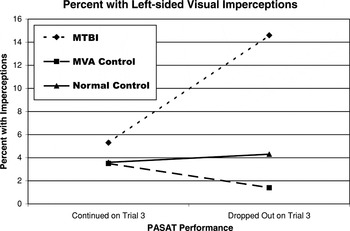
Frequency of left-sided visual imperceptions related to PASAT continuation rates (continued on PASAT trial 3 versus discontinued PASAT after trial 2). Within the MTBI group those who discontinued the PASAT had significantly higher rates of left-sided visual imperceptions. The two control groups had low rates of visual imperceptions regardless of PASAT performance.
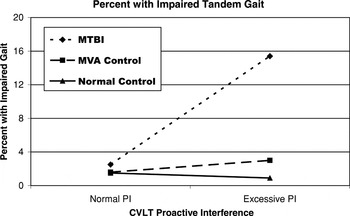
Frequency of impairment in tandem gait related to CVLT proactive interference (PI). Excessive PI was defined as a drop of more than three words recalled from CVLT trial 1 to List B. The two control groups had low rates of impaired tandem gait regardless of level of PI (overall frequency of impaired tandem = 1.5%). For the entire MTBI sample the frequency of impaired tandem gait was 3.9%. However, within the MTBI group those with excessive PI also had a significantly higher rate of impaired tandem gait (15.4%).
 You have
Access
- 244
- Cited by