Introduction
According to the National Committee on Aging in China, the population of people aged 60 and over will grow from 212 million in 2015 to 418 million in 2035 and will reach 29 per cent of the national population by then (He Reference He2015). The escalating needs of elder care will strain both individual families and social care systems. Modernisation and social changes have weakened the family's capacity to take care of its elders (Chen and Silverstein Reference Chen and Silverstein2000). Without necessary resources (Taghizadeh Larsson and Osterholm Reference Taghizadeh Larsson and Osterholm2014), sole reliance on family for elder care may no longer be a realistic option. Institutional care, however, is costly and is undesirable for most older persons (Sixsmith and Sixsmith Reference Sixsmith and Sixsmith2008). A thorough understanding of older adults' intentions for future care arrangements will not only inform service providers in designing their services but also allow policy makers to project future care needs and facilitate better resource management at the community level. It is the aim of the present study to examine the cognitive processes and beliefs associated with older adults' intentions for future care arrangements.
Elder care arrangements and familism
Elder care includes a spectrum of medical and non-medical arrangements provided by professionals, family and friends, and delivered at home, in community centres or in institutional facilities (Robison et al. Reference Robison, Shugrue, Fortinsky and Gruman2014). Although formal support and services allow older persons to maintain their independence, they are often underused in populations that have a strong belief in familism (Scharlach et al. Reference Scharlach, Kellam, Ong, Baskin, Goldstein and Fox2006). The adherence to familism is also suggested to explain a less active engagement with elder care preparation (Pinquart, Sörensen and Davey Reference Pinquart, Sörensen and Davey2003)
Familism is a family-specific form of collectivism (Kim, Knight and Longmire Reference Kim, Knight and Longmire2007). It refers to a person's attachment to his or her family, beliefs in loyalty and reciprocity, and prioritising of family interest over his or her own needs (Knight and Sayegh Reference Knight and Sayegh2010; Sabogal et al. Reference Sabogal, Marin, Otero-Sabogal, Marin and Perez-Stable1987). According to Losada et al. (Reference Losada, Knight, Marquez-Gonzalez, Montorio, Etxeberria and Penacoba2008), familism has three dimensions: familial obligation, family as referents and perceived support from the family. Familial obligation refers to the responsibilities of supporting family members in need (Losada et al. Reference Losada, Robinson Shurgot, Knight, Marquez, Montorio, Izal and Ruiz2006). Based on the principle of familial obligation, elder care is an essential way for one to fulfil duties and maintain cultural inheritance (Scharlach et al. Reference Scharlach, Kellam, Ong, Baskin, Goldstein and Fox2006). Older people with a strong familial obligation tend to distrust outsiders (John, Resendiz and de Vargas Reference John, Resendiz and de Vargas1997) and use fewer formal services (Herrera et al. Reference Herrera, Lee, Palos and Torres-Vigil2008). Family as referents sets the standard as to how life should be lived (Knight and Sayegh Reference Knight and Sayegh2010). In contexts in which family care-giving is the norm, any alternative arrangements, such as moving into a nursing home, would be considered inappropriate practice (San Antonio and Rubinstein Reference San Antonio and Rubinstein2004). Perceived support from the family demonstrates one's confidence in relying on family to solve problems. In China, there holds the old saying of raising sons for old-age support. Parents with more sons may have greater confidence in their family's capability of elder care in rural China.
Elder care arrangements in the Chinese context
Similar to the Latino cultural values on which much of the above literature is based, Chinese culture also prescribes family-based care for elders but usually parents count on the oldest son for elder care; daughters are considered outsiders after they get married (Ting and Chiu Reference Ting and Chiu2002). The adherence to familism is still prevalent in rural China where formal support and services are limited. In a longitudinal study involving 1,170 rural elders in Anhui Province, China, Cong and Silverstein (Reference Cong and Silverstein2012) found that parents favoured sons as care-givers on average but the importance of daughters in elder care was increasing.
Compared with rural elders, elders in urban China may have similar expectation for children to provide old-age support, but may have more receptive attitudes towards formal care. As a result of the One-Child Policy mandated from 1979 to 2015, one couple with only one child has become the prevalent family structure in urban China. When these one-child parents need elder care, their married adult children will have to take care of four ageing parents. Having realised the absolute shortage in family care resources, one-child parents may rely more on outside help and place equal expectations on their only sons and daughters (Downey, Condron and Yucel Reference Downey, Condron and Yucel2013). When older persons in the city of Nantong were asked to select one arrangement for future care, 31.2 per cent selected family care, 15.4 per cent went for institutional care and 53.4 per cent favoured community-based home care (Ge Reference Ge2010). Studies in urban China also revealed that parents of older age, higher income and higher education had less expectation for family-focused care (Long and Feng Reference Long and Feng2007); and elders of worse health status were more likely to turn to institutional care (Zhang and Wei Reference Zhang and Wei2014).
Intended care arrangement as a step in the process of future care preparation
An intended care arrangement (ICA) is an initial expectation for old-age support and can be explained by the model of preparation for future care (PFC; Sörensen and Pinquart Reference Sörensen and Pinquart2001). PFC is composed of five steps: awareness, information gathering, deciding on preference, concrete planning and avoidance. The first four steps are sequential behaviours in order of concreteness. Once older persons become aware of their potential care needs (awareness), they seek out information (information gathering), weigh different options, formulate their own preferences (deciding on preferences) and make concrete plans (concrete planning). According to the PFC model, an ICA formed after awareness and information gathering is an informed decision corresponding to the step of deciding on preferences. Concrete planning guided by a well-researched ICA is associated with lower levels of depression and anxiety after two years (Sörensen et al. Reference Sörensen, Mak, Chapman, Duberstein and Lyness2012) and better adjustment to thinking about a potentially stressful situation (Delgadillo, Sörensen and Coster Reference Delgadillo, Sörensen and Coster2004) in response to a sudden need for intensive care. Older adults state that they feel that care-givers can make better informed decisions if they are aware of care recipients' PFC (Pinquart and Sörensen Reference Pinquart and Sörensen2002).
Although many elders have thought about their future and considered that PFC may have advantages, few engage in concrete planning (Girling and Morgan Reference Girling and Morgan2014; Maloney et al. Reference Maloney, Finn, Bloom and Andresen1996; Sörensen and Pinquart Reference Sörensen and Pinquart2000b ). One reason for this has to do with the fifth aspect of PFC—avoidance. Initial awareness of care needs may cause negative arousal that narrows older adults' attention, diverts them from responding (Aspinwall Reference Aspinwall and Folkman2011) and invites avoidance (Sörensen et al. Reference Sörensen, Duberstein, Chapman, Lyness and Pinquart2008). Empirical findings indicate that people of stronger familial obligation are more likely to take avoidant coping (e.g., denial of a stressor) (Kim, Knight and Longmire Reference Kim, Knight and Longmire2007). An avoidant older person can still have an ICA, but it is based on limited information and potentially less rational.
Study aim and hypotheses
Few studies have examined the effects of familism on ICA planning (Kim, Knight and Longmire Reference Kim, Knight and Longmire2007), and none have been conducted with Chinese families, despite the challenges brought about by fading familism, smaller family sizes and China's distinction as home to the largest absolute number of older people in the world.
Guided by the PFC model (Sörensen and Pinquart Reference Sörensen and Pinquart2001), the present study, therefore, examines preferences for certain ICAs in a representative sample of 516 one-child parents in urban China. The primary aim of this study is to examine the relationship between familism and ICAs from the perspective of PFC. The present study includes five ICAs and divides them into service-focused ICA and family-focused ICA. As per Ganong and Coleman's (Reference Ganong and Coleman2005) suggestions, the study measures familism with normative obligations rather than felt responsibilities as both constructs are similar but the former one creates more emotional distance and reduces social desirability in responses. The study also includes three steps of PFC: awareness, information gathering and avoidance. The step of deciding on preference is excluded because it measures overlapping constructs with ICA. The step of concrete planning is dropped as the experts in the panel and participants in the pilot studies agree that planning behaviours such as ‘writing down my care preferences' may be too early for middle-aged one-child parents.
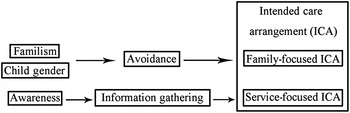
As indicated in Figure 1, we hypothesise two pathways leading to distinct types of ICAs. We hypothesise that a service-focused ICA is formed following the steps of awareness and information gathering. Alternatively, we hypothesise that a family-focused ICA is associated with familism, child gender and avoidance. Though not illustrated in the figure, demographic characteristics are controlled for all analysis because of their associations with ICA found in previous studies.
Conceptual model guiding the inquiry.

Method
This article is part of the larger study ‘Preparation for Future Care Needs Among the First Generation of One-child Parents in China’. The protocol was approved by the research ethics committee of the first author's affiliated university. Data were collected using a quota sampling strategy in Shanghai from June to August 2013. Permanent residents aged 45–65 (equal numbers of men and women) were approached by our partners in sub-district administration agencies in 11 districts and were invited to fill in a questionnaire at the scheduled time. During data collection, at least five trained researchers were on site to assist if participants needed an explanation, could not see the characters clearly or double-checked whether missed questions were left blank on purpose. Those who had more than one child, who had lost both parents or who had cognitive impairment were excluded by our partners before recruitment. A total of 580 participants were recruited and provided written consent. In all, 62 participants quit because of personal issues. Out of the 538 who completed the interview, 22 were excluded because of missing data. The subsequent analysis was conducted on the remaining 516 observations.
Measurements
Tools used in this study were validated through forward–backward translation, consultation with an expert panel and pilot testing.
ICA
Participants rated how likely they were to use each of five care arrangements: 1 (unlikely), 2 (somewhat likely) or 3 (very likely). The five arrangements were not mutually exclusive and were (1) remain in your home and rely mainly on your spouse and siblings for care; (2) remain in your home and personally hire a domestic helper; (3) move in with and rely on your child for care; (4) remain in your home and use community-based services (e.g. senior meal delivery and community-based rehabilitation); and (5) move to an elder-care institution. The first three ICAs are family-focused and the other two ICAs are service-focused.
Familism
Familial obligation was measured by participants' expectations for children's responsibilities for six aspects of elder care. Participants were asked the following: ‘Regardless of the sacrifices involved, how much responsibility should adult children with families of their own have to provide their parents with each of the following six supports?’ Reponses followed a five-point Likert scale from 1 (not responsible at all) to 5 (fully responsible; Silverstein, Gans and Yang Reference Silverstein, Gans and Yang2006). The scale was used in the University of Southern California Longitudinal Study of Generations and proved to be reliable. Higher scores indicate stronger beliefs in filial obligation (α = 0.82). An example of a type of support is ‘providing housing for elderly parents who are in need’.
Child gender
Though child gender (male or female) is a covariate in the study, its association with ICA has stronger roots in familism. In patriarchal societies, men are viewed as more influential than women, and the oldest son is obliged to take care of his biological parents (Guo, Chi and Silverstein Reference Guo, Chi and Silverstein2013). Most parents in rural China favour sons (Cong and Silverstein Reference Cong and Silverstein2012). Therefore, couples with a son may be more confident in their family's ability to solve problems and have higher perceived support from the family.
PFC
Three steps in the care planning process were measured with 11 items from the Preparation for Future Care Needs measure (Sörensen and Pinquart Reference Sörensen and Pinquart2001) and one additional question reflecting familiarity with care-giving burden and services. Participants rated how true 12 statements were for them on a five-point Likert scale from 1 (not at all true of me) to 5 (completely true of me). Awareness was assessed with five items (α = 0.68; e.g. ‘When I compare my health and capabilities with those of other people, I draw conclusions about my future needs’). Information gathering was assessed with four items (α = 0.70; e.g. ‘I have been following the public discussion in the media to learn more about care options’). Avoidance was assessed with three items (α = 0.66; e.g. ‘I try not to think about things like future loss of independence’). Higher scores indicate greater engagement with each aspect of PFC.
Covariates
We controlled for participants' demographic characteristics (age, gender, education and household income) and physical health (α = 0.71) as measured by the Physical Health Component Score of the 12-item Short Form Health Survey (SF-12; Lam et al. Reference Lam, Lam, Fong and Huang2011).
Data analysis
Five ordinal logistic regression models were run using SPSS version 21. The outcome variables were the five types of ICA. Predictive variables were filial obligation, child gender, awareness, information gathering and avoidance. Covariates of demographic characteristics and physical health were controlled across all models. Odds ratios and 95 per cent confidence intervals were calculated for individual predictors. Chi-square tests and log likelihood were used to evaluate overall model fit. Nagelkerke's statistic was used to evaluate model goodness of fit (Peng, Lee and Ingersoll Reference Peng, Lee and Ingersoll2010). A non-significant result for the parallel lines test indicated that the proportional odds assumption was not violated (University of California, Los Angeles, Institute for Digital Research and Education 2015).
Results
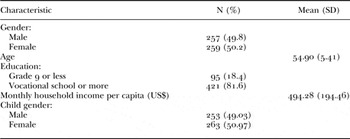
A total of 516 people (257 males and 259 females) aged 45–65 (mean = 54.90 years, standard deviation = 5.41) participated in the study. Most (N = 421, 81.59%) had received further education after graduating from junior high school (nine years of education). They had an average monthly household income per capita of US $494, which was 15.46 per cent lower than the city-wide mean of US $585 (Survey Office of the National Bureau of Statistics in Shanghai 2014). Their demographic information is presented in Table 1.
Demographic characteristics of the sample

Note: SD: standard deviation.
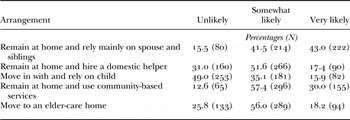
Table 2 presents participants' endorsements of ICA. The most favoured arrangements were remaining at home with the aid of a spouse and siblings (43%) and using community-based services (30%), followed by moving to an institution (18.2%), hiring domestic helpers (17.4%) and relying on children (15.9%). Less than one-third of participants found care provided by persons other than family members to be unacceptable (12.6–31.0%).
Intended care arrangements

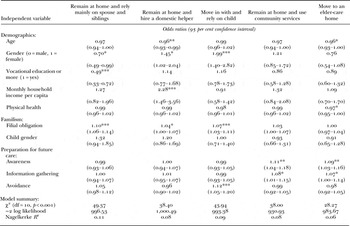
Table 3 displays the results from the logistic regression. Significant model chi-square statistics showed that familism and PFC were reliable predictors of all five outcomes when covariates were controlled. The proportional odds assumption was valid, although the pseudo R-squared was quite low.
Logistic regression models of intended care arrangements

Note: df: degrees of freedom.
Significance levels: * p < 0.05, ** p < 0.01, *** p < 0.001.
As hypothesised, using community-based services and using an institution were positively associated with awareness and information gathering. Relying on one's child was more prevalent among participants who actively avoided planning. Participants with stronger filial obligation had greater expectations of ageing at home with the aid of a spouse, siblings and helpers. Contrary to our hypothesis, child gender was not related to ICA preference.
In our sample, older age was negatively associated with choosing a domestic helper and institutional care. Female participants preferred staying at home and receiving care from helpers and their children. However, females and participants with more education expressed weaker intentions of relying on a spouse and siblings for old-age support than males and participants with less education, respectively. Participants from wealthier households were more willing to hire a domestic helper. Better physical health was negatively linked with a preference for institutional care.
Discussion
This study investigated the relationship between familism and five potential care arrangements through the lens of the PFC model. The findings enhance researchers' understanding of care preferences in a population that prioritises family over individuals. We first hypothesised that service-focused ICAs would be a more conscious choice generated after awareness and information gathering. In previous studies, these two steps of PFC predicted more advanced planning in American and European populations (Mak and Sörensen Reference Mak and Sörensen2012; Sörensen et al. Reference Sörensen, Duberstein, Chapman, Lyness and Pinquart2008; Sörensen and Pinquart Reference Sörensen and Pinquart2000a ). Consistent with these findings, we found that awareness and information gathering were associated with greater expectations for using community-based services and elder-care homes. There are two plausible explanations for the non-significant associations between PFC and family-focused ICA. First, family has played a dominant role in elder care in Chinese families for centuries. It is such a deep-rooted norm that it has turned into a default expectation, thus not requiring awareness of care needs or conscious information gathering and decision making. Second, Chinese elders know exactly how their families are capable of providing care to them, but they may be unfamiliar with formal care services. Information gathering is essential for service selection, whereas counting on family does not require extra knowledge. We also hypothesised that avoidant participants would be likely to choose a family-focused ICA. This was confirmed by the positive association between avoidance and the arrangement of relying on one's child.
These preferences may have significant policy implications. Although family care sounds plausible, it is threatened by fading familism and smaller family sizes. Also, younger adults in modern China may value individualism over collectivism, and thus may not want to limit their personal lives for elder care (Zhang Reference Zhang2004). This may be especially true in the People's Republic of China. Out of 430 million households in the People's Republic of China, 330 million are single-child families because of one-child policies (National Health and Family Planning Commission of the People's Republic of China 2014). By the time the participants in the current study need elder care, their married children may be faced with helping to care for four elders and two children or adolescents. Care-giving may become so demanding that families may be forced to resort to formal support.
We also hypothesised that familism would increase the likelihood of a family-focused ICA. As expected, participants with stronger filial obligation were in favour of care by family members and home-based care with domestic helpers. Hiring a domestic helper was so well accepted for four reasons. First, domestic help has been used for decades and is more popular than community-based services (Wu et al. Reference Wu, Carter, Goins and Cheng2005). Second, the service is delivered by one specific helper in the home, an environment familiar to the older person and in which he or she feels at ease. Third, domestic helpers usually live with older persons for a longer period of time and are regarded as quasi-family members. This is different from most in-home household and health services available in the Western world. Fourth, the services are sometimes paid for by adult children and are perceived as a way in which adult children can fulfil their traditional filial responsibilities (Chen Reference Chen2015).
In patriarchal Chinese culture, sons are obliged to provide elder care. Therefore, one would expect parents of sons to be more confident of family-based old-age support and to be inclined to prefer family-focused care arrangements. However, we did not find evidence for this hypothesis. The non-significant association between child gender and family-focused care arrangements implies that nowadays daughters and sons may bear similar filial responsibilities in urban China. As a result of one-child policies initiated in 1979, parents often exhausted their resources to cultivate the only inheritor of the family (Zhan Reference Zhan2004). For the first time, urban daughters became competent through education and financial independence (Fong Reference Fong2002). As a result, they now bear equal, if not greater, responsibility for supporting their parents as do sons. Even the traditional preference for sons is called into question, as daughters are more attentive to parents' emotional needs and no less capable than sons of providing financial and material support (Liu and Hennock Reference Liu and Hennock2008).
The associations between demographics and ICA yielded inconsistent results with previous studies. Older participants were less in favour of domestic services and elder-care homes than younger participants. This preference can be explained by traditional attitudes of lack of trust in non-family care-givers, crowded living environments, cost and gender inconvenience (e.g. personal hygiene assistance for male elders by female helpers; Zhan, Feng and Luo Reference Zhan, Feng and Luo2008; Zhan, Liu and Bai Reference Zhan, Liu and Bai2005). Female participants were more likely to expect to use domestic helpers and children than their siblings and spouse. In a patriarchal society, providing hands-on care to family members is generally a woman's duty (Lee Reference Lee2010). This may be part of the reason why females in this sample had less confidence in siblings and spouses providing care. Participants with more education tend to favour individualism (Kim, Knight and Longmire Reference Kim, Knight and Longmire2007) and are therefore less likely to rely on a spouse and siblings. It is not uncommon for Asian households that are financially able to hire live-in domestic helpers (Chau et al. Reference Chau, Woo, Kwok, Chan, Hui and Chan2012; Chou, Kröger and Pu Reference Chou, Kröger and Pu2014; Tang et al. Reference Tang, Wu, Yeung and Yan2009; Wee et al. Reference Wee, Liu, Goh, Chong, Aravindhan and Chan2014). Thus, in the present sample, households with more financial resources were more likely to foresee hiring domestic helpers to provide care. As with findings in other studies, people in poor physical health tended to endorse the use of elder-care homes.
The study has four limitations. First, we cannot establish causality between familism and ICA because of the cross-sectional nature of the study design. The PFC model suggests that planning is an unfolding process and has feedback loops. It is possible that older persons may alter their expectations and their value of familism after careful evaluation of their individual needs and family capability. For instance, an older man who realises that his adult child is not capable of providing care to him may lower his expectations of this child, which in turn may change his values of familism. It is also possible that the older man will lower his expectations of his own child but still uphold his own general beliefs.
Second, although we did not hypothesise a path from familism to awareness and information gathering, it is possible that someone who believes in familism becomes aware of future care needs and then gathers information. However, we did not find significant associations between filial obligation and these two aspects of PFC through bivariate correlation analysis in this sample. One possible explanation for this is that familism is multi-dimensional and prescribes norms for both parents and children. The present study measured children's responsibilities for providing elder care for parents; future studies may consider the relationship between other dimensions of familism and PFC.
Third, we did not differentiate between the various types of community-based services and elder-care homes. Herrera et al. (Reference Herrera, Lee, Palos and Torres-Vigil2008) suggested examining different types of community services separately, as barriers to their use may vary for the same respondent. In China, a general term like elder-care home may be poorly defined (Feng et al. Reference Feng, Zhan, Feng, Liu, Sun and Mor2011). In many cases, even professionals find the distinctions between different types of care homes blurred (Wong and Leung Reference Wong and Leung2012). A more nuanced analysis may find that familism predicts preferences for selected community-based services or that PFC predicts some family-based preferences.
Fourth, our participants were single-child parents in urban China. The results may not be applied to urban participants with multiple children or rural participants with limited formal care support and services. Future researchers may also be interested in the associations between ICA and other factors such as predisposing characteristics, enabling resources and needs proposed in Anderson's (Reference Anderson1995) model.
Despite these limitations, this study expands the application of PFC by explicitly linking PFC steps to specific ICAs, rather than just process outcomes. Our results suggest that awareness and information-gathering dimensions of the PFC model are predictive of service-focused ICA in single-child Chinese families, even after familism is controlled for. However, for the family-focused ICA of living with an adult child, only avoidance of thoughts about future care—and no other PFC process variables—was predictive after familism was controlled. Thus, in the context of high familism and available family resources, active PFC may be a less relevant construct than in a less family-focused context, and avoidance may be a more salient motivation.
Results from the present study also raise two important issues that should be addressed in future studies. First, awareness in the context of PFC measures whether an individual realises the potential for requiring personal care in the future and pays attention to information about these needs. The construct does not capture whether the individual realises the widening gap between his or her family's capacity to provide care and his or her growing need for care. It is possible for an individual to be aware of his or her personal needs yet unaware of the limited capacity of the family to provide care. Realisation of the discrepancies between ideal and realistic family support may cause stress, especially when older adults need intensive care (Losada et al. Reference Losada, Marquez-Gonzalez, Knight, Yanguas, Sayegh and Romero-Moreno2010). Identifying these individuals and educating them about their options may help to adjust their expectations to the realities of their situation. Second, although information gathering facilitates more concrete planning in PFC, it does not necessarily lead to greater reliance on services. In a study comparing various ethnic groups in the United States, older Chinese Americans were found to be most informed of the available services in the community compared with other minority groups. However, Chinese Americans in this study still turned to family for support, perhaps because the formal services were not culturally appropriate or because using them at all conflicted with their cultural familism beliefs (Scharlach et al. Reference Scharlach, Kellam, Ong, Baskin, Goldstein and Fox2006).
Our findings showed that urban females were more likely to choose family-based options. According to Goode (Reference Goode1963), modernisation shifts the emphasis of elder care at home from patrilineal to conjugal bonds. Patrilineal bonds remained strong in our sample, as women expressed higher expectations for care from their adult child. One-child policies left women no choice but to rely on daughters as much as on sons. We can infer that the non-significant association between child gender and ICA was due not to lowered expectations for sons but to heightened expectations for daughters. This is consistent with the previous finding that daughters were playing an increasingly important role in elder parents' support networks (Cong and Silverstein Reference Cong and Silverstein2012). Although spousal care has received growing recognition among urban Chinese residents (Li et al. Reference Li, Long, Essex, Sui and Gao2012), we did not find a strong reliance on the conjugal bond for elder care in this study. There are three potential reasons for female participants' reluctance to rely on husbands. First, women in patriarchal societies traditionally are subservient to men. They may not expect their husband to provide hands-on care for them. Second, because it is common for women to assume the role of care-giver, they may doubt that their husbands are capable of providing care. Third, women generally have a longer life expectancy than men (United Nations 2013). As a result, women in the present study may not have considered future care by their husband a feasible option.
Conclusions
This study aimed to understand ICAs in the context of fading familism and smaller families in urban China using a PFC framework. We found that familism was a powerful predictor of a family-focused ICA. Women from single-child households adjusted their care expectations from sole reliance on sons to equal reliance on sons and daughters. With regard to service-focused care arrangements, these single-child Chinese families reported increased awareness and information gathering, which allow them to develop informed preferences. Because avoidance was positively associated with relying on one's child for elder care, we conclude that avoidant families may need assistance in developing awareness of expected needs, understanding available options and developing realistic care expectations. However, based on previous findings linking high awareness to higher distress (Steele, Pinquart and Sörensen Reference Steele, Pinquart and Sörensen2003), interventions should emphasise helping older adults advance towards more concrete planning steps, so the risks of excessive worry and depressive symptoms are lower.
Acknowledgements
The research was self-funded. It was approved by the research ethics committee of The University of Hong Kong (reference number EA450413).