Introduction
There is mounting evidence that maternal factors during pregnancy influence prenatal and postnatal health. Epigenetics, recently defined as ‘the structural adaptation of chromosomal regions so as to register, signal or perpetuate altered activity states’Reference Bird 1 has been extensively studied as a potential mediating mechanism of such influences. The most widely studied epigenetic mechanism in somatic cells is methylation of DNA at the CpG dinucleotide. Dynamic changes in DNA methylation occur during germ cell and pre-implantation development,Reference Smith, Chan and Mikkelsen 2 , Reference Guo, Zhu and Yan 3 which has led to studies investigating the effect of gestational factors that may affect early life development and latent disease risk via changes to DNA methylation. In vitro fertilization (IVF) is a medical treatment used to help couples to conceive. It involves fertilization of the oocyte by sperm outside of the body in a culture medium, after which, viable embryos are transferred into the uterus to establish pregnancy.Reference Chason, Csokmay and Segars 4 In subsets of cases in which sperm motility is affected, intracytoplasmic sperm injection (ICSI) is performed, in which sperm is microscopically injected into the oocyte. Clearly, the initial early life experiences of IVF/ICSI offspring are different from the naturally occurring situation. The question of paramount importance is whether this critical difference of early life environment alters epigenetic profile, including DNA methylation, during development.
A number of studies have attempted to look for associations between IVF/ICSI and DNA methylationReference Katari, Turan and Bibikova 5 – Reference Kobayashi, Hiura and John 10 but most have not controlled for other maternal factors, which may have contributed to the lack of consistency of previous reports. We, and others working with humans and mice, have found evidence that maternal factors such as smoking,Reference Breton, Byun and Wenten 11 – Reference Loke, Galati and Morley 14 vitamin B12,Reference Loke, Galati and Morley 14 folate,Reference Hoyo, Murtha and Schildkraut 15 , Reference Steegers-Theunissen, Obermann-Borst and Kremer 16 alcohol,Reference Haycock and Ramsay 17 stress,Reference Chen, Li and Rialdi 18 macronutrients,Reference Loke, Galati and Morley 14 , Reference Tobi, Slagboom and van Dongen 19 – Reference Heijmans, Tobi and Stein 21 placenta weight,Reference Loke, Galati and Morley 14 cord insertionReference Loke, Galati and Morley 14 and gestational diabetesReference Loke, Galati and Morley 14 each associate with DNA methylation in infants. In addition, consumption of excess folic acid but with vitamin B12 deficiency resulted in reduced global methylation in mouse placental tissueReference Kulkarni, Dangat and Kale 22 and possibly affects fetal growth.Reference Takimoto, Hayashi and Kusama 23 Therefore, we have also analyzed possible associations between DNA methylation and the ratio of serum vitamin B12 to serum folate. Therefore, it is vital to control for these maternal factors that are possibly confounding the effect of IVF on DNA methylation in neonates.
We aimed to investigate associations of IVF with global and imprinted gene DNA methylation, controlling for a wide range of maternal factors. As surrogates for global methylation, we used the interspersed repeats LINE-1 and Alu, which account for 17 and 11% of the genome, respectively.Reference Cordaux and Batzer 24 Levels of transcription of imprinted genes are regulated in a parent-of-origin-specific manner by differentially methylated regions (DMRs), a subset of which, imprinting control regions (ICRs) control the expression of multiple genes within a single locus.Reference Murrell, Heeson and Reik 25 The locus containing the genes IGF2 and H19 is the most common imprinted locus studied in relation to the influence of maternal factors on DNA methylation because the genes play important roles in fetal growth and embryonic development.Reference Goshen, Rachmilewitz and Schneider 26 , Reference O’Dell and Day 27 Previous animal and human studies have identified the IGF2/H19 ICR and H19 promoter DMR as both being associated with gene regulation within the locus,Reference Szabo, Tang and Silva 28 and methylation levels at both loci have been previously associated with IVF.Reference Turan, Katari and Gerson 8 , Reference Nelissen, Dumoulin and Daunay 9 , Reference Fauque, Jouannet and Lesaffre 29
Most studies investigating associations of IVF/ICSI and other maternal factors with DNA methylation have been on singletons.Reference Katari, Turan and Bibikova 5 , Reference Turan, Katari and Gerson 8 , Reference Nelissen, Dumoulin and Daunay 9 Twin studies are powerful because they have the ability to separate out genetic and environmental factors, which include shared factors specific to mothers and non-shared factors associated with each twin. Previous studies showed that there were higher inter-individual and intra-pair variation in IGF2/H19 DMR methylation in IVF singletonsReference Turan, Katari and Gerson 8 and twins.Reference Turan, Katari and Gerson 8 , Reference Li, Wang and Le 30 For the former, this could be due to between-clinic or between-individual heterogeneity in IVF timing and methodologies and for the latter, such effects could represent interactions between IVF and twin-specific factors such as the nutrient supply line to each twin and/or genetic differences between dizygotic twins. To investigate such interactions, we compared the within- and between-pair differences in DNA methylation between IVF and naturally conceived twins using DNA from buccal epithelium. We hypothesized that IVF will associate with differential methylation levels within IGF2/H19 DMRs and on a global scale and that there will be larger within-pair methylation discordance within IVF-conceived twin pairs compared with naturally conceived twins. We used cells of the buccal epithelium because they represent a homogenous cell type that can be collected non-invasively.
Materials and methods
Study cohort
A subgroup of 208 twin pairs from the Peri/Postnatal Epigenetic Twin Study (PETS) cohortReference Saffery, Morley and Carlin 31 , Reference Loke, Novakovic and Ollikainen 32 were included in this study. Mothers were recruited half way through their second trimester and details of IVF procedures were obtained via questionnaire. Twins from mothers who said no to ‘did you need medical help to conceive these twins’ were classified as ‘naturally-conceived twins,’ and twins from mothers who said yes to IVF or ICSI were classified as IVF-conceived twins. Also collected at recruitment were details of smoking, alcohol and supplementary folate intake, and with details of maternal health including gestational diabetes.Reference Loke, Novakovic and Ollikainen 32 The same information was collected at 24 and 36 weeks of pregnancy and additional details of maternal nutritional intake were collected via questionnaire and from blood-derived serum collected at 28 weeks’ gestation. Our study was carried out with appropriate human Ethics approval from the Royal Women’s Hospital (06/21), Mercy Hospital for Women (R06/30) and Monash Medical Centre (06117C), Melbourne.
Tissue collection and cell processing
Cells from the buccal epithelium were collected with Catch-all Sample Collection Swabs (EPICENTRE Biotechnologies, Madison, WI, USA) within 2 weeks of delivery and stored immediately at −20°C until DNA extraction.
DNA extraction, bisulphite conversion, methylation analysis
Genomic DNA (gDNA) was extracted from buccal epithelium through salt extraction as described previously.Reference Ollikainen, Smith and Joo 33 Five hundred nanograms of gDNA were bisulphite converted using the MethylEasy Exceed Rapid Bisulphite Modification Kit (Human Genetic Signatures, North Ryde, NSW, Australia). The IGF2/H19 ICR and H19 promoter DMR regions were the same regions analyzed in our previous study.Reference Loke, Galati and Morley 14 Alu primers were designed in-house using EpiDesigner (Sequenom Inc., Herston, QLD, Australia), and primers for LINE-1 were obtained from a previous study.Reference Flotho, Claus and Batz 34 Primer sequences and PCR conditions are outlined in Supplementary Table 1. DNA methylation data were obtained by using MassARRAY EpiTYPER (Sequenom Inc.). The genomic coordinates for CpG units analyzed for IGF2/H19 ICR and H19 promoter DMR are detailed in Supplementary Table 2. Data for at least two technical replicates per amplicon were obtained for analysis. Data cleaning and removal of CpG sites overlapping with SNPs that abolish CpG site in one or two alleles were done as outlined previously.Reference Ollikainen, Smith and Joo 33 Batch correction was performed in a few steps. First, samples that overlapped (samples that had methylation data for both batches) were examined on scatterplots to investigate the nature of the batch effect. It was judged that a linear translation of the values of the second sample would suffice to remove the effect. A ‘constant value’ was calculated using these overlapped samples, by subtracting ‘mean of second batch’ from ‘mean of first batch.’ This was done separately for each assay. Second, the ‘constant values’ were added to the methylation values from the second batch.
Statistical analysis
Multiple linear regression was used to assess associations between DNA methylation and IVF as a whole or its ICSI and non-ICSI subsets, taking account of twin pairs sharing the same mother. ‘Macronutrient’ level was derived from measures of protein, energy and carbohydrate intake, as outlined in our previous study.Reference Loke, Galati and Morley 14 All continuous variables and methylation data were converted to z-scores for comparison of effect sizes across all variables. Within-pair methylation discordance values were calculated by the absolute methylation difference between twin 1 and twin 2 and were also converted to z-scores. Within-pair methylation variances for IVF/ICSI and naturally conceived twins were compared using the F-test, which compares the variances between two populations. Regression coefficients were converted to percentage difference in mean DNA methylation by multiplying each regression coefficient by the average standard deviation across CpG units. All 95% confidence intervals are provided in the tables. Bonferroni testingReference Bland and Altman 35 was used to calculate a stricter P-value threshold to reduce the number of false positives, leading to an adjusted P-value threshold of 0.003. Unadjusted P-values between 0.01 to <0.05 were considered as ‘weak evidence,’ P-values between 0.003 and <0.01 were considered as ‘moderate evidence’ and P-values <0.003 were considered as ‘strong evidence’ against the null hypothesis of no differences in DNA methylation. Multiple linear regression analyses and F-tests were performed using STATA 11, and box plots were produced using GraphPad Prism 5 software.
Results
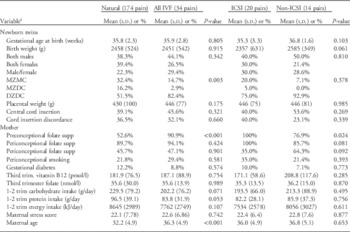
Sample characteristics and maternal data used for this study are listed in Table 1 and Supplementary Table 3, respectively. There was no evidence of differences in maternal characteristics between natural v. all-IVF groups and ICSI v. non-ICSI groups apart from zygosity and chorionicity (P<0.003 for natural v. all IVF groups), preconceptional folate supplement (P<0.001 for natural v. all IVF groups; P=0.024 for IVCI v. non-ICSI groups) and maternal age (P<0.001 for natural v. all IVF group). Multiple linear regression analysis was used to assess associations between IVF and DNA methylation in Alu, LINE-1 and the IGF2/H19 ICR and H19 promoter DMR, adjusting for peri/preconceptional folic acid intake, 28-week maternal serum folate, periconceptional alcohol intake, periconceptional smoking, maternal stress, maternal macronutrients, ratio of serum vitamin B12 to serum folate, serum vitamin B12, placental weight, umbilical cord insertion site (central v. peripheral), gestational diabetes, gestational age, maternal age and infant sex.
Newborn twins and maternal characteristics

IVF, in vitro fertilization; ICSI, intracytoplasmic sperm injection; MZMC, monozygotic monochorionic; MZDC, monozygotic dichorionic; DZDC, dizygotic dichorionic; supp, supplementation.
a A full description of variables can be found in Supplementary Table 3.
Newborn IVF-conceived twins have lower global and IGF2/H19 ICR methylation
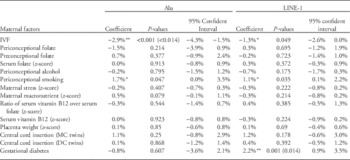
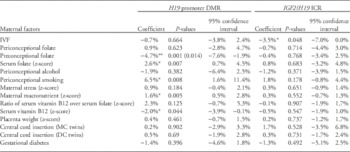
We found strong evidence of lower Alu methylation (−2.9%, P<0.001, Table 2) and weak evidence of lower LINE-1 methylation in IVF newborn twins compared with naturally conceived twins (−1.3%, P=0.049, Table 2). We found weak evidence of lower IGF2/H19 ICR methylation in IVF-conceived twins compared with naturally conceived twins (−3.5%, P=0.048, Table 3) but no evidence of a similar relationship in the H19 promoter DMR (P=0.664, Table 3).
Multiple linear regression of global methylation in buccal epithelium

Coefficients for maternal stress, maternal macronutrients, maternal serum vitamin B12 and placenta weight represent percentage difference in mean methylation for one standard deviation unit increase in the corresponding factor. Coefficients with P-values <0.05 are identified by a single asterisk. P-values in parentheses are adjusted P-values (using Bonferroni), and are only listed if the unadjusted P-values are <0.003 (adjusted P-value threshold after Bonferroni correction), and accompanied by double asterisks.
Multiple linear regression of H19 promoter DMR and IGF2/H19 ICR methylation in buccal epithelium

DMR, differentially methylated region; ICR, imprinting control region; IVF, in vitro fertilization.
Coefficients for maternal stress, maternal macronutrients, maternal serum vitamin B12 and placenta weight represent percentage difference in mean methylation for one standard deviation unit increase in the corresponding factor. Coefficients with P-values <0.05 are identified by a single asterisk. P-values in parentheses are adjusted P-values (using Bonferroni), and are only listed if the unadjusted P-values are <0.003 (adjusted P-value threshold after Bonferroni correction), and accompanied by double asterisks.
Methylation differences in the IGF2/H19 ICR between IVF-conceived twins with and without ICSI
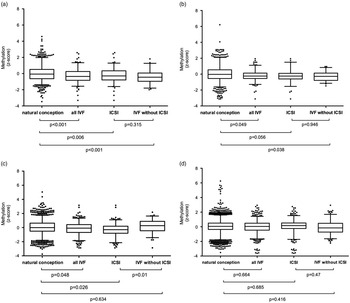
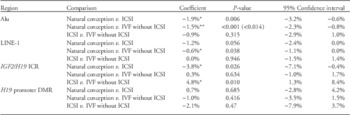
To investigate whether the global and IGF2/H19 methylation differences between IVF and naturally conceived twins were driven by ICSI, we further stratified IVF individuals to with or without ICSI. Linear regression was used to test for any methylation differences among these three groups, adjusting for maternal age, sex and birth weight. We found no evidence for a difference in DNA methylation of Alu and LINE-1 between twins conceived by ICSI and those conceived by IVF without ICSI (Fig. 1a and 1b) and weak evidence for lower methylation of IGF2/H19 ICR in twins conceived by ICSI compared with IVF without ICSI (−4.8%, P=0.01, Table 4, Fig. 1c). As we found weak evidence for lower IGF2/H19 ICR methylation in ICSI twins compared with naturally conceived twins (−3.8%, P=0.026, Table 4, Fig. 1c), but no evidence for differences between IVF without ICSI and naturally conceived twins, we conclude that lower methylation in IVF-conceived twins is driven by ICSI within the IGF2/H19 ICR.
Box plots and P-values of (a) Alu, (b) LINE-1, (c) IGF2/H19 ICR and (d) H19 promoter DMR methylation stratified according to mode of conception. The solid horizontal lines in the boxes represent the median, the box represent data within the 25th and 75th percentile range. Whiskers represent data within 5th and 95th percentile range, and the dots represent outliers.

DNA methylation differences between naturally conceived twins, IVF without ICSI and ICSI newborn twins

IVF, in vitro fertilization; ICSI, intracytoplasmic sperm injection; ICR, imprinting control region; DMR, differentially methylated region.
Coefficients with P-values <0.05 are indicated by a single asterisk. P-values in parentheses are adjusted P-values (using Bonferroni correction), and are only listed if the unadjusted P-values are <0.003 (adjusted P-value threshold after Bonferroni correction), and are accompanied by double asterisks.
Association between IVF and within-pair and between-pair variation in DNA methylation
To test our hypothesis that IVF is associated with greater within-pair and between-pair variation in DNA methylation we used two different methods. We first used regression analysis and found no evidence for an association between IVF and within-pair methylation discordance for Alu, IGF2/H19 ICR and the H19 promoter DMR (P>0.05, Supplementary Table 4). However, we found weak evidence of a slight reduction in within-pair LINE-1 methylation discordance within IVF-conceived twin pairs compared with naturally conceived pairs (−0.4%, P=0.016, Supplementary Table 4). This evidence remained even after adjusting for chorionicity and zygosity (data not shown). Second, for between-pair variation analysis, variation of DNA methylation within IVF-conceived and naturally conceived twin pairs was analyzed using F-tests. We found evidence for smaller variance in Alu, LINE-1 and H19 promoter DMR methylation in IVF-conceived twins as compared with naturally conceived twins (P=0.006, P<0.001, P=0.029, respectively, Supplementary Table 5).
Associations of other maternal nutritional and lifestyle factors with global and IGF2/H19 methylation in buccal epithelial cells
Of the other maternal factors, we analyzed in the same manner as mode of conception (controlling for all other factors) we found weak evidence that periconceptional smoking is associated with Alu and LINE-1 methylation (1.7%, P=0.047; 1.1%, P=0.035, Table 2). We found strong evidence that gestational diabetes is associated with LINE-1 DNA methylation level (2.2%, P=0.001, Table 2) but not Alu methylation. We found strong evidence of association of preconceptional but not periconceptional folic acid supplementation on DNA methylation of the H19 promoter DMR (−4.7%, P=0.001, adjusted P=0.014, Table 3), moderate evidence for association of serum folate (2.6%, P=0.007, Table 3), periconceptional smoking (6.5%, P=0.008, Table 3) and macronutrient score (1.6%, P=0.005, Table 3) with DNA methylation at the H19 promoter DMR and weak evidence for association of serum vitamin B12 (−2.0%, P=0.044, Table 3) in the same region. No significant associations were found between maternal factors other than IVF with IGF2/H19 DMR methylation (Table 3) or between supply line factors of placental weight or cord insertion and DNA methylation in any of the regions studied (Tables 2 and 3).
Discussion
Comparison of IVF-conceived twins and naturally conceived twins
Our aims were to investigate associations between IVF/ICSI and DNA methylation on a global scale, using proxies of Alu and LINE-1, and the locus-specific scale, within the IGF2/H19 imprinted region, controlling for other maternal and gestational factors.
Both global and IGF2/H19 ICR DNA methylation showed evidence of lower DNA methylation in IVF-conceived twins compared with naturally conceived twins, with strongest evidence seen for Alu repeats. This is in contrast to a previous studyReference Kobayashi, Hiura and John 10 in which no significant differences in Alu and LINE-1 methylation were found between IVF- and naturally conceived singleton, 6–9 week-old aborted conceptuses. However, as our studies differ in tissue type and gestational age, they are difficult to compare. Whitelaw et al.Reference Whitelaw, Bhattacharya and Hoad 36 performed a similar analysis in three groups of children (natural conception, IVF non-ICSI and ICSI) and although they found no evidence of LINE-1 methylation differences in buccal cell DNA between these groups, there was a trend toward lower methylation (~−1%) in the IVF only group, which agrees with our findings.
Reduced global methylation is found in most cancers,Reference Luo, Lu and Xie 37 , Reference Kitkumthorn, Keelawat and Rattanatanyong 38 where it may be associated with prognosis.Reference Li, Huang and Zeng 39 , Reference Baccarelli, Wright and Bollati 40 Outside cancer, global methylation is negatively correlated with exposure to traffic particlesReference Baccarelli, Wright and Bollati 40 and adiposityReference Perng, Mora-Plazas and Marin 41 in children, and heart disease, stroke,Reference Baccarelli, Wright and Bollati 42 inflammationReference Baccarelli, Tarantini and Wright 43 and levels of blood lipidsReference Pearce, McConnell and Potter 44 , Reference Cash, McGarvey and Houseman 45 in adults, although a positive correlation between global methylation and insulin resistance was found in adults.Reference Zhao, Goldberg and Bremner 46 Of note, higher levels of multiple cardiometabolic phenotypes have previously been found in IVF-conceived offspring.Reference Hart and Norman 47 Although reduced global methylation in cancer is associated with genome instability,Reference Kawano, Saeki and Kitao 48 , Reference Esteller 49 no such evidence exists outside cancer, possibly because effect sizes are generally smaller (<5% for non-cancer studiesReference Pearce, McConnell and Potter 44 , Reference Cash, McGarvey and Houseman 45 compared with >10% in cancer studiesReference Kawano, Saeki and Kitao 48 , Reference Suter, Martin and Ward 50 , Reference Gao, Qu and Chang 51 ). Nevertheless, taken together with our data, these findings support the continued study of global methylation as a potential biomarker for prenatal environment and clinical outcomes associated with IVF and ICSI.
The lower levels of DNA methylation we observed in Alu, LINE-1 and IGF2/H19 in IVF-conceived twins could be due to a number of factors including fertility of either parent and culture conditions for IVF. We found weak evidence that ICSI is driving the difference only at the IGF2/H19 ICR, which suggests that ICSI per se could affect DNA methylation in a locus-specific manner. One other study performed a similar analysis on buccal cell DNA from offspring, between birth and 7 years of age, on DNA methylation within the IGF2/H19 locus, albeit in a DMR within the IGF2 gene.Reference Whitelaw, Bhattacharya and Hoad 36 No evidence was found for such an association (n=29 IVF no ICSI, n=20 ICSI, n=86 natural). The discrepancy between the two studies is likely to be due to difference in DMRs analyzed. We suggest that ICSI and/or IVF procedures affect DNA methylation in a locus-specific and tissue-specific manner. It is worth noting that within the IGF2/H19 locus, methylation changes in the ICR are likely to be correlated with expression changes.Reference Bell and Felsenfeld 52 , Reference Thorvaldsen, Duran and Bartolomei 53 Such studies have shown that ICR methylation is positively correlated with expression of IGF2. If we assume that perinatal DNA methylation state reflects embryonic DNA methylation state, we would expect lower ICR methylation to associate with lower IGF2 expression and reduced fetal growth. It is therefore of note that ICSI-conceived twins were 228 g lighter than no-ICSI IVF-conceived twins (P=0.061). However, larger studies of methylation and studies of expression are needed to further investigate this relationship. Another possibility is that the DNA methylation differences we found in the IGF2/H19 ICR in ICSI-conceived offspring could be explained by male infertility, although we do not have the data to investigate this. This hypothesis was extrapolated from the findings of a previous study,Reference Kobayashi, Hiura and John 10 which found that H19 promoter methylation error, defined as having a range of methylation beyond ±2 s.d. of the mean methylation in natural conception, in IVF fetuses was also present in the fathers’ sperm.
Smaller within-pair and between-pair variation in DNA methylation in IVF-conceived twins
We observed a smaller variance in both within- and between-pair methylation in IVF-conceived twins. This does not support our hypothesis that IVF is associated with higher within-pair and between-pair variation in DNA methylation. This also disagrees with previous studies showing larger intra- and inter-individual variation in methylation in IVF offspring in a human study,Reference Turan, Katari and Gerson 8 and larger differences in placenta/fetal ratio in an mouse IVF study.Reference Bloise, Lin and Liu 54 , Reference Delle Piane, Lin and Liu 55 Though these studies were analysing methylation of cordReference Turan, Katari and Gerson 8 and cord blood,Reference Turan, Katari and Gerson 8 and placental and embryo sizes of mice,Reference Bloise, Lin and Liu 54 , Reference Delle Piane, Lin and Liu 55 which are different from our study (buccal epithelium), our result is an important finding because it does not support the idea that IVF pregnancies are somehow more variable in outcome than non-IVF pregnancies. We have previously shown that central cord insertion can influence DNA methylation.Reference Loke, Galati and Morley 14 Thus, one possible reason we speculate for lower methylation variation in IVF-conceived twins could be the lower discordance in cord insertion (central v. peripheral) within IVF-conceived twins compared with naturally conceived twins (32.1 v. 36.5%, P=0.660, Table 1). However, larger studies of multiple loci and tissues are needed to further investigate these relationships.
Comparison with our previous study
Of the four maternal factors (periconceptional smoking, maternal macronutrient, serum vitamin B12, and central cord insertion in DC twins) we previously found to be associated with H19 promoter DMR methylation in the same tissue,Reference Loke, Galati and Morley 14 only two, maternal macronutrient and maternal serum vitamin B12, were replicated in the larger data set analyzed in the current report (Supplementary Table 6). None of the maternal factors with evidence of associations in the IGF2/H19 ICR from our previous study were replicated in our current, larger data set. We accept the possibility of false positives in our earlier study and/or a batch effect between studies, despite our attempt to correct this using statistical methods. Clearly, multiple, independent studies are required to achieve reliable biomarkers of early life environment.
Associations of folic acid supplement intake with H19 promoter DMR methylation may be timing-specific
We found evidence of a negative association of preconceptional but not periconceptional folic acid supplement intake (as assessed by questionnaire) with H19 promoter DMR methylation with an effect size of 4.7%, which is relatively large for studies of the associations between prenatal factors and neonatal DNA methylation. Hoyo et al.Reference Hoyo, Murtha and Schildkraut 15 observed moderate evidence for a negative association of both pre- and periconceptional folic acid supplementation on DNA methylation in a region close to the IGF2/H19 ICR in umbilical cord DNA (−2.8%, P=0.04 and −4.9%, P=0.05, respectively). Although further studies are required to confirm these relationships, our studies point to the preconception as an understudied time period that may, though the vulnerability of the oocyte, represent a vital window for the developmental origins of health and disease.
We found a positive association between 28-week (third trimester) serum folate levels and DNA methylation at the H19 promoter DMR, contrary to the negative association with preconceptional folic acid supplement intake. However, the two measures are not directly comparable and further studies are needed to compare effect of folate intake across gestation.
Strengths and limitations
To our knowledge, this is the first study that has controlled for multiple maternal factors when analysing the association between IVF/ICSI and DNA methylation. Also, to our knowledge, this is the largest sample size used for analysing methylation differences between IVF/ICSI and naturally conceived twins. Correction for multiple testing was also performed through stringent Bonferroni corrections to reduce the possibility of false positives.
One of the limitations of this study is that the data obtained for maternal factors (apart for 28 weeks serum folate and serum vitamin B12) was solely based on the answers given by mothers and it is difficult to know for sure whether recall was accurate. However, mothers were recruited during their second trimester, thus minimizing recall bias. Due to the time taken to collect biological samples from our cohort, which took two and a half years to recruit, our data was generated in batches, which may contribute to a batch effect, despite our batch correction. We also lacked information on parental fertility so it was not possible to adjust for this variable. While we are not able to completely rule out postnatal effects on the observed methylation differences, such effects are likely to be negligible as buccal swabs were collected within 72 h of birth and we do not expect postnatal environment to be influenced by IVF-related effects.
Conclusions
We have presented strong evidence associating IVF with lower levels of Alu methylation and weak evidence of lower methylation in LINE-1 and within a region controlling expression within the IGF2/H19 imprinted gene locus involved in fetal growth. Our findings have also indicated potential evidence of ICSI being the driving factor in the methylation differences in IGF2/H19 ICR. Further studies are needed to discover whether these findings are locus- and tissue-specific and whether they are related to gene expression, genome stability and health outcomes in IVF-conceived children.
Acknowledgments
The authors thank John Carlin, Clinical Epidemiology and Biostatistics Unit (CEBU), MCRI, Mark Umstad, Royal Women’s Hospital, Melbourne, Euan Wallace, Monash Medical Centre, Melbourne and Mark Permezel, Mercy Hospital for Women, Melbourne for their contributions to establishing the PETS cohort; Sarah Healy, Tin Vaiano, Nicole Brookes, Jennifer Foord, Sheila Holland, Anne Krastev, Siva Illancheran and Joanne Mockler for recruitment and sample collection, Technical Officer Anna Czajko, Study Coordinator Geraldine McIlroy, research assistant Xin Li and Yun Dai, and all mothers and twins that participated in this study.
Financial Support
This work was supported by grants from the Australian National Health and Medical Research Council (grant numbers 437015, 607358 to Jeffrey M. Craig and Richard Saffery); the Financial Markets Foundation for Children (grant number 032–2007); and the Victorian Government’s Operational Infrastructure Support Program. The authors have no competing financial interests.
Conflicts of Interest
None.
Ethical Standards
The authors assert that all procedures contributing to this work comply with the ethical standards of the Australian guidelines on human experimentation and with the Helsinki Declaration of 1975, as revised in 2008, and has been approved by the institutional committees as indicated in the manuscript.
Supplementary materials
To view supplementary material for this article, please visit http://dx.doi.org/10.1017/S2040174415000161