A significant proportion of patients who underwent atrial switch procedures for transposition of the great arteries have now reached adulthood. Many present with the late sequelae of systemic right ventricular dysfunction.Reference Graham, Burger, Bender, Hammon, Boucek and Appleton 1 – Reference Wong, Venables, Kelly and Kalff 3 However, current right ventricular imaging techniques have important limitations in their accuracy and applicability. Echocardiographic assessment of right ventricular function has been challenging because of the complex geometry. Magnetic resonance imaging and three-dimensional echocardiography allow accurate assessment of right ventricular ejection fraction, but are difficult to apply in day-to-day practice.
Peak oxygen consumption measured by cardiopulmonary exercise test is a widely accepted, valid, and objective measure of exercise capacity and has a strong predictive value in acquired heart failure and congenital cardiac disease including patients with transposition of the great arteries after atrial switch.Reference Benson, Bonet and McLaughlin 4 – Reference Giardini, Hager and Lammers 6 Resting echocardiographic parameters assessing systemic right ventricular function have in the past failed to adequately predict peak oxygen consumption,Reference Hechter, Webb and Fredriksen 7 , Reference Li, Hornung and Francis 8 as has right ventricular ejection fraction measured by magnetic resonance imaging.Reference Roest, Lamb and van der Wall 9 Clinically relevant measures of right ventricular function are thus still lacking for this population.
Total isovolumic time, the time in the cardiac cycle during which the systemic ventricle is neither filling nor ejecting, has been shown to be prolonged in dilated cardiomyopathy and is a major independent predictor of exercise capacity.Reference Duncan, Francis, Gibson and Henein 10 Moreover, shortening total isovolumic time by means of cardiac resynchronisation therapy significantly improves cardiac output and symptoms in this population. Indeed, in acquired heart failure, total isovolumic time was a better predictor of the response to cardiac resynchronisation therapy than segmental markers of dyssynchrony.Reference Duncan, Wait, Gibson and Daubert 11 , Reference Duncan, Lim, Clague, Gibson and Henein 12
We hypothesised that total isovolumic time might be prolonged in the systemic right ventricle and relate to impaired exercise capacity late after atrial switch for patients with transposition of the great arteries.
Methods
We included all adult patients with confirmed transposition of the great arteries and prior atrial switch procedure, who underwent transthoracic echocardiography and cardiopulmonary exercise testing in our centre – within a year of each other – between January, 2006 and January, 2009. Clinical and demographic characteristics were collected from clinical databases. Patients with surgery, interventions, or acute events between the two investigations were excluded. Patients with resting cyanosis – oxygen saturation taken after 5 minutes of rest before exercise – were also excluded to avoid the confounding effect of cyanosis on the relationship between ventricular function and exercise capacity.Reference Diller, Dimopoulos and Okonko 13 , Reference Dimopoulos, Okonko and Diller 14 In all, 10 healthy subjects of similar age were included as controls.
Echocardiography
All patients and controls underwent comprehensive transthoracic echocardiography with a Phillips ultrasound imaging system (Sonos 7500 Hewlett–Packard Incorporated, Andover, Massachusetts, United States of America) interphased with a multi-frequency transducer echocardiographic machine. We performed two-dimensional and M-mode echocardiography according to the American Society of Echocardiography guidelines.Reference Henry, DeMaria and Gramiak 15 The right ventricular size was assessed using the mid-ventricular diameter on apical four-chamber view. The ejection fraction of the systemic right and subpulmonary left ventricles was assessed visually and reported using a four-level semi-quantitative scale – described as normal, mildly, moderately, or severely reduced. The right ventricular long-axis total amplitude, also known as tricuspid annular plane systolic excursion, was measured by M-mode echocardiography at the lateral portion of the tricuspid annulus. Tricuspid valve regurgitation was also quantified semi-quantitatively as none, mild, moderate, or severe. Transtricuspid flow velocity was obtained from the apical four-chamber view using pulsed wave Doppler with the sample volume placed at the tips of the tricuspid leaflets. Filling time was measured using leading-edge methodology from the onset of the E wave to the end of the A wave.
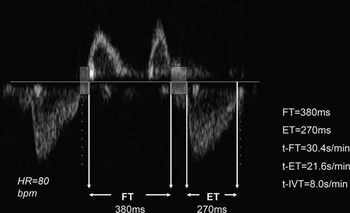
Subaortic and subpulmonary flow velocities were measured by pulsed wave Doppler in the apical views, with the sampling volume placed 1 centimetre below the aortic and pulmonary cusps, respectively. Total right ventricular ejection and filling times were derived as the product of heart rate (HR) and ejection time (ET) or filling time (FT), respectively, and expressed as seconds per minute. Total isovolumic time was then calculated (Fig 1):Reference Duncan, Francis, Gibson and Henein 10

Measurement of the total isovolumic time. HR = heart rate; t-FT = total filling time; t-ET = total ejection time; t-IVT = total isovolumic time.

Isovolumic contraction time was also recorded as the time interval between the onset of right ventricular contraction and ejection. Isovolumic relaxation time was reported as the time interval from the end of ejection to the onset of transtricuspid flow. The right ventricular myocardial performance indexReference Tei, Dujardin, Hodge, Kyle, Tajik and Seward 16 – Reference Tei, Nishimura, Seward and Tajik 18 was also calculated. Left ventricular and right ventricular pre-ejection periods were assessed by measuring time from the onset of the QRS complex to the onset of pulmonary or aortic flow, respectively. The difference between these two periods was reported as a measure of interventricular incoordination. Continuous wave Doppler was used to estimate the mean and peak pressure drop across the pulmonary or subpulmonary stenosis, when present. In order to assess intra- and inter-observer agreement, repeat measurements of total isovolumic time were performed in a blinded manner on the same digital recordings at 1-month intervals by the same and a different observer on 20 patients. It is important to note that ejection times and filling times were measured for calculation of the total isovolumic time and not a summation of the isovolumic contraction and relaxation times.
Cardiopulmonary exercise testing
An incremental maximal treadmill exercise protocol (modified Bruce) was used in all cases, which includes a stage 0 during which patients walk at a velocity of 1 mile per hour at a 5% gradient. A respiratory mass spectrometer (Amis 2000, Innovision, Odense, Denmark or Ultima PFX, Medgraphics Cardiorespiratory Diagnostics, Saint Paul, United States of America) was used to measure minute ventilation, carbon dioxide production, and oxygen consumption. Patients were encouraged to exercise to exhaustion. Peak oxygen consumption and anaerobic threshold were recorded, and peak oxygen consumption was expressed as a percentage of predicted for age, sex, height, and weight. Oxygen saturation was monitored throughout the study using pulse oximetry, and exercise-induced cyanosis was defined as oxygen saturations less than 90% at peak exercise. Heart rate reserve was calculated as the difference between predicted peak heart rate (220 minus age) and achieved peak heart rate during exercise.
Statistical analysis
Categorical variables were expressed as number (percentage) and compared between groups using Fisher's test or chi-square test, as appropriate. Continuous variables were expressed as mean plus or minus standard deviation and compared using the Wilcoxon rank-sum test or Student's t-test, as appropriate. The correlation between continuous variables was assessed using univariable linear regression analysis. Significant variables on univariable analyses were included in a stepwise backward multivariable analysis. Bland–Altman plots were produced and 95% limits of agreement calculated to assess the inter- and intra-observer agreement. Moreover, the repeatability coefficient was calculated, which is the value that encompasses 95% of measurements obtained by the same method.
A two-sided p-value of less than 0.05 was used to indicate statistical significance. Statistical analyses were performed using R version 2.8.0 (R Foundation for Statistical Computing, Vienna, Austria).
Results
Demographic and clinical characteristics
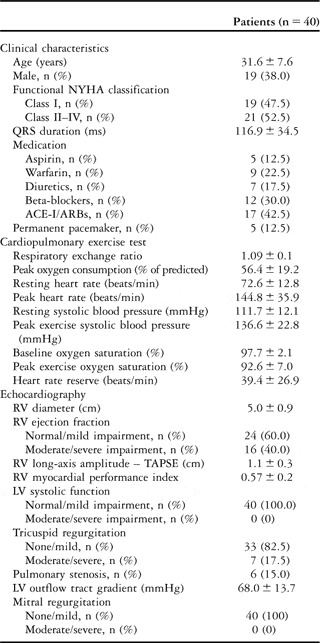
The mean age of the 40 patients was 31.6 plus or minus 7.6 years, and 38% were men (Table 1). The age at atrial switch surgery was 25.4 plus or minus 23.4 months. The majority of patients (52.5%) were symptomatic with reduced exercise tolerance. QRS duration on 12-lead electrocardiography was 116.9 plus or minus 34.5 milliseconds. There were 35 patients with a dominant R in lead V1, reflecting right ventricular hypertrophy. In all, 12 (30.0%) patients were on beta blockers, and 17 (42.5%) were receiving an angiotensin-converting enzyme inhibitor or angiotensin II receptor blocker, three patients were on a loop diuretic, and four were on spironolactone. There was one patient who had permanent atrial fibrillation, with optimal rate control, and five patients (12.5%) who had a permanent pacemaker for complete heart block – all were dual chamber and rate responsive with the pacing lead in the subpulmonary left ventricle.
Baseline characteristics.

ACE-I = angiotensin-converting enzyme inhibitors; ARB = angiotensin II receptor blockers; LV = left ventricular; NYHA = New York Heart Association; RV = right ventricular; TAPSE = tricuspid annular plane systolic excursion
Cardiopulmonary exercise testing
All patients underwent cardiopulmonary exercise testing without complication. Resting and peak heart rate were 72.6 plus or minus 12.8 beats per min and 144.8 plus or minus 35.9 beats per min, respectively, with a heart rate reserve of 39.4 plus or minus 26.9 beats per min. Baseline systolic blood pressure was 111.7 plus or minus 12.1 millimetres of mercury and increased to a maximum of 136.6 plus or minus 22.8 millimetres of mercury. Peak oxygen consumption in this population was significantly impaired (56.4 plus or minus 19.2% of predicted). Ventilatory efficiency was also significantly increased at 41.9 plus or minus 15.0. In all, seven patients desaturated during exercise.
Echocardiography
The mean systemic right ventricular diastolic diameter was increased (5.0 plus or minus 0.9 centimetre) and right ventricular systolic ejection fraction was reduced in patients with transposition of the great arteries, with 40% having moderate–severe reduction in right ventricular systolic function. Tricuspid annular plane systolic excursion was reduced compared with the systolic amplitude of the mitral valve annulus in normal controls (1.1 plus or minus 0.3 versus 1.6 plus or minus 0.1 centimetre, p-value less than 0.01). Average myocardial performance index was increased (0.57 plus or minus 0.2). Tricuspid regurgitation was present in the vast majority of patients (90.0%), but only 17.5% was moderate or severe. The majority had preserved left ventricular systolic function (90.0%). There were eight patients (20.0%) with mild mitral regurgitation and six (15.0%) patients with significant left ventricular outflow tract obstruction.
Systemic right ventricular time intervals
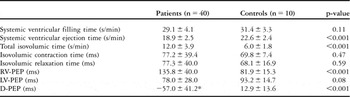
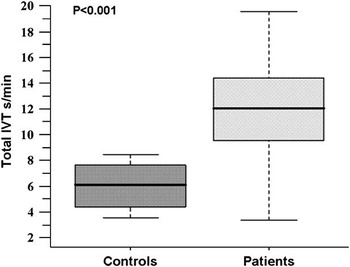
The right ventricular time intervals measured followed a Gaussian distribution. Total isovolumic time was significantly prolonged in patients with transposition of the great arteries compared with controls (12.0 plus or minus 3.9 seconds per minute versus 6.0 plus or minus 1.8 seconds per minute, p-value less than 0.001; Table 2), with only 20% of patients falling below the highest total isovolumic time value observed in normal controls (that is, 8.5 seconds per minute; Fig 2). Total isovolumic time was strongly related to QRS duration (r equals 0.66, p-value less than 0.001) and heart rate reserve (r equals 0.53, p equals 0.005).
Intracardiac timings.

D-PEP = difference between left and right pre-ejection periods; LV-PEP = left ventricular pre-ejection period; RV-PEP = right ventricular pre-ejection period
*Negative value indicates longer RV-PEP compared with LV-PEP
Comparison of the total isovolumic time between patients and controls. IVT =isovolumic time.

Isovolumic contraction time and isovolumic relaxation time were also prolonged compared with controls, although this was not statistically significant, whereas total ejection time was shorter. Right ventricular pre-ejection period was significantly longer in patients when compared with the pre-ejection period of the systemic left ventricle in normal controls (135.8 plus or minus 40.0 milliseconds versus 93.2 plus or minus 14.7 milliseconds, p-value less than 0.001). The difference between left and right pre-ejection period was also significantly prolonged, with the right ventricular pre-ejection period being significantly longer (minus 57.0 plus or minus 41.2 millisecondsFootnote * versus 12.9 plus or minus 13.6 milliseconds in controls, p-value less than 0.01).
Relationship between total isovolumic time and peak oxygen consumption
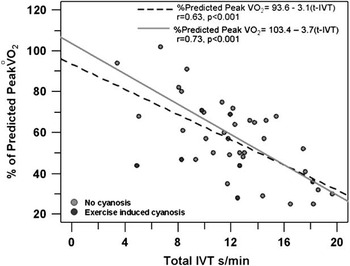
A strong inverse correlation was found between total isovolumic time and peak oxygen consumption (r equals minus 0.63, p-value less than 0.001) in patients with transposition of the great arteries after atrial switch (Fig 3). This correlation was even stronger when patients with exercise desaturation were excluded (r equals minus 0.73, p-value less than 0.001) and was maintained even after excluding patients with permanent pacemakers (r equals minus 0.67, p-value less than 0.001). Mirroring this, symptomatic patients (classes II to IV) had more prolonged total isovolumic time compared with asymptomatic patients (13.7 plus or minus 3.8 seconds per minute versus 10.2 plus or minus 3.1 seconds per minute, p-value less than 0.003). Neither tricuspid annular plane systolic excursion nor right ventricular ejection fraction related to exercise capacity. A moderate correlation was observed between peak oxygen consumption and right ventricular myocardial performance index (r equals minus 0.41, p-value equals 0.01).
The relationship between percent predicted peak oxygen consumption and t–IVT. This relationship was stronger when patients with significant oxygen desaturation during exercise were excluded. Cyanosis is associated with significant exercise intolerance and may act as a confounder in the relationship between right ventricular function and exercise capacity. t-IVT = total isovolumic time; VO2 = peak oxygen uptake.

Other univariable predictors of exercise capacity included QRS duration (r equals 0.71, p-value equals 0.001), heart rate reserve (r equals minus 0.68, p-value less than 0.0001), and the difference between left and right pre-ejection period (r equals 0.32, p-value equals 0.046). After inclusion of total isovolumic time, QRS duration, right ventricular myocardial performance index, and heart rate reserve in the multivariable regression analysis, only total isovolumic time (p-value equals 0.01) and heart rate reserve (p-value equals 0.007) remained in the model.
Reproducibility
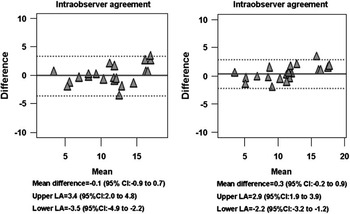
An optimal inter- and especially intra-observer agreement was found for isovolumic time, with narrow limits of agreement and no evidence of bias (Fig 4). The coefficient of variation was also small: 2.6 seconds per minute between operators and 3.4 seconds per minute within the same operator.
Bland–Altman plots demonstrating inter- and intra-observer agreement for total isovolumic time. Mean difference and 95% LA are depicted in the figure and 95% confidence interval for the mean difference and LA is described below. LA = limits of agreement.

Discussion
Resting total isovolumic time is significantly prolonged in adult patients late after atrial switch surgery for transposition of the great arteries and relates strongly to peak oxygen consumption. This is in contrast to other echocardiographic indices of right ventricular function, which bear little or no correlation to exercise capacity. The ability of this simple resting index to characterise systemic right ventricular function has many potential clinical applications including risk stratification, assessment after interventions, and follow-up.
Atrial switch procedures – that is, Senning and Mustard procedureReference Mustard, Keith, Trusler, Fowler and Kidd 19 , Reference Senning 20 – were regularly performed between the late 1950s and mid 1980s, before being superseded by the more “physiological” arterial switch (Jatene) procedure. Patients with atrial switch procedures typically remain stable until the third–fourth decade of life when late sequelae, especially progressive systemic right ventricular dysfunction and tricuspid valve regurgitation, develop. Systemic right ventricular failure is the most common cause of morbidity and mortality greater than or equal to 15 years after surgery in this population.Reference Roos-Hesselink, Meijboom and Spitaels 2 The ability to assess systemic right ventricular function accurately is therefore fundamental when following these patients and especially determining benefits of treatment. However, the complex geometry of the right ventricle, limited definition of right ventricular endocardial surface caused by heavily trabeculated myocardium, the anterior (retrosternal) position of the right ventricle, difficult imaging windows, and marked load dependence of most indices of right ventricular function make echocardiographic assessment difficult.
Our group previously reported a significant relationship between tricuspid annular plane systolic excursion and peak oxygen consumption.Reference Li, Hornung and Francis 8 However, tricuspid annular plane systolic excursion did not significantly correlate with exercise capacity in this study. This may be due to the inclusion of significantly more impaired patients in this study (peak oxygen consumption was 56.4 plus or minus 19.2% of predicted compared with 80 plus or minus 17.0% in the study by Li et al). Tricuspid annular plane systolic excursion may be less able to predict exercise capacity in more impaired patients, in which other mechanisms beyond the reduction of the free wall movement, such as right ventricular dyssynchrony, may be at work.Reference Chow, Liang, Lam, Cheung, Wong and Cheung 21
Measuring isovolumic time in the systemic right ventricle has several potential advantages. First, it can be determined in any ventricle with an inflow and outflow, however atypical its morphology or loading conditions may be. Second, it does not require measuring ventricular volumes, which depend heavily on geometrical assumptions. Third, measurements required for calculating total isovolumic time are obtained routinely during standard transthoracic echocardiography in most laboratories and thus require no additional time or effort and can be performed off-line with high reproducibility. Most importantly, the correlation to exercise capacity found in this study was much stronger than other echocardiographic indices, such as right ventricular myocardial performance index, the difference between left and right pre-ejection period and the tricuspid annular plane systolic excursion. The close relationship between resting total isovolumic time and peak oxygen consumption, an established prognostic marker in both acquired and congenital cardiac disease, including patients with atrial switch, implies that total isovolumic time may also have prognostic potential.Reference Giardini, Hager and Lammers 6 , Reference Diller, Dimopoulos and Okonko 13 , Reference Mancini, Eisen, Kussmaul, Mull, Edmunds and Wilson 22
This new index challenges us in the way we perceive ventricular function. We are traditionally used to thinking of ejection fraction as the predominant descriptor of systolic function. However, it has often been observed that some patients with severely reduced ejection fraction are asymptomatic, whereas others who appear to have normal ejection fractions have marked symptoms. The close relationship between total isovolumic time and exercise capacity allows us to relate ventricular dysfunction and symptoms more effectively and complements the use of ejection fraction alone. The physician who orders an echocardiographic examination for a patient who is increasingly dyspnoeic can now appreciate prolongation of total isovolumic time as a cause for the patient's symptoms rather than being uncertain, especially if the ejection fraction remains unchanged. Understanding this new index is important. It reflects the amount of wasted time in the cardiac cycle and global dyssynchrony. Segments of the ventricle that are not working in synchrony towards generating cardiac contraction (dyssynchronous segments) reduce the time available for ejection, whereas those segments not working in unison towards relaxation reduce the time available for ventricular filling. Although there appears to be similarities to myocardial performance index (Tei index), this index is unique. The myocardial performance index or Tei index unlike total isovolumic time is determined by the ratio of isovolumic time and ejection time. The myocardial performance index has been validated with magnetic resonance imaging assessment of systemic right ventricular ejection fraction in a similar population of patients but not compared with exercise capacity.Reference Salehian, Schwerzmann, Merchant, Webb, Siu and Therrien 23 Although both indices – Tei index and total isovolumic time – incorporate isovolumic times, the addition of the additional variable of the ejection time, which is non-discriminating in this study, in the Tei index, in its denominator may have resulted in noise and impaired its sensitivity. We speculate that the reason it is non-discriminating lies in the fact that ejection time is shortened in situations of reduced stroke volume but can also change in the same direction (shortened) in situations of positive inotropic stimulation. This study clearly demonstrates the differences between the myocardial performance index and the total isovolumic time and echoes the findings seen in left ventricular disease.Reference Duncan, Francis, Henein and Gibson 24
A strong relationship was observed between total isovolumic time and heart rate reserve in this population. Increased heart rate reserve (chronotropic incompetence) has been attributed to sinus node dysfunction in patients late after atrial switch repair for transposition of the great arteries.Reference Diller, Okonko and Uebing 25 We speculate, however, that a prolonged total isovolumic time may also impact on exercise capacity by restricting the heart rate response to exercise in patients without sinus node disease. Patients with prolonged resting total isovolumic time may disproportionately reduce their filling time as heart rate increases. There is, therefore, a physiological ceiling to heart rate, after which no further increase can occur, as filling time cannot be further shortened without compromising cardiac output. This is supported by our finding of a close relation between total isovolumic time and heart rate reserve. However, both heart rate reserve and total isovolumic time remained in the multivariable model predicting peak oxygen consumption, suggesting that additional mechanisms are in place.
QRS duration is prolonged in patients with transposition of the great arteries after atrial switch,Reference Gatzoulis, Walters, McLaughlin, Merchant, Webb and Liu 26 and in our study it correlated significantly with both total isovolumic time and exercise capacity (r equals 0.71 and r equals minus 0.42, respectively). The mechanism of QRS prolongation in this setting has not been fully elucidated but may be related to fibrosis, as demonstrated by magnetic resonance studies with gadolinium enhancement.Reference Babu-Narayan, Goktekin and Moon 27 QRS duration failed to remain in our multivariable model, suggesting that the relation between QRS duration and peak oxygen consumption is likely mediated by total isovolumic time, as previously demonstrated for dilated cardiomyopathy.Reference Duncan, Francis, Gibson and Henein 10
Limitations
This is a retrospective single-centre study involving a relatively limited number of long-term survivors with a rare congenital cardiac defect. We included one patient with atrial fibrillation in this study. Despite taking an average of five cycles for all measurements, assessment of cardiac timing remains difficult in this setting. Moreover, a limited number of patients with permanent pacing were included in this cohort. Although pacing may affect the timing of the cardiac cycle, these patients had rate-responsive pacemakers and none were limited because of a low maximum pacing rate. A significant number of patients with transposition of the great arteries with atrial switch may have sinus node dysfunction and abnormalities with the atrioventricular conduction; in these patients, abnormal isovolumic time intervals may not solely explain the exercise intolerance.
Although we attempted to exclude patients with resting cyanosis, patients with exercise-induced cyanosis were detected during the stress test. The exclusion of these patients made the relationship between exercise capacity and total isovolumic time stronger. This is reasonable as cyanosis is known to affect exercise capacity via other mechanisms, for example, reduced anaerobic threshold, respiratory and skeletal muscle dysfunction.
Other variables that can prolong total isovolumic time, such as coronary artery disease, were not assessed in this study. However, this was a young population, with a mean age of 31 years, in which the prevalence of significant coronary artery disease is likely to have been very low.Reference Giannakoulas, Dimopoulos and Engel 28 The contribution of associated abnormalities such as left ventricular outflow obstruction or septal defects was also not assessed, because of the limited sample size. A recent study assessed the use of natriuretic peptide proBNP and its relationship to diastolic dysfunction, as well as exercise capacity. We did not sample these natriuretic peptides in this study, but this would have been interesting to explore.Reference Schaefer, Tallone, Westhoff-Bleck, Klein, Drexler and Röntgen 29
Future studies involving larger numbers of patients with a systemic right ventricle, assessing both resting and exercise total isovolumic time, may shed additional light on the mechanisms of exercise intolerance in these patients and validate the prognostic potential of this easily measured echocardiographic measurement.
Conclusion
Resting total isovolumic time is abnormally prolonged and relates to impaired exercise capacity in adults with atrial switch repair for transposition of the great arteries. This is in contrast to conventional indices of systolic right ventricular function. Total isovolumic time is a simple and reproducible measurement, which could prove useful in the follow-up of these patients. Its potential role in the assessment of treatment and prognostication should be investigated in future studies.
Acknowledgements
The authors acknowledge the support of the clinical staff and technicians at the Royal Brompton Hospital, London. Sources of funding: Dr Edgar Tay was supported by a training scholarship from the Ministry of Health, Singapore. Dr Rafael Alonso-Gonzalez has received a research grant from Fundacion Alfonso Martin Escudero, Madrid, Spain. The Royal Brompton Hospital Adult Congenital Heart Disease Centre and Professor Gatzoulis have received support from the British Heart Foundation. Dr Giannakoulas was supported by the Hellenic Heart Foundation, DG Education and Culture – Lifelong Learning Programme – Leonardo Da Vinci Mobility and Hellenic Cardiological Society.