Before World War II, most industrialized countries were characterized by huge income inequality, and Japan was no exception (Minami Reference MINAMI1986; Atkinson and Piketty Reference ATKINSON and PIKETTY2007; Moriguchi and Saez Reference MORIGUCHI and SAEZ2008). Moreover, as formal systems of social insurance were underdeveloped, the poor were more vulnerable to unforeseen incidents such as illness than today's poor in developed countries.
Against this background, many studies have examined how low-income people coped with risks such as a sudden earnings shock in the late nineteenth and early twentieth centuries. Previous literature has highlighted the importance of informal transfers and assistance between relatives, friends and neighbors (Kiesling Reference KIESLING1996; Horrell and Oxley Reference HORRELL and OXLEY2000; Saaritsa Reference SAARITSA2008, Reference SAARITSA2011). However, little is known about whether financial institutions that provided loans for low-income people served as a risk-coping device. To bridge this knowledge gap, this study focuses on private pawnshops in Japan.
Japanese private pawnshops, which date back to the Kamakura period (1185–333), were the primary financial institutions for poor people in the early twentieth century. They were common even in the 1920s, in contrast to the decline of pawnbroking in European countries (Saarista Reference SAARITSA2011, p. 107; Scott and Walker Reference SCOTT and WALKER2012, p. 798; Murhem Reference MURHEM2016). In fact, there were more than 17,000 pawnshops and approximately 25 million pawnshop loans were provided per year. An important feature of pawnshops was that people could take out a loan against inexpensive goods such as clothes. In addition, pawnshop loans were small short-term loans. These features made pawnshop loans suitable for low-income people to use as a risk-coping measure.
To investigate the role of pawnshops in risk coping, we exploit the 1918–20 influenza pandemic as a natural experiment. This pandemic was one of the largest health shocks in history. One-third of the world's population were infected during the pandemic (Taubenberger and Morens Reference TAUBENBERGER and MORENS2006). In Japan, more than 40 percent of the total population were infected (Sanitary Bureau of the Home Department 1922). Using regional heterogeneity of the timing and intensity of this deadliest influenza pandemic, we examine whether people relied on pawnshop loans under the exogenous health shock.
For empirical analyses, we compiled panel data at municipality (i.e. city and county) level between 1915 and 1924 based on statistical yearbooks published by each prefectural government.Footnote 1 The data consist of over 250 municipalities, which cover more than 40 percent of the population. We estimate the effects of the health shock on pawnshop loans using a fixed effects model. Our main findings are as follows. First, there was a positive relationship between the pawnshop loan amount and the health shock intensity measured by mortality rate. This result suggests that poor people took out pawnshop loans to cope with adverse health shocks. Based on the estimation results, the amount of pawnshop loans is calculated to have increased by approximately 7–10 percent due to the influenza pandemic. Second, the pandemic increased average loan amounts but did not have significant impacts on the number of loans. These results suggest that those who regularly relied on pawnshops borrowed intensively under a health shock, whereas others did not use pawnshops even under an unexpected shock. Our further estimates imply that farmers, especially silk-raising farmers, did not rely on pawnshop loans because they were not dependent on daily income to sustain themselves. In addition, using pawnshop loans as a risk-coping measure was likely to be harder for women than men due to the Meiji Civil Code, which prohibited wives from taking out a loan without their husbands’ permission. Finally, the influenza pandemic did not decrease the redemption rate, which was approximately 90 percent. This result indicates that borrowers could repay their loans, in other words, could redeem their pawned items.
The present study contributes to the literature in the following three ways. First, we found that pawnshops served as a risk-coping device in Japan. Although previous studies have focused on informal transfers and assistance, the current study revealed the role of financial institutions, suggesting that there were various risk-coping strategies in the prewar period. Second, we provided evidence that a profit-oriented financial institution was beneficial to low-income people. In development economics, the growing body of literature has shown that microfinance, which is designed to support the poor, helps them smooth consumption when health shocks occur (e.g. Gertler et al. Reference GERTLER, LEVINE and MORETTI2009; Islam and Maitra Reference ISLAM and MAITRA2012). In contrast to microfinance, private pawnshops were not intended to reduce poverty. However, they were likely to contribute to risk coping by providing small short-term loans with inexpensive pawns. This historical evidence suggests a different form of microcredit from one in developing countries. Finally, we re-evaluated the economic role of private pawnshops in prewar Japan. In the context of Japanese financial history, the traditional view has emphasized that pawnshops accelerated poverty through foreclosure (e.g. Shibuya et al. Reference SHIBUYA, SUZUKI and ISHIYAMA1982). By contrast, corresponding with a stream of recent studies that have reviewed the traditional perspective (e.g. Ioku and Shizume Reference IOKU and SHIZUME2014), the present study sheds light on their positive role through quantitative analyses.
The rest of this article is structured as follows. Section I describes pawnshops in early twentieth-century Japan. Section II provides an overview of the 1918–20 influenza pandemic. Section III presents our data and estimation strategy. Section IV reports and interprets the estimation results. Finally, Section V concludes the article.
I
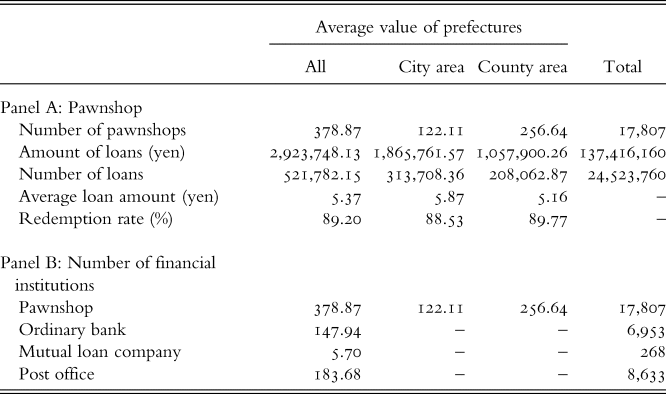
In Japan, pawnshops are a traditional financial institution that date back to the twelfth or thirteenth century (Research Bureau of the Bank of Japan 1913, p. 87).Footnote 2 Pawnshops emerged in Japan markedly earlier than in Europe; the first European pawnshop, which was a not-for-profit entity, was established in Italy in 1462. The number of pawnshops increased with the development of the market economy. In particular, they increased rapidly in the Meiji period (1868–1912) along with the growth of other modern financial institutions such as banks (Shibuya et al. Reference SHIBUYA, SUZUKI and ISHIYAMA1982, pp. 342–3).Footnote 3 As a result, pawnshops became prevalent nationwide in the early twentieth century. From the Social Affairs Bureau (1926a), we obtained data on the number of pawnshops and both the amount and the number of loans, redemptions and foreclosures for 1924 in all prefectures, which are further divided into city and county areas.Footnote 4 Panel A of Table 1 shows several indices calculated based on the above data. It is noteworthy that there were so many pawnshops – 17,807 in total, or 379 per prefecture. For comparison purposes, we present the numbers of other financial institutions, based on the Statistics Bureau of the Cabinet (1926), as well as pawnshops again in Panel B of Table 1. The number of pawnshops was 2.5 and 66.5 times greater than that of ordinary banks and mutual loan companies, respectively. Moreover, the number of pawnshops was twice as high as that of post offices that offered the postal savings system.Footnote 5 These facts highlight the ease of access to pawnshops. Indeed, the number of pawnshop loans was approximately 25 million, or 67,188 per day in 1924.
Pawnshops and other financial institutions in 1924

Notes: The average loan amount is calculated by dividing the amount of loans by the number of loans. The redemption rate is defined as the proportion of redemption to the sum of redemption and foreclosure.
Sources: See the text.
When a person transacted with a pawnshop for the first time, they needed a referral from an existing customer. If the borrower did not receive a referral they had to sign a contract, and the pawnshop checked their name and address to confirm that the goods to be pawned were not stolen or lost. By contrast, people with a referral could take out a loan without any contracts and checks. Thus, those who first applied for a loan usually brought a referral (Research Bureau of the Bank of Japan 1913, p. 91). In each case, pawnshops did not verify borrowers’ background such as occupation and health status, because it was easier for lenders to assess the value of an item to be pawned than to assess the financial status of a borrower. In other words, pawning was one of the solutions to information asymmetry. Hence, people could borrow money from pawnshops without any other requirements.
People could take out a loan within the total value of pawned items, which was assessed based on prices in the secondhand market. If the pawned items were not redeemed, pawnshops sold the items in foreclosure to antiquarians in Japan; in other countries, pawnshops typically sold unredeemed items by public auction. Moreover, the difference between the selling price of a pawned item and the amount of a defaulted loan became the profit or loss for pawnshops, since the pawnshop owned the item after the foreclosure in accordance with customs (Research Bureau of the Bank of Japan 1913, pp. 94–5). Therefore, pawnshops assessed the value of a pawned item so that they would not make a loss even if the item was unredeemed. However, borrowers transacted with other pawnshops when they thought the assessed value was too low. Competition between pawnshops prevented them from assessing the value of a pawned item as unreasonably low (Research Bureau of the Bank of Japan 1913, p. 91).
The maximum monthly interest on a pawnshop loan was regulated by the law enacted in 1895. It was determined based on the loan amount; it was 4 percent, 3 percent and 2.5 percent (i.e. 48 percent, 36 percent and 30 percent per annum) if the loan amount was less than 1, 5 and 10 yen, respectively, and fixed at 0.01 yen if the amount was less than 0.25 yen.Footnote 6 If we compare annual interests, pawnshop loan interest was higher than the annual interest on a bank loan, which was approximately 10 percent, but markedly lower than that on a usury loan, which ranged from 50 percent to 730 percent (Shibuya et al. Reference SHIBUYA, SUZUKI and ISHIYAMA1982, p. 347–8; Shibuya Reference SHIBUYA2000, p. 13), even though pawnshop loans usually had repayment terms of six months.Footnote 7 In addition, the interest rate on a pawnshop loan was stable and did not depend on the interest rates of other financial institutions or on economic conditions (Research Bureau of the Bank of Japan 1913, p. 93).Footnote 8
Pawnshops were the primary financial institutions for poor people in Japan – even in the 1920s. For instance, poor people visited pawnshops first when they needed money (Research Bureau of the Bank of Japan 1913, p. 86), and pawnshops were the only financial institutions that helped low-income people (Tokyo Institute for Municipal Research 1926, p. 2). In fact, a survey of poor districts in Tokyo conducted in 1911 showed that 1,910 of 3,047 people (62.68 percent) had an existing loan from a pawnshop at the time of the survey (Regional Bureau of the Home Ministry 1912). There were various reasons other financial institutions were not preferred by poor people: banks required expensive collateral, usuries made excessive profits, while mutual loans could not respond to participants’ demand for money and were unreliable because of the vulnerability of participants (Research Bureau of the Bank of Japan 1913; Shibuya Reference SHIBUYA2001). Another survey of 15,634 poor households in Tokyo in 1933 indicated that pawnshop loans accounted for 69.68 percent of the total borrowing (Social Division of the Municipal Bureau of Academic Affairs of Tokyo 1935). This survey also showed that borrowing from relatives or friends only occurred 20.50 percent of the time. This means that poor people were more reliant on pawnshops than on their personal networks.
The reasons that pawnshops were popular are as follows. First, they accepted even inexpensive goods as pawns. Pawning items helped poor people, who could not access credit because they were usually considered to be unreliable, borrow money. Additionally, borrowers could avoid any trouble other than foreclosure if they did not redeem their pawn (Saito Reference SAITO1989, p. 5).Footnote 9 Therefore, it seems that a loan with an inexpensive pawn was preferable for the poor to that without any pawns.Footnote 10 Shibuya et al. (Reference SHIBUYA, SUZUKI and ISHIYAMA1982) reported the numbers of pawns by type based on the pawn ledgers of a pawnshop in January and June 1917. It is striking that clothes accounted for 88.97 percent of all pawns, whereas other types of pawns had much smaller shares: 2.77 percent were piece goods (tanmono), 1.24 percent mosquito nets, 1.18 percent Japanese futons, 1.06 percent accessories and 0.48 percent watches.Footnote 11 This report indicates that people could borrow money from pawnshops against their clothes. The reason why inexpensive clothes were pledgeable was that Japan had a well-developed secondhand clothing market (Francks Reference FRANCKS, Francks and Hunter2012). In addition, the interest on a pawnshop loan was typically lowest when clothes were pawned (Shibuya et al. Reference SHIBUYA, SUZUKI and ISHIYAMA1982, p. 349). These facts support the usefulness of pawnshops for poor people.
Second, people could obtain small short-term loans flexibly. A borrower could take out a pawnshop loan quickly and redeem a pawned item by repaying the money at any time within the repayment term. Moreover, most small pawnshops were open until midnight (Social Division of Osaka City 1926, p. 67). Poor people often faced a shortage of living costs because of unexpected events such as illness, and thus their borrowing from pawnshops was mainly used for consumption (Shibuya Reference SHIBUYA2000). Hence, it was important for the poor to be able to borrow as needed.
The importance of pawnshops, however, seems to have differed between city and county. Pawnshops were strongly characterized as main financial institutions for the poor in urban areas (Mimura Reference MIMURA1935; Saito Reference SAITO1989; Shibuya Reference SHIBUYA2000). Moreover, not only poor people but also others such as students used pawnshops in metropolitan districts in the early twentieth century (Ioku and Shizume Reference IOKU and SHIZUME2014; Kajiya Reference KAJIYA2014; Shigeta and Mishina Reference SHIGETA and MISHINA2014).Footnote 12 By contrast, other financial sources such as mutual loans were also used in rural areas in the 1920s (Kojima Reference KOJIMA2011).Footnote 13 Therefore, pawnshops may have played a more substantial role in cities.
II
The 1918–20 influenza pandemic known as ‘Spanish flu’ is one of the deadliest pandemics in history. During this period, 500 million people were infected and 50–100 million people died from influenza worldwide (Taubenberger and Morens Reference TAUBENBERGER and MORENS2006). Japan also experienced the pandemic with two waves whose peaks were in November 1918 and January 1920 (Ogasawara Reference OGASAWARA2017). According to the Sanitary Bureau of the Home Department (1922), which provided the most comprehensive contemporary survey, there were 23,580,495 affected people (i.e. more than 40 percent of the population) and 385,029 influenza deaths in Japan between August 1918 and July 1920. However, this loss has been considered to be underestimated because of problems with determining cause of death and missing data. Therefore, Hayami (Reference HAYAMI2006) and Richard et al. (Reference RICHARD, SUGAYA, SIMONSEN, MILLER and VIBOUD2009) estimated the number of excess deaths between 1918 and 1920 as approximately 453,000 and 481,000, respectively. Their estimates indicate that the actual death toll associated with the 1918–20 influenza pandemic was much larger than the reported death toll.Footnote 14
During the pandemic, influenza caused symptoms such as rapid onset of high fever, chills, sore throat, cough, general malaise, headache and myalgia. In many cases, the symptoms lasted several days up to a week. Since there was no effective drug for influenza, supportive care was the predominant course of treatment; it was crucial for patients to rest in bed under conditions of proper temperature and humidity. Indeed, the Sanitary Bureau of the Home Department indicated that even transporting a patient to the hospital required careful consideration. In addition, gargling and use of face masks were encouraged as precautionary measures (Sanitary Bureau of the Home Department 1922, pp. 277–323).
One of the well-known features of the pandemic is the age distribution of mortality. Young adults experienced the highest risk of influenza death in 1918–20, whereas influenza usually strikes the very young and the elderly (Langford Reference LANGFORD2002; Richard et al. Reference RICHARD, SUGAYA, SIMONSEN, MILLER and VIBOUD2009; Gagnon et al. Reference GAGNON, MILLER, HALLMAN, BOURBEAU, HERRING, EARN and MADRENAS2013; Ogasawara Reference OGASAWARA2017). This characteristic supports findings that the influenza pandemic caused an adverse health shock and a subsequent negative income shock to working people; indeed, Karlsson et al. (Reference KARLSSON, NILSSON and PICHLER2014) revealed that the pandemic led to a significant increase in poorhouse rates in Sweden. In fact, a newspaper reported that family breadwinners who were affected but forced themselves to work often died.Footnote 15 Therefore, it was likely that people needed to obtain money from sources other than work to avoid death during the pandemic period.Footnote 16
Further, the 1918–20 influenza pandemic was unexpected, disappeared quickly and affected a large proportion of the population at random. Owing to such characteristics, the pandemic has been widely used as a natural experiment in recent years (e.g. Almond Reference ALMOND2006; Lin and Liu Reference LIN and LIU2014; Acquah et al. Reference ACQUAH, DAHAL and SLOAN2017). Moreover, the timing and intensity of the pandemic varied throughout Japan (Hayami Reference HAYAMI2006; Richard et al. Reference RICHARD, SUGAYA, SIMONSEN, MILLER and VIBOUD2009; Ogasawara Reference OGASAWARA2017).Footnote 17 Hence, we can use the regional heterogeneity for our estimation.
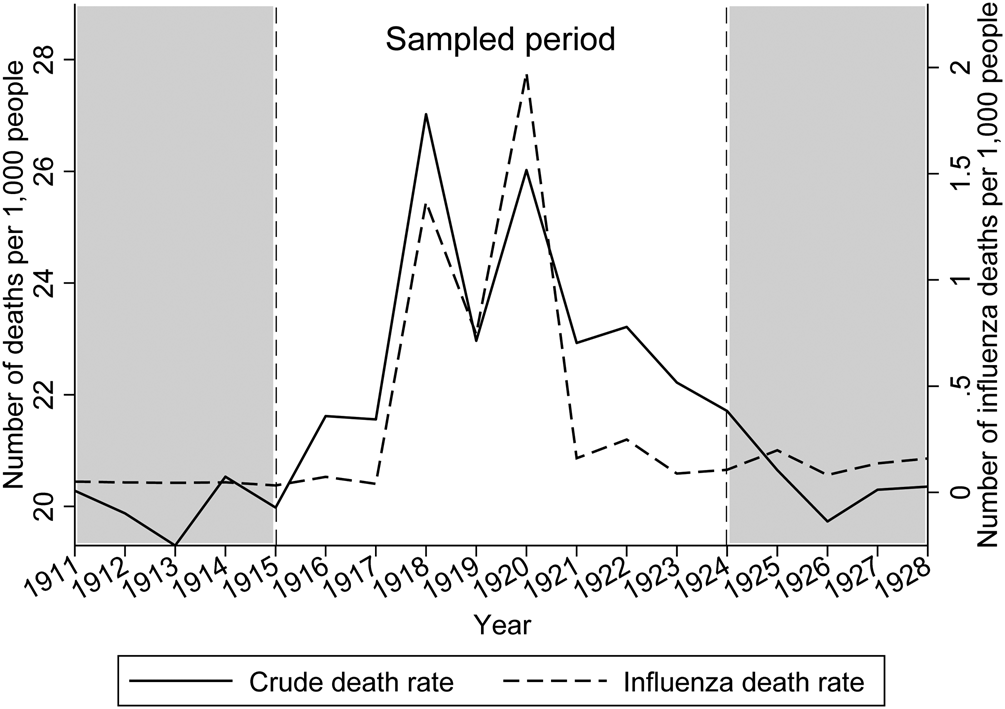
As there is a paucity of available data on the influenza death toll at the county level, we use the crude death rate, defined as the number of all deaths per 1,000 people, as a measure of the shock by the 1918–20 influenza pandemic. Figure 1 illustrates the average crude death rate and influenza death rate of prefectures where our observations are recorded, from 1915 to 1924. Obviously, these two death rates showed a similar trend during this period. In particular, not only the influenza death rate, but also the crude death rate rose dramatically in the pandemic years. This similarity allows us to use the crude death rate as a measure to exploit the exogenous pandemic in our regression analyses. Moreover, we can cover the impacts of the increase in diseases, which were not reported as influenza but were likely to be caused by the pandemic (e.g. pneumonia), by using the crude death rate.
Average crude death rate and influenza death rate, 1915–24
Notes: The crude death rate and influenza death rate are the average values of prefectures where our observations are recorded.
Sources: Statistics Bureau of the Cabinet (1915–29).

III
Our main data sources are the statistical yearbooks published annually by each Japanese prefectural government (Fuken tokeisho). From these statistical yearbooks, we can obtain data on the pawnshops, population and death toll at the city and county levels. However, all the yearbooks do not report the data we need. The data on pawnshops, death toll and both in 1915–24 are only available in 29, 30 and 19 prefectures, respectively. Thus, we compiled panel data from 272 municipalities (i.e. 35 cities and 237 counties) in the 19 prefectures.Footnote 18
Pawnshops tended to become a breeding ground for traffic in stolen goods. Therefore, an operating licence from the prefectural government was required to run one. In addition, pawnshops had to record their transactions according to the Act of Control of Pawnbroking, which was enacted in 1895.Footnote 19 These facts support the reliability of the data on pawnshops we use.
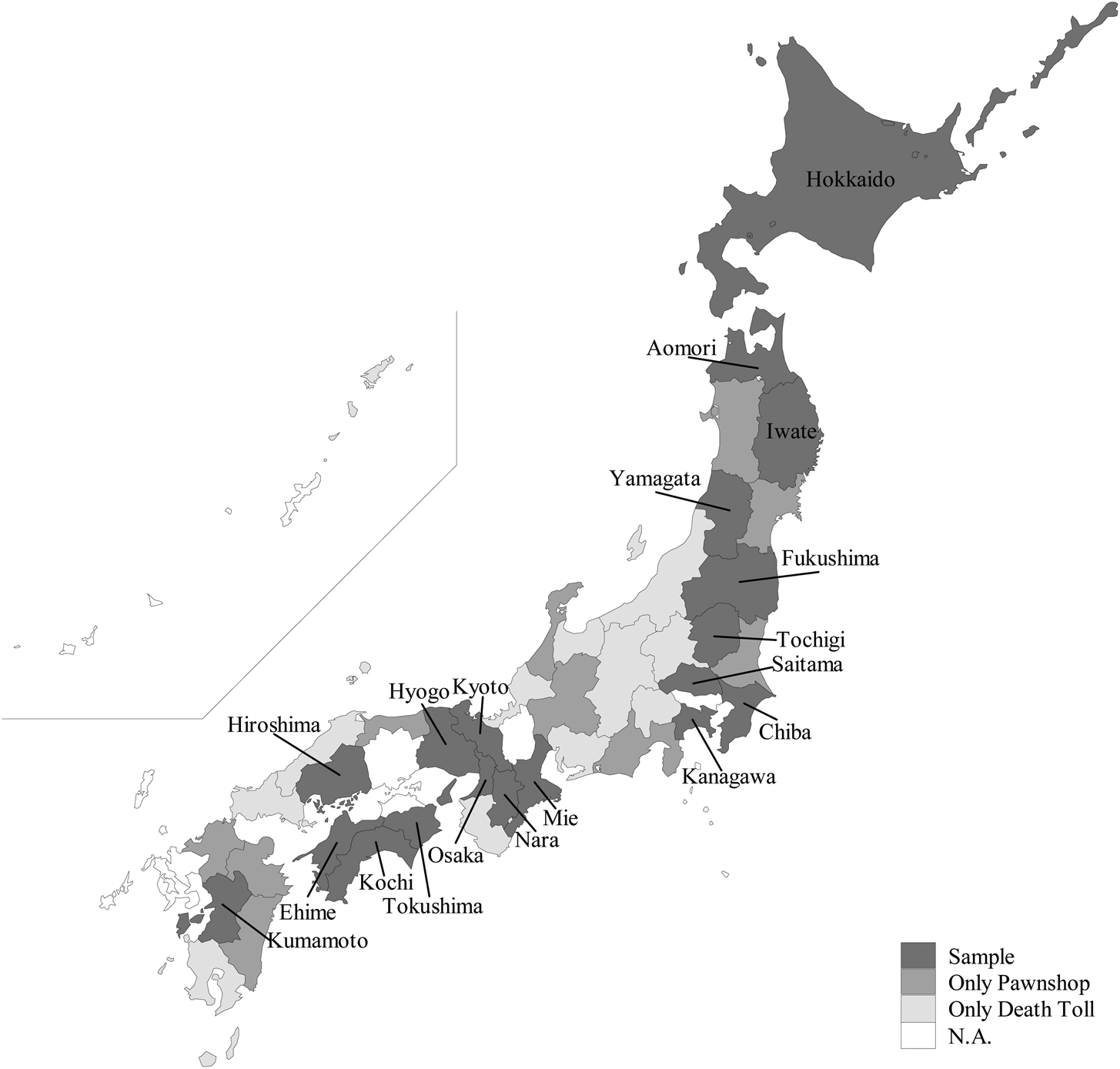
Figure 2 illustrates the spatial distribution of the prefectures where our sample cities and counties are recorded. Our observations are nationwide except in the Chubu region (central Japan). For comparison purposes, we calculated the amount of loans per pawnshop in 1924 based on our sample and the final column in Table 1, respectively; the results are 6,905 yen and 7,717 yen. The latter is larger than the former, but it is mainly driven by Tokyo. Recalculated excluding Tokyo, the latter value becomes 6,696 yen, which is close to the former. This calculation supports the representativeness of our sample.
Spatial distribution of our observations
Notes: Prefectures that include our sample cities and counties are shown with their name. Prefectures where the data on either pawnshops or death toll are available are shown in different shades of gray.
Sources: Author.

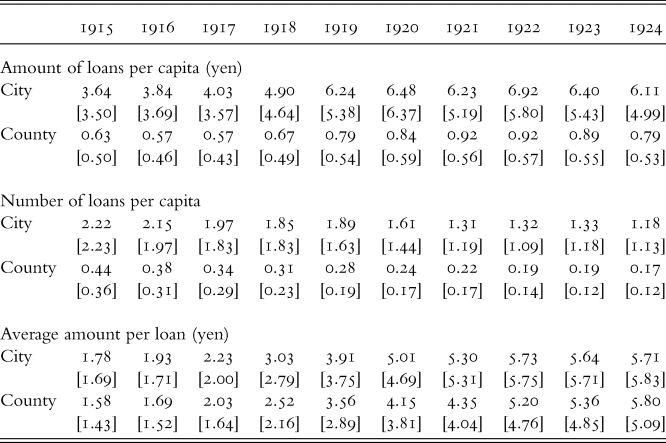
The amount and number of pawnshop loans per population and the average amount per loan in the sample are summarized in Table 2. The table shows mean and median values divided into cities and countries in each year. On the whole, the amount of loans tended to increase while it declined in 1923 and 1924. In particular, large increases were observed between 1918 and 1919. The average loan amount had a similar increasing trend. It rose rapidly during the period, especially in the late 1910s. In contrast, the number of loans gradually decreased in 1915–24. Differences between city and county are also presented. All measures were almost always larger in cities than in counties.Footnote 20 These gaps are consistent with the discussion at the end of section I concerning the role of pawnshops in urban and rural areas.
Amount and number of pawnshop loans in sample municipalities

Notes: The values are mean and median (in square brackets) in the sample municipalities in each year.
Sources: See the text.
To investigate how many pawnshop loans were taken out to compensate for losses due to illness, we estimate the following fixed effects model.Footnote 21 Our baseline model is given by
 $${y}_{{it}} = {\alpha } + {\beta CD}{R}_{{it}} + {\boldsymbol x}{^{\prime}}_{{it}}{\gamma } + {\boldsymbol z}{^{\prime}}_{{jt}} {\boldsymbol \delta } + {\nu }_{i} + {\mu }_{\it t} + {\varepsilon }_{{it}}$$
where i indexes municipalities from 1 to 272, j indexes prefectures from 1 to 19, and t indexes years from 1915 to 1924. The dependent variable yit is the logarithm of the total amount of pawnshop loans; CDRit is the crude death rate (per mil); x′it is a vector of main control variables at the municipality level; z′jt is a vector of additional control variables at the prefecture level; νi and μt represent the municipality and year fixed effects, respectively; and ɛit is a random error term.Footnote 22
The variable CDR is of our interest. By taking advantage of the exogenous shock, namely the 1918–20 influenza pandemic, we estimate the coefficient β, which measures the effect of adverse health shocks on the loan amount. If this is positive and significant, the estimated coefficient indicates that pawnshops served as an intertemporal risk-coping mechanism.
Although the health shock caused by the 1918–20 influenza pandemic was exogenous, the crude death rate consists of not only deaths related to the pandemic but also unrelated deaths. This means that some factors in the error term might correlate with the unrelated deaths included in the crude death rate. Therefore, we employ the following control variables to deal with this possible endogeneity. As main controls, we include the ease of access to a pawnshop in terms of geographical proximity (the number of pawnshops per square kilometer), the size of possible borrowers (the logarithm of population), and the share of agriculture workers (the number of farm households per 100 households). In addition, we control for the level of income using the log amounts of cocoon collection and unit rice yields, which were very important for the Japanese economy in the prewar period. Although the pandemic struck randomly regardless of wealth level, some deaths not associated with the pandemic might be correlated to income. Hence, we exclude this possible correlation from our regression analyses. As additional controls, we use the number of doctors per 100 people and the number of hospitals per area as measures of the level of available medical facilities. These variables represent the diffusion of medical treatment and access to public health that are likely to result in a decrease in deaths not related to the pandemic. Further, we take the out-of-school rate (OOSR) for children of primary school age as a measure of poverty. Since the primary school enrollment rate in Japan was already 99.03 percent in 1920 (Archives Division of the Secretariat of the Ministry of Education 1925), the OOSR (i.e. 100 – the enrollment rate) seems to capture the proportion of the poorest households, which were generally unhealthier.Footnote 23 These medical and OOSR variables are used as additional controls, because the data are only available at the prefectural level.
In addition to the aforementioned control variables, we use municipality fixed effects and year fixed effects in all specifications. These fixed effects control for all unobservable factors, including those constant over time, such as geographical characteristics, and those constant across municipalities, such as inflation.Footnote 24 Our data sources for the control variables and summary statistics are described in the Appendix (available online).
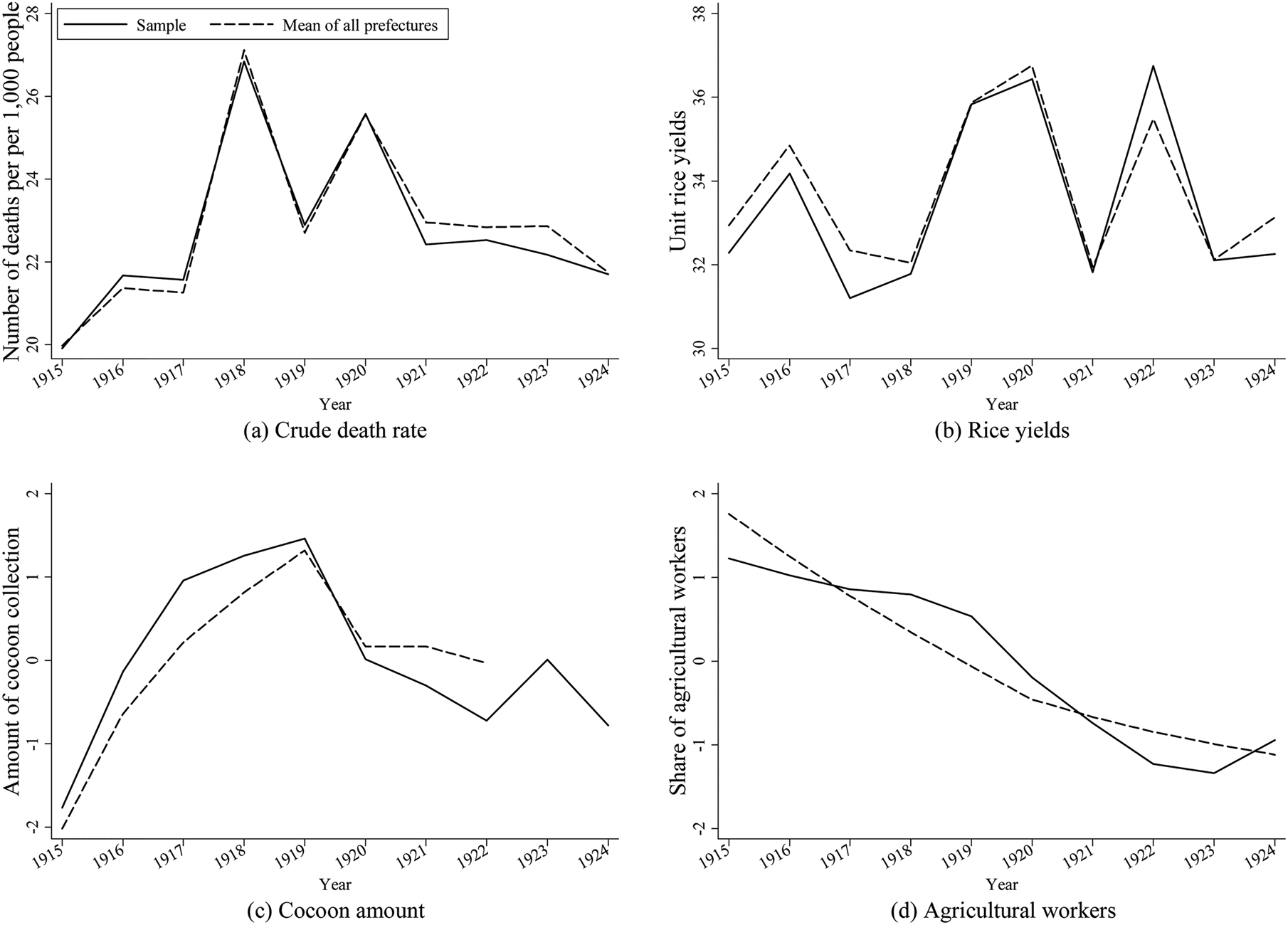
Figure 3 illustrates the mean values of four variables in both our observations and all prefectures to confirm that the sample municipalities represented the national trend during the period we study. The cocoon amount and share of agricultural workers are standardized for ease of comparison (Figures 3c and 3d). Evidently, Figures 3a–d show that the time trends in our sample are closely similar to the ones in the country.
Time trend of variables in sample municipalities and all prefectures
Notes: The amounts of cocoon collection in prefectures in 1923 and 1924 are not available because of a unit change. The cocoon amount and agricultural workers are standardized.
Sources: Statistics Bureau of the Cabinet (1918–25). See Appendix (available online) for the other sources.

To check the robustness of baseline estimates, we further conduct analyses using the following specification:
 $${y}_{i} = {\alpha } + {\beta ExMo}{r}_{i} + {\zeta preLoa}{n}_i + {\bf x}{^{\prime}}_{i}{\gamma } + {\;Cit}{y}_{i} + {Pre}{f}_j + {\varepsilon }_{i}$$
where i indexes municipalities and j indexes prefectures. The ExMori, which is the key variable, is the excess mortality in 1918 or 1920 proxied by the difference in crude death rate from the mean in 1915–17. The dependent variable yi is the logarithm of the total amount of pawnshop loans in 1918 or 1920, and the independent variable preLoani is the logarithm of mean pawnshop loan amounts in 1915–17. The control variables x′i are the same as equation (1), although the differences between 1918 (1920) and 1915–17 are used. The Cityi and Prefj represent the city and prefecture fixed effects, respectively. These are included instead of the municipality and year fixed effects.Footnote 25 Not including the data in non-pandemic years, this specification is expected to capture the effects of the pandemic shocks more clearly.
IV
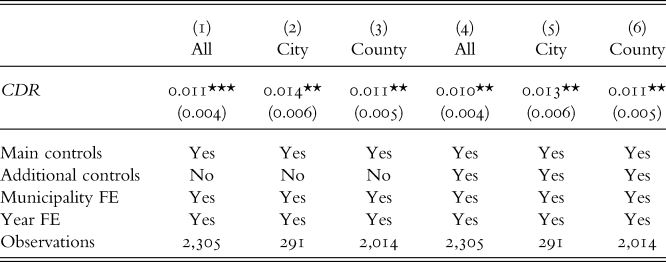
Table 3 presents the estimation results of equation (1). Columns (1)–(3) present the estimates controlling for the main control variables.Footnote 26 The results in columns (4)–(6) report the estimates from our baseline specification in which we include all the control variables. To investigate the difference in response of the pawnshop loan amounts to the influenza pandemic between cities and counties, we conduct analyses using different samples. Columns (1) and (4), (2) and (5), and (3) and (6) present our estimation results for both cities and counties, only cities and only counties, respectively.
Responses of loan amount to the influenza pandemic

* significant at the 10 percent level; ** significant at the 5 percent level; *** significant at the 1 percent level.
Notes: The dependent variable is the logarithm of the total amount of pawnshop loans. Standard errors clustered at the municipality level are in parentheses.
Sources: See the text and Appendix (available online).
Columns (1)–(3) in Table 3 show that the crude death rate had a significantly positive effect on the amount of pawnshop loans. The estimated coefficients of CDR remain positive and significant even when we control for other factors, as shown in columns (4)–(6). These results are consistent with our hypothesis, suggesting that poor people used a pawnshop loan to cope with exogenous adverse health shocks.Footnote 27 The baseline result reported in column (4) indicates that a one per mil increase in the crude death rate raised the pawnshop loan amount by 1 percent. As the increases in the crude death rate from the mean value in 1915–17 were 5.68 in 1918 and 4.34 in 1920, the total amount of pawnshop loans was likely to increase by 5.68 and 4.34 owing to the pandemic.
Furthermore, the estimated coefficients of the crude death rate are larger in cities than in counties as expected. Indeed, columns (2) and (3) show that the magnitude in cities is 0.003 or 27 percent more than that in counties. Despite including the additional control variables, the magnitude in cities is 0.002 or 18 percent more than that in counties as displayed in columns (5) and (6). These results indicate that those who lived in cities were more dependent on pawnshops for their sustenance in comparison to those who lived in counties.
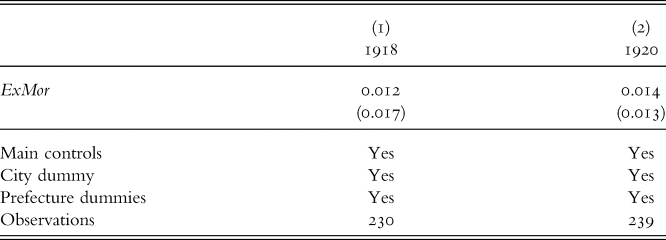
The results estimated by equation (2) are reported in Table 4. In columns (1) and (2), the excess mortality in 1918 and 1920 is used as the measures of pandemic impact. The estimated coefficients are positive, corresponding with our baseline results.Footnote 28 However, the results are not statistically significant. There are two possible reasons for the insignificance.
Effects of excess mortality on loan amount in 1918 and 1920

* significant at the 10 percent level; ** significant at the 5 percent level; *** significant at the 1 percent level.
Notes: The dependent variable is the logarithm of the total amount of pawnshop loans in 1918 or 1920. The municipalities in Aomori are not included in the estimate for 1918, and those in Hyogo are excluded from both estimates. Robust standard errors are in parentheses.
Sources: See the text and Appendix (available online).
The first is the correlation between total pawnshop loan amount and crude death rate in non-pandemic years. If the loan amounts had stronger positive correlation with mortality rate in pre- and/or post-pandemic periods than during the pandemic, it implies that using only the data in the pandemic years may have led to the insignificant results. A possible explanation for the stronger relationship in non-pandemic years is that the severest influenza pandemic made people become used to borrowing money from pawnshops to address health shocks. This is consistent with the large loan amounts and the high crude death rate after the pandemic, especially in 1921–3, compared to the pre-pandemic period (Figure 1 and Table 2). There is also indirect historical evidence. In the 1920s, pawnshops were widely recognized as the primary financial institutions for low-income people (Ministry of Finance 1926a; Social Affairs Bureau 1926a; Social Division of Osaka City 1926; Tokyo City Office 1926; Tokyo Institute for Municipal Research 1926). Meanwhile, many studies were conducted by governmental and public organizations to increase public pawnshops that better help poor people (e.g. Labor Research Division of Osaka City Office 1920; Ministry of Finance 1926b; Social Affairs Bureau 1925, 1926b, 1926c). These facts imply that, even though there was a need for improvement, the role of private pawnshops for the poor became more important after the 1918–20 pandemic.
The second reason is a statistical problem. Although the coefficient sizes presented in Table 4 are similar to the baseline results in Table 3, the standard errors are much larger. The statistical insignificance of the estimated coefficients is therefore due to their large variance. As the estimates are based on only the observations in each pandemic year, the information used is less than that in the baseline analysis. This may have caused the larger standard errors of the estimated coefficient.
In Tables 3 and 4, the estimated coefficients of the crude death rate are 0.010–0.014. As the average of the crude death rate rose from about 20‰ in 1915–17 to 27‰ in 1928 (Figure 1), our results suggest that pawnshop loan amounts increased by approximately 7–10 percent due to the pandemic.
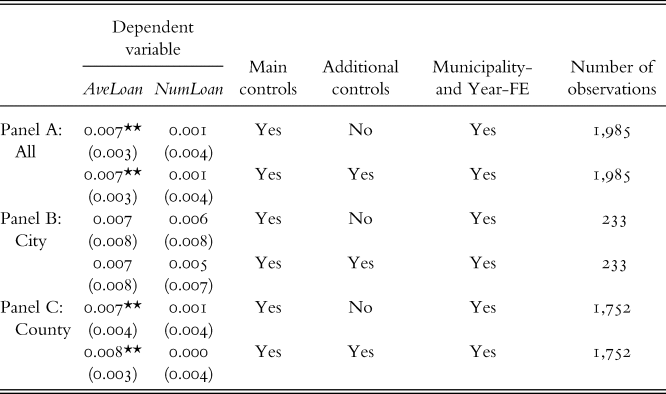
In order to examine how pawnshop loan amounts increased, we estimated the intensive and extensive margins by equation (1) using the logarithm of the average loan amount (AveLoan) and the logarithm of the number of loans (NumLoan) as the dependent variables instead.Footnote 29 The estimated coefficients of AveLoan and NumLoan are interpreted as the effects on the intensive and extensive margins, respectively. Table 5 presents the estimated coefficients of CDR for both AveLoan in the second column and NumLoan in the third column. Panel A of Table 5 shows the results for the full sample. For the average loan amount, the estimation results are significantly positive and stable across the different specifications. This finding indicates that people borrowed more money than usual from pawnshops when they hit hard times due to the pandemic. By contrast, there are no relationships between the number of loans and crude death rate. This finding implies that only those who usually borrowed from pawnshops, who were likely to be poor, took out pawnshop loans to mitigate the adverse shock.Footnote 30 In other words, our results suggest that a negative shock increased the intensive margin of pawnshop loans but had little impact on the extensive margin.
Responses of the intensive and extensive margins

* significant at the 10 percent level; ** significant at the 5 percent level; *** significant at the 1 percent level.
Notes: The second and third columns present the estimated coefficients of CDR and its standard errors clustered at the municipality level in parentheses.
Sources: See the text and Appendix (available online).
The results for counties in Panel C are similar to the results in Panel A. Panel B shows that the results for cities are slightly different from those for counties. With regard to the intensive margin, the effects on the average loan amount are positive in cities as well as counties. Although the effects in cities are not statistically significant, this result may stem from the relative lack of observations, considering that the magnitudes of the estimated coefficients in Panel B are nearly equal to those in Panel C. Another possible reason for the insignificant effects is the difference in average loan amount. Tables 1 and 2 show that the average amount of pawnshop loans was larger in cities than in counties, suggesting that city dwellers were more dependent on pawnshops regardless of the pandemic outbreak. This large amount even in normal times was likely to lower elasticity. In contrast to the intensive margin, the impacts on the extensive margin in cities are larger than those in counties, although they are not significant. These results imply that the proportion of those who depended on pawnshops increased in cities more than in counties when the influenza pandemic hit.
There are several possible explanations for the results indicating that the health shock increased the intensive margin (at least in counties) but did not have an impact on the extensive margin. First, people such as farmers were not dependent on daily income for their survival. Thus, they did not need to borrow money from pawnshops when a short-term health shock occurred. Second, people could get money from other sources such as commercial crops instead of pawnshops. Since there were more farmers and commercial crops in counties than in cities, these two explanations are likely to be consistent with the results presented in Table 5. Third, those who did not usually transact with pawnshops had more income as well as having savings. They did not need to rely on pawnshop loans. Fourth, geographical proximity was important; those who did not have easy access to pawnshops could not take out a pawnshop loan, whether they needed it or not.Footnote 31 Finally, the Meiji Civil Code in Japan prevented wives from taking out a pawnshop loan to deal with unexpected events. Wives required prior permission from their husbands to borrow money from a pawnshop. Specifically, husbands needed to contact a pawnshop before their wives took out a loan. Thus, if a husband was affected by influenza, his wife could not transact with pawnshops alone.
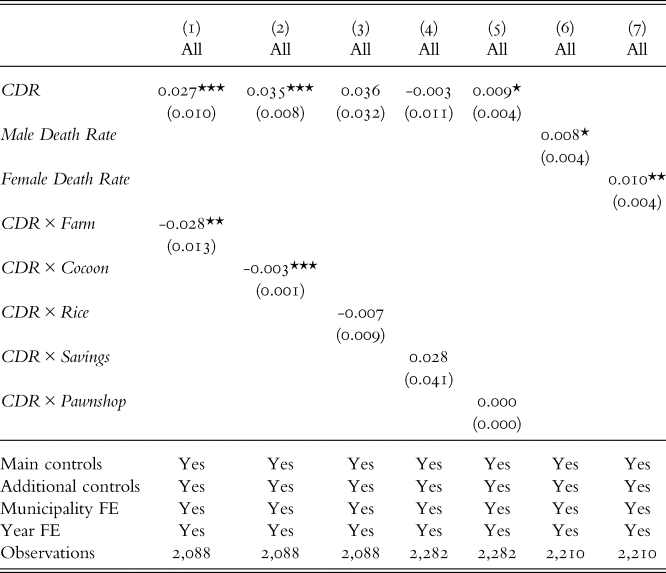
Based on the above hypotheses, we investigate the heterogeneity of the impacts of the influenza pandemic with regard to the pawnshop loan amount. Table 6 reports the results for both cities and counties using the logarithm of the total amount of pawnshop loans as the dependent variable. In columns (1)–(5), we add the interaction terms of CDR and the following variables: the ratio of farm households to total households (Farm), the log of the amount of cocoon collection (Cocoon) as a measure of commercial crop, the log of unit rice yields (Rice) as another measure of commercial crop, the proportion of postal savings depositors to the population (Savings), and the number of pawnshops per square kilometer (Pawnshop) to the baseline specification, respectively. To avoid the endogeneity problem, these variables take mean values from 1915 to 1917. In columns (6) and (7), the number of male deaths per 1,000 men (Male Death Rate) and the number of female deaths per 1,000 women (Female Death Rate) are used instead of the crude death rate, respectively.
Heterogeneity of the impacts of health shock

* significant at the 10 percent level; ** significant at the 5 percent level; *** significant at the 1 percent level.
Notes: The dependent variable is the logarithm of the total amount of pawnshop loans. Standard errors clustered at the municipality level are in parentheses.
Sources: See the text and Appendix (available online).
Column (1) shows that the estimated coefficient of the interaction term CDR × Farm is negative and significant while the coefficient of CDR is positive. This result indicates that the response of the pawnshop loan amount to the influenza pandemic was lower in areas with more farmers. In column (2), the estimated coefficient of the interaction term CDR × Cocoon is also significantly negative, suggesting that the commercial crop, rather than a pawnshop loan, was used as the means to obtain money.Footnote 32 By contrast, the effect of the interaction term CDR ×Rice is negative but not significant as shown in column (3). This difference corresponds with the historical fact that cocoons were a more important source of cash income than rice in rural areas in prewar Japan (Kusadokoro Reference KUSADOKORO2010; Kinjo Reference KINJO2016). Column (4) implies that the popularization of the postal savings system did not have a significant influence on the amount of pawnshop loans during the influenza pandemic. However, the positive estimated coefficient of the interaction term CDR × Savings may imply that there were many postal savings depositors in municipalities with large monetary demand. Column (5) presents the insignificant estimated coefficient of the interaction term CDR × Pawnshop, suggesting that the impact of the health shock on the borrowing behavior did not depend on the number of pawnshops per region, which is the proxy for geographical proximity. An explanation for this result is that most municipalities had sufficient pawnshops. Indeed, there was at least one pawnshop per two square kilometers in 75 percent of all municipalities. This percentage should become much larger if unpopulated areas were excluded. Columns (6) and (7) demonstrate that the response of the pawnshop loan amount to the health shock to males was lower than that to females, whereas men earned more than women in general in the prewar period. These results suggest that, when the unexpected shock occurred, wives could not use pawnshop loans without their husbands’ prior permission due to the Meiji Civil Code. Another possible interpretation is that small loans from pawnshops could cover losses of women's smaller wages whereas these were not sufficient to compensate losses of men's larger wages. In this case, other sources may have been preferred to pawnshop loans.
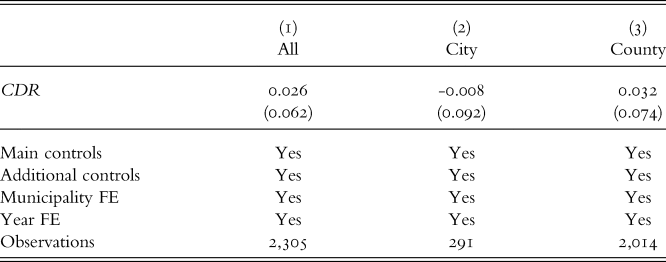
As described above, poor people took out larger loans from pawnshops than usual following the influenza pandemic. However, borrowers may not have redeemed their pawn when they took out a loan from a pawnshop to cope with an unexpected shock. In this case, our results mean that people used pawnshops to obtain money by selling their goods rather than through loans. To determine whether borrowers redeemed their pawn even when struck by the unforeseen influenza pandemic, we estimate the impact on the redemption rate by employing the same specification as in columns (4)–(6) in Table 3 except for the dependent variable. Table 7 shows the results for the proportion of redemption to the sum of redemption and foreclosure (percentage). Clearly, the estimated coefficients of the crude death rate are insignificant regardless of the sample used. Since the redemption rate around 1920 was approximately 90 percent (i.e. 89.20 percent as reported in Table 1 or 90.75 percent, which is the mean value in the full sample), this result is interpreted as evidence that most people who took out a pawnshop loan to address the health shock could redeem their pawn.
Impacts of the influenza pandemic on the redemption rate

* significant at the 10 percent level; ** significant at the 5 percent level; *** significant at the 1 percent level.
Notes: The dependent variable is the redemption rate (%). Standard errors clustered at the municipality level are in parentheses.
Sources: See the text and Appendix (available online).
V
In this study, we focused on pawnshop loans to examine a risk-coping strategy of poor people in prewar Japan. The natural experiment exploiting the 1918–20 influenza pandemic enabled us to identify the response of pawnshop loans to an adverse health shock.
Using data on pawnshop loans in more than 250 municipalities from 1915 to 1924, we revealed a positive relationship between the loan amount and crude death rate. In addition, the redemption rate was stable at a high level regardless of the intensity of mortality rate. These findings suggest that people took out pawnshop loans to address health shocks. Although the estimates using the data only in 1918 or 1920 imply that the response of loan amount may have been clear after rather than during the pandemic, this possibility does not contradict our interpretation that pawnshop loans were used to cope with health risks. We also revealed that regular users borrowed more money from pawnshops than usual following unforeseen shocks, whereas those who had not usually taken out pawnshop loans did not rely on them even in the face of health shocks. If rich people could cope with risks via interest-free methods such as savings, the difference in the risk-coping strategies exacerbated economic inequality.
The findings of this study have the following implications for the literature. First, we found a new way for poor people to cope with risk. In previous studies in European countries, informal assistance through personal networks is regarded as a major coping strategy for risk. In this study, we show that a specific type of traditional financial institution – pawnshops – was widely used to cope with an unexpected adverse health shock in prewar Japan. It suggests diversity in risk-coping strategies across time and space. Moreover, considering Ogasawara's (Reference OGASAWARA2018) finding that borrowing responded more sensitively than other sources such as gifts to income shocks in Osaka in the early twentieth century, pawnshop loans may have been an important risk-coping strategy for poor people. This interpretation is also supported by many contemporary documents, such as the Ministry of Finance (1926a), that emphasize the importance of pawnshops for the poor.Footnote 33 Further, this study provides a useful insight for development studies, where the role of microfinance has been attracting a great deal of interest. Using data from the years 1915 to 1924, we discovered that private pawnshops served as community microcredit institutions even though they were for-profit financial institutions. This finding suggests the possibility of another form of microfinance in developing countries. Finally, in the context of financial history in Japan, the present study suggests that revisions of the traditional view of pawnshops are needed. Japanese historical studies in the late twentieth century stressed that private pawnshops expanded poverty among small-scale producers through the repossession of pawned items (Shibuya et al. Reference SHIBUYA, SUZUKI and ISHIYAMA1982, p. 353). By contrast, our quantitative analyses revealed that pawnshops actually functioned as a risk-coping device for poor people in Japan. This finding supports Ioku and Shizume's (Reference IOKU and SHIZUME2014) recent view that pawnshop loans could help the poor.
The spread of pawnshops as a risk-coping device is likely to relate to economic and financial conditions in prewar Japan. Before the 1930s, public financial services to poor people were limited. In fact, there were only one and five public pawnshops in 1918 and 1920, respectively (Tokyo Institute for Municipal Research 1926, pp. 164–8). This condition allowed private pawnshops to be prevalent nationwide without competition from public institutions. The profitability of private pawnshops was sufficiently high and thus did not need support from the government. Since there were a large number of pawnshops, for example, more than 17,000 in 1924, they were easily accessible. In addition, their prevalence created price competition among pawnshops, which benefited borrowers through preventing unreasonable evaluation of the value of an item to be pawned (Research Bureau of the Bank of Japan 1913, p. 91). Thus, the prevalence was a necessary condition for poor people to utilize pawnshops as a risk-coping strategy. Although formal systems of social insurance were underdeveloped in early twentieth-century Japan, pawnshops played an important role as a private social insurance system throughout the country.
Supplementary material
To view supplementary material for this article, please visit https://doi.org/10.1017/S0968565021000111