Introduction
The prevalence of increased twin births in Podgora compared with other places in the Makarska region of Croatia has been suspected. This study undertook to check this notion in an objective manner by: (1) comparing records for Podgora with records from other villages in the same area and choosing a period for which well preserved records exist; (2) examining and reviewing studies on twinning rates for other countries and defining the parameters to observe; (3) comparing twinning rates for the chosen villages including analysis of mother's age and birth order; and (4) examining further incidence of twin births using all available records for Podgora.
This work should shed light on the current popular belief that the incidence of twin births in Podgora is higher than expected, and higher than in surrounding villages of the same regions.
Comparison period
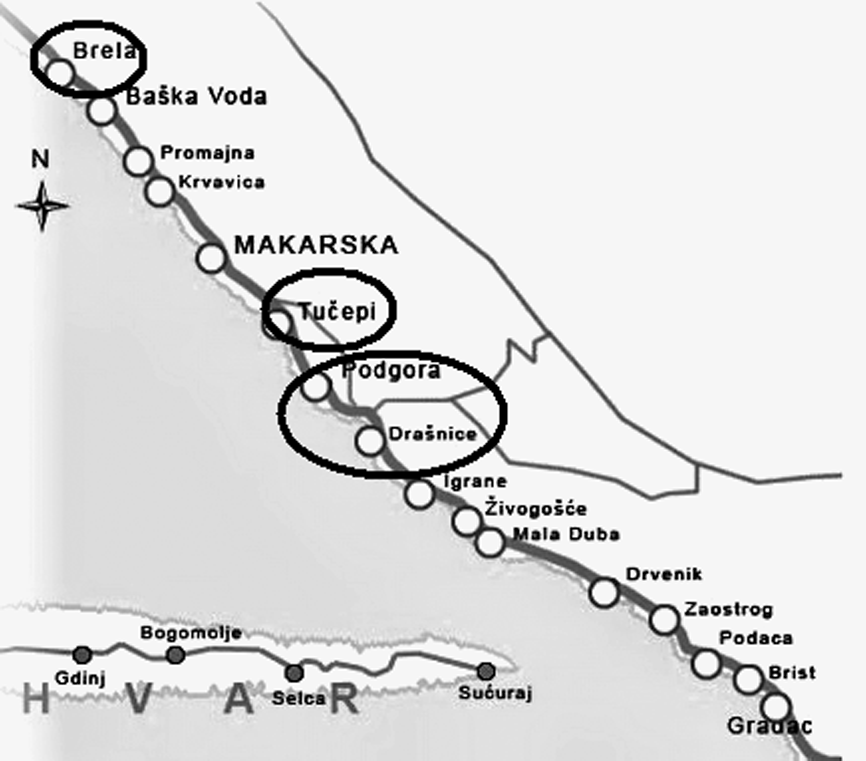
Communities with well documented ancestry represent invaluable tools for different demographic studies. The Makarska region of Croatia (Makarsko primorje, see Fig. 1) stretches 50 km south-east of Split, between the towns of Brela and Gradac. In this analysis data for Podgora, Tučepi and Brela were included as their current population levels are similar, i.e. between 1700 and 2000 people for each village. While for Tučepi (which consists of a single village) and Brela (which consists of two settlements: Brela Gornja and Brela Donja) all records are included, for Podgora (which consists of five smaller settlements), only records for two settlements, Podgora and Drašnice, are included.
Map of the Makarska region of Croatia with the villages of Podgora, Tučepi and Brela marked.

The documents used for the analysis are kept in the State Archives of Zagreb, Zadar and Split, the Archbishop Archive in Split, the Registry Office in Makarska and the church offices in Podgora, Drašnice and Brela. They contain the following:
• Podgora (settlement): births 1621–1948, marriages 1621–1949, deaths 1732–1952
• Drašnice: births 1736–1993, marriages 1739–1993, deaths 1670–1993
• Tučepi: births 1667–2000, marriages 1731–2000, deaths 1772–2000
• Gornja Brela: births 1862–1993, marriages 1858–1993, deaths 1862–1993
• Donja Brela: births 1825–1993, marriages 1825–1993, deaths 1841–1993
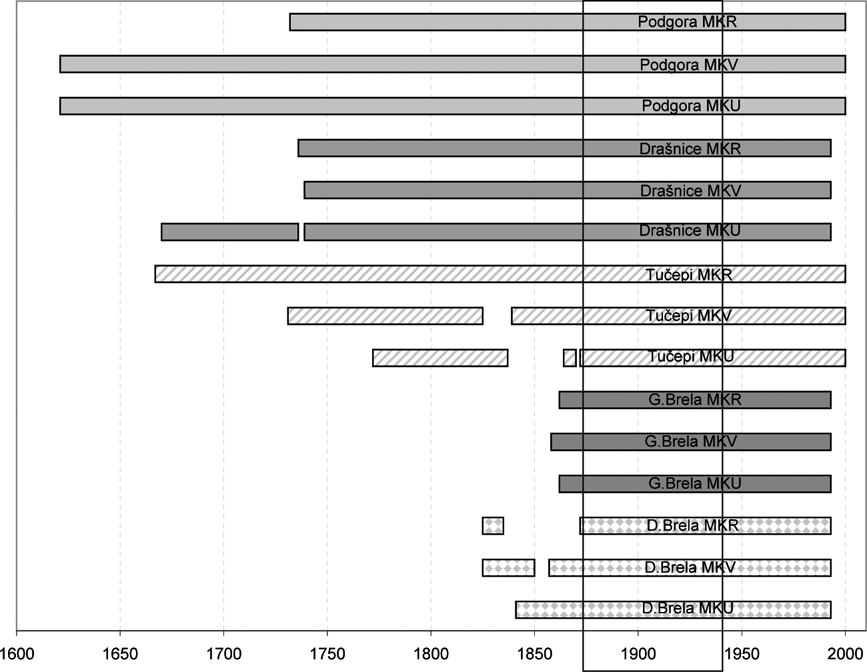
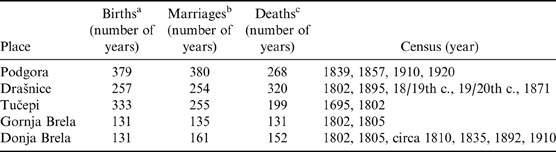
Figure 2 summarizes the records available and indicates the period (1870–1940) for which comparison is drawn. In the Appendix, a detailed description of the historical documents and their locations is given. Apart from birth, marriage and death records, census data were available for certain periods, and also contributions from numerous families to cover the periods up to today. In Table 1 the lengths of time (in years) for which records were available are specified, as well as the available census data for each place. Other records used in the research include numerous books and articles (Stojković, Reference Stojković1933; Kaer, Reference Kaer1996; Ravlić, Reference Ravlić2000).
Availability of records for each settlement used in the analysis, with the period for which data are available for all areas marked with a box. MKR: Book of Births (Matična Knjiga Rođenih, in Croatian); MKV: Book of Marriages (Matična Knjiga vjenčanih, in Croatian); MKU: Book of Deaths (Matična Knjiga umrlih, in Croatian).
Number of years of available records for each place, Makarska region, Croatia
Factors affecting twin births
The twinning rate globally is estimated at about 10 twins per 1000 births (i.e. 1%), as stated in Peller (Reference Peller2005), with an indication that this has changed significantly over the last 50 years. While twin maternities are nowadays more often used as a measure of twinning rate (where twin births are counted as one; see, for example, Fellman & Eriksson, Reference Fellman and Eriksson2002), in this study the previous definition has been adopted. Only the twinning rate up to 1940 will be analysed, i.e. the period before fertility treatments were introduced. Numerous studies have been conducted to assess twinning rates for specific populations and define the parameters affecting it. Some of these studies considered to be relevant, where authors have attempted to quantify twinning rate and the effect of mother's age and to identity other factors possibly affecting it, have been selected:
• Using statistics on Australian births during the period 1944–63, Pollard (Reference Pollard1969) concluded that the proportion of multiple births increases with increasing mother's age until 37, and decreases thereafter, and that the proportion of multiple births decreases after the first year of marriage.
• A study on 1938 data for the USA by Enders & Stern (Reference Enders and Stern1948), looking at mother's age in the USA, concluded that twinning rate increases until 35–40 and sharply decreases after 40–44.
• A study by Pison & Couvert (Reference Pison and Couvert2004), looking at the last three centuries in France, has shown that twinning rate has varied from less than 1% to 2%, and that it is affected by other factors, such as family behaviours, which are possibly affected by global events.
• A study by D'Addato et al. (Reference D'Addato, Couvert and Pison2006) looked at twinning rates in fourteen European countries, for the period between 1900 and 2000, and observed a peak just after the end of World War I (WWI) in countries like Italy, France, Germany and Sweden.
The present study analyses twinning rate, mother's age and birth order and will attempt to define social factors that could have affected twinning rate.
Data analysis
To test if there is a higher incidence of twin births in Podgora, a period (1870–1940) for which complete data were available was chosen. For each village the following information was recorded: number of infants and twins born (including sex) in each year, mother's age and birth order.
Twinning rate comparison
The total number of infants born in each place, along with an overall percentage of twins for each village during the comparison period, are shown in Table 2, where number of twins born is included in total number of births. The numbers quoted refer to number of infants born (a set of twins is counted as 2), where all births are recorded, both live and stillborn (which are almost negligible). Additional information, such as mortality of infants during the first year of life, was compared for twins and by sex, but not included in this paper as no conclusions could be drawn. The percentage of male infants born was also included.
Infant births, twinning rates and proportion male births in different villages, Makarska region, Croatia, 1870–1940

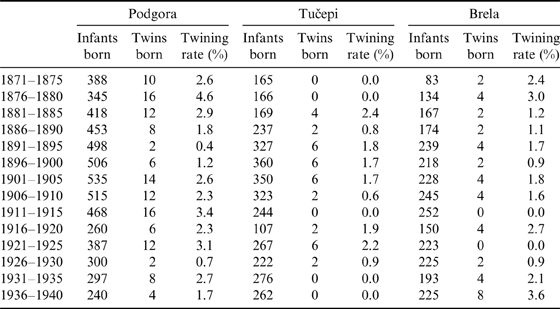
It can be concluded that twinning rate for Podgora in a given period was considerably higher at 2.3% than in the neighbouring villages of Tučepi (1.0 %) and Brela (1.5 %).
Mother's age and birth order
As seen in the literature (Enders & Stern, Reference Enders and Stern1948; D'Addato et al., Reference D'Addato, Couvert and Pison2006), mother's age is considered an important factor in twinning rate. The present analysis correlates well with other reported findings. Table 3 presents mean twins' mother's age for the three villages (with standard deviation and median values).
Average age of the mothers of twins for each village, Makarska region, Croatia, 1870–1940

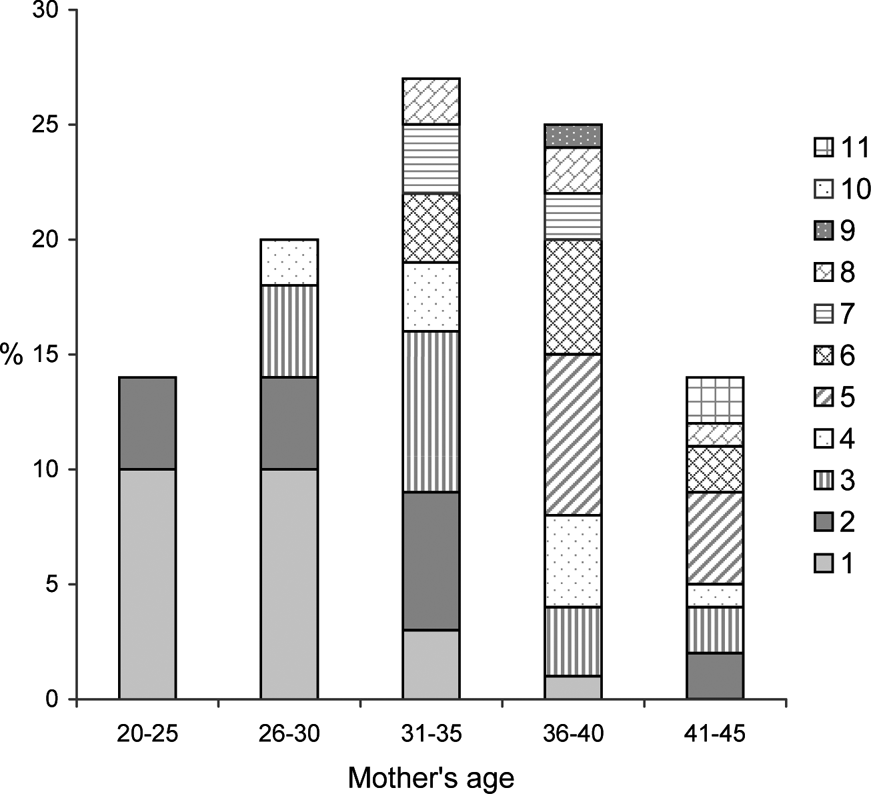
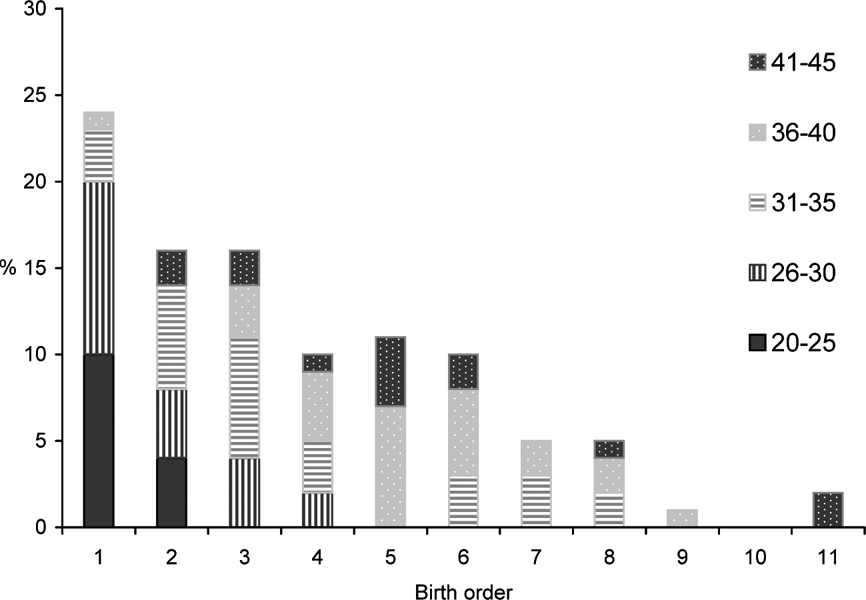
Age distribution was also considered (Figs 3 and 4). The highest chance of having twins was among women between the ages of 30 and 40, with a peak around 34 years of age.
Percentage distribution of twins by mother's age (with birth order indicated) for Podgora, Tučepi and Brela combined, 1870–1940.
Percentage distribution of twins by birth order (with mother's age indicated) for Podgora, Tučepi and Brela combined, 1870–1940.
Birth order for each twin birth correlates well with the Australian study (Pollard, Reference Pollard1969), with multiple birth occurrence decreasing after the first year of marriage (first birth), which possibly indicates that twin births occur more often when the first child is born to a women over 30.
Social and family factors
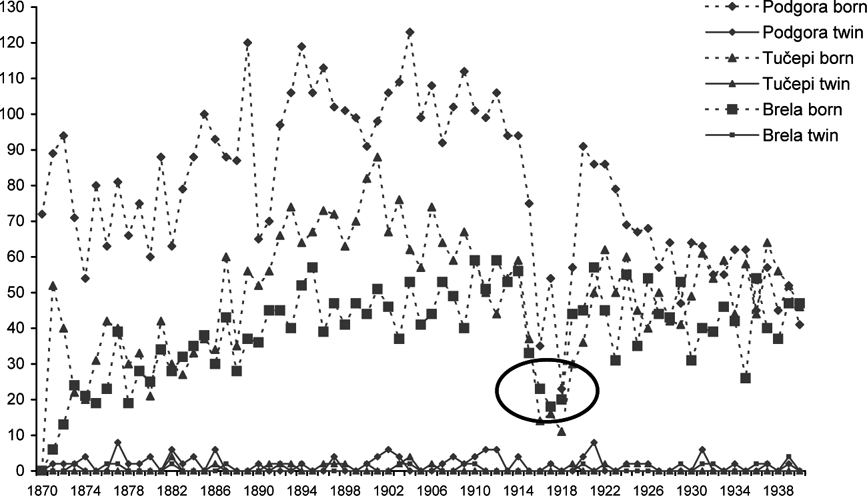
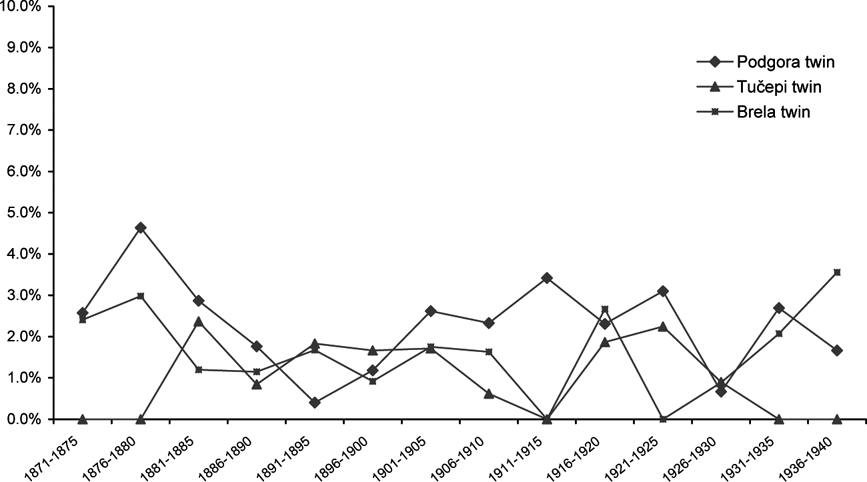
Figure 5 shows the number of infants and twins born in the study villages over the period 1870–1940. A marked dip in the number of infants born around the period of WWI was observed, which is in good agreement with the findings of other studies (Pison & Couvert, Reference Pison and Couvert2004; D'Addato et al., Reference D'Addato, Couvert and Pison2006). These authors attributed this to changes in family behaviour as a consequence of the war and the economic situation. Figure 6 and Table 4 show the data pooled into 5-year intervals.
Number of infants and twins born in Podgora, Tučepi and Brela, 1870–1940.
Twins (percentage of all recorded births) born in Podgora, Tučepi and Brela, 1870–1940.
Infants born, twinning rates and proportion of males born for each village, Makarska region, Croatia, 1870–1940
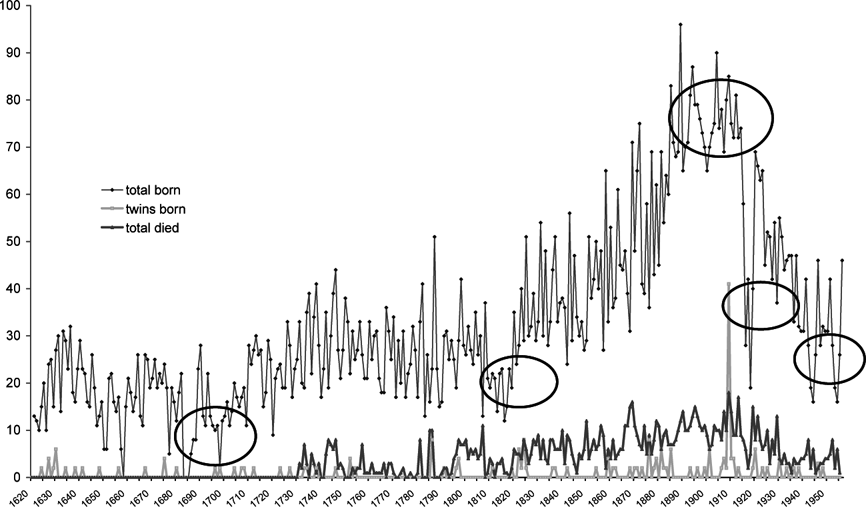
Twinning rate for Podgora for period 1621–1950
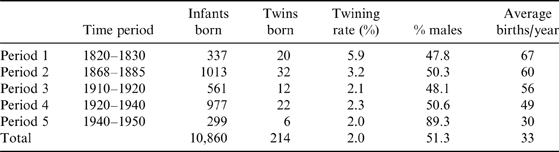
A detailed study of infant birth and twinning rates was conducted on the Podgora data for the period 1621–1950. While the analysis was conducted in the same way as for the comparison of the three villages, i.e. including twinning rate, mother's age and birth order, only the results that were in some way unexpected will be discussed here. Figure 7 presents the information graphically. While the twinning rate stayed consistently above 1.6%, five periods with slight irregularities were identified and examined further (Table 5). An unusual proportion of male babies born was noticed during the five-year period (1940–1950). The average age of women giving birth to twins correlates well with other studies, with an average value for the whole period of 34 years (SD 6, median 34). The possible reasons for this (based on Pavišić Reference Pavišić1851; Bozic-Buzancic, Reference Bozic-Buzancic1996; Anušić, Reference Anušić2008) are discussed below.
Infant and twin births for Podgora, 1621–1950.
Infants born, twinning rates and proportion of males born for Podgora, Makarska region, Croatia, 1621–1950
Period 1 (1820 to 1830)
This followed a period of lower birth rate marked by general turmoil in the area, with war, hunger and disease. It started in 1805 with the fall of the area to France, which in 1807, as a punishment for rebellion against them, burned down 117 houses. In 1813 Austria returned as ruler, and in the same year the Black Death appeared in Herzegovina, and came across the Neretva Valley to the Makarska region. More then 6000 people died in the Makarska region, with 40 families disappearing altogether. After this epidemic, a period of hunger started, especially during 1816 and 1817. There were also volcano eruptions in Asia, resulting in months of heat, mud, constant dust and red rain, destroying agriculture and causing a period of hunger in the whole of Europe (as recorded by Pavišić, Reference Pavišić1851). After 1820, there was a gradual increase in birth rate, with a sharp increase in twinning rate.
Period 2 (1868–1885)
A high twinning rate was recorded, while population growth was steadily up. This was the peak period, just before WWI, as reflected in other places around Dalmatia (see records for Blato), when many places recorded increases in population, for example Blato on Korčula doubled its population.
Period 3 (1910–1920)
This is the period around WWI and is in accordance with observations from Pison & Couvert (Reference Pison and Couvert2004), who reported higher twinning rates for the number of European countries.
Period 3 (1920–1940)
This corresponds to the period between the two world wars.
Period 4 (1940–1950)
This is the period around WWII and correlates well with the observations of Pison & Couvert (Reference Pison and Couvert2004). Figure 6 shows that since 1771, of all infants born, the sex balance was maintained and was consistent at around 50%, except for the interesting observation that the proportion of male infants born reached 89%.
Conclusions
From this comparison of three neighbouring Croatian villages (Podgora, Tučepi and Brela) over the period 1870 to 1940, the following has been established:
• The twinning rate of 2.3% for Podgora village is well above the generally expected rate and well above the rates for neighbouring villages.
• Mother's age plays a significant role in the twinning rate, with the average age of mothers giving birth to twins for the three villages ranging from 31.3 to 37.2 years.
• Twins occur more often in first births and the rate gradually goes down with subsequent births.
• The number of infants born and twinning rate in the study region have varied greatly throughout history, and this correlates well with the findings of other European studies.
Further, detailed analysis of records for Podgora covering the period from 1620 to 1950 reveal that the twinning rate for Podgora has consistently been high throughout history, with peaks in specific periods. There is also a remarkable ratio of male vs female infants born immediately after WWII with 89% of infants being male.
Future research will use the twin maternities measure, and possibly combine data with those from other regions with a high incidence of twin maternities.
Acknowledgments
The authors are grateful to all those who helped check the records, especially Smiljana Sunde, Lynette Matulovich, Noelene Erceg, Fred Petric, Ivica Domagoj Sunde, and also to Geni, a platform that allowed us to work on this problem collaboratively.
Appendix: detailed bibliography for archive documents
Podgora
• Državni Arhiv (State Archive), Zagreb
MKR/MKV 1621–1636, 1637–1689
• Državni Arhiv (State Archive), Zadar
MKR 1731–1794, 1795–1825, includes Census for 1826, 1828, 1832, 1830–1846
MKV 1731–1830, 1825–1841, 1841–1857
MKU 1732–1802, 1802–1830, 1825–1830, 1831–1854, mix MKR/MKV 1689–1730
• Državni Arhiv (State Archive), Split
MKR 1846–1863, 1863–1879, 1880–1911, 1911–1933, 1933–1948
MKV 1858–1897, 1897–1949
MKU 1854–1873, 1873–1903, 1903–1936, 1937–1949, 1946–1952
• Nadbiskupski Arhiv (Archbishop Archive), Split
Census 1839, 1857
• Župni Ured (Church Office), Podgora
Census 1910, 1920
Drašnic
• Državni Arhiv (State Archive), Zadar
MKR 1736–1796, 1796–1835, 1825–1863
MKV 1739–1834, 1837–1857
MKU 1670–1736, 1739–1834, 1825–1874
• Državni Arhiv (State Archive), Split
MKR 1863–1889, 1889–1901
Census 18/19th c., 19/20th c., 1871
• Nadbiskupski Arhiv (Archbishop Archive), Split
Census 1802
• Matični Ured (Registry Office), Makarska
MKR 1901–1948, 1946–1952, 1953–1958, 1959–1993
MKV 1858–1933, 1933–1946, 1946–1952, 1952–1958, 1960–1993
MKU 1874–1910, 1910–1946, 1946–1952, 1952–1958, 1959–1993
• Župni Ured (Church Office), Drašnice
Census 1895
Tučepi
• Državni Arhiv (State Archive), Zadar
MKR 1667–1772, 1772–1801, 1802–1825, 1825–1830, 1830–1856
MKV 1731–1771, 1772–1825, 1839–1857
MKU 1772–1825, 1825–1837
• Državni Arhiv (State Archive), Split
MKR 1856–1871, 1871–1897, 1897–1906
MKV 1858–1895
MKU 1864–1870, 1872–1909
• Nadbiskupski Arhiv (Archbishop Archive), Split
Census 1802, 1695
• Matični Ured (Registry Office), Makarska
MKR 1906–1941, 1941–1949, 1946–1951, 1951–1952, 1953–1958, 1959–1967, 1959–1998, 1998–2003
Donja Brela
• Državni Arhiv (State Archive), Zadar
MKR 1825–1835 (for both Gornja and Donja Brela)
MKV 1825–1850 (for both Gornja and Donja Brela)
• Državni Arhiv (State Archive), Split
MKR 1872–1894, 1895–1907
• Nadbiskupski Arhiv (Archbishop Archive), Split
Census 1802, 1805 (for both Gornja and Donja Brela)
• Matični Ured (Registry Office), Makarska
MKR 1908–1944, 1944–1948, 1946–1952, 1952–1958, 1959–1977, 1978–1993
MKV 1857–1929, 1930–1949, 1949–1952, 1952–1958, 1959–1977, 1978–1993
MKU 1841–1888, 1889–1935, 1935–1943, 1952–1958, 1958–1978, 1978–1993
• Župni Ured (Church Office), Brela
Census cc1810, cc1835, SA 1892, SA 1910
Gornja Brela
• Državni Arhiv (State Archive), Split
MKR 1862–1903
• Matični Ured (Registry Office), Makarska
MKR 1904–1948, 1946–1952, 1952–1958, 1959–1993
MKV 1858–1946, 1946–1952, 1952–1958, 1959–1993
MKU 1962–1889, 1890–1949, 1949–1952, 1952–1958, 1959–1993