Milk and dairy products are important sources of fat and fatty acids (FA) in the human diet. When choosing healthier eating patterns, it is recommended to reduce the intake of SFA and TFA, and to increase the consumption of polyunsaturated fatty acids (PUFA) (EFSA, 2010; USHHS & USDA, 2015). It is well established that the diet of dairy cows, and their genetic variation, are the main factors influencing milk FA composition (Shingfield et al. Reference Shingfield, Bonnet and Scollan2013). Altering the diet of dairy cows offers the opportunity to reduce milk medium-chain and total SFA content, and increase C18:1 cis-9, total PUFA and conjugated linoleic acid (CLA) contents in milk, although to a variable extent.
Milk production is often considered to have a substantial environmental impact due to methane (CH4) emissions by cattle as a result of rumen fermentation. The moderate relationship between milk FA profile and CH4 emissions (van Lingen et al. Reference Van Lingen, Crompton, Hendriks, Reynolds and Dijkstra2014), both influenced by feeding of dairy cows, indicates that the FA profile of retail milk could be used as a non-invasive method to estimate CH4 production in dairy cows.
The objectives of this study were, (i) to compare the detailed FA profiles of retail milks of two neighbouring EU countries (Estonia and Latvia) with similar climate conditions but with some differences in dairy cows’ management and feeding practice, (ii) to compare how Estonian and Latvian milks, and milk with a modified FA profile (‘designer’ milk) achieved by targeted feeding of the dairy cow, are related to the recommended human dietary intakes of different FA and FA groups, and (iii) to assess CH4 emissions via prediction equations based on milk FA composition.
Material and methods
Retail milk collection and milk fatty acid analysis
Homogenised and pasteurised retail milk (2·5 g/100 g fat, 1 l carton or bag) was purchased from supermarkets in Estonia (Tartu) and Latvia (Riga) once a month for one year (March 2011 – February 2012). All seven brands from three processors (including supermarket own labels) on sale in Estonia (total sample n = 84) and six processors’ brands in different regions in Latvia (70% of the market; total n = 72) were included in the study. Samples were kept frozen (−20 °C) and analysed at the milk quality laboratory of the Estonian University of Life Sciences, Tartu, Estonia.
The milk samples were prepared and analysed for FA profiles as described by Meremäe et al. (Reference Meremäe, Roasto, Kuusik, Ots and Henno2012). Results for all FA were expressed as g/100 g of total FA. Estimated contributions (%) of recommended daily milk consumption to the recommended or adequate intakes of FA were calculated.
Designer milk production and sampling
In a trial (April – May, 2007) on a dairy farm in Estonia (300 Estonian Holstein dairy cows, loose housed, milked twice per day, average milk yield 26·8 kg per cow per day) cows were fed a total mixed ration (TMR) ad libitum in three feeding groups based on days in milk (DIM): 1–100, 101–250 and 251 up to end of the lactation. The TMR for all feeding groups contained grass-clover (50 : 50) silage, barley and maize meal, heat treated rapeseed cake (crude fat 100 g/kg DM), cold-pressed linseed cake (crude fat 200 g/kg DM) and a mineral-vitamin mixture. Concentrate to forage ratio, metabolisable energy, crude protein and crude fat contents in DM in the three diets were respectively 59 : 41, 50 : 50, 34 : 66; 11·8 MJ/kg, 11·2 MJ/kg, 10·5 MJ/kg; 169 g/kg, 156 g/kg, 147 g/kg and 57·7 g/kg, 45·4 g/kg, 41·6 g/kg. The mean FA profile of four bulk milk samples collected was used for the comparison.
Prediction of methane production
The equation of Van Lingen et al. (Reference Van Lingen, Crompton, Hendriks, Reynolds and Dijkstra2014) was used for CH4 prediction (CH4 (g/kg of FPCM, fat-protein corrected milk) = 21·13–1·38 × C4:0 + 8·53 × C16:0-iso – 0·22 × cis-9 C18:1–0·59 × trans-10 + 11 C18:1; R 2 = 0·47). All FA in the equation were as g/100 g FA.
Statistical analysis
The effects of country, season (summer = May – October vs. winter = November – April) and country by season interaction on the FA composition of retail milks and predicted CH4 emissions were tested using fixed effect analysis of variance (ANOVA) including also the random effect of milk product brand (to consider any potential correlation between milk samples of the same brand) and two replicate measures of the same sample as repeated measures. The denominator degrees of freedom in ANOVA were calculated according to the Kenward–Roger method. To identify common patterns in milk FA profiles, and analyse their differences, principal component analysis (PCA) was performed. Additionally the FA compositions, predicted CH4 emissions and estimated contributions (%) of recommended daily milk consumption to the recommended or adequate intakes of FA were compared between Estonian and Latvian retail milks and designer milk using the t-tests with degrees of freedom equal to number of samples and followed by Bonferroni correction for multiple testing. The modelling was carried out using SAS 9.4 procedure MIXED and PCA with R 3.2.3 package ade4. The results were considered statistically significant at P ≤ 0·05.
Results and discussion
The fatty acid composition of retail milks
Even though Estonia and Latvia are neighbouring countries with similar landscape and climate, farming systems and feeding practices are different with grazing availability (16 and 60% of herds, respectively), forage to concentrate ratio (F:C) (55 : 45 and 70 : 30, respectively), use of legume-rich forage (40% of silages) and a lower proportion of maize silages in Estonia (5% vs. 19% in Latvia). These differences were reflected in the FA composition of retail milks. The FA concentrations of most milk FA, as well as FA groups, were affected by state and season, and many by the interaction of state and season (online Supplementary Table S1). The effect of season on the FA composition of retail milk was more pronounced than the effect of state.
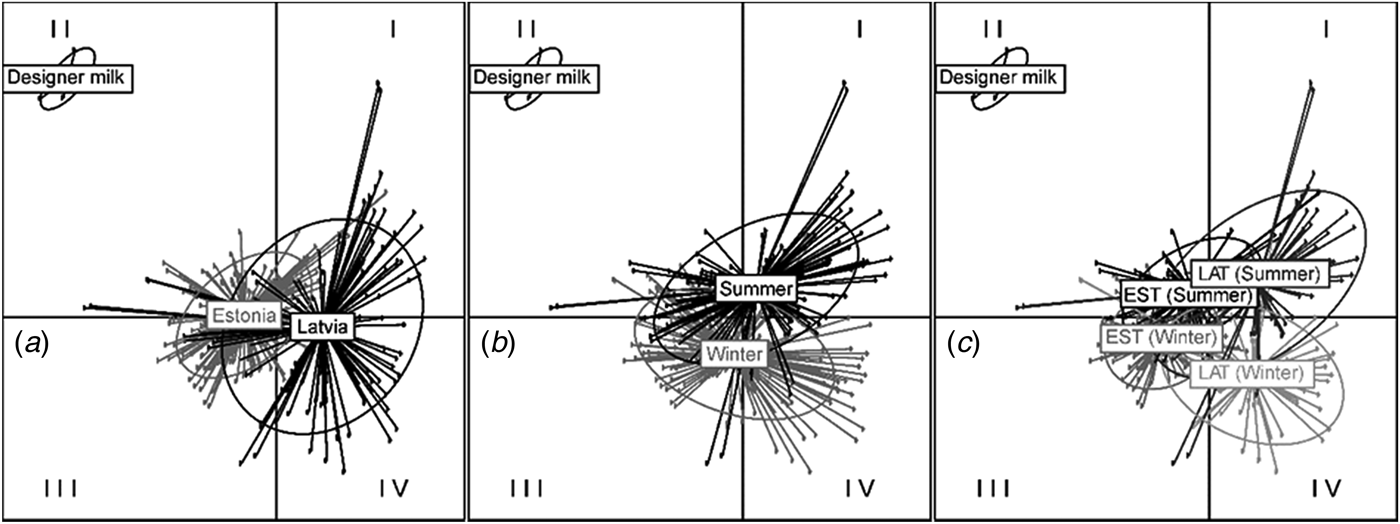
Results of PCA of the whole dataset are presented in online Supplementary Fig. S1, and the patterns of FA concentrations described by the first and the second PC according to state, season and state by season in Fig. 1.
The patterns of FA concentrations described by the first and the second principal component: (a) fatty acid patterns by national state, (b) fatty acid patterns by season, (c) fatty acid patterns by national state and season. In all figures, also the location of designer milk samples is presented. The factor loadings showing the relative importance of fatty acids in first two principal components are presented in Supplementary Fig. S1.

Relative to the overall FA pattern of Estonian retail milk, the FA pattern of Latvian retail milk was shifted towards a positive correlation with PC1 (Fig. 1a), which was related to the higher proportions of ruminal biohydrogenation intermediates including C18:1 trans-11, CLA and branched-chain FA (BCFA) originating from rumen microbes. The overall summer milk FA pattern was shifted towards the first and the second (C18 : 0, most of ruminal biohydrogenation intermediates, CLA and majority of the n-3 FA, n-6 FA) quarters (Q) of the plot (Fig. 1b). The same distinctive feature was present in both Estonian and Latvian summer milk reflecting the higher dietary supply of PUFA, especially that of C18 : 3 n-3, from fresh grass compared to winter diets (Dewhurst et al. Reference Dewhurst, Shingfield, Lee and Scollan2006). Compared to Estonian summer milk, the FA pattern of Latvian summer milk was shifted towards the first and fourth (BCFA, C15:0 and C17:0) quarters of the plot (Fig. 1c). Regarding winter milk, the FA pattern of Latvian winter milk was shifted towards the higher proportions of BCFA, C15:0 and C17:0 (IVQ) compared to Estonian winter milk and lower proportions of de novo synthesised FA (IIIQ) also FA clustered in the second quarter (Fig. 1c). The higher concentrations of BCFA and linear odd-chain FA (C15:0, C17:0) in Latvian winter milk are in line with a previously reported (Vlaeminck et al. Reference Vlaeminck, Fievez, Cabrian, Fonseca and Dewhurst2006) effect of higher F:C ratio increasing the proportions of bacteria-derived FA leaving the rumen.
Human consumption of health-related fatty acids
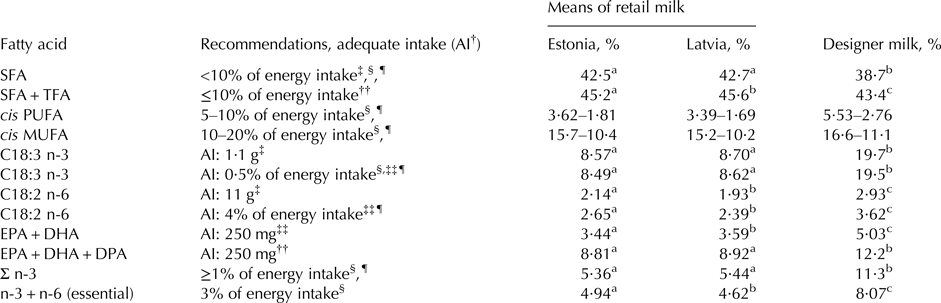
The estimated contribution of Estonian and Latvian retail milk to the recommended or adequate intakes of FA for adults (Table 1) confirmed previous suggestions (Shingfield et al. Reference Shingfield, Bonnet and Scollan2013) that milk fat is an important source for SFA (~43% of the recommended upper limit) if the recommended amount (600 mL, fat content 2·5 g/100 g; Tervise Arengu Instituut, 2017) is consumed. Estimated contributions for desirable α-linolenic acid (ALA; C18:3 n-3) were relatively low but still provided above 8% of adequate intake (1·1 g or 0·5% of energy intake). Regarding the sum of long-chain n-3 PUFA (eicosapentaenoic acid (EPA; C20 : 5 n-3) and, docosahexaenoic acid (DHA; C22:6 n-3), the latter was not detected in this study, but estimated intake of long-chain n-3 PUFA was enhanced (~3·5% vs. ~9·0% of 250 mg, Table 1) by docosapentaenoic acid (DPA; C22:5 n-3), the concentration of which was greater than EPA (online Supplementary Table S1). The function of dietary DPA remains uncertain, although some reports indicate it may be beneficial to health (Howe et al. Reference Howe, Buckley and Meyer2007)
Estimated contribution (%) of recommended daily consumption (600 mL, fat content 2·5 g/100 g) of Estonian and Latvian retail milk and designer milk, to the recommended or adequate intakes of FA for females with energy intake of ~8·37 MJ/d

† AI, adequate intake.
‡ Dietary Guidelines for Americans 2015–2020 (USHHS & USDA, 2015).
§ Nordic Nutrition Recommendations 2012. Recommended intake of macronutrients (excluding energy from alcohol) (Nordic Council of Ministers, 2014).
¶ Estonian nutrition and physical activity recommendations 2015 (Tervise Arengu Instituut, 2017).
†† Not used in cited recommendations.
‡‡ Scientific opinion on dietary values for fats, including saturated fatty acids, polyunsaturated fatty acids, monounsaturated fatty acids, trans fatty acids, and cholesterol (EFSA, 2010).
a,b,c Means with different superscript letters are statistically significantly different (P < 0·05, t-tests with degrees of freedom equal to number of samples and followed by Bonferroni correction for multiple testing).
In line with the results of a feeding trial with dairy cow diet supplemented with linseed (Stergiadis et al. Reference Stergiadis, Leifert, Eyre, Steinshamn and Butler2014) the FA profile of designer milk differed substantially from retail milk profiles (Fig. 1). Our designer milk contained more ALA, long-chain n-3 FA, trans FA and less SFA compared with retail milks (online Supplementary Table S1). Designer milk consumption would increase the estimated intake of C18:3 n-3, Σ n-3 and sum of essential FA [ALA + linoleic acid (LA; C18:2 n-6)] but also EPA and DPA (Table 1). The estimated contribution of milk fat to the recommended upper limit for dietary intake of SFA was lower for designer milk compared with retail milk, and it was also lower for designer milk for SFA + TFA.
Even though the effect of the state on the FA composition of retail milk was observed for most FA, only small differences were observed in estimated consumption of discussed FA and FA groups at the recommended milk intake level of 600 mL/d. However, while consuming designer milk ALA intake would be almost doubled to 19·7% of AI.
Predicted CH4 emissions in dairy cows
Although van Lingen et al. (Reference Van Lingen, Crompton, Hendriks, Reynolds and Dijkstra2014) indicated that milk FA composition has only a moderate potential for CH4 prediction per unit of milk, the method still enables some degree of assessment of regional differences, modification of feeding strategies and mitigation of CH4 emissions. Despite the dissimilarities in feeding strategies, there were no differences in yearly mean CH4 output values from dairy cows (g/kg FPCM; P = 0·51) between our two states. The predicted CH4 emissions were higher (P < 0·001) during the winter period compared to the summer 12·19 vs. 11·92 and 12·62 vs. 11·65 in Estonia and Latvia, respectively. Our simulation showed notably lower enteric CH4 emissions when producing designer milk (11·06; P < 0·001) compared to conventional production (12·06 for Estonia and 12·11 for Latvia). Lower predicted CH4 emission while producing designer milk, as a result of feeding oilseed (Meale et al. Reference Meale, McAllister, Beauchemin, Harstad and Chaves2013), shows that production of designer milk with higher PUFA content (hence potentially favourable for consumer health) also has environmental advantages.
In conclusion, we demonstrated state and seasonal differences in FA profiles of milks form the neighbouring countries Estonia and Latvia, and consequential differences in predicted methane outputs of dairy cattle form these countries. Despites this variation, an appreciable increase in human dietary intakes of beneficial fatty acids from milk could only be achieved by targeted feeding.
The research was financed by EU Regional Development Fund in the framework of the Competence Centre Program of Estonia under Projects EU30002 and EU 48686 of BioCC LLC; institutional research funding of Estonian Research Council, project IUT8-1; supported by COST actions FA 0802, FA 1308.
Supplementary material
The supplementary material for this article can be found at https://doi.org/10.1017/S0022029918000183