For all that was expected of the Bank of the United States (BUS) upon its incorporation in 1791, it was the unexpected that came to define its early career as a federal instrumentality. The BUS routinized a number of federal fiscal transactions (including debt payments), offered credit to public and private parties, and lent support to the public credit generally. None of this surprised either the cohort of Federalist policymakers who championed the institution in Congress or their opposition, whose objections—constitutional, sectional, or economic—had little to do with the fiscal utility of a national bank. What did surprise members of both camps was the subsequent emergence of the BUS as a policy instrument with the capacity to regulate the supply of credit available from other banking institutions, namely state-chartered banks. After all, notes monetary historian Richard Timberlake, “any imputation that [the BUS was] to control the [state] banks or regulate the monetary system in any way” was “[c]onspicuously absent” from the institution's charter.Footnote 1
This change in the national bank—an expansion of its public functions and its effective inauguration as a regulatory vehicle—was unevenly received. Many institutional elites celebrated the BUS's new capacity to limit the lending of sister institutions as “our best claim to praise,” an admirable sacrifice of profit for the sake of public safety.Footnote 2 Those who represented local interests, by contrast, were prone to open resentment of this affront to federalism and spoke of the “overweening influence [the BUS has] established over the moneyed institutions of the States.”Footnote 3 I largely limit my inquiry here, however, to the change itself—its causes, consequences, and broader import for the study of institutional change.Footnote 4
The historiography of the BUS justifies renewed attention to its acquisition of power over state banking institutions. Scholarship touching on the early career of the national bank often mentions the development only in passing, or when charitable, also characterizes the same sequence of events as unintended. Edwin Perkins offers an example of the former, noting that in addition to its fiscal responsibilities, the BUS “also served as unofficial regulator of the operations of the increasing number of state banks.”Footnote 5 Susan Hoffmann's work on the 1791–1811 period is indicative of the latter; she argues that the “primary purpose of the national bank became more complex” as a result of developments “[Alexander] Hamilton had not anticipated” when designing the institution.Footnote 6
Some historical work goes so far as to specify, and briefly discuss, the mechanism of influence: the accumulation and subsequent redemption in specie of state bank paper by the BUS, an operation which correspondingly reduced the lending capacity of state institutions. Joseph Van Fenstermaker offered a standard account of the relevant procedure when he wrote that the Bank of the United States “returned state bank notes which it had received on deposit, for redemption in gold and silver, and as a result tended to prevent excessive issues by state chartered banks[.]”Footnote 7 The most comprehensive—though still quite abbreviated—treatments belong to Stuart Bruchey and David Cowen; these scholars wrote independently on the BUS but jointly relied upon a host of primary source material gathered by the late BUS historian James O. Wettereau.Footnote 8 Bruchey, for example, relied upon original records of BUS directors' meetings in positing that by 1795, the institution “was aware of its power and duty to keep the [overall] supply of bank credit within careful limits.”Footnote 9
There is room to improve upon these accounts, both by synthesizing existing research findings and by integrating new data on how a diverse set of actors understood the emerging relationships between banking institutions. Accordingly, this article aims to present a more comprehensive portrait of the national bank's gradual evolution into what its president, Thomas Willing, called the “great regulating wheel of all the Commercial Banks in the United States[.]”Footnote 10 Such a portrait requires careful attention to the interlocking array of formal institutions and administrative initiatives that made this evolution possible, including a crucial decision by BUS directors that gave the national bank a truly national scope. It also demands a closer look at the activity of BUS elites that made regulation a reality, namely their collection and systematic redemption of state bank paper. The unexpected advent of “positive monetary control” by an arm of the national government during a period of acute sensitivity to questions of federalism and the legitimate scope of federal power understandably evoked reactions ranging from reverence (born of the desire for stable money) to abhorrence (born of the desire for a nonencroaching national government), and no picture of these developments would be complete without some attention to their early reception beyond the institutional boardroom.Footnote 11
Aside from the inherent value of chronicling these events in greater detail, analyzing the period in question also gives me an important opportunity to engage emergent models of institutional change. Recently Wolfgang Streeck and Kathleen Thelen, working within the field of comparative political economy, have problematized more traditional assumptions about the nature of institutional change; they argue that change understood as either incremental adaptation in the service of institutional continuity or the abrupt breakdown of existing arrangements fails to capture the full range of developmental possibilities.Footnote 12 In particular, they stress that “dramatic institutional reconfiguration” can result not only from short-run processes but also from “an accumulation over longer periods of time of subtle incremental changes.”Footnote 13 From this principle, Streeck and Thelen articulate a typology of gradual but transformative institutional change, relying upon empirical case studies completed by collaborators.Footnote 14
There is little doubt that during the first twenty years of its existence, the Bank of the United States underwent what Streeck and Thelen would call “conversion,” or the attachment of “new goals, functions, or purposes” to existing structures.Footnote 15 In the case of the BUS, the emergence of regulatory influence did not so much “convert” the institution in any colloquial sense as supplement its existing functions; none of the fiscal responsibilities discussed in Hamilton's Report on a National Bank were abrogated once the institution began to operate as a “watchdog over state banks and the economy.”Footnote 16 What is less clear, however, is whether the conversion process briefly sketched by Streeck and Thelen conforms with the experience of the BUS. They posit that conversion results from purposeful redirection orchestrated by political or institutional elites. Either (1) new challenges prompt the redeployment of existing institutional resources, or (2) new actors take the helm and pursue novel harbors.Footnote 17 In this article I treat their visions of the conversion process as testable propositions requiring empirical verification. While I ultimately conclude that the emergence of the Bank of the United States as a regulatory vehicle did reflect one of those visions—the structural advantages of the BUS over rival banks were leveraged by institutional elites to meet new challenges in the Early Republic's economy—the images of conversion described by Streeck and Thelen risk undertheorizing the range of possibilities for this type of institutional change. In particular, they fail to consider the possibility that institutions with acquired resources may actively seek new problems to solve.
Streeck and Thelen's visions of conversion operate on the assumption that institutional elites work with a relatively stable set of tools; these are secured at the moment of institutional choice and later deployed to new ends. However, what passes as an institutional resource at T1 may represent (1) a feature present at T0 whose subsequent import was simply underappreciated by founders,Footnote 18 or (2) a tool or set of tools absent at T0 but subsequently acquired or developed.Footnote 19 In short, institutions can meaningfully enhance their resources over time, and these enhancements may encourage an endogenous search for appropriate ways to employ the same. For these types of cases, the “challenge” or “problem” to which new resources are directed may represent as much the construction of an imperative to use resources as a bona fide dilemma. This article will test Streeck and Thelen's existing images of conversion against a constructed third account, one in which problems are rhetorically manufactured by institutional elites to justify the use of new resources. In the case of the BUS, this amounts to asking if regulatory conversion in the 1790s resulted from (1) genuine concern on the part of the institution's board of directors about excessive credit in the national economy, (2) an influx of new officers or board members in Philadelphia, or (3) an internal desire to employ the national bank's creditor status vis-à-vis state banks.
With these joint empirical and theoretical goals in mind, I chronicle here the core administrative decisions and exogenous developments responsible for placing the BUS in a regulatory posture while offering parallel commentary on how these events reflect on established tropes in American Political Development (APD). After outlining the early operations of the national bank, including its crucial decision to establish branches in four coastal cities outside Philadelphia, I discuss the related explosion in the number of state-chartered banks, which continued unabated for the duration of the period under study. This leads to my formal review and assessment of the BUS's conversion, which grew from its early and unexceptional demands on state banks for specie. After concluding that the conversion represented a sincere response to troublesome developments in the broader economy, I briefly digress in order to dismiss as anachronistic an oft-repeated suggestion that the BUS was at birth a “central bank” or became one during its early tenure.Footnote 20 I conclude by summarizing the main finding of the article and identifying two implications of the study for future research.
BUBBLES AND MANIAS: THE EARLY DAYS OF THE BUS
The Bank of the United States was not created with control of state banks or regulation of the monetary system in mind. It was chartered, in short, to serve as a fiscal auxiliary to the young federal government—to facilitate the achievement of various Article I prerogatives, namely tax collection, debt payment, and (when necessary) public borrowing.Footnote 21 Much about these fiscal ends is captured by Alexander Hamilton's written proposal for a national bank, submitted to Congress in December 1790.
The Treasury Secretary's submission, conventionally known as the Report on a National Bank, was actually entitled Second Report on the Further Provision Necessary for Establishing Public Credit.Footnote 22 Hamilton's initial Report on the Public Credit, submitted eleven months earlier, had recommended both the consolidation of existing debts and the use of tax revenue to pay interest on them.Footnote 23 In other words, the proposal sought to demonstrate a national commitment to debt management. When Congress quickly adopted these recommendations, the public's credit improved; the price of government securities rose quickly and significantly.Footnote 24 Lending money to the federal government, in short, became a less risky proposition almost overnight.
Accordingly, the subsequent Report on a National Bank should be understood with its original title in mind. How would such an institution further enhance the public's credit? Or, to use Hamilton's own language, how would the bank “be of the greatest utility in the operations connected with the support of the Public Credit[?]”Footnote 25 The answer here lay in Hamilton's scheme for capitalizing the institution. He proposed that shares in the BUS be purchased partially with specie and partially with government securities; this purchase rule would enhance the demand for (and price of) federal bonds. In other words, institutional design would be used as a tool for making public debt an even more attractive investment.
A bank whose capital structure enhanced the public's credit would offer significant fiscal support to the federal government, facilitating any future borrowing. However, Hamilton's report also suggested that the institution would support the fiscal operations of the government in other ways. In this vein, the treasury secretary wrote that a national bank would be “an Institution of primary importance to the prosperous administration of the Finances[.]”Footnote 26 It would provide some fiscal supports directly to the government: short-term loans in times of need, a safe depository for federal revenue, and an agent for both transferring public funds throughout the Union and making regular payments to public creditors (e.g., bondholders, or federal employees).Footnote 27 The bank's capital structure might enhance the public's ability to raise funds through bond sales, but these everyday functions—making loans, storing funds, and paying parties identified by its customers—would also facilitate the exercise of the government's Article I powers.
The ensuing congressional debate over Hamilton's bank proposal—which indicated universal agreement on the institution's fiscal utility for the government and deep division over its constitutionalityFootnote 28—included almost no discussion of state banks. Four were operating as of early 1791: the Bank of North America (Philadelphia), the Bank of Massachusetts (Boston), the Bank of Maryland (Baltimore), and the unincorporated Bank of New York (New York City). In the House, James Madison claimed that the “proposed bank would interfere, so as indirectly to defeat a State bank at the same place.” Madison did not, however, articulate this objection in any greater detail. Similarly, Maryland representative Michael J. Stone suggested at a subsequent juncture that the national bank would “swallow up the State banks” but also failed to explain how this would occur.Footnote 29 I mention these two remarks because they exhaust material from the 1791 debate that speaks to relations between the prospective national bank and state-chartered peers. If national bank opponents—many of whom were strong defenders of federalism—had the regulation of state institutions on their minds, many more might have said so (and explained the objection). In short, there is little reason to believe that state bank regulation or monetary authority formed any part of the BUS's original mission.
After President Washington signed the BUS bill in late February 1791, attention quickly turned to the task of organization. The main office in Philadelphia formally opened in December 1791, at first merely to facilitate the buying and selling of institutional stock but later to accept deposits and offer loans.Footnote 30 Its internal organization, however, significantly predated the opening of its doors; down payments on BUS stock were accepted in five coastal cities beginning July 4, 1791. The first board of directors was then elected by stockholders in late October and proceeded almost immediately to sanction the creation of branch banks.Footnote 31 The former development has attracted frequent scholarly attention,Footnote 32 as the public offering of BUS stock initiated an early American asset price bubble that inflated and burst within six weeks' time. The latter sequence of events, by contrast, is much less studied but actually more critical for understanding how the institution changed over time. I treat both developments below, with greater attention to the branching decision.
Americans flocked to major commercial centers on July 4, 1791, for the opportunity to purchase stock in the Bank of the United States. For twenty-five dollars in specie—around 6 percent of the share price—an individual could purchase a transferable certificate of option that entitled its bearer to make four subsequent semiannual payments so as to acquire the share in full.Footnote 33 Several scholars report that subscription books were completely filled within one hour, but James O. Wettereau contends that across multiple sites the time was somewhere between fifteen minutes and three hours.Footnote 34 On the expectation that the BUS would generate substantial dividends for its shareholders—an expectation founded on the past performance of institutions like the Bank of North America (BNA)—these “scrips” began to trade at prices far in advance of twenty-five dollars: “[b]y early August the price of the scrip in New York had skyrocketed tenfold in the Coffee Houses from $25 to $250[.]”Footnote 35 The speculative frenzy peaked around mid-month, with prices briefly reaching $325 (or $700 for the full share) in Philadelphia, and the ensuing break in the market left scrip prices between $130 and $170 for the rest of the year.Footnote 36
I have described the phenomenon known as “scripomania” in only the briefest factual terms, which unjustly robs the episode of its colorful history, impassioned personalities, and resonance with popular manias more generally. Curious readers may consult more detailed chronicles,Footnote 37 but my interest in the bubble is restricted to the further unease it generated among those already critical of the BUS. James Madison, an early constitutional critic of the national bank in the House of Representatives, saw in the frenzied activity of stock speculators the confirmed ascent of a dangerous moneyed power in American politics. By contrast, Thomas Jefferson—the most ardent constitutional foe of the BUS in President Washington's cabinet—suggested that the industry of ordinary Americans would be dangerously compromised by Hamilton's financial program.
Stanley Elkins and Eric McKitrick have noted that the speculative scenes “were all that was finally needed to goad Jefferson and Madison into shudders of loathing.”Footnote 38 Madison cynically suggested to Jefferson that speculation in federal securities and BUS scrip revealed “by whom the people of the U.S. are to be governed.”Footnote 39 In case his comment left any doubt as to the identity of these imputed governors, Madison's subsequent letter was direct to a fault: “The stockjobbers will become the pretorian band of the Government—at once its tool and its tyrant; bribed by its largesses, & overawing it, by clamours & combinations.”Footnote 40 These comments invoked the old notion that government-sponsored banking institutions would undermine or supplant wholesale their formal benefactors, a rallying cry during both the BNA and BUS charter fights. But Madison's anxiety advanced this old objection no further; it remained fundamentally forward-looking and devoid of supporting evidence. His jobbers-cum-tyrants would remain the great bugbear of the early national political economy.
Jefferson agonized less over perceived threats to constitutional government, instead rooting his disdain for scripomania in its deleterious effects on the broader economy and its constituent members. He wrote in late July 1791 of the “delirium of speculation” that had swept the country.Footnote 41 A month later, after the scrip bubble had popped, he was still lamenting its effects. To David Humphreys he wrote that “[a] spirit of gambling in the public paper has lately seized too many of our citizens . . . Many are ruined by it; but I fear that ruin will be no more a correction in this case than in common gaming.”Footnote 42 But the virtue of the citizenry was not all that was threatened by the diffuse frenzy; in more material terms their industry, the engine of national prosperity, was being compromised. Jefferson asked Edward Rutledge what he thought of this “scrip-pomany,” but then proceeded to answer his own question:
Ships are lying idle at the wharfs, buildings are stopped, capitals withdrawn from commerce, arts and agriculture, to be employed in gambling, and the tide of public prosperity almost unparalleled in any country, is arrested in its course, and suppressed by the rage for getting rich quick in a day.Footnote 43
This correspondence suggests a relatively clear causal chain for Jefferson, as a distractive quality of scripomania induced the destruction of virtuous industry on both an individual and collective scale. While obviously distinct from Madison's more traditional concern over a moneyed aristocracy, Jefferson's critique forcibly suggested that the spirit of aristocrats may corrupt the more democratic elements.
After a less volatile market for BUS scrip emerged, the next significant event in the life of the national bank came in late October with the election of the first board of directors. The influx of stockholders to Philadelphia rendered the city “so full of strangers . . . that it was for several days difficult to get good lodgings.”Footnote 44 The twenty-five-member board that emerged from the general meeting of stockholders was heavily weighted toward the northern seaboard commercial centers (80 percent hailed from Boston, New York, and Philadelphia) and also included seven members of Congress. After Oliver Wolcott, Jr., one of Hamilton's subordinates in the Treasury Department, declined the BUS presidency, the honor fell to BNA president Thomas Willing.Footnote 45 BUS historian David Cowen notes that Wolcott's greater popularity with stockholders likely arose from his explicit support for branches, a crucial administrative decision to which I now turn.
Hamilton's Report on a National Bank had briefly treated the subject of branches, recognizing that “[t]he situation of the United States naturally inspires a wish, that the form of the institution could admit of a plurality” of them.Footnote 46 The secretary had reservations, however, not the least of which was a concern that insufficient domestic expertise in commercial bank management would erode prospects for the “safe and orderly administration” of these satellites.Footnote 47 Given the “relative novelty of commercial banking” in America—the BNA had been chartered less than a decade earlier—entrusting inexperienced officers far from Philadelphia with authority that could (if misused) “hazard serious disorder” for the institution as a whole was not high on Hamilton's wish list.Footnote 48 He nevertheless attempted to placate branch advocates (namely the stockholders in commercial centers outside Philadelphia) and account for the future proliferation of managerial expertise by expressly leaving the decision to the BUS board.Footnote 49
Scholars have proffered at least two additional explanations for Hamilton's opposition to branches. The first is an imputed—but insufficiently documented—preference on the part of the secretary to centralize the institution's capital, at least at the outset, and thus render it available for use by the federal government.Footnote 50 As Edwin Perkins has noted, organization along these lines would have emulated the Bank of England, which extended credit to some private actors near London but “remained principally an institution oriented toward serving the needs of the Exchequer.”Footnote 51 Other students of the institution have recognized that a centralized system was politically unacceptable, in part due to aforementioned concerns over concentrated economic power but mostly because it would result in considerable shareholding by non-Philadelphians. This crowd was “adamant in their determination” to both profit from the institution and share its benefits with their localities.Footnote 52
Perkins's chapter on the early years of the BUS addresses another potential explanation for Hamilton's opposition. The 1784 effort to charter the Pennsylvania Bank in Philadelphia, a would-be competitor to the Bank of North America, aroused concerns over the “feasibility of [hosting] two or more commercial banks . . . in a single market.”Footnote 53 More specifically, no one in 1784 knew if two banks issuing convertible currency could coexist without one eventually being drained of its specie reserves. When organizers of the rival institution opted to join an enlarged BNA and thus eschew their original plan, it meant that no multi-institution precedent would be established within a single city (and thus, an answer given to the feasibility question). The status quo of one city, one bank held until the establishment of the BUS seven years later, which promised (at the very least) competition for the BNA in Philadelphia. Any BUS branches established in other cities with banks would simply reproduce the altered institutional landscape appearing in Philadelphia. If Perkins is correct, Hamilton may have opposed branches (or simply wished to delay their establishment) because the two Philadelphia institutions would yield considerable feedback on the prospects for competitive banking.
Representatives of several state banks, anticipating the establishment of branches but wary of these imagined effects, started clamoring for mergers with the BUS before the ink was dry on President Washington's signature. A subcommittee of the Massachusetts Bank (MAB) board of directors was created in April 1791 to investigate “a Union with the Bank of the United States, or any partial connection with the same,” and the MAB pursued this objective by purchasing 250 shares of the BUS in July, or 1 percent of the total stock.Footnote 54 Christopher Gore, a director of the MAB and later a U.S. senator from Massachusetts, wrote Senator Rufus King of New York later in the summer that “[t]he State Bank of Mass. [MAB] is well disposed to receive its death warrant at the present time. The stockholders are very largely interested in the National Bank & wou'd willingly promote the latter to the destruction of the former.”Footnote 55 A related strategy was adopted by the leaders of the Bank of New York (BONY), who purchased 300 BUS shares over the summer in anticipation of coordinating with the national bank. In early November, the BONY president wrote the BUS board of his institution's desire to “cultivate a good understanding and to obviate if possible competition between the Two Banks,” proposing inter-institutional shareholding as a means of securing mutual support.Footnote 56 These letters suggest that uncertainty over the consequences of competitive banking engendered anxious, even desperate efforts to head off such encounters before they took place. There was certainty respecting one proposition, however: “the relationship between the Bank of the United States and the state banks would hinge on the [pending] answer given [to the branch] question by directors of the [BUS].”Footnote 57
Boston and New York did not get the answers they were looking for. Not only did the board of directors sanction the creation of four branches on November 8—in New York, Boston, Baltimore, and Charleston—but they also explicitly rebuffed efforts to merge or otherwise partner with state banks. According to original BONY records examined by David Cowen, President Willing and his board elected “upon due deliberation . . . [not] to invest any part of their Capital in the Stock of either of the State Banks.”Footnote 58 These decisions meant, if nothing else, that an answer to the feasibility question was forthcoming; soon not one but four U.S. cities would host multiple commercial banks. I discuss the consequences of these choices in terms of institutional change below, but the early decisions of the BUS board also speak to the idea that institutions, once created, take on a life independent of their creators. The “whole affair of branches was begun, continued and ended; not only without [Hamilton's] participation but against [his] judgment,” a fact that confirms Joseph Stancliffe Davis's assertion that the treasury secretary “was far from dominating the directorate of the federal institution, which was generally accounted his creation and by many considered his tool.”Footnote 59 Armed with a twenty-year charter and management chosen by private shareholders, the national bank would not be
[A] mere tool of the [federal] Government. Its directors were almost invariably ready to cooperate, but they remained singularly independent of Treasury dictation. Hamilton occasionally sought to bend the directors to his purposes, but the Bank acted contrary to his views in several important instances, notably in the original decision to establish branches.Footnote 60
In more disciplinary terms, early and endogenous decision making respecting the future of the BUS and its role in the national economy immediately rendered the institution an integral but conspicuously independent auxiliary of the federal government.Footnote 61
The decision to establish branches in four coastal cities left the BUS board with subordinate considerations, namely when to open these offices and how to manage them. While the main office in Philadelphia would be ready for deposits and lending in December, “committing the Direct[ion] of Departments [i.e., branches] to a sufficient number of discreet and honest stockholders residing on the spot” would take more time, and require adoption of a selection procedure.Footnote 62 The main board ultimately took upon itself the yearly task of making branch director appointments, choosing thirteen men for each site who resided locally, were American citizens, and held BUS stock. While the branch cashier, or effective chief operating officer, would be selected by and responsible to the Philadelphia board, local boards were permitted to elect from their own ranks a branch president.Footnote 63 Once a portion of the institution's specie capital was allocated to each branch, only a dwelling was required to facilitate the commencement of branch operations. Branches were opened gradually over the first half of 1792, with BUS-Boston opening first in late March, the New York and Charleston branches on the same day in early April, and the Baltimore office in late June.Footnote 64
FROM SCRIPOMANIA TO BANCOMANIA: THE PROLIFERATION OF STATE BANKS
Because the BUS influenced—and was in turn influenced by—developments elsewhere in the American political economy, a short detour in the direction of state banks is warranted here. With respect to BUS influence on others, the emergence of a branched national bank was a significant (but not the sole) factor in the proliferation of state-chartered banks; the legacy here is ambiguous because some state institutions were chartered to attract a BUS branch, while others were chartered to repel the BUS. With respect to external developments influencing the BUS, this dotting of the American landscape with state banks quickly led national bank officers to assert responsibility for the emerging banking “system.”Footnote 65 I examine the latter outcome, which I characterize as the conversion of the national bank from fiscal auxiliary to an instrument of both fiscal and monetary policy, in the next section. My attention here, however, is restricted to commercial banks authorized by state governments.
Students of state banking in the Early Republic have offered at least three explanations for the proliferation of these institutions—desire for private or public gain, credit access difficulties, and reactions to the BUS—though I hasten to add that specific episodes of institution-building both reveal the imperfect nature of these categories and reflect mixed motives on the part of bank organizers and state lawmakers.Footnote 66 The first explanation, particularly salient in the aftermath of BUS-related scripomania, is the simple search for profit. Following the speculative frenzy of the BUS scrip offering, and consistent with Jefferson's aforementioned anxieties, the desire for quick and sizeable pecuniary gain failed to subside. The first months of 1792, for example, saw the quick organization and successful charter application of the Bank of Albany, whose organizers sold scrips to purchase $150 shares for a 10 percent down payment but soon watched those same fifteen-dollar scrips trade as high as $100.Footnote 67 Further to the south, correspondents were writing of an emerging craze for banking in New York City. Either through the speculative trading of bank scrip or the dividends expected once an institution was up and running, these enterprises looked to New Yorkers like promising ventures.Footnote 68 “I shall not tire you with a description of the Banco Mania in this place,” wrote James Watson to Jeremiah Wadsworth in January 1792; Watson was alluding to subscriptions and charter efforts for up to three new banks within the city.Footnote 69 Within days it was reported that “[t]he Bank mania [had] subside[d] a little, [with] the three different subscriptions” consolidated into a single $1.8 million proposal, but this fact leaves undisturbed the preponderant image of individual profit-seeking behavior.Footnote 70 If nothing else, many enterprising citizens of the Early Republic “recognized the powerful wealth-generating possibilities of the [bank] corporation.”Footnote 71
Individual citizens were not the only parties interested in profiting directly from banks. State governments used commercial banks in a variety of ways to generate income streams, and those streams kept “traditional state taxes low or even, in a few cases, nonexistent.”Footnote 72 Joseph Van Fenstermaker's work on state commercial banking in the Early Republic argued that states (1) owned bank stock directly (which generated dividends), (2) required the direct payment of a bonus for charters, and/or (3) taxed either dividends or the capital stock.Footnote 73 More recent work on antebellum public finance has fleshed out these claims, offering a state-by-state assessment of how banks were used. For example, the Commonwealth of Pennsylvania supplied one-third of the capital for the new Bank of Pennsylvania in 1793—a $1 million investment—and generated approximately a tenth of its internal revenue between 1791 and 1795 from resulting stock dividends.Footnote 74 This public “profit” facilitated a corresponding downward adjustment in traditional taxation.
State-chartered banks were also generated in response to real or perceived difficulties among groups in gaining access to existing credit facilities. At least two sources for these difficulties have been identified by banking students. Historian Naomi Lamoreaux has documented patterns of insider lending in antebellum New England, arguing that the bulk of bank loans were made to existing stockholders or those with personal ties to the same.Footnote 75 For those not within this privileged circle, the denial of loans was a “bitter pill” that sometimes prompted efforts to establish friendlier facilities.Footnote 76 In the Bay State, for example, suspicions “inside and outside the state legislature” that a small cohort of Massachusetts Bank directors had control of the institution in the early 1790s (and were using it to selfish ends) spurred talk of a new bank more amenable to the needs of other interests.Footnote 77 The charter of the Boston-based Union Bank, granted by the state soon after, specified that “the Directors shall wholly and exclusively regard the agricultural interest” in making a set portion of its loans.Footnote 78
Politics represented the other imputed source of difficulty for some would-be borrowers, although the line between politically motivated and network-based lending could be blurry. Edwin Perkins notes that directors at both the Bank of New York and the New York branch of the Bank of the United States were predominately Federalist, and each set “made loans primarily to their friends, relatives, and business associates.”Footnote 79 Republican pamphleteers in New York railed against these practices, identifying a “system of exclusion” in which “[t]he benefit of those institutions was chiefly confined to the adherents of one political sect.”Footnote 80 Whether those “excluded from favour” were punished for their politics or simply their business circles is difficult to determine, but it is clear that some urban Republicans (e.g., those not inherently hostile to commercial banks) began to think of these institutions as devices for both serving their own supporters and building additional grassroots support:
If the Republicans had in their hands such a financial weapon as the [Federalists] possessed, what power would be added to their campaigns! They could give loans and discounts to good Republicans, attract wavering Federalists to their side, and even assist the propertyless man to qualify as a voter.Footnote 81
Lamoreaux notes, for example, that a desire to break the “Federalist monopoly of financial institutions” in Boston motivated a group of Democratic-Republicans to organize the State Bank of Boston in 1811,Footnote 82 but the more famous episode of partisan-themed institution-building belongs to New York City, which saw the state grant a charter to the Manhattan Company in 1799. Aaron Burr—prominent New York Republican, future vice president of the United States, and Secretary Hamilton's assassin—believed that the Bank of New York in particular had been “used to patronise and encourage business men who were Federalists, and to cramp and embarrass those who held republican principles.”Footnote 83 His effort to secure a Republican institution, however, was complicated by the dominance of Federalists in both chambers of the New York legislature. Accordingly, Burr successfully pursued a state charter for a water treatment company—a charter that included a brief provision permitting “surplus capital” to be used in “other monied transactions.”Footnote 84 When the institution began to spend less time purifying water, and more time making loans, Federalists were irate. Burr's brainchild survived, and today (after mergers and acquisitions) that institution is known as JPMorgan Chase.
State banks also proliferated in this period in direct response to the emergence of the BUS and its anticipated decision to establish branches. Bank advocates either saw state charters as an indicator and/or enabler of a city's commercial importance (thus justifying the assignment of a BUS branch to it) or viewed their acquisition as part of a broader campaign against federal influence in local economic life. Merchants in Providence, including John Brown of the firm Brown & Francis, were interested in bringing a branch of the newly authorized BUS to their city in mid-1791 but understood the relative unattractiveness of the site. Brown wrote that
[W]ithout a spring to promote our young men in business here they must and will continue to go to such places as will aid them with the means of business; and in short all our wealth . . . must be transferred to other states, who by their banks promote all the valuable arts of mankind.Footnote 85
Chartering a local bank, John advised his brother Moses, would offer a “good and substantial foundation” for economic growth, which might in turn entice BUS officials to place a new branch in Providence.Footnote 86 Joseph Stancliffe Davis suggests that John Brown may have conceived of the relationship between organizing a state bank and bringing a BUS branch to Providence altogether differently; he cites evidence that Brown went “to Philadelphia to endeavor to have the [state] bank made a branch of the national bank.”Footnote 87 In other words, the goal was to convert the newly chartered Providence Bank, not supplement it. The historical point need not be resolved here, as either account renders the Rhode Island state bank a strategic play for the federal institution.Footnote 88
By contrast, the origin of the Bank of Alexandria—chartered by the Virginia legislature in late 1792—illustrates the role of explicit anti-BUS sentiment in generating state banking institutions. A number of Federalist merchants in that town commenced a campaign in 1791 to attract a BUS branch, petitioning the institution's board of directors through their congressman and independently appealing to Secretary Hamilton.Footnote 89 Merchants in Norfolk and Richmond also petitioned for a branch, and in mid-1792 Hamilton (now apparently reconciled to branches) solicited input on the candidate sites.Footnote 90 Jefferson, aghast at the prospect of Federalist “bank-mongers” invading his native soil, correctly inferred that Richmond would prevail among BUS directors and wrote to Madison asking if a “counter-bank might be set up to befriend the agricultural man.”Footnote 91 He was not alone in thinking that a state institution could effectively counter or thwart altogether a Richmond branch; Governor Henry Lee suggested to Madison that “one way is left to preserve the state from this undue operation, & that is to establish a bank under the auspices of the C[ommon]Wealth—This might easily be done & would counter-act if not defeat the plan contemplated.”Footnote 92 For reasons that remain mysterious, but likely included the frosty welcome from state political elites not connected with the merchant class, the BUS board temporarily abandoned its effort to place a branch in Virginia.Footnote 93 The state legislature, left with calls from multiple communities for credit facilities and the opportunity to reinforce its opposition to the national institution, chartered state banks in Alexandria and Richmond by the end of the year.Footnote 94 Perhaps fittingly from the perspective of some Republicans, Alexandria—the community whose bank overtures were initially ignored by BUS directors—opened its state-sponsored institution in early 1793, while Richmond—the apparent darling of the despised Federal crowd—was left with no institution at all; subscriptions to its authorized bank were insufficient to sustain the project.Footnote 95
Historian Fritz Redlich invoked this set of factors, albeit vaguely, in his brief treatment of pre-1811 state bank proliferation. Redlich identified four distinct “crops” of state banks during the 1782–1811 period, with the Bank of North America as the sole member of the first set. Those institutions set up “more or less under the influence of the [BNA]”—the Bank of New York (1784), the Massachusetts Bank (1784), and the Bank of Maryland (1790)Footnote 96—constitute the second crop. “[T]here sprang in one way or another a third crop” between 1792 and 1800, a set of approximately twenty-three institutions spread across nine states; the diverse “ways” are outlined and discussed above.Footnote 97 Finally, the 1801-1811 period witnessed the “indiscriminate multiplication of banks,” including their advent in places of “economi[c] insignifican[ce]” such as the Catskills in New York.Footnote 98
While Redlich's scheme succeeds in capturing several important breakpoints in early state bank proliferation, more should be said regarding the uneven speed and geographic spread of these developments. First, a number of these institutions appeared during short-term bursts in institutional creation, which fundamentally remade the broader banking landscape. At the conclusion of 1791, as the Bank of the United States was commencing its operations in Philadelphia, five state banking houses were open for business along the East Coast; as a federal institution the main BUS office does not figure in this total. By the end of the next calendar year, which saw the opening of four new BUS branches and the onset of bancomania in the northeast, that number had risen to twelve—an increase of 140 percent.Footnote 99 The next largest year-over-year percentage increase came in 1803, which saw the number of state banks rise from thirty-five to fifty-three (or 51 percent). The expansion of financial services here was heavily concentrated in three New England states (Massachusetts, New Hampshire, and Rhode Island), with no single causal factor explaining this time-bound crop. State-centric economic historians offering coverage of this period have emphasized the role of dividends distributed by existing institutions in generating a “banking mania of sorts” (Massachusetts), identified the “political and sectional influences” which enabled previously underserved classes to secure access to credit (Rhode Island), and noted the subjection of new banks to capital-based taxation in order to support higher education (New Hampshire).Footnote 100 While each of these factors is catalogued above, the broader point is simply that state bank expansion was not uniformly “gradual”; short but intense bursts of chartering activity often flowed from developments endogenous to American commercial banking.
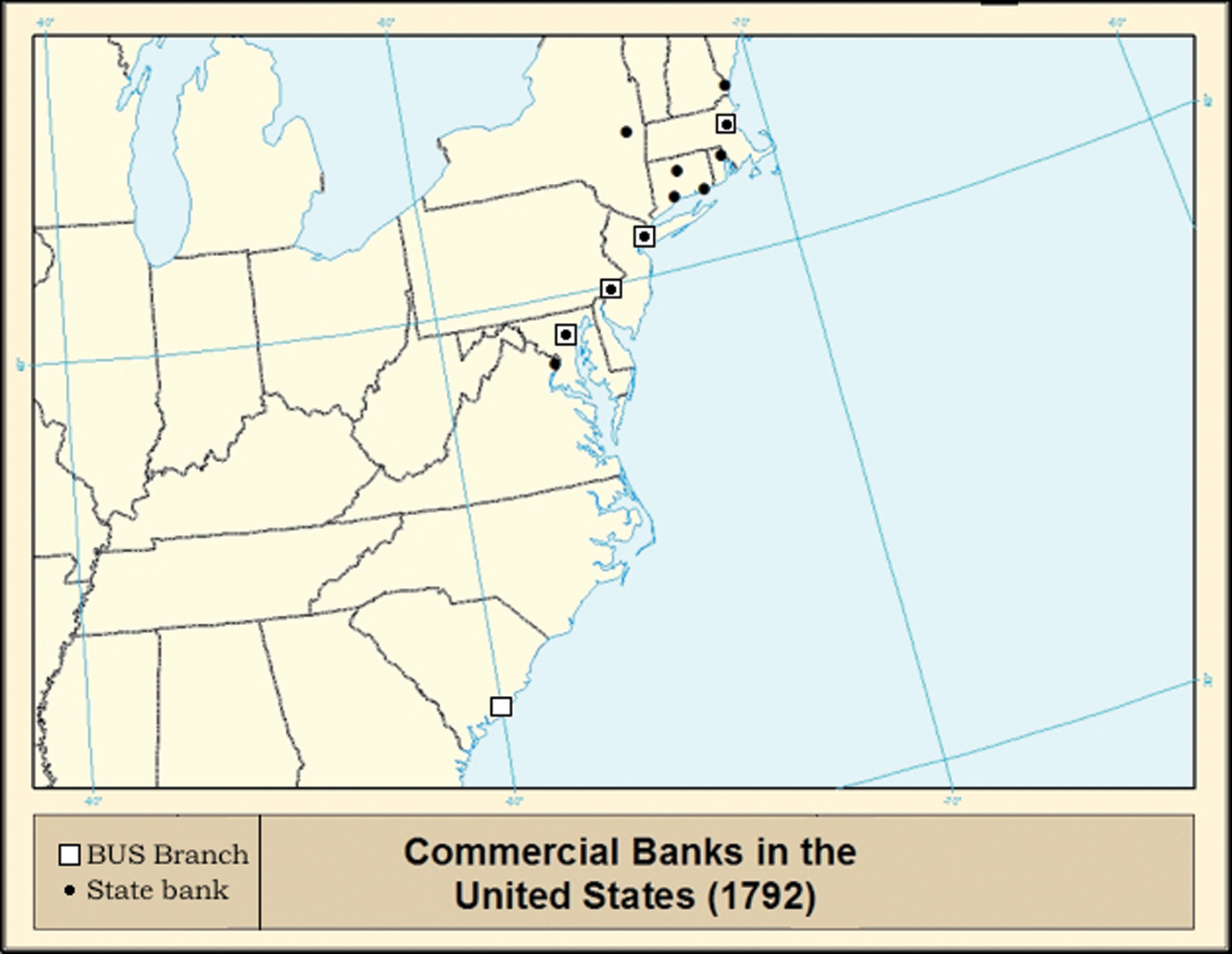
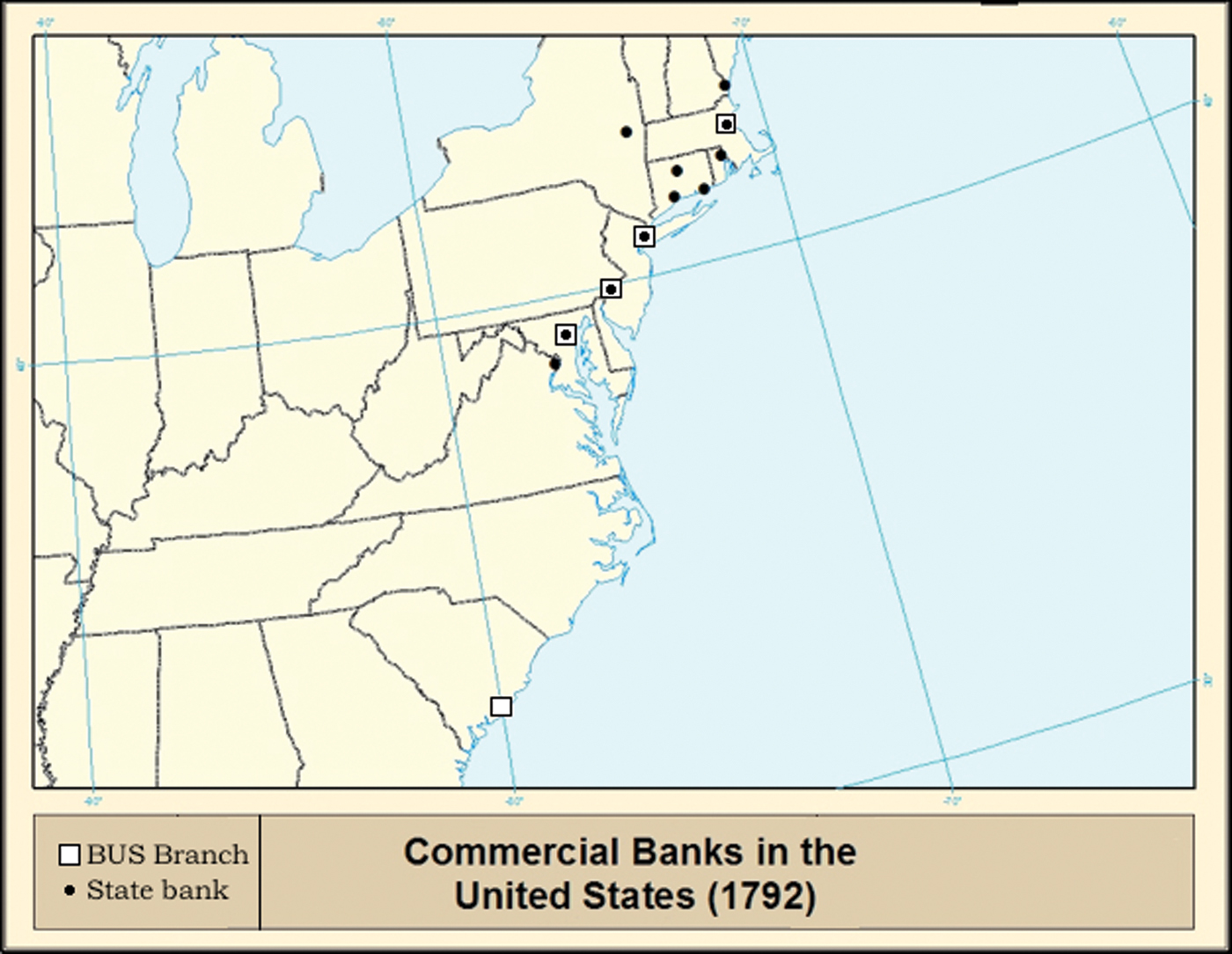
Existing surveys of state banking—an early monograph by Davis Dewey, Fenstermaker's oft-cited but largely descriptive account, Redlich's short characterization, and Perkins's brief chapter on the subjectFootnote 101—nonetheless fail to convey a sense of geographic development; neither narrative accounts nor tabular presentations of state bank growth capture the changing institutional landscape over time. The language of terrain can be more than simply metaphorical; maps are helpful devices for documenting both the numeric growth and geographic spread of banking houses over time. Figure 1 offers a picture of American banking at the end of 1792: most federal and state banking sites were located from Philadelphia northward, and the only bona fide establishment in the South was the BUS branch in Charleston, South Carolina.Footnote 102 Nine out of fourteen states hosted a commercial bank of some sort by the end of 1792, and four cities (Baltimore, Philadelphia, New York, and Boston) played host to state and federal banks. Boston was the outlier with three banks at the end of 1792, as both the Boston branch of the BUS and the Union Bank opened that year to supplement the MAB.
Source: Generated from Fenstermaker, Development, Appendix A.
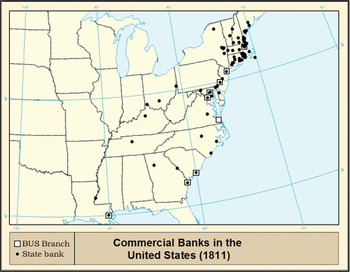
Almost two decades later, when the question of BUS renewal reached Congress, the map looked very different indeed. Figure 2 reveals that each of the seventeen states possessed at least one state-chartered institution, and territorial banks were organized in both the Mississippi and Louisiana territories.Footnote 103 The overwhelming majority of institutions were located in New England, as no state bank south of the Washington, D.C., area was chartered until the South Carolina legislature authorized two banks in late 1801. Over the next decade, thirteen state banks opened in cities as far south as Savannah (the Planters' Bank of the State of Georgia) and as far west as Nashville (the Bank of Nashville).Footnote 104 These were supplemented by new branches of the BUS in Norfolk (where it was the only bank), Washington (after it became the national capital), Savannah, and New Orleans (in the Louisiana Territory).Footnote 105 The diffusion of state banks throughout the Union was an important development from a geopolitical perspective because it subsequently offered all members of Congress a common incentive for opposing the national bank's recharter: the prospect of siphoning off BUS business to their own constituents, including the deposits of the federal government's revenue.Footnote 106
Source: Generated from Fenstermaker, Development, Appendix A.

“SO MUCH IN THE POWER OF THE BRANCH”: THE BUS AS REGULATOR OF STATE BANKS
The two previous sections have treated, respectively, the internal BUS decision in late 1791 to establish branches and the significant expansion of state-chartered banks that commenced at roughly the same point in time. While both developments increased the aggregate number of banking sites within the United States, each traced its legitimacy to a distinct system of authority.Footnote 107 The work of the First Congress rendered incorporation a concurrent power within American federalism, as physically and functionally similar banking institutions became distinguishable on account of their legitimizing source within the constitutional order. This simple fact is important for two reasons. First, the concurrent exercise of the power to incorporate, coupled with the BUS decision to establish branches in cities already home to state banks, laid the institutional groundwork for the subsequent and routine interbank contact that functionally transformed the national bank and later reshaped both its normal and constitutional politics.Footnote 108 Second, this image of distinct institutional patterns “moving alongside one another” and colliding in ways that mutually “reshape and distinguis[h]” each other is consistent with Karen Orren and Stephen Skowronek's more systematic claim that intercurrence guides institutional development over time.Footnote 109 In this section, accordingly, I explore the intercurrence between federal and state banking in greater detail, and compare the BUS's ensuing conversion into a regulatory instrument with the aforementioned images of institutional change offered by Wolfgang Streeck and Kathleen Thelen.
James O. Wettereau has noted that as 1791 drew to a close, “each of the existing State banks, except that of Providence, would soon face the competition of the mammouth [sic] National Bank or one of its branches.”Footnote 110 While the previous instrument of national finance, the Bank of North America, operated in close proximity to its successor in Philadelphia, state banks in Boston, New York, and Baltimore encountered smaller and semi-autonomous arms of the BUS in their respective cities.Footnote 111 These four pairings would reveal, at minimum, whether there was room for multiple banking institutions in a single locale—a question nearly a decade old in American banking.Footnote 112 What remained fundamentally unknown was the consequence of banks in close proximity to one another accepting each other's paper (notes and checks) on deposit, and subsequently conducting exchanges of that paper: would one bank emerge as the creditor of the other, and ruin the latter with unrelenting demands for coin? Jonathan Mason, Jr., of the Boston branch of the BUS, was anticipating the local contest well before his bank had opened its doors; on December 17, 1791, he wrote Andrew Craigie that “[t]he capital of [the Boston] branch ought to be attended to—unless it is as respectable as possible, the Mass[achusetts] Bank will control & check us instead of our commanding them.”Footnote 113
At least two procedures were established by banks in 1792 for dealing with debts to other institutions: account balances and note exchanges. In June, the directors of the Massachusetts Bank established an account with BUS-Boston and deposited therein the notes of the latter institution held by the former. Not only did this transaction render a portion of the national bank's specie payable on demand to the local state bank, but it effectively provided the MAB with a balance for paying any redemption demands made by BUS-Boston using the state bank's notes.Footnote 114 Later that same year the Boston institutions pursued a course previously set by the banks in Philadelphia and New York: the regular exchange of bank paper. On February 6, the directors of the Bank of North America approved a daily exchange of deposited notes with the main BUS office, while Bank of New York cashier William Seton reported to Alexander Hamilton in July that “we receive & pay [BUS-NYC] notes indiscriminately with our own, & I believe they do the same—we make large interchanges now & then.”Footnote 115 These precedents rendered unexceptional the BUS decision near the end of the calendar year “to send each week to the [Boston] branch of the Bank of the United States . . . all their notes and to demand therefor[e] either Massachusetts Bank notes or specie.”Footnote 116
Time revealed that multiple banks could survive and flourish within a single city, despite early doubts expressed by bankers with firsthand knowledge of the BUS and its impressive capacity to collect the paper of competing institutions.Footnote 117 The most prominent correspondence on this point belongs to the aforementioned cashier of the BONY, William Seton, and the U.S. treasury secretary. Over an eight-month period beginning in August 1792, Seton wrote Hamilton no less than three letters complaining about specie demands made on the BONY by the local branch of the BUS. His first letter confided to Hamilton a concern that BUS-NYC directors had identified the BONY as a rival and consequently “wish[ed] to take every advantage in draining us of our Specie.” His instincts here turned out to be sound, as John Kean (cashier of the main BUS office) advised Jonathan Burrall (Kean's counterpart at BUS-NYC) within weeks of Seton's letter that “the more we can curtail the circulation of [BONY] paper by fair dealing the better.”Footnote 118 Seton complained pointedly to the secretary that “whenever the interchange of Notes leaves a balance in their [BUS-NYC's] favour, a d[ra]ft for Specie soon follows.”Footnote 119 Four and a half months later, the branch-supplied pressure for specie had not only failed to abate, but had actually intensified; this caused Seton to recall Hamilton's expression that
“[T]he Branch must ultimately preponderate”—I find this to be the case every day, and indeed it has now such advantage over us, that if pusht too far, might be attended with fatal consequences . . . upon every exchange of Bank Notes which we make three times a week, the balance is eternally very large in their favour; we have therefore been obliged to pay them imense [sic] Sums in Specie . . . this of course obliges us to cramp our operations . . . and in one month to call in over Two hundred thousand Dollars of our Discounts . . . the drain of Specie is so great and we are so much in the power of the Branch (whose direction certainly bears us no good will) that I really at times feel very uneasy.Footnote 120
Hamilton's inability to save the BONY “from the depredations of the [New York] Branch”—he could merely comfort Seton with the (doubtful) claim that the BUS-NYC actions “have in no degree proceeded from any unkind disposition”—underscores once again the significant degree of operational autonomy enjoyed by the banking creature vis-à-vis its creator.Footnote 121 The secretary of the treasury could punish injurious competitive behavior on the part of the BUS by removing the federal government's deposits—an action threatened by Albert Gallatin in late 1808 and performed by Roger Taney a generation later—but he could not directly tie the national bank's hands with respect to its use of deposited state bank paper.Footnote 122 The aggressive posture of the BUS was maintained into the spring of 1793, when Seton reported to Hamilton that “[o]ur Specie is draining from us very fast . . . every week we get more & more into the power of the Branch.”Footnote 123
How, precisely, did the New York branch of the BUS find itself in such a commanding position vis-à-vis the BONY? In terms generalizable to the institution as a whole, how did a BUS branch routinely emerge as the creditor of its state bank counterpart after interinstitution clearing operations had been completed?Footnote 124 At least three factors were at play in the earliest days of the BUS. First and foremost, the national bank “had the account of the single largest transactor in the economy”—the federal government—and that transactor's revenue collectors were instructed by Secretary Hamilton to accept state bank notes for payment.Footnote 125 Once deposited in the BUS to the credit of the federal government, local notes and checks could be redeemed for specie at the discretion of branch directors. Many scholars of the early American economy understandably see deposits of federal revenue as the foundation of the national bank's regular creditor status, a point I return to below. The impressive size of the national bank's capital and the wide geographic scope of its operations also played a role by rendering state bank notes the object of exchange operations. William Seton, for example, wrote of the universal receivability of BUS paper in New York City, meaning that an individual whose private creditor refused to accept BONY notes for payment could exchange the same at BUS-NYC for national bank notes; this operation would both satisfy the creditor and render the state bank indebted to the BUS.Footnote 126 Similarly, an individual holding the notes or checks of a local institution but hoping to satisfy creditors or make purchases outside of that region could exchange his or her paper for a sort more likely to be accepted everywhere—the paper of the national bank; this too would place the relevant state bank in the position of debtor. Finally, the Bank of the United States likely benefited from deposits made by influential private customers, particularly merchants with operations in multiple states and local businessmen accepting state bank notes for their goods and services. If the largest private transactors in the antebellum economy kept accounts with the BUS, their routine deposit of state paper could also place the institution in a commanding position vis-à-vis rivals.Footnote 127
Identifying the multiple foundations for the frequent creditor status of the BUS vis-à-vis state banks is important because at least one of them—deposits of federal revenue—has been problematized by a student of the Early Republic's economy. In his influential and award-winning chronicle of antebellum American banking, Bray Hammond argued that federal revenue during the 1791–1811 period was “mostly in the notes of state banks . . . these notes being deposited in the Bank [of the United States], it could not help being their creditor.”Footnote 128 While many scholars have taken Hammond's claim here at face value,Footnote 129 an obscure footnote in Stuart Bruchey's treatment of Treasury-state bank relations between 1789 and 1795 questions its veracity. Bruchey contends that Alexander Hamilton gradually adopted a new administrative policy in the early 1790s—collectors of revenue would henceforth accept only BUS paper—and consequently, deposits of revenue would be made almost entirely in notes of the national bank.Footnote 130 If Bruchey is correct, then the regular creditor status of the BUS (at least by 1793 or so) was a function of factors other than Treasury Department policy.
To my knowledge no scholar has directly responded to Bruchey's claim, and Hammond's account remains preeminent. Evidence appears scant on this question, but at least two possibilities suggest themselves. First, James O. Wettereau wrote in an unpublished essay on the development of the BUS that after the institution was chartered, the “Treasury continued to permit payment of duties in notes of various State institutions as well, at least those [banks] located in towns or cities where there was no office of the Bank of the United States.”Footnote 131 In other words, it is possible that notes and checks from more remote institutions (e.g., the New Haven Bank, chartered in October 1792) were still accepted by local collectors after Hamilton's aforementioned circular and were eventually deposited in the nearest BUS branch (for this example, either BUS-Boston or BUS-NYC). This would render some types of state bank paper more likely to find their way into BUS coffers than others. It would also represent something of a middle ground between Hammond's (implicit) claim of universal reception of state bank notes for tax payments and Bruchey's unqualified denial for the post-1793 period. One piece of evidence bearing on this question is a letter sent in November 1808 by Treasury Secretary Gallatin to David Lenox, Thomas Willing's successor as BUS president.Footnote 132 Responding to complaints that the Baltimore branch of the BUS had made “unusually large & particularly draining” demands for specie from state banks, Gallatin reminded Lenox that
The large amount of public deposits necessarily gives a more than usual preponderance to the Bank of the United States over other Banks. No use of this ought certainly to be made to their injury or beyond what is necessary for the safety of the Bank of the United States.Footnote 133
The letter is interesting because it strongly implies—to quote a second source—that deposits of federal revenue enabled the Baltimore branch “to make such large calls on the different Banks in [the] City.” According to Baltimore-area banker Samuel Smith, the “Branch ha[d] all the other Banks constantly in Debt” in part due to the payment of federal customs bonds.Footnote 134 It would appear that at some point between April 1793 and November 1808, federal collectors in Baltimore—and possibly other cities with BUS branches—were again instructed to accept state bank paper by the Treasury Department. While this account would not disturb Wettereau's contention that some state bank paper was still accepted in the immediate aftermath of Hamilton's administrative reforms, it would largely rehabilitate—except for an interlude of unspecified duration—Hammond's general claim about the competitive advantage enjoyed by the BUS.
The upshot here is that Treasury Department policy during the early career of the BUS was an important but less than uniform facilitator of the latter institution's position vis-à-vis state banks. Collectors' acceptance and subsequent deposit of state bank notes and checks provided the national bank with leverage over local rivals. When this point is considered alongside federalism, a constitutional principle that permitted state governments to charter local banks, and the BUS decision to establish branches in proximity to these institutions, it appears that a combination of formal structures and administrative decisions (1) facilitated regular contact between federal and state institutions, (2) did so in numerous locales along the Atlantic Coast, and (3) left the national institution in a position of systematic (i.e., both temporally routine and geographically dispersed) advantage. How the BUS responded to this “strategic position” is the story of its conversion into a monetary instrument.Footnote 135
Any vigorous and sustained campaign by the early BUS to purposefully drain a state bank of its specie reserves could have done considerable damage to, or completely decimated, a smaller institution's lending (and profit-making) capacity. But that sort of ruthless competitive stance would have been politically suicidal for the national bank, vindicating old Anti-Federalist anxieties about the federal government and its institutions “absorb[ing] and swallow[ing] up the state governments.”Footnote 136 Nicholas Biddle, the president of the BUS during the height of its influence and its war with the Jacksonians, once foolishly commented to a Senate committee in 1832 that there were “very few banks which might not have been destroyed by an exertion of the power of the Bank.” Opponents of the institution were far from amused with Biddle's implication, and capitalized on his political naïveté during the Bank War.Footnote 137 The point is simply that the BUS, which operated under a time-limited charter and thus needed to maintain a large coalition of supporters in Congress, was neither at liberty to oppress state banks with unending specie calls nor even have its officers talk as if such capacity existed.
Understanding both the bank's potential and the futility of exercising it, the directors of the BUS gradually steered an independent course that judiciously utilized the institution's position without exploiting it. The first evidence of this comes from a memorandum prepared by directors of the main board in late 1795 for circulation to the branches. Invoking the “recent Institution of so many Banks,” a point treated in the previous section, the leaders of the BUS agonized openly about the emerging and “injurious Surplusage of circulating Credit.”Footnote 138 They concluded that the large expansion in aggregate banking capital not only “overexpanded the supply of credit” generally but also left the banks vulnerable as a group: “the Derangement of any one Institution, would create an Alarm & a serious Crisis, which would deeply injure the reputation of all.”Footnote 139 Consequently, the board declared its intent to “remedy the Evil” by directing branches to reduce their lending (an action expected to induce state banks to follow suit). In other words, the board “made it clear that it regarded itself as guardian of the ‘System of Bank Credit.’”Footnote 140 Going forward the BUS would not simply provide a range of fiscal services to citizens and to the federal government—it would also monitor the banking “system” as a whole (which included all state institutions) and respond to self-detected anomalies in institution-specific or aggregate credit creation. This concern for the “supply of bank credit” across institutions and the determination to supervise it is the essence of monetary authority.Footnote 141
The 1795 policy statement is important because it symbolized the national bank's acceptance of state counterparts while articulating the concurrent institutional objective to regulate their operations. Rather than unthinkingly present accumulated state bank paper for redemption in specie, the BUS would consciously employ a more conditional approach. If a particular institution or the banking system as a whole was considered within acceptable bounds of credit creation, the BUS could forego redemption of deposited notes and checks; these could be held for subsequent exchanges with state institutions or recirculated via withdrawals or new lending.Footnote 142 By contrast, if the BUS “felt that credit restraint was called for,” it could utilize its aforementioned advantage(s) over state banks by presenting their notes for redemption in specie. Such operations would effectively regulate state institutions by draining their reserves and consequently reducing the amount of credit they could safely circulate.Footnote 143 The decision by institutional elites to pursue an objective—regulation of the nascent “American banking system”Footnote 144—unconnected with the founding of the national bank is the essence of conversion as a species of institutional change.Footnote 145 Before returning to the question I posed at the beginning of this article—Does either image of the conversion process outlined by Wolfgang Streeck and Kathleen Thelen conform with the experience of the BUS?—I want to chronicle in greater detail the activity of the BUS as a (converted) regulatory instrument.
Though much of the explicit discussion of the BUS as a “restraining force on state banks” or as the “great regulating wheel of all the Commercial Banks”Footnote 146 is found in the 1811 congressional debates on rechartering the institution, surviving institutional records and correspondence furnish several examples of regulatory posturing, activity, and reflection on the part of both board members and antagonistic political elites. For example, in January 1800 the main BUS board “establish[ed] a permanent Regulation” for its Baltimore branch, one intended to “govern [its] Conduct” with state banks in that city. The board declared—and endeavored to publicize—that the Baltimore branch would redeem the paper of state institutions “whenever a Balance due to the [Baltimore] Office shall exceed a certain Amount.” Signaling openly the point at which these institutions would face demands was designed to “place the Debtor Banks on their Guard, & prepare them to meet the Exigency of the Demand.”Footnote 147 That is, the established rule implicitly set a limit on credit expansion by Baltimore banks. Despite the economic resentment such posturing induced among local bankers, members of the BUS defended their watchdog behavior as a public service. In an early 1807 letter, George Cabot of the Boston branch wrote U.S. Representative Josiah Quincy about complaints concerning the conduct of the national bank:
You know every particular of our Banks so well that it must seem superfluous for me to state many facts or opinions relating to them. Yet I cannot forbear to remark that what is alledged [sic] as a most culpable part of our conduct we have consider'd as our best claim to praise.—We are charged with doing injury to other Banks by draining them of their specie and retaining it by the limitation of our discounts. Now is there any man of sense who does not see that there is a sacrifice of our profit to the public safety?—if every Bank were to efface its credit in the unbounded manner that some do or to the extent that most of them do, the community wou'd . . . be inundated with a flood of paper.Footnote 148
Aside from its explicit vindication of the regulatory role, Cabot's extended discussion of inter-institutional relations—no other functions of the national bank were even mentioned—serves as a stark reminder that imputing institutional origins from the functions performed at a subsequent point in time can be a risky business.Footnote 149
Jefferson's concerns in the early 1790s that the BUS neither held constitutional water nor cultivated the appropriate values in citizens were hardly allayed by the institution's systematic influence over state banks. In fact, his presidential correspondence with Treasury Secretary Gallatin offers some of the sharpest pre-1811 formulations of anxiety over the growing power of the national bank. Jefferson believed, for example, that every new state bank offered fresh prey to the branched predator. In a June 1802 letter to Gallatin, President Jefferson wrote that “[t]he monopoly of a single bank is certainly an evil. The multiplication of them was intended to cure it; but it multiplied an influence of the same character with [it].”Footnote 150 For Jefferson, the institutional capacity to restrain the credit creation of a host of competing banks was effectively equivalent to the powers of a single bank operating without rivals. The ability to influence the economy nationwide on orders issued from twenty-five men in a Philadelphia boardroom struck Jefferson not simply as monopolistic, but a danger to free government itself—an alternate locale of authority. “[A]n institution like this,” the president complained, “penetrating by its branches every part of the Union, acting by command & in phalanx, may, in a critical moment, upset the government.” The emphasis here is less explicitly on the power of the BUS vis-à-vis other banking institutions and more on the political import of the same, but Jefferson's underlying message was clear: the “institution is one of the most deadly hostility existing, against the principles & form of our Constitution.”Footnote 151
The president's proposed response to the growing power of the BUS speaks not simply to the intensity of his fears but also to the aforementioned question of federal revenue (and when state bank paper was accepted as a component of it). Jefferson solicited the advice of his treasury secretary in October 1802 on a proposal to forego the almost exclusive deposit of federal revenues in the BUS and instead pursue a “judicious distribution of them” among all banks, federal and state. The president believed that these deposits furnished the BUS with the means to “swallow up the othe[r] [banks] and monopolize the whole banking business of the United States.”Footnote 152 The alternate deposit scheme would deny the BUS those critical means. Of course, deposits in the form of BUS paper posed no danger to the state banks; only their own paper could be wielded against them. As such, Jefferson's proposal reinforces the earlier suggestion that federal collectors began to re-accept state bank notes and checks for tax purposes. The president's letter implies, furthermore, that Hamilton's BUS-only tax regime was abandoned no later than 1802.
To close this section I turn to two related themes in institutional analysis, both of which (intercurrence as a developmental force; conversion as a potential response to environmental challenges) have been briefly invoked elsewhere in the article. Broadly speaking, these themes engage the causes of institutional change and models of the conversion process itself. On the question of which forces drive institutional change, the BUS as a case seems to reinforce the old APD adage that “interaction effects among multiple institutional realms” mediate the persistent reorganization of the polity.Footnote 153 The routine transactions between a large, branched auxiliary of the federal government and an expanding set of counterparts sanctioned by state governments left the former with a systematic advantage over the latter; that conversion resulted from this pairing affirms Paul Pierson's suggestion—rooted in the work of Orren and Skowronek—that developmental trajectories may be significantly shaped by “institutional coupling.” In particular, the early career of the BUS speaks to the importance of contact between federal and state institutions in resolving the effective ambiguity over who would ultimately control the amount of circulating credit in the United States. That such coupling has meaningfully shaped American federalism over time is not, however, a novel observation.Footnote 154
At the beginning of this article I suggested that conversion—a species of gradual but transformative change in which institutional resources are redirected toward new goals—captures the emergence of the BUS as a regulatory instrument. Streeck and Thelen offer two images of conversion, one in which new actors lead the process of resource redeployment and a second in which new challenges prompt the novel use of resources by existing actors. Any effort to discern the image of conversion that comports with the history of the BUS—and I proceed with such an effort below—should also consider a third possibility. In situations where institutions acquire or develop new resources over time, scholars should ask if the subsequent identification of a new challenge represents less the product of exogenous forces and more the endogenous search among institutional elites for a “problem” to solve. In other words, conversion may result from efforts to deploy new resources simply because they exist; a rationale for doing so can always be constructed. What remains, of course, is to test available evidence concerning the BUS against these three images.
If conversion represented an outgrowth of new actors assuming positions of leadership, particularly at the main BUS office in Philadelphia, a necessary but insufficient condition for sustaining this account would be demonstrating changes in the institutional hierarchy. While Thomas Willing served as president of the BUS from the opening of its doors in late 1791 until his stroke in mid-1807—a portrait of continuity if there ever was one—the position of cashier did change hands just prior to the policy announcement of October 1795. That spring John Kean, who had served in that post since the bank's establishment, “resigned the office of Cashier of the Bank of the United States in consequence of an infirm state of health.”Footnote 155 Kean was replaced by first teller George Simpson, who served as cashier of the BUS until its dissolution in 1811.Footnote 156 Conceivably, the replacement of the institution's lead day-to-day officer with a banker oriented toward alternate policy ends (e.g., the oversight of sister institutions) could explain the policy announced several months later. However, David Cowen has argued that the early BUS had a “logical chain of command starting with the [main] board and extending down into the branch . . . [i]f possible, vacancies were filled within from existing Bank employees before conducting a search of the outside business community.”Footnote 157 Simpson was part of that chain of command, meaning that his assumption of the cashier's post was less about new actors joining the institution and more about the promotion of existing actors. Furthermore, there is no evidence that Simpson espoused institutional goals at odds with those of his predecessor. Accordingly, a claim that the ascension of new actors explains the October 1795 policy statement lacks strong empirical support.
What remains to be discerned is whether the institution's explicit determination to curtail its own lending, which was also expected to reduce the “extensive credits [that] have been too incautiously granted, thro' the medium of discounts”Footnote 158 by various state banks, represented a response to genuine concerns about the state of the economy or a contrived distress aimed at legitimizing more centralized restrictions on credit extension. That is, the institutional turn toward surveying and treating the “State of Banking throughout the Union” either reflected emerging challenges (coupled with a lack of public clarity about which actors and/or institutions should face them) or the construction of a plausible but insincere narrative about looming turmoil meant to justify the use of institutional power.Footnote 159
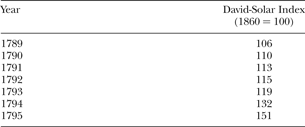
Available evidence does little to substantiate a claim that the BUS was acting without cause. Wholesale price inflation was manifest in the American economy by 1795, with the cost of goods and services rising by a full 27 percent since 1793.Footnote 160 Furthermore, individuals associated with state banks—institutions whose lending was set to be pinched by the BUS curtailment—alluded to an expanding supply of circulating credit in their correspondence. William Constable, a member of the board of directors at the Bank of New York, wrote in July 1795 that “the Engagements which People have entered into are so far beyond their means & the currency & circulation of the country are so short of representing the Amount of Payments that I am really at a loss to conjecture how the business is carried on[.]”Footnote 161 This type of observation is significant because it suggests that concerns about credit extension were not restricted to members of the BUS board,Footnote 162 even those set to endure forced lending reductions recognized that a “time of distress” was at hand.Footnote 163 Finally, there is no evidence that state bankers challenged the national bank's decision as disingenuous or agonized over a naked institutional power play. Accordingly, the challenge-induced image of institutional conversion offered by Streeck and Thelen appears to hold up well against two competing images.
JUST DON'T ASK: A DIGRESSION ON THE CENTRAL BANK QUESTION
The elephant sitting in the room that I have yet to address goes by the name “central bank.” Until this point, I have labored to avoid use of this term, knowing that such an institutional image includes not only a regulatory function vis-à-vis a system of banks but also multiple, overlapping standards that were unavailable to the array of institutional and political actors who designed, operated, and evaluated the BUS between 1791 and 1811. The question resulting from existing scholarship—Was the Bank of the United States a central bank?—has inspired not only a variety of answers but multiple standards for reaching an answer in the first place. Several of the banking historians whose work is cited above have offered glorified checklists for assessing the BUS (e.g., Richard Timberlake, David Cowen, Fritz Redlich, and John Kenneth Galbraith), while others have weighed in on the question despite cloudier standards for judgment (e.g., James O. Wettereau, Edwin Perkins, and Lawrence Broz).
My purpose here is not to enter the debate myself but rather to critique it. While no one would disagree with Wettereau's unpublished claim that the early BUS performed certain functions associated with a modern central bank, the term itself considerably postdates the institution and thus lacks a certain degree of historical coherence, even if a unified standard for assessment existed.Footnote 164 That is, all definitions of “central bank” abstractly bundle a set of fiscal and monetary functions and judge a given historical candidate against that collection. By contrast, I submit that the only characterization that respects the historical integrity of the BUS acknowledges that the institution was created to perform certain enumerated fiscal tasks but subsequently assumed a regulatory role within a growing system of banks.
Students of the BUS who measure this institution against a central banking standard collectively invoke at least five distinct functions, though among the scholars cited above only two responsibilities appear on every list. First, central banks operating under a metallic standard with convertible paper currency restrain the aggregate supply of circulating credit (including that created by other commercial banks) by presenting notes and checks for redemption.Footnote 165 Second, during times of crisis central banks lend their funds to other institutions, that is, act as a “lender-of-last-resort.”Footnote 166 A number of scholars also explicitly invoke the provision of fiscal services directly to the authorizing government, including loans, revenue deposit, fund transfer, and disbursements to public creditors (e.g., interest on government bonds).Footnote 167 Finally, a lone member of this cohort (Timberlake) suggests that central banks operate as an “office of discount for commercial banks,” that is, they enable credit expansion by the latter via loans of reserves.Footnote 168 While Cowen has exhaustively addressed what he calls the “Achilles heel” of central bank arguments respecting the Bank of the United States—the institution did not lend out its own funds to safeguard peers—Timberlake's free-standing requirement that a central bank loan reserves to institutions in nonemergency situations further burdens an argument for the BUS-qua-central bank.Footnote 169 I will outline these “problems” for the BUS briefly before offering a less anachronistic assessment of the institution circa 1811.
Edwin Perkins offered a broad statement concerning BUS historiography in 1994 when he posited that economic historians had “long ago disavowed the assertion” that the institution was a “genuine central ban[k], in part because [it] failed to act as lende[r] of last resort in financial crisis.”Footnote 170 David Cowen used Perkins's claim, in turn, to ask if a lender of last resort existed during the initial tenure of the national bank, and if so, who that lender was.Footnote 171 Cowen concluded after an exhaustive review of available correspondence that the Treasury Department periodically shifted the location of its deposits so as to aid institutions in distress; that is, it transferred public funds from the BUS to needy state banks in order to sustain the latter's capacity to pay specie. For example, distress at the Bank of Columbia throughout the calendar year 1801 was repeatedly met with temporary deposits of federal funds held at the main BUS office in Philadelphia and the branch in Baltimore.Footnote 172 This arrangement, whereby the BUS operated as the Treasury's agent when the latter detected an institution in danger, led Cowen to characterize the Treasury as “central banker” (i.e., lender of last resort) and the BUS as “central bank” (i.e., agent of the principal).Footnote 173 While he offers an eminently reasonable account of emergency aid in the Early Republic, Cowen's distinction between banker and bank only reinforces the real failure of the BUS to meet his central bank standard. Had the Bank of the United States lent its own funds to distressed peers in order to ensure their stability, a stronger case for the title could be made. However, that the BUS played the drawee to the Treasury's drawer—the quarterback who ran the play, not the coach who called itFootnote 174—only confirms that the several functions attributed to modern central banks were effectively distributed among multiple institutions during the 1791–1811 period.
If Cowen's chronicle of the early BUS reveals that the national bank did not lend to its state competitors in times of stress, it certainly stands to reason that similar loans were also eschewed during more relaxed periods. That is, an institution that could profitably extend credit on the strength of its held coin had little incentive to surrender a portion of those profits to a competing bank. In the eyes of Richard Timberlake, this fact further impairs arguments in favor of central bank status for the BUS; he posits that institutions of this character operate as an “office of discount [i.e., lending] for commercial banks.”Footnote 175 Because the national bank considered its own profit—a point repeatedly stressed in studies of the BUS—specie reserves were retained internally, and correspondingly denied to competitors.Footnote 176 Otherwise put, despite their performance of sundry public functions, the management of the BUS still operated under a strong profit-seeking imperative that left them competing for specie reserves, without eagerness to part with the same. On Timberlake's terms, such a competitive posture disqualifies an institution from central bank status.
The problem with measuring the Bank of the United States against a central banking standard is not simply that it is anachronistic, but also that analysis conducted with more historical sensitivity can still powerfully vindicate the developmental themes outlined by so-called “central bank theorists.”Footnote 177 With respect to the concept of central banking, Fritz Redlich nicely captured its fundamental unavailability to Early Republic institutional architects in noting that the BUS “cannot have been conceived as such” an establishment “since it was only the fourth bank in this country.”Footnote 178 While this claim does not dismiss suggestions that the national bank became a central bank over time, it does underscore assumptions about the existence of a banking “system” that unfairly burden the institutions of a specific time and place.
As to my broader concern about this line of analysis, one explicit theme of this article has been the historical emergence of the BUS as a regulator of its peers. Regulatory language is not my analytic imposition—it was employed openly by contemporaries who both exercised and endured the credit-curbing power of the BUS. As such, an argument that the institution was designed for other ends but subsequently acquired a monetary function vis-à-vis state banks respects both the concepts available to policymakers at the time and more recent claims that the BUS was moving into a “central” position among American institutions. Simply put, dropping altogether the language and standards of “central banking” would impose no serious analytic costs on banking students whose work highlights the institution's evolution into a regulator.
CONCLUSION
This article has revisited a largely understudied case of institutional change in the Early American Republic: the conversion of the Bank of the United States from a fiscal auxiliary of the federal government into an institution that performed both fiscal and monetary functions. While the historical change itself is thoroughly documented, with attention to the groundwork laid by a mixture of formal institutions and administrative decisions, I use the case as an opportunity to consider how institutional conversion unfolds more broadly. Existing literature suggests that institutions are redirected toward new purposes when novel challenges emerge or new actors take the reins of power. I consider a third possibility here: institutional actors who acquire new resources may rhetorically manufacture a “challenge” or “problem” that justifies the deployment of new resources. In other words, conversion may be chosen by institutional actors even in the absence of genuinely new challenges.
Evidence from this case suggests that the BUS's conversion did not result from contrived distress. Rather, the institution's turn toward state bank regulation resulted from sincere unease among its officers over the amount of credit granted by the nation's various banking institutions. Though the disingenuous construction of a policy problem does not explain this particular case of conversion, it nonetheless points to an important implication of this study. The logic of a constructed “challenge” or “problem” has been laid out here, and future studies of conversion ought to consider it as a viable third image of how this sort of change unfolds. If nothing else, it captures the possibility that actors will not always wait patiently for external developments to justify the use of acquired or developed institutional resources.
There is a second and arguably more important implication of this study, however. This article opened by identifying the national bank as a case of conversion and suggesting that this change was received less than uniformly. The regulation of state banks was ardently defended by institutional officers, but publicly criticized by many who represented local banking interests or feared a concentration of economic power. These responses to regulation formed no small part of congressional consideration of a BUS recharter bill in early 1811;Footnote 179 institutional antagonists in the Eleventh Congress were thus animated by somewhat different concerns than anti-BUS members of the First Congress.Footnote 180 The institution formally expired in 1811 when that recharter effort failed, but a subsequent and successful effort to revive it was explicitly premised on the institution's regulatory past (namely the hope of restoring it for the future).Footnote 181
My point here is not simply that conversion had downstream effects upon the institution's politics. That point is beyond dispute. However, the study of gradual but transformative change in institutions has (to this point) arguably privileged both the creation of a change typology and the generation of distinctive propositions concerning the appearance of each type.Footnote 182 The pithy historical details offered above, by contrast, point firmly toward a research frontier for affiliated scholars: the effects of slow but significant institutional change upon future politics. In future work along these lines, I hope to demonstrate how the BUS's conversion quickly drove new interest-group formation and later generated novel ideas concerning constitutional meaning.