Introduction
In Canada, the greenhouse vegetable industry is growing steadily, and tomatoes, Solanum lycopersicum Linnaeus (Solanaceae), and cucumbers, Cucumis sativus Linnaeus (Cucurbitaceae), are among the most produced crops (Agriculture and Agri-Food Canada 2016). In fact, in 2015, greenhouse tomatoes and cucumbers accounted for 60% of the value of Canadian greenhouse vegetable exports, worth CAD$311.31 million and CAD$186.24 million, respectively (Agriculture and Agri-Food Canada 2016). Overall, Quebec provides 4% of the national production of greenhouse vegetables, ranking third among Canadian provinces.
Aphids are among the insects that are most harmful to cultivated crops (Blackman and Eastop Reference Blackman, Eastop, Van Emden and Harrington2017). These biting sap-sucking insects attack a wide range of plants, causing large yield losses. For greenhouse crops, the melon aphid, Aphis gossypii Glover, and the foxglove aphid, Aulacorthum solani (Kaltenbach) (Hemiptera: Aphididae), are among the most damaging aphid species (Jandricic et al. Reference Jandricic, Filotas, Sanderson and Wraight2014). In Canada, the melon aphid is a major pest of Cucurbitaceae and causes damage to greenhouse cucumber plants by inducing a reduction in photosynthesis rate (Razmjou et al. Reference Razmjou, Moharramipour, Fathipour and Mirhoseini2006; Hu et al. Reference Hu, Zhang, Luo, Lü, Cui and Zhang2017). The foxglove aphid is also a particularly problematic pest in greenhouse crops (Jandricic Reference Jandricic2013), attacking many plants such as ornamentals and tomatoes (Jandricic et al. Reference Jandricic, Wraight, Bennett and Sanderson2010).
Chemical control is still used against both species (Wang et al. Reference Wang, Liu, Hu, Jiang and Yi2002). However, excessive and repeated use of chemical insecticides has led some aphids to develop resistance. The first incidence of insecticide resistance was recorded in Europe in 1964 in the melon aphid (Foster et al. Reference Foster, Devine, Devonshire, Van Emden and Harrington2017). Since then, several studies carried out in different locations around the world have demonstrated that this aphid pest has acquired and developed resistance to many groups of chemical insecticides, including carbamates (Furk et al. Reference Furk, Powell and Heyd1980), organophosphates (Gubran et al. Reference Gubran, Delorme, Auge and Moreau1993), pyrethroids (Wang et al. Reference Wang, Liu, Hu, Jiang and Yi2002), and even some neonicotinoids (Matsuura and Nakamura Reference Matsuura and Nakamura2014; Wang et al. Reference Wang, Wang, Wang, Rui and Cui2020). Although some studies in Japan have demonstrated low resistance to an organophosphorus insecticide in a few clones of the foxglove aphid (Takada et al. Reference Takada, Ono, Torikura and Enokiya2006), no case of resistance to a chemical insecticide has been documented for this pest in North America (Jandricic Reference Jandricic2013). The extent of the damage and economic losses caused by aphids and the emergence of resistance have led to the misuse of chemicals (Foster et al. Reference Foster, Devine, Devonshire, Van Emden and Harrington2017). These products represent a potential threat to human health and the environment; hence the importance of developing new, more environmentally friendly means of control.
Microbial biological control that is based on the use of entomopathogenic microorganisms is driven by a demand for residue-free, more environmentally safe agricultural products (Mascarin and Jaronski Reference Mascarin and Jaronski2016) and for a way to complement strategies using arthropods’ natural enemies in greenhouse crops (Gonzalez et al. Reference Gonzalez, Tkaczuk, Dinu, Fiedler, Vidal, Zchori-Fein and Messelink2016). Entomopathogenic bacteria are microbial agents used in biological control programmes against certain insect pests, including the melon aphid (Iqbal et al. Reference Iqbal, Nahiyoon, Dawar and Fayyaz2020). Because of their ability to produce beneficial secondary metabolites, some Bacillus species have successfully replaced synthetic products in insect management in agriculture (Mia et al. Reference Mia, Naher, Panhwar, Islam, Islam, Rahman, Pandey, Jha and Aeron2016). Products developed from Bacillus thuringiensis (Bt) account for 98% of bacterial microbial pesticides (Lacey et al. Reference Lacey, Grzywacz, Shapiro-Ilan, Frutos, Brownbridge and Goettel2015). Indeed, this bacterium has clearly demonstrated efficacy against a wide range of insect pests. However, some cases of insect resistance to this bacterium have been observed (Peralta and Palma Reference Peralta and Palma2017). Consequently, some studies have taken a new approach and have sought to identify other Bacillus species with insecticidal capacity. Recently, metabolites contained in biosurfactants produced by various Bacillus strains showed aphicidal properties (Yang et al. Reference Yang, Lim, Noh, Kim, Kim and Kim2017; Rodríguez et al. Reference Rodríguez, Marín, Torres, Béjar, Campos and Sampedro2018). Moreover, strains of Bacillus pumilus Meyer and Gottheil and Bacillus amyloliquefaciens showed strong insecticidal effects (Molina et al. Reference Molina, Caña-Roca, Osuna and Vilchez2010; López-Isasmendi et al. Reference López-Isasmendi, Alvarez, Petroselli, Erra-Balsells and Audisio2019), whereas Bacillus subtilis (Ehrenberg) Cohn and B. thuringiensis can induce systemic resistance to aphids in wheat (Veselova et al. Reference Veselova, Burkhanova, Rumyantsev, Blagova and Maksimov2019). Bacillus pumilus and B. subtilis, which are great producers of enzymes and secondary metabolites, are already widely used against some pathogenic fungi and thus are suitable for industrial contexts (Weber and Marahiel Reference Weber and Marahiel2002; Molina et al. Reference Molina, Caña-Roca, Osuna and Vilchez2010; Cossus et al. Reference Cossus, Roux-Dalvai, Kelly, Nguyen, Antoun, Droit and Tweddell2021).
The objective of this study was to evaluate the effect of B. pumilus PTB180 and B. subtilis PTB185, used alone and in combination, against the foxglove aphid and the melon aphid in laboratory and greenhouse trials. We hypothesised that (1) the two strains, PTB180 and PTB185, would induce mortality of both aphid species; (2) the combination of both bacteria would induce additive or synergistic insecticidal effects against both aphids; and (3) the two bacteria will have a good survival rate on plants, regardless of whether they are applied alone or in combination.
Materials and methods
Biological materials
Insects
Insect rearing was initiated during the fall of 2016. Specimens of the foxglove aphid were supplied by the Biological Control Laboratory of the Department of Biological Sciences, Université du Québec à Montréal, where they were reared on potato seedlings. We transferred them onto potato, Solanum tuberosum Linnaeus, cultivar Norland (Solanaceae) (Norseco, Laval, Québec, Canada) or tomato plants (hybrid Celebrity; Norseco) upon arrival and allowed them to acclimate on these host plants for a minimum of three months before using them in bioassays. Potato plants were used only for the rearing of the first cohorts of the foxglove aphid and were replaced by tomato plants for the subsequent rearing. Specimens of the melon aphid were supplied by the Quebec Institute for Horticultural Development (Saint-Hyacinthe, Québec, Canada) and were maintained on cucumber plants (cultivar Marketmore 70). All plants infested with aphids were kept in a growth chamber adjusted to a 16:8-hour light:dark photoperiod, a temperature of 23 °C, and a relative humidity of 65%.
To obtain cohorts of the same age for both aphid species, 10 or 15 wingless parthenogenetic adult females were introduced with a fine brush on uninfested three-week-old plants, potato or tomato for the foxglove aphid and cucumber for the melon aphid. Adults were removed after 48 hours, and the resulting nymphs were considered synchronous cohorts.
Bacteria
Spore suspensions of both strains, Bacillus pumilus PTB180 (GenBank accession number MW036295.1) and Bacillus subtilis PTB185 (GenBank accession number MW246959.1), were provided by Premier Tech (Rivière-du-Loup, Québec, Canada). These solutions contained 1 × 10⁹ colony-forming units per millilitre and were always kept at 4 °C. For the laboratory tests, a concentration of 1 × 10⁸ colony-forming units per millilitre was applied for the two strains. For the greenhouse tests, the bacteria were applied according to the manufacturer’s recommendations, with a concentration of 1 × 10⁷ colony-forming units per millilitre. All dilutions were made with water.
Treatments
Four treatments were applied to foliage in all trials conducted during the present study to evaluate the effect of both Bacillus spp. and their combinations on both aphids: (1) control (spraying with sterile distilled water); (2) B. pumilus PTB180; (3) B. subtilis PTB185; and (4) B. pumilus PTB180 + B. subtilis PTB185. For the treatment involving the two bacteria, combinations were prepared by mixing an equal volume of solution of each microorganism. The total microbial concentration of the resulting combined preparation was therefore similar to treatments applied alone, but each microorganism taken separately had a lower concentration than when applied alone.
Laboratory test
Foxglove aphid
Three independent trials repeated over time were conducted with the foxglove aphid in the laboratory. The experimental units used were Petri dishes (100 mm × 15 mm; Fisher Scientific Company, Ottawa, Ontario, Canada) containing 1.5% agar (BD Difco, Mississauga, Ontario, Canada) melted and cooled to 45–50 °C. For each trial, a total of 20 experimental units (20 Petri dishes per trial; five replicates × four treatments; 60 Petri dishes in total over all independent trials; 15 per treatment) distributed according to a completely randomised design were established. Ten second-instar aphid nymphs were transferred onto an agar-attached tomato leaf in each Petri dish and sprayed with bacterial preparations (1 mL/Petri dish). Each Petri dish therefore received 1 × 10⁸ colony-forming units (log 8 colony-forming units) of either strain or of the mixture of both strains.
Following the application of the treatments, to avoid excessive humidity, the dishes containing the leaves and insects were placed in a laminar flow hood for 30 minutes until the spray droplets dried. The Petri dishes were then maintained in a growth chamber adjusted to a 16:8-hour light:dark photoperiod, a temperature of 23 °C, and a relative humidity of 71% ± 5%. After 24 hours, the aphid nymphs were transferred to Petri dishes containing newly agar-attached plant leaves aerated by piercing 3-cm-diameter holes on the plate covers and sealing fine-mesh muslin over each hole to avoid water-vapour condensation. Due to rapid leaf senescence, the aphids were transferred every three days to freshly cut agar-attached leaves. Aphid mortality was evaluated daily for one week. Because aphids multiply rapidly, new nymphs produced by adults during the experiment were removed. The mortality percentage after one week was used for statistical analysis.
Melon aphid
The protocol used for the foxglove aphid was used also with the melon aphid, with the following modifications: two independent trials were conducted instead of three, and 3-cm-diameter cucumber leaf discs cut from three-week-old plants were used.
Greenhouse tests
The tests were conducted in a greenhouse at Université Laval (Québec, Québec, Canada), adjusted to a 16:8-hour light:dark photoperiod, a temperature of 25 °C during the day and 21 °C at night, and a relative humidity of 65%. Environmental parameters were continuously recorded during the experiments with HOBO data loggers (Onset Computer Corporation, Bourne, Massachusetts, United States of America). Tomato and cucumber plants were watered daily using a drip irrigation system and fertilised weekly with 150 mL of a solution containing 200 mg/L of the 20–20–20 fertiliser (Plant Prod 20–20–20 Classic, Plant Prod, Brampton, Ontario, Canada; 5.9% nitrate nitrogen, 3.9% ammoniacal nitrogen, 10.2% urea nitrogen, 8.7% soluble phosphorus, 16.6% soluble potassium). The experimental design was a completely randomised block design with four treatments and five replicate blocks, for a total of 20 plants.
Foxglove aphid
Two trials were repeated over time using the four treatments described above. Each experimental unit consisted of a three-week-old (four-leaf stage) tomato plant growing in a 946-mL pot containing PRO-MIX® BX Mycorrhizae (Premier Tech). Twenty wingless parthenogenetic adult female aphids (24–48 hours old) were gently introduced on the first fully expanded leaves of each plant assigned to each treatment. Entire plants were then enclosed in insect cages (34.29 × 34.29 × 60.96 cm, screen mesh 106 holes/cm2; BioQuip Products, Compton, California, United States of America) to enclose aphids but also to allow them to move freely on the whole plant. They were allowed one week to produce offspring before the treatments were applied. For each treatment, about 40 mL of bacterial preparation were sprayed per plant, using a hand sprayer and ensuring that both sides of the foliage were sufficiently and uniformly wet. Therefore, each plant received 40 × 107 colony-forming units (log 8.6 colony-forming units) of either bacterial strain or of the mixture of the two strains. After nine days, dead and live aphids were counted per whole tomato plant. The cages were also checked, and aphids present were included in the total. When counts could not be completed in one day, the plants were kept at 4 °C for one night, a process that does not affect the survival of aphids.
Melon aphid
Three trials were repeated over time using the four treatments described above. The same experimental protocol was followed for the melon aphid as for the foxglove aphid, but using cucumber plants (three-leaf stage). Also, the number of introduced aphids differed from the foxglove aphid trials. Only 10 wingless parthenogenetic adult female individuals of the melon aphid were introduced at the beginning of the trial. In addition, compared to the foxglove aphid tests, the time allowed for aphids to produce offspring was reduced from one week to only three days. However, even with fewer aphids at the initial introduction, the final density exceeded 1000 aphids per cucumber plant. Thus, only three leaves per plant were sampled for dead and live aphid counts, corresponding to older leaves that initially received adults and sprays. As the plants reached the six-leaf stage only by the end of the trial, this sampling still represents half of the plant.
Survival of bacteria
The survival of bacilli (B. pumilus and B. subtilis) on the phyllosphere of cucumber and tomato plants was evaluated in the greenhouse trials. Aphid-free plants were sprayed with the same bacterial preparations applied to the infested plants, including a sterile distilled-water control. For each host plant species, survival tests were repeated twice with four replicas each time. Tomato and cucumber leaves were collected twice, at 24 hours and at nine days after spraying, and kept overnight at 4 °C. Leaf discs measuring 1 cm in diameter were cut from these leaves using a cork borer and weighed.
Each leaf disc was ground with 1 mL of sterilised distilled water and diluted. The 10–2 and 10–3 dilutions were kept for enumeration. To prevent other bacteria from developing, all tubes containing the selected dilutions were heated in a water bath at a temperature of 55 °C for 15 minutes to induce sporulation of bacilli. Then, 100 µL of each dilution was spread on the medium Nutriment Agar Oxoid (Fisher Scientific) and incubated at 37 °C for 24 hours.
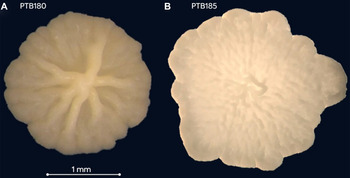
To be able to count the colonies of each of the two strains of Bacillus, it was essential to distinguish one from the other. Because the morphology of the colonies of these two strains is quite distinct, it was easy to identify each by simple macroscopic observation of the colonies formed on Nutriment Agar Oxoid. Bacillus pumilus PTB180 is characterised by a hunched-up circular shape with coiled margins and an opaque-looking whitish coloring (Fig. 1A), whereas B. subtilis PTB185 is characterised by an irregular shape with jagged margins, a creamy or slightly yellowish colour, and a flat, shiny surface (Fig. 1B). The final population at each measurement time was reported as log colony-forming units per gram of fresh leaf, and the number of colonies was calculated for a given sample according to the following formula:
 $${{{\rm{number}}\;{\rm{of}}\;{\rm{colonies}}\; \times \;{\rm{dilution}}\;{\rm{factor}}\; \times \;{\rm{volume}}\;{\rm{of}}\;{\rm{solution}}\;} \over {{\rm{leaf}}\;{\rm{fresh}}\;{\rm{weight}}\;}}$$
Morphology of bacterial colonies on Nutriment Agar Oxoid medium: A, Bacillus pumilus PTB180; B, B. subtilis PTB185. Photos from Premier Tech, Québec, Canada.

Statistical analysis
All statistical analyses were performed using the Mixed procedure of SAS software, release 9.4 (SAS Institute Inc., Cary, North Carolina, United States of America) at the 0.05 level of significance. For the laboratory tests, the mortality rates of the two aphid species were used as the response variables. These data were analysed using a generalised randomised block analysis of variance model, in which the treatments were considered a fixed factor and the repeated trials and the replication of each treatment within each block were considered random factors. Following a significant treatment effect, multiple pairwise least significant–difference comparisons were used to determine which treatments differ. The normality assumption was verified using the Shapiro Wilk’s test, and the homogeneity of the variances was verified by the residual plot.
For the greenhouse tests, the same statistical analyses described previously were applied. The response variable was the mortality rate for both aphids, but for the melon aphid, the number of live aphids found on the sampled cucumber leaves was also examined. Finally, for the tests on the persistence of bacteria, the concentrations calculated at the two measurement times (day 1 and day 9) were analysed as a function of the different treatments with an analysis of variance with repeated measures using the Mixed procedure (SAS software, release 9.4).
Results
Laboratory tests
Foxglove aphid
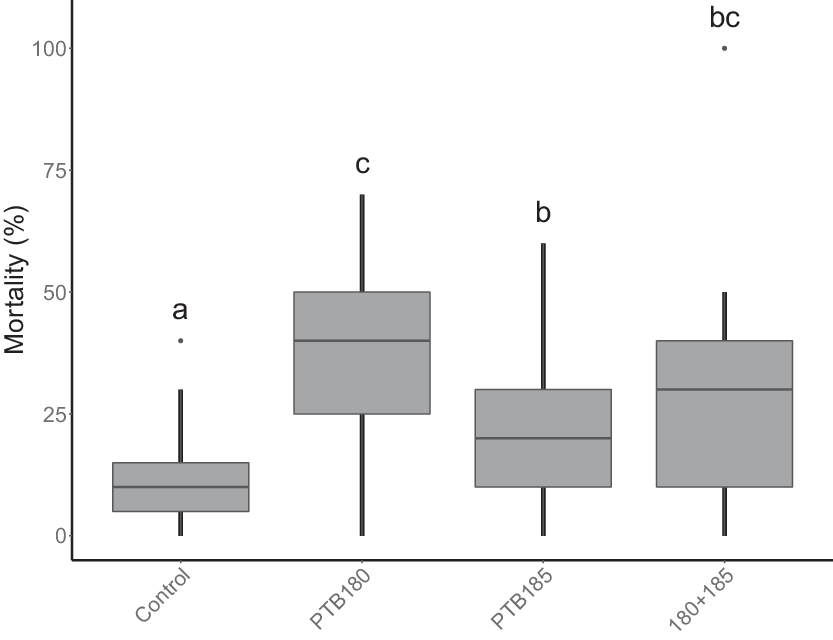
A significant effect of treatment was found on aphid mortality (F 3,54 = 8.45, P < 0.0001). Post-hoc pairwise comparisons among treatments suggest that all products (used alone or in combination) significantly increased mortality compared to the control (Fig. 2). With 38%, PTB180 induced the highest mortality rate and differed from PTB185, which induced 22% mortality. In between these, PTB180 + PTB185 induced 29% mortality, and thus differed only from the control.
Cumulative mortality of the foxglove aphid second-instar nymphs seven days after application of Bacillus pumilus PTB180 and B. subtilis PTB185, alone and in combination, on tomato leaves in laboratory testing. Trials conducted in laboratory following a completely randomised design plan with five replicas and three independent, time-repeated trials (N = 15). Treatments with same letters are not significantly different (least-significance difference, α = 0.05, F 3,54 = 8.45, P < 0.0001).

Melon aphid
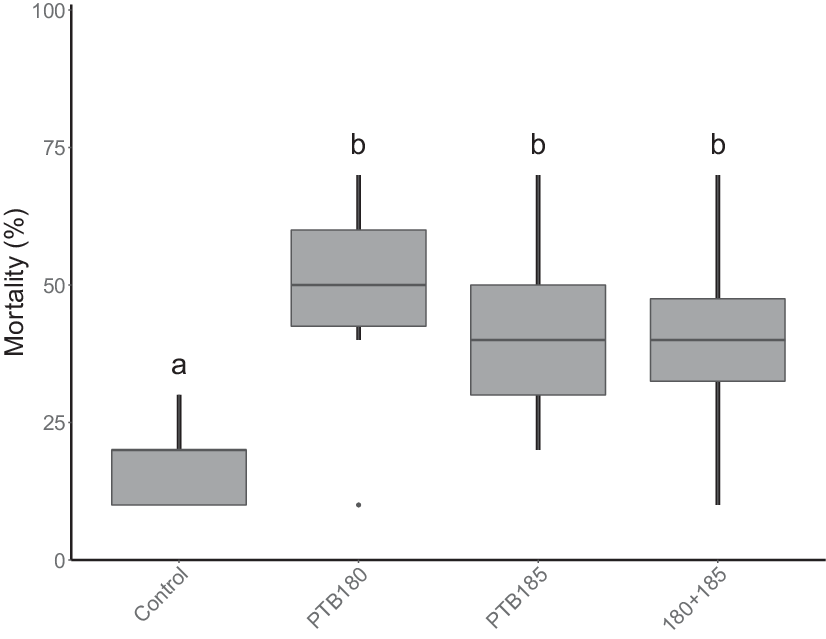
Treatments had a significant effect on aphid mortality (F 3,35 = 18.11, P < 0.0001). Post-hoc pairwise comparisons revealed that the mortality of the melon aphid in laboratory tests was similar and higher than the control for all treatments (Fig. 3), ranging between 39% and 50%.
Cumulative mortality of the melon aphid second-instar nymphs seven days after application of Bacillus pumilus PTB180 and B. subtilis PTB185, alone and in combination, on cucumber leaves in laboratory testing. Trials conducted in laboratory following a completely randomised design plan with five replicas and two independent, time-repeated trials (N = 10). Treatments with same letters are not significantly different (least-significance difference, α = 0.05, F 3,35 = 18.11, P < 0.0001).

Greenhouse tests
Foxglove aphid
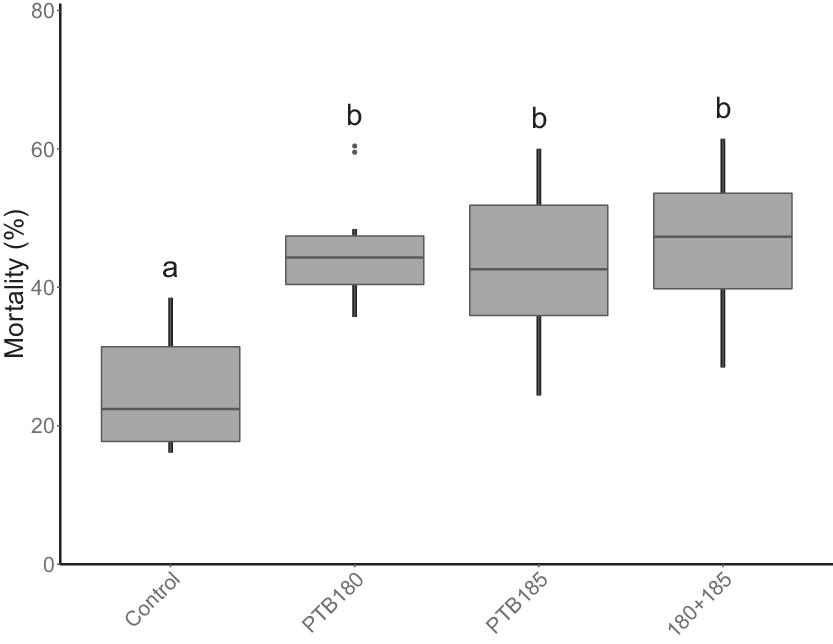
Our results showed a significant effect of treatment (F 3,27 = 111.45; P < 0.0001), namely significant differences between the control and all other treatments (Fig. 4), with mortality rates ranging from 43% to 46%. No other differences were observed between treatments.
Cumulative mortality of the foxglove aphid adults nine days after application of Bacillus pumilus PTB180 and B. subtilis PTB185, alone and in combination, on greenhouse tomato plants. Trials conducted in greenhouse following a completely randomised design plan with five replicas and two independent, time-repeated trials (N = 10). Treatments with same letters are not significantly different (least-significance difference, α = 0.05, F 3,27 = 111.45; P < 0.0001).

Melon aphid
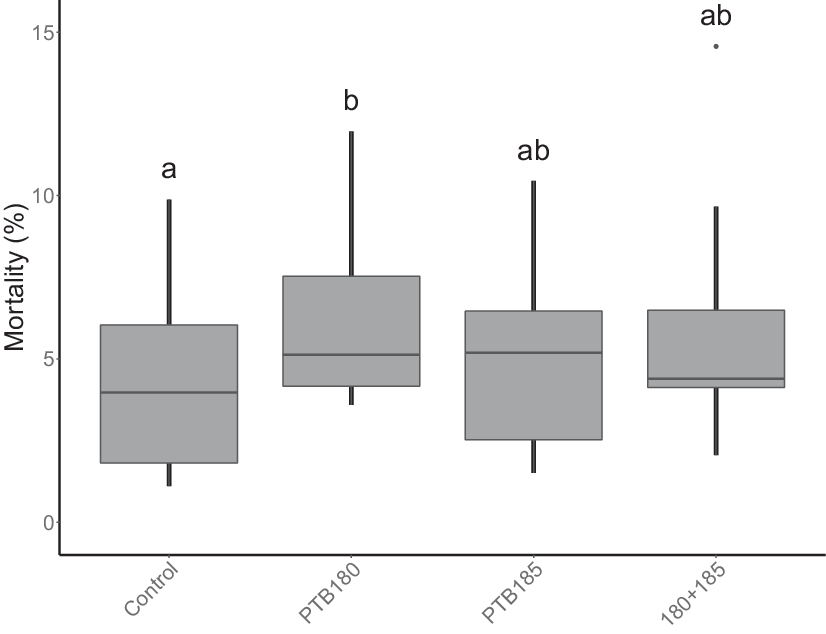
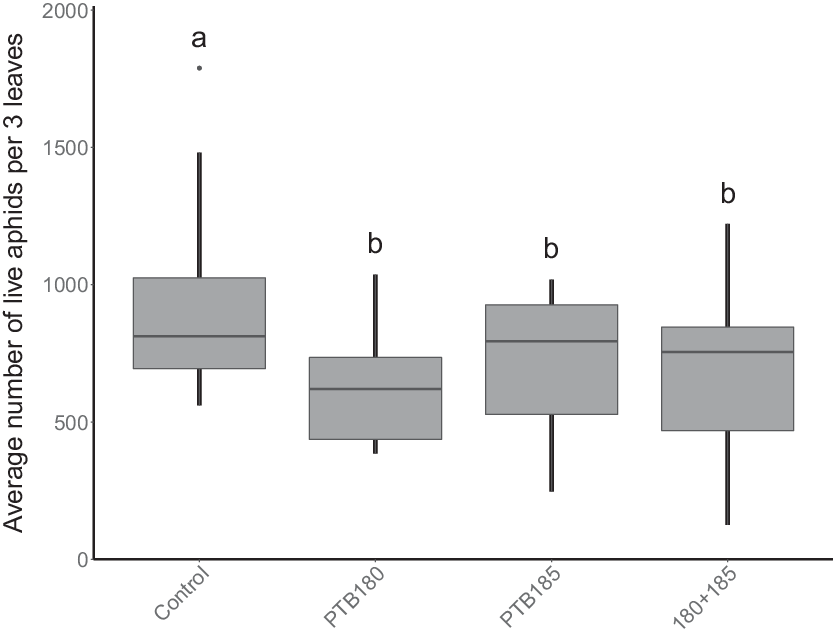
Treatments had no significant effect on the melon aphid mortality in greenhouse tests (F 3,42 = 1.81; P = 0.1594). Mortality was indeed very low, varying between 4% and 6% between treatments (Fig. 5). We therefore looked at the number of live aphids on three cucumber leaves as a function of the treatments instead of mortality. A significant effect of treatment was found on the number of live aphids (F 3,42 = 5.15, P = 0.0040). Post-hoc pairwise comparisons suggest that all treatments reduced the number of live aphids present on cucumber plants nine days after application (Fig. 6). For the control, an average of 916 live aphids per three leaves was obtained. Overall, treatments reduced the number of live aphids by an average of 26% compared to the untreated control, an average reduction of 240 aphids per three cucumber leaves. No differences were observed between treatments.
Cumulative mortality of the melon aphid adults on three cucumber leaves sampled nine days after application of Bacillus pumilus PTB180 and B. subtilis PTB185, alone and in combination, on greenhouse cucumber plants. Trials conducted in greenhouse following a completely randomised design plan with five replicas and three independent, time-repeated trials (N = 15). No treatment effect was found (F 3,42 = 1.81; P = 0.1594).

Variation in the number of live melon aphid found on three cucumber leaves sampled nine days after application of Bacillus pumilus PTB180 and B. subtilis PTB185, alone and in combination, on greenhouse cucumber plants. Trials conducted in greenhouse following a completely randomised design plan with five replicas and three independent, time-repeated trials (N = 15). Treatments with same letters are not significantly different (least-significance difference, α = 0.05, F 3,42 = 5.15, P = 0.0040).

Tests on survival
Bacteria survival
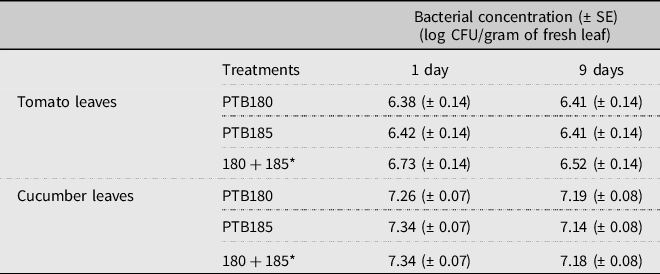
Survival tests demonstrated that both bacilli were able to persist for up to nine days on tomato and cucumber leaves when initially applied at a concentration of 40 × 107 colony-forming units per plant. On tomato leaves, the survival of bacterial was not affected by days (F 1,21 = 1.03, P = 0.3218), treatments (F 2,2.02 = 3.64, P = 0.2142), or the interaction between days and treatments (F 2,21 = 1.45, P = 0.2581). The populations of both B. pumilus PTB180 and B. subtilis PTB185 applied alone or in a combined mixture did not significantly differ after one or nine days, reaching an average of 2.8 × 10⁶ colony-forming units per gram of fresh leaf on the ninth day after application (Table 1). On cucumber leaves, the survival of bacterial differed between days (F 1,21 = 18.36, P = 0.0003) but was not influenced by treatments (F 2,3.07 = 0.07, P = 0.9320) or by the interaction between days and treatments (F 2,21 = 1.25, P = 0.3079). The numbers of B. pumilus PTB180 and B. subtilis PTB185 used alone or in a mixture significantly dropped from 2.1 × 10⁷ colony-forming units per gram of fresh leaf on day one to 1.5 × 10⁷ colony-forming units per gram of fresh leaf after nine days. No bacterial colonies grew for the control treatments.
Concentrations of Bacillus pumilus PTB180 and B. subtilis PTB185 one day and nine days after application to tomato and cucumber leaves, alone and in combined mixture. Trials conducted in greenhouse following a completely randomised design plan with four replicates and two independent, time-repeated trials (N = 8). SE, standard error; CFU, colony-forming units.

* For the PTB180 + PTB185 mixtures, the indicated colony-forming units per gram are the sum of both bacterial colony-forming units identified according to the morphology of the colonies.
Discussion
To our knowledge, this study is the first to report on the aphicidal potential of B. pumilus strain PTB180 and B. subtilis strain PTB185. Previous studies had confirmed the insecticidal effect of other strains of these two bacteria against different insects (Molina et al. Reference Molina, Caña-Roca, Osuna and Vilchez2010; Chandrasekaran et al. Reference Chandrasekaran, Revathi, Nisha, Kirubakaran, Sathish-Narayanan and Senthil-Nathan2012, Reference Chandrasekaran, Revathi, Thanigaivel, Kirubakaran and Senthil-Nathan2014) and even an aphicidal effect for B. subtilis (Rajendran et al. Reference Rajendran, Ramanathan, Durairaj and Samiyappan2011; Veselova et al. Reference Veselova, Burkhanova, Rumyantsev, Blagova and Maksimov2019).
Bacillus pumilus PTB180 and B. subtilis PTB185 showed pathogenicity against the foxglove aphid, A. solani. Indeed, our results are the first to reveal mortality of A. solani following the application of the two Bacillus strains. The insecticidal capacity of the two Bacillus species studied can be explained by their ability to produce substances and enzymes that attack specific sites on the host insect. Bacillus species, including B. subtilis, are known to produce chitinase, an extracellular enzyme that degrades chitin, a component of the cuticle of most insects during their developmental changes (Moussa et al. Reference Moussa, Shehawy, Baiomy, Taha and Ahmed2014; Kilani-Feki et al. Reference Kilani-Feki, Ben Khedher, Dammak, Kamoun, Jabnoun-Khiareddine, Daami-Remadi and Tounsi2016). For instance, chitinase purified from different strains of B. subtilis caused increased mortality of the tobacco cutworm, Spodoptera litura (Fabricius) (Lepidoptera: Noctuidae) (Chandrasekaran et al. Reference Chandrasekaran, Revathi, Nisha, Kirubakaran, Sathish-Narayanan and Senthil-Nathan2012, Reference Chandrasekaran, Revathi, Thanigaivel, Kirubakaran and Senthil-Nathan2014). It is therefore possible that the strain B. subtilis PTB185 used in our study produces this enzyme, facilitating its penetration into the body cavity of the foxglove aphid by perforating the cuticle and the intestinal membrane. Although B. pumilus may act on aphids in a similar way, this does not necessarily suggest that the two bacteria have the same mode of action (Molina et al. Reference Molina, Caña-Roca, Osuna and Vilchez2010). In fact, little is known about the insecticidal potency of B. pumilus, but strain 15.1 was shown to perform well, causing up to 94% mortality of the larvae of Ceratitis capitata (Wiedemann) (Diptera: Tephritidae) (Molina et al. Reference Molina, Caña-Roca, Osuna and Vilchez2010).
For the melon aphid, A. gossypii, our results showed different patterns than with the foxglove aphid. For instance, under laboratory conditions, we found that both PTB180 and PTB185 strains caused significant mortality of the melon aphid. Under greenhouse conditions, however, our results suggest that both bacterial strains had little effect on the melon aphid’s mortality but instead caused a significant reduction of aphid reproduction. The discrepancy between laboratory and greenhouse results may be explained by the different experimental conditions between the two environments (e.g., lighting, temperature, etc.). In addition, in the greenhouse tests, a hypothetical interaction between cucumber plants, microorganisms, and aphids may have occurred. We have not measured this interaction but hypothesise that it may have reduced the reproduction of the melon aphid by impacting its physiology or by inducing systemic resistance to the pest in the cucumber plants (Veselova et al. Reference Veselova, Burkhanova, Rumyantsev, Blagova and Maksimov2019). Such interaction has been observed by Rajendran et al. (Reference Rajendran, Ramanathan, Durairaj and Samiyappan2011), who found a decrease in the incidence of A. gossypii on cotton following the application of EPCO 102 and EPCO 16, two endophytic strains of B. subtilis. These strains act by improving the production and accumulation of defense enzymes (e.g., peroxidase, polyphenol oxidase, etc.), chitinase, and phenolic compounds in treated plants (Rajendran et al. Reference Rajendran, Ramanathan, Durairaj and Samiyappan2011). These enzymes act against the target insects in different ways, including interrupting their diet. For example, chitinase blocks the activity of the majority of intestinal enzymes essential to feeding in the tobacco cutworm, S. litura (Chandrasekaran et al. Reference Chandrasekaran, Revathi, Thanigaivel, Kirubakaran and Senthil-Nathan2014). The hypothetical interruption of A. gossypii feeding may slow down its development, therefore increasing the periods separating its moults, extending the total time required to complete its life cycle, and possibly reducing the number of offspring it produces. Also, although unlikely, a behavioural effect possibly impacted our results. Even though we sampled half of the plants and younger leaves had been deployed for only a few days, aphids might have moved to younger leaves. If this behavioural effect happened, it would have made our counts slightly inaccurate; however, its effect would be expected to be consistent among treatments. Based on this, we believe our conclusion to remain valid.
Our study is the first to investigate the interaction between B. pumilus PTB180 and B. subtilis PTB185 and the possible synergistic or additive effects between these two entomopathogens. Such effects have been observed for entomopathogens when they are combined with chemical insecticides, toxins, and other entomopathogens (Wraight and Ramos Reference Wraight and Ramos2005; Konecka et al. Reference Konecka, Kaznowski, Grzesiek, Nowicki, Czarniewska and Baranek2020). However, our results suggest that applying a mixture of both B. pumilus PTB180 and B. subtilis PTB185 against both the foxglove and the melon aphids did not improve their efficacy, as we found no clear additive effects. Indeed, the treatment involving both bacteria never differed from any treatment involving either bacterium species alone, regardless of the aphid species or of the setting (laboratory or greenhouse). Similarly, Xu et al. (Reference Xu, Jeffries, Pautasso and Jeger2011) showed that synergistic effects between biocontrol agents for the management of plant diseases are unusual and that experimental demonstrations of such effects are rare. Likewise, neither Lewis and Bing (Reference Lewis and Bing1991) nor Costa et al. (Reference Costa, Barbercheck and Kennedy2001) have detected any additive effect or increased mortality caused by B. bassiana GHA applied with a toxin produced by Bacillus thuringiensis (Bt) against the Colorado potato beetle, Leptinotarsa decemlineata (Say) (Coleoptera: Chrysomelidae), or the European corn borer, Ostrinia nubilalis (Lepidoptera: Crambidae). However, several studies have demonstrated a synergistic interaction between different strains of B. bassiana and B. thuringiensis against different insect pests (Wraight and Ramos Reference Wraight and Ramos2005, Reference Wraight and Ramos2017; Yaroslavtseva et al. Reference Yaroslavtseva, Dubovskiy, Khodyrev, Duisembekov, Kryukov and Glupov2017). As the presence or absence of synergy between two microorganisms varies according to the time of their application (Szczech and Shoda Reference Szczech and Shoda2004; Wraight and Ramos Reference Wraight and Ramos2005), additional research is recommended to test the synergistic interaction between strains PTB180 and PTB185, depending on the time and manner (simultaneously or successively) of their application against aphids, as well as their formulation.
Our greenhouse tests on the survival and compatibility of the two microorganisms used in this study showed that they both demonstrated good survival over time. We observed concentrations higher than 106 colony-forming units per gram of fresh leaf after nine days for both microorganisms on both plants. Such high counts are considered to indicate excellent survival (Jurkevitch and Shapira Reference Jurkevitch and Shapira2000; Collier et al. Reference Collier, Elliot and Ellis2005; Wang et al. Reference Wang, Xue, Han, Bu and Liu2014; Wei et al. Reference Wei, Hu and Xu2016).
In conclusion, this work revealed the aphicidal properties of B. pumilus PTB180 and B. subtilis PTB185 on two common aphid pests in greenhouse crops. These two bacterial strains caused mortality of A. solani and decreased A. gossypii reproduction. No synergy or additive effect was observed following application of the different combinations of the two bacterial strains. Overall, we detected mortality rates ranging from 30% to 50%. Those rates represent significant increases in mortality but are inferior to most optimal mortality rates experimentally reported, often ranging between 50% and 100% (Molina et al. Reference Molina, Caña-Roca, Osuna and Vilchez2010; Yang et al. Reference Yang, Lim, Noh, Kim, Kim and Kim2017; López-Isasmendi et al. Reference López-Isasmendi, Alvarez, Petroselli, Erra-Balsells and Audisio2019; Saif Ur et al. Reference Saif Ur, Zheng, Ahmed, Feng and Wang2019; Iqbal et al. Reference Iqbal, Nahiyoon, Dawar and Fayyaz2020; Trinh et al. Reference Trinh, Ha and Qiu2020). Nevertheless, they still indicate some aphicidal potential for the two bacterial strains. Achieving high mortality rates depends on many factors, such as the concentration, formulation, timing of application, delay between applications, and temperature (Saif Ur et al. Reference Saif Ur, Zheng, Ahmed, Feng and Wang2019; Prince and Chandler Reference Prince and Chandler2020). Variations in each of these factors can cause success or failure of a microbial biocontrol programme. As such, more research needs to be done regarding those parameters. Still, B. pumilus PTB180 and B. subtilis PTB185 appear to be potential candidates for biological control of the foxglove aphid in greenhouse. They also seem to influence the melon aphid, but assessment of effective application parameters is needed before these two strains could be used as biological pest control agents. If used, both products should be integrated into integrated pest management strategies alongside other available and compatible tools.
Acknowledgements
The authors thank Premier Tech’s team, especially Catherine Viel and Alain Bélanger. They also extend special thanks to Mathieu Bouchard Rochette, Elizabeth Demeule, Jean Bélanger, Victor Bérubé Girouard, Marine Daniel, Catherine Bolduc, Aurélie Boilard, Thaïs Andro, Guillaume Guengard, Clémence Landreau, Lucie Alexandre, and Andréa Duclos for their assistance in the laboratory, and they are also grateful to Gaétan Daigle for assistance with statistical analysis. The authors thank the Consortium de recherche et innovations en bioprocédés industriels au Québec (CRIBIQ), Premier Tech, Anatis Bioprotection, and the Natural Sciences and Engineering Research Council of Canada (NSERC) for financial support.