I. INTRODUCTION
Dye-sensitized solar cells (DSSCs) are intensively investigated due to their inherently [in comparison to mainstream silicon photovoltaic (PV)] simple design and low production cost, ability to perform under diffuse light conditions, and their environmentally favorable aspects.Reference Kalyanasundaram1, Reference Hagfeldt, Boschloo, Sun, Kloo and Pettersson2 In one of the DSSC research frontiers, higher conversion efficiencies are sought via, e.g., new dyes and redox electrolytesReference Yella, Lee, Lee, Yi, Chandiran, Nazeeruddin, Diau, Yeh, Zakeeruddin and Grätzel3 or plasmonicReference Qi, Dang, Hammond and Belcher4 and upconversionReference Shan, Assaaoudi and Demopoulos5 strategies. In another frontier, novel titania semiconductor film structures for enhanced light harvesting are explored.Reference Sauvage, Chen, Comte, Huang, Heiniger, Cheng, Caruso and Graetzel6 In pursuing these strategies, an important consideration ultimately is scale-up and economics if commercialization breakthroughs are to be realized.Reference Desilvestro7, Reference Baxter8 To this end, a novel hybrid paste has been developed and described consisting of aqueous-synthesized anatase nanocrystallites (A) and “urchin”-like rutile (R) submicrometer particles that advantageously allow thin (∼5–6 μm) single-layer photoanode film construction with superior performance to benchmark double-layer film structures.
The properties of TiO2 nanocrystallites have been extensively studied as far it concerns their influence on the construction and performance of the photoanode. For example, crystallite size and morphology,Reference Chou, Zhang, Russo, Fryxell and Cao9–Reference Lei, Liu and Xiao11 crystallinity,Reference Kim, Rho and Kang12 phase content,Reference Yun, Park, Kim, Shim, Bae, Huh and Won13 doping,Reference Nikolay, Larina, Shevaleevskiy and Ahn14, Reference Zhang, Liu, Huang, Zhou and Wang15 and surface groupsReference Lee, Gomez, Charbonneau and Demopoulos16 have been shown to have a significant bearing on the overall efficiency of DSSC devices. Recently, our group reported on aqueous-synthesized anatase nanocolloidsReference Charbonneau, Gauvin and Demopoulos17 possessing very high specific surface area and rich hydroxyl content, properties that were shown to lead via optimized dye (N719) anchoring/coatingReference Lee, Gomez, Elouatik and Demopoulos18, Reference Lee, Gomez, Regier, Hu and Demopoulos19 to longer electron lifetime.Reference Lee, Gomez, Charbonneau and Demopoulos16 The films made from this new crop of anatase nanocolloids suffered, however, from small pore size distribution leading to electrolyte diffusion resistance and loss of photocurrent output and efficiency. It is the scope of this paper to report on the formulation of a new hybrid paste that comprises the said anatase nanocrystallites and custom-made submicrometer-sized self-assembled nanofibre-structured rutile particlesReference Charbonneau, Gauvin and Demopoulos20—the latter acting as scattering centers, making possible the construction of high performing thin single-layer photoanode films.
In recognition of the importance of incorporating light-scattering componentsReference Ferber and Luther21 in enhancing light harvesting and thereby photon-to-electron conversion efficiency in DSSCs, the typical photoanode has a double-layer structure.Reference Ito, Murakami, Comte, Liska, Grätzel, Nazeeruddin and Grätzel22 This consists of a transparent layer (∼12-μm thick) of TiO2 anatase nanoparticles (typically 20–30 nm) on which dye molecules, i.e., the sensitizers, are adsorbed plus a light-scattering layer (∼5-μm thick) of TiO2 submicrometer-sized particles. For example, Ito et al.Reference Ito, Takahashi, Yusa, Imamura and Tanimoto23 applied a light-scattering layer of microcrystalline anatase particles on to the transparent layer of nanocrystalline TiO2 particles as a photon-trapping system, and this system enhanced the photocurrent density from 15.6 to 18.2 mA/cm2. Generally, the TiO2 material is incorporated into the formulation of a paste that can be uniformly deposited on conductive transparent substrates by screen printing.Reference Ito, Chen, Comte, Nazeeruddin, Liska, Péchy and Grätzel24 Each layer deposition is followed by annealing, involving a specific heating ramp. The scattering effect may also be achieved by other approaches such as adding an overlayer containing nanotubes,Reference Xu, Shin, Cao, Wu and Gao25–Reference Luo, Gao, Sun and Liu27 hollow TiO2 spheres,Reference Wu, Lu and Wang28 specially designed beads,Reference Im, Lee and Lee29 or TiO2 composite materials (TiO2–Al2O3, TiO2–Nb2O5, and TiO2–ZrO2).Reference Kim, Kim, Kim, Cho, Hwang, Seo, Kim and Lee30 However, multilayer deposition or specially synthesized scattering structures add complexity in the manufacturing process rendering it prohibitively expensive.Reference Kalyanasundaram1
In addition to using a scattering overlayer, recent studies based on the modeling work of Ferber and LutherReference Ferber and Luther21 showed that good light scattering can also be obtained by incorporating submicrometer-sized particles or even spherical voids (introduced in the form of polystyrene spheresReference Hore, Vetter, Kern, Smit and Hinsch31) into the nanoanatase particle (transparent) layer.Reference Yun, Park, Kim, Shim, Bae, Huh and Won13, Reference Agarwala, Kevin, Wong, Peh, Thavasi and Ho32, Reference Chou, Guo, Liu and Chen33 Thus, Agarwala et al. reported that adding P25 nanoparticles into mesoporous structure helped to provide strong light harvesting capability and large surface area for high efficiency DSSC. In their case, large rutile particles in P25-based film were used as light-scattering centers. The short-circuit photocurrent density (J sc) of the cell made from mixture of mesoporous TiO2 and P25 nanoparticles showed a higher efficiency of ∼6.5% compared to their homogeneous films.Reference Agarwala, Kevin, Wong, Peh, Thavasi and Ho32 Similarly, Chou et al. also used P25 particles to prepare the hybrid electrode. In their case, the electrode consisted of P25 as small (transparent) TiO2 particles and large (scattering) TiO2 particles synthesized by the sol–gel method. Interestingly, it has been reported that a mixed-phase TiO2, comprising of a large amount of anatase and a small amount of rutile, exhibits a much higher photocatalytic activity than either pure anatase or pure rutile.Reference Estruga, Domingo, Domènech and Ayllón34–Reference Hurum, Gray, Rajh and Thurnauer36 So far, most of the previous DSSC studies have focused on using anatase materials (nanocrystalline anatase for the transparent layer and submicrometer-sized anatase for the light-scattering layer) for the photoelectrode application. On the other hand, for optimum light harvesting and electron generation in all cases, so far, the constructed photoanode films vary in thickness from 12 to 18 μm achieved via double- or even triple-layer deposition (each screen-printed layer is ∼5–6 μm). However, based on the studies showing a higher photocatalytic activity of mixed-phase TiO2, single-layer hybrid pastes comprising anatase and rutile TiO2 particles could provide potentially better DSSC performance. But incorporating large (rutile or anatase) particles in the transparent film would inevitably lead to less dye loading, hence lower photocurrent output partly canceling the benefit from the scattering effect. It is one of the goals of this paper to report on a new rutile particle variety synthesized via controlled forced hydrolysisReference Charbonneau, Gauvin and Demopoulos20 that consists of “urchin”-like nanofibre-structured (200–400 nm) particles that proved superior scattering centers in hybrid formulation with our aqueous-synthesized anatase (5–10 nm).Reference Charbonneau, Gauvin and Demopoulos17 Furthermore, we report the optimization of the hybrid paste via the incorporation of P25 nanoparticles that we show via physical and electrochemical characterizations to eliminate losses due to electrolyte diffusion resistance or interfacial charge recombination. Last but not least, it is demonstrated that DSSCs incorporating single-layer screen-printed films of only 5–6 μm in thickness can be built with the novel hybrid paste that compete favorably with double thickness photoanodes based on benchmark commercial paste material. This is an impressive result as only 1/2 material (or 1/3 if only anatase are taken into account) was used in a single printed layer. Thinner film thickness, as achievable with the novel paste formulation described in this work, has been identified as a requirement for using new noniodide electrolytes due to their slower diffusion rates,Reference McGehee37 hence opening opportunities for achieving higher efficiencies at lower cost.
II. EXPERIMENTAL
A. Synthesis
2 M TiCl4 aqueous stock solution was prepared from concentrated titanium tetrachloride (99.9% TiCl4, Fisher Scientific, Ottawa, Canada) without any further purification. Anatase and rutile particles were synthesized using 0.2 and 0.5 M TiCl4, respectively, following the procedure described by Charbonneau et al.Reference Charbonneau, Gauvin and Demopoulos20 In general, a 200 mL solution was processed in a well-agitated batch reactor using mechanical stirring (∼1000 rpm) at 80 °C. For anatase, the 0.2 M TiCl4 solution was forced to hydrolyze at 80 °C typically over a period of 30 min including a 10-min heat-up period. Similarly, rutile was prepared in the reactor using 0.5 M TiCl4 solution at 80 °C for an extended reaction time, i.e., 2 h. The obtained colloidal suspension was poured into plastic containers, quenched, and kept in a cold water bath (at 3 °C). Anatase particles were recovered by prior neutralization to pH 3 with NH4OH (N route) as described in our previous study.Reference Charbonneau, Gauvin and Demopoulos17 Rutile was recovered using a pressure filter and washed using deionized water several times during filtration. The obtained anatase and rutile TiO2-containing gels were dried in an oven at 60 °C and manually ground in a mortar. The x-ray Diffraction (XRD) patterns of anatase and rutile are reported in Supporting information.
B. Paste preparation
The screen printing paste recipe was adapted from a standard method described in the literature.Reference Ito, Chen, Comte, Nazeeruddin, Liska, Péchy and Grätzel24 Terpineol and ethyl cellulose were used as a rheological agent and binder, respectively. The excess ethanol was evaporated using a rotary evaporator, and the final concentration of the paste was usually 10–11 wt% TiO2. In this study, we prepared different hybrid pastes with variable composition of anatase, rutile, and P25. The TiO2content of the paste was typically fixed to 3 g of powder and this was made of different components; for instance, the 40% R/40% A/20% P25 paste was composed of 1.2 g of rutile (R), 1.2 g of anatase (A), and 0.8 g of P25 powder. For comparison purposes, a commercial paste of nanoparticulate anatase of ∼20-nm crystallite size was used as well (DSL 18NR-T, available from Dyesol, Queanbeyan, New South Wales, Australia).
C. DSSC fabrication
Fluorine doped tin oxide (FTO)-coated glass was used as a substrate for both the working and the counter electrode. Preparation of the working electrode involved spreading the TiO2 paste onto the FTO glass substrate followed by sintering at 450 °C in air for 30 min yielding a 5–6-μm-thick films. Dye-coated TiO2 films were prepared by immersion into the dye solution for 24 h at room temperature.Reference Ito, Chen, Comte, Nazeeruddin, Liska, Péchy and Grätzel24 For the preparation of the counter electrode, two drops of H2PtCl6–propanol solution (50 mM) were spread onto a prepierced (two hole) FTO glass piece and then thermally treated at 380 °C for 30 min. The TiO2 anode and the counter electrode were assembled into a sandwich-type cell and sealed with a thermoplastic sealant (Surlyn-30, Dyesol) of 30-μm thickness by hot pressing at 120 °C for 4 min. The I−/I3−-based electrolyte (0.6 M methylbenzimidazole, 0.03 M iodine, 0.10 M guanidinium thiocyanate, and 0.5 M 4-tertbutylpyridine in a mixture of acetonitrile–valeronitrile, 85/15 vol%) was inserted at the back of the counter electrode through the holes, then sealed using the thermoplastic sealant and a cover glass.
D. Characterization
The surface area, average particle size, and film porosity data were obtained with Brunauer–Emmett–Teller (BET) surface area analysis performed on a Micromeritics TriStar 3000 nitrogen adsorption–desorption apparatus (Norcross, GA). A multiple point specific surface area type of analysis was carried out. The morphology and particle size of nanocrystalline films were observed by a field emission gun transmission/scanning electron microscopy (FEG-SEM) (Hitachi S-4700 FE-SEM with Oxford INCA EDS system, Tokyo, Japan) and transmission electron microscopy (TEM) (Philips CM-200 microscope operated with an accelerating voltage of 200 kV, Hillsboro, OR). The thickness of the films was measured with a Dektak surface profiler.
The photoinduced photocurrent density–voltage (I–V) characteristics of DSSCs were measured under AM 1.5 simulated sunlight irradiation (PV Measurements, Inc., Model SASS, Boulder, CO). A Keithley 2400 SourceMeter (Cleveland, OH) was used to record current. Electrochemical impedance spectroscopy (EIS) was carried out under 10 mW/cm2 irradiation with a VSP instrument (BioLogic, Claix, France) and analyzed with the EC lab software. For impedance measurements, a 10 mV AC perturbation was applied in the range of 50 mHz and 100 kHz. Open-circuit voltage decay measurements were conducted to investigate recombination kinetics under 10 mW/cm2light irradiation.Reference Zaban, Greenshtein and Bisquert38
III. RESULTS AND DISCUSSIONS
A. Morphology and configuration of aqueous anatase- and rutile-based films
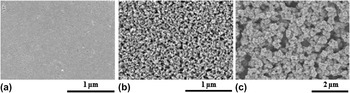
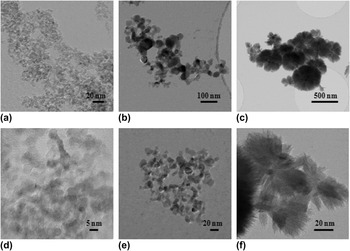
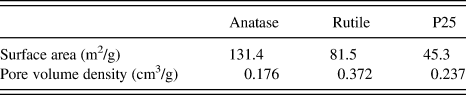
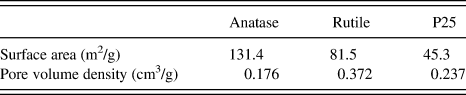
Top view FEG-SEM images of TiO2 films constructed with 100% sole ingredient pastes of aqueous anatase, aqueous rutile, and P25 are shown in Fig. 1. The film of aqueous anatase shows a densely packed surface compared to those of P25 and rutile films due to its very small nanoparticle size [5–10 nm, Figs. 2(a) and 2(d)]. It is observed from the scanning electron microscopy (SEM) images (Fig. 1) that the film composed of larger particulates is characterized with bigger pore size. Especially, large voids (∼500 nm) are found in the aqueous rutile films. The aqueous-synthesized rutile particles are 200–400 nm size according to the SEM images; however, each particle is an aggregate of smaller crystallites. Upon closed examination by TEM [Figs. 2(c) and 2(f)], it becomes evident the aqueous rutile particles to have a unique internal self-assembled nanofibre structure with “sea urchin”-like external features. For P25 anatase material, the average size is 30 nm with some particles (most likely of rutile phase) being as big as ∼100 nm. The size and structure of particles significantly affect other physical properties, such as surface area and pore density. Here, we used BET analysis to determine and compare the physical properties of the three TiO2 photoelectrodes. The results are given in Table I. The BET surface areas of both aqueous-synthesized/prepared films, namely the anatase and rutile films, are significantly higher than that of the P25 film. Particularly impressive is the high surface area of the rutile film owing to the unique “sea urchin”-like particle structure [Figs. 2(c) and 2(f)]. On the other hand, the aqueous rutile and P25 films possess a significantly higher pore volume than the aqueous anatase film. Hence, our decision to blend the three TiO2(anatase, P25 and rutile particle varieties) produced films with desired interparticle packing and networking characteristics for enhanced power conversion efficiency DSSC devices.
Top view SEM images of TiO2films (a) anatase, (b) P25, and (c) rutile.

TEM images of different TiO2particulates: anatase (a, d), P25 (b, e), and rutile (c, f).

BET surface area and pore volume density of three TiO2films (5–6-μm thick).
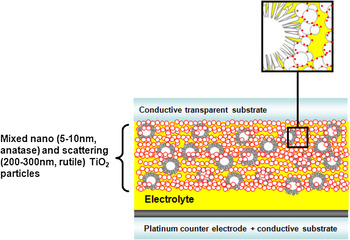
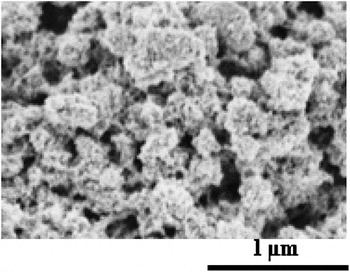
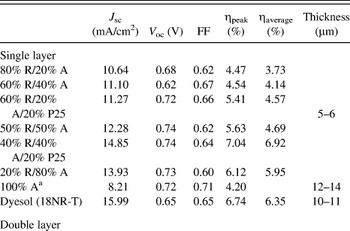
For the construction of the hybrid single-layer electrode, aqueous anatase and rutile were mixed in different ratios. Our hybrid TiO2 electrode composed of transparent anatase nanocrystallites and “urchin-like” rutile scattering particles is depicted in Fig. 3. Construction of such single-layer bifunctional photoanode can potentially produce better DSSC performance because the double-layer photoanode structure incorporating a light-scattering overlayer is known to increase film thickness and as such the thicker layer causes loss of photons traveling through electrolyte-filled photoelectrodes, as well longer electron path lengths and inevitably higher recombination rate.Reference Chappel, Grinis, Ofir and Zaban39, Reference Nakata, Liu, Ishikawa, Sakai, Saito, Ochiai, Sakai, Murakami, Abe, Takagi and Fujishima40 Since the introduction of large sized particles for light scattering decreases the anatase specific surface area causing the reduction of the amount of adsorbed dye molecules, it is important to use the proper amount of scattering particles. Hence, the need to investigate the ratio of rutile to anatase as summarized in Table II. As it can be seen as the ratio “rutile to anatase” progressively decreased from 80/20 to 60/40, 50/50, and 20/80 (all films have the same thickness at around 5–6 μm), the performance of the associated DSSC devices improved in terms of peak efficiency from 4.47% to 6.12%. By comparison, the efficiency of a 100% aqueous anatase-made film (of double thickness) was only 4.20%. This implies that by blending the anatase nanocrystallites with the “urchin-like” rutile particles, the properties/structure of the film in terms of porosity and scattering improved, hence the observed efficiency enhancement. The improved porosity of the hybrid electrode structure can be clearly seen with the SEM image presented in Fig. 4 [compare to Fig. 1(a) of anatase alone] improves the porosity. However, since the particle sizes and pore volume densities of aqueous anatase and rutile are drastically different, we decided to incorporate a fraction of P25 particles into the hybrid paste as a means of improving particle packing and hence DSSC performance, especially in light of reports that P25 improves the consistency of TiO2 paste.Reference Agarwala, Kevin, Wong, Peh, Thavasi and Ho32 This strategy proved successful as evident from the data of Table II.
Schematic diagram of the hybrid electrode structure. The sea urchin-like rutile aggregates are dispersed into the network of anatase nanoparticles. Red dots on the TiO2particles represent the dye molecules.

Top view SEM image of hybrid TiO2film (50% anatase:50% rutile).

Summary of photovoltaic data for the various hybrid DSSC devices.

a DSSC prepared by 100% anatase is added as a reference from the previous study.Reference Lee, Gomez, Charbonneau and Demopoulos16
b Each layer was 5-μm thick.
B. Analysis of photovoltaic and electrochemical properties
Table II summarizes the photovoltaic performance data of the DSSC devices built using hybrid pastes of variable composition. The thickness of all single-layer hybrid films was the same, namely 5–6 μm. On the same table, data from a double-layer film electrode consisting of separate layers of aqueous anatase (transparent) and aqueous rutile (scattering) are reported along data for devices made with sole anatase material either of the aqueous house variety or Dyesol’s commercial paste DSL NR18-T. As already mentioned for the hybrid film devices, their performance improved with decreasing rutile amount. Thus, as it can be seen, the V oc, J sc, and ηpeak increased from 0.68 V, 10.64 mA/cm2, and 4.47% to 0.74 V, 13.93 mA/cm2, and 6.12%, respectively, as the amount of rutile decreased from 80 to 20 wt%. The lower performance with increasing rutile amount is attributed to the decreased anatase surface area, and in case of decreased V oc, this is probably affected by the lower band gap of rutile (3.0 V). From all hybrid electrodes, the best DSSC performance was achieved with the 40R/40A/20P25 formulation, this time the power conversion efficiency reaching 7%. This is impressive as the amount of aqueous anatase was only 40% or, combined with P25, the total anatase amount was only 60% of a 5–6-μm-thick film. Apparently, the lower surface area of anatase was compensated by the bigger pore volume density in this case. Furthermore, P25 certainly improved the quality of TiO2 pastes in terms of consistency preventing cracks on the film during the annealing process. Thus, the incorporation of a small amount of P25 contributes not only to better connectivity between aqueous anatase and rutile but also enhanced porosity. More importantly, the average thickness of hybrid electrodes is only 5–6 μm, which is half of that of conventional cells (12–15 μm). By comparison, electrodes built with the Dyesol benchmark paste and having similar thickness yielded lower performance (4.94%), this increasing to 6.74% at double thickness. It is postulated that the unique characteristics of the aqueous-synthesized anatase crystallites (in terms of surface area and hydroxylation)Reference Charbonneau, Gauvin and Demopoulos17 allowing for improved dye coatingReference Lee, Gomez, Charbonneau and Demopoulos16, Reference Lee, Gomez, Elouatik and Demopoulos18, Reference Lee, Gomez, Regier, Hu and Demopoulos19 in combination with the effective scattering properties of the “sea urchin”-like rutile particles greatly enhance light harvesting and electron injection/collection, hence the observed high performance despite the thinner film. In addition by building thinner electrodes thanks to the unique hybrid TiO2 paste described here, the DSSC suffers less recombinationReference Chappel, Grinis, Ofir and Zaban39, Reference Nakata, Liu, Ishikawa, Sakai, Saito, Ochiai, Sakai, Murakami, Abe, Takagi and Fujishima40 than the thicker film electrode structures.
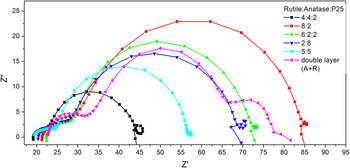
The electron transport properties of selected DSSCs prepared with different hybrid paste formulations were examined by EIS under illumination with AM 1.5 at an applied bias of open-circuit voltage (V oc). The Nyquist plots of the obtained impedance data are shown in Fig. 5. The Nyquist diagram features typically three semicircles that, in the order of increasing frequency, are attributed to charge transfer at the working (FTO/TiO2) and/or Pt counter electrodes (R1), the electron transfer at the oxide/electrolyte interface and the TiO2 film (R2), and the iodide species diffusion in the electrolyte (R3).Reference Bisquert, Garcia-Belmonte, Fabregat-Santiago, Ferriols, Bogdanoff and Pereira41–Reference Bisquert45 By increasing the amount of rutile in the hybrid TiO2, the size of R2 increased, which indicates that the recombination resistance at the TiO2/dye/electrolyte interface (R2) was higher for the larger rutile content films. As the characteristic middle frequency peak can be related to the inverse of recombination lifetime (τr) in TiO2 films (ωR = 1/τR), it is estimated that the 2:8 (20A/80R) film has a shorter electron lifetime. On the other hand, the 4:4:2 hybrid film (40R/40A/20P25) that delivered the best DSSC performance has the smallest size of R2 and hence longer electron lifetime. In the case of double-layered structure, the typical three arcs are clearly shown. Especially, R3 is more distinctive than the corresponding ones of the hybrid films indicating more diffusion resistance in the electrolyte phase. It is hard to observe R3for the hybrid electrodes, and this can be linked to accelerated iodide species diffusion in the electrolyte due to larger size pore network induced by the presence of rutile and P25 particles.
Nyquist plots of DSSCs fabricated using variable composition hybrid TiO2pastes.

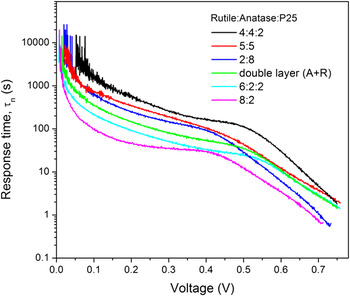
To more fully comprehend the nature of electron conduction and recombination within our hybrid electrode-based cells, we collected a number of open circuit voltage decay (OCVD) measurements. By measuring the subsequent decay of V oc after turning off the AM 1.5 simulated light, the lifetime (τn) can be obtained by:
 $${\rm{\tau }}_{\rm{n}} = ( - kBT/e)(dV_{{\rm{oc}}} /dt)^{ - 1} \quad,$$
where kBT is the thermal energy, e is the positive elementary charge, and dV oc/dt is the derivative of the V oc transient.Reference Wang, Moser and Grätzel43, Reference Wang, Ito, Grätzel, Fabregat-Santiago, Mora-Sero, Bisquert, Bessho and Imai44 The calculated τ as a function of V oc is depicted in Fig. 6. OCVD can be used to probe the nature of the contributions of recombination and conduction pathways. Specifically, at high V oc region, OCVD yields insight into the conduction of charge carriers through the particle interconnects, as this region represents an area of high carrier flux. On the other hand, OCVD in the low V oc region can be thought to relate to the nature of carrier conduction through individual particle grains.Reference Lee, Gomez, Elouatik and Demopoulos18, Reference Cass, Qiu, Walker, Fisher and Peter46Figure 6 shows that the τn curves of the three kinds of DSSCs [8:2 (80A/20R), 6:2:2 (60R/20A/20P25), and double layer (A + R)] show similar behavior in the high V oc region (>0.5 V), thus it is not clear to understand the recombination characteristics for all films in this region. However, the τn curves differentiate clearly in the low V oc region. It is apparent from the OCVD transients that the cell fabricated using the 4:4:2 (40R/40A/20P25) TiO2 hybrid formulation outperformed all the devices at both higher and lower V oc, thereby highlighting the superior transport characteristics of charge carriers through both individual grains and grain boundaries. Previous reports have also shown that electron lifetimes increase with increasing particle size due to a decrease in the number of grain boundaries.Reference Nakade, Saito, Kubo, Kitamura, Wada and Yanagida47 In our case, the large “sea urchin”-like rutile particles enhance the electron lifetime in the hybrid films with P25 contributing further to the quality of the TiO2pastes. Therefore, the variable size particles (and unique features of the “urchin”-like rutile particles) used to formulate the paste are thought to enhance interparticle connectivity.Reference Santulli, Koenigsmann, Tiano, DeRosa and Wong48
Electron lifetime derived from OCVD measurements.

IV. CONCLUSION
Photoelectrodes of mixed submicrometer-sized TiO2 rutile aggregates and individually dispersed TiO2 anatase nanocrystallites with different ratios were fabricated and studied for improved power conversion efficiency in DSSC. TiO2 rutile aggregates/anatase nanocrystallites hybrid electrodes possess several advantages for high performance of DSSCs, including the light scattering by the 200–400-nm-sized rutile aggregates and the high surface area of nanocrystallites both in aggregates and individually dispersed. A high power conversion efficiency of ∼7% was achieved with 4:4:2 hybrid (anatase nanocrystallites/P25/rutile aggregates) using conventional dye N719. The electron transport properties of DSSC with the hybrid photoelectrodes were investigated by electrochemical impedance spectra, and the results showed that it possess better connectivity for efficient electron transport. The 4:4:2 hybrid DSSC also presents the fewer recombination centers as compared to those in the other hybrid TiO2films and double-layered film according to the electron lifetime results by OCVD measurement.
Supplementary Material
Supplementary materials can be viewed in this issue of the Journal of Materials Research by visiting http://journals.cambridge.org/jmr.
ACKNOWLEDGMENTS
This work was funded through the strategic research grant program of the Natural Sciences and Engineering Research Council of Canada and sponsored by Targray Technology International, CIS Solar, Versatilis, and Hydro-Quebec.