


Introduction
“It’s important that the city has a lobbying presence in Harrisburg, and it’s doubly important that Philly, which is a Democratic city, has access to GOP leadership who basically run the show.”
—Pennsylvania Lobbyist Larry CeislerWhen do local governments mobilize as interest groups and hire lobbyists to represent them in other levels of government? Elected offcials of all types lobby each other frequently—both in the United States and other federal systems—and these efforts can dramatically influence the distribution of intergovernmental transfers and other policy outcomes (De Figueiredo and Silverman Reference de Figueiredo and Silverman2006; Goldstein and You Reference Goldstein and You2017; Payson Reference Payson2020; Sorensen Reference Sorensen2003). But most theories of interest group mobilization focus on the behavior of membership-based groups and business interests and are less well equipped to explain variation in the intergovernmental context. And while the existing literature often acknowledges that governments lobby each other (e.g., Baumgartner and Leech Reference Baumgartner and Leech1998; Cigler Reference Cigler1995; Milbrath Reference Milbrath1963), studies of intergovernmental advocacy typically emphasize the mechanics of the lobbying process rather than the initial decision to mobilize (e.g., Cammisa Reference Cammisa1995; Freeman and Nownes Reference Freeman and Nownes1999; Haider Reference Haider1974). As a result, we know little about why particular local governments sometimes choose to pay for lobbyist representation.
Drawing from existing work on interest groups, lobbying, and representation, I develop a theory of local government mobilization that emphasizes the role of political geography. As observed by Goldstein and You (Reference Goldstein and You2017), Loftis and Kettler (Reference Loftis and Kettler2015), and others, one of the features that distinguishes local governments from many other organizations that enter the lobbying arena is that they are formally embedded in the federal system. Local governments enjoy a certain level of de facto representation in other levels of government by virtue of being nested within state and federal legislative districts that serve the same constituents. The incentives to mobilize should therefore be a function of how effectively these legislators represent local interests in their respective chambers.
Specifically, I argue that local officials are particularly likely to hire lobbyists when their funding and policy preferences diverge from the elected officials serving their district in higher office. This logic is consistent with classic signaling models of lobbying developed by Potters and Van Winden (Reference Potters and Van Winden1990) and Grossman and Helpman (Reference Grossman and Helpman2001). These models predict when interest groups will invest money on lobbying given varying degrees of policy congruence with a policymaker. The intuition is that when preferences diverge, there are conditions under which hiring a lobbyist can transmit information that is both useful to the legislator and that can help move the expected policy towards the group’s ideal point.
Using newly collected panel data on municipal lobbying across the United States, I employ a difference-in-differences approach and a regression discontinuity design to demonstrate that cities are significantly more likely to hire an outside lobbyist after their district elects a state representative from the opposite political party. The estimates range from a conservative five percentage point increase to over 20 percentage points depending on the sample and model specification. Qualitative evidence suggests that cities are mobilizing specifically to compensate for the representational challenges that emerge from these partisan mismatches.
I conduct a variety of additional tests to validate the results and explore possible mechanisms. The type of partisan mismatch that appears to most strongly predict lobbying is between city residents and the state legislators representing them; adding mayoral partisanship to the models explains little additional variance. Cities also lobby primarily in response to mismatches with their own district representatives rather than in response to the overall partisan composition of the state lower chamber. Preliminary evidence from Missouri confirms that municipal lobbyists spend most of their time meeting with legislators from their own district, suggesting that the decision to mobilize is driven at least in part by the relationship between cities and their state delegation.
Existing Perspectives on Mobilization
Early studies of interest group mobilization by scholars like Truman (Reference Truman1951) and Dahl (Reference Dahl1961) assumed that lobbying was a natural consequence of disturbances to the policy environment. Researchers quickly recognized, however, that policy concerns alone are not always sufficient to spark political action. This is particularly true when groups or individuals face incentives to free-ride off the advocacy efforts of others, which hinders the mobilization process and can lead to participatory bias (Lowi Reference Lowi1969; Schattschneider Reference Schattschneider1960; Schlozman Reference Schlozman1984). Salisbury (Reference Salisbury1984) subsequently drew an important theoretical distinction between the mobilization incentives of institutions as opposed to membership-based groups, observing that institutions are more responsive to environmental conditions and both enter and exit the lobbying community at much higher rates than other organized interests.
Another rich body of research on interest group mobilization focuses less on the lobbying decisions of individual organizations and more on the overall composition of interest group communities. For example, the population ecology framework developed by Gray and Lowery models the density and diversity of interest systems as a competitive feedback process within the political environment (Gray and Lowery Reference Gray and Lowery1996; Lowery and Gray Reference Lowery and Gray1995; Lowery and Gray Reference Lowery and Gray1998), while work by Leech and colleagues demonstrates that changes to the policy agenda can spur lobbying in that area (Baumgartner and Leech Reference Baumgartner and Leech2001; Leech et al. Reference Leech, Baumgartner, La Pira and Semanko2005). Cities and other local governments are particularly likely to be attuned to such demand-creating actions of their lawmakers in other levels of government. Cities rely on both their states and the federal government for a large share of their funding, and they frequently face policy mandates on issues ranging from transportation to education to the environment.
But city officials also face several important constraints on their ability to shape the political environment in which they operate. For example, membership-based groups and corporations are often regionally dispersed and can target their lobbying efforts across multiple states and legislators. Businesses can relocate (or threaten to) if they are dissatisfied with the political environment in their district (e.g., Peterson Reference Peterson1981). Even institutions that are fairly fixed in terms of their physical location—like company town monopolies—are better equipped than local governments to shop around the legislature for allies if they aren’t happy with the actions of their district representatives. For one thing, these organizations can make campaign contributions, which are valuable to elected officials even when they represent other districts. Local governments, on the other hand, are legally prohibited from contributing to political campaigns (Cammisa Reference Cammisa1995), which limits their ability to get the attention of legislators outside of their district.
At the same time, these physical constraints mean that local officials have natural advocates in other levels of government in the form of their district representatives, who can work to secure additional funding through earmarks and appropriations and to support policies favorable to the cities in their district. In fact, virtually all cities engage in “lobbying” in the sense that they regularly contact their elected delegation in state and federal office to communicate their needs. State house members spend up to half of each week in their districts attending meetings with local elected officials and constituents (Jewell Reference Jewell1982), and city mayors, managers, and council members often have close relationships with their state delegation. Some cities also establish intergovernmental relations offices specifically to communicate the local agenda to state and federal legislators. And most cities are also members of their municipal leagues, which lobby for across-the-board legislation with collective benefits.
Why Cities Pay For Lobbyist Representation
So the question becomes, why do cities sometimes pay for lobbyist representation, given the options outlined above? I argue that when local officials diverge in terms of funding and policy preferences from their elected representatives, they can hire lobbyists to signal information about local priorities in an attempt to persuade the legislator to align their efforts more closely with city needs. The theoretical intuition can be drawn from Grossman–Helpman type models in which interest groups and legislators share some degree of policy congruence but also some conflict (Potters and Van Winden Reference Potters and Van Winden1990; Grossman and Helpman Reference Grossman and Helpman2001). When a group has a different preferred policy outcome than a legislator, there are certain conditions under which mutually beneficial communication is possible. The choice to invest money in lobbying sends a costly signal to policymakers about the state of the world, which can sometimes move policy closer to the outcome favored by the interest group.
Recent research by de Figueiredo and Cameron (Reference de Figueiredo and Cameron2019) finds strong empirical support for many of the predictions generated by the Grossman–Helpman framework. In the intergovernmental context, the model suggests that cities will have little incentive to hire lobbyists when their elected officials share congruent funding and policy goals. But when legislator priorities diverge from local preferences, lawmakers might still be willing to consider local input on certain issues. After all, representatives are tasked with serving the cities in their district even when they differ ideologically. By taking the costly step of hiring a lobbyist, cities can indicate which issues are particularly important to them, which can help time-constrained legislators decide which actions to prioritize. This might be particularly useful when legislators have only weak preferences over particular policies that would have substantial local effects.
For example, the former lobbyist for Travis County (the blue-leaning region surrounding Austin, Texas) observed that he was able to work effectively with the county’s Republican delegation by focusing on narrow issues with local fiscal implications. He explained that he “wasn’t getting into the middle of abortion or constitutional carry” (Craver Reference Craver2019). Instead, his primary task was providing information to the county’s Republican legislators to make them aware of how state actions would affect local operations. His priorities in his last legislative session included working to convince district lawmakers to oppose a property tax revenue cap on local governments and advocating for additional funding for county health clinics (Buchanan Reference Buchanan2018).Footnote 1
The idea that ideological divergence can influence the demand for lobbying by local governments is similar to the perspective advanced by Goldstein and You (Reference Goldstein and You2017), who argue that cities are more likely to lobby the federal government when they face a preference incongruence with their state governments over local public goods expenditures. In that paper, the authors provide a rationale for why cities might choose one lobbying venue over another based on the political dynamics operating across different levels of government. I argue that the decision to mobilize within a particular level of government should also depend on the relationships that cities have with their representatives in that legislature. While both theories emphasize the sensitivity of local governments to their political environments, my argument is simply that district relationships matter in addition to chamber dynamics.
Goldstein and You (Reference Goldstein and You2017) also offer evidence that liberal cities in conservative states are particularly likely to appeal to the federal government for aid because these places generally have stronger demand for public goods and less sympathetic state lawmakers. Such asymmetries should be less likely when it comes to cities lobbying in response to their relationship with their district representatives because both Republicans and Democrats actively work to procure earmarks and funding for their districts (Lazarus Reference Lazarus2009; Stein and Bickers Reference Stein and Bickers1994). Nevertheless, I examine whether red and blue cities behave differently after presenting the main results and find that both types of cities are mobilized at roughly equal rates when represented by non-co-partisans.
Measuring Mobilization with Lobbying Disclosure Data
The state-level lobbying data used in the following analyses are the product of a multi-year data collection effort that involved gathering, cleaning, and compiling lobbying disclosure data from all 50 states. Each state has its own lobbying disclosure law requiring lobbyists to report their communication with state officeholders—and each state law is at least as restrictive as the 1995 Federal Lobbying Disclosure Act (Lowery and Brasher Reference Lowery and Brasher2004). But while every state regulates lobbying, this information is more difficult to access than federal disclosure data because each state has its own reporting standards. Some states make their lobbying information publicly available online; other states are less transparent and only provide data upon request—and sometimes for a fee.Footnote 2
This 50-state lobbying database runs from 2006 to 2014 and contains nearly half a million total observations. The unit of observation is the client-year, and the main variable of interest is a binary indicator that takes a value of one if an organization disclosed any lobbying activity in a given year.Footnote 3 While some states also provide reports of total lobbying expenditures, this information varies widely from state to state. As a result, most of the following analyses focus on the binary mobilization decision to lobby or not in a given year, although I provide some additional robustness checks using the continuous expenditure measures for the states where these data are available.
Armed with information about all of the organizations that were lobbying in a given state in each year, I could identify which cities employed lobbyists by matching the names from the disclosure data with the universe of municipalities enumerated by the Census of Governments. The Census of Governments is conducted every five years by the U.S. Census Bureau and provides data on public finances for every local government in the country.Footnote 4 The population of interest is every city with more than 20,000 residents, which is the set of cities for which ideology and vote share estimates exist thanks to work by Tausanovitch and Warshaw (Reference Tausanovitch and Warshaw2014). After determining which of these city governments filed state disclosure reports, I merged this information with financial, demographic, and political data from a variety of other sources including the Survey of Local Government Finances, the American Community Survey, Missouri Census Center geography data, and state legislator party and ideology estimates from Shor and McCarty (2014). The final dataset contains information about municipal lobbying and city characteristics for each of the roughly 1,200 cities in the United States with a population of at least 20,000 and spans the period from 2006 to 2014. During this time, there were 551 that never reported lobbied, 178 cities that lobbied in every period, and 515 cities that disclosed lobbying activity in some years but not others. In the states with reliable expenditure data, cities reported spending just under $71,848 per year on average, although this amount varies dramatically across states.
When cities do hire lobbyists, they are quite transparent in their goals. They want more funding and favorable policies to increase their power, autonomy, and institutional flexibility. By way of example, Figure 1A in the Online Appendix is an excerpt from a report filed by the city manager of Palo Alto, California. The report explicitly states that the city intends to hire a lobbyist to “protect local revenue sources,” “protect and increase funding for specific programs and services,” and “oppose legislation, policies and budgets that reduce the authority and/or ability of local government to determine how best to effectively operate local programs,” among other goals. More broadly, cities tend to target most of their lobbying efforts towards legislative earmarks, budget and appropriations bills, policies with a local impact, and executive grants. In the Online Appendix, I provide some specific examples of the types of funding programs and legislation that cities are lobbying for and discuss the availability of data on this topic at the state level.
Partisan Mismatch: Leads of Treatment

There are a few important things to note about using disclosure filings to measure mobilization. As discussed earlier in the paper, city officials have four main options available to them when deciding how to mobilize: directly contacting their representatives in the legislature, establishing an intergovernmental relations office, joining a municipal league, or hiring an outside lobbyist. State lobbying laws require that cities (and other organizations) disclose the lobbying activities of both in-house employees and external firms. Unfortunately, for the vast majority of states it wasn’t possible to determine whether the reported lobbying was performed by an in-house representative working in an intergovernmental office or by an external agent. However, examining the disclosure records for a random sample of several hundred cities shows that in-house lobbying appears to be virtually constant over the course of the panel. Cities either have dedicated intergovernmental relations staff or they don’t; the key source of variation in the data comes from cities both hiring and ending their contracts with external lobbyists on a year-to-year basis.Footnote 5
Because municipal league membership and the presence of intergovernmental offices appear to be time invariant over the short course of the panel, these local characteristics can be modeled in the econometric specifications with a city fixed effect. But direct contact between local officials and their legislators is unobserved in my data. As a result, it’s important to interpret the following results in terms of paid lobbying rather than total lobbying. City officials might increase or decrease their informal lobbying efforts when a partisan mismatch occurs, and documenting these responses is a topic ripe for future research. The difference-in-differences research design still allows me to estimate the effect of a partisan mismatch on paid lobbying, provided that any informal mobilization is not correlated both with the election of a mismatched legislator and with the choice to hire an external lobbyists. This assumption seems likely given the literature on the determinants of state legislative elections (e.g., Carey, Niemi, and Powell Reference Carey, Niemi and Powell2000), and the regression discontinuity design (RDD) analysis provides an even stronger design for ruling out such a story.
Defining Policy Divergence between Cities and State Legislators
To examine how policy divergence between state representatives and their cities affects local mobilization, I rely on ideology and partisanship measures provided by Tausanovitch and Warshaw (Reference Tausanovitch and Warshaw2014).Footnote 6 The partisanship estimates aggregate precinct returns from the 2008 presidential election, and the ideology measures rely on hundreds of thousands of public opinion survey responses from city residents across the country and use multilevel regression with post-stratification to assign ideal points to cities. It is important to note that these estimates capture average partisan and ideological tendencies within a city rather than the partisanship of the city council or mayor. However, a growing body of research suggests that the policies of local officials largely reflect voter preferences (de Benedictis-Kessner and Warshaw Reference de Benedictis-Kessner and Warshaw2016; Einstein and Kogan Reference Einstein and Kogan2016; Tausanovitch and Warshaw Reference Tausanovitch and Warshaw2014). I later directly test the effects of mayoral partisanship for the subset of cities with available data and find very similar results.
For the first set of analyses, I define cities as being either Democratic or Republican by binning them into terciles based on their Democratic vote share in the 2008 presidential election. Later, I examine a time-varying measure of vote share for cities in California. The estimates are slightly larger using the time-varying measure, suggesting that using a fixed measure of partisanship is not introducing upward bias over the short course of the panel. Cities are coded as Democratic if they fall in the top third of the Democratic vote share distribution and as Republican if they fall in the bottom third. I then map cities into their state legislative districts using geographic data from the Missouri Census Center, which allows me to determine the partisanship and ideology of their district legislators using data from Shor and McCarty (Reference Shor and McCarty2011).
Partisan Mismatches Increase City Lobbying
Having labeled cities as either Republican or Democratic, I define a partisan mismatch as occurring when a Democratic city is represented by a Republican state legislator or when a Republican city is represented by a Democratic state legislator. In the case of a multi-member city, I code a mismatch as occurring when more than 50% of the delegation comes from the opposite party. The resulting estimates are very consistent if higher thresholds are used, and Table A5 in the Online Appendix shows these results. I exploit the fact that cities elect different types of representatives over time to estimate the effect of a partisan mismatch on lobbying probability. In other words, the treatment is an election that leads to a switch in alignment. There were 732 such elections over the course of the panel.
I estimate generalized difference-in-differences equations of the following form:
 $$ {Lobby}_{it}={\beta}_1{Mismatch}_{it}+{X}_{it}{\beta}_2+{\gamma}_i+{\eta}_t+{\upepsilon}_{it}, $$
where Lobbyit equals one if city i hired a lobbyist in year t. The coefficient of interest is β 1, which captures the effect of a partisan mismatch between a city and its state representative. The values for Xit include a battery of city-level covariates described in more detail in the Online Appendix. City fixed effects are captured by γi, and ηt include either year or state-by-year fixed effects.
Intuitively, this design allows me to examine the change in probability that a city lobbies before and after its district elects a non-co-partisan compared with other cities either in the same year or in the same state and year. The city fixed effects control for time invariant local characteristics that might be correlated with a city’s overall latent demand for lobbying. The year fixed effects account for temporal shocks that might lead all cities to lobby more in a certain year, such as the 2009 financial crisis. The state-by-year fixed effects go a step further and control for state specific conditions that might induce cities within that state to mobilize in a given period. For example, in 2011 the California legislature shuttered hundreds of local redevelopment agencies that cities relied on to help provide affordable housing, which led to a sharp increase in municipal lobbying across the state. A fixed effect for each state in each year can account for such state-specific disturbances. Critically, this also provides a way to proxy for changes to the state legislative agenda from year to year, which might be an important reason why cities mobilize.
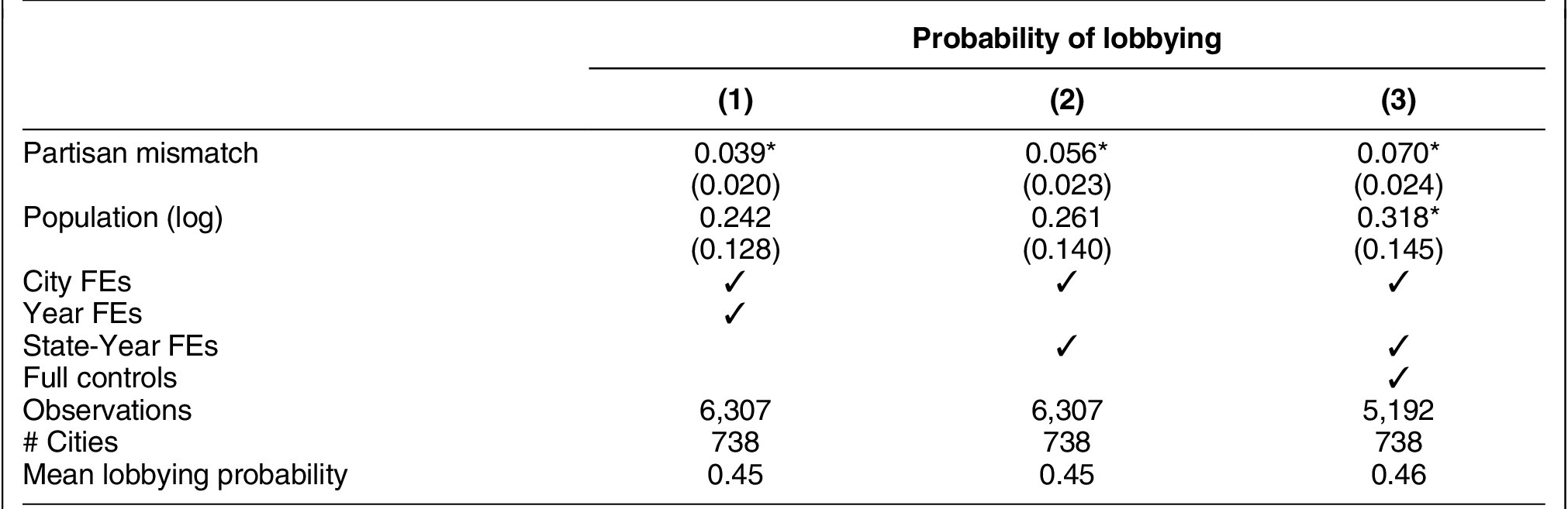
Table 1 presents the results. Across specifications, the results indicate that when a city elects a representative from the opposite political party, the probability of lobbying increases by between 4 and 7 percentage points. Given the average lobbying probability of 45%, this reflects over a 10% increase. Reassuringly, including additional covariates and more restrictive temporal fixed effects only increases the size of the estimates. For example, column 3 controls for specific features of each state legislature in each year that might increase lobbying by all cities. Compared with localities within the same state and year that are similar in terms of size and demographics, cities that are represented by a non-co-partisans are substantially more likely to hire a lobbyist. The results are similar when I bin cities into medians rather than terciles based on their partisan vote share in 2008 (results in Table A6). And when cities are represented by more than one legislator, the results are also robust to using different thresholds to specify a mismatch.Footnote 7
Effect of Partisan Mismatch on City Lobbying

Note: When an election leads to a partisan mismatch between a city’s residents and the party of their state representative, the probability of lobbying increases between 4% and 7%. Robust standard errors are clustered by city. *p < 0.05.
There is also some evidence that cities spend more money on lobbying when their district elects an out-party legislator. Table A7 shows these results for the states with reliable expenditure data. City officials report spending around 10% more money on lobbying when they face a partisan mismatch with their state representatives. Given differences in expenditure reporting across states and widespread missing data, specifications relying on this continuous measure of lobbying activity contain far fewer observations and are more prone to measurement error than the results modeling the simple decision to lobby or not. The rest of the paper focuses on explaining this binary mobilization outcome; however, it is reassuring that the expenditure analyses follow a similar pattern.
The results in Table 1 also show the results pooled across both Republican and Democratic cities. Estimating the models separately for each type of city yields almost identical coefficients and indicates that both Republican and Democratic cities experience a similar increase in the probability of lobbying after their district elects a member of the out-party (Table A8). While Goldstein and You (Reference Goldstein and You2017) find that cross-sectionally blue cities in red states are particularly likely to lobby, it appears that within the same city over time both red and blue cities are sensitive to the partisan composition of their state legislative delegation. This makes sense if co-partisan legislators are more likely to share the same spending priorities or if in-party networks somehow make communication easier. In this case, both Democratic and Republican cities might find lobbying to be advantageous.
For example, Little Rock, Arkansas, is a fairly liberal city. Its residents are 40% African American and include many well-educated white voters, and a majority of the city voted for Obama in 2008. But one of the state legislators representing part of Little Rock in 2012 was Allen Wade Kerr (R-Pulaski County), a staunch conservative who supported abortion bans and co-sponsored legislation allowing handguns to be carried on church and school properties.Footnote 8 After Kerr was elected, Little Rock hired a new lobbyist to help convince its delegation to support additional public goods funding, including “the appropriation of state funds for a housing trust fund administered by the Arkansas Development Finance Authority to serve as a funding source for local government … to help provide affordable housing.”Footnote 9
While Democratic cities were slightly more likely to experience mismatches over the course of the panel, there were also many cases of Republican cities sitting in districts that elected Democrats. This often occurs when suburban municipalities reside in districts that also represent more racially diverse cities, often on the outskirts of urban core areas. For example, Citrus Heights, California, is significantly whiter and more conservative than many of its neighboring cities in Sacramento County. Its state assembly district leans purple, and in 2011 Richard Pan (D) was elected after Republican Roger Niello was termed out of office. Citrus Heights subsequently opted to hire a lobbyist, with the goal of securing state assistance for a new police service center and commercial revitalization efforts.Footnote 10
Robustness Checks
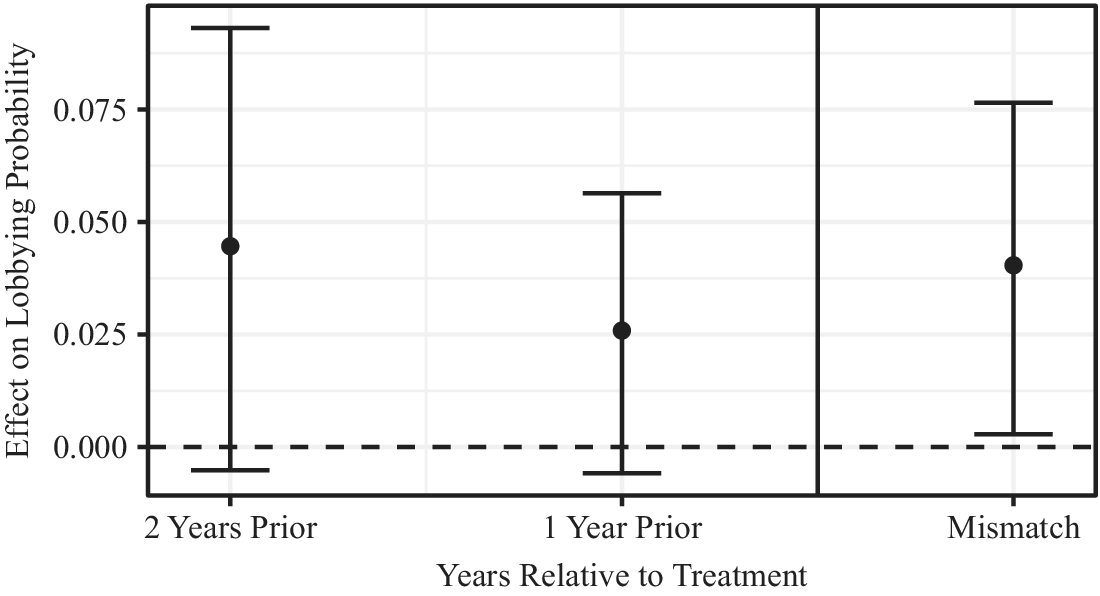
I perform several robustness checks to ensure the validity of the two-way fixed effects design. The key assumption of this approach is that aligned and mismatched cities would have followed the same lobbying trend if the mismatched cities had not elected a non-aligned candidate. To probe the likelihood of this assumption, I introduce leads of the treatment variable (in this case, an election leading to a partisan mismatch between a city and its lower house representatives) to examine if pretreatment trends are a concern. The results are in Table A11 in the Online Appendix, and Figure 1 shows the effects in graphical form.
Interestingly, it appears that the cities that become mismatched have a higher baseline probability of lobbying than other cities. This would make sense if electoral swings tend to happen in districts where representatives tend to be less attuned to local interests. Cities in those districts would potentially have reasons to lobby even before they became mismatched. However, there doesn’t appear to be a concerning pretreatment trend in the lobbying behavior of cities leading up to the election, which would be the key threat to inference with the fixed effects approach. To further assess the parallel trends assumption, I explicitly examine the lobbying behavior of 112 cities in the sample that follow a pattern of being aligned for two years before electing a mismatched representative. Comparing the probability of lobbying for these cities with a matched control sample provides additional evidence that the two groups of cities had very similar trends before the election (Figure A2 in the Online Appendix).
Still, when districts switch parties there are likely a variety of factors that could lead municipal leaders to lobby that may or may not be related to the fact that the city is now represented by a non-co-partisan. The RDD results that I present later in the paper help to allay some of these concerns. I uncover an even larger effect when comparing cities that narrowly elect an aligned or mismatched candidate, and these cities should have similar sorts of electoral dynamics around the margin of victory threshold. And to be clear, the theory predicts that local governments hire lobbyists when they face divergent preferences with district officials. To the extent that the election of a mismatched state legislator might be bundled with other circumstances that might make it difficult for cities to receive effective representation in state government, this is still compatible with the theoretical framework.
Partisanship or Ideological Congruence?
The results in the previous section demonstrate that cities are more likely to hire lobbyists when their districts elect representatives from the opposite political party. But in addition to information about partisanship, the Tausanovitch and Warshaw (Reference Tausanovitch and Warshaw2014) and Shor and McCarty (Reference Shor and McCarty2011) data also provide estimates about the relative ideological preferences of cities (compared with other cities) and state representatives (compared with other state representatives). I now examine how the ideological congruence between cities and state legislators affects the lobbying decisions of local officials. This approach allows me to introduce more nuanced, continuous measures of preferences and to check the robustness of the main results.
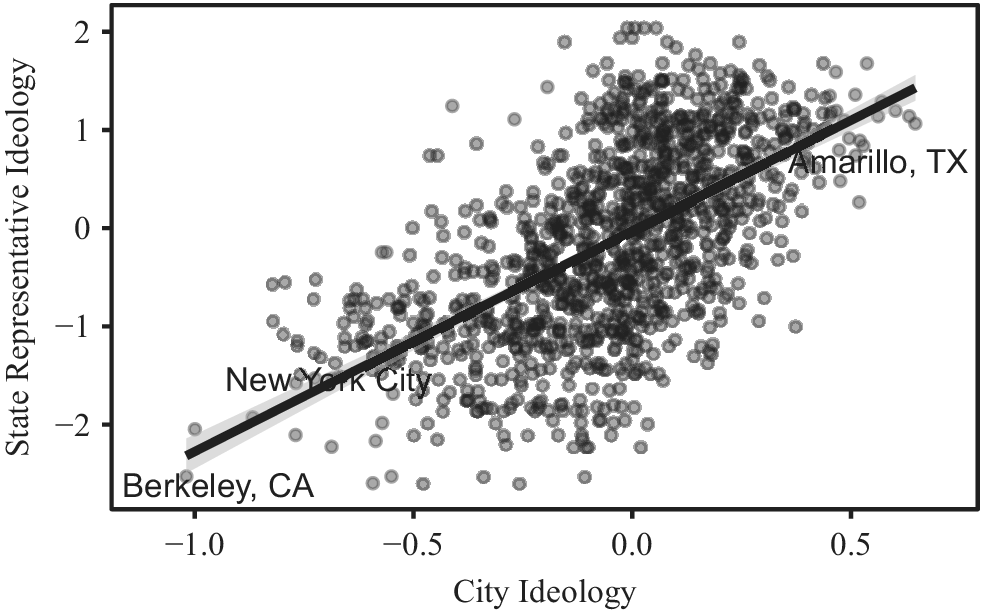
It is important to note that the ideology estimates for cities and state legislators were derived on different scales. For a city with a given ideology estimate, it is unclear which state legislator ideology score comes closest to corresponding with the preferences of that city. Nevertheless, the two measures correlate strongly. Cities with more liberal Tausanovitch and Warshaw (Reference Tausanovitch and Warshaw2014) scores have, on average, representatives with more liberal Shor and McCarty (Reference Shor and McCarty2011) scores. Figure 2 plots state representative ideology measures (lower chamber) against city ideology estimates.Footnote 11 Positive values are more conservative, and negative values are more liberal. While the range of the city ideology scores is more compressed than that of the legislator scores, the relationship is clear. The most liberal city in the sample, Berkeley, California, is represented by the most liberal state legislator, while cities and their representatives in the south tend to be more conservative.
Correlation between City and State Representative Ideology

To test how different levels of ideological congruence affect city mobilization, I bin both cities and their representatives into various quantiles based on their ideology scores. This allows me to flexibly estimate how representational patterns affect city lobbying without making assumptions about the functional form of the relationship. As in the previous section, I divide cities into terciles, with cities in the most liberal third of the distribution coded as “Liberal” and cities in the most conservative third of the distribution coded as “Conservative.” I then assign legislators to quintiles (consisting of “Most Liberal,” “Liberal,” “Moderate,” “Conservative,” “Most Conservative”). This allows me to see how cities that are relatively more liberal (or conservative) respond when they are represented by state delegates that fall at different points along the ideological distribution.
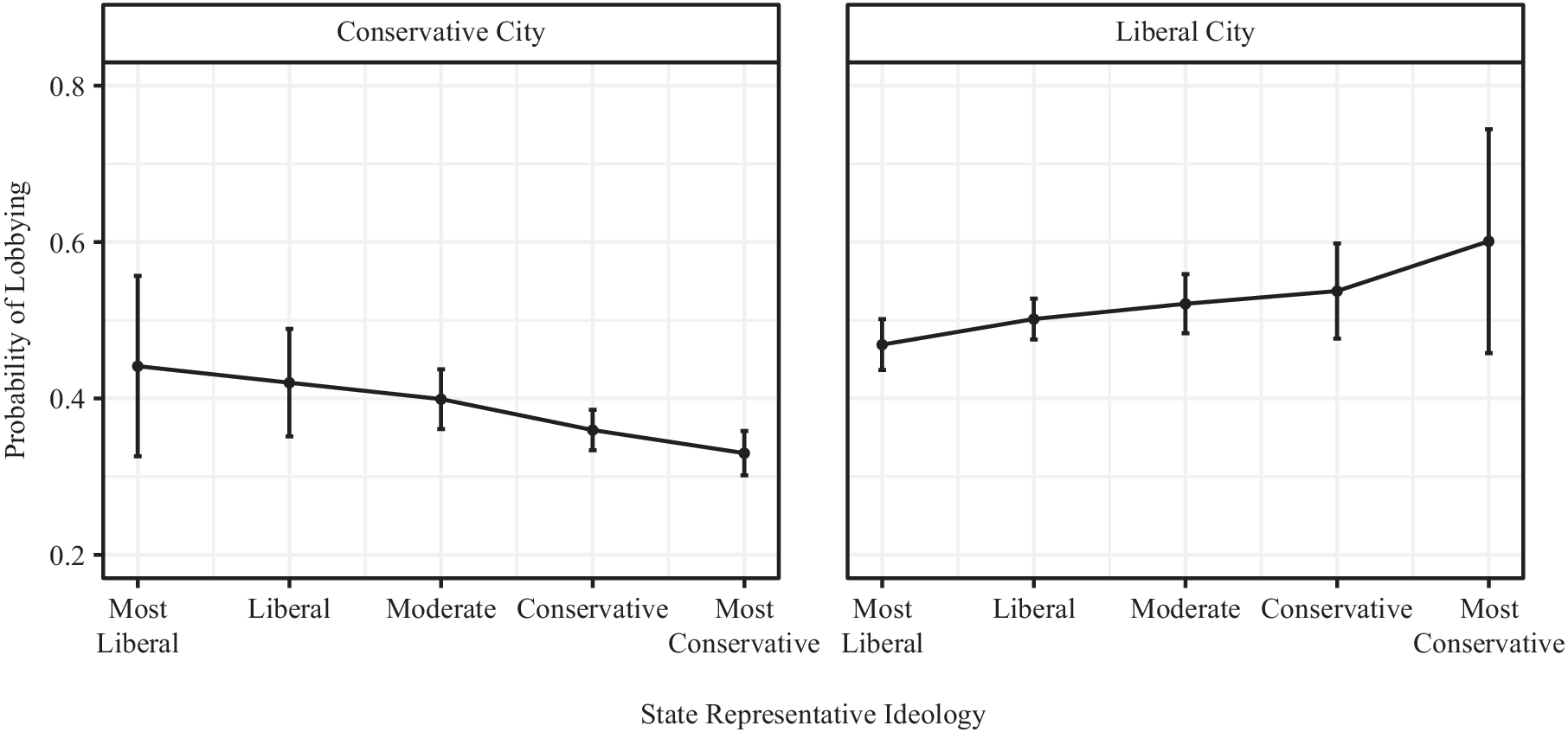
Using the same two-way fixed effects approach as before, I estimate the effect of lobbying across a variety of city and state legislator ideology pairings. Table A12 (in the Online Appendix) shows the results for both liberal and conservative cities. This flexible approach demonstrates that the probability of lobbying increases as state legislators become more extreme in their ideology. Liberal cities are 13 percentage points more likely to lobby when represented by a very conservative house member compared with a very liberal representative. Similarly, conservative cities are 11 percentage points more likely to lobby when they elect an extreme liberal as opposed to an extreme conservative.
Figure 3 illustrates the marginal effect of representative ideology on the probability of lobbying for conservative and liberal cities. The prediction intervals are a bit imprecise given the relatively small sample size in each condition, but the pattern is clear. The probability that cities hire a lobbyist generally increases as their state legislators become more ideologically distant. Cities lobby when their districts elect representatives from the opposite party, and this effect is even larger for the most liberal (or conservative) lawmakers.
Effect of Ideological Distance on Lobbying

Examining Lobbying Decisions across Close Elections: Supplementary RDD
The previous section used panel regression methods to identify the effect of different types of partisan and ideological mismatches on city lobbying. This approach compares the lobbying decisions of cities before and after their districts elect representatives with different ideological characteristics. Another, complementary approach would be to compare the lobbying decisions of cities that narrowly elect either co-partisan or mismatched candidates. If a sufficient number of these close elections occur, a regression discontinuity design can uncover the local average effect of state representative alignment on city lobbying. This approach is attractive because it relies on a less restrictive set of assumptions than the two-way fixed effects design. For example, omitted variable bias is less of a concern because near the treatment threshold cities should be more or less comparable.
To employ the RDD, I merge the dataset used in the previous section with state legislative election returns from Klarner et al. (Reference Klarner, Berry, Carsey, Jewell, Niemi, Powell and Snyder2013). I restrict the analysis to races in which the top-two vote getters are a Republican and Democrat competing for one seat. I focus specifically on races in districts that represent at least 50% of a city’s population, because these are cases in which a victory by either the aligned or unaligned candidate would change the majority party of a city’s delegation in the statehouse. Of the cities in my sample, 676 (out of 1,244) have a district large enough to meet this requirement.
As in the panel regression analysis, I define candidate alignment in terms of average city partisanship. For cities falling above the median in terms of Democratic vote share, a Democrat is considered to be an aligned candidate and a Republican is a mismatch (and vice versa for Republican cities).Footnote 12 The running variable is the margin of victory for the mismatched candidate—for example, the Republican candidate vote-share minus the Democrat candidate vote-share in a city coded as being Democratic. Values near zero indicate very close elections that might have gone either way. The key assumption for the design to recover a valid estimate of the treatment effect is that candidates are not able to sort around this winning threshold and that potential outcomes for cities are continuous at the cutpoint.
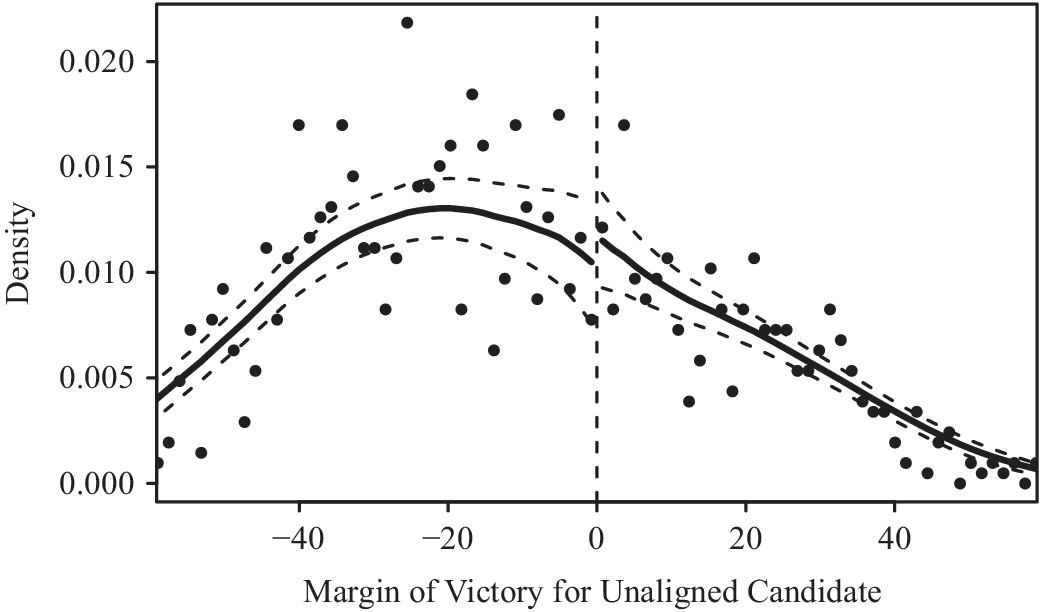
To probe these assumptions, I begin by examining the density of the running variable at the cutoff using the sorting test proposed by McCrary (Reference McCrary2008). Intuitively, if state legislators are unable to precisely manipulate their vote share, there should be a similar number of aligned and mismatched candidates falling just above and below the winning threshold. Figure 4 shows the results graphically. On average, co-partisan candidates are more likely to win their elections than unaligned candidates. But there are a roughly equal number of aligned and mismatched candidates appearing immediately on either side of the margin of victory cutoff, suggesting the validity of the RDD approach. I also examine the distribution of several key covariates like city population and median income around the cutoff and find no significant differences across treated and control units (Figure A3 in the Online Appendix).
RDD Sorting Test

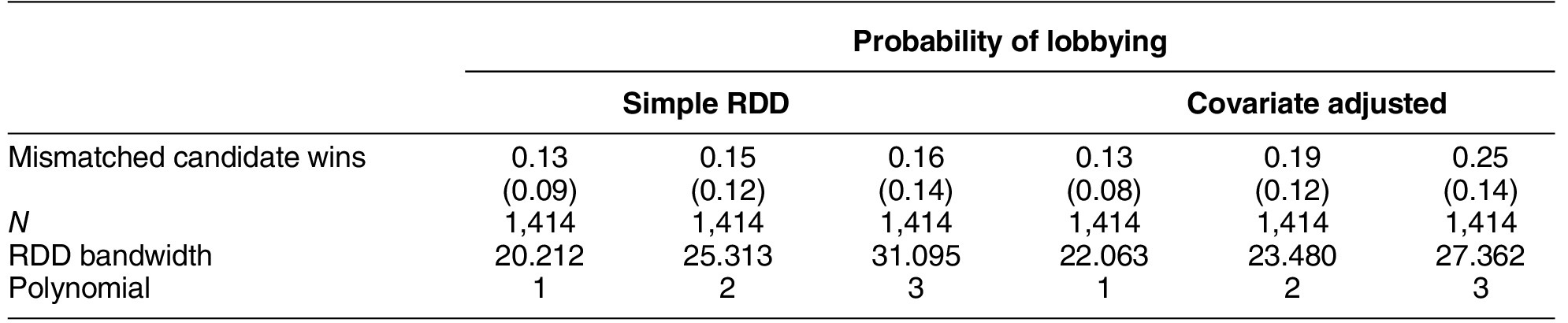
Table 2 shows the results of implementing the RDD using the rdrobust package in R. The bandwidths were selected via the Calonico, Cattaneo, and Titiunik (Reference Calonico, Cattaneo and Titiunik2014) MSERD optimal procedure, and estimates are shown across various polynomial specifications. When a mismatched statehouse candidate narrowly wins an election, cities dramatically increase their probability of lobbying by between 13 and 25 percentage points. The estimates are a bit noisy, but the pattern is clear. And after including a covariate adjustment for city population, the effects become more precise as well as larger (columns 4–6). There are also a good number of observations close to the treatment thresholds, with 166 elections having margins of victory of five points or less and 319 elections with margins of victory of 10 points or less. Table A13 in the Online Appendix shows the number of observations within different bandwidths.
RDD Results

Note: Effect of narrowly electing either a co-partisan or non-co-partisan state representative on the probability of lobbying. Triangular kernels. Calonico, Cattaneo, and Titiunik (Reference Calonico, Cattaneo and Titiunik2014) MSERD optimal bandwidths with robust standard errors clustered by city. The adjusted models include log population as a covariate.
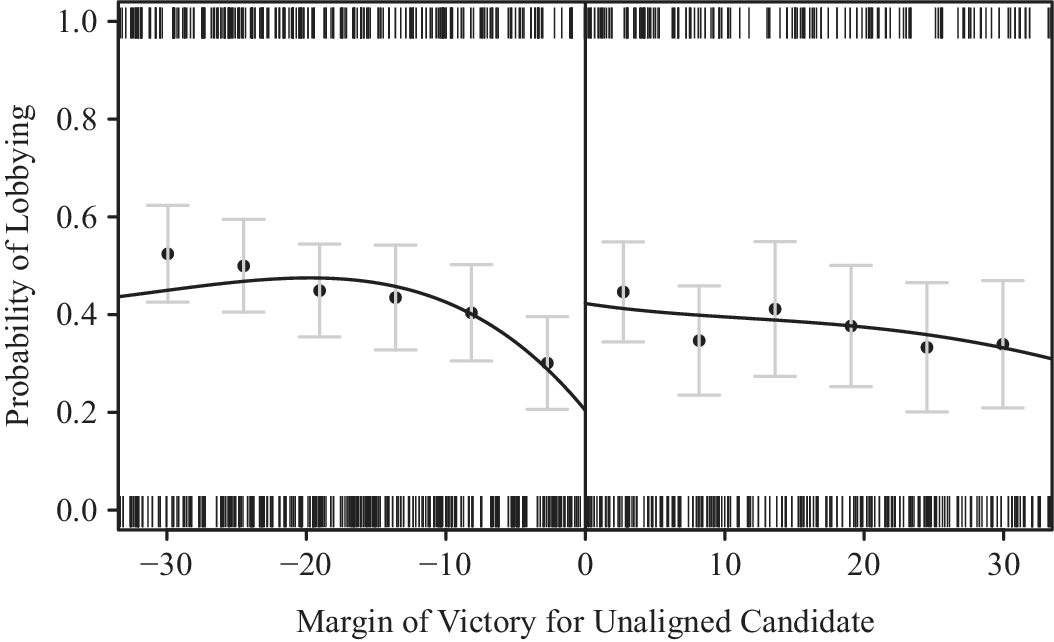
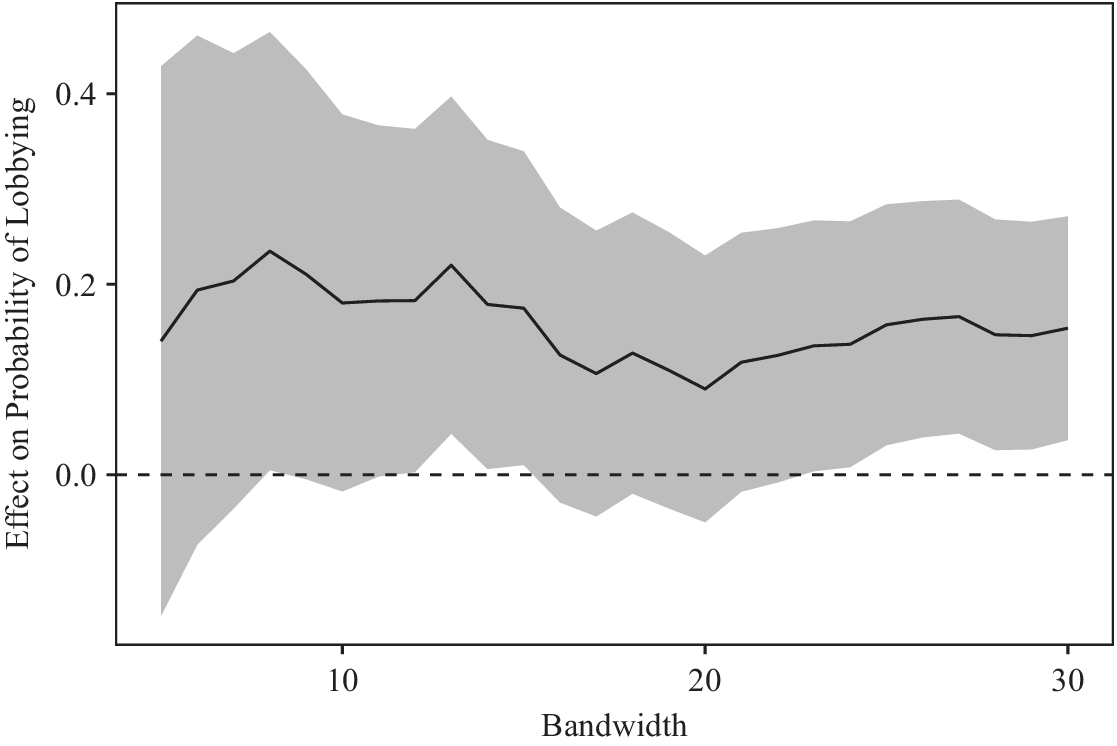
Figure 5 displays these results graphically. The points represent equally spaced binned averages across different margins of victory, and the smoother uses a fourth-order polynomial fit. At the cutoff where a mismatched candidates wins the election, there appears to be a jump in the probability that a city hires a lobbyist. A sensitivity analysis confirms that smaller bandwidths typically produce noisier effects; larger bandwidths recover fairly consistent estimates of the effect of an electoral mismatch on lobbying (shown graphically in Figure 6). As a final robustness check, I examine the effect of narrowly electing a non-co-partisan on a lagged value of the dependent variable. Reassuringly, these effects are much smaller and less precise.
Effect of Narrowly Electing Aligned vs. Mismatched State Legislator on City Lobbying

Effect of Mismatch on Lobbying Across Bandwidths

The difference-in-differences approach and regression discontinuity design both have strengths and weaknesses. The analyses rely on different assumptions and recover different quantities of interests. The two-way fixed effects regressions recover the within-city effect of lobbying as cities elect co-partisan and non-co-partisan state legislators, but there is always the possibility that time-varying confounders might bias the results. The RDD captures the local average treatment effect conditional on a relatively mild set of assumptions (Lee and Lemieux Reference Lee and Lemieux2010), but these effects should be extrapolated away from the cutpoint with caution (De la Cuesta and Imai Reference de la Cuesta and Imai2016). However, it is reassuring to observe that both approaches yield positive, substantively large estimates. In a variety of contexts, municipal officials are more likely to hire lobbyists when state legislators from the opposite party are elected.
Mechanisms and Additional Robustness Checks
The results presented so far define cities as being Democratic or Republican based on their presidential vote share in the 2008 election. If cities are relatively stable in their partisanship between 2006 and 2014 this might not be problematic. But if partisanship fluctuates, this could introduce measurement error in how mismatches are specified and potentially bias the results. Unfortunately, obtaining city-level election returns is challenging because elections are administered by counties, and many states do not have publicly available sub-county election data that can be reliably aggregated to the city level. However, California makes precinct election data available along with geographic conversion files via the California Statewide Database. As a result, I could map electoral returns to cities and construct time-varying measures of municipal partisanship based on their Democratic vote share in 2006, 2008, 2010, and 2012.Footnote 13
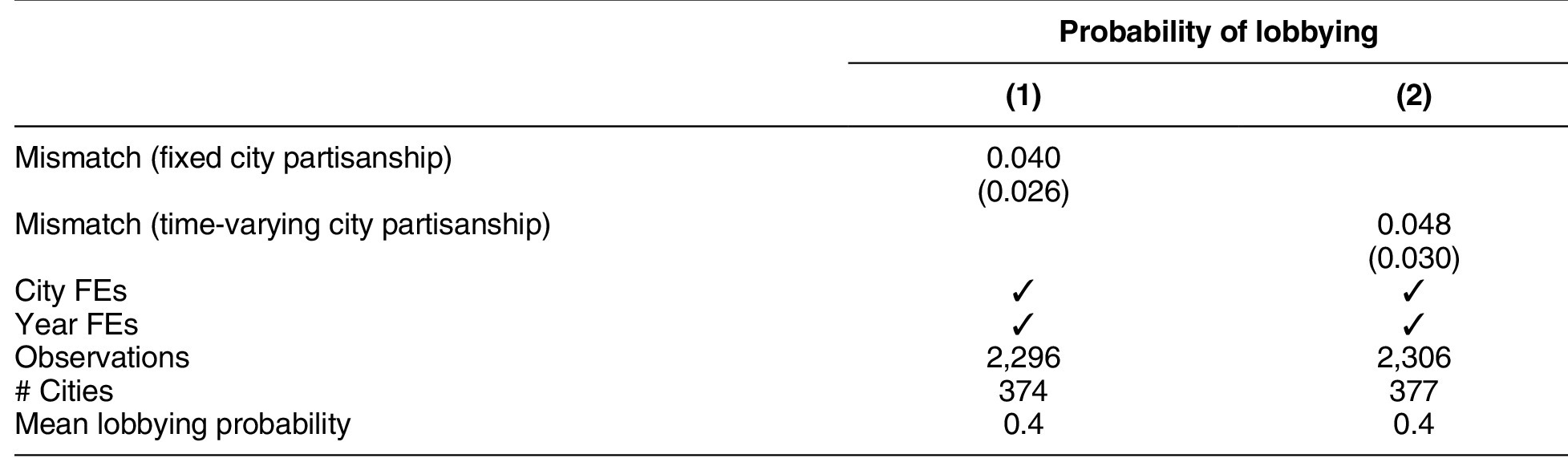
Reassuringly, 84% of Democratic cities and 87% of Republican cities were classified in the same way using either the fixed or time-varying measure of city partisanship. Defining mismatches with the time-varying measure also produces very similar estimated increases in city lobbying. Table 3 shows the results. The estimates are a bit noisy given that the sample is almost 10 times smaller than that used for the main results, but the pattern is very similar. If anything, the time-varying specification yields a slightly larger coefficient, suggesting that the fixed-partisan models are unlikely to be upwardly biased. Therefore, using city vote share in 2008 to approximate city partisanship appears to be a valid or even conservative modeling strategy.
Fixed vs. Time-Varying City Partisanship: CA Robustness Check

Note: Allowing city partisanship to vary over time when specifying mismatches yields coefficients that are similar to estimates obtained using a fixed measure of partisanship. “Fixed” partisanship uses a city’s voteshare in 2008 to define partisanship, and the time-varying measure uses city voteshare in the most recent election (2006, 2008, 2010, or 2012).The models control for population. Robust standard errors are clustered by city.
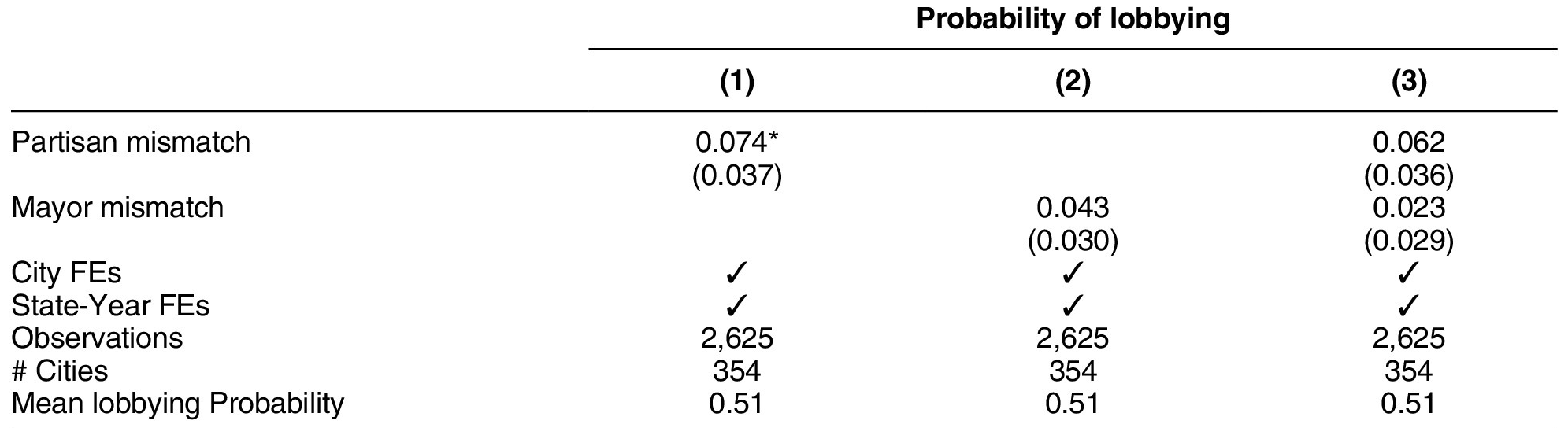
Next, I examine the effect of mayoral partisanship on city lobbying decisions. The main results in the paper define city partisanship and ideology in terms of city residents. But perhaps Democratic cities are likely to have Democratic mayors, and it might be the political alignment between the mayor and the state representative that more strongly predicts lobbying. To test this, I add data collected by de Benedictis-Kessner (Reference de Benedictis-Kessner2018) on mayoral elections and partisanship for the 640 cities in my sample for which this information is available.
As would be expected, 79% of cities that are coded as “Democratic” in terms of vote share have a Democratic mayor, and 69% of Republican cities have a Republican mayor. I specify a mayoral mismatch as existing when a Republican mayor is represented by a Democratic state legislator, and vice versa.Footnote 14Table 4 shows the effects of resident vs. mayoral mismatches on lobbying. The first column replicates the main results for the subset of cities with available mayoral party data. The second column uses the mayoral mismatch variable to predict lobbying. The effect is still positive, but it is slightly smaller and less precisely estimated. When I include both types of mismatches (column 3), the partisan mismatch between city residents and the state legislator dominates, although mayoral partisanship continues to have a modest additional effect.
Effect of Mayoral Partisan Mismatch on City Lobbying

Note: The partisanship of the mayor matters less for lobbying than the overall partisan tendencies of the city as a whole. Robust standard errors are clustered by city. *p < 0.05.
To reiterate, the point of examining how partisan alignment affects city lobbying is to evaluate whether cities are more likely to lobby when they face the disadvantages associated with being represented by elected officials with divergent policy preferences. It makes sense that a state legislator’s ability to effectively represent a community might depend more strongly on the overall partisan preferences of city residents rather than just the party of the mayor. At the same time, it is reassuring that the results follow a similar pattern across a variety of model specifications that operationalize mismatches in different ways. One of the next steps for this research will be to examine the scope conditions of the theory and assess how local governments lobby in response to a wider variety of representational dynamics.
Does Representative or Chamber Ideology Matter More?
The findings presented so far indicate that cities are more likely to hire lobbyists when they are represented by lower statehouse members from opposite sides of the partisan and ideological spectrum. But how does the general ideological composition of the state legislature affect municipal lobbying? Are cities lobbying primarily in response to ideological mismatches with their own representative, or does their alignment with the chamber as a whole also matter? Table A16 in the Online Appendix tests whether cities lobby more as the proportion of legislators from the opposite political party increases in the state lower house.
There is some weak evidence that cities are more likely to hire lobbyists as the proportion of members from the opposite party comprise a larger portion of the legislature. However, this effect is small and imprecisely estimated. The results show that cities are much more likely to lobby when they face ideological mismatches with their own representatives. These findings are consistent with the qualitative evidence provided earlier in the paper. City officeholders regularly discuss the importance of their relationship with their district delegation. They view their elected members as local representatives in the state legislature, and they often mention the role of their individual legislators in securing earmarks and other favorable policies for the district.
Exploring Mechanisms: Evidence from Missouri
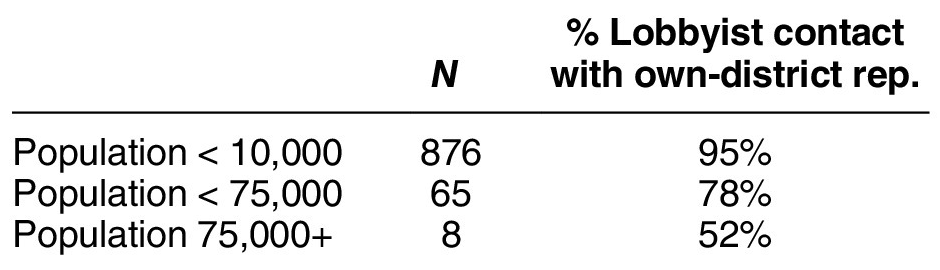
If individual legislators matter so much for city lobbying, we would expect to see municipal lobbying efforts geared primarily toward a city’s district representatives rather than other members of the legislature. Although few states keep this type of information on file, Missouri is an exception and collects detailed information on all meetings between lobbyists and state officials as well as the clients being represented. These data show that a majority of meetings between municipal lobbyists and legislators target a city’s own elected officials. However, this rate is higher for small cities. Table 5 shows the percentage of city lobbyist meetings that are with a city’s district representative, broken down by city size. Smaller municipalities like Branson, Centralia, and St. Peters contacted their own district legislators almost exclusively. Lobbyists for large cities like Kansas City and Springfield also met most often with local district lawmakers, but just under half of their meetings were with other state house legislators—typically senior members or chairs of important committees.
City Lobby Contacts in Missouri

Note: While small cities contact their district representative almost exclusively, larger cities are more likely to contact other representatives as well as their own.
When thinking about the lobbying goals of local governments, it makes sense that cities would largely target their own representatives. These are elected officials that represent the same constituents, and the requests that local governments make directly affect the ability of state legislators to serve their districts and eventually get re-elected. Historically, there is also some evidence that the most important step for cities hoping to secure particularistic policies from state government was getting their state delegation on board (Teaford Reference Teaford1984). The data from Missouri, though a bit speculative, lends some credence to the idea that local officials are, in fact, focusing their lobbying efforts on the representatives that serve their districts.
Discussion
Local governments are some of the most prolific but understudied interest groups. This paper offers a simple theory of intergovernmental mobilization that draws from standard models of costly informational lobbying and emphasizes the importance of political geography. Local governments are embedded in the federal system, and they rely heavily on their elected legislators for funding and favorable policies. As a result, they are particularly attuned to their relationship with these legislators when deciding whether to invest money in lobbyist representation. The paper opened with a quote by a Philadelphia lobbyist who claimed the city needed to lobby in order to assert itself against a dominant Republican legislature. If local officials are more likely to mobilize when their cities diverge ideologically from their elected officials in state government, this suggests that one of the reasons that cities hire lobbyists is to help them send a costly signal about their policy preferences.
For decades, interest group scholars have observed that local governments follow a different mobilization process than other types of organizations that lobby (Cigler Reference Cigler1995; Grossmann Reference Grossmann2013; Lowery et al. Reference Lowery, Gray, Cluverius and Harden2012). This paper causally identifies the effect of one important impetus for mobilization: the partisan relationship between cities and their district legislators. While the idea that interest groups respond to the demand-creating actions of politicians is not new (e.g., Gray and Lowery Reference Gray and Lowery1996; Leech et al. Reference Leech, Baumgartner, La Pira and Semanko2005), local governments are particularly sensitive to the actions of their representatives in other levels of government given their position within the federal system. The results suggest that one overlooked role of lobbyists in the intergovernmental context is their ability to facilitate representation across different levels of government when policy preferences diverge.
While this study advances our understanding of the econditions under which cities enter the lobbying arena, there are several promising avenues for future research. For example, there are a variety of representational challenges that can emerge in multilevel government beyond partisan misalignment, including coordination problems arising across fragmented legislative districts (Chen Reference Chen2010) and common pool problems induced by overlapping local jurisdictions (Berry Reference Berry2009). Do local officials also use lobbyists to help them navigate these hurdles? This paper also examines only the relationship between cities and their state representatives in the lower chamber. Incorporating information about state upper chambers and congressional representation would allow for additional empirical tests to help generalize the argument.
It’s also important to recognize that the period under study is unique by historical standards in terms of the high levels of partisan polarization. Ideological mismatches between cities and their representatives may have posed less of a challenge for local officials in previous eras when there was greater policy overlap between the two parties. The argument in this paper is that local governments should be more likely to hire lobbyists when their policy preferences diverge from their elected legislators. If data were available for previous decades, I would expect there to be a weaker relationship between partisanship and mobilization.
Classic research on interest groups often emphasizes the potential equity concerns that might arise if certain groups are more likely to mobilize than others (e.g., Schattschneider Reference Schattschneider1960). But this paper uncovers new evidence highlighting one of the potential upsides of lobbying in the intergovernmental context. If local governments can’t secure policy and funding benefits directly through their elected legislators in other levels of government, lobbying provides an alternative channel through which cities can advocate for local needs. As a result, intergovernmental lobbyists appear to play an important and largely overlooked role in facilitating vertical representation in multilevel government.
Funding
Support for this research was provided by the National Science Foundation (Dissertation Improvement Grant Award #1560599) and the Stanford Institute for Research in the Social Sciences.
Supplementary material
To view supplementary material for this article, please visit http://dx.doi.org/10.1017/S0003055420000118.
Replication materials can be found on Dataverse at: https://doi.org/10.7910/DVN/MYF97D.




Comments
No Comments have been published for this article.