


This article aims to analyse multilateral flows of capital, which contributed to weaving a Global South during the second half of the eighteenth century. It specifically revisits the functioning and financing of the slave trade from a global perspective, and offers insights for assessing older frameworks that explain the trade in either triangular or bilateral terms. To show how the interplay of the slave trade in different continents helped to build a Global South, the article focuses on the Portuguese slave trade, and the global circuits with which it was interconnected. This outlook from the South in turn sheds light on the interconnections that arguably worked across the north Atlantic. In brief, a vast set of outward interconnected capital flows are uncovered here, which, without being necessarily involved in the slave trade, were essential for making it effective.
According to the slave trade database, Brazil was the final destination for 3,537,522 captive Africans from the slaving coasts of Africa who were carried to the Americas. This demonstrates that the Portuguese empire was undoubtedly one of the main stages on which this infamous business took place. Over roughly three centuries, Luso-Brazilian ships carried 3,765,666 of the 9,903,935 slaves traded in the Atlantic world, a proportion that straightforwardly indicates the prominence of this slave-trading empire.Footnote 1 Yet, in order to purchase captives, traders in Europe and Brazil, as well as factors based in Africa, required a good supply of Asian textiles.Footnote 2 Demand for manufactures produced in India increased in African markets, closely following the steady increase of slave exports throughout the eighteenth century.Footnote 3 Investors were thus obliged to procure large amounts of silver, which were needed to purchase goods in the Indian Ocean. Whereas the different circuits in Africa, Asia, and the Americas have received a good deal of attention, less consideration has been paid to the extent to which these circuits were interlinked, and, above all, how their direct and indirect links paved the way for the reproduction of global capital. This article’s main goal is to assess the investment structures that made the Portuguese slave trade possible.Footnote 4
At the present time, two frameworks are prevalent in explaining how the Luso-Brazilian slave trade operated. This might be called the ‘triangular versus bilateral debate’. During the 1970s and 1980s, the slave trade was predominantly analysed as a triangular business involving Africa, Europe, and America. In a first step, manufactures were shipped from Europe to Africa. The purchased slaves were then transported to the Caribbean and North America, where they were destined to harvest sugar, cotton, and other commodities. Finally, these colonial staples returned to Europe, where profits were realized. This triangular framework, partially rooted in Marxist theory and partially in ships’ triangular Atlantic journeys, further advanced the theory of contributions made by the slave trade to capital accumulation and capitalism’s development in the ‘core’ of the world economy. More recently, historians have reset the agenda involving both capitalism and slavery.Footnote 5
From the 1980s, historians working on the Brazilian slave trade started to reject the above model, demonstrating the peculiarities of the commerce carried out in the south Atlantic.Footnote 6 Journeys in these waters hardly fitted the model. Instead, as abundant evidence corroborates, most ships set sail from Brazil, where they anchored right after purchasing enslaved humans in Africa. The geographical patterns of ventures naturally followed south Atlantic currents and winds. What is more, records support the notion that Brazilian staples, such as rum and tobacco, were the basis for purchasing slaves in Africa. Likewise, the eighteenth-century gold-mining boom offered an advantageous situation for Brazilian-based traders to tap into the African market.Footnote 7 The bilateral system, which is so called because it closely connected the eastern and western basins of the south Atlantic, without the interposition of Lisbon, was underpinned by a powerful local Brazilian elite, which controlled the largest number of ventures, and was supposed to own the capital needed to finance the traffic.Footnote 8 The notion of the bilateral system has since become consolidated as an accepted framework, within which the Luso-Brazilian slave trade was supposed to function.
Despite the diversity and volume of the sources employed during recent decades, many questions remain unresolved, and it is possible to cast doubt on both triangular and bilateral arguments. Little is known, for instance, about how Brazilian-based merchants purchased Asian textiles or Spanish silver. Furthermore, Lisbon-based merchants have been left out of the narrative, and also foreign shareholders, who invested strongly in these trades through forms of speculation and direct or indirect risk. Nor have westward flows of capital – that is, the capital that Asia-based merchants risked transcontinentally – been appropriately introduced into the narrative. These factors offer a valuable opportunity for disentangling the actual global flows of capital that were necessary for the Luso-Brazilian slave trade to operate, in both the short and the long term.
In this article, I argue that the slave traffic should be liberated from the south Atlantic borders to which it has been confined. The bilateral framework has many drawbacks in terms of understanding the microeconomic organization of the traffic, and the political economy that underpinned it. As to other naval powers, the south Atlantic should be extracted from the Portuguese imperial framework, in which it has been too tightly constrained. For instance, a compact bimetallic trans-imperial space entangled both the Portuguese and Spanish territories in the Rio de la Plata basin. Putting the financing of the slave trade into a larger global perspective can help to explain it more accurately. Consequently, this article offers an Atlantic history in a global perspective,Footnote 9 disclosing the connections between the Atlantic and the Indian oceans.Footnote 10 These oceans have generally been analysed as ‘self-embedded’ systems, but there has been a recent emphasis on the need to connect these oceanic worlds. By and large, historians tend to specialize in only one of these cultural areas, neglecting to reconstruct the strong connections that existed between people living in them.
In what follows, I discuss the interactions of different markets and business cycles, stressing that uncoordinated investment cycles worked simultaneously and successively, in chains. They did not follow a specific path, or gravitate around particular poles of attraction that served as motors of the engine. Uncoordinated investment cycles were bound to each other, and yet they moved according to separate dynamics. This is why it is hard to ascertain exactly where a chain started or ended. Simultaneity is the key to understanding these interactive global chains of capital investment.
Two factors support the choice for introducing capital into this panorama. Broadly speaking, scholars have heavily focused either on commodities or on the role of mercantile networks. Remarkable and well-elaborated research has been conducted on a vast array of commodities and commodity chains, for example Asian textiles, diamonds, cotton, indigo, coffee, sugar, and numerous manufactures. Merchant networks have also been the subject of considerable attention. Nevertheless, capital continues to be largely absent from most historians’ accounts, while economists generally study it in abstract or theoretical terms.Footnote 11
The article is divided into five parts, which, significantly, do not follow a hierarchical or specific order. The first part focuses on Indo-Portuguese trade and finance, to illustrate some shortcomings that obscure our understanding of how these processes actually operated. Without the chain of investments that made it possible for this trade to function, manufactures could not be purchased in the Indian Ocean, and Africans could not be bartered into slavery on any scale. A booming credit market directly and indirectly financed the slave trade. The article demonstrates that, along with many investors and scattered capital, foreign merchants intervened intensively in how the traffic was organized. The second part pays attention to the businesses of a number of Portuguese investors, who traded in the ‘four corners of the world’. The third part surveys the trends and dimensions of the huge bimetallic market connecting the Portuguese and Spanish empires, which facilitated the purchase of textiles and African captives. Finally, the last two parts discuss circuits in Asia and Africa. Westward flows of capital contributed considerably to the transcontinental business, while chains of debt allowed traders to capture Africans inland, and carry them to coastal settlements, whence they were shipped further afield.
Indo-Portuguese trade: scattered capital and speculative markets
Indo-Portuguese trade was not monopolized during the second half of the eighteenth century. The Portuguese empire followed a path contrary to that taken by England, France, or the Netherlands, which granted monopoly rights in Asian waters to privileged East India companies. In Portugal, by contrast, the 1760s witnessed the implementation of several policies intended to completely free up the trade to Asia.Footnote 12 These policies followed the end of a gold-mining boom in Brazil. The economic crisis, and the newly implemented measures that resulted, serve to delineate the chronological landmarks of this research. The novel free-trade policies were introduced because it was argued that navigation had become sluggish. The carreira da India, official ships heading to Portuguese outposts in Asia, had known a golden age during the ‘spice age’, but they had lost the capacity to effectively promote Indo-Portuguese trade. According to available data, during the early eighteenth century on average only one carreira da India ship per year left Lisbon for Asia. This compares to the seventy-seven private expeditions fitted out between 1771 and 1790.Footnote 13
The measures introduced in 1767 allowed any Portuguese national to make expeditions to Asia, although stern rules and restrictions rigorously structured the way in which this commerce was conducted. The law clearly stated that Asian manufactures had to be sold in auctions in the Lisbon customs house (Casa da India). This was not peculiar to the Portuguese empire, since auctions were also common in England and the Netherlands; in all cases, little is known about how auctions actually operated in the European entrepôts.Footnote 14 Maritime ventures had to be fitted out in Lisbon, whence it was mandatory to set sail. Ships fitted out in Asian outposts were banned from heading to Lisbon. Commodities purchased in Asia could not be unloaded anywhere other than Lisbon. Trading ventures were supposed to be fully financed by Portuguese nationals. Vessels could stop in Brazil during the outward journey, but not when returning home. Cargo could not be loaded in Brazil, nor could commodities be sold there. The idea behind these regulations was twofold: to avoid foreign participation and to prevent intercolonial trade.
A venture to Asia required huge sums, and the capital needed at least one year to make its way back to Europe. Besides the large investment and the long-term capital turnover, the risks were extremely high. This has led many to think that only a small group of rich merchants at the top of Lisbon society were in a position to provide the funds necessary to sail around the Cape of Good Hope.Footnote 15 It is true that the richest Lisbon-based merchants invested large sums in these businesses, but it is argued here that the capital market was much more diverse than previously supposed. Individual ventures seem to have been restricted, owing to the risk of putting all one’s eggs in a single basket. Shipowners who lacked sufficient capital, or who were risk-averse, carried cargo owned by many shareholders, thus splitting the risks and lowering their own exposure. Despite the restrictions imposed by risk, time, and uncertainty, the evidence does not support the idea that only a few merchants obtained gains through Asian trade. On the contrary, there was a speculative market, which produced highly favourable rates of return for a plethora of lucky investors.
Much of the capital invested in transoceanic ventures thus seems to have been raised in a highly speculative market, where scattered capital prevailed, through the crucial institution known as the ‘sea loan’, which has been poorly investigated in this context. The sea loan was a distinctive and ancient mercantile institution.Footnote 16 It was widely used in the Mediterranean world, along with other institutions such as the commenda or the commission system. In this particular system of credit, lenders, not borrowers, bore business risks, and repayment was conditional upon the safe arrival of a trading venture. The amount was bound to a specific vessel and journey, which the borrower was unable to modify. Payment was supposed to take place thirty to sixty days after the ship had safely anchored in a predetermined port. Should a misadventure occur, debtors were able to disclaim any responsibility. High interest rates prevailed, which could reach 40% per year. Nevertheless, lenders bore high risks, so it is most unlikely that the interest rates generated negative investment incentives. Indeed, the institution’s features generated extraordinary incentives and opportunities for a wide range of agents.
The mercantile instrument of the sea loan was essentially a means for generating security in Asian trade, through the allocation and dispersion of risk among many shareholders. The role of sea loans has been downplayed in the historiography, on the grounds, for instance, that high interest rates made it unattractive. Consequently, the extent of this centuries-old mercantile institution during the second half of the eighteenth century, and its role in boosting Asian trade, have both been neglected. Nothing has been written about the shares of ventures financed through loans, or the pool of investors who advanced money for maritime ventures in Portugal. Much more is known about the sea loan in Asia, where it was widely used, both for the ‘country trade’ between different parts of Asia, and for the bankrolling of vessels going westwards to the Atlantic.Footnote 17 Accordingly, it is imperative to stress that it was not only in Europe that capital was raised. Asian-based merchants made their capital flow westwards, furnishing valuable funds for trading ventures, or allowing traders and crew to make some gains.
Sea loans were seemingly contingent upon strong third-party backing, through courts of law. Even though the spread of this mercantile instrument helped to avoid paying marine insurance (to mention just one example), a strong court system, where potential conflicts could be resolved, was essential. This, in turn, imposed strict conditions on the site where commodities had to be offloaded. As borrowed money was supposed to be secured with goods purchased in Asia, any conflict arising could be solved only after the goods serving as security had been sold. Furthermore, any failed expedition was to be administered directly by the king, in order to repay lenders. From this institutional perspective, it is completely understandable that the centralization of commodities in the Lisbon customs offices was necessary, for this was a means to promote secure property rights for investors, who were supposed to reside in the city.
Two dissimilar groups could enter the credit market through sea loans: on the one hand, foreign merchants of different ranks; on the other, seamen and a vast array of itinerant traders. Seamen regularly set up short-term or voyage-by-voyage societies.Footnote 18 In consequence, they raised money that they took with them to Asia. Capital furnishers frequently provided merchandise, which was supposed to be exchanged for bullion in Brazil, or sold in Asian outposts.Footnote 19 Furthermore, orders were given for them to receive cargo or bullion during layovers in Brazilian ports. Equally, seamen and itinerant traders were offered money and received cargo in Asia, drawing on sea loans that they promised to honour, either in Europe or back in Asian outposts.Footnote 20 Seamen travelling to Asia sometimes itemized in their societal contracts that they were to raise money and draw on sea loans either in Lisbon or Brazil.
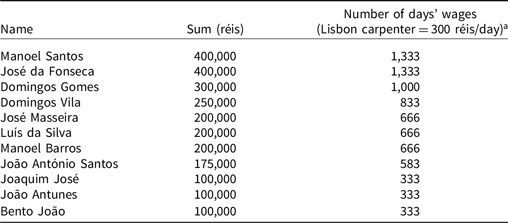
To give an example, one Simão Domingues sailed for Asia on the ship Nossa Senhora do Carmo in 1774. On this occasion, he set up two societies with his shipmates, one with João Domingues Maia, and the other with Bartolomeu Mendes (see table 1). While the former society raised 5,217,000 réis, the latter only managed to assemble 550,000 réis.Footnote 21 Along with his partners, Domingues engaged to honour a sum of 6,471,000 réis. Moreover, during the layover in Rio de Janeiro, he received 704,000 réis (10% of the total), which his brother loaned him to invest in the best way possible in Asia: trading in Goa, issuing a sea loan there, or purchasing commodities to be sent back to him in Lisbon. It is hard to determine whether investors in these societies for individual voyages were acquaintances, neighbours, friends, family members, or others, but the low sums with which they entered the credit market probably allowed for participation by a wide range of investors. These investors indirectly profited from gains in the slave trade.
Sea loans of the caulker João Domingues Maia and estimate in number of days’ wages of a Lisbon skilled worker (ship Nossa Senhora do Carmo, 1774)

a Figure taken from ‘Prices, wages and rents in Portugal 1300–1910’, http://pwr-portugal.ics.ul.pt/?page_id=56 (consulted 2 August 2018).
Source: Arquivo Histórico Ultramarino, Lisbon, Portugal, Índia, cx. 340.
Attention should be drawn to the low sums collected and invested. These commercial societies deserve in-depth research, as do the ways in which they raised money. In the instance above, the lenders might be clustered on three levels: eleven (37% share) risked on average 165,909 réis, four (28% share) invested on average 373,000 réis, and just one (36% share) invested more than 1 million réis. The large majority of the society’s borrowers resided in the same parts of Lisbon (Santa Catarina and São Paulo). Two were said to be peddlers: one sold fruit and the other chickens. It could be argued that the sailors’ professions meant that they could only be furnished with low sums. Nevertheless, the investor pool is surprising, for, at first glance, they were unlikely to have profited from long-distance trade, or to have actively taken part in Asian trade. In the same vessel travelled Vitorino Falcão, who raised 4.2 million réis from five lenders. For his part, Domingos de Freitas Guimarães was advanced money from many shareholders, such as one silversmith, who provided 3 million réis.Footnote 22
These agents have received some attention in the literature, but this has led to a serious misunderstanding. Historians hold that maritime personnel, itinerant traders, and merchants, who are sometimes mistakenly mingled into a single undifferentiated category, could have been channels through which Brazilian-based merchants bypassed the centrality of the Lisbon customs house.Footnote 23 Through the booming, if illegal, intercolonial trade, these agents supposedly supplied Brazilian slave traders with the required Asian textiles. This is said to provide clear proof for the assumption that Brazilian merchants controlled the slave trade. In addition, this is believed to corroborate the notion that the south Atlantic was based on bilateral commerce that bound Africa directly to Brazil, a connection made possible by the huge imports entering the latter directly from Asia. Erroneously, for instance, imports held to have circulated South–South (from Asian outposts to Brazil) are taken from the official balances of trade, which indeed account accurately for Asian textiles exported via the Lisbon customs house.Footnote 24
However, although seamen participated strongly in Asian trade, and very probably supplied manufactures to Brazilian-based merchants, at least two issues arise with regard to their mercantile operations and degree of involvement. First, how Brazilian merchants kept the commerce going on supplies that hinged on rather random offers, especially during the boom of the slave trade in the eighteenth century, needs to be explained. Second, and more importantly, proof should be given of Brazilians fully financing at least this part of the business, but this seems to be lacking.
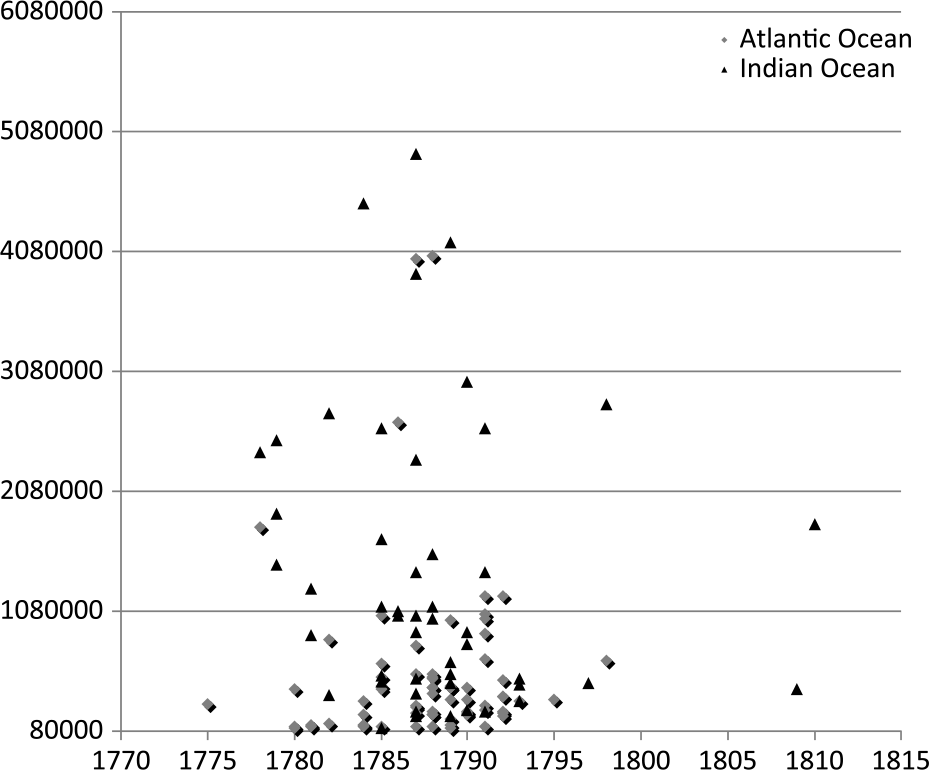
These bills gave rise to a speculative market in Lisbon, where they were transformed into negotiable instruments.Footnote 25 A captain and pilot accepted a sea loan worth 462,572 réis in April 1785, which changed hands at least three times, in June 1785, July 1787, and December 1792. A sample of unpaid sea loans leads to the hypothesis that no difference existed in the amounts involved in sea loans for voyages bound for Asia, or for much closer Atlantic outposts. Figure 1 shows a sample of 200 sea loans for voyages bound for either Asia or the Atlantic. Even though more research is needed, it seems very likely that the two destinations were on the same level, with low sums being advanced. The interest rates to be paid were different, however, as they were higher for Asian expeditions, reflecting turnover time and risk.
Sea loans (in réis) bound to trading ventures in the Atlantic and Indian oceans, 1760–1820. Source: Arquivo Nacional Torre do Tombo, Lisbon, Juízo Índia e Mina.

Foreigners were the second group of investors who participated in this credit market, as sea loans facilitated their legal entry into the business. It should be highlighted that, by directly or indirectly financing ventures to Asia, foreign merchants contributed to the purchase of the textiles needed to enslave humans in Africa, and therefore indirectly obtained gains from this traffic. The ship Nossa Senhora de Belem sailed for Macao and Batavia, bringing capital worth 50,216,200 réis. At least 70% of this figure was made up of capital advanced by many merchants through sea loans. Philippe Hockel provided the largest share. Apparently, shareholders suffered losses owing to the fact that the ship sank, which resulted in a trial. Among the complaints, investors claimed that, directly contravening orders, the captain headed to Manila, where the supercargo bought a sloop: this was chartered by the Spanish Philippines Company in order to sail to Calcutta and purchase commodities (40% being promised).Footnote 26
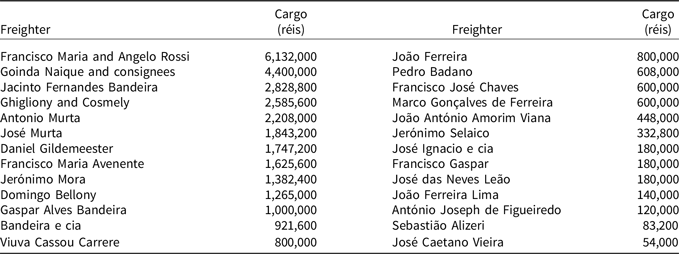
The records of the ship La Garonne demonstrate both capital dispersion and foreign capital investments. Most of the cargo was owned by capital owners, who had risked their money on the ship Nossa Senhora da O, which, after sailing along the Malabar Coast, Bengal, and Cochin (having left Calcutta in March 1785), was swept out to the Île de France (Mauritius). Once the ship was on the French island, its deplorable state led to the purchase of a new ship, La Garonne, to make the remaining part of the Atlantic journey. According to the records, the cargo was divided as follows: the shipowner (or possibly the person who chartered the vessel) claimed commodities worth 21,216,150 réis, while twenty-six investors (shareholders or mere consignees) received cargo worth 33,065,400 réis. The largest shareholders were two Italians, Francisco Maria and Angelo Rossi, and a Goa-based Indian merchant, Goinda Naique.Footnote 27 As table 2 shows, most of the investors received cargo worth less than 2 million réis. A far from insignificant 11% was shared by fifteen freighters or shareholders whose cargo was worth less than 1 million réis. It is difficult to know precisely what share of this capital taken from Lisbon to Asia depended on sea loans. For instance, the captain had been advanced 1 million réis, which was guaranteed by the British merchant Daniel Glascock.Footnote 28
Freighters and cargo for the ship La Garonne, 1785

Source: ANTT, JIM, mç. 8 n. 5 cx. 274.
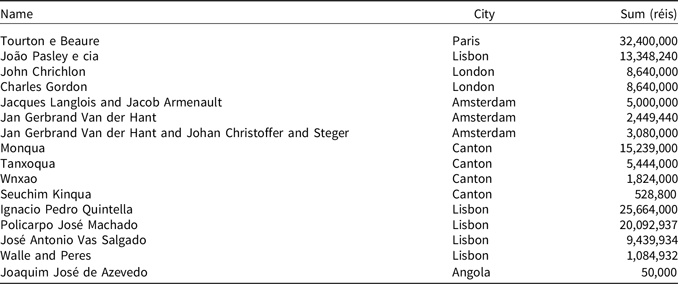
The fact that foreign merchants invested large amounts made the ‘Indo-Portuguese’ trade much less imperial than has been supposed. Most works on Eurasian trade revolve around chartered companies (English, Dutch, and French), owing to the availability of their records on Asian trade.Footnote 29 Historians have also been keen to study the way in which parallel, privately managed, trade actually worked, often as contraband or other dishonest operations carried by company servants. These servants resorted to mercantile instruments for both the country trade and to channel their gains back home, where some of them returned rich. Foreign merchants actively took part in the Portuguese trade in Asia, even though little is known about these operations. There is some evidence to back the notion that this was a steady and ongoing investment, and not merely one carried out during wartime. For instance, in 1776, according to the São Luis Afortunado’s ledgers, Lázaro Ferreira Portugal and Francisco de Paula Miranda received money from sixteen other merchants for their venture. Capital was apparently rerouted back to Paris, Amsterdam, and London. Moreover, Cantonese merchants contributed towards the financing of the expedition. Table 3 displays this information.Footnote 30
Bills and credits for the ship São Luis o Afortunado, 1776

Source: AHU, Macau, cx. 13 dc. 3.
In the Indian Ocean, French merchants frequently employed Portuguese traders in order to help their capital flow back to Europe, repeatedly transporting manufactures on Portuguese ships going both east and west. The Mascarenes and Mozambique operated as a vital crossroads for the circulation of capital and trade to the east African coast.Footnote 31 For instance, on the French islands, two French merchants owed more than 90 million réis to Manuel Eleuterio Castro, who actively participated in the slave trade during the 1760s. Pelgrom de Paris was said to owe him 22 million réis. Castro had an arrangement with Joaquim Pedro Belo, having invested, according to them, more than 1 million cruzados in expeditions to Asia during 1781–83.Footnote 32 This amount, they stated, was highly dependent on the credit provided by agents in the Lisbon market. Not only did French merchants profit from chartering Portuguese vessels and investing in Asian ventures, but they also actively traded slaves on the African west coast, selling commodities to local traders. According to a report written by local officials, in the year 1791 alone, approximately 2,300 slaves were smuggled by French ships, with a value of more than 200 million réis.Footnote 33
It was not only French and Italian merchants who contributed towards the financing of Portuguese trade in Asia. Luis Stephens, a Lisbon-based English merchant, frequently advanced credit to Portuguese merchants sailing to Asia, while also being prominent as one of the largest re-exporters of Asian commodities to northern Europe. For instance, he loaned Belo, Castro, Monteiro, and Loureiro (another Lisbon-based company) more than 100 million réis.Footnote 34 Even an opulent Portuguese mercantile society like that formed by Neves, Hubens, Portela, and Colff conducted its businesses via England to some degree. Once the company had purchased a second ship, its associates promised before the Crown to obtain capital neither in Asia nor in England, and to conduct the company’s business only with the credit that they could gather in Lisbon.
Stephens is frequently found in the records. In 1793, the priest Manoel de Jesus (executor of Guiomar Magdalena da Silva Vilhena) expected to fit out a venture to the Coromandel Coast and Bengal, in which approximately 128 million réis would be invested.Footnote 35 The priest confessed that Stephens held the largest share of the required capital (80 million réis), the remaining share being invested in wines to be purchased in Madeira. The expedition was rejected because of the rumour that the latter amount was ‘intended to repay a huge sum due in Bengal’. Officials knew that the Bengal Gazette had published information stating that the vessel offered freight 2% cheaper than Portuguese ones.
Stephens took part in a panoply of operations. He loaned capital to actual shippers, offered money, paid freight, and helped to fit out ventures. He also profited from the commission business. Bernardo Maccalum, a British merchant, chartered a vessel in Bengal, carrying his own cargo, as well as that given to him by many other merchants. The Minerva arrived in Lisbon in July 1790. At this point, Luis Stephens persuaded Maccalum to hand him the cargo, because of the owner’s lack of knowledge and protection.Footnote 36
This was not the only occasion on which Stephens became involved in Asian business issues. In 1782, the vessel Santa Maria sailed from Lisbon to Bengal flying the Portuguese flag, but mainly financed by foreign capital. The investments amounted to 320 million réis, of which British nationals owned 93%. It is clear not only that Portuguese merchants had a small share, but also that there were many shareholders involved in the venture, as at least 78 million réis came from nine sea loans taken out in Asia.Footnote 37
Lisbon capital: investments in the ‘four corners of the world’
Rich Lisbon-based merchants were able to operate simultaneously on all four continents. They participated, as lenders and borrowers, in the Lisbon credit market, contributed financing to ventures to Asia, and purchased captives in Africa whom they consigned to Brazilian-based merchants. Unfortunately, little attention has been paid to their participation in either global flows of capital or, more particularly, the slave trade: indeed, in recent decades they have been largely left out of the picture.
The business cycles involving Asian and African ventures are described as part of the portfolios of a large number of Lisbon-based merchants. António José da Mota fitted out several expeditions to the Indian Ocean. He and his partner owned two ships, which regularly sailed for the Malabar and Coromandel coasts, as well as to Macao. Furthermore, they actively participated in the slave trade. In December 1802, the ship Aguía d’América arrived in Rio de Janeiro with 700 slaves. The craft immediately returned to Benguela, in Angola, whence it was supposed to again sail for Brazil with more slaves. It is scarcely necessary to underline that, even though the ship followed a ‘bilateral path’ (Africa–Brazil–Africa), the investments were actually connected to wider capital flows. The proceeds of both shipments were to be reinvested in an expedition expected to leave Lisbon and receive the necessary funds in Rio. Witnesses further stated that, without their trading capital flowing from Africa to Rio de Janeiro, they would be unable to fit out the Asian venture. Nor could they wait for funds to be rerouted to Lisbon. According to other evidence, they repeatedly declared that they had furnished expeditions with wine and Spanish dollars. In 1798, they mentioned that the two trading ventures were worth 300,000 and 500,000 cruzados, respectively.Footnote 38
José António Pereira was another merchant involved in global credit networks. He traded along with Dutch merchants based in Lisbon, such as Daniel Guildemeester and Hermano Cremer Vanzeller. The former held the Portuguese royal diamond trade monopoly from 1761 to 1787.Footnote 39 The latter prepared ventures to Asia at least three times, in September 1780, November 1781, and February 1784. Pereira’s ships carried slaves to northern and southern Brazil, and to the Spanish colonies. For all his success, however, the merchant failed to lobby for permission to form ventures that directly connected Angola, Asia, and Brazil, which Portuguese rules completely prohibited. One of his ships was expected to sail for the Malabar Coast in order to trade in textiles. Afterwards, the vessel would head directly to Africa to exchange the textiles for slaves, which would be shipped to northern Brazil. Officials in Lisbon immediately decried the illegal nature of such a venture, and therefore refused to permit it. Earlier, in 1792, Pereira planned to employ the ship Correio de Angola, investing 30–40 million réis in commodities that would be bartered for slaves in Africa. The proceeds from selling these slaves in Brazil would in turn be reinvested in an Asian expedition worth 50–60 million réis, sailing from Brazil and returning to any port there, circumventing Lisbon.Footnote 40
One of the preferred destinations for Pereira’s ships was Calcutta (Kolkata), and his interest in the Bengal market provoked disgruntlement from other merchants. Calcutta was an extremely important financial centre for Portuguese merchants, who made this East India Company port one of their preferred destinations. Portuguese merchants are listed among the principal customers in the port-city.Footnote 41 There is no doubt that they largely profited from British investments.
In 1800, the King of Portugal appointed a consul in Calcutta, causing some discontent among Portuguese merchants who resided or traded there. They felt that the nomination might generate a power imbalance, and argued that they did not need a consul to conduct their business.Footnote 42 The appointee, António Pereira d’Almeida, had connections with the slave trade from Rio de Janeiro. He belonged to a family whose networks, like Pereira’s, extended across four continents.Footnote 43 His brother Joaquim was a rich Lisbon-based merchant, while his father, José, advanced credit to merchants based in Rio de Janeiro. In turn, João Rodrigues Pereira d’Almeida, the third brother, lived in Rio de Janeiro and was listed as one of the largest consignees of slave expeditions arriving in the city. Both José and Joaquim Pereira are mentioned as suppliers of Asian textiles to merchants requiring capital to invest in African ventures.
One issue to be solved is how these transoceanic ventures were actually planned and executed. In a document written in the 1790s, the way in which these global operations were supposed to be conducted was elaborated. On the southern coast of Africa, a slave could be purchased for approximately 50,000–60,000 réis. As slaves were bartered for goods, on which 80–100% profit could be made, it is possible to affirm that each slave cost 38,888 réis on average. The ‘biggest share’ of the latter sum was made up of goods imported from Asia, which, under certain conditions, were bought in Lisbon for 25,925 réis. At least 16,200 réis should be shipped to Asia in order to purchase goods needed to buy one slave (a 60% profit rate was estimated).Footnote 44 This information is summarized in table 4 in terms of Portuguese and Spanish currency, skilled working day wages, and grams of silver. On average, approximately forty-nine days of work by a skilled Lisbon worker, such as a carpenter, was necessary to ship the amount of bullion required to obtain the Asian textiles that would then be used to purchase a slave on the African coast.
Estimate of capital invested for bartering one slave in Benguela (1791), given in Portuguese and Spanish currency, days’ wages of a skilled Lisbon worker, and grams of silver

a 800 réis =1 Spanish silver dollar.
b Figures taken from ‘Prices, wages and rents in Portugal 1300–1910’, http://pwr-portugal.ics.ul.pt/?page_id=56 (consulted 2 August 2018).
Source: ANTT, Ministério Negócios estrangeiros, mç. 605 d. 41.
Spanish ‘silver dollars’ and bimetallic trans-imperial entangled spaces
Portuguese merchants had access to bullion, which they found mostly in Brazil. Rio de Janeiro was the main port through which coins and bullion were exported. A share of the bullion carried in Portuguese ships consisted of Spanish silver dollars purchased in Buenos Aires, in exchange for manufactures, slaves, spirits, and gold. Gold was mined in Brazil and flowed south for several reasons: exporting gold from Buenos Aires to Spain was cheaper and incurred lower taxes. The inverse happened in Brazil, where silver could be exported duty-free to Asia. These bimetallic trans-imperial exchanges tied the Brazilian economy closely to the economic trends of the Spanish empire. Many works have already underlined the role that silver played in Asian markets.Footnote 45 Rio de Janeiro-based merchants tapped into an important reservoir of metal, most of which was likely to be exported to Asia directly from South America. Unfortunately, however, the ways in which Rio de Janeiro merchants obtained this bullion, and the specific mechanisms that they employed to invest and ship money eastwards to Asian outposts, have barely been scrutinized.
Yet the fact that Brazilian-based merchants shipped bullion on board vessels that docked in Brazil on their way to Asia does not provide strong evidence that this was their own capital, or that shipments were made at their own risk. This matter stirred a heated debate in Lisbon, which lasted decades and led to inconsistent policies. Officials were fully convinced that there was no way to crack down on ever-increasing shipments. Asia-bound vessels frequently stopped over in Rio in order to pick up silver. This fact has led scholars to propose that Brazilian-based merchants sought to dominate the Asian trade through shipping bullion, leaving Lisbon merchants out of African and Asian commerce.Footnote 46 Notably, however, once laws were enforced and layovers were supposedly proscribed, it was precisely Lisbon-based merchants who frequently requested permission to carry bullion. They argued that sales were made to merchants based in both Brazil and Angola on credit, whereby they promised to honour the debts incurred by shipping cargo to Asian ports. Furthermore, the transported money was supposed to have come from the sale of slaves previously consigned to Brazil-based merchants. Vast reams of documents back up this argument.Footnote 47
One official in Lisbon lucidly explained how the different factors interlocked in this issue.Footnote 48 No one could deny that bullion was being exported from Rio de Janeiro to Asia. Much of this was in fact Spanish dollars, which were duty-free. Occasionally, and owing to the scarcity of Spanish silver, merchants shipped meias dobras (Portuguese gold currency), for which taxes had to be paid.Footnote 49 This caused a fiscal issue, since the king’s finances were concerned. Either way, the official straightforwardly stated that the owners of most of the capital were Lisbon-based merchants, and not Brazilians, as is usually supposed without proof. More important was the fact that bullion shipments affected Portuguese navigation on the Coromandel and Malabar coasts in different ways. While ventures heading to the former were mainly intended to conduct trade, vessels bound to the latter principally depended on freight. This caused an injurious and uncompetitive imbalance, which adversely affected Indo-Portuguese trade in Asia. The report demonstrates how intertwined these businesses were. Bringing silver to Lisbon, to be then shipped to Asia, would have generated transaction costs, affecting prices paid for Asian manufactures, and thereby increasing slave costs by at least 1%.
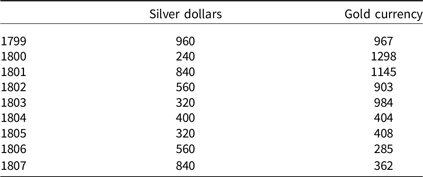
Impressive amounts of bullion flowed directly from South America to Asia. While historians have asserted that smuggling offered Brazil-based merchants the opportunity to bypass Lisbon regulations, little is known about the trends and values of those bullion shipments. However, balances of trade explicitly mention the kind of metal and currency being exported for the period 1799–1807, whether bullion, gold coins exported to Lisbon, or dollars shipped on Asia-bound ships directly from Brazil (table 5). Compared to the amount of bullion exported to Lisbon, Spanish dollars shipped to Asia amounted to over 76%, or 43% of the total bullion exported through Rio de Janeiro. Until 1803, both trends followed the same pattern, but from 1804 the sums shipped to Asia outstripped the gold coins sent to Lisbon. The impressive scale of these flows has passed largely unnoticed and uncounted, although some rough calculations can be made. A total of 13,652 slaves were exported from Brazil to Rio de la Plata in the period 1800–06.Footnote 50 This would be the equivalent of at least 2,730,000 silver dollars, as, on average, the price a slave fetched in Brazil was a quarter of that which could be obtained in the Spanish empire.
Bullion exports from Rio de Janeiro to Lisbon and Asia, expressed as millions of réis

Source: ANTT, Balanças de comercio (Balances of trade), 1799–1807.
A bimetallic market of considerable dimensions offered profitable opportunities to merchants based in Rio de Janeiro. Local officials worried that gold was being exported to Buenos Aires in exchange for dollars, which negatively affected gold exports to Lisbon. Little clarity exists on whether they actually shipped on their own account. Much research is needed in this regard.
Private mercantile correspondence suggests that the situation was convoluted. The Asian ship Neptuno, for instance, called at Rio de Janeiro’s harbour several times during the 1770s.Footnote 51 On one of these occasions, the merchant Francisco Pinheiro Guimarães, based in Rio de Janeiro, received orders from Lisbon requesting him to ship 40,000–50,000 cruzados in either silver dollars or Portuguese gold currency. In Lisbon, his correspondent dispelled doubts, arguing that Guimarães would effortlessly assemble this sum despite its size. Guimarães was told neither to advance, nor to lend, nor to invest the money. His task merely entailed the collection of a sum that Rio de Janeiro-based merchants needed to honour in Lisbon, as proceedings on consignments or commodities sold on credit. Transaction costs were avoided in this way, since debtors in Brazil drew up bills of exchange for their creditors in Lisbon. The latter were in turn paid without risking the money overseas or paying transport costs, which could reach up to 1% of the sum. Better still, capital owners increased their gains through commissions and interest rates. On the first occasion, ten bills of exchange worth 27,640,240 réis were drawn up. Following another order, Guimarães drew up twenty-four bills worth 41 million réis to be paid to several creditors in Lisbon.
Even though this requires further investigation, this seems to have been a frequent and broadly used practice. Notary records confirm the extension of transoceanic virtual transfers of money. In March 1801, Fernando de Souza Machado sold to António José de Lemos 1,000 Spanish dollars out of 6,000 dollars that João Ignacio Tavares, following Machado’s orders, had shipped from Rio de Janeiro on board the ship Bom Jesus de Além, bound for Bengal. This was not the only transaction the purchaser made.Footnote 52
There is no doubt that the gold–silver market provided merchants based in Rio de Janeiro with a lucrative opportunity to make immense gains. Nevertheless, for all the returns that they may have obtained from the currency exchange business, it seems highly likely that they depended on global credit networks for the Asian manufactures that they required to tap into African markets.
The roles of indigenous and Portuguese entrepreneurs in India
Capital and goods from India both flowed westward. Thus, in 1817, Henrique Loureiro, a Portuguese merchant of Surat, travelled to Rio de Janeiro. He intended to form a new company, in partnership with João Gomes Loureiro, to export textiles from Goa to Brazil. Both merchants belonged to a Lisbon family that had traded in Asia since at least the 1770s.Footnote 53 A couple of years later, fully distrusting his partner, Henrique came back from Asia to carefully monitor the company’s operations. When he arrived in the city, he found that the company had failed and that there was no capital to honour the huge debts that he had assumed in Asian outposts. According to his ledgers, the company’s imports into Brazil had generated debts in Surat and Bombay of more than 200,000 rupees.Footnote 54
In addition, indigenous Indian merchants intervened in this web of multidirectional capital flows. They cooperated to manage textile production, advancing money to weavers, and receiving advances from Europeans. Asian textiles were then either sold on credit or consigned to merchants operating in local spots in Asia, Lisbon, and beyond. They participated in fitting out ships bound for Lisbon to carry the cargo.
Tracing funds could prove difficult. The Hindu merchant Venquia Xete Coloso profited from the arrival of the Balsemão in Goa to consign nine bales of textiles to Francisco José Colf, who was on board as supercargo, and who in turn drew a bill on a merchant named Camotino. Once the Balsemão arrived in Bahia, Brazil, the consignee embarked for Lisbon, leaving Venquia Xete’s commodities in the hands of António José de Chagas, who was tasked with sales and payment. Chagas in turn sent the textiles to a merchant in Pernambuco, who assumed the obligation of honouring the payment.Footnote 55
Asia-based merchants consigned cargoes directly to merchants in Lisbon. On 6 May 1801, Manuel da Silva Ferreira and his partners wrote a letter to Babu Venkatesha Naique, a merchant in Goa, assuring him that they had received the cargo that he had consigned to them. Later, they wrote that the goods were still stocked in the city’s warehouses. A year later, another letter to Lisbon informed the traders that more goods had been consigned to them. They replied that, owing to lack of demand, the commodities were still kept in warehouses.Footnote 56
The cargo carried on board Portuguese ships demonstrates the participation of Indian merchants in sending textiles directly to Lisbon, Lyon, and Genoa. Most of the time, however, no mention is made of the person to whom the cargo was being shipped or consigned, for it was simply labelled as ‘to whom it belongs’. This makes it hard to deduce whether these cargoes were consigned or merely shipped, and who actually risked the money invested. In a sample of ten vessels, shipments explicitly registered as being sent to Brazilian-based merchants are scarce. For instance, the vessel Principe do Brazil itemized eighty-five different shipments corresponding to 326 trouxas (‘bundles’) and 128 bales. Only two of these eighty-five items, a total of seven bales, were shipped to Bahia at the owner’s risk. More research is needed in this regard.Footnote 57
Asian merchants also functioned as brokers. Europeans advanced money that Asians loaned to weavers, providing the latter with the capital needed to purchase yarn, equipment, and food. Advances were supposed to last one year, until the order was finally delivered. There is debate over whether weavers were tied by debt, and over the degree of their dependence on indigenous and European merchant capital.Footnote 58 Several factors may explain why weavers preferred to borrow money, regardless of their own funds. The high costs of the materials required to produce luxury goods no doubt played an important role. Loans were also a means to oblige merchants to purchase a predetermined share of the produce, or take on some of the risk. It has been argued that European sources tend to depict weavers as poor and wholly lacking in capital, whereas market conditions in which fierce competition prevailed potentially favoured producers. There were countless attempts by European companies to remove intermediaries and lend money directly to weavers, but they enjoyed little success.
An example of cooperation between Portuguese and Indians is provided by the case of Jacinto Domingues.Footnote 59 Based at the Portuguese settlement of Daman (Damão), he dealt with a factory devoted to the production of textiles for American and West African markets. The factory was in a village called Varacunda, and was administered by Mori Merwanji Maneckji, who had moved from Surat to Daman. He was a Parsi, who had persuaded many weavers, among whom were Muslims from Barcal, to move in order to work with him. Weavers were advanced money according to the type of textiles that they were contracted to deliver. Advances spanned eleven months, generally starting in April and lasting until February, when the weaver delivered the order. It is impossible to know exactly to whom the capital belonged. Maneckji confessed that he had spent money not only on housing and loans, but also on training people in operations that were usually only conducted in Surat. The factory should have paid taxes on produce worth 225,625,000 réis, but evaded them. Maneckji further stated that his participation was confined to textile production, and that he was not involved in overseas trade, which Domingues dealt with.Footnote 60
Venture capital in warring territories
Textiles journeyed across the Indian and Atlantic Oceans in accordance with uncoordinated investment cycles that operated simultaneously in different areas, of which one of the most risky was Africa. Scholars have unambiguously demonstrated that freeborn Africans were seized in raids in the interior, for transportation to the Americas. African states conducted wars as one of the main means for procuring human commodities. This commerce operated through large credit advances, which promoted violations of property rights, fostering opportunistic behaviour. Depicted in broad terms, the business operated as follows. Merchants in ports received cargo on credit from partners in either Lisbon or Brazil. They in turn disposed of these commodities by advancing them to dealers, who penetrated inland to exchange humans for goods. Merchants in ports thereby avoided much of the risk to their capital, and sidestepped the transaction costs arising from holding humans during long overland journeys.Footnote 61
In addition to credit, though less explored, was the consignment system. The owner of merchandise retained ownership, and therefore bore the risks, during the whole business cycle. The consignee performed as a broker, receiving shipments, making sales, and rerouting capital back to the owner, in return for a fee. Credit and consignment should not be confused, although they overlapped. This in turn challenges previous conclusions on the organization of the transatlantic ventures, particularly on the supposed large concentration of ownership.Footnote 62
Backland Angola was a risky territory. According to a testimony of 1792, white, black, and mixed-race people were entrusted with commodities that they traded inland, even though there was little hope that debts would be fully honoured. Many itinerant traders remained in the backlands, avoiding not only their debts but also their punishment. Estimates lead us to suppose that losses reached 1.5 million cruzados, of which Lisbon-based merchants had advanced the largest share. Furthermore, according to the same person, Lisbon-based merchants risked larger amounts of capital, overconfidently entrusting 100,000–150,000 cruzados to traders. In contrast, Brazil-based merchants made less risky deals, offering only 2,000 or 4,000 cruzados.Footnote 63
One particular society illustrates these mechanisms. Francisco Honorato de Abreu and José Abreu Castel Blanco Pimentel had a partnership in Angola at the beginning of the nineteenth century. The former was given in Luanda the full cargo of the ship Nossa Senhora do Bonfim (which was travelling to Lisbon from India), worth 73,502,790 réis. According to a trial, both partners owed more than 20 million réis to merchants in Lisbon.Footnote 64 Once Francisco left Luanda to travel inland, in order to claim debts, his associate in the city stopped shipping slaves to Rio de Janeiro, where the creditor’s attorney expected to receive his capital back. According to Pimentel, these accusations were completely baseless. Ledgers unmistakably showed that, following his partner’s departure, approximately 694 slaves had been received in Luanda and then shipped out, allowing for the payment of a large sum. His accounts unquestionably proved that at least 70% of the slaves had been shipped in order to reroute capital to Lisbon creditors through an attorney in Rio. In addition, a small number of slaves had been sent to Brazil to pay other creditors.Footnote 65
A meticulous analysis of the business conducted in the Angolan hinterland can be made on the basis of these operations. The partner in Luanda continued to send commodities to Abreu, who received shipments in a market called Cassange (Kasanje). A letter written by Joaquim Pinto Correia informs us about the way in which business took place in the African interior. As soon as he arrived back from Cassange, where he had spent several years, Pimentel used the occasion to receive updates about his partner and the company’s business. He explicitly expressed his wish to know the distance to Cassange, and the time that commodities needed to reach the final destination where sales were made. He further wondered whether his last shipments had been delivered to Abreu, and repeatedly raised questions on the schedule required for commodities to be transformed into slaves and brought to Luanda. Likewise, rough calculations were awaited on the sums advanced to Africans, and the slaves for which those commodities might be exchanged. Abreu journeyed to Cassange in order to recoup several debts, and, more specifically, to recover the merchandise sold on credit to António José da Costa, which was worth 60 million réis.
It transpired that the debtor had unfortunately died in Cassange, and that most of the commodities were stored at a great risk, thereby potentially increasing the losses caused by the unpaid debt that the deceased had left. The merchandise was found to be in a heavily damaged state, making it hard to sell. Moreover, rumours had already spread that it did not fit the requirements of the African communities from whom slaves were supposed to be purchased. Refusal on the part of African leaders obliged Abreu to give them presents, in order to persuade them to take the goods. Despite his efforts, no agreement was reached. A solution was found, although this consisted of selling the stock by advancing assortments of old and recently shipped remittances. The commodities eventually began to be accepted, but, unluckily for Abreu, a further delay ensued. A year passed before the Africans finally decided to leave the marketplace and head back inland. The delay was caused by the death of an African leader, which meant that no-one was authorized to leave before a new ruler had taken over.
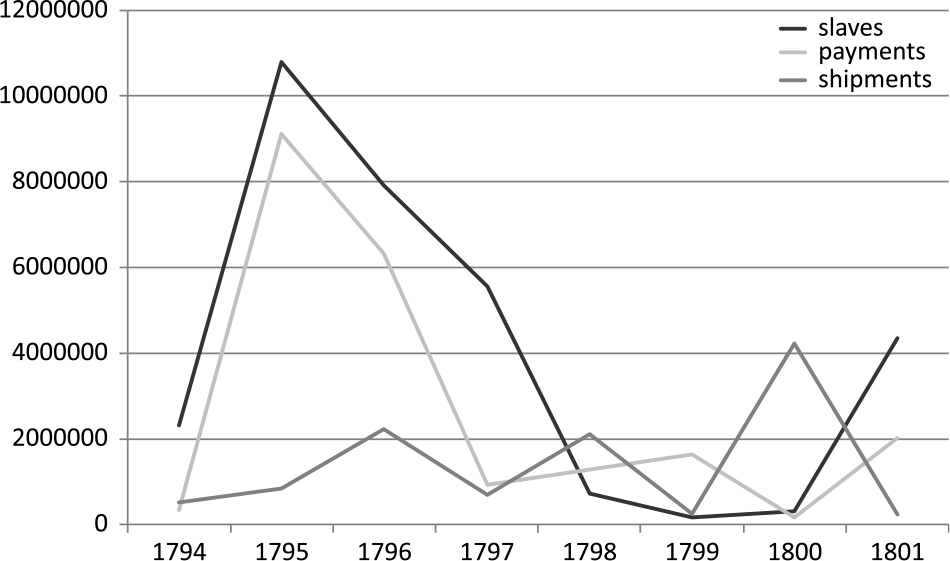
Africans returned shortly after with a small number of slaves. Notwithstanding their efforts, the partners were unable to sell all the old stock. Francisco had no choice but to advance them a new assortment. This time, the issue was solved by bartering recently purchased slaves for commodities, which, in turn, were sold on credit to Africans. Figure 2 presents the values of the commodities shipped from Luanda, and the slaves received from inland over a seven-year period.
Shipments of commodities and payments (in millions of réis) made by José Abreu Castel Blanco Pimentel, Luanda, 1794–1802. Source: Arquivo Histórico Ultramarino, Lisbon, Portugal, Angola, cx. 100 dc. 37.

Table 6 shows the time needed for the capital of a Lisbon-based merchant to be moved from African cities to Brazil in the form of slaves. Broadly speaking, more than two years were required for commodities to be sent to interior zones in Africa, and for capital to be returned in the form of slaves. In Brazil, slaves had to be sold, in order for the profits to be transformed into sugar, silver pesos, or bullion, which could be remitted to Lisbon. The timing of all these global flows has yet to be accurately determined.
Time taken to honour credits (in réis) due to the Lisbon merchant António de Souza Portela, 1799, through shipment of slaves to Rio de Janeiro

Source: Arquivo Nacional Rio de Janeiro, Junta de Comércio, cx. 377 pc. 1.
Conclusion
This article has argued that both triangular and bilateral frameworks focusing on the south Atlantic do not adequately portray the complexities and scope of Portuguese slave traffic. A third, global, approach to the financing of the Portuguese slave trade is advanced, wherein the south Atlantic has been removed from the imperial margins. In so doing, the article argues for a Portuguese Atlantic that gravitated less around an imperially rooted narrative. Putting the financing of the slave trade into a more global perspective helps to more accurately explain how it actually operated in terms of the organization of trade. When the financial and institutional foundations of Asian and African trade are analysed together, it becomes evident that they were part of larger networks and capital flows (both westwards and eastwards) which were not just framed imperially or locally.
Introducing capital into our narratives in a clearer and deeper way seems to be necessary, as is the need to think about uncoordinated investment cycles that functioned on a global scale, and that allowed different sectors to operate simultaneously and autonomously. No single agent was in a position to control or lead these trades. Everyone depended on others’ anticipations and calculations. For the system to perform, anticipations and decisions were to be made in several markets: a multitude of agents based in Lisbon who profited from diverse forms of credit; the money advanced to Asia-based weavers; the silver-for-gold exchanges that operated in the region of the Rio de la Plata; and the chains of credit and consignments that operated in Africa. Agents in each one of these markets calculated and took decisions independently without having full information on what was happening in the other areas. It was precisely their anticipations that made possible the set of connections described throughout the article.
These global uncoordinated investment cycles made the slave trade possible. Portrayed as merely being a ‘national’ enterprise of rich Lisbon-based merchants, Asian ventures actually depended upon a booming credit market, in which a much more diverse and larger pool of investors took part, who also profited somewhat from the gains produced by the trade in human beings. Accustomed to focusing attentively on Africa, most Brazilian historians underestimate and downplay the direct impact of Spanish South America on the Portuguese imperial economy. The Brazilian economy, particularly that of Rio de Janeiro, was more tightly connected to Potosí’s economic trends than was previously assumed, giving rise to a bimetallic trans-imperial entangled space. No less important were the different levels of risk and investment in which textile production, and the trade in slaves in Africa, were framed. The participation of indigenous and foreign capital, although apparently considerable, has yet to be fully revealed. Equally, we need to discover where chains started, and reach an agreement about the order in which the story should be narrated.
J. Bohorquez is currently a postdoctoral researcher at the Instituto de Ciências Sociais (ICS), University of Lisbon. Previously, he was a Weatherhead Initiative on Global History postdoctoral fellow at the Weatherhead Center for International Affairs, Harvard University. He gained his PhD at the European University Institute in Florence.