

Introduction
The proportion of all families with children headed by a lone mother has increased across European Union (EU) countries in last decades (Bernandi, Mortelmans, & Larenza, Reference Bernandi, Mortelmans, Larenza, Bernandi and Mortelmans2018; Bradshaw, Keung, & Chzhen, Reference Bradshaw, Keung, Chzhen, Nieuwenhuis and Maldonado2018; Nieuwenhuis, Reference Nieuwenhuis2020). Lone mothers are commonly perceived as being among the most vulnerable groups in many societies, facing inadequate resources, employment and policies (Nieuwenhuis & Maldonado, Reference Nieuwenhuis and Maldonado2018). As mothers often have physical custody of children in post-separation it is difficult for them to increase their workload to compensate for former partners’ income; thus, many lone mothers live in poverty (Maldonado & Nieuwenhuis, Reference Maldonado and Nieuwenhuis2015; Mortelmans, Reference Mortelmans2020; Nieuwenhuis & Maldonado, Reference Nieuwenhuis and Maldonado2018).
One income that may increase the economic well-being of lone mothers in post-separation is child support, which refers to money (or in-kind) expected to be paid regularly by non-resident parent to share the costs of children (eg. Skinner, Bradshaw, & Davidson, Reference Skinner, Bradshaw and Davidson2007). Child support is associated with many positive outcomes. It reduces poverty if received (Cuesta, Hakovirta, & Jokela, Reference Cuesta, Hakovirta and Jokela2018; Hakovirta, Reference Hakovirta2011; Meyer & Hu, Reference Meyer and Hu1999; Skinner, Cook, & Sinclair, Reference Skinner, Cook and Sinclair2017). It can improve educational attainment and cognitive development of children (Nepomnyaschy, Magnuson, & Berger, Reference Nepomnyaschy, Magnuson and Berger2012). Despite these positive outcomes, some studies show poorer child support outcomes over time (Case, Lin, & McLanahan, Reference Case, Lin and McLanahan2003; Huang, Reference Huang2009) and a significant proportion of lone-parent families eligible for child support do not receive it (Cuesta & Meyer, Reference Cuesta and Meyer2012; Ríos-Salas & Meyer, Reference Ríos-Salas and Meyer2014; Cuesta, Hakovirta, & Jokela, Reference Cuesta, Hakovirta and Jokela2018; Hakovirta & Jokela, Reference Hakovirta and Jokela2019). Lack of financial support from non-resident fathers places a financial burden on lone mothers, which has led to a growing interest in the determinants of child support receipt.
Prior research provides insights into some potential factors that are related to low receipt rates with child support. The child support system has been successful in providing payments to children with divorced parents and those whose non-resident parent has a regular income (Cancian & Meyer, Reference Cancian and Meyer2018; Cuesta & Meyer, Reference Cuesta and Meyer2012). On the other hand, the barriers to employment and insufficient income, resistance to paying support without visitation access and the enforcement system have also been shown to contribute non-compliance (Bartfeld & Meyer, Reference Bartfeld and Meyer2003; Vogel, Reference Vogel2020).
Most of the prior research on noncompliance and child support receipt is within a single country. This research contributes by exploring the child support in Europe and from a comparative perspective. There is limited knowledge on how many lone mothers receive child support across Europe and whether and how different cultural and policy contexts may influence child support receipt. This article addresses this research gap by examining the receipt of child support and the characteristics associated with child support receipt among lone mothers in 21 European countries using 2017–2018 European Union Statistics on Income and Living Conditions (EU-SILC) data. The analysis covers countries from different cultural and policy contexts (eg. prevalence of lone mothers, extent of gender equality and type of child support scheme). We focus on lone mothers as the proportion of single fathers receiving child support is minimal (Vnuk, Reference Vnuk2019). This study examines: (1) the extent to which the levels of child support receipt and amounts received differ between European countries and (2) what are the individual-level determinants of child support receipt and whether these child support correlates differ between countries. We address only private payments, ie. child support received from non-resident fathers, as not all countries operate guaranteed child support schemes where the state provides some financial support if a non-resident parent is not paying (Skinner, Bradshaw, & Davidson, Reference Skinner, Bradshaw and Davidson2007).
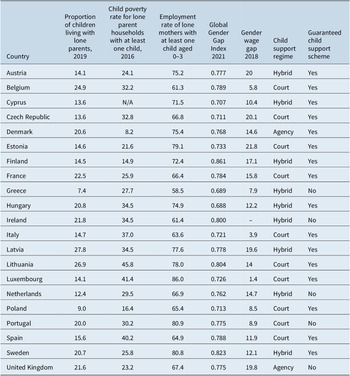
This study contributes to the literature in several ways. First, previous comparative studies show substantial cross-country differences in the receipt rates and amounts of child support, but the factors associated with child support receipt in Europe have not been rigorously studied (see countries included in this study in Table 1). As far as we know, this is the first comparative study on the determinants of child support receipt in Europe, including Eastern and Central European countries. Eastern European countries have high divorce rates (OECD, 2021), which makes child support policy important for lone parents in post-separation. Although factors associated with child support receipt have been examined in the United States, Colombia, and Peru (Cuesta & Meyer, Reference Cuesta and Meyer2012; Rios-Salas & Meyer, Reference Ríos-Salas and Meyer2014) and in Asian countries (Chung & Kim, Reference Chung and Kim2019), research evidence is scarce in Europe, especially in post-socialist countries (see however Maslauskaitė & Tereškinas, Reference Maslauskaitė and Tereškinas2017). Diverse cultural characteristics, such as gender roles, mothers’ employment and different institutional frameworks, can be expected to result in different patterns of child support receipt in different welfare states. Overall, our analysis has the potential to inform policy debates around child support policies in Europe, as it extends the empirical evidence on the determinants of child support receipt and can assist with policy development.
Situation of lone mothers in 21 European countries.

Sources: Eurostat (2021), Global Gender gap report (2021), Nieuwenhuis (Reference Nieuwenhuis2020), OECD Family Policy Database (2020), Skinner, Bradshaw, and Davidson (Reference Skinner, Bradshaw and Davidson2007) and Skinner and Hakovirta (Reference Skinner, Hakovirta, Nieuwenhuis and Van Lanckers2020).
Lone mothers in Europe: institutional context
Cultural and policy contexts play an important role in cross-country differences relating to lone mothers’ child support receipt (Chung & Kim, Reference Chung and Kim2019; Cuesta & Meyer, Reference Cuesta and Meyer2012). Table 1 provides an overview of the relevant key characteristics in the 21 countries included in this study. The first three columns provide indicators concerning the need for child support policy. It could be expected that, in countries with a high proportion of lone mothers and a high child poverty rate, child support would be especially needed, as these families are economically vulnerable. The prevalence of children living in lone-parent families ranged from 7–9 per cent of children in Greece and Poland to 25–28 per cent in Belgium, Latvia and Lithuania. The child poverty rates varied across these countries, with rates over 40 per cent in Spain, Lithuania and Luxembourg, and under 10 per cent in Denmark.
Because child support regulations can embody expectations about the appropriate roles of mothers and fathers, next three columns in Table 1 highlight gender issues. Increases in women’s earnings accounted for a decline in child support in the 1980s (Robins, Reference Robins1992), which has been suggested as being due to women’s increased financial independence. Currently, across many countries, both parents’ earnings play a key role in determining child support within current guidelines and child support formulas (Skinner, Bradshaw, & Davidson, Reference Skinner, Bradshaw and Davidson2007). Thus, a high employment rate of lone mothers might correlate with low child support receipt. Table 1 shows a substantial variation in the employment rate of lone mothers, with a low employment rate of 58 per cent in Greece and over 80 per cent in Luxembourg, Portugal and Sweden.
Broad agreement exists concerning the negative economic consequences of union dissolution for women (eg. Mortelmans, Reference Mortelmans2020; Uunk, Reference Uunk2004) and child support can help equalise income between parents (de Vaus et al., Reference de Vaus, Gray, Qu and Stanton2017; Ha, Cancian, & Meyer, Reference Ha, Cancian and Meyer2018). Thus, a smaller gender wage gap can be associated with lower levels of child support receipt. The gender wage gap showed high levels of inequality in the Czech Republic, Estonia, Latvia and the United Kingdom, and relatively low levels in Belgium, Greece and Italy. The boarder gender equality measure, the global gender gap index, benchmarks the evolution of gender-based gaps among four key dimensions (economic participation and opportunity, educational attainment, health and survival and political empowerment). No country has yet achieved full gender parity, the top countries in gender equality include Iceland and Finland, Lithuania, Norway, Sweden and Ireland.
Comparing countries Skinner and Hakovirta (Reference Skinner, Hakovirta, Nieuwenhuis and Van Lanckers2020) and Skinner, Bradshaw, and Davidson (Reference Skinner, Bradshaw and Davidson2007) categorised child support schemes as either agency, court-based or hybrid schemes, depending on the role of the courts and public agencies in the operation of a country’s scheme. We added seven countries from East and South Europe they did not consider relying on information provided by European Juridical Network and European Parliament Report on single parents by Nieuwenhuis (Reference Nieuwenhuis2020). Only two countries, Denmark and the UK, operate primarily agency schemes in which an administrative agency is responsible for the assessment, collection and transfer of child support. Ten countries use court-based schemes, in which the main responsibility for determining and enforcing child support orders lies within the judicial system. These systems are characterised as discretionary and, in most cases, they are less likely to apply standard rules and formulae when working out support liabilities. Court-based schemes include Belgium, Czech Republic, Estonia, France, Italy, Lithuania, Luxembourg, Poland, Portugal and Spain. The other nine countries, Austria, Cyprus, Finland, Greece, Hungary, Ireland, Latvia, the Netherlands and Sweden have hybrid schemes, in which both the judicial system and public agencies play a role in the main tasks of child support determination.
Countries have different mechanisms to enforce compliance with child support obligations. Some countries have approached non-compliance of child support by providing a public guarantee of a minimum of child support, which means the child can receive support from the government if the non-resident parent does not pay or does not pay the full amount (Skinner, Bradshaw, & Davidson, Reference Skinner, Bradshaw and Davidson2007). Table 1 shows that of our 21 European countries only Ireland, Greece, Netherlands, Portugal and the United Kingdom do not have a guaranteed child support scheme.
How a child support scheme relates to child support receipt is uncertain. It is possible to consider that lone mothers who live in countries with hybrid child support schemes may be more likely to receive child support than in those with court-based systems. Unlike court-based schemes, hybrid schemes offer the possibility of establishing child support arrangements outside the court. This feature may reduce the costs associated with the process of pursuing child support. For the same reason, it could be considered that lone mothers in countries with agency-based systems would be more likely to receive child support compared to lone mothers in countries with court-based systems. However, in a previous study on 13 countries, Hakovirta and Skinner (2020) found no obvious pattern in relation to the differing types of child support scheme adopted. Neither the regulations nor judicial decision-making in relation to child support calculations appear to involve any clearly discernible consistency, either within or across the scheme types.
Previous research on the receipt of child support
Previous comparative studies on child support have shown substantial cross-country differences in the receipt rates and amounts of child support received. Luxembourg Income Study data (LIS) from around the year 2000 showed that the percentage of non-widowed lone parents receiving child support varied from 22 per cent in the United Kingdom and 32 per cent in the United States, to up to 69 per cent in Finland, with the highest amounts received in the United States, the United Kingdom and Canada (Skinner, Bradshaw, & Davidson, Reference Skinner, Bradshaw and Davidson2007). The LIS data from 2013 showed that in Finland, approximately 80 per cent of lone mothers received child support compared with 42 per cent in Spain, and approximately 33 per cent in the United Kingdom, the United States, and Germany (Hakovirta & Jokela, Reference Hakovirta and Jokela2019).
Several factors influence the likelihood of lone mothers receiving child support. At the individual level, lone mothers’ educational level, age, employment status, income, marital status and number of children affect their likelihood of receiving child support. Mothers with high educational levels are more likely to receive child support in most countries (Chung & Kim, Reference Chung and Kim2019; Cuesta & Meyer, Reference Cuesta and Meyer2012; Ríos-Salas & Meyer, Reference Ríos-Salas and Meyer2014; Sorensen & Hill, Reference Sorensen and Hill2004), for which there are three main reasons. First, higher education may lead to an increased ability to navigate administrative and legal systems and greater incentive to seek child support orders. Highly educated mothers are also more likely to understand the legal requirements for obtaining child support and are more likely to seek legal advice (Chung & Kim, Reference Chung and Kim2019). Mothers with higher educational levels are also more likely to invest material resources obtained from the children’s fathers in their children (Bianchi et al., Reference Bianchi, Cohen, Raley, Nomaguchi and Neckerman2004). Due to marriage homogamy married parents often show a small gap in education. High education usually implies higher earnings, and thus a greater ability of father to pay child support (Garfinkel, Glei, & McLanahan, Reference Garfinkel, Glei and McLanahan2002).
Findings on the effects of other sociodemographic factors associated with child support receipt, such as income and employment status, are contradictory. On the one hand, it might be that non-resident fathers would be more likely to pay child support when lone mothers are financially unable to care for their children, as the likelihood of payments would promote the welfare of children (Chung & Kim, Reference Chung and Kim2019). Cuesta and Meyer (Reference Cuesta and Meyer2012) found that child support receipt was positively associated with lower levels of income among lone-mother families in Colombia. One potential explanation for this finding is that child support payments are based on need, and that, if fathers were “altruistic,” child support would be paid in situations of need (Kim & Chung, Reference Kim and Chung2020). On the other hand, lone mothers with greater economic resources are better able to negotiate the legal system effectively to ensure receipt of child support. Hakovirta and Jokela (Reference Hakovirta and Jokela2019) found, comparing six countries, that lone mothers in the highest income quintiles in Finland, Germany and Spain were more likely to receive child support. Similarly, Skinner and Meyer (Reference Skinner and Meyer2006) found that lone mothers in the United Kingdom who were already relatively better off were more likely to receive child support.
Empirical evidence concerning the effect of the employment status of parents is inconsistent, and the employment effect may be influenced by an educational effect. Working lone mothers may have greater possibilities of receiving child support, as they might have better resources to seek child support orders. On the other hand, being outside the labour market may mean that lone mothers need child support to financially support their children, or lone mothers receiving child support may be less likely to need work to financially support their children. For example, Cuesta et al. (Reference Cuesta, Jokela, Hakovirta and Malerba2019) reported that employed lone mothers in Chile and Colombia were less likely to receive support.
Marital status plays a significant role in determining the probability of receiving child support. Divorced mothers are more likely to receive child support than mothers who have never been married (Chung & Kim, Reference Chung and Kim2019; Cuesta & Meyer, Reference Cuesta and Meyer2012). It has been claimed that fathers are generally more involved with children born in marriage than in cohabitation (Maslauskaitė & Tereškinas, Reference Maslauskaitė and Tereškinas2017). In addition, divorced parents may have stronger family ties, which can increase their willingness to pay. The lower likelihood of receiving child support among never-married mothers has also been explained by the fact that paternity must first be established to obtain a child support order, and some lone mothers may not want to do so (Cuesta & Meyer, Reference Cuesta and Meyer2012).
Data, measures and methods
For the analysis, we used data from the EU-SILC, an annual household survey, designed and coordinated by Eurostat, and collected by national statistical authorities. The data provide cross-sectional information on a wide range of social issues, primarily focussing on income, poverty, social exclusion and living conditions. The advantages of the data include its comparability across many countries and relatively large sample sizes of lone mothers whose proportions in many surveys are otherwise limited.
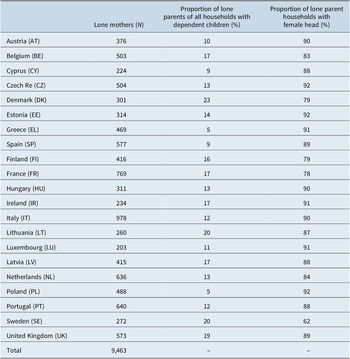
For this study, we used a pooled dataset on 21 countries that included the years 2017 and 2018. Countries were chosen based on the availability of data on child support and background variables that were included in the analysis. We limited the analysis to lone mothers aged between 18 and 64 years who lived with at least one dependent child under 18 years of age and who were not widowed and not married. The total sample consisted of 9,463 lone-mother households (Table 2). The sample sizes country-specific datasets vary from n = 203 (Luxembourg) to n = 978 (Italy).
Descriptive statistics: characteristics of lone mother families in 2017–2018.

Outcome variable
In our analysis, we conceptualised child support in the form of a cash payment made from one parent to another, for financially supporting children in post-separation. Formal child support involves a legal requirement established by a court or enforcement agency, while informal cash child support is a direct transfer from a non-resident parent to a child and involves no legal obligation. The EU-SILC data do not provide information on the type of child support; thus, we examined both formal (compulsory) and informal (voluntary) child support received from non-resident fathers.
Our outcome variable was child support receipt, which was treated as a dichotomous variable (1 = receives child support and 0 = does not receive child support). Child support receipt refers to monetary child support and alimony received from another household during the previous year and reported at the household level. The EU-SILC data do not distinguish between child support and alimony paid to an ex-spouse. However, this is not a serious limitation, as very few households receive alimony (see Meyer & Hu, Reference Meyer and Hu1999). It should also be noted that the child support variable only included the amount paid by the father, but not the guaranteed support paid by the state in some countries. Thus, we compared only private child support. We discuss the possible limitations of this approach in the concluding section of the paper.
Control variables
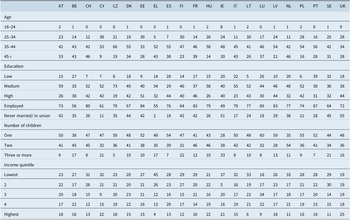
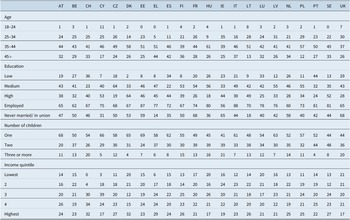
To analyse the determinants of child support receipt, we included individual-level factors, such as age (continuous variable), marital status that refers to the conjugal status of each individual in relation to the marriage laws of the country (dichotomous variable, divorced or separated/never married)Footnote 1, education (low = high school education not completed, middle = high school completed and high = higher education) and employment status based on the basic activity status at the time of the interview (dichotomous variable employed/not employed). Household-level variables included number of children (categorical variable one child/two children/three or more children) and income quintiles that were calculated using the pre-child support family income. This was obtained by subtracting the child support income from the equalised disposable income. Some of the background variables had missing values which were imputed using simple regression imputation with age, income and household size as predictors. The descriptive statistics of the background variables by child support receipt and country are presented in Table A1.
Analysis methods
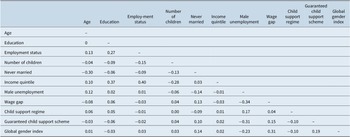
We first conducted a descriptive analysis to examine the differences in child support receipt and the amount of child support across countries, presented in purchasing power parity (ppp), and relative to the disposable income of lone mothers. Second, we ran logistic regression analyses using the pooled data for the 21 countries to examine factors associated with child support receipt. Here, we ran a model that included individual-level characteristics (age, marital status, employment status and education) and a model that included both individual-level and household-level characteristics (number of children and household’s income quintile). The models were controlled for each country. We also included interaction effects to account for possible cross-country variation in the association between lone mothers’ characteristics and child support receipt. In addition, we ran sensitivity tests and robustness checks to test whether the results change according to the type of variable we use (categorical or continuous) but found no significant differences. We also ran correlations between the covariates and macro-level variables (see Table A2).
Results
Descriptive analysis
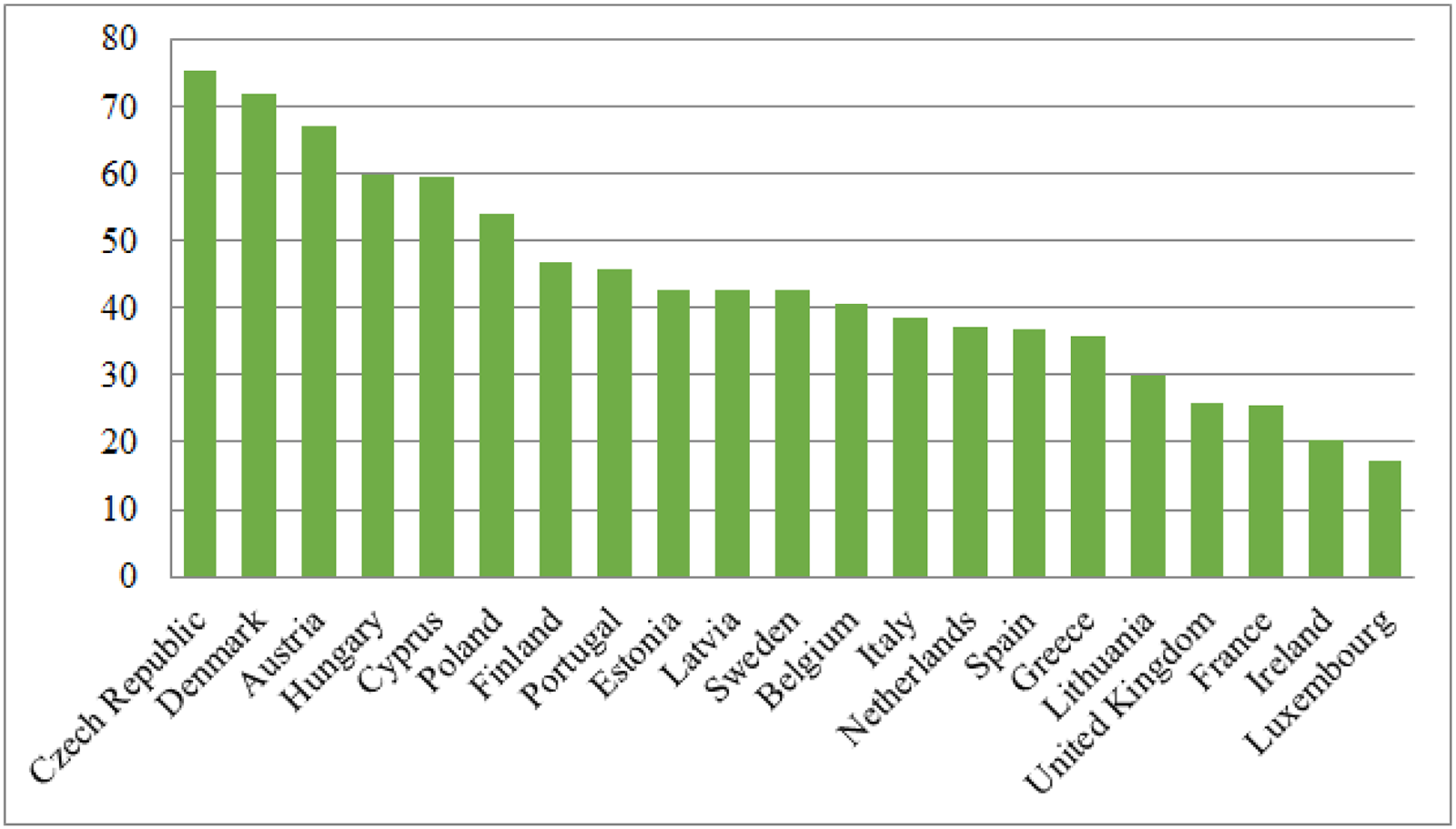
Figure 1 depicts the proportion of lone mothers receiving child support in the 21 countries. We found significant variation in the extent of receipt. Czech Republic, Denmark, Austria, Hungary, Cyprus and Poland had the highest receipt rates. Approximately one in every two lone mothers in Finland, Portugal, Estonia, Latvia, Sweden, Belgium, Italy, the Netherlands, Spain and Greece received child support. The lowest receipt rates were in the United Kingdom, France, Ireland and Luxembourg, where approximately one-fifth of lone-mother families received financial support from a non-resident parent.
Proportion of lone mother households receiving child support in 21 European countries in 2017–2018, %.

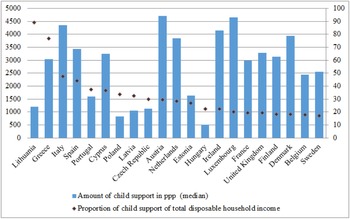
Figure 2 displays the median annual amount of child support for each country (in €ppp). The average annual amounts received across countries ranged from €4710 in Austria to €512 in Hungary. Median amounts did not correspond to the proportion of lone parents receiving child support. For example, in Luxembourg, very few lone mother families received child support, but those receiving it obtained relatively high amounts, whereas the opposite was in the Czech Republic.
Median amount of child support received by lone mothers in €ppp (EU 2020 = 100) and the proportion of child support of lone mother households’ disposable income (%) in 21 European countries in 2017–2018.

Child support formed a significant source of income for those lone mothers receiving it, particularly in Lithuania and Greece. In Southern European countries such as Italy, Spain, Portugal and Cyprus, child support accounted for approximately 40–50 per cent of total disposable household income. In Nordic countries (Finland, Denmark and Sweden), Belgium, the United Kingdom, France and Luxembourg, child support covered one-fifth or less of the total disposable household income of lone mothers.
Based on the information in Figures 1 and 2, we clustered countries into three different groups according to receipt rates and the levels of child support they provided, to obtain a general impression of what occurs among the countries. In the first group of countries, Austria, Cyprus, Denmark and Finland had a high proportion of lone mothers receiving child support, with relatively high levels of child support. In the second and largest group of countries included most Eastern European countries such as the Czech Republic, Hungary, Poland and Latvia. In these countries, receipt rates were high, but the amount of child support received was low. In the third group of countries, Greece, Spain, Italy, the United Kingdom and France, less than 40 per cent of lone mothers received child support, but those receiving it obtained relatively high amounts.
Multivariate analysis: determinants of child support receipt
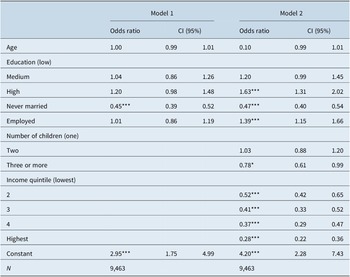
This section presents the results of the pooled regression analyses (Table 3). Model 1 included individual-level characteristics, while Model 2 included individual-level and household-level characteristics. The models were controlled for each country. Our results accorded with the findings of previous studies, namely, that higher education and lone mothers’ employment increased the likelihood of receiving child support, while lone mothers who had never been married or in union were less likely to receive child support. Lone mothers in higher-income quintiles were more likely to receive child support than those in lower-income quintiles. The association between age, number of children and child support receipt was not statistically significant.
Logistic regression on child support receipt.

Model 1 includes individual-level characteristics, while Model 2 includes individual-level and household-level characteristics. The models were controlled for each country.
Abbreviation: CI, confidence intervals.
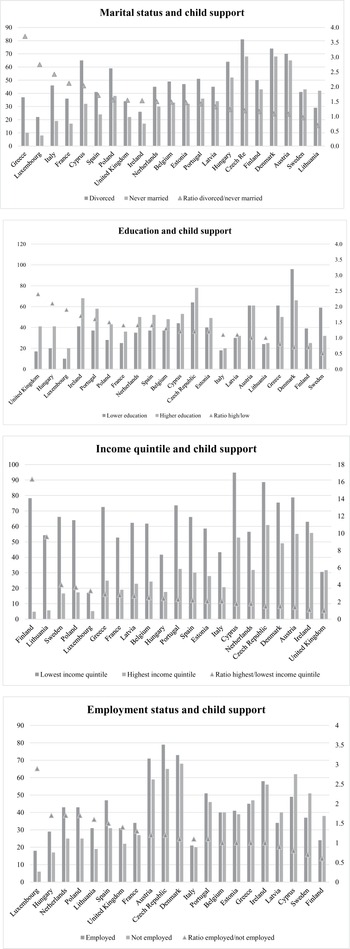
Previous studies have shown that there may be cross-country differences in terms of the effect of individual-level characteristics of lone mothers on the likelihood of receiving child support. Our findings showed that the association between marital status, educational level, employment status and income quintile, and child support receipt varied across countries (Figure 3).
Predicted probabilities for child support receipt by marital status, education, income quintile and employment status. All models were controlled for age, marital status, education, employment, number of children and income quintile. “Divorced” refers to dissolution of a legal union (divorced/separated).

Differences in the probability of receiving child support between divorced and never-married lone mothers were highest in countries with the lowest child support rates, such as Greece, the United Kingdom, France and Luxembourg. In countries where child support receipt rates were among the highest, such as Austria, Sweden and Denmark, never-married lone mothers were equally or slightly more likely to receive child support compared to divorced lone mothers. Similarly, regarding marital status, the differences between educational levels were most marked in Luxembourg, the United Kingdom and Ireland, where higher-educated lone mothers were twice as likely to receive child support compared to lone mothers with lower educational levels. The smallest differences were again found in Austria, Denmark, Sweden and Finland, where lower-educated lone mothers had a slightly higher likelihood of receiving child support compared to higher-educated lone mothers.
In Luxembourg, employed lone mothers were three times more likely to receive child support compared to those who were not employed, followed by Hungary, the Netherlands, Poland and Lithuania. In contrast, in Finland, Sweden and Cyprus, lone mothers who were not employed were more likely to receive child support, while in the rest of the countries, the likelihood of receiving child support did not vary significantly by employment status.
While the pooled regression results (Table 3) showed a positive association between child support and income, the average marginal effects by country suggested significant cross-country variation in the association between child support and income quintiles. Interestingly, in most countries, lone mothers in the lowest quintiles were more likely to receive child support than those in the highest income quintiles. The differences were most marked in Finland, Lithuania, Sweden and Poland. In the United Kingdom, Ireland, Austria and Denmark, the likelihood of receiving child support was approximately the same for the two income groups.
We also ran multilevel regression models (not shown here) to test the association between institutional factors (type of child support regime, male unemployment rate, and gender wage gap and gender equality index) and child support receipt. No statistically significant associations were found.
Discussion and conclusions
Using 2017–2018 EU-SILC survey data from 21 countries, this study extends current knowledge on the individual and family characteristics associated with child support receipt among lone-mother families in Europe. As child support is an important income for lone mothers and contributes to children’s wellbeing, it is useful to have a better understanding of the determinants associated with child support receipt in different cultural and institutional contexts.
This study provided important new findings. Child support policies have been developed to ensure that following family breakdown, parents in separated families continue to financially support their children (Skinner, Bradshaw, & Davidson, Reference Skinner, Bradshaw and Davidson2007). This obligation is enshrined within the United Nations Convention on the Rights of the Child, Article 27: “State Parties shall take all appropriate measures to secure the recovery of maintenance for the child from the parents or other persons having financial responsibility for that child.” The analysis showed that a substantial proportion of lone-mother families in the 21 European countries did not receive child support and non-resident parents were not fulfilling their financial responsibilities.
Second, there was significant variation in the extent of child support receipt across countries. The highest child support receipt rates were found in the Czech Republic, Denmark and Austria. These countries also had a high gender wage gap, ie. men had higher earnings than women. A large gender wage gap may continue to position mothers as primary carers and child support payers as breadwinners, leading to an increase in child support receipt. The ideological and cultural persistence of the male breadwinner model may put greater emphasis on fathers’ economic obligations towards their children (Hakovirta, Meyer, & Skinner, Reference Hakovirta, Meyer and Skinner2021). Our results also indicated that in countries where the need for child support was high, for instance, due to the high child poverty rates, lone mothers did not seem to benefit from child support.
Third, we found cross-country variation in the association between individual-level and household-level characteristics and child support receipt. Socioeconomic differences in child support receipt were generally most marked in countries with low child support receipt. For example, in Luxembourg, employed lone mothers were three times more likely to receive child support than unemployed lone mothers, and divorced lone mothers were nine times more likely to receive child support than never-married lone mothers. However, in most countries, lone mothers in the lowest quintiles were more likely to receive child support than those in the highest income quintiles. The largest differences between income quintiles were found both in countries with high child support coverage (Finland and Sweden) and in those with low rates of child support receipt (Lithuania). In Nordic countries, lower-educated lone mothers were more likely to receive child support, whereas the opposite was the case in France, the United Kingdom and Luxembourg. In other countries, differences between educational levels were less marked.
The expectations for child support may differ in a separated family in which both parents have equal caring responsibilities (last column of Table 2). In earner-carer countries, equal caring responsibilities between parents combined with equal earning responsibilities mean there need not be financial transfers.
In general, socioeconomic factors among lone mothers exerted a strong influence on child support receipt. Low socioeconomic status was a common barrier to child support receipt in most countries, and lone mothers faced similar challenges in pursuing child support. It may be that when fathers are disadvantaged, they cannot provide economic resources for their children (also Vogel, Reference Vogel2020). Thus, it seems that current child support policies work for families with more resources and less well for disadvantaged families. In countries with guaranteed child support schemes, lone mothers are in a better position, as the state provides support in case of non-compliance.
Since the role of contextual factors in determining child support receipt among lone-mother families remains largely unknown, we also tested the association between several country-level factors, including the type of child support regime, existence of guaranteed child support scheme, male unemployment rate, gender equality (gender wage gap and global gender equality index) and child support receipt. No statistically significant associations were found, which is why we excluded contextual factors from the final analyses. While our results only showed variation in child support receipt at the individual level, country-level determinants need to be considered in future research, eg. in terms of how welfare state institutions, such as child support enforcement, predict child support receipt in various countries. The different institutional arrangements found in child support policies, ie. whether court-based, agency-based or a hybrid system, did not appear to influence child support receipt, with no clear pattern or consistency found in terms of the regulations or judicial decision-making in relation to child support determination, either within or across the scheme types. This finding accorded with those of previous studies (Hakovirta & Skinner, Reference Hakovirta, Skinner, Bernardi and Mortelmans2021).
The results should be interpreted considering the following limitations. First, the EU-SILC data were not designed for child support research, thus limiting the extent to which the role of various child support policy schemes could be examined. For example, while the focus of our analysis was on private arrangements, it would have been interesting to include guaranteed child support. Including guaranteed child support would inevitably show a higher proportion of lone mothers receiving child support (see Hakovirta & Jokela, Reference Hakovirta and Jokela2019).
Another limitation was that not all factors that may be related to child support receipt could not be controlled. For example, prior research suggests that in addition to lone mothers’ characteristics, child support receipt is dependent on the circumstances of fathers (Hakovirta, Meyer, & Skinner, Reference Hakovirta, Meyer and Skinner2019; Maslauskaitė & Tereškinas, Reference Maslauskaitė and Tereškinas2017). While we acknowledge that non-resident parents’ characteristics and their ability to contribute to their children’s lives would be important to consider, very few comparative data sets, including the EU-SILC, have no information on non-resident fathers that could be linked to lone-mother households. Furthermore, child support payers’ new partnerships and children’s contact with non-resident parents may influence the likelihood of paying child support. Remarriage of non-resident fathers can decrease the ability to pay child support (Hakovirta, Meyer, & Skinner, Reference Hakovirta, Meyer and Skinner2019), while some low-income fathers prefer paying informal support over formal support (Vogel, Reference Vogel2020). Our data did not include frequency of contact, which has been shown to correlate with child support receipt (Maslauskaitė & Tereškinas, Reference Maslauskaitė and Tereškinas2017). Moreover, shared care arrangements where children live with both parents for approximately equal amounts of time have increased in many countries (Steinbach, Augustijn, & Corkadi, Reference Steinbach, Augustijn and Corkadi2020). In these families, parents often make private arrangements, and child support is not always required, which may result in a lower proportion of lone-mother families receiving child support.
Beyond these general difficulties and limitations, this study showed that lone mothers in Europe face barriers to child support, which might affect their economic well-being. This finding has implications for the development of child support policies. There is no easy solution for non-compliance with child support if non-resident fathers have no financial capacity to pay. For instance, increasing trend in multi partner fertility may lead fathers facing multiple obligations. This burden may reduce the proportion of the child support obligation that they are able to meet (Meyer, Cancian, & Cook, Reference Meyer, Cancian and Cook2005). A public guarantee of a minimum amount of support has been suggested in the United States as it might help non-resident fathers not to have to pay beyond their current means (Cancian & Meyer, Reference Cancian and Meyer2018). Second, having been formerly married is a significant predictor of child support receipt. However, cohabitation has become a popular living arrangement among families with children. While child support policies treat married and cohabitant partners in an equivalent way in most countries (Skinner, Bradshaw, & Davidson, Reference Skinner, Bradshaw and Davidson2007), our results highlight the need to promote policies supporting continuity concerning cohabited fathers’ financial commitments in post-separation. Finally, shared parental leave increases fathers’ involvement in post-separation (Duvander & Jans, Reference Duvander and Jans2009), as fathers who were more involved prior to separation tend to have more frequent contact after separation (Haux & Platt, Reference Haux and Platt2021). Increased efforts to help fathers maintain bonds with their children are more likely to lead them to provide financial support.
Funding
This research was funded by Academy of Finland funding (decision number 294648) and the Academy of Finland Flagship Programme (decision number: 320162).
Appendix
Characteristics of lone mothers receiving child support by country in 2017–2018, %.

Source: European Union Statistics on Income and Living Conditions 2017–2018.
Characteristics of lone mothers not receiving child support by country in 2017–2018, %.

Source: European Union Statistics on Income and Living Conditions 2017–2018.
Correlations between individual and macro-level variables.

All correlations with |r| ≥ 0.02 are statistically significant.