Juliet, in Shakespeare's tragedy and in Kenneth MacMillan's balletic adaptation, is a revolutionary character inveighing against immediate patriarchal machinations. Editors of the First Folio (1623) of Shakespeare's complete dramas eschewed the performance-oriented, mass-produced and mass-circulated, magazine-sized first quarto (Q1, Reference Shakespeare1597). Instead, they forcefully redacted the more literary second quarto (Q2, 1599) text to concoct a mythology of a timeless, blotless bard. Opting for lyricism, symmetrical balancing, and female acquiescence to patriarchal will, the editors enforce structures resisted by both the early theatrical and later balletic Juliets.
In 1964–65, MacMillan with dancers Lynn Seymour and Christopher Gable concocted a Juliet who would challenge fundamental balletic conventions of femininity. Juliet's revolutionary personality was constructed to declassify ballet through defiant stillness, off-balance choreography, and unconventional facings. Economic, moral, and aesthetic concerns waged against Seymour's rebellious Juliet, and the premiere as well as the internationally disseminated film (1966) of Juliet were performed by Margot Fonteyn. Fonteyn's classifying instinct effaced these balletic transgressions and recast Juliet into an aesthetic of grace and verticality.
Decisions at the hands (and feet) of authors, editors, choreographers, dancers, and boards may work to classify or declassify an archive. Beginning with literary and literal examples of concepts of effacement and marginalization central to critical theory, similar strategies emerge for the continuance of hegemonic power and tactics for resistance to acts of rebellion against these networks that infuse the inception of Kenneth MacMillan's Romeo and Juliet (first performed in Covent Garden, February 9, 1965). In the case of both the Folio's Romeo and Juliet and MacMillan's choreography, assertions of power against the character of Juliet reflect familiar patriarchal machinations. In the case of Lynne Seymour's creation and performance of Juliet, the confluence of the character-dancer role creates a dynamic where specific decisions aimed at taming Seymour have produced lasting effects on the character of Juliet as archived.
Q1 and the Threat of Juliet
In their introduction to the First Folio edition of Shakespeare's dramas (Reference Shakespeare1623), editors John Heminge and Henry Condell console readers that Shakespeare's “mind and hand went together: and what he thought, he uttered with that easiness, that we have scarce received from him a blot in his papers” (Shakespeare Reference Shakespeare1623). As both had been actors in Shakespeare's company, it is curious that Heminge and Condell seemingly dismiss the notion that actor input, improvisation, and redactions in light of audience receptivity at least informed Shakespeare's writing.Footnote 1 In a classifying move synonymous with the Renaissance, the editors imposed an artificial five-act structure upon the plays’ texts, which had previously flowed without the imposition of acts and scenes (Edmondson and Wells Reference Edmondson, Wells, Mehl and Jansohn2011, 26–27). Printed on paper of quality equal to the most expensive Bibles, framed by clear margins, clean lines, and classical structure, the Folio presented itself as the unique, authoritative vista into Shakespeare's unhesitating, unerring, versified cogitation, and it discounted, excised, and rearranged any evidence to the contrary. Regarding the Folio, John Jowett surmises, “The way it presented Shakespeare was very carefully calculated to make a collection of theatre works look plausible as what we would now call works of literature. The book not only gives us the texts; it gives us Shakespeare as a cultural icon” (Reference Jowett2007, 92).Footnote 2
In the case of Romeo and Juliet, one problematic sample of evidence to be effaced or heavily redacted is the earliest printing of the play: a magazine-sized quarto published in 1597 called Q1 (for first quarto).Footnote 3 In comparison with Q2, which appeared two years later and was the basis for the Folio version, Q1 streamlines the dialogue and exhibits ostensibly less complicated speech.Footnote 4 In the early twentieth century a team of scholars, dubbed the New Bibliographers, purported to have applied positivist scientific scrutiny to the examination of texts. While this gaze did not completely deny Shakespearean authority over Q1, his authorship was deemed visible only in pieces, and Q1 was thus denigrated to a “bad quarto.” In a textbook exemplification of begging the question, the New Bibliographers assumed that the more lengthy, complex, allusion-filled the text, the more likely it is to be from Shakespeare's quill. Conversely, shorter, less ornate texts are allegedly less likely to be Shakespearean. Q1 of Romeo and Juliet’s absence from the official Stationers’ Register, to whom books of all public plays were to be submitted for censure and licensing, was taken as further evidence in New Bibliographers’ dismissing it as an especially “bad” quarto. Yet, despite being labeled “bad,” Q1 has fewer typographical errors than Q2. Q1's concision suggests that it was intended for performance by an acting troupe (and here the New Bibliographers echo Heminge and Condell regarding “surreptitious copies” [Shakespeare Reference Shakespeare1623]), and it also contains more stage directions. Finally, in the view of the New Bibliographers, Q1 demonstrates reliance upon actors’ frequently unreliable memories. Together these factors invoke a robust corporality, theatricality, performativity, and defiance of legal conventions that are antithetical to the New Bibliographer's self-validating hypothesis.
While such a dismissal of Q1 has long reigned, more recent scholarship has turned to investigating and celebrating Q1 for the insight it provides upon early modern performance as well as the politics behind editing practices exemplified by the Folio. Fueled as much by postmodern interrogations of textual stability, feminist analysis, and exposure of patriarchal hegemony, New Historicism's and manuscript studies’ concerns for the materiality of playing, printing, and circulation and the degree of close analysis claimed, but found wanting, by the New Bibliographers, scholarship from the 1990s on began to reconsider Q1.Footnote 5 Rather than a pirated text pieced together by the spotty memories of profiteering actors or the purloined working draft that reached completion in Q2, these scholars argue Q1 represents an authorial text intended for performance that is actually more recent than Q2. Grace Ioppolo writes that Q1 “contains a number of cuts that may have been due to abridgement for a small acting company, cuts probably made by Shakespeare himself” (Ioppolo Reference Ioppolo1991, 89). Such cuts, whether authorial or by some other redactor, to nonessential action and lengthier poetic passages distill the play's intrigue into “two-hours’ traffic” for performance within the repertory of a troupe (Shakespeare Reference Shakespeare and Holland2000, Prologue 1).Footnote 6 Thus, what makes Q1 bad as a facsimile of whatever is imagined to have first been scratched by Shakespeare's quill renders it excellent as a platform for understanding what circulated upon early modern stages as Shakespeare's Romeo and Juliet. As it is unlikely that Q2 ever appeared on stage in its entirety, cutting can be considered a productive formation for appearance. As Steven Orgel notes, “The text then, was not the play” (Orgel Reference Orgel2002, 21).
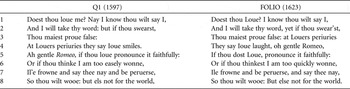
Comparing eight lines of Q1's and the Folio's presentations of act 2, scene 2, lines 92–97 (Table 1), Romeo and Juliet reveals subtle editorial decisions that both assert power over Juliet and attempt to curtail her resistance (Shakespeare Reference Shakespeare and Holland2000, 2.2.92–97).Footnote 7
Comparison of Q1's and the Folio's Presentations of Act 2, Scene 2, Lines 92–97

The balcony scene from Shakespeare's Romeo and Juliet is exemplary of Juliet's dangerously nondocile directive capacities and her dancerly comprehension of bodily legibility and rhetoric. The Folio editors efface Juliet's vulnerable specification of “me” as well as her stifling Romeo with “nay” before she feeds him his confession of love (“I know thou wilt say I”). Curiously, this reduces Q1's eleven syllables not to iambic pentameter's requisite ten syllables, but nine. Q1 repeats Juliet's preemptive “Nay” (“Nay doo not sweare at all”), and the Folio follows Q2 in disregarding Juliet's insistent negation. In line 4 “smiles” is amplified into “laughs” in the Folio, thus tightening the allusion to Ovid's Art of Love, yet thereby losing the symmetrical relation to “frown” in line 7 (Ovid Reference Mozley1979, book 1: 633–34).Footnote 8 In line 6, the Folio inserts “thinkest,” rendering the line eleven syllables, and has Q2's “quickly” for Q1's more provocative “easely.” Finally, the Folio's line breaks at lines 3 through 5 reflect the endings of iambic pentameter lines, preserving the visual distinction between meter and prose and providing rather uniform lines on both sides of the passage.Footnote 9 Sonnet-like in its exploration of opposed possibilities and their consequences, Juliet coaches Romeo through a choreography of wooing. She proffers two hermeneutics: the “easy” or “quick” path of forthright legibility and a playfully deceptive and constantly strategic route, where nays guide rather than deter.
The Folio's substitutions and effacements in the passage above do not represent a more significant discrepancy between the two versions: Q1's Juliet enjoys 40 percent fewer lines than the Folio's source, Q2 (Erne Reference Erne2007, 26). If we follow Ioppolo's (Reference Ioppolo1991) hypothesis that Q1 represents cuts due to the authorial decisions (and, to a far lesser degree, gaps in actors’ memories), it seems that Shakespeare excised nearly half of Juliet's lines.Footnote 10 Moreover, passages cut for this performance-oriented text were often the most poetic, such as her epic-styled soliloquy of longing for Romeo at 3.2.1–28, which may be said to deprive Juliet of an arena to compete with, if not surpass, her male interlocutors in verbal complexity and conceptual refinement.Footnote 11
Yet, rather than nullifying Juliet's significance in Q1, the comparative terseness centralizes the significance of her words and also focuses the audience upon her bodily activity (Gurr Reference Gurr1992, 122). While the Folio follows Q2 by including lines demonstrating Juliet's poetic and philosophical acumen—and granted that such an inclusion can be seen to defy patriarchal conventions of the mentally inferiority of the female sex—it nonetheless relegates her to a realm where man has long been regarded as master. Though safely housed within the structures of the Folio's grammar and logic, the corporeal mastery of Q1's Juliet, her constant orchestration of movement, is not effaced but simply unnoticed for its lack of rhetorical flourish. In figure 1 Juliet expresses comprehension of how to manipulate a man by facial gestures alone (e.g., frowning), and she entertains the notion of indulging in this choreographic ritual if it is necessary for Romeo to deem her virtuous. Following Q2, the Folio Juliet's autonomy increasingly takes the form of the corporeal argumentation and the coordination or choreography of bodies (e.g., her orders to the Nurse, 1.5.129, 135; 2.5.1). She frequently dictates Romeo's movement: he is to come to her, kiss her while she remains still (1.5.109), stay and wait for her (1.5.138), return to her (1.5.68), remain with her (3.5.1, 16), and leave before morning (3.5.26, 35). Through the corporeal act of consummating her marriage with Romeo, she has defied her own father; she is no longer subject to Lord Capulet's ire but lawfully and theologically bound to the doting Romeo. If verbality is not the only locus for evidence of Juliet's plotting and resistance, then excising her lines does not necessarily imply a diminishment of her autonomy. Juliet's comparative verbal silence in Q1 is relief to her bodily discourse. Through speech, but more often through choreography of others and rehearsed execution of decisively legible actions—can we call them dance?—Juliet makes and takes her life through her own hands.
A Pointed Rebellion: The Seymour-MacMillan Juliet's Stillness
Because Juliet's sedition in Q1 so frequently takes the form of giving commands regarding how and where others should move and since her most powerful acts of rebellion are corporeal, it is unsurprising that intuitions of this corporeality behind the façade of mellifluous cogitation have drawn seemingly innumerable choreographers to Juliet (Felciano Reference Felciano and Cohen1998). In Kenneth MacMillan's Romeo and Juliet, a dancerly debate is staged between Juliet as the embodiment of English feminine balletic virtue—cast in terms of control, uprightness, and decorum—and Juliet as a rebel against precisely such gendered aesthetic codes. In addition to male editors, the essayed effacing of Juliet's rebellion from ballet history is in large part at the hands of conservative interpretations by ballerinas whose desire to prettify tends to pacify.
First conceived as a showcase for the talents of Lynn Seymour for the Canadian Broadcasting Corporation program, Premiere, the nine-minute balcony scene of Romeo and Juliet was choreographed by MacMillan, Seymour, and Christopher Gable (as Romeo) in just three days.Footnote 12 The choreography uses sometimes awkward stillness and unruly out-of-balance choreography to help portray what Lynn Seymour described as “real pimply teenagers who'd bump noses when they'd first kiss” (Seymour Reference Seymour, Galeazzi, Watson, notator and Hollander.2002). What has become known as Kenneth MacMillan's Romeo and Juliet ([1965] 1999) is an exceptionally collaborative piece for ballets of this period. During the rehearsal process, Seymour, Gable, and MacMillan discussed Shakespeare's text line by line. The process influenced their decision to center the ballet around Juliet as a “dominant, self-willed girl” whose life would come to parallel Seymour's in an uncanny manner (Seymour Reference Seymour1984, 184). Seymour describes Juliet as “part child, part woman; impulsive and impractical, but always loving—a modern free spirit who knew exactly what she wanted and would risk all to get it” (1984, 285). MacMillan—who famously quipped, “I'm sick to death of fairy stories”—was eager to bring realism to the stage to counter the Royal Ballet's long engagement with what he considered fantastic plots and affected expressions of a limited emotional palate.Footnote 13
Rather than seeking to translate the Shakespearean text into dance, the choreography took the corporeal and kinetic sensations of falling in love as its impetus and models. Thus, the balcony scene explores love through a set of contrasting kinetic themes: stillness and the sense of motion inside this stillness and off-centeredness and the ability to relish the pause of this imbalance. The intimacy begins from a distance and with a long stillness as Juliet stares down at Romeo, the two seemingly petrified as gawky, grinning statues. Gable reflects upon the creation of this pre-dance thus:
What we talked about was the fact that when she comes down [from the balcony stairs], she does something very brave which gives the whole pas de deux its impetus: she takes his hand and puts it on her heart, because she wants him to feel how fast it's going. And we very, very consciously devise a series of steps there that were all slightly off balance and turning and reeling. You know that minute when you know that you are hugely, deeply attracted to somebody and when you realize that they're feeling the same way? You can't believe it's happening. Oh boy, it's like stars bursting in your head! We were looking for that sort of reeling, spinning thing that never begins and never stops. Which is why I was so distraught when Rudi [Rudolf Nureyev] cut all that and put in a big, virtuoso manege because he felt Romeo needed big dancing steps there. (Newman Reference Newman1982, 277–78)
After Juliet descends, the two join hands, remain still for the count of ten, then walk directly downstage. Next, by placing Romeo's hand on her heart (and on her breast), Juliet acquaints Romeo with the hermeneutics of corporeality. Similar to Juliet's homily above that exterior aloofness can belie interior devotion, the ballet's tactile lesson in erotic pulse-taking is that Juliet's stillness is illusory; beneath her breast, her heart is stomping. Not only is there a motion in the stillness, but that motion can only be perceived because of the stillness. Romeo may not move, but must be still in order to feel the motion. Stillness is before, between, and within motion.Footnote 14
Romeo next sets off in a series of renversés (Fr. “turned inside out”) en dehors (“outward”), perhaps the most out-of-balance movement in the academic vocabulary.Footnote 15 Through inclining himself forward while traveling backward in this contorted, teetering arabesque, Romeo dances Gable's description of the aural intoxication of hearing words of love that flood the inner ear and disrupt balance. Gable's complaint cited above implies that Nureyev's manege (usually a series of jumps in a circular pattern for danseurs) returned the male dancer-in-love to the familiar palette of manly movement—viz., jumping and turning—and that Romeo's incessant motion and the thud of his feet on the stage blind and deafen us to Juliet's choreographic assertion, her bodily nay. In versions of MacMillan's Romeo and Juliet currently available on DVD (which follow Nureyev's remasculinization efforts), Juliet emotes facially and in place while Romeo spins and bounds across the stage throughout his variation. Yet, MacMillan counterbalances this immobility by having Romeo sit on his knees for a full minute and a half while Juliet approaches him and recedes, uses him for support, and encircles him during her own solo. Thus, while Nureyev's editing threatens to reinstitute a patriarchal hierarchy of the bounding danseur and the emoting ballerina, Romeo remains choreographically grounded on his knees before Juliet.
Still, stillness should not be understood only as a foil to manly activity or as betraying a lack of choreographic imagination or investment. Instead, Juliet's stillness inserts a metaballetic splice within the choreography that comments upon the boundaries of ballet even as it ruptures them. MacMillan's uses of stillness are not unique in ballet, and they are in fact present in the two Romeo and Juliets that most influenced his own choreography, namely, Leonid Lavrovsky's Romeo and Juliet (originally choreographed in 1940, released on film with the Bolshoi Ballet in 1955 that toured to London in 1956) and John Cranko's version (with La Scala in 1958 and reworked and produced with Stuttgart Ballet in Reference Cranko1962).Footnote 16 While MacMillan was of course not original in using stillness, the centrality and duration of stillness, as compared with correlates in Lavrovsky's and Cranko's versions, was radical and intentionally rebellious.
A first moment of stillness comes when Juliet sees Romeo during the Capulet masque. Rather than emoting balletically through bourées or arabesques, Juliet and the masked Romeo stare at each other, arrested by a gravitas that ballet cannot stir into motion. Regarding this moment of love at first sight—and a sense of motion within stillness—Seymour explains, “Time stops for a minute … and then resumes, but something's gone clunk” (Seymour quoted in Newman Reference Newman1982, 233). Gable's account corroborates: “Lynn and I decided that it was such a huge thing that one couldn't choreograph it. So what we did was stand stock still for a long time. Dead still, just looking, not moving, nothing at all. For a long time” (Gable quoted in Newman Reference Newman1982, 277). Gable's account maintains that the couple conceived of this moment of falling in love as exceeding the capacity of ballet due to its enormity, which is a curious statement given that ballet has been no stranger to heterosexual couples falling in love. As will be addressed shortly, I understand Gable's comments to refer to the fact that the encounter of Juliet and Romeo ignited an explosion that would not only obliterate the wall between the Capulets and the Montagues but would also cause considerable damage to the edifice of British ballet. However, in itself this first stillness is not without precedent in the Romeo and Juliet tradition. In Cranko's version Juliet stands frozen looking at Romeo, who is escorted past by Mercutio and Benvolio, while Paris kneels before her. The film of Lavrovsky's ballet also choreographs the two as stunned, but Ulanova (who receives the bulk of the screen time for this moment) shifts her torso several times while her arms slowly return to their gestural function following the solo. Juliet's stillness in the MacMillan-Seymour-Gable Romeo and Juliet echoes Juliet's silence in Q1. Whereas the lack of verbosity in the latter provides relief for Juliet's actions, the ballerina's stillness lets spectators harken toward her inner, but not imperceptible, dance of turmoil.Footnote 17
Threats of demolition of balletic conventions of drama are more aggressive and pointed at the beginning of act 3. With Romeo having just left her bedroom, Juliet readies herself for a confrontation with her parents while Romeo's leitmotiv parades around her. MacMillan chose not to represent Juliet's severe agitation and uncertainty through movement. Instead, Juliet sits on the edge of her bed, again dead still. Aware of the implications of representing Juliet's turmoil through stillness, MacMillan conspired with Seymour:
“She is going to find a way out,” said Kenneth, “but she's despairing.” He inhaled wistfully on a cigarette. “I don't want her prancing around the bedroom.”
“Could she just sit on the bed?” he asked provocatively.
My eyes lit up. “Shall we dare?” (Seymour Reference Seymour1984, 185)
According to Seymour, MacMillan “stressed how timing and stillness could have the same effect as the zoomed in close-up in film, an art form that had always influenced him” (Seymour, n.d.). The Benesh score indicates only that Juliet sits with her knees together and toes on the floor (Photo 1). While the upper body was not notated, Margo Fonteyn effaces Seymour's discomfiting decision to position Juliet en face in the 1966 filming, staring directly at the spectators. Instead, Fonteyn sits on the floor with her left shoulder to the bed for twenty seconds before she gazes from her left to the right. Three camera cuts amend for the lack of action (MacMillan [1965] 1999).Footnote 18 Yet, even when performers take the challenge of the en face stare, film editing seems discomfited. In the 1984 Ferri-Eagling and the 2003 Ferri-Corella film recordings (MacMillan Reference MacMillan, Ferri and Eagling1984, Reference MacMillan, Ferri and Corella2003), Juliet does sit in the middle of the foot of the bed, facing directly front (en face).Footnote 19 As if coming to terms with the scope of Juliet's dilemma, the 1984 film begins with a close-up of Juliet and slowly opens out to include her colossal and frighteningly empty bedchamber. Alternatively, the 2003 film climbs across rows, economic strata, and principles of optics, ushering itself to a front-row view of Juliet's sufferings until, finally, it is closer than any offstage spectator could ever hope to be, showing her pulse throbbing in her neck.
“Juliet sits on bed.” From the Benesh score, notated by Faith Worth. Reproduction of Notation by Liz Cunliffe. Reproduced with kind permission of the Royal Academy of Dance.

A final stillness is the duet from the tomb scene where Juliet is presumed to be dead by Romeo. Whereas the previous two silences argue against ballet's compulsion to movement, this final silence contends with balletic representations of death. Against aesthetic conventions, against personality, against life itself, MacMillan instructed Seymour:
“Don't be afraid to look ugly. You're just a lump of dead meat.” And the last duet was ugly and unromantic, with my legs rubbery, exposed, open. When I killed myself, after Romeo's death. I died with my legs askew. Watching a rehearsal, a [Covent] Garden executive sniffed, “That's vulgar. Juliet should die with her legs crossed. Nobody wants to see what she had for breakfast.” (Seymour Reference Seymour1984, 186)Footnote 20
Indeed, Seymour's dead Juliet was much less prettified and the “necrophilliac pas de deux” was longer and more disturbing than in either Lavrovsky's or Cranko's tomb scenes (186). Attacking the executive's belief that patriarchal conceptions of womanhood and the balletic dictates of decorum would extend even through death, MacMillan coached Seymour that Juliet should die more like Baudelaire's “L'Albatross”— “gauche et veule!… comique et laid” (gauche and weak … comical and ugly)—than Fokine's Dying Swan (1905) (Baudelaire [1857] Reference Baudelaire and McGowan2008, 15–16). Considering Seymour's two statements on the role provides a contrast with the indelicate, flopping corpse MacMillan wanted and the thick residue of technique Fonteyn was unable to remove from the role. Not at all inclined to display her petite-déjeuné, Fonteyn's Juliet-corpse points her feet and indeed dies in fifth position. Yet, even if the form of classical ballet technique — with its pointed feet and nongaping thighs — is eschewed by Seymour's Juliet, an immense amount of balletic training is employed in order to disallow Juliet from looking balletic. Extreme spinal flexibility allows Juliet to splay and droop in keeping with notions of a corpse before rigor mortis, while core abdominal strength and spinal articulation allow her to control her descent and protect her head when she is dropped to the ground. Juliet is allowed to show no muscular exertion, and classical technique camouflages such labor through the use of invisible inner musculature.Footnote 21 The chest may not heave even though the dancer is nearly exhausted at the close of the ballet, but controlled breathing focusing expansion on the sides and back of the ribcage must be employed. Again, stillness works metaballetically as it bursts the boundaries of balletic decorum and also turns deeply inside the balletic body itself, down to the very bones.Footnote 22
Classifying Juliet
Despite Seymour's inextricable role in the forging of this Juliet and heedless of Gable's partnership in the process, the first casting was given to Margot Fonteyn and Rudolf Nureyev. Seymour speculates that she was reprimanded by the board for having an abortion and that this was her “punishment, for falling in love and getting married and then being careless enough to get pregnant—a greater offence for a young dancer than an abortion” (Seymour Reference Seymour1984, 191; Parry Reference Parry2009, 287–88). Rather than a board-mandated disciplining, Zoë Anderson, in her The Royal Ballet: 75 Years (2007), insinuates that the board's hands were tied. Hol Soluk, who was producing the Royal Ballet in its US tour, demanded a performance by Fonteyn and Nureyev in order to make the tour financially viable. The star-studded couple (therefore?) should also open in London (Anderson Reference Anderson2007, 163).Footnote 23 Both versions of the story corroborate that the decision ultimately lay with the board. The motivation—whether patriarchal slut-shaming or capitalistic genuflection to finance over aesthetics and ethics—remains shrouded. In any case, Fonteyn did not shy away from the opportunity. In her autobiography, Fonteyn recalls, “Kenneth MacMillan created his own version of the ballet that had bowled me over when I saw Ulanova and the Bolshoi and, despite my usual misgivings about my age and ability, I grabbed the role enthusiastically”(1984). Seymour was not happy to unhand what Fonteyn had grabbed:
Margot wisely, understandably, wanted to create her own Juliet. Her position was vulnerable. She was expected to learn the highly individual movement specifically shaped for another dancer. I gave her the gist and she instinctively made adjustments. She did not choose to die with her legs askew or sit quietly on the bed during a long musical passage. These decisions were absolutely right for Margot. Her Juliet, she decided, must have more moonlit enchantment. To Margot's consternation and Kenneth's aggravation, the other Juliets immediately emulated her every move. Ravaged from a lack of sleep, Kenneth moaned, “They are completely ruining my vision of the ballet.” (Seymour Reference Seymour1984, 188–89)
Seymour's “gist” might have been offered begrudgingly, leaving Fonteyn to rely upon instinct and adjust because she was provided a mangled script. Thus “adjustments”—such as not dying with her legs spread and not sitting still for forty seconds staring en face but instead placing the legs into the more coy and balletic fifth position and a less confrontational diagonal and sweep of her gaze—classified the choreography. By classification I mean first the editing-for-codification at the hands of the board and Fonteyn and her followers so that Romeo and Juliet would be recognized within the class or species of British classical ballet. As the face of the Royal Ballet, Fonteyn's performance and, in particular, the canonical global status it attained through being archived and circulated in film threatened to efface the MacMillan group's attacks upon classical ballet within the Royal Ballet's establishment.Footnote 24 And it is this effacing that is the second move of classification. Acts of insolence, rebellion, protest, excess, and conflict are classified; they are effaced, cut, or excised from the archive.Footnote 25
MacMillan's strong reaction cited above — “They are completely ruining my vision of the ballet”—indicates that “adjustments” were not mere stylistic choices inflecting the choreography with an individual's personality or technical skills. Classifying in the form of imposing symmetry, clear lines, and participation within a tradition find easy correlates with the redaction of the Folio both in form and motivation. And like the monetary investment of printing the Folio, the investment in filming Fonteyn's performance indicates a venture into a lasting, reproducible, exportable national cultural product—a classic. Dividends were prompt and promising. Critical and popular responses to Seymour versus Fonteyn in the role generally did not agree with MacMillan's harsh indictment. Fonteyn and Nureyev received forty-three curtain calls in London, thirty-three in New York, and the film release of their performance was embraced enthusiastically in Europe and the United States. (Porter Reference Porter1965b, 28; Barnes Reference Barnes1965a, 48).Footnote 26 Clive Barnes's review of the 1967 showing in New York City is emblematic of the praise bestowed on Fonteyn and of his recognition of the import of the role for her:
Margot [Fonteyn] is Juliet. She came to the role in the gloriously shining twilight of her career, rich with a new maturity, confident with unmistakable technique. She risked some part of her reputation in the inevitable comparison with her predecessor as the world's greatest ballerina, Galina Ulanova, and she risked it in a role the choreographer had created in rehearsal upon another dancer, Lynn Seymour. (Barnes Reference Barnes1967)
Meredith Daneman's hagiographic Margot Fonteyn: A Life (2004) is emblematic in its preference for Fonteyn's classifying vis-à-vis Seymour's curves and disruptive efforts of self-expression. She praises the sartorial decision against Seymour's high-waisted gown toward “something purely white, moulded low on the hips, to flatter Margot's less decadent line,” and Daneman points out that Fonteyn stabs herself in the heart instead of the stomach (468).Footnote 27 The stab to the heart tightens allusions to Shakespeare's text, but effaces Seymour's indication of her own woe: the pregnancy terminated in order to continue working on the ballet and the subsequent punishment by the board.Footnote 28 While there was no shortage of praise for Fonteyn, some critics had greater difficulty ignoring Seymour haunting Fonteyn's performances. Apparently aware that Seymour's intimacy with Juliet is due to her hand in creating the character, Andrew Porter pronounced, “Juliet is plainly a role conceived for Lynn Seymour, and so until we have seen her dance it we cannot be precise about MacMillan's intentions” (Porter Reference Porter1965a, 22).Footnote 29 In his review of their premiere performance, Clive Barnes writes, “The very individual, carefully acted and passionately felt Seymour-Gable approach brings a great quality to the ballet” (Barnes Reference Barnes1965b, 28). Despite the American hysteria over Fonteyn and Nureyev, Seymour and Gable were also the favorites of New York Times critic Allen Hughes. Hughes concludes that after receiving twenty-two curtain calls, “Miss Seymour and Mr. Gable did project subtleties and qualities in the work that Dame Fonteyn and Mr. Nureyev did not” (Reference Hughes1965, 28). Weighing against Fonteyn's maturity, in the sense of age and the less passionate performativity, he notes cautiously, “Ms. Seymour was a special delight. Her youthful appearance and manner seemed made to order for the part of Juliet” (28). In her autobiography, Seymour quotes headlines that place her above Fonteyn: “In Lynn Seymour We Have the Juliet of our Dreams” and “the New Fonteyn” (Seymour Reference Seymour1984, 193; Parry Reference Parry2009, 294–95).Footnote 30
The Slant of Script: Coaching and Declassifying
The meaning resides between the notation symbols as much as it does in them. (Watts Reference Watts, Bales and Eliot2013, 376)
Fonteyn's classified Juliet was preserved and disseminated through the film production, but what means are available to declassify the ballet archive? Autobiographies, interviews, journalism, minutes from meetings, and dance notation challenge the domination of film, attuning spectators to the presence of what is not there. With this final section, I will briefly consider the role of dance notation in declassifying the archive before turning to the contributions of what might be considered the opposite: live coaching by former performers.
Ninette de Valois argues for a minimalist view of notation: “Notation is essentially basic; it is a record of the choreographer's own work and its relationship to the music; it is the only fundamental evidence for posterity of the original choreographic script, but it must not be assumed that it is necessarily concerned with interpretation and production” (De Valois Reference Ninette1977, 129). The priorities of notation then lie with preserving the choreographic product and its partnership with music. De Valois juxtaposes these elements with interpretive and staged elements of the choreography, which lie outside the domain of notation. Yet, all these claims are contestable. As we will see in the case of off-axis choreography, precise notation (as is also the case with film) does not guarantee that a choreographer's “work” will find its way into notation, particularly if the notator regards this work as an idiomatic performative quality. Despite the fact that the MacMillan Romeo and Juliet was notated, Seymour stated that not only this off-balance work but also musicality and use of the stage's capacity to produce momentum were lost in subsequent performances.Footnote 31 But this is by no means to dismiss dance notation, which also archives visibility itself. Following W. T. J. Mitchell (Reference Mitchell and Mirzoeff2002), dance notator and theorist Victoria Watts argues that dance notation is itself an archive of “seeing made visible” or a way of looking at looking: “The dance score serves as a repository of information, simultaneously corporeal and textual, on changing ways of seeing and changing ways of moving” (Watts Reference Watts, Bales and Eliot2013, 372). Thus, a notator habituated to focusing upon foot placement and final poses—and a notation system focusing upon such forms—might overlook dynamics Seymour and MacMillan considered fundamental to the role. Yet, while stillness and positions give themselves to notation, off-axis choreography might easily be overlooked as instability to be corrected by the time the curtain rises. Such “qualities” might be amended as upright or simply remain invisible to a notator who has not learned to see them (or has learned not to see them).
Juliet's struggle to balance her passion for personal freedom with familial duty and her desire to remain a girl under the necessity of becoming a woman overnight are choreographically rendered through Juliet's incessantly dancing off-axis, out of balance. Pulled in both directions, Juliet cannot remain placid or untouched, and the support offered through partnering Romeo is all the more crucial. Moreover, just as Juliet found a stillness to oppose the traditional kinetic emoting of ballet, performing poses and turns slightly out of balance insinuates the presence of motion within stillness. Rather than a strict plumb line of verticality, Juliet dances the arch of the pendulum, slowly rising to the apex, then harnessing momentum for her next movement.Footnote 32
Whatever did and did not occur during the sessions in which Seymour was to offer her Juliet to Fonteyn segment by segment no doubt contrasts sharply with footage from her coaching sessions with Tamara Rojo for “Juliet's Solo” in the Royal Academy of Dance's 2013 production of Romeo and Juliet. While Rojo is already familiar with the timing and the placement of her feet and limbs, Seymour's attention is directed largely at Rojo's torso, and she encourages her to arch and torque her spine away from the plumb-line attained and preserved through her classical training. At the outset of their coaching session, Seymour tells Rojo,
One of the reasons why I wanted to have a stab at this variation today is because with a lot of Kenneth's work practically everything he did was off balance … falling off. It's hard to get right away; I don't expect it to work all at once but just so you know what his intentions were so that you can, as time goes on, work toward getting it more comfortable for yourself while still honoring what he had in mind. (MacMillan, n.d, 00:20–44)
Although learning the role nearly fifty years after its debut and the subsequent changes Juliet brought unto the ballet stage, Rojo initially has difficulty executing the steps off balance. During the tiny steps en pointe of the bouré, Seymour instructs her to spread her arms and tip off balance while seeking a center toward which to gravitate “like a jumbo jet going backwards” (2:58–3:53). During a sequence of turns followed by front-to-back semicircles of the leg (rondes de jambe), Seymour encourages Rojo to be bold, stepping “out” deeper and using momentum to leverage her up rather than carefully placing her foot beneath her and rising in the manner she's been trained: “Again, these choreographic diagonals, they can help you an awful lot. … I really used to think of stepping out stepping out, because it really helped me stay. It seems scary, but in fact it makes you take the force to stay, rather than doing it underneath yourself” (6:55–7:16). Seymour's term “choreographic diagonals” implies that the trajectories across the floor were plotted in tandem with the dancer as a means to build sufficient momentum to sustain her through moments that, were she moving slowly or with more control, would be impossible. The visual impressions are not stills, but blurs; they are off-axis smears of time that cannot be held, but exist only in movement.
Within the context of memory, transmission, editing, reproducing, and performing, it is noteworthy that Seymour embraces supposedly contradictory convictions regarding choreographic fidelity. While we have seen her place great emphasis on some aspects of positioning and trajectory, other mutations seem to be nugatory. Regarding foot placement for a series of piqué turns, Seymour says, “I do remember doing both of these front, but if it's changed, I don't think it matters that much” (5:44). Seymour frequently sings the score while she “marks” movement—a minimal-exertion enacting of the choreography adding a muscular element to memory when learning the movement for the first time and evoking the world in which the movement is at home.Footnote 33 Thus, Seymour's reinvigorating sequences of the limbs and vocal chords together evokes the Juliet she fashioned along with MacMillan, a Juliet she herself cannot access and impart through physically static, silent memory. This living attachment to the choreography and intimacy with its inception supplements even as it challenges the assurance promised by purportedly precise archiving methods. Balletic terminology fails; specifying ronde de jambe en l'air (circle of the leg in the air) à l'attitude derrière croisé (to a bent leg position with the upstage leg behind) sur la pointe avec les bras en la quatrième (on pointe with the arms in fourth) excludes the fundamental component: off-balance. Optically based means of archiving likewise fail. Photo 2 illustrates the moment of one of the ronde de jambes Seymour encouraged Rojo to dance off center. Yet, if Seymour is leaning downstage (or toward the photographer) during this turn, it is imperceptible in the photograph. Likewise, the video archive of Fonteyn's uncompromised verticality provokes the false impression of seeing the MacMillan Juliet.Footnote 34 What is most evident is that knowing the choreography—in the narrow sense of steps—does not bring one to MacMillan's revolutionary Juliet. Conjuring Juliet is not merely a matter of adroitly enacting the correct steps; an embrace of dizziness and courage to burst the bounds of technique and propriety are demanded. Bringing a ballerina to Juliet requires a guide who can reestablish a broken communication with the past and demolish externally imposed structures. The situation defies a binary between choreography and performance mirroring familiar oppositions between text and performance. Doing the steps certainly doesn't conjure Juliet, but neither does adding one's personal flair. Instead, the performative qualities are the choreography.
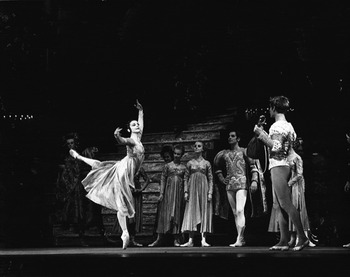
Lynn Seymour as Juliet and Christopher Gable as Romeo in Kenneth MacMillan's Romeo and Juliet. The Royal Ballet 1965. Photograph from Royal Opera House Collections © 1965 Roy Round. Permission granted by Tobias Round.

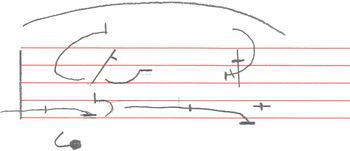
Seymour encourages a dancerly hermeneutic. Like Q1, MacMillan's Romeo and Juliet was made to be performed in a sense not recovered until one actually moves. Floor patterns take not only presentation into account, but lay down a runway where ample momentum can be attained to throttle through steeply banking turns. The simplicity of the script or two-dimensional images is given depth and a sense of motion though the relief of personal testimony and the smears of kinesthetic opposition. The off-axis dynamic challenges the Benesh notator not only because it is motion, but also because imbalance resists being repeated in exactly the same way by even the same performer. While having the line in Photo 3 not quite reach the top bar and be angled out toward the notator would render such off-axis moments explicit according to visual principles of a vanishing point, drawing it in this way runs contrary to the divisions of the Benesh notation (where the top bar is designated for the head). What is clear is that the torso is not vertical. Arguably Mitchell's and Watts's “way of seeing” archived within the archive attempts to preserve the revolutionary moments and momentum of Juliet.
From “Juliet's Solo,” from the Benesh score, notated by Faith Worth. Reproduction of Notation by Liz Cunliffe. Reproduced with kind permission of the Royal Academy of Dance.

Conclusion
Privileging printed text and film as somehow objective and unchanging is a presumption rendered dubious in light of the performative nature of editing to produce those documents. The security of the Folio is insecure, and its fixity is but a snapshot of a great deal of activity, a moment before momentum. By comparing variations between disparate printings of Romeo and Juliet, absences present themselves and invite speculation regarding the motivation behind and physicality involved in such effacing. Insisting upon the antipode—that performance is somehow more lasting, authentic, or emblematic of authorial intent—is likewise problematic, for interpretations may veer so far from choreographic or authorial intent as to make the crooked straight. Words—sounded through vibrating vocal chords, shaped by the mouth, and prompted by memories regained through re-enacting—are already embodied. In the context of dramatic scripts and coaching, these words are earned through performance, like sweat. Declassifying the archive—in the sense of making public—may lead to declassification: reencountering and reintegrating bodily arguments against the monolithic classic.