Introduction
Farmers use a variety of synthetic and natural inputs to support optimal plant growth. Conventional approaches to managing soil fertility rely on the application of fertilizers to supplement existing soil nutrients to achieve a ‘sufficient level of available nutrients’ (SLAN) for maximum crop yield. The SLAN concept is often integrated with a ‘buildup and maintenance’ (B&M) strategy in which farmers get soil nutrient levels to a target level, then apply soil amendments, usually nitrogen (N), phosphorus (P) and potassium (K), at rates designed to replace the nutrients removed in harvested crops (Eckert and McLean, Reference Eckert and McLean1981; Black, Reference Black1993).
Another approach to soil fertility management is ‘soil balancing.’ In addition to the application of N, P and K, the soil-balancing approach places a central focus on balancing calcium (Ca), magnesium (Mg) and potassium (K) levels to improve soil structure, stimulate soil microbiology and increase nutrient availability to crops, according to leading non-academic soil-balancing books (Kinsey and Walters, Reference Kinsey and Walters2006; McKibben, Reference McKibben2012; Astera, Reference Astera2014; Zimmer and Zimmer-Durand, Reference Zimmer and Zimmer-Durand2017). Soil balancers typically apply soil amendments with high levels of Ca and low levels of Mg to achieve recommended base cation saturation ratios (BCSRs) in the soil of 60–75% Ca, 10–20% Mg, 3–5% K and 15% of other cations. These ranges can vary based on the local soil and management contexts (Kinsey and Walters, Reference Kinsey and Walters2006; Zimmer and Zimmer-Durand, Reference Zimmer and Zimmer-Durand2017).
The ideas behind soil balancing originated over a century ago, but were further developed in the mid-20th century by William Albrecht, a University of Missouri soil scientist, and were later assembled, published and popularized by Charles Walters, founder of the alternative agriculture organization ACRES, USA. Early research on soil balancing was motivated by perceived negative impacts of synthetic sources of nitrogen (N), phosphorus (P) and K on soil and food quality (Albrecht, Reference Albrecht1975; Walters and Fenzau, Reference Walters and Fenzau2003; Albrecht and Walters, Reference Albrecht and Walters2011). A number of books have been published by private agronomic consultants that draw upon variations of the idea that adjusting Ca and Mg ratios can be a critical tool in managing soil fertility and soil health (Kinsey and Walters, Reference Kinsey and Walters2006; McKibben, Reference McKibben2012; Brunetti, Reference Brunetti2014; Zimmer and Zimmer-Durand, Reference Zimmer and Zimmer-Durand2017). The authors of these non-academic soil-balancing books regularly speak at agricultural meetings and/or operate consulting businesses.
Although accurate scientific estimates of the prevalence of the practice are difficult to find, soil-balancing practices focused on BCSR appear to be particularly prevalent within the organic sector (Ingram, Reference Ingram2007), which has grown dramatically in the USA and Europe over the last decade (Niggli et al., Reference Niggli, Slabe, Halberg, Schmid and Schlüter2008; Greene et al., Reference Greene, Dimitri, Lin, McBride, Oberholtzer and Smith2009; Greene, Reference Greene2013). In particular, two recent case studies of organic weed management found that over half of farmers perceived a relationship between soil nutrient levels, soil drainage and weed problems (Jabbour et al., Reference Jabbour, Gallandt, Zwickle, Wilson and Doohan2014; Zwickle et al., Reference Zwickle, Wilson and Doohan2014). Some of the farmers in these studies felt that changes in soil properties and weed populations were connected to their use of soil balancing.
Over the last 40 yr, there have been two reviews published that summarize results from the roughly 15 published scientific papers that have tested the ideas behind BCSR, only three of which were published since 1985 (Kopittke and Menzies, Reference Kopittke and Menzies2007; Chaganti and Culman, Reference Chaganti and Culman2017). These studies have all found manipulation of BCSR to have no significant effects on crop yield. As a result, the practice of soil balancing has been criticized by soil scientists for recommending overapplication of expensive amendments without evidence of any yield benefit (Chaganti and Culman, Reference Chaganti and Culman2017). Meanwhile, the growing reliance of farmers on private sector farm advisors has raised concerns about the objectivity or reliability of information obtained by farmers from these sources (Compagnone and Simon, Reference Compagnone and Simon2018), a concern that is reflected in scientists' critical views of private soil-balancing consultants, who are seen as having a vested financial interest in selling soil amendment products (Brock et al., Reference Brock2020).
Because scientific studies have focused primarily on the impacts of managing base cations on crop yield under controlled experimental conditions, many prominent soil-balancing practitioners feel that these experiments do not represent the actual practice of soil balancing (Kinsey and Walters, Reference Kinsey and Walters2006; Zimmer and Zimmer-Durand, Reference Zimmer and Zimmer-Durand2017). Although all of these consultants adhere to the core tenets of BCSR theory, their soil-balancing recommendations have evolved to include a wider range of management practices beyond adjusting Ca and Mg ratios, and advocate for an integrated approach to promoting soil health (Brock et al., Reference Brock2020).
To our knowledge, no previously published studies have provided a scientifically valid estimate of the prevalence of organic farmers who adhere to a soil-balancing philosophy, or captured information about the types of practices used and outcomes perceived by farmers who employ soil balancing. Our research was designed to fill this gap. To determine how widely soil balancing is used among organic farmers, we implemented a large scale survey of farmers who grow organically certified corn in Indiana (IN), Michigan (MI), Ohio (OH) and Pennsylvania (PA). We use the survey results to address four key research questions:
(1) What is the prevalence of soil balancing among organic corn farmers in this region?
(2) What soil management practices do self-identified soil balancers use?
(3) What types of farms are most likely to practice soil balancing?
(4) What agronomic and economic outcomes do organic corn farmers perceive from using soil balancing?
Methods
We implemented a mail survey of certified organic corn farmers in four states (IN, MI, OH and PA) in the early spring of 2018. The sample frame included all 1662 growers listed on the latest USDA certified Organic INTEGRITY Database list who raised corn in these states. A modified Dillman method was used in which an advance letter was sent in late January 2018 and three waves of surveys were mailed between February and April 2018, followed by reminder postcards after each wave (Dillman et al., Reference Dillman, Smyth and Christian2014). The survey was promoted through short articles in newsletters associated with several regional organic certification agencies. The 8-page survey contained questions about the overall farm operation and detailed information about a ‘typical field on which certified organic corn was raised in 2017.’ Field-level questions explored soil characteristics, field crop rotation history and use of various inputs.
The survey included questions about specific practices and overall philosophical approaches to organic soil management. It also solicited details about the respondent's understanding and use of ‘soil balancing.’ Based on our review of the soil-balancing literature and previous qualitative research with soil-balancing consultants and farmers, we centered our survey definition on BCSR. The core section of the survey on this topic began with the following text:
Some farmers follow a practice often referred to as soil balancing. Soil balancing usually focuses on balancing the saturation ratios of base cations (e.g., Calcium, Magnesium, Potassium) to improve soil qualities and the availability of other nutrients. Common target base cation saturation ratios are Calcium (65–75%), Magnesium (10–15%), and Potassium (3–5%). Soil balancing is often achieved through application of high calcium and low-magnesium forms of lime or gypsum. The next section asks you about your experiences with soil balancing (if any). Given this definition, do you use a version of this soil balancing approach on your farm?
We also recognized that soil balancing can include practices that go beyond BCSR management. Therefore, our survey instrument included different questions to capture the diverse ways that soil balancing might be practiced. Initially, respondents who answered yes to the first question (e.g., ‘self-identified soil balancers’) were invited to write out a short description of ‘what you do and what you are trying to accomplish’ through soil balancing? Answers to this open-ended question were qualitatively coded to capture the frequency with which key phrases or concepts were mentioned in the written answers. The survey also asked self-identified soil balancers how long they have used the approach, and solicited feedback on the kinds of impacts they perceived from the use of soil balancing on their farm. In a separate part of the survey, we asked farmers how important different considerations were to their soil management decisions. One option made explicit reference to BCSR, which enabled us to compare the consistency of answers between the two sections of the survey.
Finally, we captured information from all respondents about their use of a range of other soil amendments (manure, micronutrients, biostimulants, etc.) and cultural soil management practices (e.g., tillage, crop rotations, and cover crops), and compared the frequency of these behaviors between self-identified soil balancers and non-soil balancers.
A total of 859 farmers returned useable surveys, and an additional 166 farmers were disqualified because they did not grow certified organic corn in 2017 or were no longer farming at this address, which resulted in a final response rate of 57.4%. Response rates were highest in IN and OH (66 and 62%, respectively) compared to 53% in PA and 47% in MI. Organic corn production in this region is dominated by livestock producers. Roughly 75% of respondents raised livestock, and almost 60% milked dairy cows. Less than a third (27%) of respondents relied on the sale of cash grains (corn, soy and wheat) as their main source of farm income. Farms in our sample operated an average of 118 acres of organically certified land (median = 60 acres), which is very similar to the results of the 2016 USDA organic survey for this four state region (109 acres). About 70% operated between 10 and 99 acres. Only 4% of respondents operated more than 500 acres of certified organic farmland. Interestingly, there are a significant number of Amish-owned farms in the states included in this study, such as Pennsylvania (Winsten et al., Reference Winsten, Parsons and Hanson2000; Cross, Reference Cross2015) and Ohio (Donnermeyer and Luthy, Reference Donnermeyer and Luthy2013), and 63.5% of our respondents relied on horses to carry out fieldwork, a common indicator of adherence to Amish or conservative Mennonitepractices.
Results
The prevalence of soil balancing
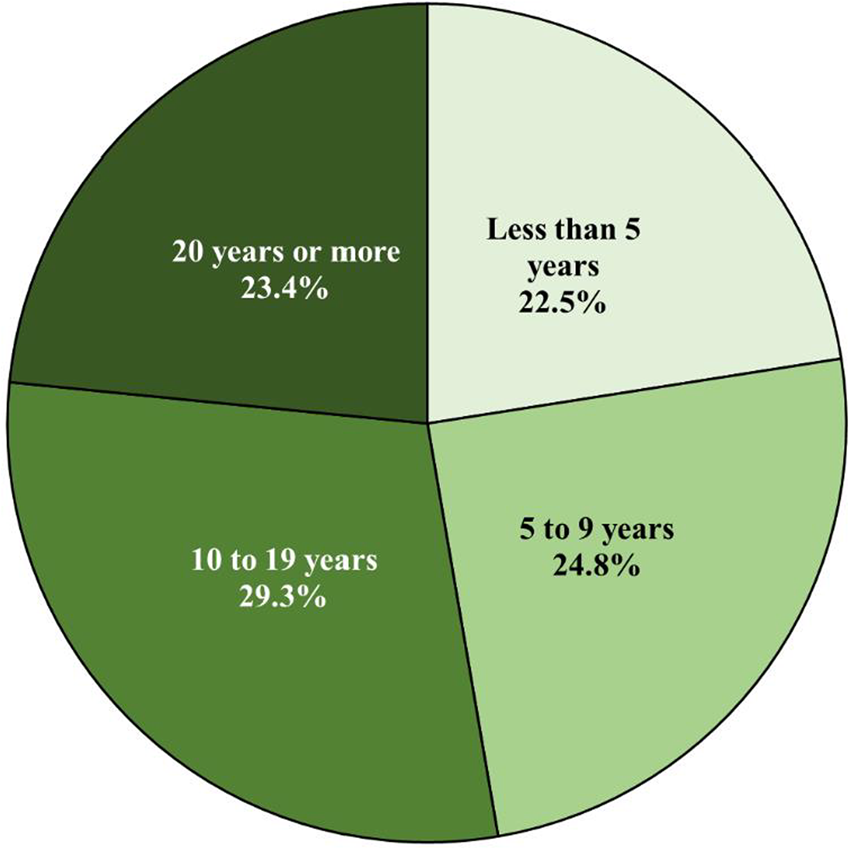
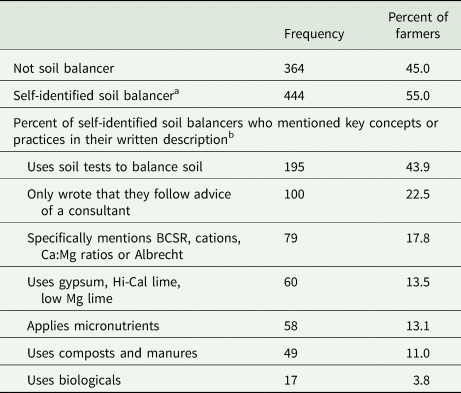
A little over half (55%) of organic corn growers indicated that they used a version of soil balancing similar to that described in the survey (Table 1). This suggests that a significant fraction of the organic farming population in this region is familiar with and self-identify as a soil balancer. The survey also asked all self-identified soil balancers how many years they have been using soil-balancing approaches. Over half reported practicing soil balancing for 10 yr or more (Fig. 1). This suggests that soil-balancing ideas are not a particularly new phenomenon among organic corn growers in this four-state region.
Percent of self-identified soil-balancing farmers based on years using this approach.

Percent of farmers reporting use of soil balancing, and frequency with which different concepts are mentioned in their written description of their soil-balancing management approach

a Indicated they use a practice meeting this definition: ‘…balancing the saturation ratios of base cations (e.g., calcium, magnesium, potassium) to improve soil qualities and the availability of other nutrients. Common target base cation saturation ratios are calcium (65–75%), magnesium (10–15%) and potassium (3–5%)… often achieved through application of high calcium and low-magnesium forms of lime or gypsum.’ An additional 51 respondents did not provide an answer to this question.
b Answers are not mutually exclusive; 35 self-identified soil balancers did not provide a written description.
To characterize their understanding and practice of soil balancing, we also used their written descriptions to explore the frequency with which they mentioned specific concepts and management practices. It is important to note that not all farmers gave us detailed written comments and the categories we constructed are not mutually exclusive. Rather, they capture the different overlapping key concepts that farmers chose to highlight as descriptions of their soil-balancing practices and goals.
The most common theme in the written descriptions was the use of soil tests to guide nutrient management decisions, mentioned by 44% of self-identified soil balancers. A significant fraction (23% of self-identified soil balancers) wrote that they relied on consultant advice to implement a soil-balancing program. The use of Hi-Cal lime and/or gypsum was only explicitly mentioned in 14% of the written comments. The application of these Ca-rich amendments is one of the primary ways BCSR levels are typically achieved or maintained. Thirteen percent of self-identified soil balancers mentioned micronutrients (especially boron), which reflects approaches often seen in the private consultant literature. Eleven percent of comments described the use of compost and manures as a key part of the approach to soil balancing. The diversity of goals and practices included in farmers' written descriptions of their soil-balancing approach underscores the complexities in how soil balancing is conceived and practiced among organic farmers.
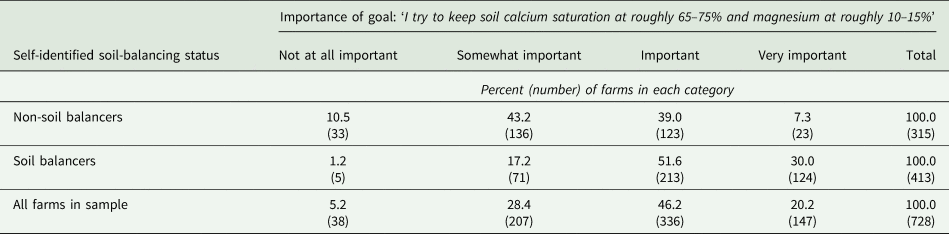
To gage how soil-balancing principles fit into broader management strategies, we asked all respondents to rank how important different considerations are to their soil management decisions. Among a list of 14 possible considerations, we included one option that was designed specifically to reflect BCSR soil-balancing principles: ‘I try to keep soil calcium saturation at roughly 65–75% and magnesium at roughly 10–15%.’ This question provides an independent estimate of the importance of soil balancing in this region. About 20% of respondents said BCSR was very important to them, and nearly two-thirds said it was either important or very important (Table 2). The results suggest most organic corn growers think that attaining a recommended target Ca:Mg ratio is important.
Number and percent of farmers rating BCSR balancing as important to their organic soil management strategy, by self-identified soil-balancing status

χ2 test significant at P < 0.001; η = 0.410.
Note: Only includes respondents who answered both questions.
A comparison of farmer responses to the original ‘do you use a soil-balancing approach’ question and the ‘how important is this principle to you’ question is shown in Table 2. Overall, the two variables are strongly related (χ2 significant at P < 0.001). Among the self-identified soil balancers, 30% indicated that achieving ideal Ca:Mg percentage was a ‘very important’ priority, and another 52% thought it was ‘important.’ Meanwhile, among farmers who did not identify as a soil balancer, significantly smaller proportions gave the same response (7 and 39%, respectively). Although a relatively small percent of self-identified soil balancers (roughly 18%) rated achieving BCSR target cation saturation levels as only somewhat or not important, given that BCSR is the core of the standard soil balancing approach.
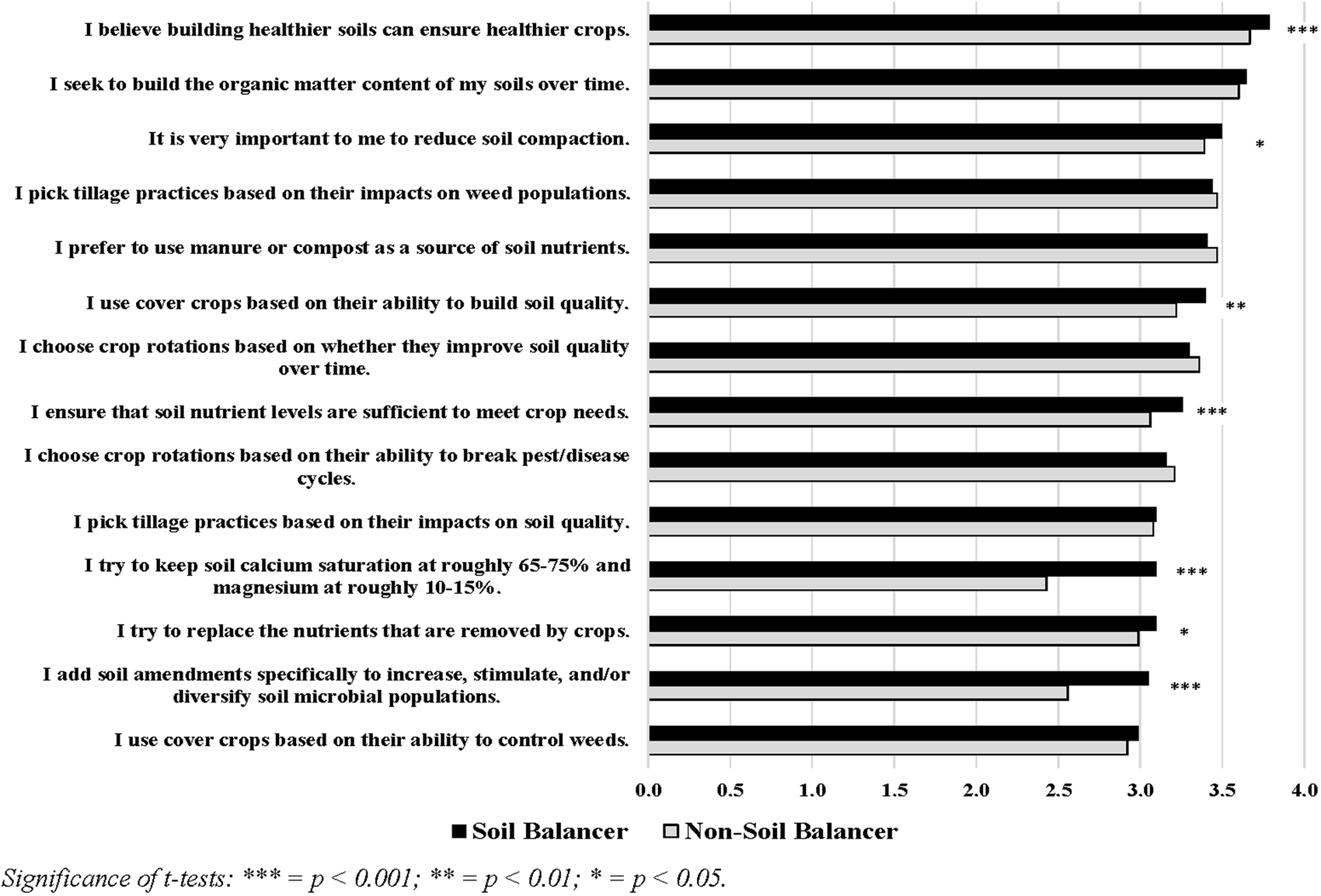
To see how soil balancing ranks alongside other considerations as a guide for soil management, we compared the average importance score for each of the 14 principles included in the survey (Fig. 2). Results suggest that the BCSR approach is less important than most other soil management considerations, regardless of self-identified soil-balancing status. Self-identified soil balancers did rate BCSR as more important than non-soil balancers (P ≤ 0.001). They also rated six other considerations as significantly more important than non-soil balancers, including replacing nutrients removed by crops, using amendments to stimulate soil biology, building soil quality and reducing soil compaction. Overall, even when they adhere to a soil-balancing philosophy, most self-identified soil balancers consider multiple soil management considerations (including but not limited to BCSR) when making soil management decisions.
Average importance of different soil management considerations among organic corn farmers, by self-identified soil-balancing status. Significance of t-tests: ***P < 0.001; **P < 0.01; *P < 0.05.

Use of different soil amendments and management practices
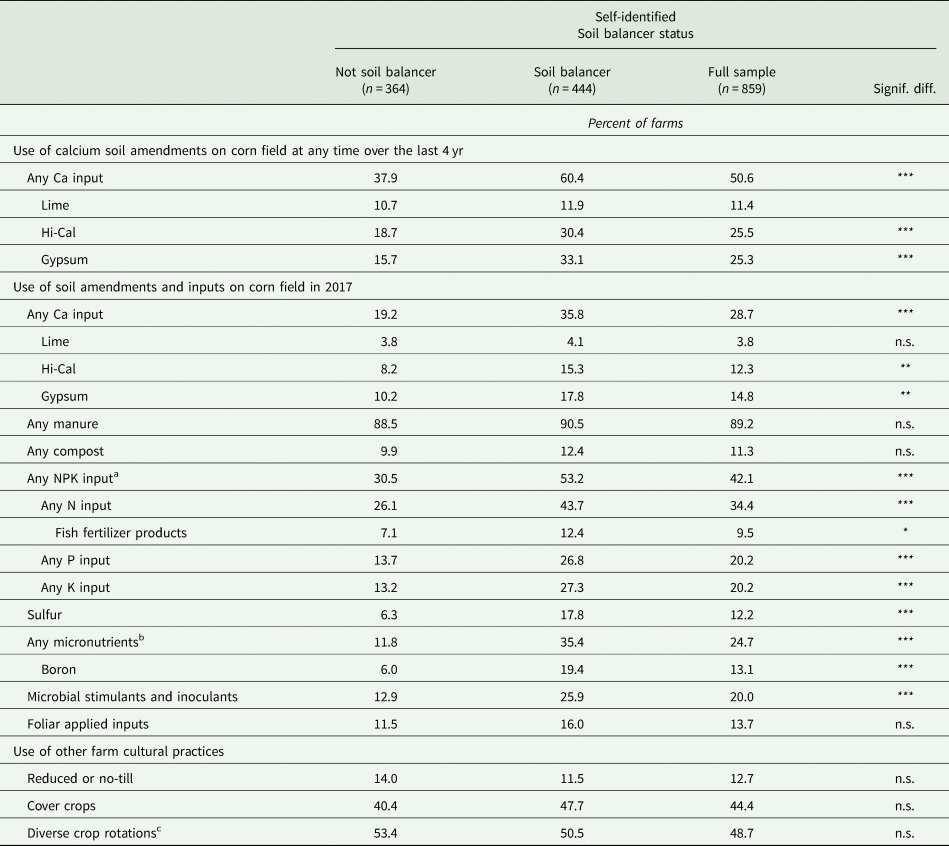
Before farmers answered the questions on BCSR soil balancing, the survey instrument gathered detailed information about specific management practices and soil amendments they had used on a typical organic corn field in 2017. This allowed us to compare the frequency of use of different farm inputs and management practices between self-identified soil balancers and non-soil balancers. Not surprisingly, farmers who self-identified as soil balancers were significantly more likely to use Ca amendments than other organic corn growers (Table 3). Self-identified soil balancers were roughly twice as likely to use BCSR-recommended Ca inputs such as Hi-Cal lime and gypsum on their cornfield in 2017 compared to non-soil balancers. This pattern was even more prominent when looking at the incidence of Hi-Cal lime and gypsum applications over the last 4 yr. Although the use of BCSR-linked forms of Ca was higher among soil balancers, they were no more likely to use agricultural lime compared to non-soil balancers.
Use of various soil amendments and inputs by self-identified soil-balancing status

Statistical significance from exact χ2 test where *P < 0.05; **P < 0.01; ***P < 0.001.
a Includes any amendments that included nitrogen, phosphorus and/or potassium (excl. compost and manure).
b These include farmers who specifically mentioned adding boron (B), copper (Cu), iron (Fe), manganese (Mn) and zinc (Zn). Some listed micronutrient products that also provided sulfur (e.g., copper sulfate or zinc sulfate). Others listed examples of commercially available mixed micronutrient amendments (such as SeaShield, Accelerate or PhotoMag sold by Advancing Eco-Agriculture) or generic ‘micronutrients’ but did not specify content.
c Farmer did not raise corn or soybeans in rotation on this field over previous 3 yr prior to planting corn.
With the exception of lime, manure and compost, which did not differ across the groups, the self-identified soil balancers were significantly more likely to use most other forms of soil amendments or fertility inputs. For example, over half of soil balancers used an organic fertilizer input containing N, P or K in 2017 (excluding manure and compost), compared to roughly 30% of non-soil balancers. Soil balancers were also three times more likely to apply sulfur as well as micronutrients (especially boron), and significantly more likely to apply biological inoculants and stimulants on their organic corn fields. Although there were some modest differences, it did not appear that soil-balancing farmers were more or less likely to use conservation tillage, cover crops or diverse crop rotations.
We found similar results when comparing soil management practices among farmers who rated BCSR goals at different levels of importance (not shown). The consistency of these patterns reinforces the idea that regardless of how we operationalize the concept of soil balancing, soil balancers are more likely to use a wide range of soil amendments on their organic corn fields.
Differences by farm enterprise type
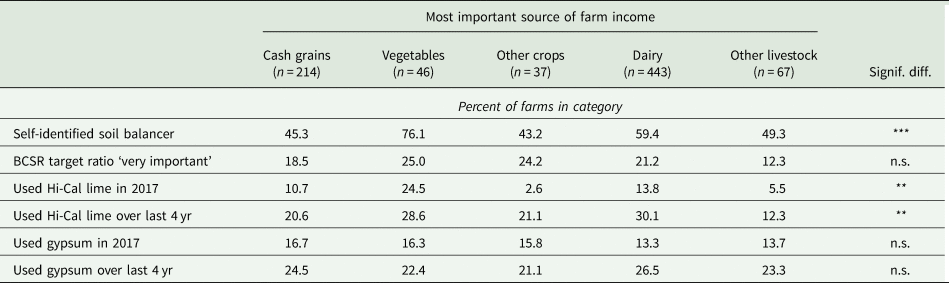
Although the survey sample was limited to certified organic farms growing corn in 2017, the respondents represented diverse types of farming operations (based on their most important sources of farm income). The prevalence of soil balancing and the use of specific farm management practices as summarized by farm type is shown in Table 4. Results suggest that operators of vegetable farms were more likely than other farm types to identify as a soil balancer and to frequently use Hi-Cal lime (P = <0.001). Dairy farmers were the next most likely to identify as a soil balancer (P ≤ 0.001) and to use Hi-Cal lime (P ≤ 0.01). There were no significant differences across farm types related to the percent of farmers reporting BCSR saturation levels as ‘very important’ to their management approach or in their use of gypsum.
Percent of respondents self-identifying as soil balancer or using calcium-based inputs, by farm enterprise type

Statistical significance from χ2 test where *P < 0.05; **P < 0.01; ***P < 0.001.
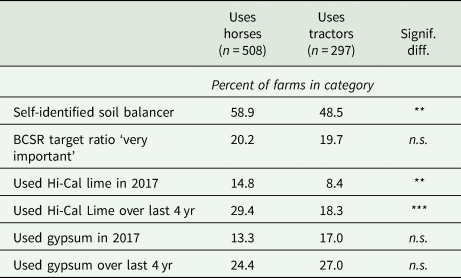
A large fraction of the farmers who grow organic corn in this region are members of Amish, Mennonite or other related communities. Among the respondents to the survey, nearly two-thirds (63.5%) relied primarily on horses to carry out fieldwork on their organic corn fields. In our region, the vast majority of farmers who use horse-drawn equipment in the field are Amish, particularly Old Order Amish, with smaller numbers of New Order Amish, Swartzentruber Amish and Mennonites (Long, Reference Long2003). Given that Old Order Amish rely on horses for field operations and have a desire to keep farms family centered, their farms tend to be smaller (Kraybill and Hostetter, Reference Kraybill and Hostetter2001; Cross, Reference Cross2015). As shown in Table 5, organic corn growers relying on horse-drawn equipment were more likely to self-identify as soil balancers (though they were not more likely to say that BCSR saturation targets were very important to them) (P < 0.001). These farmers were also more likely to use Hi-Cal lime (P < 0.001), but not more likely to use gypsum. The average acres of organic land operated for soil balancers were not statistically different from non-soil balancers (even when controlling for Amish status).
Percent of respondents self-identifying as soil balancer or using calcium-based inputs, by whether farmer used horses or tractors to pull field equipment

Statistical significance from χ2 test where *P < 0.05; **P < 0.01; ***P < 0.001.
Farmers’ observations of soil-balancing outcomes
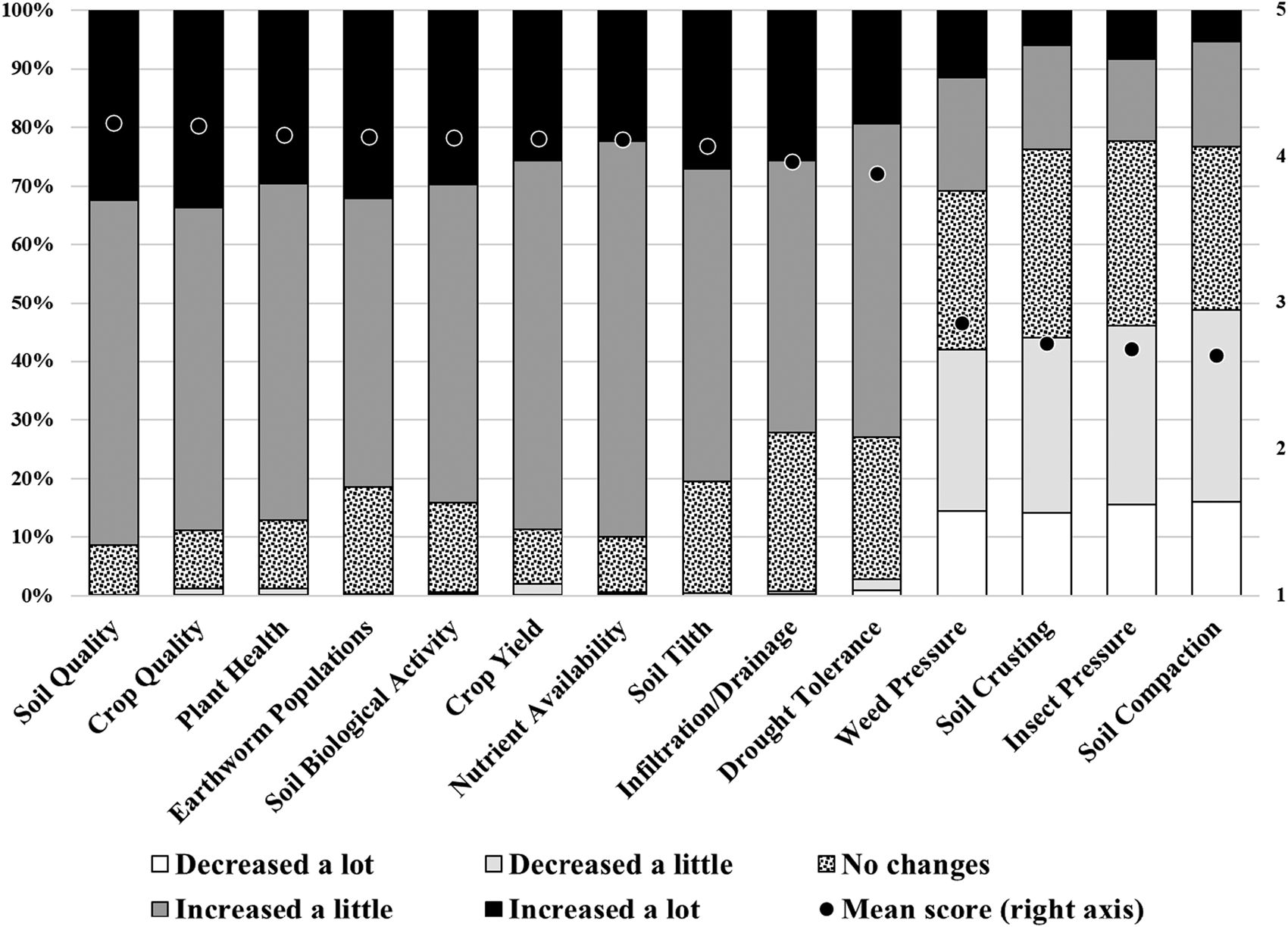
Self-identified soil balancers were asked to describe whether their use of soil balancing increased or decreased various types of outcomes on their farm. Results are shown in Figure 3. Farmers perceived an association between their use of soil balancing with a wide range of positive outcomes, particularly for soil quality and plant health (including crop quality, soil-biological activity and earthworm populations). Slightly fewer farmers (but still an overwhelming majority) perceived significant improvements in yield, nutrient availability and soil tilth. Although most farmers indicated they observed improved infiltration and drought tolerance, a few said that these did not change on their farms after they switched to a soil-balancing approach. Four items on the survey reflected negative agronomic stressors (weed pressure, insect pressure, soil crusting and soil compaction) that might be affected by the use of soil balancing. Most soil balancers reported that these negative conditions declined after balancing their soils (suggesting a benefit), but a minority reported increases in these problems
Percent of self-identified soil-balancing farmers reporting positive and negative agronomic outcomes on their farms.

Discussion
Soil balancing is an approach to soil fertility management that has been researched and promoted for decades by a group of private consultants and farmers (Kinsey and Walters, Reference Kinsey and Walters2006; McKibben, Reference McKibben2012; Brunetti, Reference Brunetti2014; Zimmer and Zimmer-Durand, Reference Zimmer and Zimmer-Durand2017), and is often prominently featured in books, magazines and presentations at organic and sustainable farming conferences and workshops. Building on research by Albrecht in the mid-20th century, modern soil balancing is centered on manipulation of the soil BCSR, but often integrates management of other aspects of soil chemistry, biology and physical conditions.
Our results suggest that over half of the farmers who raise certified organic corn in this four-state region adhere to a soil-balancing philosophy that involves using calcium amendments to balance the saturation ratios of base cations to improve soil quality and nutrient availability. At the upper bound, we estimate that 55–65% of organic corn farmers meet a basic definition of soil balancing. This reflects the share of farmers who self-identified as using the BCSR-focused soil-balancing approach described in the survey, as well as the proportion who said BCSR targets are ‘important’ or ‘very important’ to their soil management philosophy.
Although self-identification as a soil balancer is clearly very prevalent among organic corn farmers overall, we observed significant complexity in the operational definitions and actual practices farmers associated with the use of soil balancing. For example, the intensity of their use of BCSR management principles and practices varied. Based on their written descriptions of their approaches, it appears that self-identified soil balancers draw on diverse sources of information and use a broad range of management guidelines to determine their soil-balancing practices. Conservatively, we estimate that roughly 20% of all organic corn growers utilize a strong BCSR approach that focuses heavily on target cation saturation ratios, as evidenced by their writing about these ratios when describing their soil-balancing approach, or by ranking BCSR goals as ‘very important’ to their soil management decisions.
This diversity was reflected in their actual use of inputs on certified organic corn fields. As one would expect from BCSR theory, self-identified soil balancers were much more likely to have applied specialized calcium amendments (gypsum or Hi-Cal forms of lime) to their corn fields. However, just over half (54%) of self-identified soil balancers used one or both of these amendments over the last 4 yr on their corn fields compared to 31% of non-self-identified soil balancers. Soil balancers also reported greater use of several other purchased soil amendments (organic NPK fertilizer blends, micronutrients, microbial stimulants and inoculants, etc.). We did not see any difference between self-identified soil balancers and non-soil balancers in their frequency of use of other common organic farming management practices, including compost or manure amendments, cover crops and diverse crop rotations.
Organic farms that rely on the sale of vegetables or dairy products for the majority of their farm income were more likely to self-identify as a soil balancer than cash grain farmers. Since both vegetable and dairy farms produce relatively high-value products, this suggests a possible link between the intensity of farm sales and the use of soil-balancing approaches. It could also reflect particular concerns about calcium deficiencies in soils on dairy farms, an issue raised by BCSR's original proponents (Albrecht and Walters, Reference Albrecht and Walters2011). Similarly, farmers who used horses to pull equipment on their corn fields (likely members of Amish communities) were also more likely to use a soil-balancing approach than tractor farmers. It is not clear whether the apparently greater prevalence of soil balancing among Amish farmers reflects cultural or social factors or is merely a reflection of their greater reliance on dairy and vegetable production (vs cash grains).
Farmers and consultants have long argued that soil balancing has generated positive results under working farm conditions. The nonacademic soil-balancing literature (i.e., ACRES, USA books and newsletter) is full of descriptions of experiences where BCSR principles and associated practices have transformed relatively poor producing soils into dynamic and productive agricultural fields (McKibben, Reference McKibben2012; Brunetti, Reference Brunetti2014; Zimmer and Zimmer-Durand, Reference Zimmer and Zimmer-Durand2017). Over 80% of the self-described soil balancers in our survey reported observing positive impacts from using the practice on several indicators of soil health and crop quality. Most common were perceived improvements in soil physical and biological quality, plant nutrient availability and improved crop health and quality, which is consistent with the claims made by soil-balancing consultants (Kinsey and Walters, Reference Kinsey and Walters2006; McKibben, Reference McKibben2012; Brunetti, Reference Brunetti2014; Zimmer and Zimmer-Durand, Reference Zimmer and Zimmer-Durand2017).
This difference between unfavorable scientific research findings and the widespread use and perceived benefits of soil balancing among consultants and farmers presents a puzzle. The perceived benefits of farmers and experiences of consultants seem on the surface to conflict with the lack of positive results in scientific studies. To some extent, the gap could be explained by differences in the definition of soil balancing (BCSR-only i.e., manipulations of Ca, Mg and K saturation ratios) deployed in most scientific experiments vs a more complex and expansive definition (BCSR + other soil health practices) that can be seen in the private sector consultant literature. Indeed, consultants often argue that managing base cations alone is unlikely to generate the outcomes associated with the practice (Kinsey and Walters, Reference Kinsey and Walters2006; Brunetti, Reference Brunetti2014; Zimmer and Zimmer-Durand, Reference Zimmer and Zimmer-Durand2017). These more expansive conceptions of soil balancing are reflected in our survey results where self-identified soil balancers were more likely to use a wide range of practices, and their written definitions of soil balancing often included concepts and approaches that go well beyond BCSR.
Whatever the reason, it is clear that organic farmers and consultants who use alternative practices such as soil balancing draw more on personal experiences and input from neighbors and colleagues rather than peer-reviewed papers to guide their approaches, and their decisions tend to be pragmatic, flexible and context specific (Romig et al., Reference Romig, Garlynd, Harris and McSweeney1995; Ingram et al., Reference Ingram, Fry and Mathieu2010; Schneider et al., Reference Schneider, Ledermann, Fry and Rist2010; Krzywoszynska, Reference Krzywoszynska2019).
Since soil balancing among farmer respondents in our survey was associated with greater use of a wide range of other organic soil amendments (micronutrients, microbial stimulants and NPK fertilizers), it is possible that the agronomic benefits farmers perceive could be the result of independent or interacting effects of these complementary practices with BCSR management. We are not aware of any published peer reviewed research that systematically examines the interactions of BCSR management with the use of other organic farming soil amendments or cultural practices. Meanwhile, there is a parallel scientific literature (not targeting soil balancing) that documents potential benefits of gypsum amendments on soil tilth and drainage, particularly when soils have excessively high Mg levels (Favaretto et al., Reference Favaretto, Norton, Joern and Brouder2006; Reading et al., Reference Reading, Baumgartl, Bristow and Lockington2012; Wang and Yang, Reference Wang and Yang2018; Tirado-Corbala et al., Reference Tirado-Corbala, Slater, Dick, Bigham and Munoz-Muno2019). Since some agronomic research on gypsum utilizes forms of gypsum (industrial byproducts) that are not allowed in organic production, it could be useful to expand this work to include organic production amendments and management systems.
Our study has several limitations. The sample included only farms with certified organic corn acreage in the eastern corn belt/northeast region. Given that corn farmers who grew vegetables were most likely to be soil balancers, it would be helpful to study soil balancing using a larger targeted sample of organic vegetable farmers (many of whom do not grow corn and thus were not in our sample). It would also be useful to conduct surveys of organic producers in other parts of the USA to see if the prevalence of soil-balancing practices differ, especially considering that organic farms in our study area tend to be smaller than national averages (McBride et al., Reference McBride, Greene, Foreman and Ali2015) and were dominated by Old Order Amish. Anecdotal evidence from our interviews with local consultants and farmers suggests that soil balancing is also practiced by conventional grain farmers in our region, and it would be interesting to explore whether the prevalence and diversity of soil management practices deployed by certified organic farmers is duplicated among conventional farmers.
Finally, in terms of assessing outcomes of soil balancing, we recognize that our findings reflect farmer perceptions and we were not able to independently evaluate their reports of improvements in soil health, crop yields, etc. Moreover, our analysis focuses on farmers who self-identified as soil balancers rather than comparing farmers based on actual measurements of their soil's Ca:Mg:K ratios.
In conclusion, our results suggest that soil balancing is a widely used method of managing soil quality in organic corn production in our study region, but the way farmers use the practice typically combines manipulation of BCSR with use of other soil amendments designed to adjust soil chemistry, biology and physical structure. Farmers perceive positive outcomes from using soil balancing, but there is a need to evaluate these claims independently since their perceptions may reflect the impacts of non-BCSR practices, and their observations may be influenced by feedback from their private consultants, who may have a financial conflict of interest associated with the sale of soil-balancing amendments.
The gap between scientific skepticism and widespread practice among organic farmers reflects both challenges and future possibilities for collaboration. Previous published scientific studies have a limited focus on BCSR chemistry impacts on crop yield. Future scientific research on soil balancing would do well to explore the independent and potential interacting effects of soil Ca:Mg ratios with other related soil amendments and management practices that are used by farmers who claim to be following this approach. Concerns about the impacts of reliance on synthetic fertilizers on soil quality has led to a large and growing scientific literature comparing the impacts of synthetic fertilizers vs manure/compost amendments (Haynes and Naidu, Reference Haynes and Naidu1998; Gopinath et al., Reference Gopinath, Saha, Mina, Pande, Kundu and Gupta2008; Melero Sanchez et al., Reference Melero Sánchez, Madejón, Herencia and Ruiz Porras.2008; Bullock and Hitzhusen, Reference Bullock and Hitzhusen2015; Dhaliwal et al., Reference Dhaliwal, Naresh, Mandal, Walia, Gupta, Singh and Dhaliwal2019). This study and the emerging field of integrated soil health research (Bhardwaj et al., Reference Bhardwaj, Jasrotia, Hamilton and Robertson2011; Larkin, Reference Larkin2015; Lehman et al., Reference Lehman, Cambardella, Stott, Acosta-Martinez, Manter, Buyer, Maul, Smith, Collins and Halvorson2015) could provide a model for more holistic and interdisciplinary approaches to studying complex farming systems, particularly approaches that rely on the use of on-farm resources (like manure) and adaptive management of agroecosystem dynamics, as is common among organic farmers.
Acknowledgements
We are grateful for the organic corn farmers who took the time to fill out the survey and share their views and experiences on soil balancing. We also benefited from input from and discussions with other members of our project team, and extensive editorial support from Cassandra Brown.
Financial support
This study is supported by Organic Agriculture Research & Extension funding grant no. 2014-51300- 22331/project accession no. 1003905 from the USDA National Institute of Food and Agriculture.
Conflict of interest
There are no financial interests or conflict of interests, in general, involving this research.
Ethical standards
This research was approved by the Institutional Review Board of the Ohio State University.