Introduction
Over the past century, the Earth's climate has warmed by approximately 0.6°C (Easterling et al., Reference Easterling, Horton, Jones, Peterson, Karl, Parker, Salinger, Razuvayev, Plummer, Jamason and Folland1997, Reference Easterling, Evans, Groisman, Karl, Kunkel and Ambenje2000; Walther et al., Reference Walther, Post, Convey, Menzel, Parmesan, Beebee, Fromentin, Hoegh-Guldberg and Bairlein2002). However, this trend in rising temperature has not been a steady process; and, since the mid-1970s, parts of the world have experienced a rapid increase to a rate of warming of 0.2°C per decade (Karl et al., Reference Karl, Knight and Baker2000). Aphids, like all insects, are ectothermic and, therefore, possess a limited ability to regulate body temperature above or below ambient. As a consequence, climate warming is likely to have profound effects on distribution patterns and the pest and invasive status of insects (e.g. Williams & Liebhold, Reference Williams and Liebhold1995; Parmesan, Reference Parmesan1996; Hill et al., Reference Hill, Thomas and Huntley1999; Parmesan et al., Reference Parmesan, Ryrholm, Stefanescu, Hill, Thomas, Descimon, Huntley, Kaila, Kullberg, Tammaru, Tennent, Thomas and Warren1999; Yamamura & Yokozawa, Reference Yamamura and Yokozawa2002; Battisti et al., Reference Battisti, Stastny, Netherer, Robinet, Schope, Roques and Larsson2005; Vanhanen et al., Reference Vanhanen, Veleli, Paivinen, Kellomaki and Niemela2007; Tougou et al., Reference Tougou, Musolin and Fujisaki2009).
The majority of research into insect thermal biology has focused on the lethal effects of low temperatures and the ability of insects to exhibit seasonal and rapid cold hardening (e.g. Bale et al., Reference Bale, Harrington and Clough1988; Larsen & Lee, Reference Larsen and Lee1994; McDonald et al., Reference McDonald, Bale and Walters1997; Kelty & Lee, Reference Kelty and Lee1999; Powell & Bale, Reference Powell and Bale2004, 2008; Sinclair & Chown, Reference Sinclair and Chown2006). However, non-lethal thermal thresholds can have important effects on insect performance and success. Due to the limited control of body temperature, the thermal environment will affect many aspects of the biology and behaviour of insects. It is the non-lethal thermal tolerance traits, such as temperatures of induced coma and movement thresholds, which provide ecologically relevant information since survival is of little benefit if movement is compromised, resulting in mortality through inability to feed or escape predation or parasitism.
A new method described in Hazell et al. (Reference Hazell, Pedersen, Worland, Blackburn and Bale2008) has enabled the continuous recording and measurement of non-lethal thermal tolerance traits in small insects. This method permits multiple specimens to be cooled or heated within an arena and behavioural traits to be recorded by video capture technology without disturbance to the specimens. The method has already proven successful in determining movement and coma thresholds, which can otherwise be hard to define (Hazell et al., Reference Hazell, Groutides, Neve, Blackburn and Bale2010a,Reference Hazell, Neve, Groutides, Douglas, Blackburn and Baleb). More recently, the method has been adopted to investigate relative walking speeds of predator and prey species to determine the potential of a predatory insect to act as a biological control agent (Hughes et al., Reference Hughes, Alford, Bale and Sterk2010).
Here, we report experiments investigating relative walking speeds of the peach-potato aphid Myzus persicae (Sulzer) (Hemiptera: Aphididae) using the method described in Hazell et al. (Reference Hazell, Pedersen, Worland, Blackburn and Bale2008). This aphid species has an extensive, global distribution and, in Europe, is found from Scandinavia to Spain, experiencing sub-Arctic through to temperate and Mediterranean climates (Blackman, Reference Blackman1974). The aphid also has many genetically distinct clones within both its holocyclic (sexual) and anholocyclic (asexual) life cycles. This leads to three possible outcomes when investigating variation in walking speeds along the latitudinal cline of the species' European distribution: (i) A relationship between walking speed and latitude exists indicating that regional adaptation occurs. (ii) Aphid mixing throughout Europe is extensive and no relationship between walking speed and latitude is evident. (iii) Clones differ in thermal tolerance and mobility and, as a consequence, any pattern in walking speed depends on the composition of the population at the time of collection. Due to the recent development of the method, no study exists whereby latitudinal variation in relative walking speeds of an insect species has been determined. This study investigates the plasticity and adaptability in the walking speed of different clones of M. persicae collected from geographically distinct climates within its European distribution and then acclimated at temperatures that would be commonly and less frequently experienced at the different collection sites. Such information will be useful in increasing the baseline knowledge on aphid thermal biology with implications for pest management and the prediction of how and which clones or populations of M. persicae will be affected by climate change.
Materials and methods
Insect material
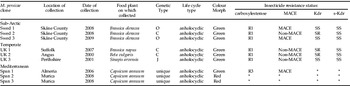
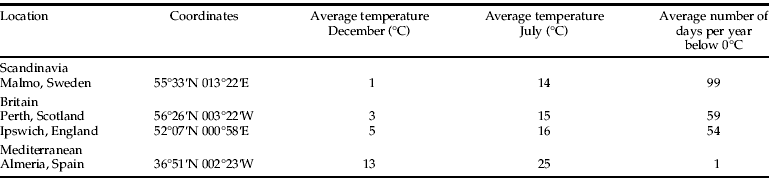
Individual Myzus persicae clones were collected from three geographically distinct regions within Europe (Sweden, Britain and Spain) to represent a latitudinal gradient spanning approximately 20°. Nine clones were collected in total, three from each geographically distinct region. Detailed information on experimental clones is provided in table 1, with code names used throughout for individual clones provided in the first column. Meteorological data for locations near to aphid collection sites are provided in table 2 as an indication of the variation in local climate between collection sites.
Characteristics of aphid clones used in experiments including aphid collection information, genetic variability, lifecycle type and insecticide resistance, where available. Genetic type is indicated by a universal letter code, with clones of the same letter proving identical at the loci examined. Clones classified as unique proved individual from microsatellite analysis and have not, as of yet, been assigned a genetic type. Insecticide resistance was determined by four resistance mechanisms. Carboxylesterase levels are indicated by classifying clones as either susceptible (s), of median resistance (R1), high resistance (R2) or extreme resistance (R3). The presence of modified acetylcholinesterase (MACE) is indicated by clones being classified as either MACE or Non-MACE. Knockdown resistance (Kdr) and super Kdr (s-Kdr) is indicated by clones being classified as either super susceptible (SS) or super resistance (SR).

* Information on resistance is not available as clones were lost due to overheating in CE room, before typing.
Meteorological data for locations close to aphid collection sites (Data: Weatherbase, http://www.weatherbase.com/).
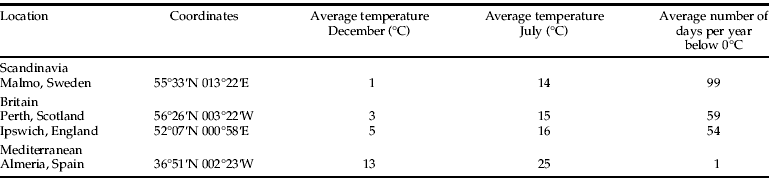
Single monoclonal lineages were established for each of the nine experimental clones and maintained in the laboratory at 20±0.5°C, photoperiod L:D 16:8 h, representing an approximate intermediate temperature for the three locations (average July temperatures for Malmo, Sweden and Almeria, Spain are 14°C and 25°C, respectively. Source: Weatherbase, http://www.weatherbase.com/). Aphid culturing was carried out in ‘Blackman boxes’ (Blackman, Reference Blackman, Minks and Harrewijn1988) for which aphids were enclosed within a ventilated box containing a single leaf of food material, Chinese cabbage (Brassica rapa var. Wingbok). The apterous aphid nymphs (<25 h old) used in experiments were the offspring of adults, synchronized in age, which had developed at one of the five temperature acclimation regimes from birth: constant culture at 20±0.5°C, 10±0.5°C for one generation, 10±0.5°C for three generations, 25±0.5°C for one generation and 25±0.5°C for three generations. Acclimation over one generation investigated intragenerational effects whilst acclimation over three generations examined intergenerational effects.
Lifecycle type
The lifecycle type of clones was determined using a method previously described by Vorburger et al., (Reference Vorburger, Lancaster and Sunnucks2003). Reproducing adults (known as generation G0) were placed under conditions of short day length (L:D 12:12 h) and lower temperature (14.5°C) and allowed to reproduce for 48 h within freshly prepared Blackman boxes, conditions known to induce sexual morphs in holocyclic clones. Adults were removed after 48 h and nymphs (G1 generation) allowed to develop into wingless parthenogenetic females under these conditions. On commencing reproduction, four adults of the G1 generation were retained for each clone and allowed to reproduce for a total of 20 days. All nymphs produced (G2) were retained and allowed to develop until adult ecdysis to determine the morph type. Aphid morphs were classified as alate (winged) or apterae (wingless) or male. Of the alate forms produced, four were transferred to separate Blackman boxes and allowed to reproduce for sufficient time to produce approximately five nymphs each. The resultant nymphs (G3) were allowed to develop until adult ecdysis, and the aphid morphs were again classified as apterous parthenogenetic females or sexual females and consequently as either holocyclic, anholocyclic or of an intermediate lifecycle type (androcyclic or intermediate).
Genetic variation
The ability of M. persicae to reproduce clonally, both within the anholocyclic and holocyclic lifecycles, results in the production of genetically distinct aphid clones within a population (Fenton et al., Reference Fenton, Woodford and Malloch1998, Reference Fenton, Malloch, Woodford, Foster, Anstead, Denholm, King and Pickup2005; Kasprowicz et al., Reference Kasprowicz, Malloch, Pickup and Fenton2008). As a consequence, the genetic variability of the nine experimental clones was determined using microsatellite DNA analysis performed at the Scottish Crop Research Institute in Dundee, Scotland. DNA was extracted from a single aphid preserved in ethanol, representing one of the nine asexual clones and amplified. Three microsatellite loci, chosen for resolution, were selected (M49, M63 and M86) and amplified using fluorochrome primers labelled at the 5′ end of the reverse primer and PCR ready to go beads, and then analysed on an automated sequencer using the method detailed in Kasprowicz et al. (Reference Kasprowicz, Malloch, Pickup and Fenton2008). Aphids with identical microsatellite patterns at the loci examined were likely to have originated from the same stem mother and were classified as the same type. Due to dominance by a limited number of clonal types within northern Europe (Fenton et al., Reference Fenton, Margaritopoulos, Malloch and Foster2010), the three, highly polymorphic loci provide effective sorting of clonal types. In the event of finding unusual clones, microsatellite analysis could be expanded to include three additional loci (M35, M40 and myz9). When six loci are used, the probability of any two aphids having the same genotype at each of the three loci by chance is 2.43E−13 (Fenton et al., Reference Fenton, Margaritopoulos, Malloch and Foster2010). Assuming that the allele frequency is equal or very similar at the three loci used in the current study, the probability becomes 5.15E−9. The ability to identify distinct clones enabled further investigation into whether aphids of the same clonal type are more alike in their thermal tolerance than clones of different types.
Insecticide resistance type
Differential fitness of aphid clones linked to variation in insecticide resistance has recently been reported and suggests that possession of the Kdr mechanism reduces aphid responsiveness to environmental cues (Fenton et al., Reference Fenton, Margaritopoulos, Malloch and Foster2010). It is possible that possession of insecticide resistance mechanisms may prove costly to other aspects of aphid biology such as their thermal biology. The resistance type of the experimental clones, therefore, was determined to enable investigation into possible links between insecticide resistance and aphid thermal tolerance.
Clones were characterised for insecticide resistance mechanisms by Rothamsted Research in Hertfordshire, England, using a method described in van Toor et al. (Reference van Toor, Foster, Anstead, Mitchinson, Fenton and Kasprowicz2008). The level of carboxylesterase, conferring resistance to organophosphates and carbamates, was measured using an esterase assay by absorbance at 450 nm. Aphid clones were then categorised as either susceptible (S), with medium resistance (R1), high resistance (R2) or with extreme levels of resistance (R3). The presence of modified acetylcholinesterase (MACE) was determined using a kinetic assay and scored as either MACE or Non-MACE. Resistance to pyrethroids was determined via identification of Kdr and s-Kdr mutations using an allelic discrimination PCR assay on L1014F and M918 T in the voltage gated sodium channel protein (for more detailed information on all resistance typing experiments, see van Toor et al., Reference van Toor, Foster, Anstead, Mitchinson, Fenton and Kasprowicz2008).
Determining walking speeds
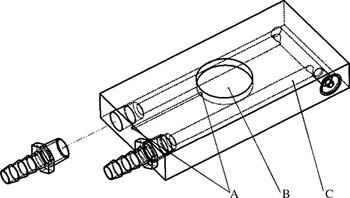
The effect of temperature on activity thresholds was determined using a method described by Hazell et al. (Reference Hazell, Pedersen, Worland, Blackburn and Bale2008). An aluminium block arena (fig. 1) was created, which attached to an alcohol bath (arena depth 7.5 mm, diameter 25 mm), enabling pumping of heated or cooled alcohol fluid throughout channels drilled into the block and thus allowing fine control over the temperature experienced within the arena. The walls of the arena were coated with Fluon (Blades Biological, UK) to prevent aphids climbing up the arena sides, and a thermocouple (Tecpel, Taiwan) was placed within the arena to accurately monitor the exposure temperature experienced. A camera (Infinity 1–1; Lumenera Scientific, Canada) was positioned directly over the arena, which connected to video recording software (Studio Capture DT; Studio86designs, UK) on a desktop computer.
Aluminium block design used to measure aphid activity thresholds: (A) channel for the thermocouple to measure arena temperature; (B) aphid arena; (C) channel for pumping alcohol fluid to enable fine temperature control over the arena (Hazell et al., Reference Hazell, Pedersen, Worland, Blackburn and Bale2008).

A sample of five aphid nymphs was placed within the arena set to the culture temperature, and the arena was covered with a thin sheet of Perspex. The arena temperature was lowered from culture temperature at a rate of 0.5°C min−1. At 2.5°C intervals, cooling was temporarily halted, and the arena was held at the specific temperature for five minutes, before cooling continued to the next temperature, 2.5°C lower. Cooling continued in this way until 0°C was reached. During the five minute holding periods, the camera recorded aphid movement within the arena at a rate of one frame per five seconds, and videos were logged to a desktop computer with both time and temperature displayed on the screen. This procedure was repeated with a new sample of aphids to produce a total of ten aphids for each clone by treatment combination.
Videos of aphid movement were played back using StudioMeasure (Studio86designs, UK), frame by frame, with arena temperature and time displayed on the screen. Distance travelled was measured using the computer mouse to mark the location of the aphid on screen. The video was then moved on one frame, and the new location of the aphid was marked. This was continued for the entire video. When marking an aphid position, the tip of the head was selected as the point of marking because this was an easily identifiable reference point for each specimen.
The resultant computer output was exported to Microsoft Excel in the form of a series of values of distance travelled (mm) per frame for each holding temperature. Data from four minutes of film were used for each holding temperature for subsequent analyses.
Statistical analysis
Walking speed data were analysed using the Scheirer-Ray-Hare extension of the Kruskal Wallis test (a non-parametric two-way ANOVA design since the data were not normally distributed but were of equal variance) performed in MINITAB (Minitab Inc., 2004), with clone and temperature inputted as factors, a method previously detailed in Hughes et al. (Reference Hughes, Alford, Bale and Sterk2010). Since the declining temperature regimes during which aphid mobility was recorded varied between acclimation treatments, data from different acclimation treatments were analysed separately as opposed to combined to investigate clonal variation in walking speeds.
Results
Characterisation of lifecycle, clonal and insecticide resistance types of experimental clones
Details of the characterisation of the nine experimental clones are displayed in table 1. Insecticide resistance varied between experimental clones. All experimental clones were of the anholocyclic lifecycle and were categorized as six different clonal types. The three Mediterranean clones were each unique, although they had not previously been assigned a universal clonal type code. UK 3 was shown to be a clonal type J; and Swed 2, UK 1 and UK 2 were shown to be a clonal type C. Swed 1 and Swed 3 were clonal type O, only recently reported in Britain and not in Scandinavian at the time of collection (Fenton et al., Reference Fenton, Margaritopoulos, Malloch and Foster2010).
Walking speed
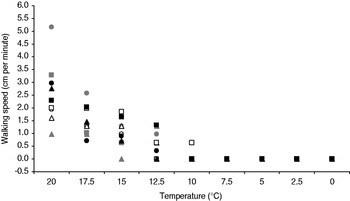
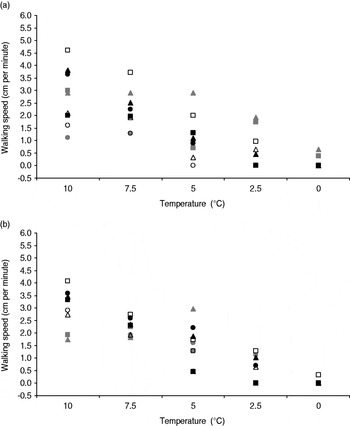
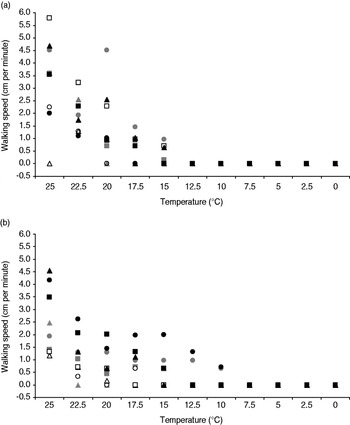
Scheirer-Ray-Hare tests revealed significant effects of temperature and clone on walking speeds for nymphs reared at constant 20°C (temperature: P<0.001; H=6742; df=8, clone: P<0.001; H=230; df=8) (fig. 2), at 10°C for both one generation (temperature: P<0.001; H=2652; df=4, clone: P<0.001; H=689; df=8) and three generations (temperature: P<0.001; H=3060; df=4, clone: P<0.001; H=184; df=8) (fig. 3), and at 25°C for both one generation (temperature: P<0.001; H=8719; df=10, clone: P<0.001; H=847; df=8) and three generations (temperature: P<0.001; H=6866; df=10, clone: P<0.001; H=975; df=8) (fig. 4).
Median walking speed (cm min–1) of M. persicae nymphs at a range of constant temperatures when acclimated to 20°C. Spanish clones are represented by closed grey symbols, British clones by open symbols and Swedish clones by closed black symbols. Interquartile range values for median values are provided in Appendix 1 ( , Span 1;
 , Span 2;
 , Span 3; ○, UK 1; △, UK 2; □, UK 3; ●, Swed 1; ▲, Swed 2; ▪, Swed 3).

Median walking speed (cm min–1) of M. persicae nymphs at a range of constant temperatures when acclimated to 10°C for (a) one generation and (b) three generations. Spanish clones are represented by closed grey symbols, British clones by open symbols and Swedish clones by closed black symbols. Interquartile range values for median values are provided in Appendix 1 (, Span 1; , Span 2; , Span 3; ○, UK 1; △, UK 2; □, UK 3; ●, Swed 1; ▲, Swed 2; ▪, Swed 3).

Median walking speed (cm min–1) of M. persicae nymphs at a range of constant temperatures when acclimated to 25°C for (a) one generation and (b) three generations. Spanish clones are represented by closed grey symbols, British clones by open symbols and Swedish clones by closed black symbols. Interquartile range values for median values are provided in Appendix 1 (, Span 1; , Span 2; , Span 3; ○, UK 1; △, UK 2; □, UK 3; ●, Swed 1; ▲, Swed 2; ▪, Swed 3).

Median walking speed decreased with temperature for any one treatment. The fastest rates of walking were observed at 25°C for aphids acclimated to 25°C for one generation (fig. 4) (e.g. fastest median walking speed of 5.8 cm min–1 was recorded for UK 3). However, walking speeds for aphids acclimated at 20°C (fig. 2) or 25°C, although initially relatively rapid, quickly decreased. On reaching temperatures of 10°C and below, most aphid clones acclimated at 20°C and 25°C displayed median walking speeds of 0.0 cm min–1 with little variation around the medians, indicating that the majority of individuals were immobile. Aphids acclimated at 10°C, however, maintained greater relative rates of walking to temperatures as low as 0°C (fig. 3).
No relationship between walking speed and latitude of aphid collection was evident across all acclimation treatments, although some clonal variation was suggested by the data. UK 3, for example, displayed relatively fast walking speeds across the majority of acclimation treatments (e.g. median of 4.6 cm min−1 at 10°C and 3.7 cm min−1 at 7.5°C following acclimation for one generation at 10°C; 4.1 cm min−1 at 10°C and 2.7 cm min−1 at 7.5°C following acclimation over three generations at 10°C; 5.8 cm min−1 at 25°C and 3.2 cm min−1 at 22.5°C following acclimation for one generation at 25°C) and maintained mobility to lower temperatures relative to the other clones. However, this was not consistent with results obtained following acclimation over three generations at 25°C (fig. 4) where UK 3 became one of the slowest of clones (e.g. median 1.3 cm min−1 at 25°C and 0.7 cm min−1 at 22.5°C). Following acclimation at 10°C for both one and three generations (fig. 3), Span 2 displayed increased activity and fast walking speeds in relation to the other clones at temperatures of 5°C and below (e.g. median of 2.9 cm min−1 at 5°C, 1.9 cm min−1 at 2.5°C and 0.6 cm min−1 at 0°C following acclimation for one generation at 10°C). Following acclimation over three generations at 25°C (fig. 4), it was the Scandinavian clones, in particular Swed 1, which displayed some of the fastest walking speeds across all temperatures (e.g. median of 4.2 cm min−1 at 25°C and 2.6 cm min−1 at 22.5°C).
Discussion
Effect of acclimation on aphid walking speed
The mobility of M. persicae, as indicated by walking speed, declined with decreasing temperature; and, therefore, aphid performance was maximal at temperatures closest to the acclimation temperature, with departure from optimal temperature conditions causing a decline in aphid performance, as previously reported for Drosophila melanogaster (Meigen) (Diptera: Drosophilidae) (Crill et al., Reference Crill, Huey and Gilchrist1996; Gilchrist et al., Reference Gilchrist, Huey and Partridge1997; Dillon & Frazier, Reference Dillon and Frazier2006).
Acclimation at the culture temperatures of 20°C and at 25°C resulted in mobility ceasing at temperatures as high as 12.5°C, with aphids stopping walking at 12.5°C following acclimation at 25°C for one generation and at 7.5°C following acclimation at 20°C or 25°C over three generations. Results, therefore, suggest that further acclimation over three generations at 25°C enables aphids to retain mobility to temperatures up to 5.0°C lower when compared to aphids acclimated over just one generation or at 20°C. Acclimation at 10°C for both one and three generations resulted in mobility being maintained to temperatures as low as 0°C, far below the temperatures at which clones acclimated at 20°C and 25°C ceased walking.
M. periscae, therefore, displays a high level of plasticity, adapting quickly to different temperatures irrespective of latitude of collection. Comparable maximal activity levels are maintained at temperatures near to the acclimation temperature, irrespective of acclimation treatment, and aphids acclimated at 10°C can remain active to temperatures considerably below those at which aphids acclimated at 25°C and 20°C are rendered immobile. This ability to rapidly adapt to a range of temperatures will have contributed to the success of M. persicae as a pest species and enabled its current global distribution (Blackman, Reference Blackman1974). In addition, with current trends of global warming predicting increases of between 0.2°C and 0.6°C per decade in global mean temperatures (Cannon, Reference Cannon1998; Easterling et al., Reference Easterling, Evans, Groisman, Karl, Kunkel and Ambenje2000; Karl et al., Reference Karl, Knight and Baker2000; IPCC, 2007), this high level of plasticity could make M. persicae relatively unaffected by climate change, enabling gradual adaptation to changing temperatures.
Geographic variation in aphid walking speed
No clear relationship between latitude and mobility was revealed in the current study. This contrasts to data collected on walking speeds in D. melanogaster, which revealed that tropical flies (collected from the Congo) displayed faster walking speeds than temperate flies (collected from France) when reared at 25°C, although the temperate flies outperformed the tropical flies when reared at a ‘low’ temperature of 18°C (Gibert et al., Reference Gibert, Huey and Gilchrist2001). These findings suggest that flies display maximal performance in relation to the climate of collection origin. It, therefore, would be predicted in the current study that Scandinavia clones would be better adapted to low temperatures, enabling Scandinavian clones to outperform temperate and Mediterranean counterparts following low temperature acclimation (10°C) or when held at low holding temperatures. Likewise, it would be predicted that Mediterranean clones would be better adapted to high temperatures, outperforming temperate and Scandinavian clones following high temperature acclimation (25°C) or when held at high holding temperatures. This was not observed in the current study, and there was a lack of any consistent pattern with latitude across acclimation treatments and holding temperatures. Where a pattern was suggested, it was the converse of what would have been predicted, with Scandinavian clones outperforming the majority of clones when acclimated at 25°C over three generations. In addition, Span 2 performed well at low holding temperatures of 5°C and below following low temperature acclimation.
All the clones used in these experiments were anholocyclic. It is possible that holocyclic clones may differ in mobility at different temperatures compared with anholocyclic clones. Although the holocyclic lifecycle of M. persicae would be expected to be more common in colder climates, this is not the case because the primary peach host (Prunus persica) does not occur in such regions. If holocyclic aphids are found in Scandinavia in summer, it is, therefore, likely that they are migrants rather than the progeny of year round resident aphids and are consequently not representative of the climate in which they were collected, but rather the climate from which they originated. The occurrence of the two lifecycle types in Scandinavia, the UK and Spain in relation to the primary host plant and climate are discussed in Alford et al. (in press Reference Alford, Blackburn and Balea,Reference Alford, Blackburn and Baleb).
Due to the lack of any consistent relationship between latitude and mobility, it is possible that the selection pressure of temperature at the different locations is not great enough to induce latitudinal differences in thermal biology. Alternatively, clonal mixing could occur over large scales in Europe as a result of jet stream dispersal (Zhu et al., Reference Zhu, Radcliffe, Ragsdale, Macrae and Seeley2006), thus preventing local adaptation in mobility. Substantial dispersal between populations has previously been suggested to limit local adaptation in Australian M. persicae populations (Vorburger et al., Reference Vorburger, Lancaster and Sunnucks2003).
Clonal variation in aphid walking speed
The current study included nine clones of six different clonal types: type C (UK 1, UK 2 and Swed 2), type O (Swed 1 and Swed 3), type J (UK 3) and three unique clones (Span 1, Span 2 and Span 3) which were genetically different from one another although have not previously been assigned a type letter code. Although no clear relationship between walking speed and latitude was found, variation between clones was suggested, for example, with UK 3 (type J) proving to be consistently one of the fastest clones across all temperatures where mobility was maintained. In addition, Span 2 (unique) displayed an increase in activity levels at temperatures of 5°C and below following acclimation at 10°C over both one and three generations and could be indicative of an increased adaptation to low temperatures. It is possible that aphid thermal tolerance is a trait that could be best described by clonal type, a topic that recently has been discussed in relation to lethal temperatures in Alford et al. (in press Reference Alford, Blackburn and Balea). Evidence of a relationship between thermal biology and aphid clonal type is currently lacking in the literature. However, Kasprowicz et al. (Reference Kasprowicz, Malloch, Pickup and Fenton2008) suggest that clonal type L is a type best adapted to cold climates since it is almost exclusively sampled in the northeast of Scotland.
Since the current study is represented by few clonal types with limited replication, the relationship between aphid mobility and clonal type could form an interesting avenue for future research. Ultimately, if mobility is related to clonal type, it could be the consequence of a characteristic closely associated with aphid clonal type, such as the levels of insecticide resistance or the presence of bacterial symbionts. It is already reported that aphid clones possessing Kdr mechanisms have reduced fitness due to the deleterious effects of carboxylesterase overproduction, which, in turn, impacts responsiveness to environmental cues (Fenton et al., Reference Fenton, Margaritopoulos, Malloch and Foster2010). It is believed that this occurs due to a reduction in the sensitivity of the nervous system, disrupting perception of external stimuli (Fenton et al., Reference Fenton, Margaritopoulos, Malloch and Foster2010). It is not known whether this disruption of the nervous system extends to locomotor activity, although, if it did, it would provide clones lacking the mechanism (type O and J in the current study) with a fitness advantage. This could go partway to explaining the ability of type J clone UK 3 to maintain mobility at a faster rate across the majority of acclimation treatments and temperatures and to maintain mobility to temperatures lower than most clones at the majority of acclimations temperatures. If such a link between insecticide resistance and locomotor activity was determined, it would have implications for predator-prey interactions since certain clonal types could prove more vulnerable to predation than others. This, in turn, would provide information when determining the relative success of biological or chemical control in crop management.
In addition to insecticide resistance, aphid thermal tolerance is further altered by the presence of bacterial symbionts. The specific bacteria include Serratia symbiotica and Hamiltonella defensa which both act to increase aphid heat tolerance (Chen et al., Reference Chen, Montllor and Purcell2000; Montllor et al., Reference Montllor, Maxmen and Purcell2002; Russell & Moran, Reference Russell and Moran2006). In addition to thermal tolerance, bacterial symbionts can alter other aspects of aphid biology, such as resistance to parasitic wasps (Oliver et al., Reference Oliver, Moran and Hunter2005), fungal infection (Scarborough et al., Reference Scarborough, Ferrari and Godfray2005) and the utilization of host plants (Tsuchida et al., Reference Tsuchida, Koga and Fukatsu2004). Although shown to impact heat tolerance, the effect of secondary symbionts on other aspects of aphid thermal biology such as mobility thresholds is currently unknown.
A more comprehensive investigation involving a greater number of clonal types is required to thoroughly test if aphid mobility is related to clonal type and to ascertain the relative importance of insecticide resistance and the presence of bacterial symbionts. If walking speed is a behavioural trait related to clonal type rather than local latitudinal adaptation, it is possible that the effects of climate change on clones would not be uniform, with implications for the relative proportions of M. persicae clonal types within a population.
In summary, data demonstrate that the mobility of M. persicae, as indicated by walking speed, is maximal at temperatures closest to the acclimation treatment and subsequently declines with decreasing temperature. Maximum performance was comparable across acclimation treatments, enabling M. persicae to maintain a consistent level of activity at holding temperatures close to the acclimation temperature, regardless of acclimation treatment. In addition, acclimation to lower temperatures (10°C) enabled aphids to maintain mobility at lower temperatures which would otherwise render the aphids immobile. These observations demonstrate the great plasticity of aphids with which they can readily adapt to different temperatures, irrespective of latitude of collection origin. With current trends in climate change, these results suggest that aphid species could prove insensitive to climate change, readily adapting to the changing conditions. Such knowledge concerning the natural enemies of aphids is, therefore, important if we are to fully understand how the predator-prey interaction is likely to be impacted by climate change and to ensure successful biological control into the future.
No consistent evidence for a relationship between walking speed and latitude was obtained, suggesting that large-scale redistribution could occur between aphid populations in Europe preventing local adaptation. Although a relationship with latitude was not supported, clonal variation was suggested. We propose that aspects of aphid thermal biology, such as locomotor activity in a declining temperature regime, could be impacted by aphid clonal type, as determined by microsatellite analysis, which could, in turn, be related to a clone specific trait such as insecticide resistance or the presence of bacterial symbionts. More extensive studies involving a greater number and replication of clonal types are required to confirm this and could provide an exciting focus to future work.
Acknowledgements
This study was funded by a NERC postgraduate studentship awarded to LA as part of the grant NE/C518949/1 awarded to JSB and TMB. We thank the Scottish Crop Research Institute (SCRI) for clonal typing and Rothamsted Research for resistance typing the clones used in experiments.
Appendix 1
Interquartile ranges for median walking speeds (cm min–1) at set holding temperatures for Myzus persicae clones acclimated to (a) 20°C, (b) 10°C for one generation, (c) 10°C for three generations, (d) 25°C for one generation and (e) 25°C for three generations.