

Genomic selection
Genomic selection is rapidly becoming the state-of-the-art selection methodology in dairy cattle breeding schemes around the world (Hayes et al., Reference Hayes, Bowman, Chamberlain and Goddard2009; Calus, Reference Calus2010). The main benefit of genomic selection is that it can accurately identify genetically elite animals at a very young age, because it relies on estimates of genetic merit derived from DNA information (i.e. genomic breeding values). These genomic breeding values are considerably more accurate than the traditionally used pedigree indexes for young animals derived solely from information on the genetic merit of the animal's sire and dam. The increased accuracy of selection at a young age makes genomic selection attractive for dairy cattle breeding programs, where traditionally rapid annual genetic progress has been hindered by the long generation interval and low reproductive rate of cattle.
Because genomic selection is based on the evaluation of the DNA information of an individual, accurate knowledge of the effect of each variation in DNA on the range of performance traits evaluated in breeding programmes is required. The smallest variation at the DNA level is a single-nucleotide base change and these single-nucleotide polymorphisms (SNPs) are currently used in the implementation of genomic predictions within genomic selection procedures. Nowadays, dairy cattle genomic selection programmes use information on up to 54 001 SNPs on individual animals (Hayes et al., Reference Hayes, Bowman, Chamberlain and Goddard2009; Calus, Reference Calus2010), although technology platforms with up to 777 962 SNPs are also commercially available (http://www.illumina.com).
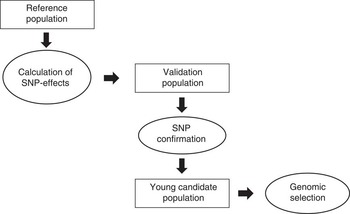
The associations between each genotyped SNP and performance are estimated using a so-called reference population and confirmed in a different validation population (Figure 1). Accurate phenotypic and pedigree records are required in both populations. This reference population consists of several thousand animals with known genotypes and phenotypes. The initial concept of genomic selection was that the genotyped SNPs would be in linkage disequilibrium with the causal mutations (Meuwissen et al., Reference Meuwissen, Hayes and Goddard2001), or in other words a given allele of a genotyped SNP was more often than not co-inherited with a given allele in the causal mutation, affecting the traits in the breeding goal/selection index. However, several studies have shown that (the accuracy of) genomic selection relies heavily on the relationships between the reference population and the selection candidates (Habier et al., Reference Habier, Fernando and Dekkers2007; Pszczola et al., Reference Pszczola, Strabel, Mulder and Calus2012a); stronger genetic relationships are associated with increased accuracies. An optimum balance of animal relationships within the reference population v. relationships between the reference, validation and selection candidate populations is also crucial. At the same time, care should be taken in the validation process to avoid an overestimation of the expected accuracy. Such an overestimation may be owing to results from the same genetic evaluation being used for both reference and validation animals (Amer and Banos, Reference Amer and Banos2010). The problem is exacerbated with low-heritability traits.
Schematic illustration of the populations and processes of genomic selection.

In addition, genomic selection accuracy is a function of the size of the reference population, the heritability of the trait analysed and the effective size of the overall population from which the reference population is sampled (Daetwyler et al., Reference Daetwyler, Villanueva and Woolliams2008). This has implications for genomic selection for robustness traits as it implies that a large genotyped population (i.e. at least several thousand animals) is required, which includes animals that are also phenotyped for animal robustness. All else being equal, the lower the heritability of the trait under selection, the greater the reference population required. In this paper, we describe the potential of using genomic selection for traits related to cow robustness, some of which may be lowly heritable and difficult to record, and the prospects and challenges involved in this application.
Animal robustness
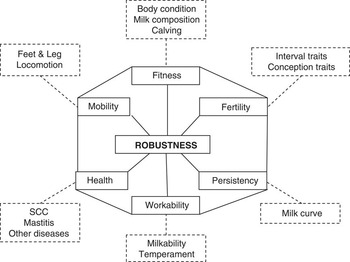
A commonly used definition of robustness of a cow is ‘the ability to maintain homeostasis in commonly accepted and sustainable dairy herds in the near future’ (Ten Napel et al., Reference Ten Napel, Calus, Mulder and Veerkamp2009). The term robustness is generally used in relation to non-production or so-called functional traits. In the last few decades, dairy cattle breeding goals have broadened from primarily focusing on production traits to now including both production and functional traits in a balanced breeding goal (Miglior et al., Reference Miglior, Muir and Van Doormaal2005; Shook, Reference Shook2006). Figure 2 gives a schematic representation of many (groups of) traits related to robustness that are currently included in international breeding goals, together with the actual traits that are measured for management purposes and genetic improvement. Several of these functional traits are measured on a large scale, such as fertility-related interval traits, somatic cell count and many conformation traits. Nonetheless, most of these traits are, in fact, either indicator traits or index traits (Figure 2) for other underlying traits, which are usually difficult or expensive to measure in a sufficiently large population to undertake accurate genetic evaluations. Examples are calving interval used as a measure of fertility, somatic cell count to predict (susceptibility to) mastitis, and feet and leg conformation traits to predict mobility and lameness. Each of these indicator traits themselves are complex phenotypes of underlying physiological phenotypes. For example, calving interval is made up of a combination of the ability of the cow to ovulate post calving, express oestrus, conceive and establish pregnancy, as well as gestation length. Measuring these underlying traits in a traditional dairy cattle breeding scheme is usually not an option, as the costs to obtain records on hundreds of daughters on commercial farms for each male selection candidate are simply too high.
Dissecting robustness in dairy cattle; component functions in solid boxes; recorded traits associated with each function in dashed boxes.

New low-cost phenotyping strategies are currently under investigation to better predict or measure these difficult to acquire phenotypes associated with animal robustness traits. One of these strategies, investigated as part of the RobustMilk project, is the use of mid-IR spectroscopy of milk to predict energy intake and energy balance (McParland et al., Reference McParland, Banos, O'Donovan, Coffey, MCCarthy, O'Neill, Wall and Berry2011). Image analysis techniques and sensor technology will also lead to the acquisition of larger number of low-cost phenotypes in the future (Berry et al., Reference Berry, McParland, Bastin, Wall, Gengler and Soyeurt2013).
Compiling reference populations for robustness traits
Genomic selection somewhat relaxes the requirement to have phenotypic measurements on many progeny for each selection candidate, which makes it especially attractive for difficult or expensive to measure traits. This is because genomic selection opens up the opportunity to establish specialised reference populations of limited size in which these novel or difficult to measure traits are recorded without the need of progeny of the selection candidates being present. These reference populations may be commercially owned (e.g. nucleus-type herds) to provide commercial advantage, nationally owned funded by public good, or jointly established international reference populations with strong genetic linkages to the selection candidates of the respective countries. Moreover, already collected data from (international) research experiments or research herds (Wall et al., Reference Wall, Coffey, Veerkamp, McParland and Banos2011; Banos et al., Reference Banos, Coffey, Veerkamp, Berry and Wall2012) could also be pooled. Within the RobustMilk project, international data were collated for progesterone-based traits (Berry et al., Reference Berry, Bastiaansen, Veerkamp, Wijga, Wall, Berglund and Calus2012), feed intake and energy balance-related traits (Veerkamp et al., Reference Veerkamp, Coffey, Berry, de Haas, Strandberg, Bovenhuis, Calus and Wall2012b), and somatic cell score (Wijga et al., Reference Wijga, Bastiaansen, Wall, Strandberg, de Haas, Giblin and Bovenhuis2012). Similar pooling of data for feed intake and efficiency in dairy cattle has been undertaken between Australia and New Zealand (Pryce et al., Reference Pryce, Arias, Bowman, Davis, Macdonald, Waghorn, Wales, Williams, Spelman and Hayes2012), and between Australia and Europe (de Haas et al., Reference de Haas, Calus, Veerkamp, Wall, Coffey, Daetwyler, Hayes and Pryce2012). Other initiatives are underway to pool data for feed intake (Veerkamp et al., Reference Veerkamp, Calus and De Haas2012a) and methane emission (de Haas et al., Reference de Haas, Windig, Calus, Dijkstra, de Haan, Bannink and Veerkamp2011). There is potential for substantial increases in the power of detecting single effects (e.g. SNP) on such traits when individual compatible data sets are merged (Banos et al., Reference Banos, Coffey, Veerkamp, Berry and Wall2012).
The objective of the RobustMilk project was to combine data from individual partners recognising that each individual partner had too small a reference population to generate highly accurate genomic predictions. Within the RobustMilk project, de Haas et al. (Reference de Haas, Calus, Veerkamp, Wall, Coffey, Daetwyler, Hayes and Pryce2012) compared the accuracy of genomic prediction using only the individual country data sets, v. using an overall combined data set. In that study, data sets for dry matter intake were combined across countries (Australia, United Kingdom and The Netherlands), and the pairwise genetic correlations for dry matter intake between countries varied from 0.36 to 0.74. De Haas et al. (Reference de Haas, Calus, Veerkamp, Wall, Coffey, Daetwyler, Hayes and Pryce2012) showed that (1) a multi-trait model achieved the highest gain in accuracy across all countries and (2) all countries benefitted when all countries were included together in the prediction model. In a few situations when only two countries were included, however, realised accuracies in fact were lower compared with a scenario where only data from the country itself were used. These results indicate that generally there is an expected benefit of combining data, albeit in each specific case compatibility of data sets needs to be investigated. Compatibility can be established by empirical quantification of the realised benefit not only in terms of prediction accuracy, but can also be assessed at the level of the data by estimating genetic correlations between data sets and by investigating genetic links between data sets, either through pedigree or SNP information. There are no straightforward guidelines on how strong these links should be. Nevertheless, it is worth noting that problems of limited connectedness may be minimised using SNP information instead of pedigree information (Pszczola et al., Reference Pszczola, Strabel, Mulder and Calus2012a), because the SNP information provides a more accurate reflection of the relationships between pairs of animals, including pairwise relationships that are zero in a relationship matrix calculated from pedigree.
When a reference population needs to be established for difficult to measure traits, the most likely cost-effective strategy is to generate genotypes and phenotypes on cows, instead of genotyping bulls and phenotyping large paternal half-sib progeny groups (Buch et al., Reference Buch, Kargo, Berg, Lassen and Sorensen2012; Van Grevenhof et al., Reference Van Grevenhof, Van Arendonk and Bijma2012). On the basis of cow reference populations consisting of 600 to 2000 cows with single phenotypic measurements, the accuracy of direct genomic values (DGV) for traits with heritabilities ranging from 0.2 to 0.5 was reported to be in the range of 0.3 to 0.5 (Verbyla et al., Reference Verbyla, Calus, Mulder, de Haas and Veerkamp2010; de Haas et al., Reference de Haas, Windig, Calus, Dijkstra, de Haan, Bannink and Veerkamp2011 and Reference de Haas, Calus, Veerkamp, Wall, Coffey, Daetwyler, Hayes and Pryce2012), which closely resembles the theoretical expected range of 0.29 to 0.63 based on a deterministic formula (Daetwyler et al., Reference Daetwyler, Villanueva and Woolliams2008; Daetwyler, Reference Daetwyler2009).
An important question is which animals should be included in the optimal construction of a reference population. With regard to performance of the cows, it has been shown that sampling extreme cows (i.e. from both tails of the distribution of phenotypes) yields higher accuracy than selecting cows at random or only selecting the best cows (Jiménez-Montero et al., Reference Jiménez-Montero, Gonzalez-Recio and Alenda2012). Selecting the best cows, in fact, yielded the lowest accuracy. Many studies have shown that the degree of relationship between reference populations and selection candidates affects the prediction accuracy (Habier et al., Reference Habier, Fernando and Dekkers2007; Pszczola et al., Reference Pszczola, Strabel, Mulder and Calus2012a). These relationships are especially important for small reference populations (Wientjes et al., Reference Wientjes, Veerkamp and Calus2013). In addition, it has been shown that strong relationships among animals in the reference population, in fact, have a negative effect on the average accuracy of genomic predictions in selection candidates (Pszczola et al., Reference Pszczola, Strabel, Mulder and Calus2012a). As a consequence, the optimal reference population design maximises the relationships between the reference population and the evaluated animals, while minimising the relationship among animals in the reference population.
Both from the perspective of relationship to the evaluated animals and from the perspective of sampling extreme phenotypes, it is likely that adding ‘unique’ animals to the reference population leads to higher increases in accuracy compared with adding animals at random. This implies that for traits where phenotypes are abundant, animals could be selected on the basis of extreme phenotypes, that is, selecting the best and the worst animals. For traits where phenotypes are difficult or expensive to obtain, or in future scenarios where the majority of animals in a population are genotyped, entire populations could be screened on the basis of genotypes to select an optimal set of animals that needs to be phenotyped and subsequently included in the reference population, because they optimally contribute to the accuracy of genomic prediction in the whole population.
Implementing the aforementioned theoretical optimum design of a reference population may of course not be possible because of practical limitations. To achieve sufficiently high accuracy of genomic prediction, several alternative strategies exist. Phenotypic data may be available from past experiments, but no DNA of these animals may be available. However, those records can be used in the analysis, using either relationship matrices that combine genomic and pedigree-based relationship matrices (Aguilar et al., Reference Aguilar, Misztal, Johnson, Legarra, Tsuruta and Lawlor2010; Veerkamp et al., Reference Veerkamp, Mulder, Thompson and Calus2011), or using sophisticated imputation algorithms to derive their genotypes (Hickey et al., Reference Hickey, Kinghorn, Tier, van der Werf and Cleveland2012).
Predicted accuracy of genomic selection for robustness traits
In recent years, several simulation studies have investigated the potential benefit of genomic selection for difficult or expensive to measure traits. Buch et al. (Reference Buch, Kargo, Berg, Lassen and Sorensen2012) quantified the added benefit of using phenotypic records of cows, in addition to sires and test bulls with progeny, to enable genomic predictions for this trait. They concluded that cow phenotypes are especially important when the reference population is small, and that DGV accuracies reach acceptable levels to begin selection within 3 years after starting recording the new trait. Amer (Reference Amer2012) investigated the effect on genetic gain by switching from a progeny-testing scheme to genomic selection, both on production and robustness traits that were previously selected based on progeny testing. He showed that genomic selection, in fact, may result in a selection response favouring production traits relative to robustness traits owing to an increased difference in the accuracy of selection achieved for robustness compared with production traits when implementing genomic selection. A similar trend was shown for fitness v. production traits by Egger-Danner et al. (Reference Egger-Danner, Willam, Fuerst, Schwarzenbacher and Fuerst-Waltl2012). Those authors, however, also showed that starting to include direct health traits in the index did result in a similar increase of genetic gain across trait groups when introducing genomic selection. Thus, the problem of favouring production traits in genomic selection at the expense of, for example, robustness traits can be reduced by increased recording of the robustness traits to improve the accuracy of selection for those traits, or by improving the definition or statistical modelling of the trait, thereby potentially increasing the heritability of the trait.
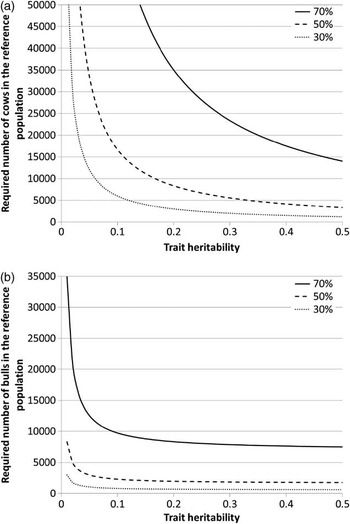
Genomic breeding values of robustness traits may still have, at most, moderate accuracy depending on the nature of the trait because the heritability may be low and the reference populations used may be limited in size. We theoretically predicted the required reference population size to achieve genomic breeding values with a reliability of 30%, 50% or 70%. Details on the predictions are presented in the Appendix. The required reference populations to achieve the desired reliabilities are presented in Figure 3, assuming either a cow reference population with one record per cow (Figure 3a), or a bull reference population, where the phenotype of each bull is based on 100 daughters with one record each (Figure 3b). Figure 3b shows that a reference population of >10 000 bulls, which is currently available in several countries (Lund et al., Reference Lund, de Roos, de Vries, Druet, Ducrocq, Fritz, Guillaume, Guldbrandtsen, Liu, Reents, Schrooten, Seefried and Su2011), yields reliabilities of DGVs of at least 70% for traits with a heritability >0.1. Figure 3a shows that a reference population of 2000 cows yields reliabilities of 30% for a trait with a moderate heritability of 0.3. This implies that genomic selection based on a limited cow reference population will yield genomic breeding values with reliabilities that are much lower than currently accepted in the dairy cattle industry. Marketing individual bulls based on breeding values with such low reliabilities is unlikely to happen. Nevertheless, achieving genetic progress for traits at the level of the whole population, on the basis of cow reference populations of 2000 to 10 000 cows, is possible (Calus et al., Reference Calus, de Haas, Pszczola and Veerkamp2013).
Required number of cows (a) or bulls (b) in the reference population to achieve a reliability of 30%, 50% or 70% as a function of trait heritability. x-axis = trait heritability; y-axis = number of animals.

Multi-trait genomic prediction – combining old and new successful strategies
The strategy to use less-expensive predictor traits in multi-trait prediction models proved to be successful in traditional breeding programmes to increase the accuracy of prediction. This therefore suggests that the accuracy of genomic prediction may also benefit from using predictor traits in combination with multi-trait analysis. So far, only a few simulation studies have investigated this combined model, and those studies indeed support that multi-trait genomic prediction can lead to a considerable increase in genomic prediction accuracy (Calus and Veerkamp, Reference Calus and Veerkamp2011; Jia and Jannink, Reference Jia and Jannink2012).
Two studies have investigated the benefit of using multi-trait genomic prediction for US Holsteins. Using multi-trait genomic prediction for first-parity conception rate resulted in a doubling of the reliability (prediction accuracy squared) of genomic predictions (Aguilar et al., Reference Aguilar, Misztal, Tsuruta, Wiggans and Lawlor2011). Similarly, it was shown that the reliability of genomic breeding values for the conformation trait ‘strength’ increased from 0.40 to 0.45 when a multi-trait genomic prediction model with 18 conformation traits was used instead of a single-trait model (Tsuruta et al., Reference Tsuruta, Misztal, Aguilar and Lawlor2011). Both studies used the so-called ‘single-step approach’ that combines genotype and pedigree information of genotyped and ungenotyped animals in a single relationship matrix, and considered scenarios where genotyped animals generally had phenotypes for all traits included in the model. Another study, using data generated within the RobustMilk project, investigated the additional benefit of exploiting a multi-trait GBLUP-type model to predict genomic breeding values for dry matter intake, using measurements for milk yield and live weight as indicator traits (Pszczola et al., Reference Pszczola, Veerkamp, De Haas, Strabel and Calus2012b). This study showed that indeed the indicator traits improved the accuracy of prediction for dry matter intake and also indicated that the accuracy was similar to a multi-trait pedigree-based model. This was most likely the result of moderate to strong genetic correlations between the predicted trait and the indicator traits, as it has been shown previously that added benefit of genomic information in multi-trait models is decreased when indicator traits with strong genetic correlations are used (Calus and Veerkamp, Reference Calus and Veerkamp2011).
Within the RobustMilk project, a Bayesian model was developed that can use data from two traits that are each measured on a separate group of animals (Calus et al., Reference Calus, De Haas and Veerkamp2012). This model was applied to a scenario where the one group of animals was a cow reference population and the other group of animals was a bull reference population. Results showed that accuracies of genomic prediction for the trait measured on the cows benefitted from exploiting the additional information on the bull trait and helped to reduce potential bias in predicted breeding values. In addition, using the cow and bull data combined resulted in increased power to detect quantitative trait loci (QTL), using the Bayesian model. Similar results were found when using this model in a genome-wide association study for milk fatty acid content as part of the RobustMilk project (Bastin et al., Reference Bastin, Gengler, Soyeurt, McParland, Wall and Calus2012). In addition, evidence for two QTLs related to progesterone levels, detected using the single-trait model, improved when a bivariate model was applied using information on correlated fertility traits (Berry et al., Reference Berry, Bastiaansen, Veerkamp, Wijga, Wall, Berglund and Calus2012).
Predicted accuracy and response to genomic selection, using a multi-trait approach with one trait recorded on cows and the other on bulls, was investigated using deterministic simulation within the RobustMilk project (Calus et al., Reference Calus, de Haas, Pszczola and Veerkamp2013). Scenarios were considered where phenotypes for a new trait were available on up to 10 000 cows, whereas a bull reference population of up to 20 000 animals was available for an overall index, which had a genetic correlation of −0.5, 0.0 or 0.5 to the new trait. When the new trait had a negative correlation with the overall index, achieving favourable genetic progress for the new trait was only possible in the extreme situation where the new trait had a moderate heritability (0.30) and when it was economically as important as the overall index. In all other scenarios with a negative correlation between the new trait and the overall index, the cow reference population was not sufficient to achieve favourable genetic progress for the new trait. When the new trait had an economic value that was at least 20% of the economic value for the overall index, using the cow reference population did diminish the negative genetic response for the new trait caused by selection for the overall index. In all scenarios where the genetic correlation between the new trait and the overall index was zero or positive, considerable genetic response could be achieved using a reference population of up to 10 000 cows, the rate of response achievable depending on the heritability and the economic value of the new trait.
Future perspectives for genomic selection for robustness traits
Genotyping all newborn (female) calves in dairy cattle populations as part of routine herd management will soon become the norm as the ever-decreasing cost of genotyping continues. In this scenario, genotype data will completely replace pedigree information in genetic evaluations. The major benefit of such a scenario is that animals to be phenotyped and thereafter included in the reference population can be strategically selected on the basis of their genotypes, to design a reference population that is optimally related to the whole population. In addition, wide-spread genotyping enables application of ‘genomic mating plans’, that is, mating plans that are based on complementarity of the genotypes between mated animals. Such genomic mating plans can be used to control or reduce (genomic) inbreeding levels. Minimising inbreeding is particularly important for robustness traits because inbreeding depression is greatest for traits associated with animal fitness (McParland et al., Reference McParland, Kearney, Rath and Berry2007). Moreover, genomic mating plans can be potentially used to exploit non-additive effects (Toro and Varona, Reference Toro and Varona2010), which is particularly important, given the proliferation of crossbreeding in some populations. An important issue for difficult or expensive to measure traits is the persistence of the accuracy of genomic predictions across generations. Persistency of accuracy across generations reduces the required number of additionally phenotyped animals that need to be added per generation to retain the prediction accuracy at the same level. One way to achieve this is to increase the degree of co-inheritance between the genotyped marker and the true causative mutation. This can be achieved through whole genome sequencing. These high-density data may be obtained on the reference population directly, or be imputed using information of other individuals in the same population. However, considerable attention must be given to developments in algorithms to optimally exploit the plethora of genotype information emanating from sequence data.
A phenotype observed in the field (e.g. fertility) is a direct consequence of the additive genetic makeup of the animal as well as non-additive genetic (e.g. interactions between genes within biological pathways) and other environmental influencing including errors (e.g. cow inseminated at the inappropriate time of the oestrus cycle). Being able to dissect complex phenotypes like robustness into its individual components may increase the heritability of these components (i.e. less residual noise) and aid in resolving antagonisms between traits (e.g. calving interval and pregnancy fertility traits), and thereby increase genetic gain. Omic technologies, such as (targeted) transcriptomics, metabolomics and proteomics, could provide useful tools in dissecting robustness, if the costs are sufficiently low and if the technologies can be applied to relatively large populations of animals.
Conclusions
Genomic selection opens up opportunities to begin genetic selection for traits where generating a large population of phenotyped animals is currently prohibitive. Strategic genotyping and phenotyping, especially through joint (international) partnerships can reduce the cost per partner of generating accurate genomic predictions for robustness traits. The EU project RobustMilk has set an example on how to establish a multi-country reference population for scarcely recorded traits, and greatly contributed to insights on how to start genomic selection for robustness traits. Experiences to date indicate that for newly recorded robustness traits that are negatively correlated with the main breeding goal, cow reference populations of ⩾10 000 are required when genotyping is based on medium- or high-density SNP arrays. Further genotyping advances (e.g. sequencing) combined with post-genomic technologies will enhance the opportunities for selection to improve cow robustness.
Acknowledgements
The authors acknowledge funding from the RobustMilk project. The RobustMilk project is financially supported by the European Commission under the Seventh Research Framework Programme, Grant Agreement KBBE-211708. RobustMilk acknowledges the financial support of EAAP towards the cost of publication. The content of this paper is the sole responsibility of the authors and it does not necessarily represent the views of the Commission or its services.
For more information, please visit the website www.robustmilk.eu, read the other papers in these proceedings or contact the project coordinator: Roel F. Veerkamp (E-mail: Roel.Veerkamp@wur.nl).
Appendix
The reliability of a genomic breeding value (r 2) can be predicted using the general formula (Daetwyler et al., Reference Daetwyler, Villanueva and Woolliams2008; Daetwyler, Reference Daetwyler2009):
 $${{r}^{\rm{2}}} \, = \,{{q}^{\rm{2}}} \frac{{\frac{{{{n}_p}}}{{{{n}_G}}}{{h}^{\rm{2}}} }}{{\frac{{{{n}_p}}}{{{{n}_G}}}{{h}^{\rm{2}}} \, + \,1}}$$
where q 2 is the proportion of the total genetic variance captured by the markers, np is the number of phenotypic records used (assuming one record per animal), nG is the number of QTL or effective chromosome segments and h 2 is the heritability of the trait. For q 2, we used a value of 0.8, which is reported for the commonly used 50k SNP chip (Daetwyler, 2009). The chosen value for nG was 1000 to reflect the effective number of independent chromosomal segments (Goddard, Reference Goddard2009).
For bull reference populations, where the phenotype of individual bulls is their (deregressed) breeding value based on daughter information, h 2 in equation (1) can be replaced by the reliability of the bulls’ daughter-based breeding value. This reliability can be calculated as
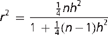 $${{r}^{\rm{2}}} \, = \,\frac{{\frac{1}{4}n{{h}^{\rm{2}}} }}{{1\, + \,\frac{1}{4}\left( {n\,{\rm{ - }}\,1} \right){{h}^{\rm{2}}} }}$$
where n is the number of daughters (assumed to be 100). To calculate the number of records required to obtain a certain reliability r 2, equation (1) was rearranged to
 $${{n}_p}\, = \,\frac{{{{r}^{\rm{2}}} {{n}_G}}}{{{{h}^{\rm{2}}} \left( {{{q}^{\rm{2}}} \,{\rm{ - }}\,{{r}^{\rm{2}}} } \right)}}$$