Over the course of the 1920s and 1930s, the General Motors Corporation (GM) sought and largely achieved unparalleled success in overseas markets. It did so not only through technical and managerial innovation, but also through the particular way it used techniques of public relations. GM's employees constituted one such “public,” as the automaker became one of hundreds of American firms that launched new internal newspapers during the interwar years.Footnote 1 Within this broader trend in American business, however, GM's overseas division used such media in a novel way: to articulate to overseas employees and consumers how its cars fit into a global vision of political and economic change. Even as GM bought foreign automakers such as Vauxhall (1925) and Opel (1929) to evade tariffs and import restrictions in key territories, its employee magazine General Motors World insisted that all GM automobiles deserved access to a world market unencumbered by trade barriers and other forms of economic nationalism. General Motors World thus imbued the company's global growth with a moral quality that went beyond arcane questions of production costs, product lines, and staffing structures. Such aspects might have been top concerns of executives within GM's Manhattan headquarters. But General Motors World presented a more polemical argument for GM's role in the world economy in its messages to its overseas staff. In so doing, it assumed a complex and historically significant role not often attributed to employee newspapers, complementing the automaker's simultaneous use of advertising aimed directly at foreign customers.
American automakers have been the subject of a wealth of historical analysis, including recent research about their expansion into foreign markets that has balanced what was once—with the notable exception of Mira Wilkins and Frank Ernest Hill's American Business Abroad—a historiography tilted toward their domestic activities.Footnote 2 Yet the desire to study discrete aspects of these enormous companies, while reasonable, has also produced some artificially bounded categories of scholarship on their international expansion. Some scholars have examined GM's organizational model in international contexts, building on Alfred Chandler's classic studies of GM's corporate structure.Footnote 3 Generally, their work has emphasized GM's acquisitions of Vauxhall and Opel as pivotal moments in its foreign expansion, arguing that General Motors grew because it embraced the idea of a decentralized global corporation rather than trying to compete with the Ford Motor Company's more centralized structure on its own terms. These studies have echoed the argument made by GM's CEO Alfred P. Sloan in his memoirs, published in 1964.Footnote 4 Other historians have examined the role of advertising in spreading awareness and cultivating popular opinions of American automobiles in foreign countries. Their work has complemented a field of scholarship about automakers’ domestic marketing led by Roland Marchand, who argued that GM made a concerted effort in the 1920s to portray itself not as a faceless behemoth but as a company with a “corporate soul.”Footnote 5
Though convincing and informative on their own terms, these two bodies of scholarship—one on GM's global corporate structure; the other on its global corporate image-making—have rarely intersected. A focus on General Motors World, which GM published for nearly fifty years beginning in 1922, allows historians to bridge this gap. It was not unusual for a large company such as GM to have one or more internal newspapers in the first half of the twentieth century—by 1925, the Pennsylvania Railroad alone boasted six.Footnote 6 Almost all house organs promoted what one scholar has characterized as “welfare work,” using corporate jingoism to counter the demands of organized labor and proclaim “a new age in labor relations . . . guided by the gentle hand of management.”Footnote 7 At a time when many firms were beginning to recognize the importance of public relations directed at employees, however, General Motors World stood out for two important reasons. First, its long print run allows historians to track changes both in the content of GM's corporate messages and in the role of the newspaper in disseminating them.Footnote 8 Second, the global scope of the messages General Motors World communicated and the audiences they were intended to reach (primarily back-office workers in GM's foreign plants, but also distributors, dealers, and, more indirectly, assembly line workers and overseas customers) adds a new dimension to our understanding of how GM executives wanted to portray the automaker's early years of worldwide expansion. In its pages, readers found not only run-of-the-mill corporate cheerleading but also fiery editorials that declared GM to be leading a shift away from protectionism and other remnants of imperialism. At the same time, General Motors World portrayed GM's overseas staff and associates as unusually attuned to the needs of the countries and markets in which they worked, a cultural sensitivity that would supposedly guarantee GM's success once barriers to its expansion were removed. In the 1920s and 1930s, General Motors World and these dual messages formed the core of a dynamic global marketing effort that previous scholarship has largely overlooked. If in the United States GM's marketing promised to make “the nation a neighborhood” while extolling the company's bigness as a benefit, General Motors World offered the automaker a way to disseminate messages that echoed this domestic brand while giving an arguably even more political, ideological, and moral meaning to its overseas employees’ work.Footnote 9
The marketing efforts and other corporate activities described in the pages of the newspaper—as well as the existence of the newspaper itself—also complicate assumptions about the role of decentralization in GM's global success. While it is statistically sound to conclude, as one author has, that GM “grew by acquisition,” General Motors World and other aspects of the automaker's overseas public relations were run in a more centralized manner.Footnote 10 Sometimes every month, sometimes less often, GM plants around the world received from the company's New York headquarters copies of a newspaper that contained both implicit and explicit instructions on how they should work with local distributors to sell GM cars. A full appreciation of GM's interwar growth must therefore consider its overseas marketing and the corporate structure behind that marketing as interrelated. To GM executives, the power of public relations lay in its ability to shape perceptions not just of GM's cars but also of the broader changes that the company's expansion outside the United States heralded for international commerce. In this effort, media like General Motors World allowed GM to coordinate its messaging on an international scale. Thus, when the magazine's inaugural issue declared that it would “sell the world,” it was not merely engaging in rhetorical bombast.Footnote 11 General Motors World was tasked with nothing less than convincing GM's overseas employees that their work had meaning beyond simply selling cars. They, in turn, were expected to communicate that meaning to potential buyers, both atomizing and universalizing their needs as GM invited them to participate in a new global economy of consumption through the purchase of an automobile.Footnote 12
The World of General Motors
The man in charge of GM's overseas division was a true believer in the power of marketing. James D. Mooney was an Ohio-born college dropout, failed prospector, and World War I veteran. Having worked his way up GM's corporate ladder from a parts company that the automaker had acquired, Mooney ultimately spent nearly two decades as leader of its overseas operations.Footnote 13 In his writing, his speeches, and his actions within the company, Mooney constantly promoted the idea that marketing should be central to GM's global business. He outlined his philosophy of industrial management in Onward Industry! one of several books he wrote or cowrote during his time at GM. In what was perhaps a subtle criticism of Ford, which occasionally went years without investing in corporate advertising, Mooney argued that the existing literature on management suffered from “one-sidedness” in its emphasis on “efficient shop management.” The “paramount necessity” of modern industry, he wrote, was not “factory organization” but in fact “higher marketing efficiency.” Well-run companies were not those that had the most productive assembly lines but rather those that had solved “the problem of distribution . . . to which all problems of shop management are subordinate.” A company that built fine cars was useless if it could not move them, so to speak.Footnote 14
To Mooney, marketing targeted at employees was an essential part of any firm's broader public relations strategy. Even before the launch of General Motors World, he included a section on employee newspapers in Advertising the Technical Product, a book-length guide to marketing that he cowrote in 1920. “A discussion of the employee's magazine may not properly belong in a book on technical advertising,” he admitted, but “recent years have proved the value of such a publication.” A good employee magazine cultivated “that intangible asset ‘shop spirit,’ esprit’ [sic] de corps—whereby the man in the shop is made to feel an interest in his work beyond the amount contained in his weekly pay envelope.”Footnote 15 An amusing anecdote, recounted in the tenth-anniversary issue of General Motors World, underlined Mooney's interest in his own export division's magazine. The inaugural issue announced an employee contest to choose the publication's permanent name—exactly the sort of “shop spirit” activity Mooney envisioned. Afterward, however, Mooney apparently intervened and insisted that the magazine be called General Motors World.Footnote 16
GM's overseas leadership was not alone in its belief in the communicative power of a company magazine. While one historian has traced the origins of the genre to 1887, when National Cash Register began publishing a monthly newsletter, the number of magazines published by American firms grew exponentially during the interwar years.Footnote 17 An analysis of 338 house organs conducted in 1930 found just 27 that had begun publishing before 1910, versus 147 launched in the 1910s and 128 between 1920 and 1924 alone.Footnote 18 A cottage industry developed alongside to advise firms on how and why they should set up their own house organs. Consultants published instructional books containing detailed advice on the proper typography, layout, and selection of content that would most interest readers.Footnote 19
There were substantial similarities across many house organs but also some significant differences. A typical approach was that of The Mixer, the newspaper of the Joliet Steel Works. Its issues contained plant safety information, the meeting schedules of various employee clubs and athletic leagues, collections of important-sounding quotations said (purportedly) by famous people past and present, vague patriotic exhortations, recipes that might interest employees’ wives, editorials on topics as broad as the importance of education and as mundane as informing your employer of your most current home address, and a “personals” section with tidbits of information about individual employees, perhaps submitted by employees themselves. “Personals” was, according to the aforementioned study, generally the largest section in employee newspapers from this era.Footnote 20 Even large firms such as Chrysler Motors had magazines that consisted mostly of such content. Other major corporations—Ford and National Cash Register among them—tended to publish articles about significant company and industry news written in a more professional style than the tidbits found in The Mixer, but without the sustained global focus and polemical editorials that characterized General Motors World.Footnote 21 A third type of house organ, exemplified in the 1910s by the National City Bank of New York's The Americas and later by IBM's Think, offered opinion writing on broad international topics, but tended not to promote the companies’ own products and services explicitly. These publications were aimed at clients and consumers rather than employees and featured high-minded content intended to imbue the firms that published them with prestige and trustworthiness.Footnote 22
Within this varied mass of new media, General Motors World was notable for the way it blended promotion of GM automobiles with opinionated writing on broad themes of international politics and the global economy. This combination represented a novel form of “institutional advertising,” a practice that was gaining in popularity in the 1920s. One of its chief proponents was Edward Bernays. An Austrian-born American, Bernays worked briefly for GM in the early 1930s but became broadly known across American industry for his theories of the importance of public relations, which he couched in the languages of Fordism and psychology (he was a nephew of Freud). In this “age of mass production . . . ,” Bernays wrote, “there must be a technique for the mass distribution of ideas.” Companies—or anyone who hoped to move public opinion—were responsible for determining the “motives which actuate man in the group.” A small group, once “actuated,” would then have a domino effect on larger groups.Footnote 23 The key was to craft a compelling narrative within which a large company's business could be situated, rather than simply reciting dry facts and figures. As Mooney himself had written in 1920, “what the product will do is of importance,—not the product.”Footnote 24 By 1922, GM had already identified its employees as a distinct “public” to which it could advertise. In its report to investors that year, the company declared that “the time has arrived to reach out to . . . the employes [sic] of General Motors and its dealers . . . and the more than two million users of General Motors products.” The company would build “goodwill and public understanding” by telling “the story of General Motors” not just to customers but to its own workers.Footnote 25
Building a Reputation in Foreign Markets
The early issues of General Motors World showed the automaker outlining the story it intended to tell. In June 1922, the first edition of what was briefly called General Motors Export Monthly left GM's New York headquarters at West Fifty-Seventh Street and Broadway bound for sales offices worldwide. The title was fitting, for GM did not yet assemble any cars overseas. In fact, foreign sales made up less than 5 percent of the company's units sold that year.Footnote 26 To say that the newspaper adopted a bullish vision of the company's global prospects, however, would be an understatement. In a front-page editorial titled “The Job Before Us,” its editors proclaimed that GM would be nothing less than
a new East India Company, with the world as its market, and its employees filled with the same enthusiasm that took Clive from the counting house at Madras to the trenches before Trichinopoli. . . . In a very real sense, we may all be considered to be on the firing line, whether our station be at the wheel of a demonstrator in Shanghai, behind a dictaphone in New York or in a distributor's office planning a sales campaign for New South Wales. To each of us is given the opportunity to further advance the standard of General Motors into every land which requires the great necessity we are providing—Transportation.Footnote 27
The self-assured editorial highlighted Mooney's idea of advertising as central to GM's overseas business. The company's battlefront—its “firing line”—was located not at the point of manufacture but at the point of sale; two of the three examples cited in the editorial referred explicitly to the process of selling the car to prospective buyers.
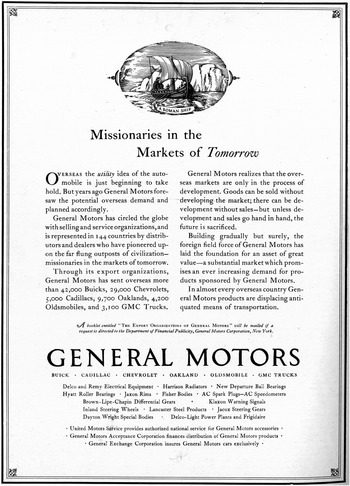
At the same time, early issues of the newspaper were notable for the way they portrayed GM as a firm that operated independent of national politics. The single comparison with the East India Company notwithstanding, General Motors World rarely characterized GM as a company whose interests were innately tied to those of any government. The reason for this editorial decision was clear: in the pages of General Motors World, the automaker's products were rivaled only by inferior foreign models whose continued existence was made possible by their own governments’ onerous tariffs on GM products. In December 1923, for instance, the magazine quoted an engineer at its Oakland division who, having toured the “leading motor car plants” of Europe, was struck by their lack of “economical production.”Footnote 28 If GM could depict the protections afforded these automakers as unnatural, an opening would be created for the company to sell in foreign markets. Other company media from this period reinforced GM's image as an independent participant in global commerce. Print advertisements, reprinted in General Motors World, described the automaker's employees as “Missionaries in the Markets of Tomorrow” whose ingenuity would bring wealth to all nations through improvements such as “motorizing and electrifying the farm to help increase the supply of foods” (see Figure 1).Footnote 29
This General Motors advertisement from the early 1920s declared GM's “foreign field force” of overseas employees to be “Missionaries in the Markets of Tomorrow.” (Source: General Motors World, Aug. 1923, 8. Courtesy of General Motors LLC.)

Before long, evidence emerged that the company was disseminating such messages successfully. In 1923, a prominent local businessman wrote a letter to the editor of the Times of India. He wished to highlight a fact that Innes Randolph, a GM export executive based in India, had recently mentioned motor fuel was cheaper in the United States than in India, despite higher labor costs and the greater distance it had to travel. “It seems a great pity,” he recalled Randolph saying, “that India should not reap the full benefits of having within its own borders the source of supply.”Footnote 30 Randolph's remarks showed that GM's nascent public relations efforts were often quite subtle. The automaker's representative on the subcontinent had not been so tactless as to denounce outright the tariffs, preferential trade relationships, and cartel behavior that kept the price of fuel high. He merely suggested that such phenomena were denying the would-be owners of Chevrolets and Buicks the full potential of his company's automobiles. General Motors was not the first company to advocate for changes in protectionist patterns of trade. But the way that it did so, framing the problem as harmful not only to the corporation but also to the prospects of an emergent consumer class trapped behind tariff barriers, was the hallmark of a company versed in the new language of public relations and conscious of its global brand. GM was selling not just a car, but a critique. It had come to India to offer something new and apolitical: a “car for every purse and purpose” that made transportation less burdensome.Footnote 31 But something old and highly political was getting in the way: restrictions on trade based on fusty ideologies and ancient wars. GM's potential buyers in India had chosen wisely to invest in their own personal mobility. Would governments let them?
In fact, GM executives had more than a passing interest in the answer to this question and were already making efforts to circumvent the most burdensome tariffs on their products. If Randolph had shown off a “demonstrator” car to the businessman (and, given GM's sales techniques, there is a good chance he did), it was probably made not in Michigan but in Oshawa, Ontario. GM had purchased an automobile company there and by the early 1920s was assembling enough vehicles at Oshawa to send one freight train of GM automobiles per week to Montreal and other points of overseas export, according to General Motors World.Footnote 32 This method permitted the cars to enter Britain and its other colonies subject to relatively little duty, allowing them to compete with Ford cars made in England.Footnote 33 This protectionist environment was likely the major factor behind GM's rapid construction of overseas plants in the 1920s, beginning in 1923 when it repurposed a 93,000 square foot cable factory in Copenhagen as its first European assembly facility. Though it was capable of producing just twenty-five cars per day, its distribution territory was vast, comprising Scandinavia, the Baltic States, and much of central and eastern Europe.Footnote 34
The Copenhagen plant's status as an “export assembly” demonstrated how GM intended to expand its overseas presence directly in response to trade barriers. The Danish division did not manufacture its own parts; instead, “completely knocked down,” or CKD, kits were shipped from overseas. Because they could be packed more tightly, these kits were less expensive to ship. As unfinished goods, they were often subject to lower tariffs as well.Footnote 35 In GM's North American plants, custom-made counting jigs and counting tables made sure that workers packed the correct number of each part in the kit, while a signage system ensured left-hand-drive and right-hand-drive kits were sent to the proper markets. Workers overseas then assembled the cars according to detailed instructions.Footnote 36 Throughout the 1920s and 1930s, GM replicated the Copenhagen setup across Europe and around the world. Assembly in Argentina and Brazil began in 1925, in New Zealand and South Africa in 1926, and in Java and Japan in 1927.Footnote 37 By 1928, GM boasted nineteen assemblies in fifteen countries, including two in Africa, one in Southeast Asia, and three in South America.Footnote 38 These plants comprised what was called the GM Export Group (from 1926 to 1928) or the GM Export Division (from 1928 to 1938). Its sibling division in charge of exporting finished vehicles—somewhat confusingly called the GM Export Company—grew to envelop the entire second floor of the firm's New York headquarters. Staff included an in-house translation team of six.Footnote 39
As GM strategically opened foreign assembly lines to reduce the impact of tariffs, it deployed General Motors World as a way to attack protectionism writ large. The newspaper's editors excoriated the old European powers for the harm their trade barriers caused. On top of ridiculous tariffs such as France's 45 percent duty on automobile imports, the newspaper lamented the decision of the “Latin countries” to institute taxes based on horsepower, which favored their inferior domestic automakers’ “almost miniature” engines over GM's more powerful designs.Footnote 40 But General Motors World also framed tariffs as a problem that went beyond the cost of owning a car. The bigger issue, the newspaper said, was that protectionism was inseparable from the broader conflicts that had caused so much global turmoil in recent years, in the lives of both its employees and its customers around the world. The specter of World War I and what many Americans perceived as its cause—the inanities of European politics—loomed over GM's argument. Protectionism, said General Motors World, constituted “an economic crime which is, except for the War itself, unparalleled in all history for its viciousness and stupidity.”Footnote 41 The few European nations for whom the magazine reserved praise were, incidentally or otherwise, those that had remained neutral in the war. While the company's prospects in Italy were “practically closed” and those in France “not encouraging,” the Dutch engaged in “fair play” and believed “in getting the greatest value . . . no matter what the origin of the product may be.” Opposition to trade barriers led to physical progress, too: General Motors World noted the presence of “exceptionally good roads” in the Netherlands.Footnote 42
Advocating for Good Roads
While opposition to tariffs was the most frequent talking point found in General Motors World, the automaker also developed a more general critique of economic nationalism. The newspaper's description of the Netherlands hinted at the power of “good roads” advocacy to cultivate the perception that GM automobiles heralded a fundamental change in the relationship between societies, governments, and markets. As one scholar has written, debates in this era about the relative merits of cars and trains often focused not on the vehicles themselves but on their “paradigms of regulation.” The railroad represented a “paradigm” of rationalism, planning, and coordination, while the automobile stood for “liberty, individualism, property rights and entrepreneurship.”Footnote 43
The message of GM and other “motor road” advocates was simple: roads offered not just a different mode of travel, but also a more liberating kind of transportation. “A road is, generally speaking, politically disinfected,” read an article from 1929 in the North American Review. “There are no awkward issues of haute politique involved. . . . [U]nlike a railroad, it cannot easily become a test of diplomatic prestige or a means of foreign domination.”Footnote 44 Long before the global embrace of highway building, the company's export division left nothing to chance in its effort to associate the GM brand with road construction and to depict good roads as essential to a country's national progress. The user manuals of its cars presented one particularly direct way for GM to conduct public outreach. As early as 1923, the automaker had included “good roads propaganda” in the pages of the manuals that were included with exported vehicles. Stoking local movements in favor of road construction, General Motors World noted, would surely bring “an increase in our business in such localities.”Footnote 45 In Japan, GM brought to its Osaka plant a professional transportation engineer from New York to advise local freight companies on how to move their goods most effectively. The country's major English-language daily, the Japan Times & Mail, had been a staunch supporter of roadbuilding generally and of GM specifically. On one occasion, the newspaper had printed what appeared to be an editorial that contained, buried in the text, a note explaining that it had been written by the GM Export Company. The headline was simple: “Country Needs Roads to Advance.”Footnote 46
One of GM's most persistently targeted markets was Brazil, where the automaker opened a plant at São Paulo in 1925 and another at São Caetano do Sul four years later.Footnote 47 With a large working class that had the potential to be upwardly mobile, Brazil symbolized to GM executives the progressive potential of the product they were selling. Mooney had visited in 1922 and proclaimed the country would “become one of the greatest automobile countries in the world.” Indeed, despite the substantial cost of car ownership, 40 percent of members in the São Paulo automobile club described themselves as farmers or ranchers.Footnote 48 Within Brazil, GM engaged in “good will” activities to reinforce its positive reputation. The corporation's subsidiary, GM do Brasil, arranged for a temporary link between a radio station in São Paulo and another in Rio de Janeiro, allowing the two to broadcast simultaneously (and, not coincidentally, to air a promotional statement from GM in both markets).Footnote 49 One of the company's São Paulo distributors joined the national good roads advocacy group, while a Chevrolet dealer in Porto Alegre remitted a small percentage of its sales to the association. By the late 1920s, the GM distributor network in Brazil comprised more than fifteen hundred people. Around the world, Mooney wrote, “the farm laborer, whom we still think of erroneously as a peon, is buying silk dresses and stockings for his daughters. . . . [F]rom Buenos Aires to Bagdad, the automobile is being used and is exerting influence for good.”Footnote 50
The Messages and Mechanisms of GM's Overseas Public Relations
GM's promotional efforts around roadbuilding necessarily focused on its customers, the car owners. But other elements of its public relations strategy were oriented more toward its overseas workforce. At GM, previously neglected or colonized peoples would achieve their full potential by working on its overseas assembly lines, aided by the technical knowledge of GM's mostly American managerial staff. “Every motor car or truck sold abroad is creating wealth in the territory where it is sold,” Mooney wrote in Nation's Business, and this policy meant using local workers “as fast as this labor can be obtained and trained.”Footnote 51 In 1934, General Motors World informed readers that the company had already succeeded at this task in India, where GM had opened an assembly plant in a former warehouse in 1928.Footnote 52 “The prophets of discouragement were on hand to augur that it couldn't be done,” the newspaper recalled. “The average Indian was too frail for such arduous manual labor, they chorused; there were too many religious and caste barriers for plant harmony; the Indian mentality couldn't adjust itself to mechanical thinking. But . . . the oracles of trouble were discredited.”Footnote 53 Other GM personnel echoed this observation. R. G. Jones, head of the new General Motors Java division, included with his praise of native workers an implicit criticism of colonialism. “There is something amusing in a white man sitting on a cool veranda sipping whiskey and soda and talking about how lazy the natives are,” he said, “while all the time natives are passing by in the hot sun, carrying loads that the average white man couldn't lift.”Footnote 54
GM thus portrayed its business decisions as direct investment in its most literal sense. In this public relations effort, the company relied not just on its own advertisements and the internal propaganda of General Motors World, but also on friendly editors of foreign newspapers. Mooney's writing appeared frequently in opinion sections and in the brand-new automobile pages of several foreign newspapers, sometimes even under the newspaper's own byline. “General Motors is doing more than merely selling cars and trucks,” he argued in 1928 in an op-ed printed in the Times of India. “It is actually in business in the respective countries, employing local labor and capital and to the extent possible, local materials.”Footnote 55 The following year, the Japan Times & Mail printed an unsigned article that, intentionally or not, reused Mooney's language. “General Motors is not merely selling its cars in these markets,” it read, “but is in business in those countries and making itself a part of the economic life of the nations concerned.”Footnote 56 The Singapore Straits Times gave GM even more favorable coverage. The newspaper observed in 1929 that GM and its biggest rival were “following diametrically opposite policies” and cited one of GM's advertising slogans to prove the point:
Ford is an industrial dictator, brooking no interference with his personal plans, concentrating all his energies and resources on the motor vehicle and on a highly restricted group of models at that, and paying no attention to any outside enterprise whose existence is not directly related to the Ford Motor Company. General Motors has been built up on a widely different policy. Starting out to supply “a car for every purse and purpose,” it . . . is almost an industrial democracy in its interior organization . . . with the utmost publicity attending all its actions. It would be impossible to imagine two business enterprises more diverse in every particular.Footnote 57
Adulation from the global press was not dumb luck, but rather the result of a concerted effort. A clipping agency furnished the second floor at GM's New York headquarters with a monthly report on the company's coverage in international newspapers, which noted the model of vehicle mentioned and the type of reaction, and GM sent letters to dealers worldwide on how “the good will of newspapers may be created and maintained.” The strategy seemed to work. General Motors World reported that through the first eleven months of 1931 GM received 74 percent more free publicity in the international press than all its competitors combined.Footnote 58
The Overseas Operations Group during the Great Depression
The effect of the economic crisis on GM was significant. Between 1929 and 1932, annual overseas sales fell by 70 percent.Footnote 59 Yet the company's global public relations strategy remained largely unchanged. In fact, a person for whom General Motors World was the sole source of news could have been forgiven for thinking the Depression was not so great at all. When the crisis was discussed, both in General Motors World and in other venues, export division executives argued that it was merely proof that their support of unrestricted global trade had been correct all along. They asserted that trade was the ultimate source of all global prosperity. Therefore, any decline in prosperity must necessarily have been the result of governments preventing industrial leaders from bringing their products to market.Footnote 60
Even before the full effects of the Depression were known, GM's international divisions became visible advocates for this worldview. Fifty-six of the automaker's overseas executives sent cables to Washington expressing their opposition to the Tariff Act of 1930 (better known as the Smoot-Hawley Tariff), while Mooney's opposition to the law was considered significant enough that the Japan Times & Mail noted it in its headline about the bill's enactment. The new tariff caused GM to redouble its public relations efforts. General Motors World ran editorials decrying the “crushing weight” of tariffs and import restrictions while highlighting steps the world was taking toward freer trade. (A relatively minor trade agreement between the United States and Belgium, signed in 1935, ran in the magazine as front-page news.)Footnote 61 Mooney gave speeches in support of trade in his dual role as a GM executive and president of the American Manufacturers Export Association. In April 1931, he decried the “vicious tariff shackles our various governments have put on us” in an address to the New York Board of Trade, which was broadcast on eleven radio stations nationwide. “The hand writing is on the wall,” Mooney said. “People will trade! . . . There is wanted only an adjustment in the attitude toward trading among the various nations.”Footnote 62
Faced with such barriers, Mooney decided that his speeches and frequent contributions in General Motors World were insufficient. He wrote another book, one that outlined his view of the economic relationships America needed to build with the rest of the world: The New Capitalism was published in 1934. Part manifesto and part economics primer, it described an “ideal economic America” in which “traditional American political ideals” would be combined with “real economic laws.”Footnote 63 On the latter point Mooney was particularly emphatic. He included numerous illustrations depicting tariffs as valves at the bottoms of enormous containers of liquid “trade.” When a tariff was increased, it reduced the quantity of goods available for public consumption to a trickle.Footnote 64 The laws that demanded freer trade, Mooney's book showed, were as immutable as those of physics. As in Onward Industry! three years earlier, an emphasis on the act of selling a product distinguished Mooney's otherwise boilerplate views. “Our capitalistic system can thrive only through dissemination—in other words distribution,” he wrote. This process consisted not just of “physical means,” but also “marketing or merchandising practices.”Footnote 65
Mooney's vision for the post-Depression economy reflected work that was already taking place within GM. In August 1931, the company called a meeting in New York of its worldwide export division sales executives, some of whom had not set foot in the United States in years. Over twelve days, the men heard speeches, examined the latest models on display at the company's headquarters, and were treated to a pleasure cruise on Oyster Bay and a garden party hosted by Mooney. The purpose of the meeting was not to discuss building cars for the demands of the 1930s, but rather to identify how the cars that GM was already building could be better sold—a “fresh merchandising attack,” as General Motors World described it. “The answer to the question of more good business is more good dealers,” one executive told his assembled colleagues. “Until we dominate the distributive facilities available in our markets abroad, we cannot possibly hope to dominate the markets themselves.” The speeches and notes of the meeting were typed and bound into books, which in turn were sent to each foreign plant.Footnote 66
In the months that followed, General Motors World made clear that even while GM did not sell cars directly to overseas buyers, it was the responsibility of the export division to instruct distributors on how best to advertise the vehicles GM made.Footnote 67 The idea that GM's overseas managers were intimately familiar with their territories was crucial, as it highlighted the modest degree of cultural awareness that GM wanted customers around the world to associate with its brand. To that end, the corporation publicized its use of “market research,” a term that had come into use along with “public relations.” In 1927, GM established a partnership with the J. Walter Thompson advertising agency, which agreed to open a field office in any country to which General Motors expanded. By the following year, its admen had already produced fifty-five market studies about cars, based largely on public surveys.Footnote 68 In this way, as scholars have noted, the image of a company seemingly performing “scientific” market research on a global scale could serve as its own form of public relations.Footnote 69 Lillian Schoedler, an American who worked briefly as a secretary for GM in East Asia in the 1920s, noted that executives inaugurated the Batavia plant with a Javanese ceremony involving the sacrifice of a water buffalo—a gesture that to a white American woman must have seemed like a substantial degree of cultural sensitivity. In Osaka, where Schoedler was based, GM preserved a religious shrine that had existed at the assembly site.Footnote 70 A New York Times op-ed written by GM Export Company general manager W. T. Whalen in 1929 further demonstrated how the strategy worked. A GM representative, Whalen wrote, would know never to sell a green car in India, which “certain religious groups” would find unlucky, or a yellow car in Japan, as the color represented mourning. To Whalen, these small gestures were proof of the company's global cultural awareness. “These fieldmen know countries,” he wrote of the overseas employees. “They know peoples. They become thoroughly familiar with habits and practices and customs. They are in truth diplomats.”Footnote 71
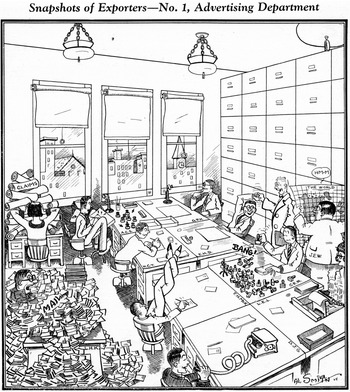
In theory, knowledge of local cultures gave GM's overseas managers a greater participatory stake in the company. Nevertheless, many aspects of the company's global image-making were not entrusted to its overseas staff or distributors (see Figure 2). Beginning with the 1924 Buick, GM headquarters produced “campaign books” for new vehicle models that were sent to overseas distributors instructing them on how to conduct public relations campaigns in their own countries. By 1928, GM was producing three such books per year for every model of car it manufactured, both in the United States and at its foreign assembly plants. They included memoranda on how to organize local auto shows and “dealers’ conventions,” model advertisements, suggested ad copy, and information on the steps necessary to carry out a successful mail-marketing scheme using national postal networks. The international distributors, in turn, were required to send all of their locally produced advertising back to New York for inspection.Footnote 72 In cases where local managers had interesting ideas, the pages of General Motors World offered a way to draw other global divisions’ attention to them and suggest they follow the leader. The November 1929 issue, for example, highlighted two model showrooms constructed at a GM plant in New Zealand: “A. L. Right Motors Limited,” showing the ideal setup for a dealership, and “U. R. Wrong & Co.,” showing the layout to avoid.Footnote 73 In other respects, the magazine more explicitly encouraged competition among its divisions. A chart stating each foreign assembly's “plant rating” was published in most issues of the newspaper beginning in the late 1920s, ranking the plants by the ratios of their actual profits and expenditures to their budgeted profits and expenditures.Footnote 74 Perhaps so as not to fall in the rankings, managers at the Batavia plant devised an electromagnetic alert system that made a mark on a paper chart whenever a car came off the assembly line and another whenever the line was stopped. The production manager met daily with his line foreman and general superintendent to review the chart. “People on the line cannot alter it without the office being able to detect such alteration,” assured General Motors World—perhaps an implicit encouragement to other branch managers to implement similar systems in their countries.Footnote 75
A cartoon depicting the export division's advertising department in New York in the November 1924 issue of General Motors World. The department left little to chance, sending “campaign books” to overseas distributors for each GM model and requiring that distributors send advertising copy back to New York for inspection. (Source: General Motors World, Nov. 1924, 7. Courtesy of General Motors LLC.)

In addition, GM regularly reminded its overseas managers—who were overwhelmingly American and almost exclusively white—that they were highly interchangeable, relocating them to vastly different cultures on a fairly regular basis as if they were members of a foreign service corps. Randolph, whose remarks on oil prices had so incensed the reader of the Times of India, was by 1926 a managing director in Australia for GM. His colleague Arthur Wieland took a more circuitous route up the corporate ladder, beginning as a managing director of General Motors Near East in Egypt, then spending four years in Germany at General Motors GmbH and Opel, before finally relocating to become regional director for Japan, China, Java, and the Philippines. Even he probably traveled fewer miles over the course of his GM career than did E. M. Van Voorhees, who started at the Osaka plant in 1929, left for the Brazilian operation in 1930, thence to GM's short-lived Russian office in 1933, and finally to Madrid in 1935. Why General Motors maintained such a policy is unclear, though it perhaps discouraged the development of fiefdoms led by particular general managers at its overseas plants.Footnote 76
For its lower-level white-collar employees, GM tended to draw more from the local labor force. General Motors World informed its readers that this was company policy, but the degree to which it was the case varied significantly by country. In Osaka, the supply manager, service manager, sales promotion manager, assistant sales managers, assistants to the managing director, and assistant production manager positions were all held by Japanese men as of 1934. But a clear gap existed between the middle rank of the office and the top: the managing director, treasurer, ports manager, sales manager, production manager, and advertising manager were white. The effort to introduce greater diversity at the Osaka office had progressed further than in Bombay that same year, where none of the top thirteen managers at the GM plant was native to India.Footnote 77 The exception that proved the rule was GM Nordiska, the corporation's Scandinavian division, where the staff, “while not 100 percent Swedish, closely approaches that figure in its representation of the territory,” wrote General Motors World with pride. To highlight the close cultural congruence between GM and the region, local managing director Elis Hoglund, an American, praised Nordic governments for their low tariffs.Footnote 78
GM's assembly line workers were usually local, though not always native to the countries in which they worked. A census of 662 workers at the São Paulo plant found that just under a quarter of them were Brazilian by birth. The rest were immigrants, most commonly Romanians, but also Italians, Slavs, Germans, and Spaniards.Footnote 79 Though a racial or at least national divide usually existed between such workers and the plant's administrative staff, GM's public relations promoted the idea that cars made by customers’ own countrymen could serve as a step toward their emancipation from imperial patterns of commerce. “It has always been obvious to General Motors that users of cars and trucks in the East could never be completely served until both they and the dealer organization . . . were in the same close touch with the actual manufacturers as their fellow motorists in the West,” a GM executive in India had told the Times of India in 1929.Footnote 80 Three years later, a company advertisement praised the “Indian skill and experience” and “high standards of quality” found at the Bombay plant, which was proudly described as “building cars in the east for the east.”Footnote 81 If these and other workers at GM's overseas sites had earned the company's respect, however, it was of a limited kind. Thanks to widespread use of the CKD process, most of the actual manufacturing took place in North America. Moreover, GM issued extremely detailed “assembly notes,” “assembly operation bulletins,” and other updates regarding the drying time of a particular paint, the misalignment of a particular hole by 3/64 of an inch, or even the ideal plant layout. These were sent abroad on a regular basis, either as memos, booklets, or, on occasion, film reels.Footnote 82
Conclusion
As the focus of business history moves—in one scholar's apt description—“beyond the parameters of the profitmaking firm,” the efforts of GM's overseas operations division to imbue the company's foreign expansion with deeper meaning are significant.Footnote 83 First, they serve as a reminder that much of the best scholarship on GM—while certainly not ignorant of its financial success—is perhaps better characterized by its emphasis on how GM avoided becoming a victim of its sheer size. To Chandler and his fellow structuralists, GM's relatively flexible, somewhat autonomous model of divisional coordination and management allowed the firm to remain nimble—at least compared to Ford—even as it grew.Footnote 84 Marchand and other scholars of public relations, meanwhile, have seen as GM's chief innovation its early recognition that consumers responded positively to advertising that told stories about the values that GM stood for, to product lines that reconciled customers’ needs to be treated both as individuals and as members of a community, and to a strong network of dealers and distributors that assured car owners a multinational company cared about them.Footnote 85 Despite their different emphases, these camps are united not by a singular focus on GM's profitability but rather by their use of the automaker to inquire into the nature of corporate “bigness.”Footnote 86
At the same time, the wealth of information in General Motors World suggests that the role of public relations efforts within multinational firms—both the messages they conveyed and the mechanisms by which they conveyed them—deserves historians’ renewed attention. House organs reveal details about corporations’ attempts to appeal to employees that are not necessarily captured in traditional narratives focused on labor relations, decision-making hierarchies, or advertising aimed at outsiders. By considering employee magazines and other forms of “internal” public relations as core elements of large companies’ daily work, previously imperceptible lines of communication, processes of policymaking, and ways employees might have thought about their jobs—or at least were told to think about their jobs—begin to appear. In particular, GM's overseas public relations invites reexamination of the ways in which factions within large firms contested the interwar politics of globalization. The free-trade editorials of General Motors World were aimed not at blue-collar workers on GM's North American assembly lines and only indirectly at their overseas analogs. Instead, they served to assure a global corps of managers stationed thousands of miles away from home that they were, in fact, “missionaries in the markets of tomorrow,” not just men selling cars but servants to a cause. Executives like Mooney hoped that this attitude would then prove contagious on shop floors and ultimately on showroom floors around the world. It is worth probing further, however, why executives believed it was necessary to devote so much time and energy to convincing them in the first place. At the very least, companies like GM whose business became increasingly multinational during the interwar years clearly did not take for granted the idea that the middle ranks of their workforce would necessarily embrace that development as natural, inevitable, or favorable. Rather, an age of accelerated globalization demanded new ways of talking to white-collar employees about the purpose of their work.
Tasked with “selling the world,” GM's overseas division treated the company's global expansion as a strategy that indeed had to be sold—not just to foreign customers but also to its own employees. General Motors World demonstrated this not in spite of its clear biases but rather because of them. As one historian has written, corporate “cultural materials . . . reveal themselves not as objective illustrations but as carefully framed arguments.”Footnote 87 From their perch above the streets of midtown Manhattan, GM staff articulated to colleagues oceans away a theory of their roles in the vanguard of a new sociopolitical order, in which unfettered trade would bring about unrivaled prosperity and unleash the liberating potential of the automobile. One cannot quantify the number of cars sold, plants opened, or free-trade skeptics turned true believers as a result of GM's efforts to cultivate “shop spirit.” It is certain, however, that the men in charge of GM's global expansion believed that describing what their cars meant for the countries in which they were now being sold was nearly as important as building them.