Introduction
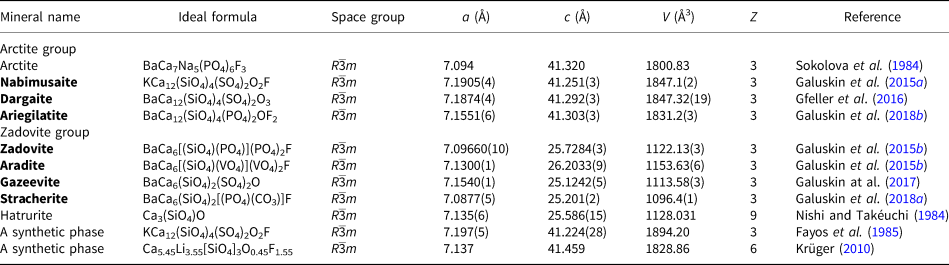
In pyrometamorphic rocks of the Hatrurim Complex, which have a wide distribution along the Dead Sea Rift in the territories of Israel, Palestinian Autonomy and Jordan (‘Mottled zone’; Bentor, Reference Bentor1960; Gross, Reference Gross1977; Vapnik et al., Reference Vapnik, Sharygin, Sokol and Shagam2007), seven new minerals with modular intercalated antiperovskite structures derived from hatrurite have been discovered during the last few years (Table 1).
A comparison of minerals with modular antiperovskite structure derived from hatrurite discovered in rock of the Hatrurim Complex*, related mineral species and synthetic materials.

* Minerals found in the Hatrurim Complex are given in bold font.
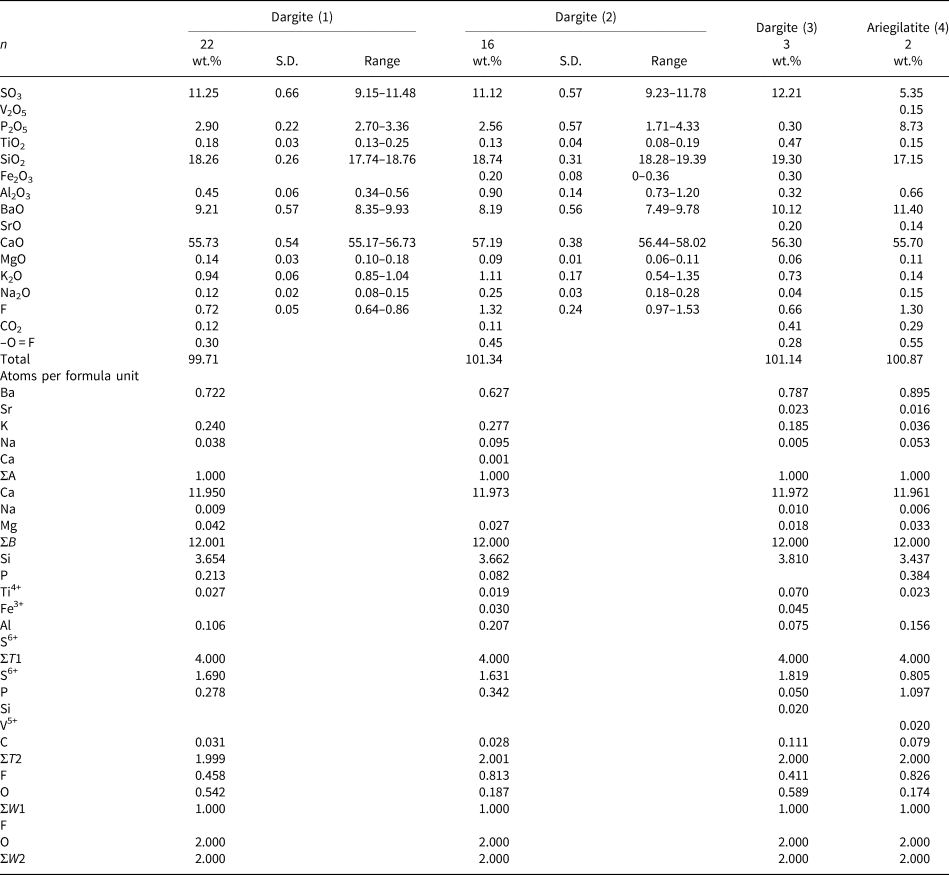
Representative compositions of dargaite from Nahal Darga (1), Ma'ale Adumim (2) and Shadil-Khokh (3); and ariegilatite from Ma'ale Adumim (4).

n = number of analyses; S.D. = standard deviation.
Dargaite with the end-member crystal chemical formula BaCa12(SiO4)4(SO4)2O3 was found at the same time as isostructural nabimusaite, KCa12(SiO4)4(SO4)2O2F, in larnite rocks from the Jabel Harmun locality, Palestinian Autonomy. However, a description of dargaite as a new mineral was hampered initially by the grain size (Galuskin et al., Reference Galuskin, Gfeller, Armbruster, Galuskina, Vapnik, Murashko, Wodyka and Dzierżanowski2015a). Discovery of larnite pebbles containing relatively large dargaite grains within larnite pseudoconglomerates at the Hahal Darga locality, Palestinian Autonomy, finally permitted a meaningful investigation of this mineral, the results of which we present in this paper.
Dargaite forms a solid solution with nabimusaite, KCa12(SiO4)4(SO4)2O2F and ariegilatite, BaCa12(SiO4)4(PO4)2OF2. It is isostructural to the phosphate mineral arctite, BaCa7Na5(PO4)6F3 (Table 1; Sokolova et al., Reference Sokolova, Yamnova, Egorov-Tismenko and Khomyakov1984). Arctite-group minerals are classified as having intercalated antiperovskite structures (Krivovichev, Reference Krivovichev2008; Galuskin et al., Reference Galuskin, Gfeller, Armbruster, Galuskina, Vapnik, Murashko, Wodyka and Dzierżanowski2015a, Reference Galuskin, Gfeller, Galuskina, Pakhomova, Armbruster, Vapnik, Włodyka, Dzierżanowski and Murashkob), for which octahedra are anion-centred and tetrahedra are cation-centred.
Several phases belonging to the structural type of intercalated antiperovskites have already been described (Table 1). These minerals of the series with end-members zadovite, BaCa6[(SiO4)(PO4)](PO4)2F and aradite, BaCa6[(SiO4)(VO4)](VO4)2F, occur in paralavas of the Hatrurim Complex in the Negev Desert, Israel (Galuskin et al., Reference Galuskin, Gfeller, Galuskina, Pakhomova, Armbruster, Vapnik, Włodyka, Dzierżanowski and Murashko2015b). Gazeevite, BaCa6(SiO4)2(SO4)2O, was found in an altered xenolith of the Shadil-Khokh volcano, Sothern Ossetia and at a few localities of larnite pseudoconglomerates of the Hatrurim Complex (Galuskin et al., Reference Galuskin, Gfeller, Galuskina, Armbruster, Krzątała, Vapnik, Kusz, Dulski, Gardocki, Gurbanov and Dzierżanowski2017). Stracherite BaCa6(SiO4)2[(PO4)(CO3)]F (Galuskin et al., Reference Galuskin, Krüger, Galuskina, Krüger, Vapnik, Pauluhn and Olieric2018a), was discovered recently in spurrite rocks of the Hatrurim Complex in the Negev Desert.
The structure type of the arctite group (3:1 type) is described by the formula AB 12(TO4)4(TO4)2W 3, while the zadovite group (1:1 type) has the formula AB 6(TO4)2(TO4)2W; where A = Ba, K, Sr…; B = Ca, Na…; T = Si, P, V5+, S6+, Al…; and W = O2–, F– (Table 1). Antiperovskite single {[WB 6](TO4)2} layers in the zadovite-type structure and triple {[W 3B 12](TO4)4} layers in the arctite type intercalate with single A(TO4)2 layers (Gfeller et al., Reference Gfeller, Galuskin, Galuskina, Armbruster, Vapnik, Włodyka and Dzierżanowski2013; Galuskin et al., Reference Galuskin, Gfeller, Armbruster, Galuskina, Vapnik, Murashko, Wodyka and Dzierżanowski2015a,Reference Galuskin, Gfeller, Galuskina, Pakhomova, Armbruster, Vapnik, Włodyka, Dzierżanowski and Murashkob; Galuskin et al., Reference Galuskin, Gfeller, Galuskina, Armbruster, Krzątała, Vapnik, Kusz, Dulski, Gardocki, Gurbanov and Dzierżanowski2017, Reference Galuskin, Krüger, Galuskina, Krüger, Vapnik, Pauluhn and Olieric2018a,Reference Galuskin, Krüger, Galuskina, Krüger, Vapnik, Wojdyla and Murashkob). In stracherite, BaCa6(SiO4)2[(PO4)(CO3)]F, half of the tetrahedral sites in the A(TO4)2 layer are partly substituted by CO3 triangles (Galuskin et al., Reference Galuskin, Krüger, Galuskina, Krüger, Vapnik, Pauluhn and Olieric2018a).
The mineral is named after the Canyon (Nahal) Darga, near to where it was first discovered, and which is the type locality in the Judean Mts, West Bank, Palestinian Autonomy, Israel. Type material has been deposited in the mineralogical collection of the Fersman Mineralogical Museum, Leninskiy pr., 18/k2, 115162 Moscow, Russia, catalogue number 4713/2 (this specimen also is co-type for gazeevite, author's number DR5D, Nahal Darga).
Methods
Crystal morphology and chemical composition of dargaite and associated minerals were examined using optical microscopes and a Philips XL30 ESEM/EDAX analytical electron scanning microscope (Faculty of Earth Sciences, University of Silesia, Poland). Chemical analyses of dargaite were performed with a CAMECA SX100 microprobe (Institute of Geochemistry, Mineralogy and Petrology, University of Warsaw, Poland) at 15 kV and 20 nA using the following lines and standards: BaLα and SKα – baryte; PKα – apatite; CaKα – wollastonite; MgKα and SiKα – diopside; FeKα – hematite; AlKα and KKα – orthoclase; TiKα – rutile; NaKα – albite; SrLα – SrTiO3; and FKα – fluorphlogopite.
The Raman spectrum of dargaite was recorded on a WITec alpha 300R Confocal Raman Microscope (Department of Earth Science, University of Silesia, Poland) equipped with an air-cooled solid laser (532 nm) and a CCD camera operating at –61°C. The laser radiation was coupled to a microscope through a single-mode optical fibre with a diameter of 3.5 μm. An air Zeiss LD EC Epiplan-Neofluan DIC – 100/0.75NA objective was used. Raman-scattered light was focused on a broad band single mode fibre with effective pinhole size ~30 μm and using a monochromator with a 600 mm–1 grating. The power of the laser at the sample position was 42 mW. Integration times of 3 s with accumulation of 15 scans and a resolution 3 cm–1 were chosen. The monochromator was calibrated using the Raman-scattering line of a silicon plate (520.7 cm–1).
Single-crystal X-ray studies were carried out on a dargaite grain ~0.03 mm × 0.03 mm × 0.02 mm in size, using a Bruker APEX II SMART diffractometer (MoKα, λ = 0.71073 Å; University of Bern, Switzerland). Experimental details are summarised in Table 3. Diffraction data were collected with ω scans at different φ settings (φ-ω scan) (Bruker, Reference Bruker1999). Data were processed using SAINT (Bruker, Reference Bruker1999). An empirical absorption correction using SADABS (Sheldrick, Reference Sheldrick1996) was applied. The structure of nabimusaite (Fayos et al., Reference Fayos, Glasser, Howie, Lachowski and Perez-Mendez1985; Galuskin et al., Reference Galuskin, Gfeller, Armbruster, Galuskina, Vapnik, Murashko, Wodyka and Dzierżanowski2015a) was taken as the initial model. Subsequently the structure was refined using the program SHELX97 (Sheldrick, Reference Sheldrick2008) to R 1 = 3.79%. The refinements including anisotropic atom displacement-parameters were carried out with neutral atom scattering-factors (Tables 3–6). The crystallographic information file has been deposited with the Principal Editor of Mineralogical Magazine and is available as Supplementary material (see below).
Crystal data, X-ray measurement and refinement parameters for dargaite.

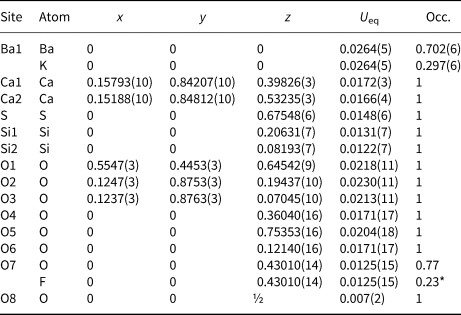
Atom coordinates, occupancies and U eq (Å2) values for dargaite.

* F at O7 fixed according to results of chemical analyses; Occ. = occupancy
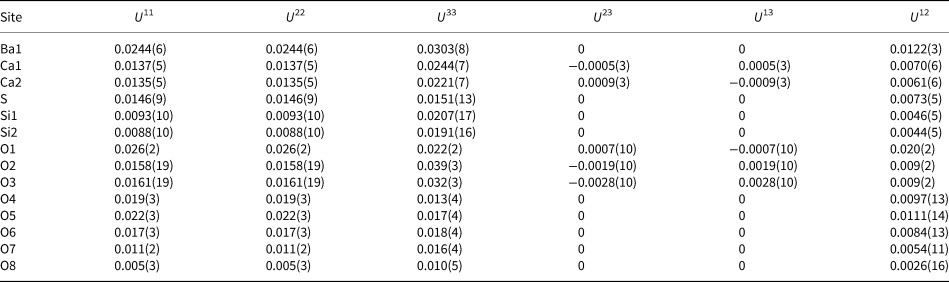
Anisotropic displacement parameters U ij (Å2) for dargaite.

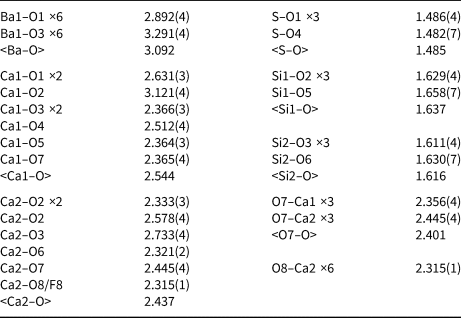
Selected interatomic distances (Å) for dargaite.

Occurrence and description of dargaite
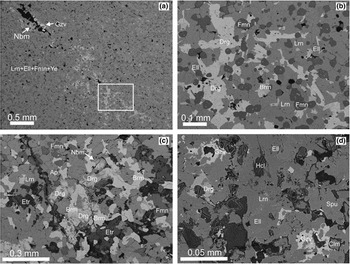
The holotype specimen (larnite pebble 3.5 cm in size) containing relatively large dargaite aggregates (up to 100–150 μm in size) of dargaite grains (up to 30–40 μm in size) (Fig. 1a, b) was found at one small outcrop of larnite pseudoconglomerates in the Judean Mts, West Bank, Palestinian Autonomy (31°36.5'N, 35°22.7'E). This outcrop including neighbouring hills of pyrometamorphic rocks, is known under the common name ‘Nahal Darga’ (see geological scheme in Novikov et al., Reference Novikov, Vapnik and Safonova2013). These outcrops are located ~1–1.5 km to the north of the well-known tourist site: Canyon (Nahal) Darga, located close to the west shore of the Dead Sea.
(a) Dargaite is confined to linear porous zones in larnite rock, in which nabimusaite and gazeevite also occur, in the holotype specimen, Nahal Darga. The white frame shows the location magnified in Fig. 1b; (b) dargaite aggregates replace fluorellestadite and partially larnite; (c) xenomorphic dargaite grains in larnite rock from Ma'ale Adumim; and (d) very rare dargaite grains found in altered carbonate xenolith of the Shadil-Khokh volcano at the boundary of larnite (merwinite) and spurrite zones. Drg = dargaite, Ell = fluorellestadite, Lrn = larnite, Fmn = fluormayenite-fluorkyuygenite, Brm = brownmillerite, Ye = ye'elimite, Nbm = nabimusaite, Gzv = gazeevite, Ap = fluorapatite, Etr = ettringite, Hcl = hydrocalumite, Spu = spurrite and Clm = chlormayenite.

Larnite, fluorellestadite–fluorapatite, brownmillerite, fluormayenite–fluorkyuygenite and ye'elimite are the main minerals of the holotype specimen; ternesite, shulamitite and periclase are rarely present. Dargaite, nabimusaite and gazeevite occur in linear zones of higher porosity embedded in massive larnite rocks (Fig. 1a). Pores are filled with ettringite and Ca-hydrosilicates, less commonly with gibbsite, brucite, baryte, katoite and calciolangbeinite. It is notable that fluorkyuygenite has a considerable distribution in these linear zones. In the groundmass fluormayenite with ye'elimite rims prevails (Środek et al., Reference Środek, Dulski and Galuskina2018).
Dargaite is colourless, transparent with white streak and vitreous lustre, it shows no ultraviolet luminescence. Dargaite is brittle and exhibits pronounced parting and imperfect cleavage along (001). Dargaite is uniaxial (–), ω = 1.643(3), ε = 1.639(3) (589 nm) and has no pleochroism. Mohs hardness is ~4.5–5.5 and mean VHN = 423 kg/mm2 (load 50 g, range 380–492 kg/mm2, 14 measurements). Density could not be measured because of abundant tiny inclusions of ye'elimite and larnite; the calculated density is 3.235 g cm–3. The Gladstone–Dale compatibility factor is [1 – (K p/K c)] = –0.007, superior (Mandarino, Reference Mandarino1981) using the empirical formula.
The empirical formula is (Ba0.72K0.24Na0.04)Σ1(Ca11.95Mg0.04Na0.01)Σ12([SiO4]0.91[PO4]0.05[AlO4]0.03[Ti4+O4]0.01)Σ4([SO4]0.84[PO4]0.14[CO3]0.02)Σ2(O2.54F0.46)Σ3 (Table 2). Considering the prevailing occupants at structural sites, the end-member formula is BaCa12(SiO4)4(SO4)2O3.
The compositional variation of dargaite found in larnite rocks of the Hatrurim Complex at Ma'ale Adumim locality, Palestinian Autonomy and in altered carbonate xenolith from the lava bed of the Shadi-Khokh volcano, Southern Ossetia (Fig. 1c,d) is shown in Table 2. Higher P contents are characteristic of dargaite from larnite rocks of the Hatrurim Complex compared to dargaite from Southern Ossetia (Table 2, Galuskin et al., Reference Galuskin, Gfeller, Armbruster, Galuskina, Vapnik, Murashko, Wodyka and Dzierżanowski2015a).
Empirical formulae calculated from microprobe analyses on the basis of 19 cations for dargaite from different localities show an overestimation of cations (>13 atoms per formula unit) at the Ba and Ca sites. These overly high numbers may be due to neglecting the light ‘tetrahedral’ cations in the analytical procedure. Occurrence of stracherite, BaCa6(SiO4)2[(PO4)(CO3)]F (Galuskin et al., Reference Galuskin, Krüger, Galuskina, Krüger, Vapnik, Pauluhn and Olieric2018a) and ariegilatite, BaCa12(SiO4)4(PO4)2F2О, in spurrite rocks of the Hatrurim Complex, with CO3 contents above 1 wt.% (Galuskin et al., Reference Galuskin, Krüger, Galuskina, Krüger, Vapnik, Pauluhn and Olieric2018a), strongly suggests that C is most probably the missing cation in dargaite. The presence of CO32− groups in dargaite from different localities is confirmed by weak Raman bands at ~1080 cm–1 (see below). Calculated data show that CO3 contents in dargaite are very low (<0.1 atoms per formula unit, Table 2) and do not influence the general crystal chemical conclusions.
Raman spectroscopy study and structure of dargaite
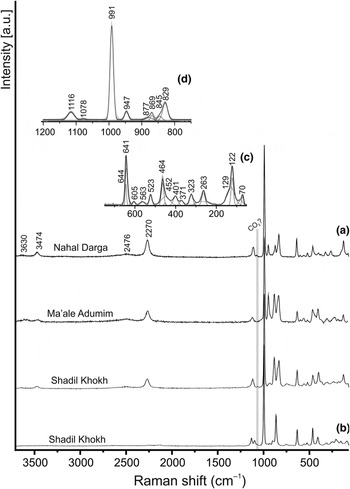
Raman spectra of the holotype dargaite from Nahal Darga and also for dargaite from Ma'ale Adumim and Shadil-Khokh (Fig. 2) were obtained. The spectra correspond to those of Ba-bearing nabimusaite (Galuskin et al., Reference Galuskin, Gfeller, Galuskina, Pakhomova, Armbruster, Vapnik, Włodyka, Dzierżanowski and Murashko2015b); the following main bands are distinguished on spectra of the holotype dargaite (Fig. 2, cm–1): 70, 122, 129, 263 and 323 (lattice mode, Ba–O, Ca–O vibrations); 401 [ν2(SiO4)4–]; 464 [ν2(SO4)2–]; 523 [ν4(SiO4)4–]; 563 [ν4(PO4)3–]; 641 and 644 [ν4(SO4)2–]; 829 and 869 [ν1(SiO4)4–]; 947 [ν1(PO4)3–]; 991 [ν1SO4)2–]; 1078 [ν1(CO3)2–?]; and 1116 [ν3(SO4)2–]. Dargaite from Southern Ossetia contains only negligible P content and thus lacks the characteristic Raman band near 950 cm–1. The band at 1080 cm–1 related to vibrations of CO3 groups is easily detectable. Dargaite from Ma'ale Adumim contains up to 4.33 wt.% Р2О5 (Table 2) and produces a strong Raman band at 947 cm–1 [ν1(PO4)3–]. Bands at ~2270, 2476, 3474 and 3630 cm–1 observed on all Raman spectra might be interpreted as: (1) overtones (e.g. ν3); (2) combinational bands (e.g. ν3+ν4); or (3) artefacts of a layered mineral structure with strong scattered properties of such a system.
Raman spectra of dargaite from the three localities (a) in comparison with gazeevite spectrum (b); and (c and d) fitting results of holotype dargaite Raman spectrum in the ranges 60–750 and 750–1200 cm–1, respectively.

A doublet at 830 and 870 cm–1 [ν1(SiO4)4–] (Fig. 2) relates to the two types of (SiO4)4– tetrahedra in antiperovskite layers of dargaite (Table 4). This doublet is distinctive in the Raman spectra of dargaite, BaCa12(SiO4)4(SO4)2O3 and is different to the spectrum of gazeevite, BaCa6(SiO4)2(SO4)2O. In gazeevite there is only the one type of (SiO4)4– tetrahedra associated with only one strong band at 865 cm–1 (Fig. 2; Galuskin et al., Reference Galuskin, Gfeller, Galuskina, Armbruster, Krzątała, Vapnik, Kusz, Dulski, Gardocki, Gurbanov and Dzierżanowski2017a).
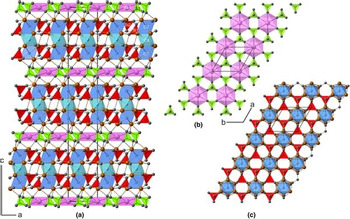
Dargaite is isostructural with nabimusaite and its synthetic analogue (Fayos et al., Reference Fayos, Glasser, Howie, Lachowski and Perez-Mendez1985; Galuskin et al., Reference Galuskin, Gfeller, Armbruster, Galuskina, Vapnik, Murashko, Wodyka and Dzierżanowski2015a). Dargaite is trigonal with space group R  $\overline 3 $m. The unit-cell parameters are: a = 7.1874(4) Å, c = 41.292(3) Å, V = 1847.32(19) Å3 and Z = 3. The structure is formed by three-layered antiperovskite modules {O3Ca12(SiO4)4}2+ interstratified with Ва(SO4)22– layers (Fig. 3). In the nabimusaite structure the antiperovskite module {FO2Ca12(SiO4)4}3+ intercalates with K(SO4)23– layers (Galuskin et al., Reference Galuskin, Gfeller, Armbruster, Galuskina, Vapnik, Murashko, Wodyka and Dzierżanowski2015a). Both antiperovskite modules in dargaite and nabimusaite are derived from hatrurite (Gfeller et al., Reference Gfeller, Galuskin, Galuskina, Armbruster, Vapnik, Włodyka and Dzierżanowski2013). The main difference is that the (SiO4)4– tetrahedra inside the antiperovskite layer of hatrurite have the tetrahedral apices pointing in the same direction whereas in nabimusaite–dargaite the apices alternate pointing up and down (Galuskin et al., Reference Galuskin, Gfeller, Armbruster, Galuskina, Vapnik, Murashko, Wodyka and Dzierżanowski2015a). The structural formula of dargaite Ba0.7K0.3Ca12(SiO4)4(SO4)2[O2.5F0.5] is close to the empirical formula of the holotype specimen (Table 2).
(a) The crystal structure of dargaite along [010]. Ca atoms are shown as brown spheres, SiO4 tetrahedra in red, SO4 tetrahedra in green and BaO6 octahedra in pink. The structure is characterised by modules of three face-sharing antiperovskite type [OCa6] octahedra (blue). The triplets extend along the threefold axis at (0, 0, z), (⅓, ⅓, z) and (⅔, ⅔, z). Dargaite is isostructural to nabimusaite, KCa12(SiO4)4(SO4)2O2F. The octahedral F site in nabimusaite is occupied by O (blue) in dargaite, BaCa12(SiO4)4(SO4)2O3. (b,c) The antiperovskite modules {Ca12(SiO4)4O3}2+ in dargaite (c), are intercalated by Ba(SO4)22– slices (b).

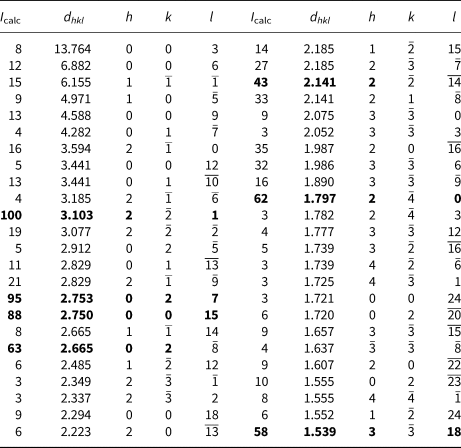
We could not collect meaningful powder diffraction data because of a limited amount of dargaite and difficulties obtaining pure material due to inclusions and admixtures of other minerals. Therefore, a calculated powder diffraction pattern from the structural data is given in Table 7.
Calculated powder diffraction pattern of dargaite*.

* Conditions: CuKα1+2 = 1.540598, Debye-Scherrer geometry, I > 2.00. The strongest lines are given in bold
Discussion
Dargaite belongs to the arctite structural type (Sokolova et al., Reference Sokolova, Yamnova, Egorov-Tismenko and Khomyakov1984; Galuskin et al., Reference Galuskin, Gfeller, Galuskina, Armbruster, Krzątała, Vapnik, Kusz, Dulski, Gardocki, Gurbanov and Dzierżanowski2017). We suggest that the structural formula AB1 6B2 6[(T1O4)2(T2O4)2](T3O4)2W1 2W2 of the arctite-group minerals should be simplified to AB 12(TO4)4(TO4)2W 3 with combined sites B1 and B2, T1 and T2, and W1 and W2. In this organisation, the formulas of nabimusiate and ariegilatite contain only one double occupied W site (made of W1 = O7 and W2 = O8) KCa12(SiO4)4(SO4)2[O2F] and BaCa12(SiO4)4(PO4)2[OF2], respectively. In dargaite, BaCa12(SiO4)4(SO4)2[O3], all sites have unique occupation. In arctite, Ba(Ca7Na5)(PO4)4(PO4)2F3, combined occupation is only observed for the B site.
Nabimusaite, KCa12(SiO4)4(SO4)2O2F, daragite BaCa12(SiO4)4(SO4)2O3 and ariegilatite BaCa12(SiO4)4(PO4)2OF2 form a continuous solid-solution series (Galuskin et al., Reference Galuskin, Gfeller, Armbruster, Galuskina, Vapnik, Murashko, Wodyka and Dzierżanowski2015a, Reference Galuskin, Krüger, Galuskina, Krüger, Vapnik, Wojdyla and Murashko2017c; Table 2). The main isomorphic scheme in the nabimusaite–dargaite series is AK+ + WF– → ABa2+ + WO2–, in the dargaite–ariegilatite series: T(SO4)2– + WO2– → T(PO4)3– + WF–, and in the nabimusaite–ariegilatite series: ATK(SO4)23– + WO2– → ATBa(PO4)24– + WF– or expressed in two separate schemes: (1) AK+ + T(SO4)2– → ABa2+ + T(PO4)3–; and (2) T(SO4)2– + WO2– → T(PO4)3– + WF–. Isomorphic substitutions in the tetrahedral layer A(TO4)2 of the nabimusaite–dargaite and dargaite–ariegilatite series are balanced by the O/F ratio variation within the antiperovskite modules {[W 3Ca12](SiO4)4}. In the nabimusaite–ariegilatite series a substitution of (SO4)2– for (PO4)3– is balanced by K+ → Ba2+ in the tetrahedral layer and/or O → F in the antiperovskite module.
The authors refining the structure of the synthetic phase, KCa12(SiO4)4(SO4)2O2F, assigned fluorine to the central antiperovskite layer (Fayos et al., Reference Fayos, Glasser, Howie, Lachowski and Perez-Mendez1985), corresponding to O8 in Table 4. In the case of its natural analogue – nabimusaite, the model with fluorine in the central antiperovskite layer was also adopted for structure refinement (Galuskin et al., Reference Galuskin, Gfeller, Armbruster, Galuskina, Vapnik, Murashko, Wodyka and Dzierżanowski2015a). However, calculation of bond-valence sums (Brown and Altermatt, Reference Brown and Altermatt1985) for dargaite, nabimusaite and synthetic KCa12(SiO4)4(SO4)2O2F (Supplementary Tables S1–S3) suggested that F enters the external antiperovskite layers (О7Са6 octahedral layers, Fig. 3). Thus, the original model has to be revised. In arctite, BaCa7Na5(PO4)6F3, F occupies the central and the external antiperovskite layer (corresponding to O7 and O8). In contrast to other minerals of the arctite structure type, in arctite fluorine incorporation in the central antiperovskite layer (corresponding to O8) is favoured by the substitution Na → Ca at the F coordinated octahedral site (Sokolova et al., Reference Sokolova, Yamnova, Egorov-Tismenko and Khomyakov1984).
The holotype dargaite, (Ba0.72K0.24Na0.04)Σ1(Ca11.95Mg0.04Na0.01)Σ12([SiO4]0.91[PO4]0.05 [AlO4]0.03[Ti4+O4]0.01)Σ4([SO4]0.84[PO4]0.14[CO3]0.02)Σ2O2.54F0.46, represents a solid solution between dargaite, BaCa12(SiO4)4(SO4)2O3, nabimusaite, KCa12(SiO4)4(SO4)2O2F and ariegilatite, BaCa12(SiO4)4(PO4)2OF2, with a small contribution of an exotic end-member, for example, BaCa12[(SiO4)2(PO4)2](PO4)2O3 (Table 2). Predominance of Ba at the A site (Ba > K + Na) and O at the W site (O > F) is the basis for distinguishing the new mineral, the Ba-analogue of nabimusaite. In the dargaite–nabimusaite and dargaite–ariegilatite series, isomorphic substitutions ABa2+ + WO2– → AK+ + WF– and Т(SO4)2– + WO2– → T(PO4)3– + WF–, respectively, have a significant effect on: (1) the increase of F content in dargaite, e.g. K- and P-bearing dargaite from Ma'ale Adumim: (Ba0.63K0.28Na0.09)Σ1(Ca11.97Mg0.03)Σ12([SiO4]0.92[PO4]0.02[AlO4]0.05[FeO4]0.01)Σ4([SO4]0.82[PO4]0.17[CO3]0.01)Σ2O2.19F0.81(Table 2, an. 2); and (2) the decrease of F content in ariegilatite, e.g. S-bearing ariegilatite from Ma'ale Adumim: (Ba0.90K0.04Na0.05Sr0.01)Σ1(Ca11.96Mg0.03Na0.01)Σ12([SiO4]0.86[PO4]0.09[AlO4]0.04[TiO4]0.01)Σ4([PO4]0.55[SO4]0.40 [CO3]0.04[VO4]0.01)Σ2O2.17F0.83 (Table 2, an. 4).
Formation conditions of the nabimusaite–dargaite series and associated gazeevite have been discussed before (Galuskin et al., Reference Galuskin, Gfeller, Armbruster, Galuskina, Vapnik, Murashko, Wodyka and Dzierżanowski2015a, Reference Galuskin, Gfeller, Galuskina, Armbruster, Krzątała, Vapnik, Kusz, Dulski, Gardocki, Gurbanov and Dzierżanowski2017). Minerals with the intercalated antiperovskite structure derived from hatrurite form at hot spots under the influence of pyrometamorphic by-products (gases, fluids and melts) on minerals of an early clinker association, such as larnite, fluorellestadite and ye'elimite (Galuskin et al., Reference Galuskin, Galuskina, Gfeller, Krüger, Kusz, Vapnik, Dulski and Piotr Dżierzanowski2016). Paragenesis of ternesite, Ca5(SiO4)2SO4, with minerals of the dargaite–nabimusaite series allows estimation of the temperature of this assemblage at ~900°C (Galuskin et al., Reference Galuskin, Gfeller, Armbruster, Galuskina, Vapnik, Murashko, Wodyka and Dzierżanowski2015a).
Acknowledgements
The authors thank Fernando Cámara, Pete Leverett and Ramiza Rastsvetaeva for their careful revisions that improved the early version of the manuscript. The work was supported by the National Science Centre (NCN) of Poland, grant no. 2016/23/B/ST10/00869.
Supplementary material
To view supplementary material for this article, please visit https://doi.org/10.1180/minmag.2017.081.095