I. INTRODUCTION
Barium titanate (BaTiO3) is widely used in the electronics industry. With its high dielectric constant and low losses, it is used as a basic ferroelectric material in many electronic components, such as multilayer ceramic capacitors, as well as positive temperature coefficient thermistors and sensors. Previous studies on the effects of the Ba/Ti ratio on BaTiO3 have focused on doping elements and dielectric properties. However, doping elements may cause complications in studies of the Ba/Ti ratio. Therefore, to realize the effects of the Ba/Ti on tetragonality, Curie temperature, and the dielectric constant of BaTiO3 powderbecomes very important. Hu et al.Reference Hu, Harmer and Smyth1 pointed out that the solubility limit of BaO in BaTiO3 is lower than 100 ppm. Lee et al.Reference Lee, Randall and Liu2 revised the BaO–TiO2 phase diagram and the solubility limit of BaO in BaTiO3 and pointed out that the Ba/Ti ratio may change when the sintering temperature does. For example, the Ba/Ti ratio ranges between 0.9834–1.0051 and 0.9665–1.0097 when sintered at 1200 and 1320 °C, respectively. Lewis and Catlow found that Schottky defects occur more easily than Frenkel defects in nonstoichiometric BaTiO3, and these defects in Ba-excess and Ti-excess are shown in the following equations, respectivelyReference Lee, Randall and Liu2:
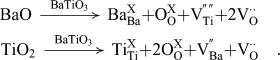 $$ {\rm{BaO}}\buildrel {{\rm{BaTiO}}_{\rm{3}} } \over {\hscale250%\longrightarrow} {\rm{Ba}}_{{\rm{Ba}}}^{\rm{X}} {\rm{ + O}}_{\rm{O}}^{\rm{X}} {\rm{ + V}}_{{\rm{Ti}}}^{{\Prime\,\Prime\rm{}}} {\rm{ + 2V}}_{\rm{O}}^{{\rm{ \cdot\cdot}}} {\rm{TiO}}_{\rm{2}} \buildrel {{\rm{BaTiO}}_{\rm{3}} } \over {\hscale250%\longrightarrow} {\rm{Ti}}_{{\rm{Ti}}}^{\rm{X}} {\rm{ + 2O}}_{\rm{O}}^{\rm{X}} {\rm{ + V}}_{{\rm{Ba}}}^{\Prime\rm{}} {\rm{ + V}}_{\rm{O}}^{{\rm{ \cdot \cdot }}} \quad.} $$
On the other hand, the formation energies of barium vacancies (5.5 eV) and titanium vacancies (24 eV) are lower than the diffusion energies of titanium ions (83 eV) and barium ions (20 eV) in BaTiO3, and thus, the solubility regime on the Ti-excess side should be wider than that on the Ba-excess side.
AbelardReference Abelard3 proposed that tetragonality decreases as the grain size of BaTiO3 decreases, leading to the so-called “size effect.” Previous studiesReference Dufour, Monty and Ervas4–Reference Dutta, Gallagher and Twu12 had obtained results that indicate that tetragonal and cubic phases coexist in BaTiO3 in a core–shell structure (core: tetragonal, shell: cubic) when the grain size decreases. A cubic phase appearing on the BaTiO3 surface leads to a decrease in the transformation enthalpy of BaTiO3 powder and also decreases the Curie temperature. Arlt et al.Reference Arlt, Hennings and de With13 also pointed out that permittivity shows a maximum ∼5000 at grain sizes of 0.8–1 μm and strongly decreases at grain sizes <0.7 μm. The decrease in permittivity observed at smaller grain sizes is obviously correlated to structural changes in the BaTiO3. Therefore, to determine the effects of the Ba/Ti ratio on tetragonality, Curie temperature, and dielectric constant, the size effect needs to be excluded. In the present paper, high-purity BaCO3 and TiO2 were used to synthesize BaTiO3 powder via a conventional solid-state reaction. The crystalline sizes of BaTiO3 powder with various Ba/Ti ratios were located in the same region through different calcination conditions. The effects of the Ba/Ti ratio on the crystal structure and microstructure of nonstoichiometric BaTiO3 powder are discussed below.
II. EXPERIMENTAL PROCEDURE
High-purity commercial BaCO3 (S BET = 12.2 m2/g; 99.3%) and TiO2 (Toho Titanium, Kanagawa, Japan; S BET = 23 m2/g; 99.9%) powders were chosen as the starting materials. The powders with different Ba/Ti ratios were placed in a polyethylene jar containing deionized water and yttrium-stabilized tetragonal zirconia polycrystals grinding balls (φ = 2 mm). After ball milling for 8 h, the slurry was decanted from the polyethylene jar and dried at 100 °C for 24 h.
The thermal behavior of the mixed powders was analyzed using differential thermal analyses equipped with a thermal gravimeter (DTA-TG; STA 449C; Netzsch, Selb, Germany). A sample with a weight of around 50 mg was placed in an Al2O3 crucible pan. The measurement was performed in air at a flow rate of 50 mL/min. The heating rate in the DTA measurement was 10 °C/min, and alumina powder was used as an inert reference material. The Ba/Ti ratio was confirmed by x-ray fluorescence spectrometry (XRF; S8 TIGER; Bruker, Madison, WI). The BaTiO3 powders were ground after calcination. The 10-g calcined BaTiO3 powders were mixed with wax (binder) and pressed into disks 40 mm in diameter with 312 MPa for 30 s. The XRF method was used to calibrate the Ba/Ti ratio against the batched ratios of solid-state-reacted method. The crystalline phases of the powders were identified by a x-ray diffractometer (XRD; D5000; Bruker-AXS, Madison, WI). The morphology of the powders was characterized by scanning electron microscopy (SEM; S4100; Hitachi, Tokyo, Japan). The particle size was measured from SEM micrographs using Lucia measurement software (Laboratory Imaging, version 4.71), and each sample contained at least 200 grains when undergoing the examination. The tetragonality (c/a ratio) was obtained from cell parameters that were calculated from the XRD pattern and cell parameter software.Reference Huang14 The phase transition temperature was measured using a differential scanning calorimeter (DSC; Perkin Elmer, Waltham, MA, DSC 7). According to previous studies, the permittivity of powder material can be measured by a liquid method.Reference Lee and Kim15–Reference Petrovsky, Petrovsky, Kamlapurkar and Dogan19 In this study, the electrode was made of two conductive metal plates with 30 mm2 surface area. Short plastic rods separated the two parallel metal plates with a distance of 2 mm. Organic solvent butoxyethanol (relative permittivity 5.30) was used as the host liquid for slurry preparation. The slurry with 10 wt% solid content was prepared by mixing powder with the host liquid via ball milling for 3 h. The dielectric constant of BaTiO3 powder was measured using a LCR meter (4284A; Agilent, Santa Clara, CA). The electrode was used to put the electrode in the slurry, and the mixing rule was used to obtain the dielectric constant of the powder.
III. RESULTS AND DISCUSSION
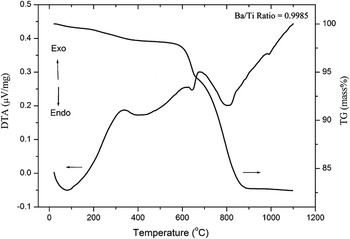
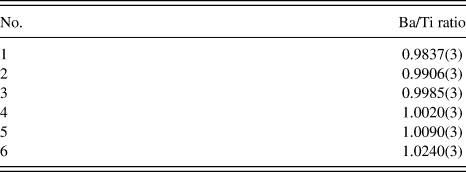
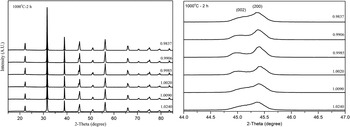
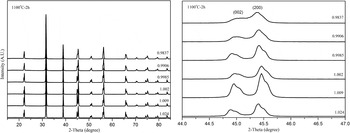
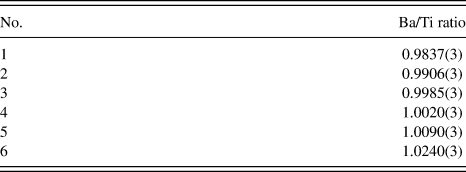
The DTA/TG results for the mixed powder with a Ba/Ti ratio of 1.002 are shown in Fig. 1. It can be seen that the TG signal revealed a significant weight loss between the temperatures of 400 and 900 °C. The reaction started at around 330 °C, rapidly proceeded at 700 °C, and was nearly completed at 900 °C. According to a previous study,Reference Templeton and Pask8 the endothermic reaction, with a peak with weight loss at 650 °C, was the decomposition of BaCO3. The next endothermic reaction, with a peak at 810 °C, was due to the orthorhombic to hexagonal phase transformation of BaCO3. The BaTiO3 could be formed in the temperature range from 700 to 800 °C. Based on the DTA/TG results, 1000 and 1100 °C were chosen as the calcination temperatures with different dwelling times. The Ba/Ti ratios of all the BaTiO3 powders calcined at 1000 °C for 2 h were confirmed by XRF, and the results are shown in Table I. The error values of all the samples were 0.0003. Comparing with the Ref. Reference Lee, Randall and Liu2, the difference of Ba/Ti ratio may due to different synthesis method and sample preparation procedure. The XRD patterns with various Ba/Ti ratios calcined at 1000 °C/2 h and 1100 °C/2 h are shown in Figs. 2 and 3. All samples exhibited a tetragonal structure, as evidenced by the separated (002) and (200) diffraction lines. The XRD patterns revealed no significant amount of intermediate Ba2TiO4 (JCPDS No. 72-0135) phase. All BaTiO3 powders with various Ba/Ti ratios were synthesized at 1000 °C for 2 h with a single phase (BaTiO3; JCPDS No. 05-0626). As a result, the solubility limit of barium and titanium ions in nonstoichiometric BaTiO3 was in the range of 0.9837–1.024 when calcined at 1000 °C for 2 h.
DTA/TG curves of the mixture with Ba/Ti = 0.9985.

Ba/Ti ratio of all BaTiO3 powder measured by XRF.
XRD patterns of BaTiO3 powder with various Ba/Ti ratios calcined at 1000 °C for 2 h.

XRD patterns of BaTiO3 powder with various Ba/Ti ratios calcined at 1100 °C for 2 h.

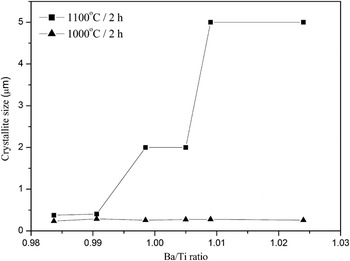
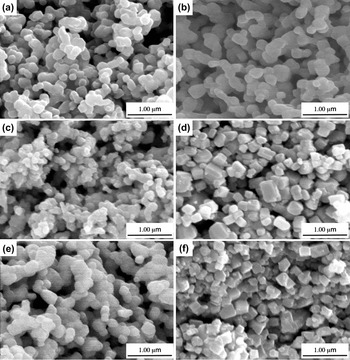
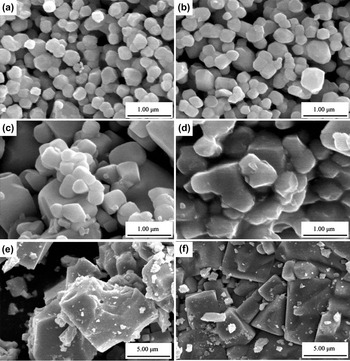
The crystallite sizes of the BaTiO3 powders with different Ba/Ti ratios calcined at 1000 and 1100 °C for 2 h are shown in Fig. 4. The crystallite sizes were located in the same region (around 260 nm) with different Ba/Ti ratios when calcined at 1000 °C for 2 h. When the calcination temperature was increased (up to 1100 °C), the crystallite size increased with increases in the Ba/Ti ratio. These changes in the crystallite size with the Ba/Ti ratio were due to the increase in the chemical diffusion coefficient of the BaTiO3 system. In a previous study, a Ti4+ vacancy required more activation energy than a Ba2+ vacancy in BaTiO3. As a result, a Ti4+ vacancy had a lower diffusion rate than a Ba2+ vacancy in BaTiO3. Increasing the diffusion rate of a Ti4+ vacancy led to increases in the chemical diffusion coefficient of BaTiO3. Finally, the crystallite size increased along with the chemical diffusion coefficient. There were more Ti4+ and O2− vacancies in the Ba-excess samples. Ti4+ vacancies improved the chemical diffusion coefficient, which subsequently increased the crystallite size in the Ba-excess samples. The microstructures of the BaTiO3 powder with different Ba/Ti ratios calcined at 1000 and 1100 °C for 2 h are shown in Figs. 5 and 6. The SEM micrographs show that under calcined at 1000 °C for 2 h, the crystallite sizes were located in the same region, around 260 nm.
Particle sizes of BaTiO3 powder with various with Ba/Ti ratios calcined at 1000 °C for 2 h and 1100 °C for 2 h.

SEM micrographs of BaTiO3 powder with various Ba/Ti ratios calcined at 1000 °C for 2 h. (a) 0.9837, (b) 0.9906, (c) 0.9985, (d) 1.0020, (e) 1.0090, and (f) 1.0240.

SEM micrographs of BaTiO3 powder with various Ba/Ti ratios calcined at 1100 °C for 2 h. (a) 0.9837, (b) 0.9906, (c) 0.9985, (d) 1.0020, (e) 1.0090, and (f) 1.0240.

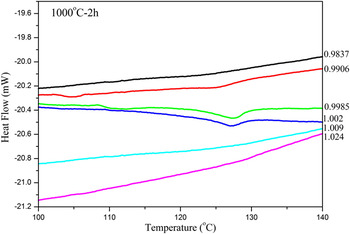
The Curie temperature of the BaTiO3 powders with different Ba/Ti ratios calcined at 1000 °C for 2 h, and measured by DSC, are shown in Fig. 7. The results show that BaTiO3 powder with ratios 0.9906, 0.9985, and 1.002 exhibit significations Curie temperature. The Curie temperature of BaTiO3 powders shifted to a lower temperature with the ratios of 0.9906 and 1.002. As mentioned above, the crystallite size was located in the same region (∼260 nm), and therefore, the size effect could be excluded. The decreasing of Curie temperature may be attributed to the defects formed in the BaTiO3 powder. The concentration of vacancies increased when the Ba/Ti ratio strayed away from 1. The formation of defects decreases the structural energy of BaTiO3, thus improves the phase transformation from tetragonal to cubic.
Curie temperature with different Ba/Ti ratios of BaTiO3 powder calcined at 1000 °C for 2 h.

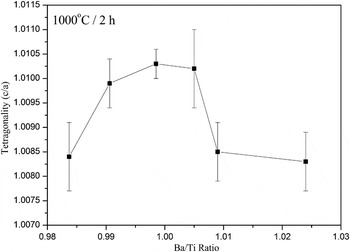
Changes in the tetragonality with different Ba/Ti ratios calcined at 1000 °C for 2 h are shown in Fig. 8, and it can be seen that the tetragonality shows a discontinuous change in the solubility limit range. The results show that the tetragonality decreased when the Ba/Ti ratio strayed from 1. This can be attributed to the fact that both the barium and titanium vacancies came out in the Ti-excess and Ba-excess BaTiO3 powders, respectively.
Tetragonality various with different Ba/Ti ratios of BTiO3 powder calcined at 1000 °C for 2 h.

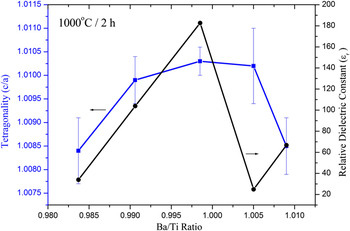
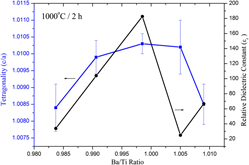
The dielectric constant and tetragonality of BaTiO3 powders with various Ba/Ti ratios are shown in Fig. 9. The dielectric constant of the BaTiO3 powder with different Ba/Ti ratios is measured by the mixing rule, as shown in the following equation:
 $${\rm{\varepsilon }}_{{\rm{eff}}} \,= \,{{{\rm{\varepsilon }}_1 } \over {X_1 }} + {{{\rm{\varepsilon }}_2 } \over {1 - X_1 }}\quad,$$
Dielectric constant and tetragonality of BaTiO3 powder with various Ba/Ti ratios.

where εeff, ε1, and ε2 are the dielectric constants of the slurry, powder, and solvent, respectively. X 1 is the volume ratio of the powder. The results show that the powder with the Ba/Ti ratio closest to 1.0 had the highest dielectric constant. This may be due to the Ba2+ and Ti4+ vacancies coming out in the Ti-excess and Ba-excess BaTiO3 powders, respectively.
IV. CONCLUSIONS
The effects of the Ba/Ti ratio on the crystalline phase, Curie temperature, and dielectric constant of solid-state-reacted BaTiO3 powder were investigated in this study. The experimental results showed that the tetragonality decreased and the Curie temperature shifted to lower temperature when the Ba/Ti ratio strayed from 1.0. The dielectric constant of BaTiO3 powder with various Ba/Ti ratios is calculated from the mixing rule. The BaTiO3 powder had the maximum dielectric constant when the Ba/Ti approaching 1.0. XRF and XRD revealed that the solubility limit of the barium and titanium ions was within the range of 0.9837–1.0240. The SEM images showed that the BaTiO3 crystallites were of the same size range (∼260 nm) after calcination at 1000 °C for 2 h. Therefore, the size effect can be excluded in this study, and this finding can be attributed to the fact that the barium and titanium vacancies came out in the Ti-excess and Ba-excess in the BaTiO3 powder, respectively.
ACKNOWLEDGMENT
This work was supported by the National Science Council, under Grant No. NSC100-2221-E-006-134-MY3.