Introduction
Skills policy, which combines the input of governments, employers and educational institutions, is receiving increasing attention (Organization for Economic Cooperation and Development, 2013). Recent studies have emphasised the importance of effective skills utilisation among employers, the role of governments in ensuring an adequate skills supply through education and training initiatives, and the continued importance of skills policies in promoting economic growth and social inclusion (Findlay and Warhust, Reference Findlay and Warhurst2012; Keep, Reference Keep2014). Migration also plays an important role in influencing skills supply and in determining the competiveness of individual countries within a globalised economy. Within the UK, there is some evidence that the professional skills of individuals in certain ethnic minority groups are in demand and rewarded, as reflected in their earnings at the top end of pay distribution, with Indians and Chinese males earning as much, on average, as their White counterparts (Longhi and Platt, Reference Longhi and Platt2008). However, it is well-established that some minorities do not earn as much as their education would warrant, and that some groups, including Pakistanis, Bangladeshis and some recent migrants, tend to be over-represented in low-paid work, although there is considerable polarisation between and within groups (Heath and Cheung, Reference Heath and Cheung2006; Brynin and Güveli, Reference Brynin and Güveli2012; Low Pay Commission, 2013). The over-representation of ethnic minorities in low-paid work, the focus of this article, is especially noteworthy within the context of increasing in-work poverty in both developed and developing economies (Eurostat, 2010; MacInnes et al., Reference MacInnes, Aldridge, Bushe, Kenway and Tinson2013; International Labour Organization, 2014).
UK government initiatives on tackling poverty continue to emphasise employability, even though work does not necessarily provide a route out of poverty. Some evaluation has been undertaken of the effectiveness of employability schemes on ethnic minority groups (Barnes et al., Reference Barnes, Hudson, Parry, Sahin-Dikmen, Taylor and Wilkinson2005; Aston et al., Reference Aston, Bellis, Munro, Pillai and Willison2009), but this has received relatively little policy attention. Yet scrutiny of the scope for individuals from diverse ethnicities to progress to better paid work is important since skills and knowledge can, if appropriately harnessed, contribute to more economically vibrant workplaces, reduce poverty and enable individuals to fulfil their potential. The aim of this article is thus to consider the opportunities for, and barriers to, progression to better paid work as a route out of poverty, including among ethnic minorities in the UK, and to consider the implications of this for skills policy.
This article is structured as follows. First, we consider some of the main characteristics and developments in skills policy in relation to the labour market, focusing on the roles of government and employers, and concerns relating to progression from low-paid work. We consider the presence of migrant workers and other ethnic minorities in the labour market, and argue that greater attention needs to be paid to aligning developments in skills policies with efforts to reduce labour market inequalities, including those related to migration and ethnicity. Next, we outline our approach to conceptualising ethnicity, migration and progression to better paid work. The study that this article draws on is then introduced and the findings discussed. We argue that while all low-paid workers face formidable challenges to career progression, migration and ethnicity interact in complex ways to influence opportunities for doing so. Finally, the article ends with a consideration of the implications for skills policies.
Skills policy, the labour market and migration
Government has traditionally played a major role in determining skills policy, primarily in helping to ensure an adequate supply of skills through education and training (Keep, Reference Keep2014). In the UK, skills levels continue to be low relative to those of other countries, as revealed by a recent Organization for Economic Co-operation and Development (OECD) report (2013). There has been increasing recognition of the important role that employers play in ensuring effective skills utilisation through demand-side interventions to ensure innovation, productivity and competitiveness (Findlay and Warhust, Reference Findlay and Warhurst2012; Wright and Sissons, Reference Wright and Sissons2012). Government too has a key role in encouraging employer demand for high levels of skills and in identifying relevant jobs where skills are needed (McIntosh, Reference Mcintosh2013; Keep, Reference Keep2014). Educational providers are vital to developing appropriate skills, in spite of facing funding reductions due to cuts in public spending (Keep, Reference Keep2014). There is also increasing recognition of the importance of integrating skills policies with other social and economic policies to maximise their impact, including efforts to tackle low pay, workplace innovation, people management and employment relations (Wright and Sissons, Reference Wright and Sissons2012).
Also of relevance in considering the role of skills policy to progression from low-paid work is the ‘hollowing out’ of the labour market in many European countries, including the UK and the US (Goos and Manning, Reference Goos and Manning2007). This phenomenon, the process by which the shares of total employment in high-ranked and low-ranked jobs have expanded relative to middle-ranked jobs over time (McIntosh, Reference Mcintosh2013), has given rise to concerns relating to the match between existing skills in the workforce and the skills that are required in the labour market. The phenomenon may also result in fewer intermediate-level jobs to which low-paid workers, including ethnic minorities, can progress. However, McIntosh (Reference Mcintosh2013) argues that analysis of wage distributions shows changes over time that are not allowed for in studies of job polarisation in which occupations are classified according to initial wage. Thus, although certain types of intermediate jobs, particularly in skilled production, have declined numerically, with impacts on employee progression, new intermediate-ranked jobs can arise as jobs move up and down the wage distribution, and totally new jobs may also appear. This indicates that progression beyond low-paid work remains possible.
A further factor that influences skills supply and utilisation is the increasing tendency for outsourcing of low-paid work, thereby blurring employer accountability for skills development and progression (Wills et al., Reference Wills, Datta, Evans, Herbert, May and McIlwaine2010; Overall, Reference Overall2012). Another element is the apparent willingness of migrant workers to accept lower pay and poorer terms and conditions, perhaps due to lack of alternative options, making it cheaper for employers. Ruhrs and Anderson (Reference Ruhrs and Anderson2010) argue for a range of measures to be put in place to reduce employer reliance on migrant workers and to counter claims that these workers are under-cutting wages and working conditions for other workers. This includes greater labour market regulation, more investment in education and training, better wages and conditions in some low-waged public sector jobs, improved job status and career tracks and a decline in low-waged agency work.
To date, skills policy and research does not appear to have addressed the issue of differences in skills within the low-paid workforce and the experience of different outcomes at work, including along the basis of ethnicity and migration status, a gap which this article seeks to address. We argue that debates around skills policy should take into account three specific ways in which they are likely to impact on migrant workers and settled ethnic minorities. Firstly, it is important to acknowledge that the contested nature of skills (Grugulis, Reference Grugulis2007) is of particular relevance to migrant workers, including orientations towards work such as ‘a positive work ethic’, which features prominently among the reasons given by employers for valuing migrant workers (UK Commission for Education and Skills, 2012; Chartered Institute of Personnel Development, 2013). Secondly, it is noteworthy that analysts have argued that it is not so much the shortage of skills in the labour market, but its distortion and under-utilisation, including among ethnic minorities, that need to be addressed (Kamenou et al., Reference Kamenou, Netto and Fearfull2012). Thirdly, it may also be argued that migrant workers’ willingness to take up low-paid work, which does not match their educational qualifications, knowledge or experience, contributes to either the under-utilisation of their skills, or the utilisation of skills that they are not paid for.
Conceptualising ethnicity, migration and progression to better paid work
Consistent with Giddens’ (Reference Giddens1984) structuration theory, we view low-paid workers as capable of taking action to improve their opportunities for progression, although these opportunities are shaped by structural and institutional factors, operating at various levels, ranging from macro-level globalising forces to the micro-politics of organisational relationships. For example, at a micro-level, low-paid workers’ participation in further education may be viewed as an enactment of their agency in supply-side interventions, but their ability to use and develop existing skills in the workplace may be shaped and constrained by structural factors, such as the accessibility and quality of demand-side interventions. Other factors that might constrain agency and influence participation in demand-side interventions at the micro level relate to the extent to which individual workers successfully negotiate their (ethnic) identity and gain acceptance within the workplace (Netto, Reference Netto2011). At a meso- or organisational level, the extent to which employers are supportive of workforce development and implement equal opportunities policies is also likely to influence the extent to which workers from different ethnic groups are able to progress within the workforce. Finally, at a macro-level, migratory flows of labour are also likely to influence the skills utilisation of individuals from different ethnic groups, thus constraining agency.
Key to our analysis is the concept of ethnicity, which we use as a means of grouping individuals on the basis of common origins, cultures, customs and language. Contemporary definitions of the term recognise the fluid and contextual nature of ethnicity (Platt, Reference Platt2007), including its potential to be shaped by place (Netto, Reference Netto2011). However, in relation to examining opportunities for gaining workplace progression, we agree with Goulbourne and Solomos (Reference Goulbourne and Solomos2003), following Barth (Reference Barth and Barth1969), that it is important to examine the boundaries that mark off ethnic groups from each other, as well as to identify the elements associated with each ethnic group. This is because it is at these boundaries that differences are highlighted and competition and conflict may arise. It is possible to delineate boundaries along many dimensions of ethnicity (for example, country of origin, self-identification or religious affiliation), but for the purposes of exploring the role of migration and ethnicity on progression from low-paid work, we will focus on the following categories: majority ethnic groups, recent migrants and established ethnic minorities. Of course, any such categorisations are inevitably prone to two main limitations. First, they necessarily obscure some differences between and within specific ethnic groups (Hills et al., Reference Hills, Brewer, Jenkins, Lister, Lupton, Machin, Mills, Modood, Rees and Riddell2010; Platt, Reference Platt2011). Second, they do not account for the multiple dimensions of identity that individuals possess (for example, class, religion, gender, age and sexuality) and the potential for disadvantage due to intersecting identities (Kamenou et al., Reference Kamenou, Netto and Fearfull2012). Recognising these limitations, we are convinced that analysis of our three broad categories allows for useful comparisons between the work experiences of employees that can inform the development of skills policy.
The study
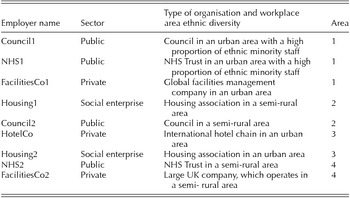
This article draws on an in-depth qualitative case study approach to examining progression among low-paid workers of all ethnicities. Large organisations (with more than 1,000 employees) in the public, private and voluntary sector were contacted to examine low-paid worker progression, given the wider range of opportunities available for progression within such organisations compared to smaller ones. Nine organisations located in four geographical areas − two in England and two in Scotland − agreed to participate. Three of these areas have longstanding ethnic minority populations, while the fourth semi-rural area has been predominantly ‘White Scottish’ until a growth in the migrant worker population since 2004. All nine organisations were in the service sector, with four in Scotland and five in England, and all directly employed low-paid workers from a range of ethnic backgrounds. Table 1 provides details of the organisations.
The case studies

Interviews were conducted with sixty-five low-paid workers and forty-three managers. Senior managers facilitated access to other managers and low-paid workers by publicising the research and passing on to the research team the contact details of those interested. Interviews were conducted in English, in private, and participants were assured of confidentiality and told that all comments would be anonymised. They were also provided with the opportunity of withdrawing both prior to and during the interview; a few prospective participants did so. All the interviews were recorded, transcribed and inputted into Nvivo. We adopted deductive coding based on categories from the interview schedules and developed emergent codes from preliminary reading of the transcripts. This article focuses on the perceptions and experiences of low-paid workers, supplementing this with analysis of interview data with managers and organisational policy frameworks, wherever possible, within the constraints of word length.
The low-paid worker sample
The term ‘low-paid workers’ is used to refer to individuals earning less than £25,000 per annum and with household income eligible to be subsidised by in-work tax credits. Among our sample, more than half earned less than £15,000. There were slightly more women (54 per cent) than men (46 per cent), with interviewees fairly evenly distributed in age brackets between eighteen and fifty-five years. Slightly more than half were born or brought up in the UK, this group being evenly split between ethnic minorities who were born or grew up in the country (seventeen interviewees) and ‘White British/Scottish/Irish’ (seventeen interviewees). The former included those who identified themselves as ‘British Bangladeshis’, ‘British Muslim’, ‘British Asian’ and ‘Black British’. The sample of migrant workers was almost equally divided between those from the EU (sixteen) and non-EU (fifteen) nationals. The former group consisted mainly of Eastern European nationals, while the non-EU sample consisted mainly of individuals of African and Asian origin. Twenty-three individuals are categorised as long-term migrants and eight as recent ones, that is, those who had migrated to the UK in the last five years. A full breakdown of the ethnic profile can be found in Hudson et al. (Reference Hudson, Netto, Sosenko, Noon, de Lima, Gilchrist and Aigbekaen-Kamenou2013). Most of the low-paid workers interviewed were on permanent employment contracts, with thirty-nine (60 per cent) working full-time and twenty-six part-time (40 per cent). Most were employed at entry-level positions, with the largest group employed in administrative roles, followed by cleaning, catering and caring. Quotes are mainly attributed to low-paid workers in terms of their ethnicity, gender and migration status.
The manager sample and interviews
Managers at different levels of organisations were interviewed, including eleven HR Managers, thirteen line managers and a range of senior managers. Interviews explored policies and processes related to progression, equal opportunities, the role of Human Resources and management. Quotes are attributed to managers by their role and organisation.
Findings of the research
Educational background and career aspirations of low-paid workers
The educational background of low-paid workers varied considerably, including twenty-six (40 per cent) who possessed low-level qualifications (defined as level 2 or below of the National Vocations Qualifications (NVQ) Framework), eighteen with level 3 or intermediate-level qualifications, and a further eighteen with level 4 or 5 qualifications.Footnote 1 High educational attainment was attributed to attending good schools, high parental expectations and the influence of siblings or others. In contrast, low educational attainment was linked to growing up in families who struggled to make ends meet, and poor schooling experiences. Recent migrants tended to be more highly educated than other groups; this finding is consistent with research that has revealed significant mismatches in educational attainment and the nature of migrant employment (International Organization for Migration, 2012).
Many low-paid workers wished to move up the career ladder, including through being promoted to a team leader or supervisor, in order to improve their standard of living. However, others were less definite, signalling openness to consider a wide range of possibilities, along with other factors, such as caring responsibilities, current working conditions, opportunities for obtaining training or securing promotion within the current job, personal interests and levels of fluency in English. The diversity in educational background, qualifications and career aspirations among low-paid workers highlights the importance of providing a wide range of opportunities for development, including through lateral moves within the organisation.
Factors enabling progression in the workplace
Formal (recognised) qualifications were almost universally viewed as playing a crucial role in improving opportunities for career progression, including among migrants whose overseas qualifications were not recognised. This was confirmed by managers, some of whom reported encouraging or supporting employee attempts to seek further qualifications through flexible working, bursaries or in-house training programmes. One illustration of this can be seen in the case of a migrant who had left Poland with the equivalent of NVQ intermediate-level qualifications. She initially worked in a number of entry-level jobs and followed this by combining participation in further education with part-time work. On completion of the course, she succeeded in moving to a better paid full-time administrative job within the same organisation. She viewed the successful completion of the course as playing a critical role in moving up the career ladder.
Within the workplace, apprenticeships were viewed as widening opportunities for career development through allowing participation in education while continuing to work. This can be seen in the case of an interviewee of Bangladeshi origin, with immigrant parents who had struggled to make ends meet. With few educational qualifications, he started work in an entry-level role in a large local authority, and like others engaged in such schemes, viewed his participation in an apprenticeship scheme as a major step in enabling him to acquire further qualifications and progress to a better paid job.
In terms of informal developmental opportunities, both managers and low-paid workers identified line manager support as a major factor shaping low-paid worker progression. Supportive line managers alerted individuals to developmental opportunities and offered helpful feedback on performance:
I had a chef who always wanted me to get involved in the kitchen, rather than concentrating on the washing up. So he kept on pushing me . . . and I ended up being the breakfast chef. (Ghanaian man, established ethnic minority)
It comes down to having quality managers who are well educated in these issues. They’re up to date with what they are required to do . . . how the policies should be applied and stick to it . . . that's where the frontline interface is . . . And then others will, hopefully model themselves on that. (HR manager)
However, such managers tended to be the exception rather than the norm. Similarly, examples of informal coaching or mentoring were rare, suggesting that overall, informal workplace cultures were not supportive of low-paid worker development.
Barriers to career progression
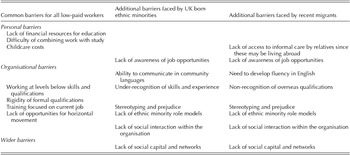
Barriers to career progression identified by low-paid workers can be categorised as resulting from: (a) personal factors, (b) organisational factors and (c) social networks. While some of these barriers were faced by individuals from all ethnic backgrounds, other barriers appeared to be faced by either settled ethnic minority groups or recent migrants. Below, we disentangle those barriers that are common to all low-paid workers from those that relate directly to either recent migration or to more ‘intractable’ issues faced by other ethnic minorities.
While the importance of formal qualifications was widely recognised as crucial in enabling progression to better paid work, common barriers included the costs of further and higher education, rising living costs and the loss of income incurred in pursuing education. Other pragmatic constraints involved the difficulty of combining employment and personal study, with fatigue emerging as a recurrent theme. Consequently, employer support through allowing time off for study or through providing financial support was seen as crucial.
The second group of barriers faced by individuals related to organisational factors. Many low-paid workers of all ethnicities appeared to be working below their skills and qualifications. Consistent with the findings of Green and Felstead (Reference Green and Felstead2013), training offered to low-paid workers appeared to focus on doing the current job well, rather than on preparing individuals to take on more challenging and better paid roles. Where training and developmental opportunities were available, the means of accessing such opportunities were not always clear, with both settled ethnic minorities and recent migrants articulating concerns about lack of transparency. In contrast, managers tended to report that while the current climate of recession and austerity had reduced opportunities for progression due to low staff turnover and cuts to lower management posts, opportunities for progression were open to all. This view appears complacent in the light of the finding that, in all nine organisations, few people from ethnic minorities held middle or senior management posts. Further evidence that institutional barriers may be hindering development opportunities for all comes from recent research that reveals the low uptake of modern apprenticeship schemes by ethnic minorities in all four UK countries (Sosenko and Netto, Reference Sosenko and Netto2013). A further organisational barrier was that while horizontal mobility within the same organisation is viewed as a means of widening skills and experience (UK Commission for Employment and Skills, 2012), opportunities for such movement appeared to be limited, with individual workers expressing anxiety about being seen to be ‘rocking the boat’ by actively seeking out such opportunities.
A few managers identified levels of fluency in English as a factor that might disproportionately affect ethnic minority low-paid workers in terms of career progression. While fluency in English might be viewed as a personal issue, and some recent migrants accepted that it was their responsibility to acquire competency in English, enabling proficiency in English as a second language as part of adult education might also be viewed as the responsibility of government. Ironically, the possession of language skills can also hamper progression to better paid work. Some ethnic minority interviewees who were fluent in community languages explained how they were held back from promotional opportunities because these skills were required by the organisation in order to communicate with a multi-lingual population, but were not formally acknowledged. In such instances, it appeared that these individuals were being exploited by the organisation through not being rewarded for the additional linguistic skills they brought to the job.
Perhaps the institutional barrier that was hardest to overcome related to the degree of fit between individuals’ perceptions of their identities with perceived organisational expectations and norms of who should assume leadership roles. Both recent migrants and established minorities were more likely to articulate concerns about organisational expectations of who should assume these roles. The quote below is typical:
Common barriers to better paid work experienced by low-paid workers and additional barriers experienced by ethnic minorities

Well, I have known people to apply for jobs and you know they can do it, they have got all the qualifications, they have had all the right experience and everything. But then somebody else has got it because sometimes I do think it is the case of the face fits. (British Muslim woman, established ethnic minority)
Related to this, the lack of role models from ethnic minority backgrounds in managerial roles − confirmed by organisational workforce data − served to lower expectations that they would be promoted among both recent migrants and other ethnic minorities, and reinforced perceptions of prejudice and racial stereotyping. Another barrier identified by ethnic minority interviewees (including recent migrants) was the lack of social interaction within the workplace, and the way its absence contributed to feelings of isolation and a sense of being marginalised from developmental opportunities. While exclusion from social networks within the workplace can be demotivating at an individual level, the consequences of this may also result in individuals being excluded from informal flows of communication, including about potential developmental opportunities. In contrast to the concerns of ethnic minority low-paid workers, managers appeared unaware of the potential for informal workplace practices to undermine formal equal opportunities policies and processes. Further, while the case study organisations had policies and processes for dealing with racial harassment or discrimination in the workplace, in practice workers reported being reluctant to make formal complaints for fear of damaging relationships and reducing opportunities within the workplace.
Finally, social networks that ethnic minority interviewees belonged to tended to be more limited in terms of their potential to lead to a wider range of employment opportunities, since many of their friends and relatives worked in similar low-paid jobs. While a few managers reported using informal recruitment practices which operated to the advantage of some ethnic minority workers when vacancies arose in certain jobs, these practices also served to lock the workers into low-paid work. Such workers rarely seemed to benefit from informal processes, such as social connections that led to their progression to better paid work.
Conclusions
In highlighting the complex relationship between individuals’ migration status, their ethnic identities, and progression opportunities from low-paid work, the findings suggest that three major areas need to be taken into account in developing skills policy. First, there is a need for more explicit recognition within skills policy of barriers to skills acquisition that are related to poverty, such as the lack of affordability of further or higher education for low-paid workers from all ethnic groups. This suggests the need for government to make better connections between anti-poverty policies and skills policy. Further, it indicates the need for demand-side interventions among employers that proactively support individuals from all ethnic groups to pursue formal qualifications while working, where these qualifications are viewed as important for development and promotion, and to ensure that the criteria for entitlement to such support is clearly communicated within organisations.
Second, the findings highlight the diversity of the low-paid workforce in terms of skills and qualifications. Other ‘hidden’ skills brought by sections of this workforce, such as the ability to communicate in languages spoken by an increasingly diverse population, should also be acknowledged. The findings indicate that the skills of more highly qualified workers, among whom migrant workers feature prominently, are either not being utilised, or utilised but not reflected in wages. On this basis, it may be argued that such workers are exploited, in part due to their low bargaining power as recent migrants. Better utilisation of existing skills may be achieved through job design and more flexibility within the organisation in providing low-paid workers from all ethnicities with opportunities to both use and develop existing skills, for example, through horizontal mobility within the organisation. This might take the form of incentivising managers to support skills development through including this as a criterion in performance management frameworks.
Third, the different barriers experienced by low-paid workers indicate the need for more explicit links to be made between implementing skills policy through demand-side interventions and equal opportunity policies and processes, including through organisational review and ethnic monitoring of who is benefiting from such interventions. It also suggests the need for greater awareness of how informal workplace cultures can undermine these policies and processes, including through the lack of transparency around accessing developmental opportunities that might lead to better paid work. Unless positive steps are taken in this direction, the study indicates that while recent migrants may gradually overcome many of the barriers to progression, including by gaining greater familiarity with institutional structures and processes and acquiring linguistic competency in English, they might continue to find themselves locked into low-paid work. This, in turn, suggests the need for a transformation of organisational cultures over time through greater awareness of informal processes that can stand in the way of more effective skills utilisation within the workforce.
The study also makes a contribution to exploring the links between low-paid worker agency and participation in demand- and supply-side interventions. It reveals that a wide range of factors shape the career aspirations of individual workers and influence the extent to which they have benefited from supply-side interventions in the form of formal education and the possession of (recognised) educational qualifications. The findings suggest that while pursuing further education and being employed in low-paid work is possible, personal barriers make it difficult for all workers, with ethnic minorities facing additional challenges. Opportunities for low-paid workers to be involved in demand-side interventions appear to be limited, due to informal workplace cultures that are largely not conducive to their development. Again, ethnic minorities and recent migrants face additional organisational barriers that include the largely unacknowledged ways in which ethnicity is used as a resource by organisations, their lack of visibility at senior levels of the organisation and their tendency to be excluded from informal flows of communication. These barriers interact in complex ways to constrain their participation in demand-side interventions and progression beyond low-paid work. At a macro-level, the study suggests the need for effective skills utilisation to be conceptualised within the context of an ethnically diverse population at the national and local level. Such an approach would require identifying inequalities in skills recognition and the specific barriers faced by ethnic minorities, including the additional challenges for recent migrants. Fundamentally, this relates to who is seen ‘to belong’, so it will be difficult to transcend, but important first steps that could be taken include greater awareness of these issues among skills policy makers and influencers, training providers and employers.
It is also important to acknowledge the limitations of skills policy as a means of enabling routes out of poverty for workers of all ethnicities, and the need for an integrated approach that supplements such policies with a range of interventions. It is widely recognised that growth in jobs and tackling high unemployment are key to ensuring access to ‘good jobs’ rather than ‘any jobs’ (Lewis, Reference Lewis2011; Lloyd and Commander, Reference Lloyd and Commander2011). However, within the context of increasing wealth inequality (OECD, 2011), it is also recognised that growth needs to be accompanied by a greater emphasis on wage-setting mechanisms within institutions, a higher minimum wage, as is currently being supported by Living Wage campaigns, and a lower wage ratio between jobs at the top and the bottom of organisational hierarchies. Unless such actions are taken, effective skills utilisation and equal opportunities in the workplace are unlikely to counter the growing numbers of people experiencing in-work poverty.
Finally, the limitations to the roles that individual governments can play in influencing skills policy in a global economy must be acknowledged. The study indicates the importance of cooperation between governments in collecting and sharing data on current and anticipated skills demands, as well as on existing supply of skills. In the context of increasing flows of migration, as well as differences in the levels of skills between different waves of migration, this is likely to be facilitated by capacity building in data collection and skills need analysis in countries of origin as well as destination. This can help ensure that skills provision is more closely aligned to skills demand, and contribute to skills recognition and reward among migrants, including in low and middle ranked jobs.
Acknowledgements
The authors would like to gratefully acknowledge the constructive comments provided by three anonymous reviewers. We would also like to thank the Joseph Rowntree Foundation for funding the empirical work which this article draws on, in particular, Graham Whitfield and Helen Barnard. Thanks are also due to all the employers and employees and individuals who participated in deliberative workshops in the four case study locations of the research. We would also like to thank the Council of Ethnic Minority Voluntary Organisations (CEMVO) Scotland and Voice for Change in England, our partners in the study.