

1. Introduction
Two of the most relevant questions regarding the political economy of the Third Reich have been the subject of controversy over the last 20 years: ‘How well was the German economy prepared to wage war at the end of the 1930s?’ and ‘How fast did it mobilize at the beginning of the 1940s?’ Former studies claimed that an in-depth mobilization did not take place before 1942, allegedly because the Nazi regime sought to achieve its expansionist goals by fighting short wars (Blitzkriege) with a comparatively small number of soldiers and arms. This strategy, scholars have argued, stemmed from Hitler's reluctance to place the full burden of war on the German population and risk an internal upheaval.Footnote 1 According to this view, the strategy changed only at the end of 1941 after the Red Army had brought the German Wehrmacht to a halt near Moscow and the United States had entered the war. Confronted with the prospect of a long-lasting war against the United States and Soviet Russia, German military planners realized that they must considerably increase armament production. Therefore some scholars characterize the German economy during the first two years of the war as a ‘peace-like war economy’.Footnote 2 The purpose of this strategy, they maintain, was to free up resources for consumption or for use in other non-war-related respects.
This interpretation was first expressed by the Final Report of the United States Strategic Bombing Survey (USSBS) published in October 1945: ‘The Germans did not plan for a long war, nor were they prepared for it. Hitler's strategy contemplated a series of separate thrusts and quick victories . . .’Footnote 3 Over the following two decades, evidence for this claim – supported and refined by economist Burton H. Klein, co-author of the Final Report, and economic historian Alan S. Milward – relied on the following observations. First, according to the index provided by the German armament ministry, munitions production remained static in 1940 and 1941. Second, an analysis of the investment figures in prewar Germany published by the German Statistical Office, or Statistische Reichsamt (SRA), illustrates, as Burton H. Klein argues, that ‘there was no pronounced concentration of its investment in those activities associated with economic preparations of war’.Footnote 4 Others asserted that during the first years of the war as well, the armament industries increased their capacity only slowly.Footnote 5 Third, production of consumer goods decreased only slightly after the war had begun.Footnote 6
Since the 1980s, however, the validity of the Blitzkrieg hypothesis has been increasingly questioned by scholars.Footnote 7 Richard Overy objected to some of its interpretations, noting that a substantial share of consumer goods was used by the Wehrmacht and that private households’ per-capita consumption dropped from 1940 onward.Footnote 8 Adam Tooze disclosed serious flaws in the data hitherto used, which underestimated the real output of the German war economy during the first years of the war.Footnote 9 Armament production, in particular, did not stagnate between 1940 and 1941, but rather increased. In addition, historians have failed to uncover evidence that Hitler went to war with a deliberate Blitzkrieg strategy. Rather it appears the Germans did not follow a grand strategy before late 1940 because they had no realistic concept of the type of war they were to wage.
Today, most studies also challenge the third supporting argument of the older Blitzkrieg hypothesis: the allegedly low level of warfare-related industrial investments during the last peacetime years and at the beginning of the war.Footnote 10 Overy has emphasized the large investments in autarky industries in the context of the so-called Four-Year Plan of 1936 in order to make Germany self-sufficient and to prepare its economy for war.Footnote 11 These investments in basic industries created the substructure for Germany's capacity to sustain a longer war. Moreover, many studies in German business history suggest that from 1936/7 on, German industry was increasingly militarized in terms of investment and production.Footnote 12 Finally, postwar overall industrial investment estimates by Dietrich Eichholtz show that there was an investment boom during the first years of the war.
Still, as will subsequently be shown, this statistical picture is highly problematic. First, researchers have not been able to reconcile the evidence presented by studies of single companies – those which observed significant investments in the autarky and armament sectors during the last peacetime years – with the results of Klein's analysis of the investment figures published by the SRA – results which maintained there was no such ‘pronounced concentration’. Second, data regarding investments in the armament industries during the Nazi period have so far been fragmentary. Figures on investments in armament industries quoted by studies are occasionally inaccurate, such being the case with investments in air force armament plants in 1940 and 1941.Footnote 13 Finally, as this article will show, the estimate of overall industrial investment during the war has several significant shortcomings. Thus, a more thorough study of the amount and structure of industrial investment during the Nazi period may contribute to the discussion mentioned.
More detailed information on the level of industrial investments may also expand our understanding of the effects of strategic bombing in Nazi Germany. The publications of Jörg Friedrich have renewed debate on this issue. Given the alleged relatively small amount of damage to industrial plants, Friedrich argues, at least implicitly, that the bombing of the population, which had no military effect, was particularly precarious from a moral standpoint.Footnote 14 The well-known account of the slight damage sustained by the industrial plants is based predominantly on observations by the USSBS and on calculations by Rolf Krengel in the 1950s. According to his estimate, the West German industrial capital stock in 1945 even surpassed that of the late 1930s.Footnote 15 This calculation relies on the following consideration: war damage is the difference between the real postwar capital stock and the potential postwar capital stock resulting from the real prewar capital stock plus war investments minus normal capital consumption during the war. Consequently, real bombing damage would have to have been greater, if war investments had exceeded the figures previously used.
Additional specifics on the structure of industrial investments will further contribute to our understanding of the long-term effects of Nazi economic policy.Footnote 16 Werner Abelshauser contends that this policy had modernizing effects on the German economy and spurred the massive economic growth in West Germany during the 1950s. Christoph Buchheim, on the contrary, characterizes the German economic development during the Nazi period as ‘deformed growth’, assuming greater investments in armament industries, which proved useless under ‘normal’ economic conditions such as existed in postwar Germany. The question remains how ‘useless investments’ and their share of total industrial investment may be estimated.
In sum, precise information on the amount and structure of German industrial investment during the Nazi period is largely a research desideratum. This article attempts to fill this void by using hitherto neglected sources, namely the files of various organizations: the Wirtschaftsgruppe Maschinenbau (WGM), a semi-public trade organization for machinery manufacturers; the state-owned Deutschen Revisions- und Treuhand AG, which audited armament companies; the SRA; the ministry of finance (Reichsfinanzministerium); the armament ministry (Reichsministerium für Rüstung und Kriegsproduktion); and the Four-Year Plan agency. The following section demonstrates that overall industrial investment data, used thus far for both the war and the prewar period, are incorrect, and presents the results of a re-estimate which reveal industrial investments to be significantly higher than previously assumed. The third section provides new data regarding the investment structure and explains how the impact of autarky investments on total wartime industrial investment has previously been overestimated. The new estimate of investments in armament industries shows that significant investments occurred during the late 1930s – particularly in the first two years of the war – and contradicts the older Blitzkrieg hypothesis. This estimate suggests that the Nazi regime enlarged war-related industrial capacity to the detriment of civilian sectors and thus created the preconditions for waging war. Huge armament investments in the first years of the war further indicate that the so-called armament miracle, under munitions minister Albert Speer, may have been due to an increasing capital stock. In addition, the use of an indicator based on market signals clarifies that at least one-third of total investment has to be considered capital misallocation. Finally, given the investment boom during World War II, the effects of strategic bombing may have been drastically underestimated up to this point. To allow for easier readability, detailed estimation procedures and statistics are to be found primarily in the Appendix.
2. New investment figures and comparison with existing figures
Table 1 shows the re-estimated figures and the existing figures. The latter rely, until 1939, on the investment figures published by the SRA pertaining to Germany within its pre-1938 borders, and, during the war, on estimates by Dietrich Eichholtz.Footnote 17 The re-estimate of total industrial investment in Nazi Germany shows these figures to be notably higher, particularly from 1936 on. Though the re-estimates denote a considerable drop in investments from 1943 on, they were still high in the final years of the war.
Existing figures and re-estimates of industrial investment in Germany (m RM)

Sources and methods: see text.
Why did the existing figures considerably underestimate actual industrial investments? In the following, the shortcomings of the SRA's investment figures will be addressed. These figures ignore a large share of the armament industry's investments as they neglect, first, investments in those munitions plants that from 1934 were financed by the army and leased to private companies (in the following abbreviated as APL) as well as so-called army-owned equipment goods leased to private companies (reichseigene Maschinen – in the following abbreviated as AEL).Footnote 18 Second, the entire investment in the air force armaments industry is omitted. The choice of investments estimate methods employed by the SRA did not permit them to take armament investments of both APLs and AELs into account.Footnote 19 The SRA industrial investments estimate relied primarily on data available from business reports and balance sheets published by big joint-stock companies. Investments of small joint-stock companies and of firms with a different legal form such as the limited liability company (GmbH) were calculated using different indirect methods and information. In order to conceal the rearmament, the legal form of APLs, which were subsidiary companies of the holding company Montan GmbH, was that of the GmbH, because limited liability companies were not bound to publish balance sheets. The procedures employed by the SRA in order to estimate a GmbH's investments, however, did not allow them to capture APLs’ investments – or, at best, only to a small extent. AELs are not included at all. The omission of the air force armaments industries’ investments in the SRA's statistics did not arise from estimation procedures but from the desire of the Nazi regime to conceal armament investments.Footnote 20 The amount of investments not denoted by the official figures is substantial; until 1939, about 1.6 bn RM were invested in air force armament plants, about 1 bn RM in APLs and about 200 m in AELs – an amount which in sum matched official total industrial investments in 1937.Footnote 21 These omitted investments were most likely recorded under public investments, as the contemporary investment definition classified portions of the military expenditures as investments of the public administration, particularly spending on durable goods such as barracks.Footnote 22 Nearly all of the excluded investments were financed by the Wehrmacht's budget.
Whether investments in the military shipbuilding industry were included in the official industrial investments statistics is not certain. For example, these investments, widely made by state-owned companies, amounted to 320 m RM in 1939, whereas the official figures show investments for the whole German shipbuilding sector to be only 56 m RM.Footnote 23 It is certain that the SRA's investment statistics – given its estimation procedure – cannot have accounted for equipment goods and armament plants leased by the navy to private companies.Footnote 24 Data indicating the proportion of these investments to the total of the investments in naval armament industries are unavailable.
Hence, total industrial investments during the prewar period will be re-estimated as the mean of an upper limit and a lower limit of actual industrial investments. The lower limit is estimated by totalling the investments of the air force munitions industries, of the APLs and of AELs to the industrial investment figures published by the SRA. The upper limit results from adding investments in naval armament plants to the lower limit. It should be noted that the result for 1939 overestimates the investments in Germany's pre-1938 territory because parts of the investments in armament industries omitted by the SRA were invested in Austria and the Sudetengebiet, both annexed in 1938. Unfortunately, we have no information as to the amount of investments in armament industries outside the pre-1938 German borders.
Why is Eichholtz's estimate for the war period misleading and how can we re-estimate actual industrial investments in this period? His estimate is based on an approximation of investments in the former Central Germany by Helmut Kupky and on an assessment of investments in West Germany by Rolf Krengel – both published by the German Institute of Economic Research (Deutsches Institut für Wirtschaftsforschung or DIW).Footnote 25 These estimates relied on the machinery investment figures for the period 1938–44 published after the war by the former chief statistician of the Nazi armament ministry, Rolf Wagenführ. Kupky and Krengel assumed that in different industrial branches the respective ratio between construction and machinery investments was fixed for technical reasons. Hence, they concluded, the respective prewar ratios provided by the SRA could be applied to estimate industrial investment during the war also. To calculate investments in the respective German regions, the authors assumed a correlation between investment and the value added in these regions.Footnote 26 By means of interpolation, Eichholtz estimated investments for all of Germany based on the information provided by Krengel, Kupky and Wagenführ. Eichholtz believed his estimate applied to Germany within the prewar borders, but considering that he employed Wagenführ's machinery data – which refers to Greater Germany (Grossdeutschland) – his estimate, too, realistically only applies to Greater Germany.
Eichholtz's calculation has several shortcomings. First, the SRA data used as a basis for his estimate are, as already demonstrated, too low. Second, newly discovered sources show Wagenführ's figures to be greatly distorted.Footnote 27 They do not, for instance, include machinery imports. Moreover, in contrast to the basic assumption of the Eichholtz, Krengel and Kupky estimates, machinery investment figures contain machinery that was normally used outside the industrial sector, such as farm machinery. However, machinery investments can be adjusted. The adjusted figures on industrial machinery investments differ significantly from those estimated by Wagenführ. An estimate by the armament ministry of industrial construction investments in 1943 also reinforces the view that Eichholtz's figures are misleading.Footnote 28 Eichholtz's estimation procedure implicitly assumes that industrial construction investments in 1943 amounted to 1,079 m RM – an amount far lower than that estimated by the armament ministry (1,834 m RM).
Using the revised machinery figures, specifics about the decomposition of industrial investments in 1939 in construction and equipment, and the estimate of the armament ministry on construction investments in 1943, we can estimate industrial investments during the war period.Footnote 29 In contrast to our estimate for the prewar period, the wartime estimate refers to Germany within its actual borders since the machinery investments time series applies to Greater Germany and does not point to which share of capital goods was invested in Germany within the pre-1938 borders. Given that population of Greater Germany exceeded that of the prewar 1938 area, and considering that the new territories were less industrialized, we can roughly estimate that about 80–90 per cent of total industrial investments during the war may have been invested in the pre-1938 area. A check suggests that our estimate on industrial investments in Greater Germany is reliable. The SRA estimated – but never published – industrial investments in the pre-1938 German borders for 1940.Footnote 30 The sum of this estimate (3,200 m RM) and the investments in the armament industries in 1940 adds up to 5,604 m RM, which is very similar to the result of our estimation procedure (5,873 m RM), considering that the latter encompasses Greater Germany.
The next section examines the share of war-related industrial investments – investments in autarky branches and in the armament industries – in total industrial investments, and discusses these results regarding the aforementioned questions.
3. Discussion
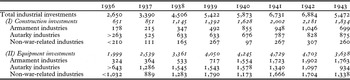
Table 2 illustrates both the amount of investments in the armament and autarky industries and their respective share of total industrial investments, which can be calculated until 1943.
The impact of investments in autarky and armament industries on total industrial investments, 1934–43

Sources: see text.
In row II the estimated investments in the armament industries are shown to have increased significantly during the 1930s and peaked during the war. Row III presents industrial autarky investments, defined as industrial Four-Year Plan investments minus investments in explosives and gunpowder plants, i.e. investments characterized as armament investments and included in the time series on investments in the armament industries. This article, it should be noted, does not use the well-known data on industrial Four-Year Plan investments between 1936 and 1942 since transcription errors render them inaccurate.Footnote 31 Instead, it employs information about industrial Four-Year Plan investments drawn from the original source. Autarky investments in 1934 and 1935 are calculated on the basis of investments in metal ore mining, the cellulose fibre industry and fuel industry provided by the SRA.Footnote 32 Autarky investments in 1943 are estimated.Footnote 33 As can be seen, autarky investments increased strongly after the implementation of the Four-Year Plan and exceeded the annual investments in the armament industries significantly in the prewar period. Further, investments both in the armament and autarky industries constituted a considerable share of total industrial investments from 1936 on. Given that the 1936 autarky investment figure covers only the investments of the second half of that year, and taking into account that the autarky and armament industries’ share of total industrial investments remained approximately stable until the end of the war, it can be concluded that – in terms of industrial investments structure – Nazi Germany's economy must be characterized as a ‘war-like peace economy’ during the late 1930s. However, whereas the share of autarky investments peaked in the prewar years, the share of armaments investments, which greatly exceeded autarky investments between 1940 and 1943 in absolute numbers, reached its height during the war.
These results clearly contradict the economic Blitzkrieg hypothesis. Klein's claim, based on SRA's published industrial investments’ figures, that in the 1930s ‘no pronounced concentration of [Nazi Germany's] investment in those activities associated with economic preparations of war’ could be observed, is not correct. Not only, as highlighted by Overy, was the raw material basis for waging war heavily extended in Germany before a war of attrition ever became reality, but the same also applies to the armament industries.
Some might argue, however, that increasing investments in the armament industries do not necessarily contradict the Blitzkrieg hypothesis, since capacity enlargement of the armament industries during the 1930s was also caused by the increasing deployment, and necessary equipping, of new troops. Whereas during the first years of Germany's rearmament, underutilized industrial capacity could still be used to produce munitions, from the mid 1930s, such free capacity no longer existed in some industries – the shipbuilding sector being one example. As a consequence, the so-called Z-Plan of 1938, for instance, projected an intensified capacity enlargement in this industry to facilitate the production of more war vessels.Footnote 34 Moreover, the lack of free production capacity in the powder and explosives industries was certainly one of the factors constraining Germany's ammunition production in the late 1930s.Footnote 35 For this reason the Nazi regime planned to intensify the extension of capacity in these industries by means of the so-called quick plan (Schnellplan).
Yet, capacity limits were not the only reason for the increasing investments in the armament industries. For example, the capital stock in the aircraft industries grew considerably during the final prewar years despite stagnating production.Footnote 36 Many aircraft producers had built up substantial overcapacity during the late 1930s, which were not almost fully utilized until the war when employment increased rapidly. In the case of the APLs, the Nazi regime also consciously cultivated large overcapacity during the late 1930s.Footnote 37 It should further be taken into account that the late 1930s rearmament plans, such as the Z-Plan, went above and beyond what was needed for fighting a short war both in their dimensions and their time-horizon.Footnote 38 Consequently, the investments made in 1939 in order to fulfil the Z-Plan, for example, clearly served to prepare for a larger war. In addition, between a quarter and one-third of the prewar investments in the naval armament industries had the explicit purpose of being utilized only in the event of war.Footnote 39 Finally, how the Wehrmacht allocated the uses of iron and steel during the last prewar years indicates that those responsible were not merely concerned with equipping as many troops as possible. During these years, the rearmament plans were troubled by steel shortages, which lead to official steel rationing in the German economy from 1937 on. At the time, the total iron and steel quantities requested by the different Wehrmacht branches were frequently significantly reduced. It should be noted that before the implementation of the rationing system, steel used for construction efforts (barracks, airfields, armament plants and fortifications) constituted approximately 50 per cent of the Wehrmacht's total steel consumption.Footnote 40 Yet, despite frequent overall reductions in the quantities of iron and steel requested, the Wehrmacht branches did not usually curtail the amount of iron and steel used for extending the industrial capacity above average, but rather planning for ammunition production and the construction of military infrastructure, such as barracks. Occasionally, as in the case of the air force industries in 1938, one Wehrmacht branch even exceeded the prospected absolute amount actually allocated to the expansion of capacity of the armament industries, although the total quantity requested by the air force had been reduced and the existing capacity in the industries manufacturing for the air force was not fully utilized. In sum, given the already existing overcapacity in some armament industries during these years that the authorities were aware of, we have to conclude that the channelling of the scarce iron and steel available for the armed forces into capacity enlargements of the armament industries clearly contests the economic Blitzkrieg hypothesis.
Statements of high-ranking Nazi leaders support this interpretation, demonstrating that they did not rule out the possibility of a longer war in 1939 and early 1940, although they did not have a clear strategy in this period against whom to fight a big war. Adolf Hitler, for example, asserted in 1939: ‘Every army and every government has to aim for a short war. Yet, the government also has to be prepared for a war lasting 10 to 15 years.’Footnote 41 (‘Jede Wehrmacht oder Staatsführung hat den kurzen Krieg anzustreben. Die Staatsführung hat sich dagegen auch auf den Krieg von 10 bis 15jähriger Dauer einzurichten.’) In early 1940, as the Wehrmacht was preparing the French campaign, the following principles for the German war economy were laid out during a meeting of high-ranking Nazi and Wehrmacht leaders, among them Hermann Göring and Wilhelm Keitel: ‘Maximum increase [of the munitions output] for the year 1940, so that the war might be won this year. Continuation of the programmes needed for a longer war.’Footnote 42 (‘Höchste Steigerung [of the munitions output] für 1940, damit in diesem Jahr der Krieg gewonnen werden kann. Fortführung der Programme, die für einen längeren Krieg notwendig sind.’) Obviously, as the above estimates of war-related industrial investments suggest, the Nazi regime had already acted on these principles before they developed a clear strategy in the later half of 1940 against whom to fight a big war.
In addition, these results clearly contradict Overy's ‘disorder hypothesis’. The Nazi regime, he claims, had planned for a big war against the Western powers since 1938, to be fought after 1942.Footnote 43 The war against the UK and France, however, threw German mobilization into disorder, leading to only static armament production in 1940 and 1941. As Overy argues, this disorder also stemmed from the incompetence of the authorities responsible for the economic mobilization, which contributed to an insufficient use of the resources committed to the war economy.Footnote 44 The data presented above, however, suggest that the management of the German war economy was hardly incompetent, considering that the share of war-related industrial investments rose from 61 per cent in 1939 to 79 per cent in 1940 and investments in the armament industries more than doubled from 1939 to 1940 due to a massive reallocation of the scarce resources of the German economy.
Consequently, the findings of this article confirm Tooze, who recently questioned both the older Blitzkrieg hypothesis and Overy's disorder thesis. Tooze suggests instead a third interpretation of the Nazi regime's military strategy and its relation to the demands it placed on the German economy.Footnote 45 He argues that plans to prepare for a big war may have been formulated briefly in 1937 and 1938 but relapsed into incoherence by 1939. Tooze stresses that Nazi Germany started to prepare for a big war in the aftermath of the successful French campaign. Following its victory in France, Germany expected that at some point in time it would have to fight a war of attrition in the West, not only against the United Kingdom but also against the United States, i.e. against a prospective coalition with vast economic potential. To succeed in such a war, Germany had to expand both its armament industries – especially the aircraft industries – and its raw material basis. A conquest of Russia would lead to a considerable broadening of available resources to provide for warfare. In addition to ideological arguments, this reasoning motivated Nazi Germany to wage war against the Soviet Union – a war which Hitler and the German high command hoped, with respect to the fast victory in the French campaign, could be fought as a Blitzkrieg too.Footnote 46 At the same time, the Blitzkrieg against Russia was intended to free up resources to broaden the industrial basis for the expected war of attrition in the West, or, in Tooze's words, ‘to prepare two wars at once’. Given these strategies and expectations, the use of all resources available for maximizing the munitions production was no imperative for Germany in 1940/1. Rather, troops were to be equipped with the munitions necessary to win a short war against Russia, while greater resources were to be channelled into a massive expansion of the armament industries, especially the aircraft industries, in order to prepare the big ‘war of continents’.
This article's findings support this interpretation. Investments in the armament industries peaked during the first years of the war. Furthermore, our estimates show that the air force industries’ share of the total investments in the armament industries increased during these years, compared to the last peacetime years. Whereas this share amounted on average to about one-third in 1938 and 1939, it rose to half in 1940 and 1941. As a result, the capacity of the air force industries approximately tripled between the beginning of the war and the end of 1941.Footnote 47 Machine tools for Wehrmacht purposes were increasingly allocated to the Luftwaffe between 1940 and 1941 in order to expand the air force industries: whereas the air force's share of total Wehrmacht machine tools purchases amounted to 22 per cent in the third quarter of 1940, it reached a level of 39 per cent in the fourth quarter of 1941.Footnote 48
Given the significant capacity expansion of the armament industries during the first two years of the war, one must agree with Tooze's assertion that this investment boom contributed to the so-called armament miracle, i.e. the massive increase in Germany's armament production after 1941.Footnote 49 Many plants built during the first years of the war began producing munitions in 1942.Footnote 50 Another of Overy's hypotheses, however, is to be contested. Overy argues that the increase in armaments production benefitted from an alleged reduction of investments after 1941, which freed scarce resources such as labour and steel.Footnote 51 Yet, the estimates presented in this article suggest that investments in the armament industries remained high throughout 1942 and 1943; the annual average of these investments even slightly exceeded the investment figures of the first two years of the war. Autarky investments were at similar levels in 1942/3 and in 1940/1.
The fact that the re-estimated overall industrial investment figures significantly exceeded those assumed thus far also suggests that the effects of allied bombing were more severe for West Germany than calculated by Rolf Krengel. His estimate relies on data regarding the capital stock of West German industry prior to and after the war. The data used for the prewar value are the investment figures published by the SRA. The postwar capital stock was estimated by using figures on postwar investment and the value added of industry under conditions of full employment in the 1950s. Considering the normal capital consumption and his war investment estimate, Krengel calculated that war damage corresponded to only one-fifth of the gross capital stock of 1942.Footnote 52 War damage was assigned to specific years of varying severity, which seem to correspond, though Krengel provides no exact information, to the intensity of bombing attacks.Footnote 53 The results of Table 1 imply that investments during the Nazi period exceeded Krengel's estimate by 2.1 bn RM.Footnote 54 Thus, war damage measured in net values, i.e. in the time value of assets in 1944/5, must have exceeded the figures calculated by Krengel by about 31 per cent – instead of 8.7 bn DM (in constant prices of 1950), war damage amounted to about 11.4 bn DM!Footnote 55 Had it not been for war damage, West German industry's net capital stock in 1945 would have surpassed the actual amount by about 31 per cent, instead of ‘only’ about 23 per cent, as calculated by Krengel.Footnote 56
This article has shown that, observing the autarky and armament industries’ share of total industrial investment from 1937, Nazi economic policy had a substantial impact on the structure of investment. This does not imply, however, that investments in industries not prioritized by the state were almost totally crowded out. This is shown by calculating non-war-related industrial investments per capita (in constant 1928 prices) during the Nazi period as a percentage of the respective per-capita investments in 1928 (Table 3). Non-war-related investments are defined as total industrial investment minus investment in autarky and armament industries. It is remarkable that this ratio increased during the last three peacetime years and did not decrease dramatically during the war compared to the ratios from 1936 to 1938.Footnote 57 This cements the contention that, in the second half of the 1930s, the German economy may be considered – in terms of investment structure – a ‘war-like peace economy’. Yet, this indicator also points to the, albeit limited, investment opportunities outside the autarky and armament industries. It also shows that, even in wartime, the regime was never able to channel investments exclusively towards state-desired projects.Footnote 58
Non-war-related industrial investments during the Nazi period (1928 prices)

bOwn calculation. For data on Germany's population within the pre-1938 and post-1940 borders, see Wagenführ Reference Wagenführ1954, p. 135.
Finally, when incorporating market signals into the analysis, the re-estimates allow conclusions about the proportion of capital misallocation to total industrial investment – at least from an ex-ante perspective. The state offered various contract types to induce the desired investments, as companies were not generally forced to invest according to the wishes of the Nazi regime.Footnote 59 These contracts differed in the way the amortization risk was distributed between the state and private companies. As a rule, companies would choose leasing contracts stipulating their use of a state-owned plant if they assumed that the plants would be of little use in the long run and particularly in the case of normalization of economic policy.Footnote 60 Consequently, it is not surprising that private companies were not usually disposed to buy APLs and AELs that the state attempted to sell during the war, even when the price was very low compared to the capital invested.Footnote 61 In addition, because of the high risk associated with using armament plants for peacetime purposes, investments contracts between the state and the private industry in armament branches usually stipulated the state carrying the entire or almost the entire amortization risk. In other words, private companies’ contract choices suggest that all of these investments – at least a third of total industrial investments between 1934 and 1943 and more than 40 per cent during the war – were widely considered misallocations.Footnote 62 It is thus questionable whether these state-induced investments of the Nazi period led to a modernization of the German economy, which resulted in the West German ‘economic miracle’ of the 1950s.
4. Conclusion
On the basis of this evidence, commonplace scholarly interpretation may be revised in the following three ways. First, it appears that industrial investments significantly exceeded – by about 10 bn RM or 24 per cent – the previously assumed figures. The greatest share – about two-thirds – derives from wartime investments. Allied strategic bombing, consequently, had greater effects than estimated by Krengel. Second, the revisions of the investment structure and the amount of armament and autarky investments confirm the criticism of the older Blitzkrieg hypothesis because war-related industrial investments already constituted a significant share in the final prewar years. In addition, investments in armament plants peaked during the first years of war, i.e. before a war of attrition had to be fought. In sum, it seems that at least from 1937 on – measured by the investment structure – the German economy was a ‘war-like peacetime economy’. Prior to having a clear notion about the enemies to be fought in a big war, Nazi Germany's leaders did not discard the possibility of a longer war and prepared accordingly. However, investment in non-war-related industries, i.e. investment not desired by the state, remained possible, though comparatively less than in 1928. Therefore, the claim that companies had almost no alternatives to autarky and armament investments is untenable. The leeway they had, in spite of huge misallocations and significant bombing damage, may have favoured the rise of West Germany's economy in the 1950s, because the postwar capital stock, particularly in the non-war related branches, was considerably newer than previously assumed.
Acknowledgments
I would like to thank the late Christoph Buchheim, Jens Nissel, Albrecht Ritschl, the participants of the annual conference of the Economic History Society in Reading, the participants of the economic history seminar at Yale University and two anonymous referees for their very helpful suggestions and comments.
Appendix 1. SRA's estimations procedure
1924 is the first year for which the SRA collected industrial investment data. These data are mainly based on the business reports and balance sheets published by big joint-stock companies.Footnote 63 The capital of these big firms covered more than 90 per cent of total capital of all joint-stock companies. To capture only real investments, and not capital increase due to mergers, SRA requested additional information in the case of the most important joint-stock companies.Footnote 64 Investments of small joint-stock companies and of firms with a different legal form, such as the limited liability company (GmbH), which were not bound to publish balance sheets, were estimated using different methods and information.Footnote 65 One method was based on the plants’ statistics (Betriebstättenzählung), using information given about the number of employees of firms with a certain legal form in the respective branches. A second method relied on the property tax statistics (Vermögenssteuerstatistik), using the amount of property taxes paid by firms with a certain legal form in different branches. The third method relied on the production statistics (Produktionsstatistik), employing the output produced by firms with a certain legal form in different branches. Essentially based on the known property tax/investment ratio or the known employees/investment ratio or the output/investment ratio of big joint-stock companies in a particular branch, the SRA inferred the investment of all other firms in the same branch by using the information provided by the plant's statistics or the property tax statistics or the production statistics. In the case of important GmbHs, the SRA double checked its results by directly requesting detailed information.Footnote 66
However, given these SRA procedures, investments in APLs cannot have been included in the statistics – or at best only to a small extent. The German military intentionally chose the legal form of GmbH, not bound to publish balance sheets, for all its leasing firms, to conceal the rearmament.Footnote 67 Investment figures of these companies could have only been estimated or directly requested by the SRA. The estimation method relying on property taxes would have implied that these companies did not invest. Leasing assets of the holding company Montan GmbH were only ‘trust estate’ because this holding company was a non-profit-corporation.Footnote 68 Accordingly, no property tax had to be paid. Therefore APLs cannot be measured by the property tax statistics and the leaseholders’ balance sheets mentioned no leasing assets.Footnote 69 The same applies to AELs. It is unknown whether APLs were included in the plants’ statistics, but, even so, the estimation method relying on the workforce size would have significantly underestimated the true investments in APLs. Since they were considered stand-by plants, the capital utilization of these firms was extremely low prior to the war when compared with ‘normal’ GmbHs. In 1938 the capacity utilization ratio of all APLs amounted – based on one shift only – to less than 40 per cent.Footnote 70 This very low capacity utilization further suggests that the investments of these companies would be equally underestimated relying on the production statistics.
Finally, the SRA does not appear to have directly requested prevalent data, which suggests that the SRA had no information about APLs’ investments. A letter from the SRA to Otto Donner, head of the governmental Institute of Defence Economy (Forschungsstelle für Wehrwirtschaft), regarding the investments of the most important firms of the defence economy, such as the explosives and gunpowder industry, supports this conclusion.Footnote 71 The Institute of Defence Economy was subordinated to the Four-Year Plan organization, and Otto Donner was a close advisor of Hermann Göring, head of the Four-Year Plan organization and air force minister. Therefore, the SRA most likely disclosed all information available, including information not published elsewhere. However, the letter, relying on the results of the SRA investment statistics, captured only important joint stock companies and detailed the three most important explosives and powder producing companies to have invested 29 m. RM in 1939. Yet, the same year investments in the APLs producing gunpowder and explosives amounted to approximately 350 m RM.Footnote 72
Appendix 2. Estimate of investments in armament plants
Armament investments from 1934 to 1939 are calculated as the sum of total investments in the naval armament industries, of total investments in the aircraft armament industries, of investments in APLs, and of the investments in AELs. Given that data on investments of private companies in army munitions plants is not available, this estimate represents a lower limit of total investments in armament capacities. However, the investments omitted were probably not very high, because in order to produce the quantitatively most important armament good manufactured for the army, ammunition, the normally existing capacity of the metalworking sector could be employed without significant new investments. Unfortunately, data on investments of the different Wehrmacht branches during the war are fragmentary. However, a time series for machine tools purchased for Wehrmacht purposes between 1938 and 1943 is available. By using this time series, we can estimate total investments in the armament industries during the war in the following way: as a first step, we decompose total investments in the armament industries during the prewar period in equipment and construction investments by employing information given by different sources. In the case of the APLs, the construction–equipment ratio amounted to 70 per cent.Footnote 73 In the case of the air force armament industry, information is available for all aircraft construction firms and for all aircraft engine producers.Footnote 74
Investments in armament industries, 1934–43 (m RM)

aFor the method employed, see text. Data on machine tools purchases for Wehrmacht purposes rely on BArch R 13 III/290; BArch R 13 III/192, note, 31 August 1944, machinery investment.
bDülffer Reference Dülffer1973, p. 426.
cBArch R 2/5551, Übersicht über die Investierung und Finanzierung der Luftwaffenrüstungsindustrie, fol. 17. The air force plant investments figures until the end of 1939 are split up into the single years according the performance of investments in aircraft engine industries and in the airframe industries (Budraß Reference Budraß1998, table 21, p. 381).
dHopmann Reference Hopmann1996, p. 121, table 14. Investment figures given for the accounting year (starting on 1 April 1) are transformed in the calendar year.
eIn order to estimate (V), we employed the data on the book value of AELs at the beginnings of 1944 given by BArch R 3/183, fol. 213. This book value can be interpreted as an approximation of total investments in AELs, because even if it is true that the book value underestimates total investments, we have to consider that from 1943 a considerable amount of these machines were sold to private companies. Investments in AELs are split up into the single years according the performance of investments in APLs.
The construction–equipment ratio of aircraft construction firms and aircraft engine producers was very similar (76 per cent). Assuming that the latter ratio applies, as well, to both whole investments in the aircraft industries and those in the naval munitions industries, we can calculate a weighted average ratio between construction and equipment investments in the armament industries (including AELs!), which amounts to 69 per cent. As a second step, we estimate equipment investments in armament industries during the war by multiplying the annual Wehrmacht purchases of machine tools during this time with the 1939 ratio between equipment investments and Wehrmacht purchases of machine tools. As a third step, we estimate construction investments during the war by using the prewar construction–equipment ratio and the estimate made by the armament ministry on construction investments mentioned in Section 2. According to the latter estimate, investments in armament industries in 1943 made up to 699 m RM, implying a construction–equipment ratio in that year amounting to 40 per cent. In order to estimate construction investments between 1940 and 1942, we assume that in these years, the construction–equipment ratio amounted to the mean between the prewar ratio and 1943 ratio. Given that construction prices significantly increased during the war, whereas equipment prices remained constant, in real terms this assumption implies a significant decrease in the construction–equipment ratio in the armament industries during the war. Yet, this assumption seems to be plausible, considering that at the beginning of the war especially investments in equipment goods were made in order to convert industrial plants from peacetime production to munitions production. And later, during the war, the armament ministry ordered the use of pre-existing free shop floors rather than building new production sites. It should be noted that during the war, too, our estimate represents a lower limit of total investments in armament capacity because it extrapolates the prewar estimate. However, it seems that investments of private companies in army munitions plants during the war were probably not very high. Investment loans for private army munitions producers were provided before 1942 by the Industriebank AG which financed, additionally, autarky and naval projects, and from 1942 on by a special public bank, the Heeresrüstungs-AG. These loans amounted to 1 bn RM at maximum during the war.Footnote 75
The validity of the 1940 and 1941 estimate can be checked by adding up the well-known investments in air force plants and APLs during these years. The latter's share of the total investments in armament industries estimated above (92 per cent) exceeds the prewar share (76 per cent). Yet we know that during these two years, investments in gunpowder and explosives (made by the APLs) and, from late 1940 on, investments in the air force industries, were top priorities.
Appendix 3. Wagenführ's estimate on machinery investments
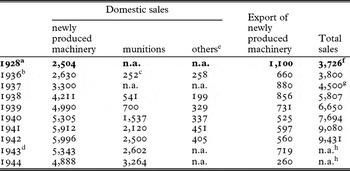
The original source of Wagenführ's data is an unpublished survey – provided by the armament ministry in the summer of 1944 – of the German war economy.Footnote 76 Archival files allow the reconstruction of the time series of machinery investments calculated in this document.Footnote 77 In January 1944, the WGM replied to an inquiry by the armament ministry regarding the machinery industry sales between 1936 and 1943.Footnote 78 Based on this information, machinery sales could be disaggregated into domestic and foreign sales. Domestic sales could be broken down into armament goods, repairs of machinery, production of new machinery, etc. In February 1944, Wagenführ requested information from the WGM regarding machinery investments, whereupon the WGM subtracted the sales of products that were intermediate but not capital goods (as for example, ball bearings) from the respective domestic production of new machinery sold in Germany in 1942 for each sub-branch. The result was an investment figure of 4,225 m RM.Footnote 79 Using the total intermediate goods–capital goods ratio of 1942, Wagenführ's department estimated machinery investments between 1938 and 1943.Footnote 80
This estimate, however, has some serious shortcomings: first, in his calculation of investment figures of the various sub-branches, the WGM official made a summation or copying mistake. Instead of 4,525 m RM he calculated 4,225 m RM. Second, the extrapolation method used by Wagenführ's department implies that (i) the intermediate goods–capital goods ratios of different sub-branches would be constant during 1936 and 1943, and (ii) that the shares of the different sub-branches’ sales of total machinery sales would be invariant compared with the relations of 1942. Regarding the performance of the intermediate goods–capital goods ratios in the other years (i.e. except for 1942), we have no information. Yet it can be shown that the different sub-branches’ shares of total machinery sales differed significantly in the years between 1936 and 1942.Footnote 81 Third, Wagenführ's figures do not include machinery imports. As a result of these weaknesses, Wagenführ's method underestimated the machinery investment. In addition, and in contrast to the basic assumption of the Eichholtz, Krengel and Kupky estimates, machinery investment figures contain machinery normally used outside the industrial sector, such as farm machinery. Furthermore, they do not include all capital goods but only those manufactured by the sub-branches that belonged to the WGM. Trucks, for instance, or electrical equipment were excluded.
Appendix 4. A re-estimate of industrial machinery investments
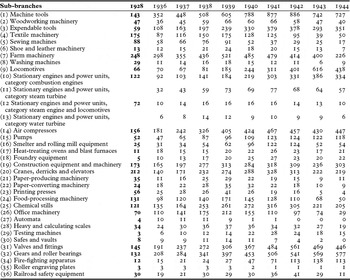
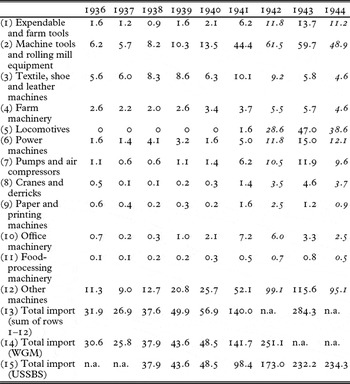
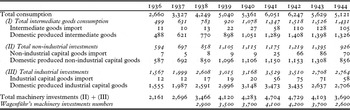
The re-estimate relies on the data on mechanical engineering sales between 1936 and 1942 employed by Wagenführ. As mentioned, these sales are decomposed mainly into four categories, among them newly produced machinery sold in Germany (Table A2). This domestically sold, newly produced machinery is disaggregated in sales of the 36 sub-branches that were included in the organization of the WGM (Table A3). Checks with other sources show that these figures are reliable.Footnote 82 Figures for the years 1928, 1943 and 1944 are estimated or rely on other sources. As a first step, to estimate the amount of investment goods, intermediate goods have to be subtracted from domestically sold, newly produced machinery. To estimate the intermediate goods amount in the respective years, we first multiply the intermediate goods–sales ratios of different sub-branches (as calculated by the WGM) by the domestic sub-branches sales given in Table A3.Footnote 83 As a second step, we add machinery imports identified as investments goods to the amount of domestically produced and sold investments goods. Import categories cannot be decomposed according to the sub-branches categories used by the WGM (Table A4). Thus, to estimate import investments, we allocate import values respectively to intermediate goods and investments.Footnote 84 From this procedure results the machinery investment of the German economy between 1936 and 1944. As a third step, to estimate industrial machinery investment, we have to subtract from total machinery investments those investment goods that were normally purchased by branches outside the industrial sector. To identify these branches, we use information given by the industrial census of 1936, which in detail decomposed the sales of the respective sub-branches in different products.Footnote 85 In the case of machinery imports, we assume that the following are industrial investments: textile, shoe-making and leather-working machinery; food-processing machinery; cranes and derricks; machine tools and rolling mill equipment.Footnote 86 Finally, based on these considerations, we can estimate and decompose the consumption of newly produced mechanical engineering products in Germany between 1936 and 1944 (Table A5).
Sales in the German mechanical engineering sector 1928, 1936–44 (m RM)

aBArch R 13 III/193, machinery sales 1928 and 1938, 8 July 1941; BArch R 13 III/193, machinery sales 1937, 24 March 1938.
bFor 1936–42, see BArch R 3/1917, WGM to Dr Stoffregen, 22 January 1944, fols. 19–63 (data refer to the current borders of the Reich).
cBArch R 3102/3541, production survey of the mechanical engineering sector 1936.
dFor the munitions production in 1943 and in 1944, see USSBS, 1976, appendix table 19, p. 219. For data on domestic and foreign sales of newly produced machinery in 1943 and in 1944 see Table A3, footnote c. All numbers are rounded.
eRepairs, commission processing, renting, etc.
fIn this year domestic sales without both newly produced machinery and munitions amounted to 122 m RM.
gIn this year domestic sales without both newly produced machinery and munitions amounted to 400 m RM.
hTotal production in 1943 and 1944 may not be significantly lower than in 1941, given that according to USSBS estimates machine tools repairs increased significantly in these years due to allied bombing. See USSBS 1976, pp. 44–5, 47–8.
Domestic sales of sub-branches of newly produced German machinery 1928,a 1936–44b,c (m RM)

aBArch R 13 III/193, machinery sales 1928 and 1938, 8 July 1941.
bFor 1936–42, BArch R 3/1917, WGM to Dr Stoffregen, 22 January 1944, fol. 19–63.
cThe figures provided by the WGM for 1936–42 are completed for 1943–4 by information published by the USSBS (USSBS, 1976, appendix table 17, p. 218; appendix table 20, p. 220; appendix table 29, p. 227) and by Statistisches Handbuch von Deutschland, p. 409. The USSBS data – based on a study by the WGM in summer 1945 – provide information about sales of newly produced machinery. However, information about the sub-branch that manufactured gears and roller bearings is omitted. This problem is solved for 1944 by using information published after the war by the Statistisches Handbuch von Deutschland. The respective figure for 1943 is estimated by calculating the mean of the 1942 and 1944 values. In addition, USSBS does not provide information about the decomposition of the machinery production in 1943 into domestic sales and exports. However, the Statistisches Handbuch provides export data for 1943. Unfortunately, for some sub-branches export data for 1943 as well as for 1944 are aggregated. To resolve this, the export share of the respective sub-branch on total exports in 1942 is extrapolated.
Machinery imports,a 1936–44b (m RM)

aRows 1–13: for 1936 and 1937, Statistisches Jahrbuch für das Deutsche Reich 1938, p. 262; for 1940, Statistisches Jahrbuch für das Deutsche Reich 1941/42, p. 290; for 1939, 1941, 1943, Statistisches Handbuch von Deutschland, p. 408. For row 14, see BArch R 3/1917, WGM to Dr Stoffregen, 22 January 1944, fol. 26; for row 15, see USSBS (ed.), 1976, appendix table 29, p. 227.
bIn 1942 and 1944 total machinery imports in these years are not decomposed by the published sources. To estimate the import value of the respective sub-branches (according the classification in Table A2) for 1942, total import value provided by the WGM is multiplied by the mean of the relative import shares of the respective sub-branch of total imports in 1941 and 1943. To estimate the import value of the respective sub-branches for 1944, total import value provided by the USSBS is multiplied by the respective sub-branch's relative import share of total imports in 1943.
German consumption of newly produced mechanical engineering products 1936–44a (m RM)

aFor estimation procedures, see text. Consumer goods are subsumed under non-industrial capital goods, because their amount may have been very small.
Appendix 5. Re-estimating industrial investments during the war
In order to re-estimate total industrial investments during the war, we employ a method similar to that used for estimating investments in the armament industries. As a first step, we decompose total industrial investments during the prewar period by employing the estimate on the decomposition of investments in the armament industries and data provided by the SRA about the respective decomposition of investments in ‘normal’ industries.Footnote 87 As a second step, we estimate industrial equipment investments during the war by multiplying the annual industrial machinery investments during this time by the 1939 ratio between equipment investments and machinery investments (1.34). It should be noted that we interpret the residual between the equipment investments and the machinery investments in 1939 as an estimate for equipment goods which were not produced by the WGM, i.e. self-provided equipment, electrical equipment, trucks, etc. As a third step, we estimate construction investments during the war by using the estimate made by the armament ministry on industrial construction investments in 1943, implying a construction–equipment ratio in that year which amounts to 50.4 per cent. In order to estimate construction investments between 1940 and 1942, it is assumed that the construction–equipment ratio continuously increased from the 1939 value (34.3 per cent) to the 1943 value. It is assumed that this increase continued, too, in 1944. Yet, given that construction prices significantly increased whereas equipment prices remained constant during the war, this assumption implies nevertheless, in real terms, a decrease in the construction–equipment ratio during the war. Yet this assumption seems to be plausible because of the remarks made in Appendix 2.
Are the high levels of industrial construction activity during the war resulting from this estimate (see Table A7) plausible, given that compared with the prewar period overall construction in the German economy, as well as the number of construction workers, decreased significantly?Footnote 88 Yes. First, we have to remark that between 1939 and 1942 residential construction declined significantly from 220,000 dwelling units to only 50,000.Footnote 89 In the case of the Autobahnen the decrease was still more dramatic: construction dropped from 1,116 m RM in 1939 to 155 m RM in 1942.Footnote 90 Building of fortifications, especially the western fortification, the Siegfried Line, which cost approximately 2 bn RM between 1938 and 1940, was stopped after the France campaign.Footnote 91 Second, there are several indicators that suggest a high level of industrial construction investments during the first years of the war. In the oil branch, for instance, the number of construction workers doubled to 70,000 between the beginning of the war and mid 1941 and peaked in spring 1943 at 85,000 workers.Footnote 92
Appendix 6. Estimating real investments in non-war-related industries
In order to estimate real investments figures in non-war-related industries, we employ the following method. As a first step, we decompose investments in the armament and autarky industries by employing the estimate of the decomposition of investments in the armament industries (Appendix 2) and by assuming in the case of the autarky industries that the construction–equipment ratio in these industries matched during the war – in real terms – that of the prewar period in the chemical and fuel industry calculated by the SRA (41 per cent). It should be noted that this article does not employ the existing construction price index but the one compiled by the plenipotentiary of the construction industry (Table A6). The latter captures the price increase more accurately than the former, which, according to contemporary observers, led to an underestimation.Footnote 93 As a second step, by using these decomposition estimates and the estimate of total industrial investments in construction and equipment made in Appendix 5, we can calculate construction and equipment investments in non-war-related industries as a residual (Table A7). As a third step, we employ the respective price index for construction and equipment investments in order to estimate non-war-related investments in 1928 prices (Table 3).
Construction and equipment prices 1934–44 (1928 = 100)

aKrengel Reference Krengel1957, p. 397.
bOwn calculation on the basis of the data provided by BArch R 3/Film 77815, Oberbaurat Steffens, Das Bauwesen geschichtlich, technisch u. wirtschaftlich gesehen (History of the Construction Industries, c. 1944). Given that the construction department's index is only available until 1942, construction price levels in 1943 and in 1944 are estimated by using the information about the construction price increases between 1942 and 1944 given by existing construction price index.
Decomposition of industrial investments (m RM), 1936—43

Sources: see text.