Introduction
Clinical depression is a significant health problem. The disorder is highly prevalent (Ferrari et al. Reference Ferrari, Somerville, Baxter, Norman, Patten, Vos and Whiteford2013), associated with the deterioration of daily functions and activities (Judd et al. Reference Judd, Akiskal, Zeller, Paulus, Leon, Maser, Endicott, Coryell, Kunovac, Mueller, Rice and Keller2000), excess mortality (Cuijpers & Smit, Reference Cuijpers and Smit2002), and substantial social and economic costs (Greenberg & Birnbaum, Reference Greenberg and Birnbaum2005; Sobocki et al. Reference Sobocki, Jönsson, Angst and Rehnberg2006). Furthermore, it becomes a chronic condition in many cases. More than half of those who suffer from a major depressive episode will have one or more recurrences (Solomon et al. Reference Solomon, Keller, Leon, Mueller, Lavori, Shea, Coryell, Warshaw, Turvey, Maser and Endicott2000), spending as much as 21% of their time in a depressed condition (Vos et al. Reference Vos, Haby, Barendregt, Kruijshaar, Corry and Andrews2004). It is estimated that by 2030 clinical depression will be a main cause of loss of healthy life years (World Health Organization, 2008). Nevertheless, most people suffering from depression do not receive treatment and approximately one-third of those who do receive treatment do not respond to evidence-based approaches (Andrews et al. Reference Andrews, Issakidis, Sanderson, Corry and Lapsley2004).
Given these challenges, prevention could offer new opportunities for reducing the burden of depressive disorders. A report from the Institute of Medicine (1994) defined prevention as any intervention directed towards stopping the onset of new cases of a mental disorder in people who do not yet meet criteria for that specific disorder. Prevention may be targeted to the whole population (universal prevention), to a subgroup of the population whose risk of developing the disorder is significantly higher than average (selective prevention) or to those who have subclinical symptoms (indicated prevention). Of these, indicated prevention has received the most attention by researchers assessing its effect on the prevention of depression (Van Zoonen et al. Reference Van Zoonen, Buntrok, Ebert, Smit, Reynolds, Beekman and Cuijpers2014). Data are available demonstrating benefits of indicated prevention with clinical relevance (Muñoz et al. Reference Muñoz, Cuijpers, Smit, Barrera and Leykin2010), since having subclinical symptoms is one of the strongest predictors for developing a depressive disorder (Cuijpers & Smit, Reference Cuijpers and Smit2004).
However, one difficulty in researching depression-prevention programmes is the need for large samples to provide sufficient statistical power to examine the programmes’ impact on the incidence of depression. One strategy to increase the statistical power is to select a sample with a combination of subclinical depressive symptoms and multiple risk factors (Cuijpers, Reference Cuijpers2003; Muñoz et al. Reference Muñoz, Cuijpers, Smit, Barrera and Leykin2010). In this context, a risk factor for the development of depression that has been examined extensively in intervention research is being a non-professional caregiver of a person in a situation of dependency (Saxena et al. Reference Saxena, Jané-Llopis and Hosman2006). Women are twice as likely as men to suffer from depression (Bromet et al. Reference Bromet, Andrade, Hwang, Sampson, Alonso, de Girolamo, de Graaf, Demyttenaere, Hu, Iwata, Karam, Kaur, Kostyuchenko, Lépine, Levinson, Matschinger, Mora, Browne, Posada-Villa, Viana, Williams and Kessler2011) and most caregivers are women (Eurostat, 2002). Caregivers, meanwhile, are more likely than non-caregivers to suffer from depression by a ratio of 2.8–38.7 (Cuijpers, Reference Cuijpers2005), and previous studies have found that between 15% and 32% of caregivers fulfil criteria for a depressive disorder (Cuijpers, Reference Cuijpers2005).
Randomized controlled trials have demonstrated that indicated prevention can reduce the incidence of depression and depressive symptoms in the short and long term across various populations (see Clarke et al. Reference Clarke, Hornbrook, Lynch, Polen, Gale, Beardslee, O'Connor and Seeley2001; Allart-van Dam et al. Reference Allart-van Dam, Hosman, Hoogduin and Schaap2003, Reference Allart-van Dam, Hosman, Hoogduin and Schaap2007; Willemse et al. Reference Willemse, Smit, Cuijpers and Tiemens2004; Arnarson & Craighead, Reference Arnarson and Craighead2011; Vázquez et al. Reference Vázquez, Torres, Blanco, Díaz, Otero and Hermida2012). However, only one study (Vázquez et al. Reference Vázquez, Otero, Torres, Hermida, Blanco and Díaz2013) has analysed the short-term efficacy of preventive indicated intervention in a population of non-professional caregivers. In this randomized controlled trial, 173 caregivers were randomly assigned to a problem-solving intervention or to a usual-care control group. The intervention consisted of five weekly 1.5-hours group sessions, developed based on the problem-solving model of depression (Nezu et al. Reference Nezu, Nezu and Perri1989). In this approach, the experience of depression is a dynamic process that changes in intensity and quality over time depending on an individual's major life events, current problems, and problem-solving coping. It is assumed that problem-solving coping plays an important role as a mediator and moderator of the relationship between stressful life events (major negative events and daily problems) and depression. Compared with the control group, the problem-solving intervention group achieved a greater reduction of depressive symptoms (d = 1.54) and had a lower incidence of depression (4.5% and 13.1%, respectively) after treatment. Given the existing evidence that caregivers experience constant life events and daily problems such as family conflicts, interference with social activities, and work (e.g. Scharlach et al. Reference Scharlach, Sobel and Roberts1991; Semple, Reference Semple1992; Clark & Bond, Reference Clark and Bond2000; Owen et al. Reference Owen, Roth, Stevens, McCarty, Clay, Wadley, Goode and Haley2002), the problem-solving therapy seems appropriate for this population, especially for those who have subclinical depressive symptoms.
However, the extent of the effect of this indicated prevention intervention over time in caregivers is unknown. Also, in spite of the abundant literature dealing with interventions targeting this population (Pinquart & Sörensen, Reference Pinquart and Sörensen2006; Gallagher-Thompson & Coon, Reference Gallagher-Thompson and Coon2007), no study to date has evaluated the long-term efficacy of indicated prevention of depression in non-professional caregivers. Given that actually determining the efficacy of an intervention to prevent depression requires tracking over a period of time to study the emergence of new and avoided cases of depression (Muñoz et al. Reference Muñoz, Cuijpers, Smit, Barrera and Leykin2010), a long-term evaluation of the only existing study of indicated prevention of depression in caregivers is essential.
The aim of this study was to evaluate the long-term efficacy (12 months of follow-up) of a brief problem-solving intervention to prevent the onset of depression as evaluated using the Structured Clinical Interview for Axis I Disorders of the DSM-IV (SCID) in female caregivers with subclinical depressive symptoms not yet meeting the diagnostic criteria for depression (i.e. indicated prevention). As the central hypothesis, significant differences were expected at the 12-month follow-up in the incidence of depression between participants that received indicated preventive intervention and those who received usual care. Furthermore, we expected an effect of the number of sessions attended (compliance) on the incidence of depression. In addition, significant differences were expected between the groups in terms of depressive symptoms, emotional distress and caregiver burden.
Method
A detailed description of the methodology has been previously reported (Vázquez et al. Reference Vázquez, Otero, Torres, Hermida, Blanco and Díaz2013). Central aspects of the methodology are highlighted here.
Participants and procedure
A randomized controlled trial was performed. Participants were recruited from the official registry of non-professional caregivers through an agreement with the Ministry of Labour and Welfare of the Galician Regional Government (Spain). The caregiver sample was extracted based on the sample size estimated for this trial and considering that approximately half of all caregivers experience subclinical symptoms of depression (Rivera et al. Reference Rivera, Elliot, Berry, Grant and Oswald2007). Specifically, a sample of 20 localities in the region of Galicia was randomly selected subject to stratification by type of habitat [rural (<2000 inhabitants) or urban (⩾2000 inhabitants)] and province (Coruña, Lugo, Pontevedra, or Orense), and a sample of 401 caregivers was then randomly selected. Caregivers were contacted by telephone or mail to inform them of the project and were invited to a meeting with a group of experts who explained the study in detail and answered any questions. Eligible participants were female caregivers recognized as such by the authorities, scoring ⩾16 on the Spanish version of the Center for Epidemiologic Studies Depression Scale (CES-D; Vázquez et al. Reference Vázquez, Blanco and López2007), with no current major depression episode and no history of major depression according to the Spanish version of the SCID (SCID-CV; First et al. Reference First, Spitzer, Gibbon and Williams1999).
It was estimated that a sample size of 69 per group (138 total) would be sufficient to detect a 20% difference in the rates of incidence of depression (according to the DSM-IV-text revision criteria) between the experimental and control groups, assuming an α of 0.05 and a power (1 − β) of 0.80. Allowing for an 18% attrition rate, the recruitment goal was 84 participants in each group (168 total). The incidence and attrition rates were based on previous studies of indicated prevention for depression (Clarke et al. Reference Clarke, Hornbrook, Lynch, Polen, Gale, Beardslee, O'Connor and Seeley2001; Willemse et al. Reference Willemse, Smit, Cuijpers and Tiemens2004).
Written informed consent was obtained from all participants. The study followed the guidelines established in the Helsinki Declaration of 1975 as revised in 2008, and was approved by the Committee for Ethical Research of the University of Santiago de Compostela (Spain). Participants were allocated randomly to either the intervention or control group by an independent statistician using a random numbers table.
Intervention and control condition
The intervention group received a brief intervention in group format, based on the problem-solving model of Nezu et al. (Reference Nezu, Nezu and Perri1989). Prior to the intervention, a treatment protocol was developed and formalized into a manual, and a pilot tested (Vázquez et al. Reference Vázquez, Otero, López, Blanco and Torres2010). The intervention consisted of five sessions, each lasting 1.5 hours, once a week. The intervention was offered in centres close to the caregivers’ homes and included about five participants in each group. In all, the interventions were applied by three psychotherapists (one per group) who were previously trained in problem-solving therapy by two clinicians, each with more than 17 years of experience. There were no significant differences among the different therapists in terms of intervention outcomes on incidence of depression [χ2 = 0.73, degrees of freedom (df) = 2, p = 0.905, 95% confidence interval (CI) 0.90–0.92], depressive symptomatology (χ2 = 0.35, df = 2, p = 0.838, 95% CI 0.84–0.86), emotional distress (χ2 = 0.631, df = 2, p = 0.730, 95% CI 0.72–0.74) or caregiver burden (χ2 = 2.55, df = 2, p = 0.279, 95% CI 0.28–0.30). Sessions were recorded, and adherence to the protocol was assessed by one of the expert clinicians by watching the videotaped sessions and comparing them with the manual. Protocol adherence by the therapists was 96%, indicating that the main elements in the protocol were actually administered.
Participants assigned to the control condition (usual-care control group) were not subject to any intervention and did not receive any educational materials. However, they had unrestricted access to any type of treatment for their depressive symptoms (psychological, medical or social services) available to them in their communities. In this condition, participants were administered assessment instruments collectively, with approximately five participants in each group at the same measurement points as the problem-solving group.
For ethical reasons, when a caregiver was determined to meet the criteria for the diagnosis of a major depressive episode, they were referred to the health services available in their community to receive appropriate psychological or psychiatric treatment.
Outcome measures
Participants were previously assessed at pre-treatment and post-treatment (Vázquez et al. Reference Vázquez, Otero, Torres, Hermida, Blanco and Díaz2013). In this study, participants were evaluated 1, 3, 6 and 12 months after the intervention ended. All evaluations were conducted by the same trained interviewers who were blinded to the group to which each participant had been assigned. The main outcome measure was incidence of major depression. Diagnoses of major depression were obtained using the SCID-CV (First et al. Reference First, Spitzer, Gibbon and Williams1999). It is a semi-structured interview that provides diagnostics of the DSM-IV, which has test–retest reliability for psychiatric patients (κ = 0.61). Secondary outcomes were depressive symptoms, emotional distress, caregiver burden and compliance with treatment. Depressive symptoms were evaluated using the Spanish version of the CES-D (Vázquez et al. Reference Vázquez, Blanco and López2007), which is a self-reported 20-item scale. Each item is rated on a four-point Likert scale ranging from 0 (rarely or never) to 3 (most of the time). Therefore, the total score can range from 0 to 60, where higher scores correspond to greater depressive symptomatology. The CES-D has a Cronbach's α of 0.89. Emotional distress was evaluated with the Spanish version of the General Health Questionnaire (GHQ-28; Lobo et al. Reference Lobo, Pérez-Echeverría and Artal1986), which contains 28 items divided into four subscales (somatic symptoms, anxiety and insomnia, social dysfunction, and severe depression) of seven items each with four answer choices. The total score ranges between 0 and 28, where a higher score is indicative of greater distress. The GHQ-28 has a Cronbach's α of 0.97 (Godoy-Izquierdo et al. Reference Godoy-Izquierdo, Godoy, López-Torrecillas and Sánchez-Barrera2002). Caregiver burden was evaluated with the Caregiver Burden Interview (CBI; Zarit et al. Reference Zarit, Reever and Bach-Peterson1980), which consists of 22 items that are rated on a Likert scale with five response options ranging from 0 (never) to 4 (almost always), so the total score ranges from 0 to 88. In this scale, there is a direct relationship between the total score and the burden experienced by the caregiver. The CBI has a Cronbach's α of 0.82. It was translated into Spanish following the guidelines of Guillemin et al. (Reference Guillemin, Bombardier and Beaton1993), including the translation/back-translation method. All these instruments have been widely used in the caregiver population (Pinquart & Sörensen, Reference Pinquart and Sörensen2006; Gallagher-Thompson & Coon, Reference Gallagher-Thompson and Coon2007). The diagnoses of major depression and depressive symptoms were evaluated at each of the follow-ups at 1, 3, 6 and 12 months, and emotional distress and caregiver burden were evaluated at each time point with the exception of the 1-month follow-up in order to reduce respondent burden. Last, to evaluate compliance with treatment, we recorded the number of attended sessions for each participant.
Statistical analysis
Following the CONSORT (Consolidated Standards of Reporting Trials) statement (Schulz et al. Reference Schulz, Altman and Moher2010), all analyses were performed in agreement with the intention-to-treat principle. We compared the outcome variables between the groups, with all participants being analysed in the group to which they were assigned. The most conservative approach was adopted by considering drop-out as a treatment failure (i.e. that depression was triggered) and by replacing missing data with baseline scores. During the study, 28 dependent family members died (nine in the problem-solving group and 19 in the control group). For these cases, administration of CBI to the caregivers was interrupted, and the missing data were not imputed to reflect the nature of missing data in this context. To analyse attrition, the χ2 test was used (or Fisher's exact test for expected values smaller than 5) for categorical variables (social class, education, main occupation, relative cared for, gender of person cared for), and the Mann–Whitney U test for two independent samples for continuous variables (age; age of person cared for; hours a day of care; time of care; and scores on depressive symptoms, emotional distress, and caregiver burden).
With respect to major depression, the cumulative 1-year incidence rate was computed and the differences between groups were analysed with the χ2 test. Relative risk (RR), differences in risk (RD), and the number needed to treat (NNT) were calculated following the formulas proposed by Guyatt et al. (Reference Guyatt, Sackett and Cook1994). Furthermore, the Kaplan–Meier method was used to estimate the survival probability of the participants in the intervention group. We also evaluated treatment compliance (session attendance) and its relationship with the incidence of depression. A complier average causal effect (CACE) analysis was conducted, assuming that the members of the control group had the same probability of non-compliance as the members of the intervention group and that merely being offered the treatment has no effect on outcome (Hewitt et al. Reference Hewitt, Torgerson and Miles2006). Good compliers were defined as participants attending four or more sessions, and poor compliers were those who attended three or fewer sessions. RR was calculated to compare the good compliers in the intervention group with potential good compliers in the control group.
The effect of the intervention on depressive symptoms, emotional distress and caregiver burden was analysed by repeated-measures analysis of variance with ‘condition’ as the inter-subject factor and ‘time’ as the intra-subject factor. When time or time × condition effects were significant, post-hoc t tests with Bonferroni-corrected values and the standardized mean differences (d) were computed from the t test (Wuensch, Reference Wuensch2012). Effect sizes of d = 0.2–0.5 are interpreted as small, d = 0.5–0.8 as moderate and d ⩾ 0.8 as large (Cohen, Reference Cohen1988). All data were analysed with SPSS for Windows (version 20.0; USA).
Results
Description of the sample
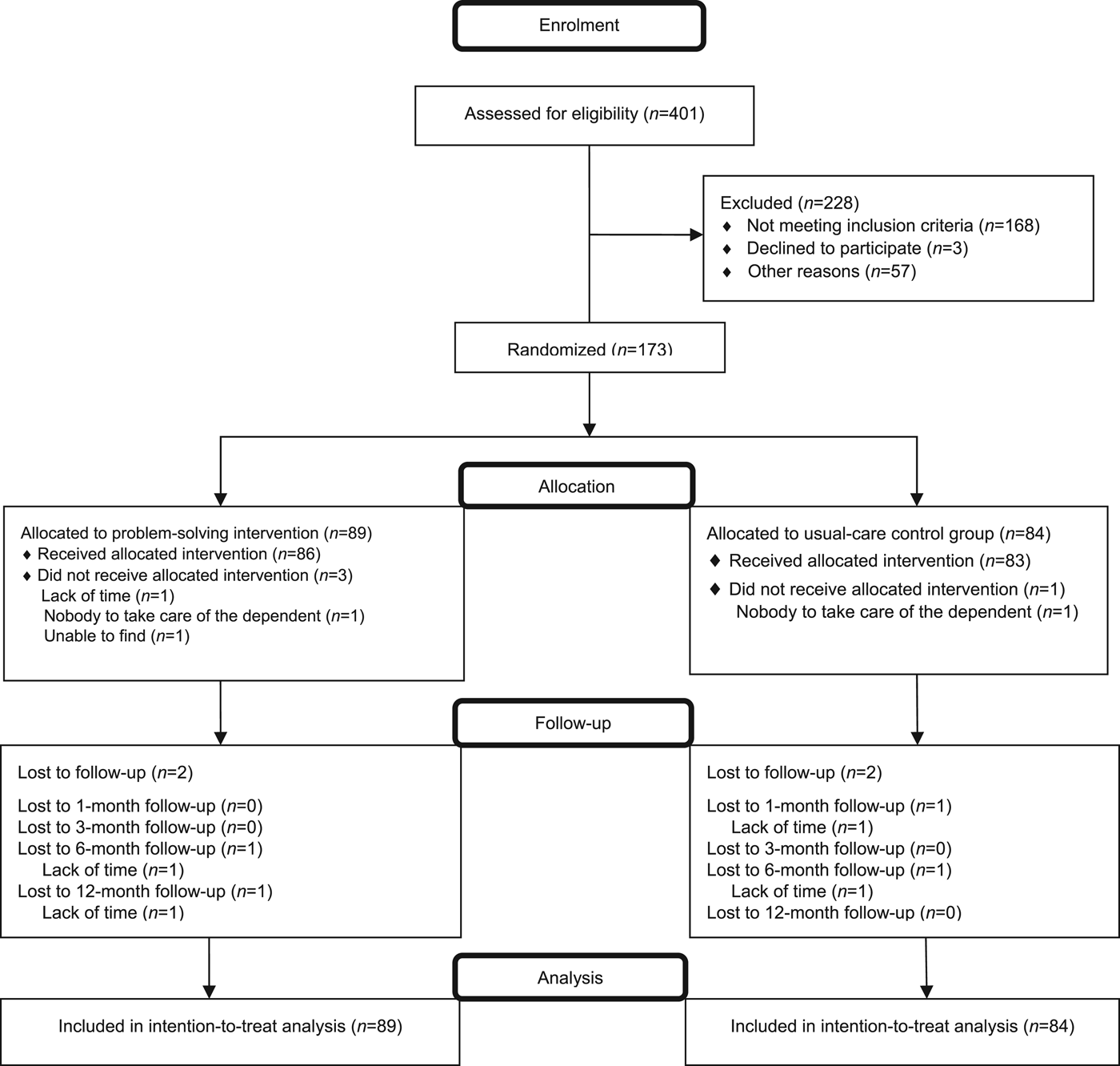
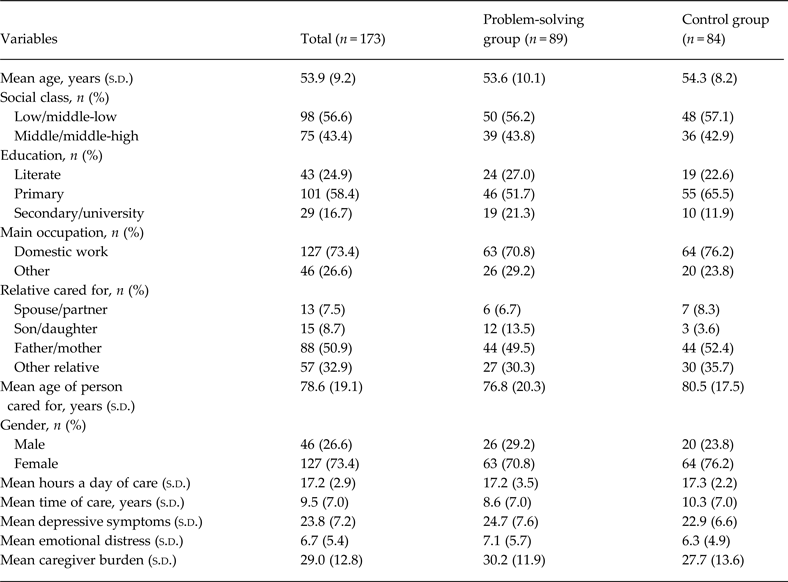
Of 401 caregivers who were approached, 176 (43.9%) fulfilled the inclusion criteria; of these, three (1.7%) refused to participate in the study either due to incompatibilities with working hours, lack of interest in the study, or health problems. Some of the reasons for this low refusal percentage were the fluid relationship with the administration and the lack of institutional support to date for this population. The final sample thus consisted of 173 caregivers, who were randomly assigned to the problem-solving intervention group (n = 89) or to the usual-care control group (n = 84) (Fig. 1). The mean age of the participants was 53.9 (s.d. = 9.2) years (53.6 and 54.3 years in the problem-solving and control groups, respectively). Domestic work was the main occupation for 73.4% of the caregivers (70.8% and 76.2% in the problem-solving and control groups, respectively), 50.9% were providing care to their mother or father (49.5% and 52.4% in the problem-solving and control groups, respectively), and the period of care extended for an average of 9.5 years (8.6 and 10.3 years in the problem-solving and control groups, respectively). Among the people receiving care, 73.4% were women (70.8% and 76.2% in the problem-solving and control groups, respectively), with a mean age of 78.6 years (76.8 and 80.5 years in the problem-solving and control groups, respectively). Following Altman (Reference Altman1985), we did not statistically test baseline differences; instead we report sociodemographic, care and clinical characteristics of the total sample as well as for each group (see Table 1). As can be seen, there were no remarkable or clinically relevant baseline differences, suggesting that randomization had resulted in a balanced trial.
CONSORT (Consolidated Standards of Reporting Trials) flow diagram.

Baseline sociodemographic, care and clinical variables of the study participants
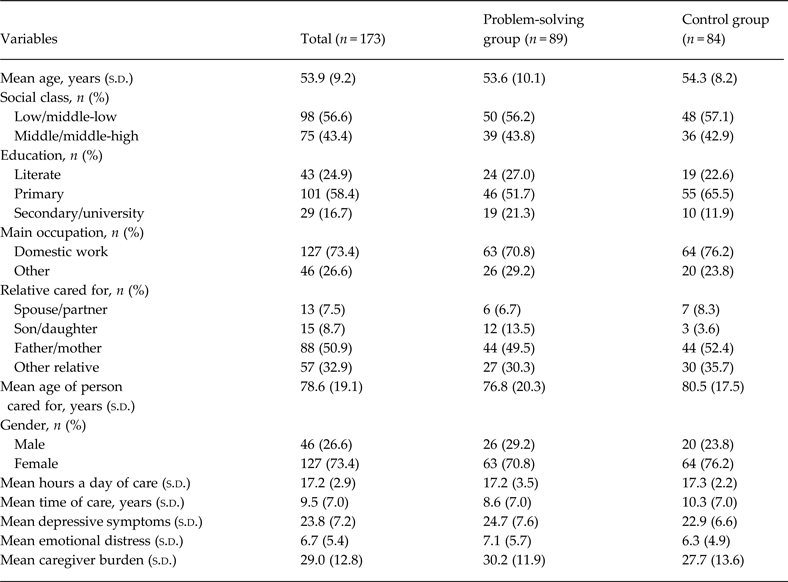
Data are given as mean (s.d.) or as number of participants (percentage).
Strategies recommended by Grady et al. (Reference Grady, Cummings, Hulley, Hulley, Cummings, Browner, Grady and Newman2007) were followed to minimize the loss of subjects. These strategies included simplification of the intervention, organizing sessions at a convenient time, and documenting several contact numbers for each participant for better tracking at follow-ups. Drop-outs were documented and analysed. After 12 months, 165 (95.4%) of the participants had completed all evaluations. In all, five participants (5.6%) in the problem-solving group and three participants (3.6%) in the control group dropped out. No significant differences were found for any of the baseline sociodemographic, caregiving or clinical characteristics between the participants that remained in the study and those who did not complete the follow-up evaluations.
Main outcome: incidence of major depression
At the 12-month follow-up, nine of the 89 participants (10.1%) in the problem-solving group and 21 of the 84 (25.0%) in the control group had developed major depression. Of these, four in the problem-solving group and 18 in the control group had been diagnosed with depression according to DSM-IV criteria, and five participants in the problem-solving group and three in the control group had an imputed value for depression. The RR was therefore 10.1/25.0 = 0.40 (95% CI 0.20–0.81), indicating that the incidence of depression was significantly lower in the problem-solving group (χ2 = 6.68, df = 1, p = 0.010). The RD was 0.25–0.10 = 0.15 (95% CI 0.04–0.26) and the NNT was 6.7, rounded to 7 (95% CI 4–27).
In the problem-solving group, a major depressive episode was recorded in four caregivers immediately after the treatment, two at the 6-month follow-up and three at the 12-month follow-up (mean time 54.1 weeks). In the control group, of the 21 caregivers who developed depression, 11 did so at the end of treatment, two at the 1-month follow-up, two at the 3-month follow-up, and six at the 6-month follow-up (mean time 46.3 weeks). The survival distributions for the two groups were significantly different (Mantel–Coxχ2(1) = 6.97, p = 0.008).
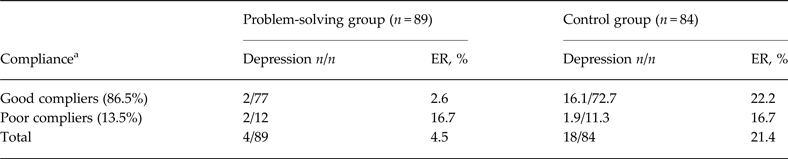
Of the five sessions included in the intervention, the mean attendance was 4.3 (s.d. = 0.8) sessions. The CACE analysis data are listed in Table 2. In the problem-solving group, 77 (86.5%) participants were considered good compliers, and 12 (13.5%) participants were considered poor compliers. A total of two [event rate (ER) = 2.6%] of the good compliers and two (ER = 16.7%) of the poor compliers experienced a major depressive episode. In the control group, assuming the same proportion of compliance, 16.1 (ER = 22.2%) good compliers and 1.9 (ER = 16.7%) poor compliers would develop a depressive episode. Comparing the good compliers in the intervention with the potential good compliers in the control group, the RR of developing a depressive episode was 0.12 (95% CI 0.03–0.50).
Incidence of depression according to CACE analysis
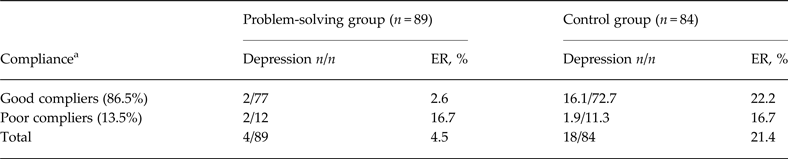
CACE, Complier average causal effect; ER, event rate (risk of depression).
a Good compliers = participants attending four or more sessions; poor compliers = participants attending three or fewer sessions.
Secondary outcomes
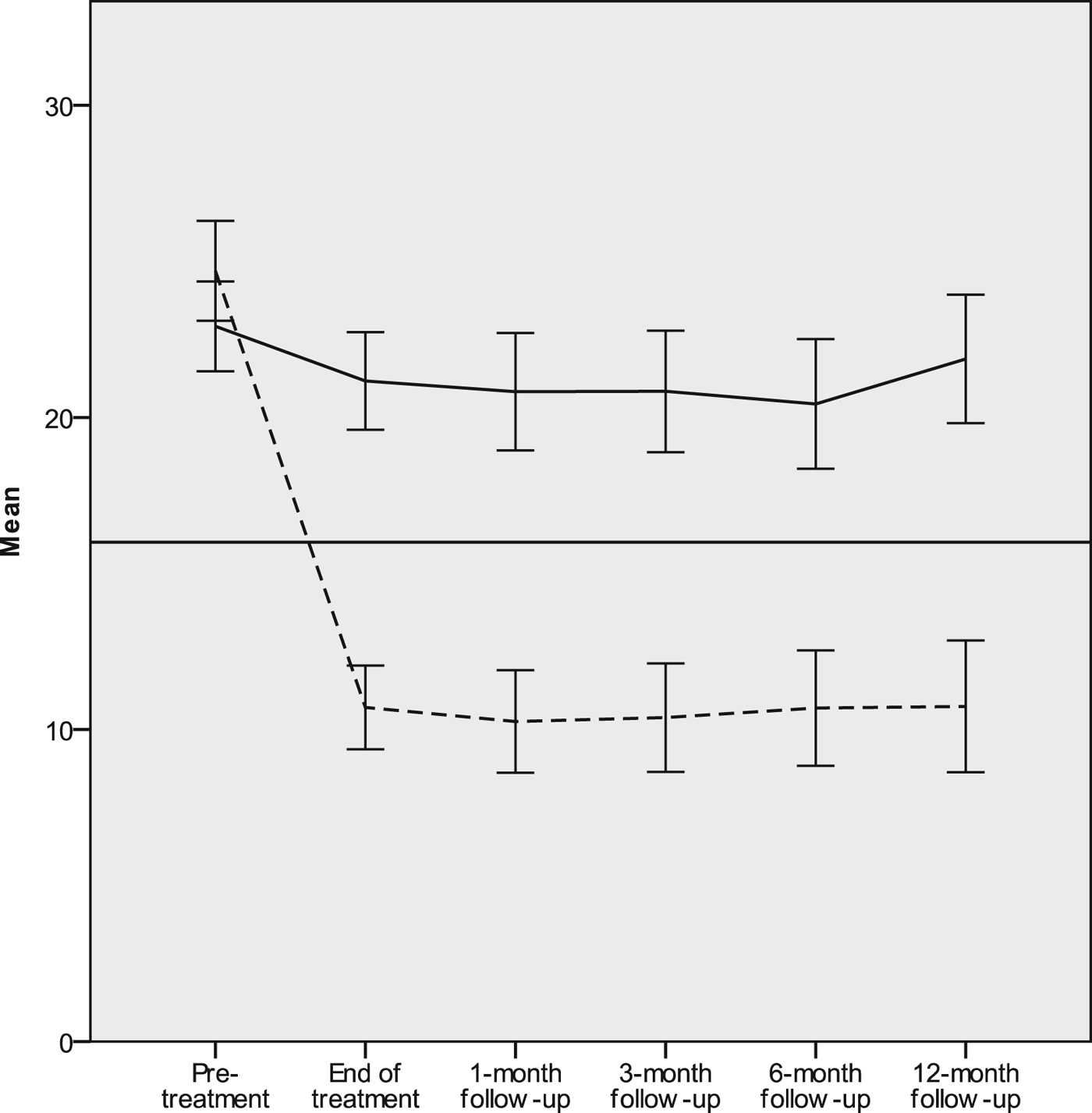
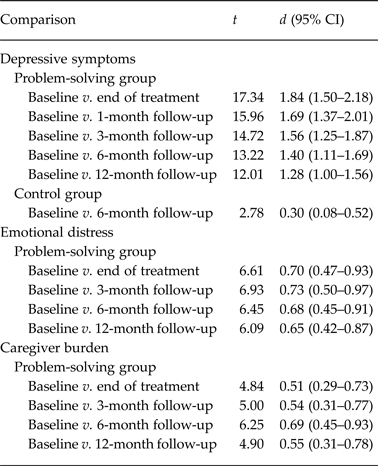
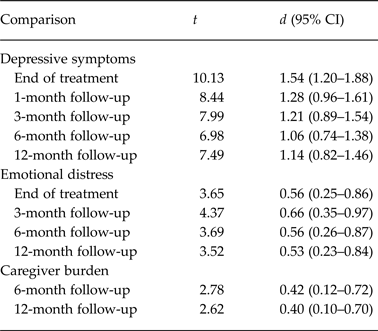
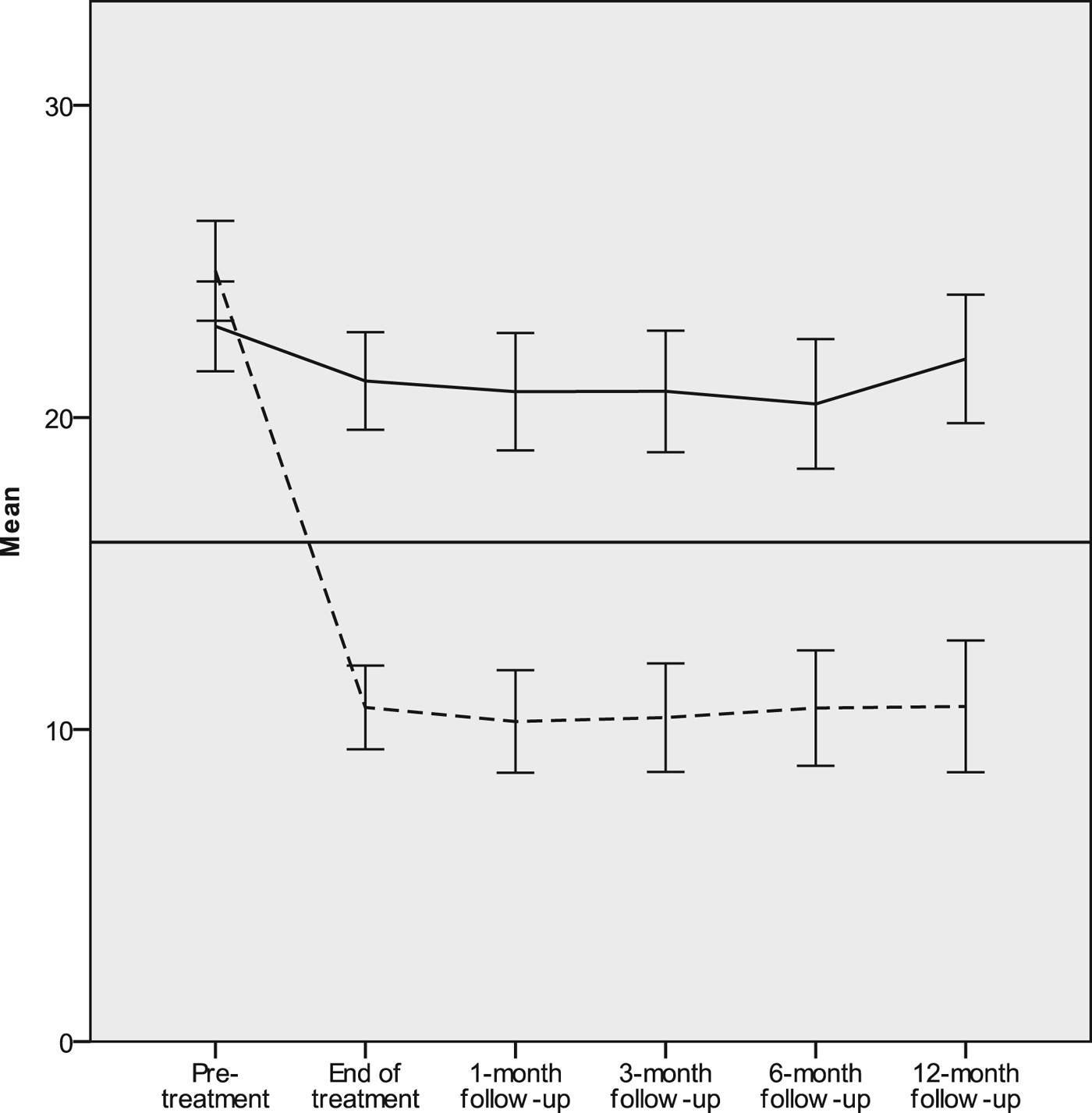
Fig. 2 shows the progression of depressive symptoms at the different times measured in the problem-solving and control groups. In the problem-solving group, the mean CES-D score was 10.7 (s.d. = 6.4) at post-treatment, 10.3 (s.d. = 7.8) at the 1-month follow-up, 10.4 (s.d. = 8.2) at the 3-month follow-up, 10.7 (s.d. = 8.8) at the 6-month follow-up and 10.7 (s.d. = 10.0) at the 12-month follow-up. The corresponding values in the control group were 21.2 (s.d. = 7.2), 20.8 (s.d. = 8.7), 20.8 (s.d. = 9.0), 20.4 (s.d. = 9.6) and 21.9 (s.d. = 9.5). Significant effects of condition were found (F 1,171 = 68.79, p < 0.001, η p 2 = 0.29). Time also had significant effects for symptoms of depression (F 5,855 = 61.95, p < 0.001, η p 2 = 0.27). In the problem-solving group, significant improvements were found between baseline and post-treatment, baseline and 1-month follow-up, baseline and 3-month follow-up, baseline and 6-month follow-up, and baseline and 12-month follow-up. In the control group, significant differences were only found between baseline and the 6-month follow-up (see Table 3). The time × condition interaction was significant (F 5,855 = 36.14, p < 0.001, η p 2 = 0.17). Bonferroni-corrected t tests showed that immediately after the intervention, the reduction in CES-D scores was significantly greater in the problem-solving group than in the control group, and it was maintained at the 1-, 3-, 6- and 12-month follow-ups (see Table 4).
Depression symptoms as a function of time in both groups during 12 months of follow-up: - - -, problem-solving group; —, control group. The reference line on the y-axis indicates a score of 16 on the Center for Epidemiologic Studies Depression Scale (CES-D); a score ⩾16 was an inclusion criterion for the study. Values are means, with vertical bars representing 95% confidence intervals.
Student's t test statistics and standardized mean differences between baseline and follow-up assessments a
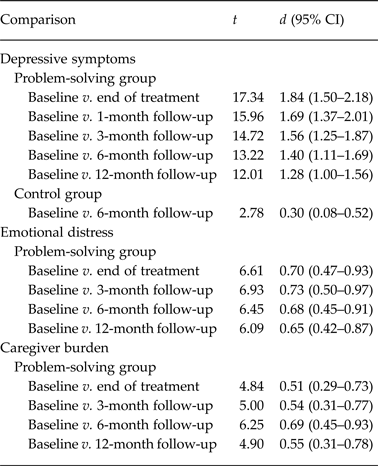
d, Standardized mean difference; CI, confidence interval.
a Only significant results after Bonferroni correction are shown.
Student's t test statistics and standardized mean differences between the problem-solving and control groups a
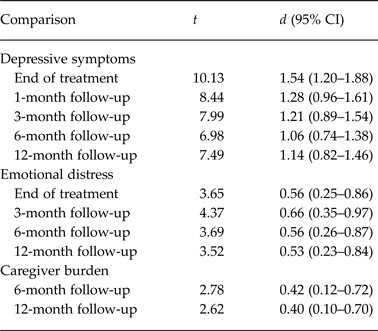
d, Standardized mean difference; CI, confidence interval.
a Only significant results after Bonferroni correction are shown.
Regarding emotional distress, the mean GHQ-28 score in the problem-solving group was 2.7 (s.d. = 3.8) at post-treatment, 2.2 (s.d. = 3.2) at the 3-month follow-up, and 2.6 (s.d. = 4.1) at the 6- and 12-month follow-ups. The corresponding values for the control group were 5.4 (s.d. = 5.7), 5.4 (s.d. = 5.8), 5.6 (s.d. = 6.1) and 5.8 (s.d. = 6.2). As in the case of CES-D depressive symptoms, significant effects of condition were found for emotional distress (F 1,171 = 13.18, p < 0.001, η p 2 = 0.07). Time also had significant effects (F 4,684 = 18.91, p < 0.001, η p 2 = 0.10). With respect to the baseline values, emotional distress was significantly lower immediately after the intervention and at the 3-, 6- and 12-month follow-ups in the problem-solving group. However, no differences were found between pre-treatment and the different time points in the control group (see Table 3). The time × condition interaction was significant (F 4,684 = 9.27, p < 0.001, η p 2 = 0.05). We did not observe significant differences between the problem-solving and control groups at baseline, but significant differences were found at post-treatment and were maintained at the 3-, 6- and 12-month follow-ups (see Table 4).
Concerning caregiver burden, the mean CBI score in the problem-solving group was 23.9 (s.d. = 10.5) at post-treatment, 24.0 (s.d. = 10.7) at the 3-month follow-up, 23.0 (s.d. = 10.9) at the 6-month follow-up and 24.0 (s.d. = 11.3) at the 12-month follow-up. The corresponding values in the control group were 27.9 (s.d. = 10.9), 28.2 (s.d. = 9.8), 28.1 (s.d. = 11.5) and 29.5 (s.d. = 13.5). Condition had significant effects (F 1,143 = 7.08, p = 0.009, η p 2 = 0.05). Significant effects of time were also found (F 4,564 = 4.86, p = 0.001, η p 2 = 0.03). With respect to baseline, significant improvements in the problem-solving group were found immediately after the intervention and at the 3-, 6- and 12-month follow-ups. However, no differences were found between baseline and the other time points in the control group (see Table 3). The time × condition interaction was also significant (F 4,564 = 5.97, p < 0.001, η p 2 = 0.04). Significant differences between the problem-solving and control groups were found at the 6- and 12-month follow-ups (see Table 4).
Discussion
Main findings
This study evaluated the long-term efficacy of a brief indicated preventive intervention for reducing depression in a sample of female non-professional caregivers with subclinical depressive symptoms. The results after a 12-month follow-up indicate that the favourable impact of preventive intervention was still present 1 year after completing the programme. After 12 months, it was found that 10.1% of the caregivers in the problem-solving group developed a depressive episode, which compares favourably with the 25% in the control group. The RR was thus 0.40, and for approximately every seven caregivers treated with the intervention, one new case of depression would be prevented. Furthermore, there was a significant delay in the onset of depression in the intervention group compared with the control group (p = 0.008). These data demonstrate the intervention's efficacy to prevent (or at least delay) new cases of clinical depression.
The wider context
One explanation for the effect of the intervention may be found in the model of depression by Nezu et al. (Reference Nezu, Nezu and Perri1989). They hypothesized that the decrease in depressive symptoms is moderated by effective problem-solving coping (by reducing the negative impact of problems and major life events). Existing evidence suggests that individuals characterized as effective problem solvers exhibit fewer depressive symptoms compared with those individuals less effective at problem solving (Nezu & Ronan, Reference Nezu and Ronan1985; Nezu et al. Reference Nezu, Nezu, Saraydarian, Kalmar and Ronan1986).
Our findings of RR = 0.40 and a NNT = 7 are superior to most prevention trials as reviewed in the meta-analysis of depression prevention performed by Van Zoonen et al. (Reference Van Zoonen, Buntrok, Ebert, Smit, Reynolds, Beekman and Cuijpers2014), who found a mean RR of 0.74 and a NNT of 13 in indicated prevention trials. However, it is important to keep in mind that this meta-analysis included studies with follow-ups ranging from 4 to 24 months.
Regarding depression symptoms, it was found that following the intervention the problem-solving group displayed significantly less severe depressive symptomatology than the control group, amounting to a large effect size (d = 1.54). This intervention effect was maintained up to 12 months (d = 1.14), which suggests long-term efficacy. Again, our results are better than those observed in most indicated prevention trials (e.g. Allart-van Dam et al. Reference Allart-van Dam, Hosman, Hoogduin and Schaap2003, Reference Allart-van Dam, Hosman, Hoogduin and Schaap2007; Young et al. Reference Young, Mufson and Gallop2010), where early outcomes were often not maintained in the long-term. Even though our findings are consistent with those from other studies where long-term effects were documented (e.g. Clarke et al. Reference Clarke, Hornbrook, Lynch, Polen, Gale, Beardslee, O'Connor and Seeley2001; Willemse et al. Reference Willemse, Smit, Cuijpers and Tiemens2004; Arnarson & Craighead, Reference Arnarson and Craighead2011), none of these other studies observed such a large effect size. There are some possible reasons for this, possibly related to more structured usual-care services in other studies compared with the present study. In this study, the usual-care services were psychological and medical treatments and social services available in the community. In contrast, in the study conducted by Clarke et al. (Reference Clarke, Hornbrook, Lynch, Polen, Gale, Beardslee, O'Connor and Seeley2001), usual care could be provided by the Health Maintenance Organization in Portland, and in the study of Willemse et al. (Reference Willemse, Smit, Cuijpers and Tiemens2004) the usual-care treatment was based on the Dutch primary care guidelines for depression.
Furthermore, it is documented that only 11% of Spanish caregivers receive professional mental health help (Institute for Elderly and Social Services, 2005), which may derive in lack of treatment for their depressive symptoms. Another possible explanation relates to study design. While most studies dealt only with participants showing elevated depressive symptoms (e.g. Allart-van Dam et al. Reference Allart-van Dam, Hosman, Hoogduin and Schaap2003; Willemse et al. Reference Willemse, Smit, Cuijpers and Tiemens2004; Young et al. Reference Young, Mufson and Gallop2010), we selected a high-risk sample with multiple risk factors (having subclinical depressive symptoms, being female, being a caregiver). The inclusion of a high-risk sample follows recommendations for preventive interventions (Cuijpers, Reference Cuijpers2003; Muñoz et al. Reference Muñoz, Cuijpers, Smit, Barrera and Leykin2010), and it may have resulted in larger effect sizes.
The influence of additional resources for treating depression on the findings is minimal due to the low percentage of caregivers receiving professional help (Institute for Elderly and Social Services, 2005), and because in the problem-solving group only those participants who developed depression (four subjects) received these services. In addition, we employed conservative treatment of the data with the intention-to-treat strategy. Even when analysing the effect of the intervention in participants who received it as intended by the original group allocation (CACE), it was found that high session attendance (four sessions or more) resulted in an 88% reduction in the incidence of depression.
To understand the generalization of these results for depression prevention, other effects of the intervention in the life of the participants were also analysed (emotional distress and caregiver burden). The problem-solving group showed significantly lower levels of emotional distress at both post-treatment and at the 12-month follow-up, as well as lower levels of caregiver burden at the 12-month follow-up. The effect size for post-treatment emotional distress was moderate (d = 0.56) and was maintained after 12 months (d = 0.53). The effect size for caregiver burden after 12 months was small (d = 0.40). These reductions in emotional distress and burden are important, given that these two problems are frequently observed among caregivers (Pinquart & Sörensen, Reference Pinquart and Sörensen2006; Gallagher-Thompson & Coon, Reference Gallagher-Thompson and Coon2007).
Implications
There are several implications of this study for future research and for clinical practice. These results replicate and extend the findings regarding the short-term impact of the intervention reported by Vázquez et al. (Reference Vázquez, Otero, Torres, Hermida, Blanco and Díaz2013). They are also consistent with cognitive–behavioural theories that posit the importance of the effect of practice on learning consolidation during treatment. In addition, the use of booster sessions to sustain the intervention's protective effects (at least 1 year) does not seem necessary. The observed effects were reached after only five sessions, while the majority of the indicated intervention programmes for depression typically consist of 10 or more sessions (e.g. Clarke et al. Reference Clarke, Hornbrook, Lynch, Polen, Gale, Beardslee, O'Connor and Seeley2001; Allart-van Dam et al. Reference Allart-van Dam, Hosman, Hoogduin and Schaap2003; Arnarson & Craighead, Reference Arnarson and Craighead2011). This points to a more efficient programme applied in our study. Given that ours was a community sample (not one of convenience), intervention was directed to caregivers dealing with people suffering from diverse conditions, and the observed attrition rates were low; this study showed a high external validity. Furthermore, the application of the intervention in an applied context (with caregivers, in locations near their homes) suggests the real-life effectiveness of the intervention.
As the number of caregivers will increase considerably over the next few decades, and because this population is at high risk for depression, the problem is a significant one from a public health perspective. Depressive disorders impair daily functioning in general, but in the case of caregivers it can also affect the quality of care that they provide to their loved one (Williamson & Shaffer, Reference Williamson and Shaffer2001). Public health policies are needed to establish effective preventive strategies for the long term, such as those presented in this study. Even if the effect of these interventions is to merely to delay the onset of the disorder by 1 year, the implications of an effective prevention programme are significant.
Limitations
Some limitations of our study must be considered. The sample was composed only of women, and thus it remains unknown how outcomes would translate to male caregivers. New studies may benefit from including both genders. It also remains to be understood which the active components of the intervention are. Future studies could perhaps evaluate whether the problem-solving processes are the main mediators of change, and how much each component of the intervention contributes to the overall efficacy. Because participants in both groups could not be blinded to knowledge of their assigned group, a Hawthorne effect may have at least partially influenced the results. Although this would equally affect both groups, it should be noted that in the control group, being evaluated may not be completely innocuous, and, without the evaluation, the results in this group might have been worse. Analyses were performed following the intention-to-treat principle. Although it is standard to use more sophisticated methods for imputing missing values than replacing them with baseline scores, the amount of missing data was small, and it is unlikely that the results would change significantly. Finally, this study was conducted in Spain and the results may not be generalizable to other countries. More studies about long-term efficacy of indicated prevention depression in caregivers are needed across different cultural settings.
In spite of these limitations, this is the first randomized controlled trial providing evidence of longer-term efficacy of indicated prevention of depression targeted at non-professional caregivers. These results are promising and suggest a venue to reduce the burden of depression in informal caregivers, possibly with additional beneficial effects for patients in the charge of the caregivers.
Acknowledgements
This research was supported from Ministry of Labour and Welfare (Xunta de Galicia). This study was supported by grant 2007/PN017 from the Ministry of Labour and Social Affairs of Spain.
Declaration of Interest
None.