Volumes 38 to 47 of Central European History, which appeared from July 2004 to June 2014, represented years of fundamental transition in the life of the journal and of its sponsoring society: then the Conference Group for Central European History, now the Central European History Society.Footnote 1 This fundamental transition manifested itself in three forms: institutional formality, both of the journal and of the Conference Group/Society; publishing organization and technology—from the ways in which the editor produced the journal to the ways in which the audience consumed the scholarship it published; and, last but not least, the intellectual focus and content of the history of German-speaking Central Europe that Central European History presented to scholars and students alike. Although the decade presented some unexpected and surprising challenges, all these transitions were already visible in July 2002 when I presented my proposal to become editor of Central European History to the Editor Search Committee, which consisted of Konrad Jarausch, Kees Gispen, and then-editor Kenneth Barkin.
Institutional Formality
At the time that I sought the editorship of Central European History, the Conference Group was a very informal organization. In a technical sense, it was an “unincorporated membership association,” an assemblage of members lacking the formality of legal incorporation. In addition, it was (and is) an affiliate society of the American Historical Association, which itself holds a congressional charter, rather than a state corporate charter—an oddity that Herbert Baxter Adams explicitly sought.Footnote 2 The Conference Group/Society depended (as it still does) on a volunteer (now elected) Executive Board, and very greatly on a volunteer Executive Secretary/Treasurer (now Executive Director) and editor, both of whom drew the necessary logistical and budgetary support for their positions from “institutional support” agreements with their home college or university. The Conference Group drew modest income from the publishing contract for the journal (after 1991); for years, it collected dues direct from its members, produced a mailed newsletter, administered article and book prizes, commented on matters of interest to the discipline of historians of German-speaking Central Europe, and selected the editor of Central European History.
The journal, as Konrad Jarausch discusses elsewhere in this commemorative issue, came into existence in 1968 to fill the gap left by the disappearance in 1964 of the Journal of Central European Affairs, an interdisciplinary journal published at the University of Colorado from 1941 to 1964, and founded and edited by S. Harrison Thomson.Footnote 3 The Conference Group selected Douglas A. Unfug of Emory University as its first editor, without designating a term of office. Under Unfug's editorship, Central European History self-published, which meant that he undertook all marketing and subscription services, and assumed all editorial and manuscript production duties as well. He then contracted independently with compositors and printers to produce the printed journal—and finally, word has it, fulfilled the institutional and individual subscriptions himself by enlisting his family to gather around the dining room table to stuff journals into envelopes and add address labels. To call this institutional informality is perhaps an understatement. Subscription prices were set at rates sufficient to offset production and distribution costs, and produced no royalties for the Conference Group. Indeed, the Conference Group subsidized the journal's editorial office each year from funds raised by membership dues. Yet, Unfug, who died in October 2017, bravely worked under this arrangement for twenty-three volumes, from 1968 to 1991. By his final year, timeliness of production issues had arisen, and the leadership of the Conference Group intervened, both to increase the formality of the institutional publishing arrangement and to select a new editor.
Part of the transition from the founding editor to the second, from Douglas Unfug to Kenneth Barkin, was to find an academic publisher for the journal. In December 1990, the Conference Group chose Humanities Press International, a small but vibrant academic trade press, to publish the journal for a term of five years; this was renewed in 1995 for a second term of five years. The most important consideration for moving to a professional press was to ensure the timely sale and fulfillment of institutional subscriptions to college and university libraries, which not only produced the widest reach for the scholarship contained in Central European History, but also brought in the greatest share of total revenue from subscriptions. As editor, Barkin could thus devote more of his energies to the intellectual work of responding to and shaping the field of the history of German-speaking Central Europe during a post-unification decade characterized by political turbulence, as well as by methodological and theoretical upheaval in the discipline of history.
In 1998, the publishing contract for Central European History shifted from the small Humanities Press International to the giant Dutch academic publishing house, E. J. Brill, under circumstances involving once again the timeliness of the journal's appearance. The Conference Group renewed the contract with Brill for five more years in December 2000, to expire on December 31, 2005. Thus, as I prepared my proposal to become editor on July 1, 2004, I knew that one of my main tasks in the first eighteen months of my term would be to consider publishing arrangements for Central European History beginning on January 1, 2006.
As I transitioned into the editorship, supported wonderfully by Kenneth Barkin and his assistant editor, Ursula Marcum, I quickly discovered that the institutional informality of the Conference Group and the journal—together with the duress caused by concerns about the timeliness of the appearance of Central European History—posed two problems. First, all the previous publishing contracts had been cursory and informal, leaving many important details unaddressed; second, the renewal contract of December 2000 with Brill had been unfavorable to the Conference Group; third, ownership of trademark in the title “Central European History” and of copyright in the journal itself had been, ever since 1968, at best unclear, certainly fragmented, and arguably not in the hands of the Conference Group, which had sponsored and fostered the journal since its beginning.
As a matter of due diligence, and in order to clarify questions of ownership of trademark in the journal's title (both in print and in digital form), and of copyright to the journal as a “work,” I spent much of 2005 working with a Negotiating Committee appointed by the Executive Board, which consisted of Roger Chickering (then President), Jennifer Jenkins (then Executive Secretary/Treasurer), and me (as editor). We sought bids from academic presses, including Brill, to publish the journal for a term of five years beginning January 1, 2006. In the course of this negotiation, upon the recommendation of the Negotiating Committee, the Executive Board authorized me to retain intellectual property counsel and to perfect ownership of trademark in the title “Central European History” in the hands of the Conference Group. And when the Executive Board and membership subsequently approved a new contract with Cambridge University Press (CUP), the terms of that contract, and the generosity of Emory University, permitted unification of all claims of copyright in and to Central European History from volumes 1 through 38 clearly in the hands of the Conference Group, now Central European History Society (CEHS), as of 2012. The CUP-CEHS contract also provided, and still provides, that the Society owns copyright in the journal. Not only has the publishing contract with Cambridge established the Conference Group/Society on a more secure financial footing, then, but it has also formally established that the Society indisputably owns its own journal (the legal, intellectual property term is “incontestability”). Thus, when the editorial transition from me to Andrew Port took place in 2014, the institutional basis of the journal and of the Society was substantially more formal—and rational, in Weberian terms.
Publishing Organization and Technology
The circumstances of publishing organization and technology for Central European History, when I became editor, read as quaint today in astonishing ways. Kenneth Barkin had made great strides in the production process by adding a skilled and talented assistant editor, Ursula Marcum, who handled virtually all the copy-editing duties. My greatest anxiety about becoming editor of the journal was whether I would be able to find another assistant editor as able as Ursula, which I happily did when I found Gayle Godek, who served splendidly in that role for the entire decade of my editorship, with whom it was a joy to work, and whose care, precision, and genial nature constantly drew gratitude from contributors. Barkin had also improved the journal—which had published book reviews only sporadically over its first twenty-three volumes—by adding a Book Review section in 1991; this quickly became a venue of record for the evaluation and communication of scholarship published in English and German on the history of German-speaking Central Europe.
Because it is a great logistical task to manage manuscript flow and review commissioning both for articles and book reviews, my proposal envisioned, from the beginning, the addition of an associate editor, whose primary role would be to edit the Book Review section, but who would also be a close and trusted collaborator and advisor to the editor on matters of editorial policy. Upon election, I persuaded my long-time colleague and friend, Catherine Epstein of Amherst College, to undertake this role, which she did with aplomb, diplomacy, and high intellectual standards for both my terms as editor. Catherine produced like clockwork eighty or more reviews per volume for ten years, soliciting and obtaining high quality and perceptive reviews that served authors and the profession in disseminating the latest and most creative work in our field; furthermore, she achieved her goal of having reviews of the vast majority of books appear within twelve months of their publication. Beyond this, Catherine's wisdom and judgment were always supports of first resort to me, in ways large and small, and the journal is inestimably better off for her contribution.
Production and dissemination of the journal in 2004 took place in ways that today seem primitive. Until Kenneth Barkin assumed the editorship in 1991, article submissions required the mailing of two printed manuscript copies to the office of the editor; after 1991, he invited authors to include “either 3½ inch or 5¼ inch double-sided diskettes” with digital copies of the articles. Copy-edited manuscripts, as well as page proofs, circulated between the editorial office and authors by mail, entailing much expense and delay. Upon assuming the editorship, I shifted the mechanism of submission to digital files sent as email attachments, and subsequently circulated copy-edited manuscripts and later proofs also by email.Footnote 4 Although other humanities and social science journals had, by 2005, already begun to use online submission systems such as Manuscript Central by ScholarOne—and although Cambridge University Press had agreed in its first contract to manage a transition to the Manuscript Central online submission system—I failed to make that transition. Having developed reliable procedures whereby Gayle, Catherine, and I produced the journal on a timely basis, I chose not to disturb this success by shifting to Manuscript Central. I am pleased that Andrew Port has followed my transition advice and worked with Cambridge to implement this innovation, and, in doing so, he has established Central European History on a far sounder production footing for the future.
Another publishing technology goal contained in my editorial proposal was to increase the digital availability to subscribers of Central European History. In 2004, Brill had begun to disseminate the journal in a proprietary digital form, as well as in print, but the system was unfamiliar to institutional and individual subscribers; in addition, it existed in isolation from most other history journals. Brill had not shown any interest in having the backlist of Central European History included in JSTOR.Footnote 5 And tensions still existed between, on the one hand, marketing and revenue interests in preserving print subscriptions, particularly the lucrative institutional ones, and, on the other, ease of dissemination in digital form. My editorial proposal called for a full-scale commitment to digital accessibility, and, particularly with the new publishing contract with Cambridge beginning in 2006, this commitment was successful. Central European History joined JSTOR in 2006, making access of the full backlist available at institutions that are members. Cambridge aggressively marketed the journal, in both print and digital subscriptions, to both institutional and digital subscribers. It also freshly digitized the entire backlist of the journal and marketed access to that archive to institutional subscribers, eventually making it available as a subscription benefit to all institutional and individual subscribers. Finally, over the terms of the first two contracts with Cambridge (2006–2015), Cambridge ably managed the revolution in academic library serial acquisitions, which saw a massive shift from institutional subscriptions to individual scholarly journals or publishers’ lists of scholarly journals, to institutional participation in consortial subscriptions, to scholarly journal content (purchased by academic library consortia such as OhioLINK, CARLI, and other acronym-fixated organizations). In the consortia, colleges and universities contribute to state-wide or other consortia of research libraries to negotiate a collective subscription to journals.Footnote 6 Cambridge's size, experience, and skill ensured that the volunteer officers of the Central European History Society and the volunteer editor of Central European History did not have to anticipate, evaluate, master, and respond to this rapidly-changing environment in their spare time, and thus the decision to choose Cambridge as the journal's publisher paid off in a vast expansion of the breadth and scope of access to the scholarship in the journal. In all of this, the CEHS owes—and I personally owe—exceptional gratitude to Mark Zadrozny, Executive Publisher at Cambridge, who shepherded the journal through all these changes.
My term as editor thus ended with successful transitions to a mature publishing relationship for Central European History with the leading academic press in the world, and to digital means for production of the journal and the dissemination of its scholarship. Opportunities for improvement and advancement abound, but the journal remains well placed to adapt to future changes in publishing organization and technology.
Intellectual Focus and Content of the History of German-Speaking Central Europe
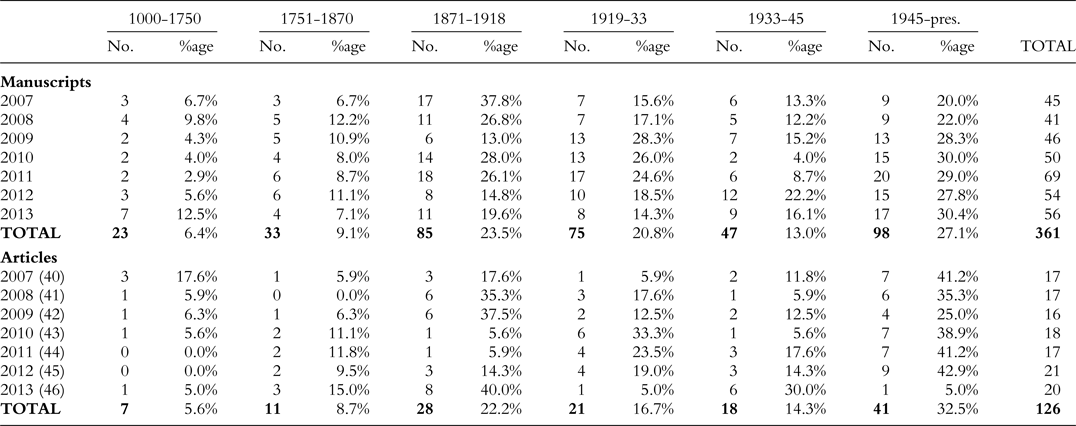
David Blackbourn, Catherine Epstein, and Andrew Port have written persuasively about shifts in the scholarship on the history of German-speaking Central Europe, within that portion of the historical profession that focuses on it, and in the types of articles published in Central European History.Footnote 7 From my perspective as editor, the decade from 2004 to 2014 produced two predictable and healthy transitions—and two that surprised me. The predictable and healthy transitions were the maturation of post-1945 as a focus of scholarship in the history of Central Europe, and the internationalization of German history. Blackbourn and Port, who quantify, among other things, the temporal focus of papers given at the German Studies Association annual meeting, as well as book reviews and articles that appeared in Central European History before and after 1990, have both found a shift from nineteenth- to twentieth-century history, and indeed to the post-1945 period, as well as shifts in subject matter and method. Table 1 adds to their findings data on manuscript submissions to Central European History for the final seven full years of my editorship (2007–2013), culled from the editor's annual reports. As the table suggests, whereas new work on the nineteenth century continued to flow to the journal, post-1945 history emerged as and remained the largest single temporal field of work for authors seeking to publish in Central European History.
Articles and Mansucripts by Temporal Period

A second intellectual trend in the scholarship on German-speaking Central Europe was the internationalization of the field. This included the study of German policy, trade, and culture, of Germans settlers and others outside of Europe, and, most notably, of the study of “borderlands” in Central Europe and the interaction between German-speakers and non-German-speakers—whether in the Czech lands of the Habsburg Empire or as a result of the post-Versailles minority treaties in Upper Silesia. The shift from political history to the “new” cultural history noted by Andrew Port opened up a new space for inventive and creative scholarly work.
Closely related to the research on Central European “borderlands” was one surprising transition, namely, an increased and consistent flow of submissions that dealt with the history of Poland, Hungary, Rumania, and even Ukraine—without any connection to Germany or to Germans who lived in those regions. This reflected the plasticity of the very concept of “Central Europe” and embodied not only changes and cultural-political transitions after the fall of communism in 1989–1991, but also the enlargement of the European Union (EU) in 2004 and again in 2007. This added ten new member states previously thought of as “Eastern Europe,” but that had a variety of political, economic, and cultural reasons to attempt to define themselves as lying in “Central Europe.” A long history lay behind this phenomenon, but historical research on topics such as the Rumanian fortification of the mouth of the Danube to stem Russia imperial ambitions consistently tested the expansiveness of Central European History’s stated scope of publishing scholarship dealing with the history of German-speaking central Europe.Footnote 8
The second transition that surprised me is one that Port notes, namely, the ending of the theoretical polemics between practitioners of social/structural history and of the “new” cultural history of language, gender, and culture in the quiet triumph of the latter. I agree with Port's observation that the new theories that had prompted so many programmatic statements through the 1990s became a foundation in the training of younger scholars, and that the inclusion of close attention to language, a focus on the subaltern, marginal, and liminal, as well as emphasis on agency, meaning, and subjectivity are all not only integral to whatever topic they pursue but also frame their methodological approach as well.Footnote 9 The transition from polemics to practice in new methods and theories has enriched the work and broadened our understanding of the historical actors we study.
In sum, the years 2004–2014 saw an intellectual transition that expanded and deepened the field in which historians of German-speaking Central Europe work. As Epstein shows, the renewal of interest in the history of Germany and of Central Europe that emerged following the unification of Germany in 1990, the EU enlargement eastward beginning in 1995, and the unanticipated and early availability of archives from the German Democratic Republic, all boosted scholarship in German and Central European history and helped secure our field—which, in the dire academic job market, remains better for Central Europe than it does for other scholars of European history.
Conclusion
Stewardship of an institution such as Central European History involves strong doses of conservation and innovation, and transition is an essential element in both. The journal reached 2004 with an outstanding reputation for excellence in the quality of scholarship it published and for integrity in its publishing process. Any editor's first goal must be not to squander that inheritance. But the rapidity of change, both intellectual and technological/economic, means that that same editor must also risk transition to new structures and methods in order to preserve and transmit that inheritance. This is why I take substantial satisfaction in the fact that the thriving scholarly journal that Andrew Port has seen to its fiftieth volume continues as the leading journal published in English on the history of German-speaking Central Europe.