This year marks four decades since the publication of James O’Connor’s landmark The Fiscal Crisis of the State.Footnote 1 In this groundbreaking contribution, O’Connor argues that the capitalist state faces two major challenges to withstand inexorable fiscal crises. The first hinges on the ability of the state to balance its expenditure compromises and revenue competences. The second unveils how the state may become prey to a host of special interests organized around labor, business, or the poor. These political pressures, in essence, engender a great deal of inefficiencies, in addition to the proliferation and perpetuation of pork-barrel policies.
While O’Connor wrote his book at the onset of the 1970s Oil Crises, the world has since then undergone a more or less permanent fiscal crisis. Several factors underlie the imbalances that cause countries to experience such crises. Previous work has emphasized the causal effects of distortionary macroeconomic policies, external conditions such as large abrupt changes in world interest rates or the terms of trade, and the quality of governance in emerging market countries.Footnote 2 However, a budding corpus of scholarship in political economy set out to provide evidence that probably the fundamental cause of fiscal instability is its institutional nature. In addressing the institutional dimension of the political economy of crises, Bates’ seminal work on Africa and his subsequent study of the collapse of the International Coffee Organization show that in institutionally weak societies, elites and politicians count on various ways of expropriating different segments of the society via different fiscal policies.Footnote 3 It is the presence of this type of expropriation and the power struggle to control the state to take advantage of the resulting rents that underlie fiscal instability. Arguably, weak institutions impinge on several dimensions. For example, Acemoglu and Robinson show how ‘‘weak institutions’’ might encourage coups and revolutions, leading to political and economic instability.Footnote 4 Alternatively, institutional failures may also make fiscal adjustment unlikely. In an important paper, Rodrik suggests that countries with weak institutions are unable to deal with major economic shocks, suggesting an important interaction between global trends and institutions.Footnote 5 In theoretical terms, institutional weakness then leads to structural fiscal vulnerability. The underlying assumption, then, is that institutional weakness amounts to a main source of predicaments in distributive politics. Framing political dynamics in terms of their transaction costs,Footnote 6 contested institutions engender opportunity structures for politicians and elites to expropriate collective goods and rents. Weak institutional designs are vulnerable, the argument goes, because they fall short of enforcing rules of the game to cope with policy uncertainty and crisis. Strong institutional frameworks, by the same token, constrain politicians and political elites, restraining excessive political horse-trading and its related collective-action problems.
This article takes aim at this prevailing conventional wisdom and suggests that institutions, be they weak or strong, can at times undermine the normative purposes for which they were created in the first place. What is more, strong, historically persistent, institutional arrangements have unintended distortionary fiscal consequences that extant institutionalist research often fails to acknowledge. My main contention is that transaction costs and related public policy approaches overstate the merits of equilibrium models of institutional persistence. In fact, the aspects being praised by said approaches such as institutional resilience may ultimately compound deadlocked and perennially malfunctioning political arrangements. These analytical perspectives actually overlook instances of perverse institutionalization of political power, namely when groups and entities holding political power at a certain point have strong incentives to manipulate institutional arrangements to protect their interests in the future.
In this study, I focus on the manipulation of territorial institutional design, which results from the political empowerment of economically marginal subnational units that at times occurs in federal and decentralizing polities. While said empowerment, bequeathed as the legislative overrepresentation of economically vulnerable territorial units, is bestowed in a historical compensatory spirit, it often perpetuates a vicious circle of inefficient (one could argue, unfair) territorial redistribution. In this regard, this article aims to underscore how federal institutions beget unintended economic and fiscal results. Likewise, it seeks to contribute to the debate on intergovernmental fiscal relations by discussing the role of institutional complexity in federal systems and the theoretically unwieldy topic of legislative malapportionment and elucidating the non-obvious yet persistent effects of such overrepresentation on fiscal policies. Additionally, this critical analysis sheds light on the empirical realities about why seemingly ineffective institutions are chosen and preserved as often as they are.
In what follows, I discuss these topics analytically, hoping to highlight previously unforeseen and counterintuitive aspects of the impact of legisla-tive overrepresentation on the governance of fiscal crisis in multilevel polities. This discussion is based on the experience of Argentina, a federation exhibiting one of the most decentralized fiscal systems in the world yet featuring severe imbalances in the territorial distribution of legislative and economic resources. Argentina, a country whose policies of economic adjustment in the early 1990s have won it international acclaim, has proved unable to restructure its federal system for addressing severe imbalances in the intergovernmental fiscal relations. The overall unsustainable level of subnational debt and the limiting authority of the center to rein in fiscal discipline lurked underneath Argentina’s foreign debt default—the world’s largest—and the so-called corralito, namely, freezing bank accounts and forcing those with dollars to convert their accounts into devalued pesos. The move caused absolute outrage among the population, with citizens bashing their pots and pans in street demonstrations, causing the then recently elected President De la Rúa’s government to resign in December 2001 and the outburst of one of the worst episodes of the Argentine fiscal saga.
The underlying thesis I explore here is that suboptimal institutional design of some federal systems endows some subnational units to play a pivotal role in the intergovernmental fiscal arena, engendering an unsustainable fiscal order. Spared from the more radical effects of neoliberal fiscal adjustment and structural reform between 1989 and 1995, poorly populated, mostly economically disadvantaged, and thus transfer-dependent regions brought into play their political overrepresentation to shield themselves from unwanted reforms.Footnote 7 These “low-maintenance” jurisdictions, insofar as they afford more “political bang for the buck,” kept preserving their overspending privileges both during the ruling of the Peronist Party throughout the 1990s and its replacement by the Radical Civic Union Party in 1999. These privileges, consisting of securing federal bailouts as well as disproportionate amounts of federal investment funds, were consistently conferred with the deliberate aim of targeting legislators from overrepresented provinces ruled by parties who oppose the federal incumbent.Footnote 8 Admittedly, favoring opposition forces over co-partisan forces may have the unexpected effect of damaging partisan interests because targeting greater transfers to opposition bulwarks bolsters their political bases and their capacity to more effectively challenge the ruling party in future elections. Still, short-term policy coalitions based on territorial politics had consistently hurt long-term partisan concerns, at the same time as the increasing territorialization of national mainstream parties, particularly since the late 1990s, weakened the capacity of national party leaders to enforce general bargains. By the same token, subnational party leaders gained further ground to pursue strategies for extracting compensation for the fiscal losses in the course of Argentina’s Great Depression.
This article recognizes that while the Great Depression had manisfested itself more acutely in the economic realm, as Argentina experienced the worst recession in its entire history, the extent of the crisis outstripped the fiscal dimension. Without denying the importance of the external debt default and its economic consequences, it is crucial to point out that Argentina was entering the 2000s in the midst of a political and social implosion. In fact, the pervasive “que se vayan todos” (they all must go) slogan used in massive demonstrations across Argentina in December 2001 underscored a crisis of political legitimacy that was incubating among social sectors, have-nots as much as affluent ones.Footnote 9 The looming infighting between the executive, controlled by the Unión Cívica Radical (UCR) and the ruling coalition, which included the left-wing Frente para un País Solidario (FREPASO), transpired into successive political developments that undermined the credibility of the government. The appointment of nonpartisan and unelected advisers such as Domingo Cavallo, the then neoliberal architect of the convertibility plan and known for advocating policymaking based on executive decrees, was perceived as a lose–lose solution for most Argentineans. Alongside this drastic reshuffling of the economy minister, between October 2000 and August 2002 there were five cabinet crises, two presidential resignations, and one Senate crisis. This political conundrum and the ensuing crisis of representation notwithstanding, Argentina survived said political turmoil without abandoning democratic politics in contrast with the unwieldy international repercussions of the debt default. Therefore, without overlooking the political dimension, my analysis seeks to articulate an institutional explanation of the fiscal watershed that preceded the Great Depression.
In summary, this article seeks to tentatively shed light on the effects of territorial institutional design in crisis-ridden contexts, as well as the particular and often complex consequences of legislative malapportionment in intergovernmental horse-trading. As I will show, the fate of fiscal crises in Argentina bears the imprint of the legislative overrepresentation of small provinces, which are being bestowed significant advantages in the distribution of federal grants as well as in the soft-budget constraints leading to their inexorable indebtedness. Paradoxically, the institutional insulation of the legacy of the Argentine Constitutional Convention of 1816, which gave rise to malapportionment, precluded significant attempts to adjust territorial representation to curb an increasingly unfair distribution of economic and fiscal resources in the country.
Determinants of Fiscal Crises in Argentina: Soft-Budget Constraints and Divided Government
The mainstream literature on fiscal crises in Argentina has articulated two categories of explanations. First, the absence of hard-budget constraints has been mentioned at length, amounting to a sort of Achilles heel of Argentine political economy.Footnote 10 The Argentine revenue-sharing system has conspicuously burdened the federal government with taxing responsibilities, at the same time as subnational governments were granted expenditure capacities almost unmatched by their counterparts elsewhere in the world.Footnote 11 In fact, this disjuncture between spending and taxation makes Argentina one of the countries with the largest vertical fiscal imbalances in the world.Footnote 12 Adding to the resulting common pool resources’ dilemma fostering fiscal imprudence is the internalization of the negative externalities of provincial overspending by the national governments.Footnote 13 This overspending is facilitated by the availability of national and international credit for subnational expenditures, which often is secured using the revenue-sharing funds as a guarantee for future payments. The second category relates to the horizontal and vertical dimensions of ruling with a divided government. The former dimension concerns the absence of simultaneous same-party majorities in the executive and legislative branches of government, and the latter, more dramatically crucial to my central argument, to the distribution of partisan loyalties between central and subnational governments. Touted as a kind of “iron law” of Argentina politics, the greater political stability of Peronist incumbents allows them to keep their legislative and provincial dominance even when they lose presidential elections, assuring the almost unchallenged electoral advantage of the Peronist Party at the subnational level.Footnote 14 This tenet of Argentine politics is reinforced by the support base of the Radical Civic Union, the other leading electoral force, whose support bases draws on voters from relatively wealthier constituencies, who are geographically concentrated in the most populated provinces and politically disadvantaged provinces in federal fiscal politics.
Whereas these explanations have some kernel of truth, they fall short of accounting for the institutional complexity that lurked beneath the unruly fiscal scenario that triggered Argentina’s Great Depression of the late 1990s. In particular, these explanations had not paid sufficient heed to the effects of legislative malapportionment. Therefore, we contend that the political biases engendered by extraordinary high levels of malapportionment accrued fiscal distortions throughout the 1990s related to coalition-making imperatives driving national governments to be more lenient with the fiscal excesses of economically marginal but politically overrepresented regions. Fiscal decision-making amid recurring economic shocks, such as the 1989–91 hyperinflation, the 1994 Mexican crisis, and the 1998–2002 recession, stimulated the creation of oversized coalitions in Congress whose survival was contingent on the doling out of short-term compensations to those provinces that supported fiscal restructuring to deal with such shocks.Footnote 15 Whereas most provinces suffered fiscal loses from such restructuring, smaller, overrepresented provinces, which are more affordable to co-opt and politically predicable due to the entrenchment of partisan enclaves, have been given more latitude to pursue narrow provincial fiscal interests.Footnote 16 This suboptimal fiscal equilibrium faded away when, despite the support of the larger provinces ruled by the Peronist opposition, small provinces ruled by the Peronist Party sabotaged the last desperate move of the national government to cut down spending to ease the ongoing recession and probable debt default as a result of the Russian crisis of 1998 and the resulting devaluation of the Brazilian real. Further, the divided government thesis, insofar as it rests on the presumption of cohesive and integrated national parties and resulting partisan discipline in Congress,Footnote 17 has been gradually losing ground amid the increasing organizational denationalization and weakening of the programmatic national agendas of the Peronist and Radical parties.Footnote 18 With regard to the impact of soft-budget constraints, not withstanding their long-standing presence, they had not been decisive in exacerbating the ongoing crisis scenario because the East Asian currency crisis and the crises mentioned above deterred investors in developed countries from investing in debt-ridden Argentina, especially in its most vulnerable provinces. As a result, the available resource pool for overspending was already contracting dramatically. Consequently, the divided government and structural fiscal profligacy arguments cannot per se account for the exacerbation of the crisis that led to the Argentine fiscal collapse of the late 1900s unless explicit attention is paid to the effects of the legislative overrepresentation of small provinces.
The Limits of Analyses Based on Institutional Strength: Charting the Paradox of Malapportionment
The concept of institutional strength is widely used but often poorly defined in the literature on comparative politics and political economy. Characterizations range from a Weberian understanding of state institutions as the monopolist of legitimate violence and protectors of private property rightsFootnote 19 to their ability to penetrate deeply into society and effectively regulate the social, economic, or political behavior of citizens.Footnote 20 Institutional strength has been associated with ideational innovation,Footnote 21 “veto points” or “strategic openings,”Footnote 22 and implementation capacity.Footnote 23 While most of these perspectives share some tacit understanding about the significance and causal role of political institutions, they seldom refer explicitly to the notion of institutional strength, nor do they identify its concrete and measurable indicators.
To fill this analytical vacuum, the concept of institutionalization has often been employed as a proxy of institutional strength, mostly drawing on Samuel Huntington’s definition of institutionalization as “the process by which organizations and procedures acquire value and stability.”Footnote 24 In the same vein, North claims that institutions reassert themselves by “providing a structure to everyday life,” generating a scenario that is not easily modified.Footnote 25 These heuristic characterizations have, however, translated into more rigorous and precise scrutiny in research on legislatures and political parties. First, building on the seminal study by Nelson Polsby on the U.S. Congress, analysts have shown that legislatures institutionalize through professionalization, namely when boundaries for roles, internal complexity, and universalistic criteria are well established.Footnote 26 Second, party institutionalization takes place when “citizens and organized interests must perceive that parties and elections are the means of determining who governs, and that the electoral process and parties are accorded legitimacy.”Footnote 27 Institutionalization then connotes the process of consolidating a democracy and presages responsible policymaking. Put simply, while this scholarship on institutionalization diverges in the object of study, there is one factor it agrees upon: insofar as institutionalization amounts to ascertaining and entrenching the “rules of the game,” it is adjoined by positive developments and performance.
Levitsky and Murillo provide perhaps the clearest characterization of institutional strength. They identify enforcement and stability as two central dimensions to assess institutional strength. Accordingly, formal institutional arrangements that persist in substance and over time are deemed strong. In practice, this suggests that when said arrangements withstand adversity and endure, actors and groups become increasingly aware of the effect of institutional rules on their interest and, concomitantly, learn how to organize to cope with institutional effects, even the unintended ones.Footnote 28 Such unplanned effects are of course the result of cognitive limitations as well as changing social contexts. Blundered human calculations and evolution aside, institutional dynamics may engender vicious practices, especially when key actors protected by institutional veto points control the process of institutional adjustment. In his seminal contribution to institutional analysis, Pierson admits that unintended effects are not randomly distributed and often stem from the entrenchment of sectorial and territorial concerns. This entrenchment is part and parcel of the path-dependent nature of institutional design and the ensuing encapsulation of vested interests.Footnote 29 In turn, unintended consequences of institutional design are not only inevitable but often are reinforced by the fact that designers create rules that make the preexisting arrangements hard to reverse. Furthermore, Pierson convincingly reminds us that policy legacies are important. While political decentralization is a necessary condition for federal arrangements, significant institutional differences are at play. Several examples can be cited at length, but suffice it to contrast the U.S. and Argentine rule for electing senators. Although in both cases the interests of the subnational governments received considerable attention in the process of institutional design, the Americans have tempered the state’s preeminence by requiring the popular election of senators in the early 1900s, whereas Argentina followed suit almost a century later following the 1994 Constitutional Reform. Moreover, the importance of provincial-level decisions in the selection of candidates to the National Congress underlies the facade nature of said reform insofar as voters, in absence of primary elections (only adopted following the 2009 law 26.571 promoting the democratization of political party nominations), have no significant latitude in the process. As I will show, the tight control of Argentine legislators by provincial party leaders has dramatic spillover effects on the nature of fiscal policies.
Consequently, it is not far-fetched to claim that institutional strength may well encapsulate obsolete and malfunctioning features of politics. Let us focus, for instance, on institutional arrangements based on statutory and constitutional principles. Considering that the difficult-to-amend character of constitutional institutional arrangements is part of the need to protect their higher law character and that special majorities are often required in multitiered polities,Footnote 30 we should not be surprised about the enduring institutional legacy of the U.S. Great Compromise of 1787, which set the historical paradigm of granting each state equal representation in the Senate. However, a substantial empirical literature provides evidence that, beyond the point of whether overrepresentation is the result of the impartial protection of minority rights or rather stems from political negotiations, the legislative overrepresentation of the smallest units generates suboptimal outcomes in terms of fair economic distribution and performance. Institutional persistence amid increasing demographic change translates into lopsided politics, suggesting that the immense and rising variation in state population led Senate apportionment to grant disproportionate weight to small-state voters in determining the composition of the Senate and the distribution of federal funds.Footnote 31
While the deleterious effects of this historical landmark decision on U.S. politics are well documented,Footnote 32 it is important to bear in mind again some significant comparative insights. While Argentina has never opened any permanent institutional channel in its political process for discussing and eventually amending the most evident and worrisome aspects of territorial overrepresentation, the American experience has been different. The intervention of the Supreme Court and its decision in Baker v. Carr in 1962, ordering legislatures to reapportion, meant not only that legislative malapportionment began to win recognition as a national political problem to be addressed, but also that the judiciary would eventually steer the politics of reapportionment set in motion by said radical decision. In short, the Gordian knot of territorial institutional design is, borrowing from Pierson, vested in the inherent propensity of constitutions to disallow certain types of revisions altogether, insofar as they provide veto power to those regions that would lose protections or privileges as a result of possible reforms.Footnote 33
The Significance of Malapportionment
Commonly referred to as malapportionment or overrepresentation,Footnote 34 the unequal representation of the population in at least one chamber of the legislature has emerged as a historical compromise in the formation of the nation or union to balance the representation of people and of the regions. While normatively sound insofar as it redresses the economic and demographic vulnerability of smaller jurisdictions, the deviation from a proportional population-based standard represents not only a serious institutional problem but also leads to the “devaluation” of the vote.Footnote 35 Other deleterious effects of malapportionment stem from enabling local bosses to hold the national government hostage on important policy issues. Moreover, malapportionment has profound politico-economic significance because it “assigns” disproportionate benefits to overrepresented units.
In fact, an extensive empirical literature confirms that legislative malapportionment not only has a decisive effect on the coalition-building efforts of executives at the central and subnational level but also substantial and direct consequences on the quality of the political system. While in its origins malapportionment provided territorial institutional protections for regionally based elites against the growing influence of the metropolitan areas, among its unintended consequences is a fairly broad range of issues affecting political dynamics. Malapportionment can lead to estrangement between executive and legislative branches insofar as it exacerbates partisan biases that eventually “prevent” redistricting efforts.Footnote 36 While originally seen as countervailing rural political power in the United States and Canada,Footnote 37 malapportionment weakens progressive forces and bolsters patronage-dependent forces, undermining the ability of national-level incumbents to implement and consolidate democratic reforms in Latin America. In this regard, malapportionment has played a central role in the “deadlock of democracy” in Latin America.Footnote 38
With regard to the purported effects of legislative overrepresentation on public policy, it is thought to have deleterious consequences on national public finances. The overrepresentation of the smallest units not only empowers the legislators of said units to coalesce in demanding policy concessions to the expense of populous states but also may generate suboptimal outcomes in terms of fair economic distribution and performance. Legislative apportionment is central for distributive politics because “senate coalitions are likely to prefer to distribute funds in ways that disproportionately benefit constituents in less populous states even in the absence of conflict between large and small states.Footnote 39 The underlying logic is that overrepresented, often economically vulnerable, units are more affordable coalition partners because they can be co-opted at the least cost while still providing the same political assets that richer jurisdictions provide.
From the standpoint of the structure of incentives of subnational governments, malapportionment decisively conditions the nature of intergovernmental exchanges insofar as it makes overrepresented provinces more attractive for coalition building and hence it may play a tiebreaker role when the center is unable to steer majority support in the legislature. The experiences of Argentina, Bolivia, and Venezuela provide preliminary evidence to the connection between Senate overrepresentation and the subnational origin of national fiscal disarray. While to some extent windfall resources from oil in the latter case offset fiscal distress, subnational assertiveness in the legislature amounted to co-optative, patronage-ridden intergovernmental relations in most cases. All else being equal, peripheral, transfer-dependent jurisdictions in these countries have clearly signaled their preference for a centralized fiscal system based mostly on transfers and bailouts from the central government. The resulting outcome is increasing potential for subnational overspending and fiscal crisis.
Some theoretical considerations, however, should be kept in mind. Unless reapportionment reforms take place, malapportionment can only be affected by demographic shocks such as migration or changes in the size of the overall population. In essence, these shocks occur infrequently. Hence, malapportionment cannot singlehandedly be a cause of policy developments or fiscal crises. For that reason, this article articulates an institutional explanation of the fiscal crisis that takes into account the mutually reinforcing interaction of biased territorial representation and partisan influences. Drawing on Arend Lijphart’s finding that electoral malapportionment and the effective number of parliamentary parties are negatively correlated,Footnote 40 I argue that precisely legislators from overrepresented provinces are more shielded from the effects of electoral accountability than legislators from provinces with more parties competing for regional support. In this vein, as I will subsequently show, legislators from the former provinces could confront the national executive in times of extreme fiscal circumstances without much concern about jeopardizing their political survival. In sum, rentier politics and the resulting putative electoral immunity acted together with the enduring strategic incentives rendered by legislative overrepresentation.
The “Enigma” of Argentine Economic Development: Fiscal Consequences of Biased Provincial Representation
Argentina in the early years of the twentieth century was one of the most affluent nations in the world. The per capita income was on a par with West European countries such as France and Germany and matched those of Australia and Canada. In contrast, while many economies experienced exceptional growth after World War II, Argentina has grown erratically, with long periods of stagnation and recession. This weak economic performance reached dramatic proportions when in the early 1990s unprecedented hyperinflation turned Argentina into one of the worst cases of macroeconomic meltdown in recent history. While the economic literature has attributed this economic decay to populist macroeconomic policies and abusive expansion of state capacities,Footnote 41 the emerging consensus among many researchers is that the fiscal crisis was precipitated by the maintenance of subnational patronage networks and was determined by the varying capacities of provincial governments to adjust their public finances.Footnote 42
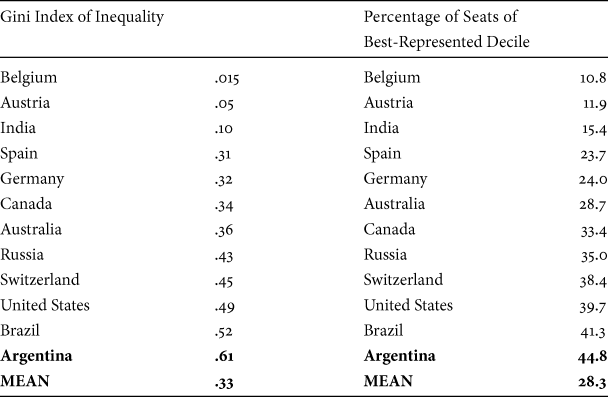
Argentina stands out as one of the federations with the world’s highest level of malapportionment. As shown in Table 1, the Stepan-Swenden federal data bank scores the Argentine Senate with a Gini Index of Inequality of 61 percent, nearly doubling the scores of Germany and Canada and well above decentralized federations such as the United States and Brazil.Footnote 43 With regard to the policy scope of the territorial chamber, Argentine bicameralism is highly symmetrical, furnishing the Senate with authority to approve presidential nominees and advisers, authorize the president to declare an emergency rule in case of foreign military attack, and appoint judges that assess federal expenditures. More crucially from the perspective of this article, all revenue-sharing bills and federal co-responsibility fiscal laws must originate in the Senate. While the lower house normally has greater authority in originating money bills, general tax laws, troop recruitment, and others, revenue-sharing bills (including federal transfers) are controlled by the Senate. Additional senatorial prerogatives can be cited at length, but the encapsu-lation of federal fiscal issues at the upper-chamber level suffice to highlight why this house is the institutional point of reference to uncover the politicization of these issues.
Senate Overrepresentation (Stepan/Swenden Data)

Source: Stepan (2004) and author’s own calculations.
Note: Higher values denote higher malapportionment.
The Argentine legislative system then overrepresents poor and underpopulated territories more than most federal systems. As indicated above, its Senate ranks highest on a scale of territorial overrepresentation among the world’s upper chambers. Concretely, this means that the peripheral, most unpopulated areas, with roughly 30 percent of the national population, have held forty of forty-eight seats in the Senate (83 percent of the total). According to Gibson and Calvo, only one of the nineteen peripheral provinces has more than 10 percent of the population of Buenos Aires. Yet with 40 percent of the population, Buenos Aires province holds 4 percent of the Senate seats.Footnote 44 This overrepresentation also pervades the lower chamber, where proportionality is supposedly substantiated, insofar as the overrepresented regions hold roughly 35 percent of the eligible electoral population but hold 50 percent of the legislative seats. Reynoso compares the ratio between the votes and seats in Buenos Aires and Tierra del Fuego, the most and least populated provinces, respectively. He shows that, while in the 1993 election, in order to obtain a seat, Buenos Aires needed ten times the number of votes needed by Tierra del Fuego, it needed fourteen times more for the 1995 legislative elections.Footnote 45 This amounts to a yawning gap that by far exceeds the original federal normative purpose of compensating peripheral areas due to their demographic vulnerability. The summative effect of overrepresentation in both chambers of Congress accounts for the tilted, nonproportional nature of intergovernmental fiscal relations in Argentina, couched as a case of “reallocative federalism.”Footnote 46
The Argentine Constitution of 1853, which originated in the constituent assemblies of Parana and Santa Fe, established that seats in the low chamber would be allocated proportionally to district population. However, this principle was forsaken when the 1949 Constitutional Reform, under the leadership of Juan Domingo Perón, introduced an amendment whereby a minimum of two congressmen per province would be elected, regardless of their population. This distortion was further increased to a minimum of three congressmen by General Alejandro Lanusse in 1973 and to five congressmen by General Reynaldo Bignone in 1983, before the government was transferred to civilians. Thus, the representation of the traditionally conservative peripheral, that is, hitherto historically overrepresented regions in the lower chamber, was unreasonably boosted. In the case of the military, the rationale is that, by manipulating legislative apportionment to overrepresent districts where the elite is dominant, the military regime secures the political and economic interests of its strategic allies once democratic elections take place. This kind of garrison reapportionment has exacerbated the already documented built-in representational bias in the Argentine Senate. Regarding the apportionment of the Senate, this has changed over time. The Constitution of 1819 assigned one senator per province, while the Constitution of 1853 allocated two. In 1973, it was increased to three senators per province, which has been maintained since then. As can be seen, most of the amendments had only intensified the territorial representational asymmetries in Argentina, affording a sort of historical inevitability of blackmailing poor provinces to gain federal resources and conduct patronage politics without fiscal restraints.
The fiscal correlate of this representational conundrum is the disjuncture between national-level fiscal adjustment reforms and provincial-level overspending, which contributed to Argentina’s 2001 economic crisis, the worst since the Great Depression of the 1930s. This fiscal behavior is also contextually related to a long-standing history of provincial obstruction of economic reform initiatives of the central government.Footnote 47 However, the provinces have varied widely in their willingness to sustain these reforms. Although some quickly cut public-sector employment and overall spending like Mendoza, others, like Rio Negro, have done none of the above, leading to severe fiscal imbalances and extensive indebtedness. It is instructive to point out that while both provinces have relatively similar levels of economic development, the latter is considerably more overrepresented in both legislative chambers. Thus, the kingmaker role played by poor (i.e., transfer-dependent) provinces has induced an overspending bias across jurisdictions as these provinces have tried to overuse the national common source of revenue, since provincial spending is financed from taxes collected by the central government. Concomitantly, most attempts at implementing fiscal responsibility measures have proved to be unsuccessful.
Sabotaging the Fiscal Rescue Plan: Perverse Redistribution as the Achilles Heel of Argentine Federalism
By the end of the 1990s, Argentina was a sort of poster child for “Washington consensus” economists and policymakers. Less than three years later, the country found itself in an unprecedented economic depression that alarmed international lenders as well as pundits concerned with the political impact such a crisis might have on a still-consolidating democracy. Argentina’s economic crisis has then led to the search, typical of such spectacular cases, for the supposed causes of its experience. Among the conclusions that some writers have drawn are that currency boards and fixed exchange rates are very risky and external shocks have precipitated a steady decline in the influx for foreign capital.Footnote 48 The currency-board-like Convertibility Plan that the Argentine government had adopted in 1991 was spectacularly successful in reducing inflation. However, fixing the value of the Argentine peso to the U.S. dollar resulted in an overvaluation of the peso. According to this perspective, this overvaluation made the Convertibility Plan unsustainable, and the inevitable collapse of the plan produced the current crisis. Concomitant to this problem, the East Asian currency crisis of 1997–98 and the Russian currency crisis of August 1998 made investors in developed countries much more cautious about investing in developing countries in general. Brazil, Argentina’s largest trading partner, withstood a currency crisis in 1998 by allowing its currency to float freely, thus making the Argentine peso much less competitive.
The explanations mentioned above are correct in emphasizing the interaction between domestic monetary supply and foreign factors, namely that an overvaluation of the Argentine peso after the devaluation of the Brazilian real in 1998 produced unsustainable trade deficits and led to the crisis. Yet there is a wide consensus from both national and international analysts that the most dramatic deficit, and the one that ultimately made Argentina’s acclaimed economic model unsustainable, is the one brought about by the demand side of the equation, especially that of political origin.Footnote 49 The difficulty of enforcing fiscal discipline transpired as the central parameter, resulting from the inability or unwillingness of controlling deficits and limiting provincial indebtedness. Neither the second Menem administration (1995–99), negatively affected by the rising economic costs of Convertibility Law, nor the subsequent De la Rúa administration were able to enforce fiscal discipline because of their eroding political clout and the concurrent relative strengthening of the provincial governors.Footnote 50
Several factors motivated the lack of political consensus to control the fiscal deficit. First, spending on pensions and salaries of government employees, including superfluous employees, comprises a larger part of the budget than is desirable for a country at Argentina’s level of economic development. More worrisome, most of these jobs are located at the subnational level, whose monitoring becomes more difficult than those present at the central government level.Footnote 51 Second, once the partisan affiliation of governors is added to the representational biases, a truly complex picture emerges. In a previous study, I show that overrepresented provinces ruled by governors who belong to parties different from the one that controls the national executive can bring into play their representational advantages to attract shares of federal transfers beyond social welfare criteria.Footnote 52 Third, the delegation of provincial taxing authority to the federal government and the transfer of expenditure responsibilities to the provinces resulted in significant fiscal imbalances by the end of the 1990s.Footnote 53 Federal revenue sharing weakens the link between the taxes provinces levy and the revenues they spend. The federal government has not been willing to get tough with provinces that are essentially bankrupt. As a result, the provinces face weak financial discipline.
This unruly panorama of fiscal indiscipline was nonetheless addressed by the national government in its quest to meet the agreements with the International Monetary Fund to allow Argentina to receive credit lines in order to weather fiscal emergencies.Footnote 54 In turn, crucial developments occurred between 2000 and 2001. These relate to the plan of the La Rúa finance minister, Jose Luis Machinea, to adopt a battery of hard-line tax measures and the reduction of 1.2 billion pesos in public current spending.Footnote 55 As noted above, the central government negotiated from a weakened position because it could not count on disposable public resources to co-opt the provinces and lure them into accepting a disadvantaged deal. Additionally, most of the provinces were ruled by the opposition Peronist Party. Given these constraints, Machinea offered a lump sum that would be paid in advance to temper the putative effects of the fiscal reform. Nevertheless, the Peronist opposition has played out unevenly; while the larger Peronist-ruled provinces such as Buenos Aires, Santa Fe, and Córdoba cooperated with the government initiative, the smaller and poorer (i.e., overrepresented) Peronist provinces of Formosa, Jujuy, Misiones, and Santiago del Estero rejected the deal, maintaining previous budgetary limits almost intact and shielding themselves from new austerity measures.Footnote 56
To offset the increasing fiscal distress, the provinces reacted by issuing their own quasi-monies to make up for funds they would not be able to receive. While the provinces always issued complementary currency in the form of bonds and drafts to manage shortages of cash, the scale of such borrowing reached unprecedented levels during this period. However, these quasi-currencies were mostly issued by the rich province of Buenos Aires, known as the Patacón, and the national government that circulated the LECOP (Letra de Cancelación de Obligaciones Provinciales, Letter of Cancellation of Provincial Obligations), buttressing the appeal of poorer provinces to obtain federal funding for maintaining previous spending limits. In fact, while fifteen out of twenty-four provinces issued some sort of quasi-currency, the provinces of Buenos Aires and Córdoba released about 80 percent of the total. Likewise, with the exception of Santa Fe, which issued no quasi-money, the other most populated provinces of Mendoza, Tucuman, and Entre Rios ranked next. Thus, five out of twenty-four provinces accounted for nearly 90 percent of the total amount of funny money available in the country.Footnote 57 The underpopulated provinces, lacking such parallel currency in cases such as La Pampa and San Luis, or just counting on a very limited minting like Formosa and La Rioja, kept exerting pressure bilaterally on the federal government to maintain previous levels of public spending, mostly in state-related jobs and pensions, to make up for the scant financing options available to them. This has certainly been the case in San Luis, which additionally negotiated a currency basket separately with the Chilean money-minting authority (Casa de la Moneda) that included the Chilean peso, the Argentine peso, and their own quasi-money. More prosperous overrepresented jurisdictions like oil-rich Santa Cruz resorted to equivalent yet more aggressive steps, as they threatened to cut off the provision of gasoline and natural gas to the rest of the country unless the tax on oil exports was severely reduced. Likewise, anticipating an impending freezing of deposits by the federal government, Santa Cruz deposited the provincial reserves in Luxembourg and rejected pleas from De la Rúa to bring back the money to the country.Footnote 58 Very tellingly, Néstor Kirchner, the then-governor of Santa Cruz, was to become Argentina’s president in 2003, to be succeeded by his wife, Cristina Fernández de Kirchner, in 2007. Put simply, overrepresented provinces resorted to diverse tactics, based on their structural endowments, for prompting the federal government in times of fiscal emergency to pursue their narrow territorial interests.
As a last resort, President Fernando de la Rúa appointed Domingo Cavallo, the architect of the Convertibility Plan during the Menem administration, as economics minister. Cavallo presented a new economic plan in Argentina’s Congress. In March 2001, however, the Congress, through a coalition of the legislators representing overrepresented jurisdictions, refused to allow Cavallo to cut government salary and pension costs, and the government sold debt to cover the deficit. In December 2001, the government defaulted on its debt and in January 2002 abandoned the Convertibility Plan. The distorting nature of Argentine federalism once more prevailed. Federalism and its concomitant institutional protection of the autonomy of subnational units can at times have perverse effects on fiscal performance. Despite federalism’s ostensible “market-preserving” quality, deadlocked and malfunctioning federal institutions can lead to economic catastrophes.
Conclusion
Almost all theoretical and empirical research on the political economy of development starts with the presumption that frequent changes in institutional arrangements are commonplace and that such weakness is the underlying source of state failure and concomitant fiscal catastrophes. This conventional wisdom concedes that stability is the missing link, and that such stability not only epitomizes a mere passage of time, but also, and chiefly, it reflects institutional survival amid changes in power and preference distributions. This approach, without disputing some of its theoretical and empirical merits, juxtaposes institutional continuity and sound policies in an almost teleological fashion, thus assuming that a major problem in much of the developing world is that institutions of all types have consistently failed to take root. This article takes issue with this perspective, casting some doubt on the theoretical validity of extant research on the consequences of institutional weakness. In a nutshell, while frequent changes in political institutions hamper the gradualism and trust-building necessary for economic institutions and economic outcomes, in other instances the structure of the economy shows significant disarray in the face of stable and potentially deadlocked political structures. Thus, enforceable and stable arrangements do not necessarily induce Pareto-optimal outcomes.
In this article, I address this debate in comparative political economy by exploring the trajectory that led Argentina to experience one of the most dramatic fiscal collapses of our era and the decisive effect of legislative malapportionment, which is one of the most stable and resilient institutional characteristics of Argentine federalism. As this analysis suggests, when the sorting out of subnational fiscal relations takes place in malapportioned legislative institutions, it is possible to see a mutually reinforcing relationship between political decentralization and the entrenchment of regional enclaves that can exploit their institutional clout to sabotage intergovernmental coordination in times of fiscal crisis. Amounting to veto players in economic-adjustment policies, regional politicians are institutionally endowed for extracting resources from the center with little concern for the potential impact of their economic decisions on the federation as a whole. When we further add the soft budget constraints that originated in the national government’s bailouts of regional borrowing and debts, the result is a critically weakened center that resorts to federal transfers or fiscal leniency to buy off political support but that is unable to pursue badly needed intergovernmental fiscal reforms.
This conclusion is not without qualification, however, as there might be a wider range of factors affecting the unfolding of fiscal crises in developing countries. In this regard, further research is necessary for conceptualizing the reciprocal and causal complex connections between fiscal crises and intergovernmental politics. The conventional wisdom, which this article endorses, has so far depicted subnational actors as debt-hungry and passive spectators of fiscal policies for which national governments had taken full responsibility. The question arises, then, how crucial provincial finances are in causing the crisis. Considering the federal government’s blunders in economic policy that deepened the contraction of the economy and reduced tax revenues, the subnational blame may well be partially offset. Still, variation in the representational advantages of some provinces mattered because the level of provincial support for the emergency measures to avoid the Great Depression diverged, as shown above. A more detailed inquiry into the political and institutional differences across subnational units may then shed light on diverging trajectories as well as unexpected outcomes. Last but not least, this study seeks to provide a more nuanced perspective on the need to “strengthen” institutions, which has become quintessentially central to the literature on democratic and economic consolidation. In the same vein, “weak” institutional structures may facilitate the fine-tuning and manipulation of fiscal policies, opening opportunities for ideational innovation in times of crisis.
This article looks at the Argentine experience, whose significance is more relevant to countries with some level of institutionalization of intergovernmental politics, especially regarding the representational advantages of poor, peripheral regions and revenue-sharing schemes that induce soft-budget constraints. One avenue for future research would be to consider cases of extreme fiscal crisis where the multilevel institutional dimension may be at play. The current challenge of Greece to overcome the ghost of debt default and exit from the Euro zone is partly related to the accumulative effect of favored allocations of intergovernmental transfers from the European Union related to the representational advantages of this country in the Council of Ministers, which is the cornerstone of the fiscal policy discussions of the bloc.Footnote 59 In closing, although I have not sought to offer policy advice, I draw attention to the “double-edge sword” nature of institutional arrangements and hope that subsequent iterations on the analytical challenges this article poses will enrich the debate on institutional design and fiscal policies in developing countries.