This study examines puberty-related changes in neurobehavioral systems underpinning emotional reactivity and regulation using pupillary and behavioral measures of emotionally salient information processing. Gaining a better understanding of normative changes in emotional information processing across pubertal development may help us to understand a paradox in adolescent health (Dahl, Reference Dahl2004; Steinberg et al., Reference Steinberg, Dahl, Keating, Kupfer, Masten, Pine, Cicchetti and Cohen2006). Although adolescence is one of the healthiest periods of the life span with respect to physical health, overall morbidity and mortality rates increase 200–300% (Ozer, Macdonald, & Irwin, Reference Ozer, Macdonald, Irwin, Mortimer and Larson2002; Resnick et al., Reference Resnick, Bearman, Blum, Bauman, Harris and Jones1997). Accidents, suicide, homicide, depression, anxiety, alcohol and substance use, eating disorders, human immunodeficiency virus, sexually transmitted diseases, and unwanted pregnancies all increase sharply in this developmental period (Ozer et al., Reference Ozer, Macdonald, Irwin, Mortimer and Larson2002; US Preventive Services Task Force, 1996). Furthermore, many of the most costly, chronic, and impairing disorders of adulthood, including mood disorders, anxiety disorders, and drug and alcohol abuse, typically onset during adolescence (Alpert, Maddocks, Rosenbaum, & Fava, Reference Alpert, Maddocks, Rosenbaum and Fava1994; Chung, Martin, & Winters, Reference Chung, Martin, Winters and Galanter2006; Pine, Cohen, Gurley, Brook, & Ma, Reference Pine, Cohen, Gurley, Brook and Ma1998).
Many of these problems and disorders have been linked to the onset of puberty or early pubertal maturation, particularly in females (Angold, Costello, & Worthman, Reference Angold, Costello and Worthman1998; Caspi, Lynam, Moffitt, & Silva, Reference Caspi, Lynam, Moffitt and Silva1993; Ge, Conger, & Elder, Reference Ge, Conger and Elder1996; Graber, Lewinsohn, Seeley, & Brooks-Gunn, Reference Graber, Lewinsohn, Seeley and Brooks-Gunn1997; Orr & Ingersoll, Reference Orr and Ingersoll1995). This puberty-linked increase in adolescent mental and behavioral health problems appears to be related to difficulties with the control of emotions and behavior (Dahl, Reference Dahl2004). In fact, many health problems that increase during this period involve dysregulation of emotion (e.g., bipolar disorder, depression, anxiety disorder) or risk taking and poor decision making in the face of emotional influence (e.g., unsafe sex, peer pressure to engage in substance abuse or drunk driving). Consistent with this model, there is initial evidence that problems in emotion regulation during adolescence are linked to the development of depressive symptoms and problem behaviors (Silk, Steinberg, & Morris, Reference Silk, Steinberg and Morris2003), although the role of puberty in this relationship is not well understood. Thus, gaining a better understanding of normative puberty-specific changes in systems involved in emotional reactivity and regulation is critical to elucidating the nature of adolescent health problems and refining prevention and intervention approaches.
Development of Neurobehavioral Systems Subserving Emotional Information Processing During Adolescence
Recent research in developmental neuroscience suggests that problems in emotion regulation during adolescence may result from dyssynchronous development in neurobehavioral systems involved in both emotional reactivity and regulation (Dahl, Reference Dahl2004; Ernst, Pine, & Hardin, Reference Ernst, Pine and Hardin2005; Steinberg, Reference Steinberg2005; Steinberg et al., Reference Steinberg, Dahl, Keating, Kupfer, Masten, Pine, Cicchetti and Cohen2006). There is some evidence that change in regions of the brain that subserve primarily socioemotional functions, such as responding to social stimuli, and the perception and evaluation of risk and reward, may be directly linked to pubertal maturation (Nelson, Leibenluft, McClure, & Pine, Reference Nelson, Leibenluft, McClure and Pine2005; Steinberg, Reference Steinberg2007; Steinberg et al., Reference Steinberg, Dahl, Keating, Kupfer, Masten, Pine, Cicchetti and Cohen2006). These areas undergo significant reorganization in early adolescence that appears to be triggered, at least in part, by the hormonal changes of puberty (see Nelson et al., Reference Nelson, Leibenluft, McClure and Pine2005; Patton & Viner, Reference Patton and Viner2007). Emerging evidence from animal and human studies suggests that, presumably as a result of this reorganization, the brain systems that regulate rewards, social information, and emotions become more sensitive and/or active during puberty (Chambers, Taylor, & Potenza, Reference Chambers, Taylor and Potenza2003; Dahl, Reference Dahl2001; Nelson et al., Reference Nelson, Leibenluft, McClure and Pine2005; Spear, Reference Spear2000; Steinberg, Reference Steinberg2005, Reference Steinberg2007). Consequently, pubertal adolescents seem to seek experiences that create high-intensity feelings. For example, one study found that among adolescents of a similar age, those who were more advanced in puberty were more likely to seek exciting experiences and show risk-taking behavior (Martin et al., Reference Martin, Kelly, Rayens, Brogli, Brenzel and Smith2002). In addition, Quevedo, Benning, Gunnar, and Dahl (see this issue, 2009) found that pubertal adolescents showed appetitive potentiation of the postauricular reflex, a marker of appetitive motivation, whereas their same-age prepubertal peers showed no modulation of this reflex. Quevedo et al. also found that puberty was associated with an increase in the magnitude of the eye-blink startle response during an affective picture viewing paradigm regardless of the valence of the picture, suggesting that puberty may be associated with a general increase in the reactivity of neural systems underlying the startle response, possibly including the amygdala and fear-related circuitry.
Increased sensation seeking and/or affective intensity could interact with the social–contextual changes that accompany puberty to lead to a spiraling of both positive and negative emotions. The transition through adolescence involves a period of flux and renegotiation (Cicchetti & Rogosch, Reference Cicchetti and Rogosch2002), including dramatic changes in the social environment, such as the increasing importance of peer and romantic relationships, changing family relationships, and entry into quasiadult roles such as working and driving (Steinberg & Morris, Reference Steinberg and Morris2000; Steinberg & Silk, Reference Steinberg, Silk and Bornstein2002). Evidence suggests that changes in the parent–child relationship, including increased frequency and intensity of parent–adolescent conflict, may actually be directly linked to pubertal maturation (Steinberg, Reference Steinberg1987). Other changes are indirectly triggered by puberty because changes in physical appearance lead to changes in the way children and adolescents are treated by parents, other adults, and peers, especially those of the opposite gender. A wide array of affective challenges accompany these new experiences, including increased self-consciousness, social anxieties, igniting romantic interests, academic pressures, and attempts to balance a desire for immediate gratification with an understanding of the importance of long-term goals and consequences. These changes can be both exhilarating and overwhelming, creating new challenges in the integration of cognitive and emotional processes in ways that require skills in emotion regulation.
Some evidence suggests that the adolescent brain may not be fully prepared to handle these challenges. Brain regions that subserve cognitive control functions mature more gradually over the course of adolescence and young adulthood, and are believed to be largely independent of pubertal timing (Steinberg et al., Reference Steinberg, Dahl, Keating, Kupfer, Masten, Pine, Cicchetti and Cohen2006). For example, regions of the prefrontal cortex that underpin higher cognitive–executive functions show functional changes that continue well into late adolescence and even early adulthood (Jernigan & Sowell, Reference Jernigan, Sowell, Keshvan and Murray1997; Lewis, Reference Lewis1997; Sowell & Jernigan, Reference Sowell and Jernigan1998). Perhaps as a result of this continued maturation, adolescents appear to perform cognitive tasks less efficiently than adults (Luna et al., Reference Luna, Thulborn, Munoz, Merriam, Garver and Minshew2001) and utilize a different set of brain structures than adults to accomplish certain attentional tasks in the context of emotion (Monk et al., Reference Monk, McClure, Nelson, Zarahn, Bilder and Leibenluft2003).
Thus, it is believed that puberty directly affects neural systems involved in social and emotional responsivity, whereas development of systems mediating higher cognitive functions occurs slowly, continues well beyond pubertal maturation, and is relatively independent of pubertal timing (Dahl, Reference Dahl2004; Nelson et al., Reference Nelson, Bloom, Cameron, Amaral, Dahl and Pine2002). With pubertal onset occurring at earlier ages (Herman-Giddens, Reference Herman-Giddens2006; Worthman, Reference Worthman, Panter-Brick and Worthman1999), adolescents may now find themselves in emotionally challenging situations as much as a decade before having developed the full capacity to regulate the associated emotion. This has led to a metaphor for the historical advancement of puberty as “starting the engines with an unskilled driver” (Dahl, Reference Dahl2004). This dilemma may explain, in part, the fact that adolescents often make poor decisions (e.g., high rates of participation in dangerous activities such as automobile accidents, drug use, and unprotected sex) despite understanding cognitively the risks involved (Cauffman & Steinberg, Reference Cauffman and Steinberg1995; Reyna & Farley, Reference Reyna and Farley2006; Slovic, Reference Slovic1987, Reference Slovic2000). These decisions may reflect an imbalance in cognitive and emotional influences on decision making and behavior during adolescence, with the scale temporarily tipped toward emotional influences until skills in cognitive control gradually “catch-up” (Ernst et al., Reference Ernst, Pine and Hardin2005).
Despite this compelling model, few empirical studies have examined puberty-specific changes in affective systems in human populations. There is a need to better understand normative changes in emotional information processing across pubertal development (Steinberg et al., Reference Steinberg, Dahl, Keating, Kupfer, Masten, Pine, Cicchetti and Cohen2006). In the current study, we address this question by examining whether pubertal differences exist in pupillary reactivity to emotional stimuli among a sample of typically developing children and adolescents.
The Pupillometric Approach to Studying Emotional Information Processing
Pupillometry is a novel approach to studying emotional information processing that holds promise for understanding puberty-specific changes in affective systems. An ancient proverb holds that the eye is “the window to the soul.” In fact, research suggests that the pupil does provide a window into the activity of the mind. Pupil dilation provides a peripheral index of brain activation in response to a specific stimulus. The pupil becomes more dilated in response to stimuli that require greater cognitive load or that have greater emotional intensity (Beatty, Reference Beatty1982; Beatty & Lucero Wagoner, Reference Beatty, Lucero Wagoner and Cacioppo2000; Siegle, Steinhauer, Carter, Ramel, & Thase, Reference Siegle, Steinhauer, Carter, Ramel and Thase2003; Siegle, Steinhauer, & Thase, Reference Siegle, Steinhauer and Thase2004). For example, research has carefully demonstrated incremental increases in pupil dilation with conditions requiring greater memory or cognitive effort, such as remembering more digits, up until a person reaches the limits of his or her mental capacity (Granholm, Asarnow, Sarkin, & Dykes, Reference Granholm, Asarnow, Sarkin and Dykes1996; Kahneman & Beatty, Reference Kahneman and Beatty1966).
This response occurs because the pupil is innervated by brain structures involved in both cognitive and emotional processing. Inhibition of the constrictor muscle occurs through parasympathetic innervation of the Edinger Whestphal nucleus, which receives extensive inputs from cortical and limbic regions. Stimulation of the dilator muscle occurs through a hypothalamic pathway, which also receives corticolimbic inputs. Thus, stimulation of limbic regions such as the amygdala increases pupil dilation (Koikegami & Yoshida, Reference Koikegami and Yoshida1953), as does stimulation of the midbrain reticular formation (Beatty, Reference Beatty and Coles1986). The midbrain reticular formation receives afferent projections from the frontal cortex, particularly, structures such as the anterior cingulate cortex, which are implicated in emotion regulation (Szabadi & Bradshaw, Reference Szabadi and Bradshaw1996), and sends efferent projections to the ocular motor nuclei. Concurrent pupillary/functional magnetic resonance (fMRI) studies suggest that pupil dilation provides a summative index of task-related cognitive/affective brain activity (Siegle, Steinhauer, Stenger, Konecky, & Carter, Reference Siegle, Steinhauer, Stenger, Konecky and Carter2003). Pupil dilation also provides information about the time course of brain activation in response to a stimulus. The pupil remains dilated as long as the processing demand persists and, because pupil dilation can be sampled every 16 ms, provides a dynamic measure of changes in cognitive/affective load following exposure to the stimulus.
Pupillometry has long been used in cognitive science to understand cognitive processes (see Beatty & Lucero Wagoner, Reference Beatty, Lucero Wagoner and Cacioppo2000). The role of the pupil in emotional processing has also been recognized for a long time (Janisse, Reference Janisse1973), although remarkably little research has been conducted in this area. Early studies of the pupillary response to emotion refuted the original theory put forward by Hess (Reference Hess1965) that the pupil dilates in response to attractive stimuli and constricts in response to aversive stimuli, instead demonstrating that the pupil dilates to both positive and negative emotional stimuli (Janisse & Peavler, Reference Janisse and Peavler1974; Stelmack & Mandelzys, Reference Stelmack and Mandelzys1975). Emotion researchers have recently shown renewed interest in utilizing the pupillometric approach in emotional information processing paradigms. For example, Partala and Surakka (Reference Partala and Surakka2003) found that the pupils of normal adults dilated more to positive and negative sounds than to neutral sounds. In a study using an emotion regulation paradigm, Urry et al. (Reference Urry, van Reekum, Johnstone, Kalin, Thurow and Schaefer2006) recently demonstrated that when participants are asked to intentionally regulate their affect, initial and sustained pupil dilation is increased.
Siegle and colleagues (Siegle, Granholm, Ingram, & Matt, Reference Siegle, Granholm, Ingram and Matt2001; Siegle, Steinhauer, Carter, et al., 2003) have shown that patterns of pupil dilation to emotional stimuli are altered in depressed adults relative to normal controls. For example, depressed adults show increased and sustained pupil dilation on a task requiring identification of the valence of emotional words for up to 30 s after their responses compared to normal controls. This finding has been replicated in both medicated and unmedicated adults with major depressive disorder (MDD), and has been shown to be specific to emotional rather than purely cognitive information processing (Siegle et al., Reference Siegle, Granholm, Ingram and Matt2001, Reference Siegle, Steinhauer and Thase2004, Reference Siegle, Steinhauer, Carter and Thase2008). It is correlated with self-reported rumination, and thus appears to reflect sustained elaboration on emotional information (Siegle, Steinhauer, Carter, et al., 2003).
Although researchers have used pupil dilation as an index of cognitive processing in children and adolescents (Gardner, Philp, & Radacy, Reference Gardner, Philp and Radacy1978; Juris & Velden, Reference Juris and Velden1977), we are only aware of one study that has used pupillometry to examine emotional information processing in children and adolescents. Silk et al. (Reference Silk, Dahl, Ryan, Forbes, Axelson and Birmaher2007) examined depressed and typically developing children's pupil dilation to emotional words on a valence identification task similar to the task completed by depressed adults in Siegle et al.'s (2001; Siegle, Steinhauer, Carter, et al., 2003) studies. We found that depressed children and adolescents exhibited a diminished late pupil dilation response to negative emotional words relative to controls that was related to greater depressive severity. We also found that children with lower levels of late pupil dilation to negative words in the laboratory reported experiencing higher levels of negative emotion, lower positive emotion, and a lower ratio of positive to negative emotion in their everyday lives using ecological momentary assessment, suggesting that the finding related to problems in emotion regulation in depressed youth. These findings were unique to sustained processing. Overall, the Silk et al. (Reference Silk, Dahl, Ryan, Forbes, Axelson and Birmaher2007) findings suggested that depressed children might be avoiding negative emotional information, blunting their emotional response, or engaging in less regulation in response to negative emotional information. It is important that this pattern differed from Siegle et al.'s (2001; Siegle, Steinhauer, Carter, et al., 2003) findings for depressed adults, which showed increased pupil dilation to negative words in depressed subjects relative to controls. This discrepancy highlighted the need for normative data on the developmental trajectory of pupillary reactivity to emotional information, which the present study was designed, in part, to address.
The Current Study
This study investigates pupil dilation to emotional stimuli among a new sample of pre-/early and mid-/late pubertal typically developing children and adolescents in the seconds following presentation of emotional words. We examined initial pupillary reactivity to emotional words as well as sustained pupil dilation after the word was no longer on-screen. Because of theorized increases in sensitivity to affective stimuli, we hypothesized that mid-/late pubertal children would show greater initial pupillary reactivity to emotional words than pre-/early pubertal children. We also conducted exploratory analyses to examine whether sustained processing of emotional words differed across pubertal development. Finally, we hypothesized that mid-/late pubertal children would have a slower reaction time to label the emotional words than pre-/early pubertal children because of emotional interference effects, and would rate themselves as more emotional during the laboratory visit.
Method
Participants
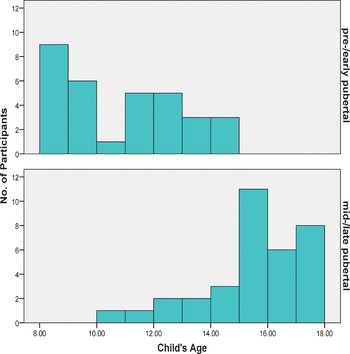
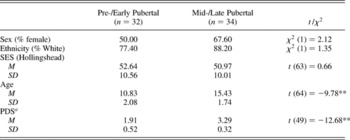
Participants were 66 typically developing children and adolescents. Participants (39 females) ranged in age from 8.1 to 17.9 years (M = 13.2, SD = 3.0). Thirty-four participants were in the mid-/late pubertal group (ages = 10.96–17.91, M = 15.43, SD = 1.74), and 32 were in the pre-/early pubertal group (ages = 8.06–14.75, M = 10.83, SD = 2.08). Figure 1 displays the distribution of age as a function of pubertal status group and additional demographic characteristics are presented in Table 1. Exclusion criteria for the study included: (a) symptoms suggestive of an Axis I psychiatric disorder based on the Child Symptom Inventory—4 (CSI-4; Gadow & Sprafkin, Reference Gadow and Sprafkin1998b) or the Adolescent Symptom Inventory—4 (ASI-4; Gadow & Sprafkin, 1998a), (b) the existence of a major systemic medical illness, (c) a history of serious head injury, or (d) having eye problems or difficulties in vision not corrected by the use of glasses or contact lenses.
The distribution of participants' age as a function of the pubertal status group. [A color version of this figure can be viewed online at journals.cambridge.org/dpp]

Demographic characteristics of participants

Note: SES, socioeconomic status; PDS, Pubertal Development Scale (Peterson et al., 1988).
aSee the revised PDS scoring criteria in the Method Section.
**p < .01.
Procedure
The university's institutional review board approved the study. All participants were recruited from community advertisements and normal control samples in existing research projects. To participate in the study, children and their parents were required to sign assents and informed consents, respectively. Because this study focused on a normative sample of children, participants' psychiatric symptomatology was assessed using a questionnaire that screens for Diagnostic and Statistical Manual of Mental Disorders—Fourth Edition (DSM-IV; American Psychiatric Association, 1994) Axis I disorders, the CSI-4 or the ASI-4 (Gadow & Sprafkin, Reference Gadow and Sprafkin1998a, Reference Gadow and Sprafkin1998b), with the parent or guardian serving as the informant. Participants completed an initial phone screen and one 2-hr laboratory visit at the Child and Adolescent Neurobehavioral Laboratory, during which event-related potential and pupil dilation assessments were completed using methods described previously (Ladouceur et al., Reference Ladouceur, Dahl, Williamson, Birmaher, Ryan and Casey2005; Siegle, Steinhauer, Carter, et al., 2003; Silk et al., Reference Silk, Dahl, Ryan, Forbes, Axelson and Birmaher2007).
Self-report measures
Current affect
The Positive and Negative Affect Schedule for Children (PANAS-C; Laurent et al., Reference Laurent, Catanzaro, Joiner, Rudolph, Potter and Lambert1999) was used as a child-report measure of current feelings of positive and negative affect at the beginning of the testing session. Thirty emotions were rated on a 5-point scale, with positive emotions summed to form a Positive Affect Scale and negative emotions summed to form a Negative Affect Scale. The PANAS-C possesses high internal consistency and good convergent and divergent validity (Laurent et al., Reference Laurent, Catanzaro, Joiner, Rudolph, Potter and Lambert1999).
Demographic information
A sociodemographic questionnaire was used to obtain sociodemographic information from parent and child. This questionnaire included information regarding basic sociodemographic information such as age, gender, family history of affective disorders, and socioeconomic status (Hollingshead, Reference Hollingshead1975).
Psychiatric symptomatology
To screen for Axis I psychiatric disorders in this normative sample of children, parents completed a paper and pencil psychiatric screening inventory about child symptomatology. Parents of children 12 years of age and older completed the ASI-4 (Gadow & Sprafkin, Reference Gadow and Sprafkin1998a) and parents of children less than 12 completed the CSI-4 (Gadow & Sprafkin, Reference Gadow and Sprafkin1998b). The ASI-4 and CSI-4 both inquire about child behavior over 17 categories related to DSM-IV (American Psychiatric Association, 1994) diagnostic categories. The ASI-4 and CSI-4 demonstrate convergent and discriminant validity with corresponding scales of the Child Behavior Checklist (Achenbach, Reference Achenbach1991) and with clinician diagnoses (Gadow & Sprafkin, Reference Gadow and Sprafkin1998a, Reference Gadow and Sprafkin1998b). The CSI-4 has also been shown to correlate with DSM-IV diagnoses (Gadow, Devincent, Pomeroy, & Azizian, Reference Gadow, Devincent, Pomeroy and Azizian2005).
Pubertal development
Pubertal status was measured using the Pubertal Development Scale (PDS; Petersen, Crockett, Richards, & Boxer, Reference Petersen, Crockett, Richards and Boxer1988), a self-report measure of pubertal status completed by each child that has been shown to have good psychometric properties (Petersen et al., Reference Petersen, Crockett, Richards and Boxer1988). To score the PDS, we only included questions that indexed the three main developmental axes of puberty: growth (item 1), adrenal (items 2 and 3), and gonadal (items 4 and 5, males only; item 6, females only; see Dorn, Dahl, Woodward, & Biro, Reference Dorn, Dahl, Woodward and Biro2006). The questions that met these criteria required participants to rate puberty-related physiological changes. The excluded questions asked for subjective measurements of height, weight, and pubertal completion as well as the assessment of pubertal development in relation to peers. A composite measure was created on a 4-point scale with a median score of 2.8. A median split was used to place participants into pre-/early and mid-/late pubertal groups. These decisions were based on earlier studies in our laboratory that included Tanner staging by physical exam and hormonal measures of puberty in conjunction with the PDS. The PDS has been shown to correlate with Tanner stages on physical exam (Brooks Gunn, Warren, Rosso, & Gargiulo, Reference Brooks-Gunn, Warren, Rosso and Gargiulo1987). Recently, Shirtcliff, Heiligenstein, Hoornstra, Squires, and Pollack (2007) found that the PDS was correlated with Tanner stages based on physical exam and was also a good predictor of basal hormones responsible for advancing pubertal development.
Pupil dilation assessment
The pupil dilation testing occurred in a moderately lit room in which the experimenter was present. Stimuli were displayed in dark gray on a light gray computer screen. Participants sat approximately 122 cm from the bottom of the stimulus. Stimuli were lowercase letters approximately 1 cm high, subtending a 45° visual angle. Reaction times were recorded using a game pad capable of reading reaction times with millisecond resolution. The game pad was modified to have only three working buttons, arranged in a triangle, so that respondents' fingers were nearly equidistant from each possible response. To account for differential response latencies to different buttons, the mapping of game pad buttons to responses was counterbalanced across participants.
Pupil dilation was recorded using methods previously described and tested (Siegle et al., Reference Siegle, Granholm, Ingram and Matt2001; Siegle, Steinhauer, Carter, et al., 2003). In brief, data were collected using a table-mounted RK-726 eyetracker. The eyetracker consisted of a video camera and infrared light source that were pointed at a participant's eye and a device that tracked the location and size of the pupil using these tools. Pupil size was recorded at 60 Hz (every 16 ms) and passed digitally from the eyetracker to a computer that stored the acquired data along with signals marking the beginning of trials, the end of fixation, stimulus onset time, and reaction time. The resolution for a typical participant was better than 0.05-mm pupil diameter.
Word valence identification (VID) task and word recall
Pupil dilation was collected while participants completed a word VID. Participants were instructed to identify the emotional valence of 66 words by pressing a corresponding button as quickly and accurately as possible. Using the three-button game pad described above, participants pressed the button that corresponded with their rating of the word as positive, negative, or neutral. The positive (i.e., birthday), negative (i.e., divorce), and neutral (i.e., lamp) words used in the word VID task were chosen from a corpus of emotional words normed for use with children and adolescents (Neshat-Doost, Moradi, Taghavi, Yule, & Dalgleish, Reference Neshat-Doost, Moradi, Taghavi, Yule and Dalgleish1999). Twenty-two words from each valence category were selected and balanced for word length and frequency. Each trial included a 1-s fixation mask (a row of Xs that they were instructed to look at), the presentation of the word for 5 s, and a mask (another row of Xs) for the 6-s intertrial interval. A word recall assessment was administered following the word VID task. Children were given 1 min and 30 s to recall as many of the words from the task as possible. For the purposes of this analysis, we calculated indices of number of emotional (positive or negative) and neutral words recalled.
Data selection, cleaning, and reduction
Trials with reaction times below 100 ms and above 4.9 s were discarded as outliers (Matthews & Southall, Reference Matthews and Southall1991). Data were cleaned using our laboratory's standard procedures (derived from Granholm et al., Reference Granholm, Asarnow, Sarkin and Dykes1996). Blinks were identified as large changes in pupil dilation occurring too rapidly to signify actual dilation or contraction. Trials comprised of over 50% blinks were removed from consideration. These procedures resulted in the elimination of M = 16 trials per subject. Linear interpolations replaced blinks throughout the data set. Data were smoothed using a 10-point weighted average filter. Then, linear trends in pupil dilation calculated over blocks of trials were removed from pupil dilation data to eliminate effects of slow drift in pupil diameter not related to trial characteristics. The final pupil dilation variable used in analyses was a measure of change in pupil diameter from baseline calculated for each sample (every 16 ms) and then averaged across samples for each second in a trial. Baseline pupil diameter was calculated separately for each trial based on the average dilation over the 167 ms (10 samples) preceding the onset of the stimulus. Baseline pupil diameter was subtracted from pupil diameter after stimulus onset to produce the final pupil dilation index. This index therefore represents a change in millimeters from baseline. Pupil dilation was then averaged across seconds in a trial to create pupil dilation waveforms depicting the average time course of pupil dilation across a 12-s trial by word valence (positive, negative, or neutral) or puberty group.
Plan of analyses
Pupil dilation analyses were conducted using mixed effects models with an autoregressive (AR1) covariance structure, using pupil dilation as the dependent variable. Models included pupil dilation at each second for each valence per subject, with subject treated as a random effect and time and valence as repeated measures. Fixed effects included pubertal group, valence, waveform segment, and all interactions. Based on previous studies (e.g. Siegle, Steinhuer, Carter, et al., 2003; Silk et al., Reference Silk, Dahl, Ryan, Forbes, Axelson and Birmaher2007), we focused on two specific regions of interest in the pupil dilation waveform: (a) a “peak” segment defined as the period 2–4 s following word presentation, and (b) a “late” segment defined as the latter 3 s of the period during which the word was off-screen (9–12 s). The peak segment represents initial reactivity and the late segment represents sustained processing. Because the pupil continues to grow throughout childhood and adolescence, peaking somewhere between the ages of 6 and 20 (Boev et al., Reference Boev, Fountas, Karampelas, Boev, Machinis and Feltes2005; Kohnen, Zubcov, & Kohnen, Reference Kohnen, Zubcov and Kohnen2004; MacLachlan & Howland, Reference MacLachlan and Howland2002), baseline pupil size could introduce a confound, as having a larger pupil would allow for a greater range of reactivity. For this reason, we also included a covariate for baseline pupil diameter to account for potential differences in pupillary reactivity based on differences in pupillary size across pubertal development.
To follow up significant effects from the mixed models, group and valence contrasts on pupil dilation were examined at each sample along pupil dilation waveforms. Guthrie and Buchwald's (Reference Guthrie and Buchwald1991) contiguity threshold technique was used to control type I error across these tests. This technique defines the size of a temporal window over which a series of contiguous point-by-point tests could be considered significant, controlling error across all tests at p < .05. Autocorrelation is accounted for via Monte Carlo simulations of the maximum length of adjacent significant tests present in less than 5% of simulated data with a similar autocorrelation structure to acquired empirical data. Using this technique, regions of the waveforms were considered significantly different when over 0.78 s of consecutive tests were statistically significant at p < .1 in the peak (2–4 s) region and when over 0.95 s of consecutive tests were statistically significant at p < .1 in the late (9–12 s) region.
Results
Table 1 shows demographic characteristics of the sample. As shown in Table 1, there were no gender, race, or socioeconomic status differences between the pre-/early and mid-/late pubertal groups.
PANAS-C ratings and reaction times
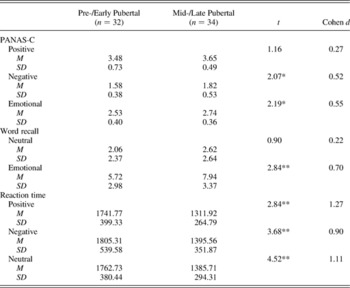
Table 2 presents comparison of puberty groups on behavioral and subjective measures. We first examined whether puberty groups differed on self-reported emotionality in the lab. We found that mid-/late pubertal children rated their current negative affect on the PANAS-C higher (M = 1.82, SD = 0.53) than pre-/early pubertal children (M = 1.58, SD = 0.38). There were no significant differences in ratings of positive affect on the PANAS-C, although mid-/late pubertal children were higher (M = 2.74, SD = 0.36) than pre-/early pubertal children (M = 2.53, SD = 0.40) on a global measure of emotionality that included the average of all positive and negative items on the PANAS-C.
Pubertal differences in behavioral and subjective measures of emotional processing
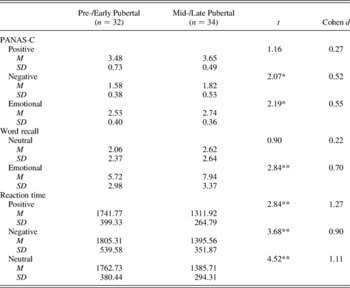
Note: PANAS-C, Positive and Negative Affect Schedule for Children (Laurent et al., Reference Laurent, Catanzaro, Joiner, Rudolph, Potter and Lambert1999).
*p < .05. **p < .01.
Next, we examined participants' harmonic mean reaction times (time taken to classify words) on the valence identification task to test whether puberty groups differed in overall reaction time or reaction time to words of a specific valence. A repeated-measures analysis of variance (ANOVA) indicated that there were no differences in reaction times by word valence and no Pubertal Group × Valence interactions, but mid-/late pubertal children responded more quickly to all words (M = 1,364.40, SD = 274.65) than pre-/early pubertal children (M = 1,769.94, SD = 400.20).
Pupil dilation
We examined pupil dilation waveforms to test for group differences in pupil dilation during the word VID task. Mixed effects analyses indicated a main effect on pupil dilation for word valence, F (2, 877) = 3.44, p < .05, and a main effect for waveform segment, F (1, 489) = 59.50, p < .001, that was qualified by a Group × Segment interaction, F (1, 489) = 4.64, p < .05. The Group × Valence × Segment interaction did not reach statistical significance, F (1, 922) = 2.15, p = .12. There was no effect of baseline pupil diameter on pupil dilation during the task, F (1, 394) = 0.03, p = .86.
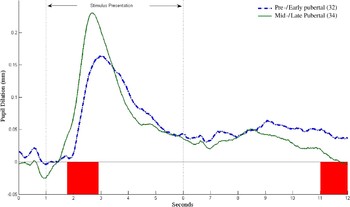
Pairwise comparisons of estimated marginal means for the valence effect revealed that pupil dilation across the waveform was greater to neutral words (M = 0.07 mm) than to positive words (M = 0.05 mm); however, this difference was not significant using Guthrie and Buchwald's (1991) contiguity threshold criterion. To follow up the Group × Segment interaction, group contrasts on pupil dilation were examined at each point along pupil dilation waveforms within the peak and late regions. Results of these analyses, shown in Figure 2, indicate that pubertal groups differed in their peak pupil dilation, with mid-/late pubertal children showing greater peak pupil dilation than pre-/early pubertal children, regardless of word valence: 1.78 to 2.93 s: t (64) = 2.40, p < .05, d = .59. Pubertal groups also differed in late pupil dilation, with mid-/late pubertal children showing decreased late pupil dilation compared to pre-/early pubertal children in the final second of the task: 11.03 to 12.00 s: t (64) = −2.05, p < .05, d = −.50.
Pubertal group differences in pupil dilation to all words. Shaded regions are statistically significant at p < .05. [A color version of this figure can be viewed online at journals.cambridge.org/dpp]

We also conducted exploratory analyses to examine specificity of these findings to pubertal status. Because age is measured more precisely than puberty, it will typically wash out the effects of puberty when it is included in the same model; thus, this is a conservative analysis. However, the high number of degrees of freedom provided by measuring pupil dilation repeatedly over time (one measurement per second for 12 measurements per participant per condition), and the analysis of this data in a mixed effects model accounting for temporal autocorrelation among measurements, yielded sufficient degrees of freedom to conduct exploratory analyses including both age and puberty. To do so, we recomputed the mixed effects model described above controlling for participant's age. The Pubertal Group × Segment interaction remained significant controlling for age, F (1, 489) = 4.75, p < .05. Because there was a significant main effect for age, F (1, 397) = 9.24, p < .01, we recomputed the mixed effects model using participants' age rather than pubertal status. This model included a random effect for subject, repeated effects for time and valence, and fixed effects for age, valence, waveform segment, and all interactions, as well as a covariate for baseline pupil diameter. The effect for valence remained significant, F (2, 877) = 4.73, p < .01; however, the Age × Segment interaction was not significant, F (1, 489) = 2.74, p = .10. Furthermore, there were not significant correlations between peak pupil dilation and age (r = .18, p = .15) or between late pupil dilation and age (r = .02, p = .88), suggesting that the pupil dilation findings were not driven by age.
Word recall
To examine whether word recall on the free recall test immediately following the word VID task was associated with pubertal status, we conducted a multinomial logistic regression to predict puberty group membership from recall of emotional and neutral words. Number of emotional words recalled emerged as a predictor of pubertal status (B = −.26, p < .01), but not number of neutral words recalled (B = −.15, p = .18). Follow-up t tests indicated that mid-/late pubertal children remembered more emotional words (M = 7.94, SD = 3.37) than pre-/early pubertal children (M = 5.72, SD = 2.98; t = 2.84, p < .01). There were no differences in the number of neutral words recalled by mid-/late pubertal children (M = 2.62, SD = 2.64) and pre-/early pubertal children (M = 2.06, SD = 2.37; t = .90, p = .37).
Relations among pupil dilation and word recall, PANAS-C ratings, and reaction time
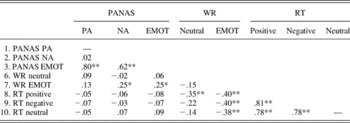
We examined relations between behavioral and subjective measures using bivariate correlations. Table 3 shows intercorrelations among PANAS-C ratings, reaction times, and participants' word recall. These correlations reveal that current positive affect ratings on the PANAS-C were not related to other indices of emotional information processing, but ratings of current negative affect and overall emotionality on the PANAS-C were associated with remembering more emotional words on the free recall task. In addition, there were inverse relationships between emotional words and reaction time on all conditions of the task, with children who responded faster remembering more emotional words. Relationships between reaction time and memory for neutral words were less strong, with significant associations between memory for neutral words and reaction times to positive words but not to negative or neutral words. Together, the findings suggest that youth higher in emotionality had faster reaction times on the word VID task as well as biased memory for emotional words.
Intercorrelations between behavioral and subjective measures of emotional processing

Note: PANAS, Positive and Negative Affect Schedule for Children (Laurent et al., Reference Laurent, Catanzaro, Joiner, Rudolph, Potter and Lambert1999); PA, positive affect; NA, negative affect; EMOT, emotional; WR, word recall; RT, reaction time.
*p < .05. **p < .01.
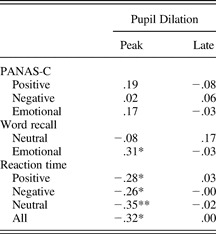
We also conducted exploratory analyses examining how the initial pupillary response was related to behavioral and subjective measures of emotionality. As we needed a single peak value for use in correlations, we extracted each participant's average peak pupil dilation. This was computed by calculating the highest pupil dilation value within the 2- to 4-s window for each trial and averaging this peak value across trials. As puberty groups did not differ in pupil dilation by word valence, peak pupil dilation was collapsed across word valence categories. Table 4 summarizes the correlations between peak pupil dilation and the behavioral and subjective measures. First, as shown in Table 4, there were no relationships between peak pupil dilation and current PANAS-C ratings.
Bivariate correlations between initial peak and late pupil dilation and behavioral and subjective measures
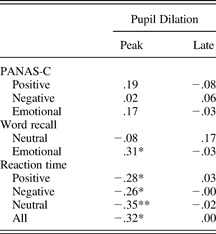
Note: PANAS-C, Positive and Negative Affect Schedule for Children (Laurent et al., Reference Laurent, Catanzaro, Joiner, Rudolph, Potter and Lambert1999); Peak, maximum dilation from 2 to 4 s; Late, average dilation from 9 to 12 s.
*p < .05.
Second, we examined whether peak pupil dilation was associated with word recall and reaction time. We conducted a repeated-measures regression in which word recall was a repeated measure and peak pupil dilation was a continuous explanatory variable. There was a significant peak Pupil Dilation × Valence interaction for recall for emotional versus neutral words, F (1, 64) = 5.14, p < .05. To interpret this effect, we examined correlations between pupil dilation and word recall separately for emotional and neutral words. As shown in Table 4, overall peak pupil dilation was associated with greater recall of emotional words (r = .31, p < .05), but was not associated with recall of neutral words (r = −.08, ns).
Third, we conducted a repeated-measures regression in which reaction time was a repeated measure and peak pupil dilation was a continuous explanatory variable. There was a significant main effect for peak pupil dilation that was not moderated by valence, F (1, 64) = 7.05, p < .01. As shown in Table 4, greater initial peak pupil dilation was associated with faster reaction times on the emotional word VID task regardless of word valence (r allvalences = −.32, p < .05).
We also examined whether late (9–12 s) pupil dilation to all words was associated with behavioral or subjective ratings of emotional information processing. As shown in Table 4, late pupil dilation was not correlated with subjective ratings of emotionality in the lab. Repeated-measures regressions indicated that late pupil dilation was not associated with word recall or reaction time, either alone or in interaction with word valence.
Discussion
In this study, we found evidence that cognitive and affective processes involved in classifying the emotionality of words appear to undergo alterations during pubertal maturation. These cognitive–affective changes were apparent in measures of psychophysiology, memory bias, and subjective ratings of emotion among children in the mid or late stages of puberty compared to children and adolescents who were prepubertal or in the beginning stages of puberty. First, mid-/late pubertal children and adolescents showed greater peak pupillary reactivity to words during an emotional word identification paradigm than pre-/early pubertal children and adolescents. This peak pupil dilation was associated with greater memory for emotional but not neutral words on an unexpected free recall task, suggesting that it may be linked to emotionally relevant processing. This finding was replicated controlling for participants' age, and was not found using age rather than puberty as a predictor, suggesting that the effect is puberty specific. Second, mid-/late pubertal children and adolescents showed a bias toward remembering more emotional words than pre-/early pubertal children on an unexpected free recall task following the emotional word identification paradigm. Third, we also found that mid-/late pubertal children rated themselves as higher in emotionality, especially negative affect, during their laboratory visit than pre-/early pubertal children.
These results are generally consistent with models suggesting that puberty is associated with greater reactivity of neurobehavioral systems involved in emotional information processing (Dahl, Reference Dahl2001; Nelson et al., Reference Nelson, Leibenluft, McClure and Pine2005; Spear, Reference Spear2000; Steinberg, Reference Steinberg2005; Steinberg et al., Reference Steinberg, Dahl, Keating, Kupfer, Masten, Pine, Cicchetti and Cohen2006). However, we did not find that the increased initial pupillary response on the emotional word VID task with puberty was moderated by word valence. This parallels Quevedo et al.'s (2008) finding of increased startle response with puberty during an affective pictures paradigm irrespective of picture valence. Our finding of increased puberty-linked pupillary reactivity on the emotional word identification task could have occurred through at least two mechanisms: (a) increased devotion of general cognitive processing resources in the pubertal group or (b) increased affective reactivity in the pubertal group. Because pupil dilation provides a summative index of task-related cognitive and affective brain activity (Siegle, Steinhauer, Stenger, et al., 2003), and because we did not include a purely cognitive task in our protocol, we cannot rule out the possibility that the increased pupillary reactivity is driven primarily by more cognitive processes, such as reading and classifying the word. However, given that pubertal children and adolescents were generally older, it would be expected that these participants would have an easier time performing the cognitive aspects of the task. Thus, we would expect them to devote less mental resources to cognitive aspects of the task such as reading and classifying words than pre- and early pubertal children, resulting in smaller mental effort-related pupil dilation relative to pre- and early pubertal participants.
In addition, we found that participants' whose pupils initially dilated more in response to the words presented in the emotional valence identification task remembered more emotional words in the unexpected recall task. Initial pupil dilation was not associated with memory for neutral words. This suggests that initial pupil dilation was related to emotional biases in word retrieval, an important late-stage component of information processing models (e.g., Anderson, Qin, Jung, & Carter, Reference Anderson, Qin, Jung and Carter2007). This finding, in conjunction with the emotional context of the task, in which participants' attention was explicitly directed toward evaluating the emotional qualities of the words presented, suggest that the pubertal difference in peak pupil dilation is at least partially driven by affective processes.
There may also be important maturational changes in cognitive systems related to these findings, such as changes in reactivity to verbal stimuli or engagement in reading. Our use of verbal stimuli is particularly relevant here. Booth et al. Reference Booth, Burman, Van Santen, Harasaki, Gitelman and Parrish(2001, Reference Booth, Burman, Meyer, Gitelman, Parrish and Mesulam2004) have proposed that cerebral maturation occurring after puberty could lead to the automatization of reading routines. Specifically, they hypothesize that brain maturation, along with increased practice and exposure, leads to specialization of a network of left brain regions involved in reading including the angular or supramarginal gyrus. However, the extent of changes in reading-related neural activity beyond late childhood and the timing of such changes relative to puberty is still poorly understood (see Proverbio & Zani, Reference Proverbio and Zani2005). Future research is also needed to examine whether pubertal differences in pupil dilation are found in more purely cognitive information processing tasks, as well as affective tasks with both verbal and nonverbal stimuli.
Even more likely is the possibility that puberty is linked with changes in processes that are at the interface of cognitive and emotional processing. The valence identification task, which requires youth to make cognitive decisions about potentially emotional stimuli, is an example of this type of integration. It requires participants to cognitively process (i.e., pay attention to and classify words according to valence) emotionally salient information. Although tasks that require the integration of cognitive and emotional functions need specific methodological designs to be able to tease apart and draw firm conclusions about cognitive versus affective systems, these types of tasks are representative of the types of processes implicated in the decisions and dilemmas that adolescents are faced with on a daily basis. These decisions rarely require pure cognitive processing or pure emotional processing (they require an integration of the two), and this integration may be the adolescents' biggest challenge. For example, Reyna and Farley (Reference Reyna and Farley2006) reported that although adolescents are capable of arriving at the same judgments about risky decisions (e.g., drunk driving) as adults, they are somewhat slower in their response. Baird, Fugelsang, and Bennett (Reference Baird, Fugelsang and Bennett2005) demonstrated that such behavioral differences were related to differences in the neural circuitry recruited in adolescents compared to adults. Future studies are needed that are designed to explicitly test the maturation of the neural systems involved in cognitive–emotional integration, particularly the impact of puberty.
The lack of valence moderation in the present study appears to be explained by the fact that children in our sample had a strong pupillary reaction to neutral words as well as to emotional words. In fact, there was a trend for pupil dilation across the waveform to be greater to neutral words than to emotional words, although it was not replicated across a long enough segment of the waveform to be considered significant. There are at least two potential explanations for this relatively strong pupillary reactivity to neutral words. First, because participants' attention was directed toward evaluating the emotional aspects of each word, participants may have been more likely to view neutral words in an emotional context. Research has shown that the interpretation of neutral stimuli can vary depending on the valences of the other stimuli presented during the experimental context (Russell & Fehr, Reference Russell and Fehr1987). For example, the word “pen,” when viewed alone, may appear relatively neutral; but when asked to evaluate its emotionality an adolescent may begin to think about school and homework and attach a negative evaluation to this word. In fact, we conducted debriefing interviews on a small number of subjects and were struck by the idiosyncratic positive and negative qualities several youth attached to seemingly neutral words such as “pen” and “sheep” and “tree.” It may be that there are few inherently neutral words. Consistent with this explanation, Siegle et al. also found that unmedicated depressed adults' initial pupil dilation does not differ as a function of word valence when attention is directed toward identifying emotional valence of words (Siegle et al., Reference Siegle, Granholm, Ingram and Matt2001), although valence specificity was observed in medicated depressed adults (Siegle, Steinhauser, Carter, et al., 2003).
Second, stimuli that are novel and ambiguous can be arousing (Schwartz et al., Reference Schwartz, Wright, Shin, Kagan, Whalen and McMullin2003; Whalen, Reference Whalen1998). For example, Schwartz et al. (Reference Schwartz, Wright, Shin, Kagan, Whalen and McMullin2003) have shown increased amygdala activity in novel versus familiar faces, all with a neutral expression. This is theorized to occur because the amygdala acts to detect and process unexpected or unfamiliar information that might have potential biological importance (Schwartz et al., Reference Schwartz, Wright, Shin, Kagan, Whalen and McMullin2003; Whalen, Reference Whalen1998). Because neutral words may be ambiguous in terms of their valence, these words might elicit greater reactivity of neural systems.
There is some evidence that youth in particular may have a tendency to show affective reactions to neutral stimuli during experimental procedures. For example, Thomas et al. (Reference Thomas, Drevets, Whalen, Eccard, Dahl and Ryan2001) found that children had greater amygdala reactivity to neutral faces than adults. Youth may thus be more sensitive to the ambiguity of neutral stimuli, or, especially among pubertal children, have a tendency to see emotion even in nonemotional stimuli. Reactivity to neutral stimuli based on either ambiguity or overgeneralization of emotion would likely be intensified when children are asked to classify the valence of neutral words, a task that is much easier for words that are obviously positive or negative than for ambiguous neutral words. These findings do, however, differ from our previous study, which included a small sample of 8- to 17-year-old typically developing children as well as children with MDD. In this study, we found that children's initial pupil dilation was greater following negative words than neutral or positive words (Silk et al., Reference Silk, Dahl, Ryan, Forbes, Axelson and Birmaher2007). Although both studies used the same words, there were a number of differences in the context in which the task was completed in the two studies, such as time of day, distance from computer screen, and length of overall study (participants in the MDD study stayed in the laboratory overnight). Future research with larger samples of both typically developing and clinical populations of children is needed to resolve this issue.
There are several potential brain mechanisms that might underlie this increased initial pupil dilation during the emotional word identification task. Pupil dilation results from extensive inputs from both cortical and limbic regions of the brain mediated via sympathetic and parasympathetic pathways (Steinhauer, Siegle, Condray, & Pless, Reference Steinhauer, Siegle, Condray and Pless2004). Pupil dilation has been associated with stimulation of the amygdala (Koikegami & Yoshida, Reference Koikegami and Yoshida1953) as well as stimulation of the frontal cortex and anterior cingulate cortex via connections from the midbrain reticular formation (Beatty, Reference Beatty and Coles1986). Thus, increased initial pupil dilation could indicate increased limbic reactivity or increased engagement of regulatory structures. The use of pupil dilation alone cannot distinguish between purely emotional reactions and other processes, such as emotion regulation, that also involve cognitive components (Urry et al., Reference Urry, van Reekum, Johnstone, Kalin, Thurow and Schaefer2006). This lack of specificity is a limitation to the pupillometry approach that could be addressed in future research using concurrent collection of pupillometric and neuroimaging data, which is now available in many fMRI environments (see Siegle et al., 2003b).
One of the strengths of this study is that we were able to show that increased pupil dilation to negative words was specific to the effects of puberty above and beyond participants' age. Disentangling pubertal and age effects is an important but challenging task given that the two are highly related. There is a need for future studies to be designed in ways that will facilitate the identification of puberty-specific effects, such as selecting youth matched on age but differing on pubertal status (i.e., this issue, Quevedo et al., Reference Quevedo, Benning, Gunnar and Dahl2009). Using this approach, the researcher can attribute group differences to pubertal effects without having to include a statistical covariate for age in the model. Obtaining the most precise measure of puberty that is possible, such as Tanner staging via physical examination, will also enhance researchers' ability to detect puberty-specific effects.
We also found that sustained pupillary responses among children in mid- to late puberty were smaller compared to children and adolescents who were prepubertal or in the initial stages of puberty. Mid-/late pubertal children and adolescents showed decreased pupil dilation to all words on average in the last second of the trial compared to pre-/early pubertal children and adolescents, regardless of word valence. Unlike the peak pupil dilation response, this sustained response was not related to memory for emotional words or reaction time. We have previously observed a more pronounced decrease in late pupil dilation response to below baseline levels in depressed children and adolescents relative to controls that is specific to negative words and is correlated with other indices of emotionality (Silk et al., Reference Silk, Dahl, Ryan, Forbes, Axelson and Birmaher2007); however, this difference among typically developing children and adolescents is more subtle, occurs over a shorter region of the waveform, and is less clearly associated with emotional processes. The present finding might indicate that children further along in puberty are disengaging their attention from the task more than pre- and early pubertal children when the word is no longer on the screen. These adolescents might be more bored, or might be demonstrating improved skills in refocusing attention away from emotional material relative to pre- and early pubertal children. Although studies have investigated differences in attentional control between adolescents and adults (e.g., Monk et al., Reference Monk, McClure, Nelson, Zarahn, Bilder and Leibenluft2003), little is known about changes in attentional control as a function of puberty, and further research is needed in this area.
Contrary to our hypotheses, we also found that mid-/late pubertal children and adolescents had faster reaction times to all words than pre-/early pubertal children and adolescents. This finding may be a function of faster reading speed among children further along in puberty, as these children are also older. Nevertheless, faster reaction time was associated with remembering more emotional words, suggesting that faster reactions may be reflecting an attentional bias toward the emotional words.
Strengths and limitations
Several limitations of the present study should be noted. The sample was small, limiting our power to detect small to moderate effects. The small sample also limited our ability to examine gender by puberty interactions and to explore differences between prepubertal and early pubertal children and between mid- and late pubertal children. Reliance on child report to assess puberty is another limitation; however, there is evidence that the PDS correlates with Tanner Stages on physical exam and hormonal measures of puberty (Brooks-Gunn et al., 1987; Shirtcliff et al., Reference Shirtcliff, Heiligenstein, Hoornstra, Squires and Pollak2007). We also acknowledge that the median split used to create pubertal status groups is relatively arbitrary. As discussed above, future research would benefit from obtaining measures of pubertal development (e.g., physical exam) that are more precise and thus can be included in analyses with age and can be used to create groupings that are less arbitrary.
Finally, we relied on verbal affective stimuli. We chose to use words because they are less visually complex and thus can be more easily balanced for visual characteristics, such as luminosity, that can affect pupil dilation. Despite this advantage, words are subject to developmental differences in reading speed and may also be less ecologically valid than affective faces or pictures. However, affective words have now been used successfully in several studies with child and adolescent samples, and have been useful in delineating developmental pattern of emotional processing (Perez Edgar, & Fox, Reference Perez Edgar and Fox2003) as well as revealing alterations from normative patterns of emotional information processing in studies youth with and at risk for mood disorders (Gotlib, Traill, Montoya, Joormann, & Chang, Reference Gotlib, Traill, Montoya, Joormann and Chang2005; Neshat-Doost, Taghavi, Moradi, Yule, & Dalgleish, Reference Neshat-Doost, Taghavi, Moradi, Yule and Dalgleish1998; Silk et al., Reference Silk, Dahl, Ryan, Forbes, Axelson and Birmaher2007) and anxious youth (Taghavi, Dalgleish, Moradi, Neshat Doost, & Yule, Reference Taghavi, Dalgleish, Moradi, Neshat Doost and Yule2003; Vasey, El-Hag, & Daleiden, Reference Vasey, El-Hag and Daleiden1996).
This study also has several notable strengths. It utilized a multimethod approach including physiological, behavioral, and subjective measures of emotional information processing in conjunction with pubertal assessment, a domain often overlooked in developmental research. This is the first study of which we are aware to assess pupil dilation to emotional stimuli in typically developing children and adolescents. Findings suggest that this novel approach is a promising method for understanding emotional information processing in children and adolescents. It provides strong temporal precision regarding the pattern of early and late emotional processing that is not available by self-report or even by many other psychophysiological measurement approaches. Furthermore, pupil dilation is measured using noninvasive and affordable techniques that were easily tolerated by children. Research with clinical samples of depressed adults (Siegle et al., Reference Siegle, Granholm, Ingram and Matt2001; Siegle, Steinhauer, Carter, et al., 2003) as well as our initial work with depressed children (Silk et al., Reference Silk, Dahl, Ryan, Forbes, Axelson and Birmaher2007) suggest that pupil dilation to emotional words may have clinical relevance, which is particularly exciting because pupil dilation could eventually be measured in clinical settings. The finding that the pubertal differences in pupil dilation remained significant controlling for age suggests that this method may be indexing an important neurobehavioral change that is specific to pubertal maturation. Future concurrent pupil/fMRI studies may be able to combine the temporal specificity of the pupillometry approach with the spatial specificity of the fMRI approach to delineate the specific neural systems underlying these puberty-linked changes in the time course of pupillary response to emotional words.
Clinical implications
The findings of the present study support models that view puberty as a period of enhanced sensitivity to emotional stimuli (Dahl, Reference Dahl2001; Spear, Reference Spear2000; Steinberg, Reference Steinberg2005; Steinberg et al., Reference Steinberg, Dahl, Keating, Kupfer, Masten, Pine, Cicchetti and Cohen2006). Given evidence that prefrontal systems subserving regulatory control are still developing throughout adolescence (Sowell & Jernigan, Reference Sowell and Jernigan1998), the pubertal window is a critical period for parents, teachers, and other adults to support children in practicing and refining skills for emotion regulation. Paradoxically, this occurs at a time when parents may be inclined to distance themselves from their children emotionally. Despite more physically mature appearances and more conflictual parent–child relationships (Steinberg, Reference Steinberg1987), parents remain critical sources of support for adolescents during the emotional journey through puberty (Steinberg & Silk, Reference Steinberg, Silk and Bornstein2002). The pubertal period may also provide a window of opportunity for intervening in clinical and vulnerable populations of children. Early intervention during this period of relative plasticity could lead to long-term reductions in health-related cost and suffering in adulthood.