Introduction
Prior to the invention or adoption of the bow, atlatls were globally one of the most common means of propelling a projectile. An atlatl is an implement used to propel a dart, with a grip at one end and a hook for the dart at the opposite end. In some types of atlatl, a weight is attached to the implement's body. The ability to operate such weapons effectively was a critical skill, but not a simple one to master. Proficient atlatl users probably would have had greater success in hunting than those less skilled with the atlatl, resulting in dietary and social advantages for themselves and their community. Such individuals might also be more successful in warfare and self-defence. The salience of adept atlatl use was probably widely acknowledged in the past, and people surely experimented with how to master these weapons. This article examines how individuals became skilled in atlatl use during the Late Holocene on the coast of Oregon, USA, and how materially this was achieved.
Research on atlatl use in North America often focuses on when and why these weapons were eventually replaced in most regions by bows, and the consequent changes in social organisation, conflict and foraging (Blitz Reference Blitz1988; Hughes Reference Hughes1998; Lambert Reference Lambert2002; Yu Reference Yu, Sellet, Greaves and Yu2006; Ames et al. Reference Ames, Fuld and Davis2010; Bettinger Reference Bettinger2013; Bingham et al. Reference Bingham, Souza and Blitz2013; Blitz & Porth Reference Blitz and Porth2013; Kennett et al. Reference Kennett, Lambert, Johnson and Culleton2013; Angelbeck & Cameron Reference Angelbeck and Cameron2014; Grund & Huzurbazar Reference Grund and Huzurbazar2018). This research has drawn on experimental archaeology examining the differences in bow and atlatl accuracy, striking power, suitability for different types of prey, reload rate, production cost and gender-specific use performance (Whittaker & Kamp Reference Whittaker and Kamp2006; Whittaker Reference Whittaker and Ferguson2010, Reference Whittaker2013; Bettinger Reference Bettinger2013; Grund Reference Grund2017). While bows and atlatls are both highly variable in form and performance, a few overall differences between the two weapon systems emerge in this literature. Compared to atlatls, bows are more accurate, can be reloaded more quickly and have a greater maximum striking range. These attributes made bows more suitable for individual or small group hunting, while atlatls were most effective when used by multiple hunters working together.
Differences in learning rates among bow and atlatl users are less clear. Whittaker (Reference Whittaker2013) has examined differences in the accuracy of bow and atlatl users and how this improves over time. He argues that proficiency, a relatively high level of shot consistency, is more rapidly obtained with a bow than with an atlatl. Grund (Reference Grund2017) has used modern recreational atlatl and bow competition data to propose that individuals using atlatls achieve near-maximum accuracy faster than those using bows. Accuracy on average, however, was always lower among those using atlatls. Although Breslawski et al. (Reference Breslawski, Etter, Jorgeson and Boulanger2018) scrutinised Grund's data and found no clear evidence for significant differences in learning curves between the two weapon types, they nonetheless state that “there is undoubtedly a difference between learning rates for each technology” (Breslawski et al. Reference Breslawski, Etter, Jorgeson and Boulanger2018: 36). To date, however, no studies have addressed how people in the past became skilled in atlatl (or bow) use through their pragmatic and material engagement with these objects.
Since the 1980s, archaeology has increasingly searched for ways to understand the lives of past children (Lillehammer Reference Lillehammer2015; Crawford et al. Reference Crawford, Hadley and Shepherd2018). One major focus of this research is the study of childhood learning, most often in regard to craft production (Greenfield Reference Greenfield and Derevenski2000; Crown Reference Crown2001; Kamp Reference Kamp2001a). Many crafts require years to master, and therefore it is widely assumed that such learning was often initiated in childhood. An issue that has challenged studies of learning in the past, and analyses of childhood in archaeology more broadly, is the assumption that learning processes and methods leave little or no discernible material traces (Kamp Reference Kamp2001b; Baxter Reference Baxter2008). While multiple childhood archaeological studies have clearly shown that this is not the case, many regions of the world still lack any literature on the archaeology of childhood and learning; the Northwest Coast of North America is no exception (Ruttle Reference Ruttle2010).
The term ‘enskilment’ refers to the process of actively and repetitively engaging with other living beings, things and places to accrue skill (Pálsson Reference Pálsson1994; Ingold Reference Ingold2000). Enskilment is an experiential process, and for many technical skills, is best achieved by repeatedly carrying out the activity to be learned or embodied while employing its associated material items (Walls Reference Walls2012). In the late nineteenth and early twentieth centuries, Indigenous children on parts of the Northwest Coast learned to use bows and some other technologies by working with versions of reduced size (Haeberlin & Gunther Reference Haeberlin and Gunther1930: 65; Underhill Reference Underhill1945: 132; Smith Reference Smith1984: 44). Presumably, both the extensive learning curve required for using a bow—and for all other aspects of hunting and warfare—and the challenge of drawing an ‘adult-sized’ weapon encouraged this particular material enskilment practice. Acquiring skills through engagement with reduced-size technology is referred to in the sports literature as ‘equipment scaling’ (Buszard et al. Reference Buszard, Reid, Masters and Farrow2016). Given that such practices occurred during this early historic period, is it possible that the same sort of scaling was utilised in the past when learning to master the atlatl, and if so, can we find material traces of it?
Par-Tee and regional context
Par-Tee (35CLT20) is a shell midden site located approximately 22km south of the mouth of the Columbia River, on the northern Oregon Coast (Figure 1). Historically, this area was home to Chinookan- and Salish-speaking populations (Suttles Reference Suttles1990). George Phebus and Robert Drucker excavated Par-Tee in the 1960s and 1970s, investigating an area of approximately 550m2 and recovering around 7000 tools, very few of which have ever been studied (Phebus & Drucker Reference Phebus and Drucker1979; Losey & Yang Reference Losey and Yang2007; Moss & Losey Reference Moss, Losey, Braje and Rick2011). Most of the artefacts and faunal remains from these excavations, including those described here, are curated at the National Museum of Natural History, Smithsonian Institution, in Washington D.C.
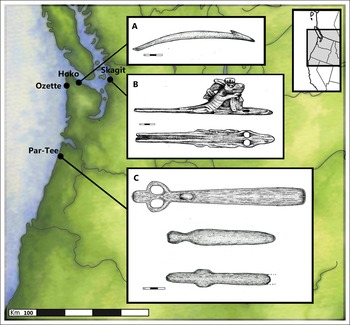
Map of the study area. Location and form of other archaeological atlatls in the region are indicated: A) Hoko River wet/dry site (Croes Reference Croes1995); B) Skagit River (Taylor & Caldwell Reference Taylor and Caldwell1954); C) Par-Tee (illustration by E. Hull).

The excavations at Par-Tee revealed a few stone-surrounded hearths and other simple stone features, along with multiple human burials, but no clear evidence of residential structures (Phebus & Drucker Reference Phebus and Drucker1979). Modelling of recently obtained radiocarbon dates on terrestrial mammal bone from the midden suggests that the primary period of occupation was around cal AD 100–800 (Sanchez et al. Reference Sanchez, Rick, Culleton, Kennett, Buckley, Erlandson and Losey2018). A few historic-era artefacts found near the site's surface indicate an additional, ephemeral period of reoccupation in the sixteenth and seventeenth centuries AD. Among the numerous artefacts recovered from the site are 180 projectile points (hafted bifaces), 129 of which have stems for hafting; the remainder are triangular or foliate in shape. All points appear to be from the site's primary period of occupation. Application of Hildebrandt and King's (Reference Hildebrandt and King2012) atlatl dart-arrow index to the stemmed points (their method is best applied only to stemmed points) classifies 97 as atlatl dart points, and 31 as arrow points; one was unclassifiable. This suggests that both atlatls and bows were used at Par-Tee.
While Par-Tee's faunal assemblage is diverse, subsistence clearly focused on marine fauna, including a suite of marine mammals, as well as estuarine shellfish, fish and pelagic birds (Losey & Power Reference Losey and Power2005; Colten Reference Colten2015). Terrestrial mammals, such as elk (Cervus elaphus) and deer (Odocoileus sp.), constitute a small portion of the faunal assemblage (3.3 per cent of the identified specimens). Whales—grey (Eschrichtius robustus) and humpback (Megaptera novaeangliae) in particular—were exploited by the site inhabitants, and the presence of a humpback phalanx with an embedded elk-bone projectile suggests that at least one such whale was locally hunted (Losey & Yang Reference Losey and Yang2007; Wellman et al. Reference Wellman, Rick, Rodrigues and Yang2017).
All positively identified archaeological atlatls on the Northwest Coast date to the Late Holocene. In 1952, a wooden atlatl made from yew (Taxus brevifolia) was dredged from the mouth of the Skagit River in Washington State (Taylor & Caldwell Reference Taylor and Caldwell1954) (Figure 1B). The atlatl was directly dated to 1700±100 BP (RIDDL-86; Fladmark et al. Reference Fladmark, Nelson, Brown, Vogel and Southon1987), which calibrates to c. AD 105–560 (at 95.4 per cent confidence using OxCal v.4.3 and the IntCal13 calibration curve (Bronk Ramsey Reference Bronk Ramsey2009; Reimer et al. Reference Reimer2013)). This radiocarbon date should be used with caution as it lacks any measurement of δ13C fractionation, but generally, the Skagit atlatl appears to be similar in date to those from Par-Tee. The hook end of the wooden atlatl is missing, and its grip consists of two finger loops and an elongated palm pad. The atlatl's built-in weight is carved from the same piece of wood as the body, and takes the form of an elaborate three-dimensional sculpture. A shaft groove is present on the intact portion of the body. Four wooden (species unidentified) atlatls were also recovered from the Hoko River wet/dry site (45CA213) in Washington State (Figure 1A). These are relatively simple implements, averaging around 0.3m in length, with simple rod-like bodies and hooks at one end (Croes Reference Croes1995: 169–70). At the opposite ends are small knobs, presumably used for the attachment of a wrist line. Radiocarbon dates from associated contexts and objects suggest that these four atlatls date to between c. 1000 and 500 cal. BC (Croes Reference Croes1995: 26). A fragmented atlatl dart from the same period was also found at this site (Croes Reference Croes1995: 169).
The timing of the introduction of the bow and arrow to western Oregon and other areas of the Northwest Coast is poorly constrained. Bows and arrows are very rare on the Northwest Coast, their use being inferred almost entirely through the presence of smaller stone projectile points. In the Coast Salish region of Washington State and British Columbia, these weapons appeared around cal AD 400 (Angelbeck & Cameron Reference Angelbeck and Cameron2014). Bows and arrows were possibly present in the inland Columbia Plateau area to the east a few centuries or even several millennia earlier (Ames et al. Reference Ames, Fuld and Davis2010; but see Hildebrandt & King Reference Hildebrandt and King2012). In California, to the south, bows and arrows appeared in some interior regions no earlier than c. cal AD 200. They dispersed slowly to the coast, reaching northern California around cal AD 900 or later (Kennett et al. Reference Kennett, Lambert, Johnson and Culleton2013).
Atlatls at Par-Tee
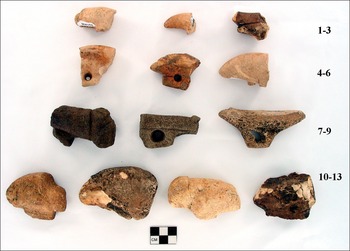
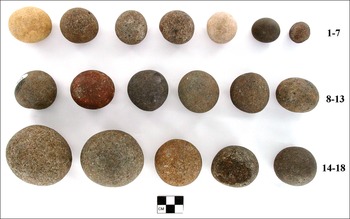
The Par-Tee collection includes at least 68 atlatl fragments, all of which are carved from whalebone. At least 14 possible atlatl weights are also present, including stone and whalebone specimens (Figure 2). All of the atlatls and possible weights were found either in midden deposits or, more rarely, on the site's surface; none were found in graves. All specimens are broken and incomplete, but can be classified here into three general types.
Potential atlatl weights from Par-Tee; specimen 9 is bone, and the remaining are stone (photograph by R. Losey).

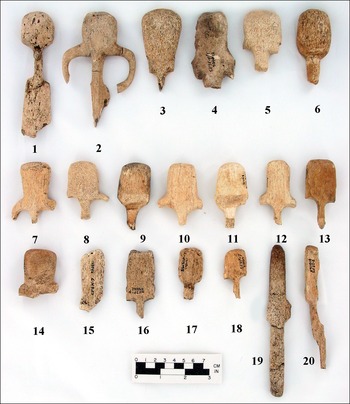
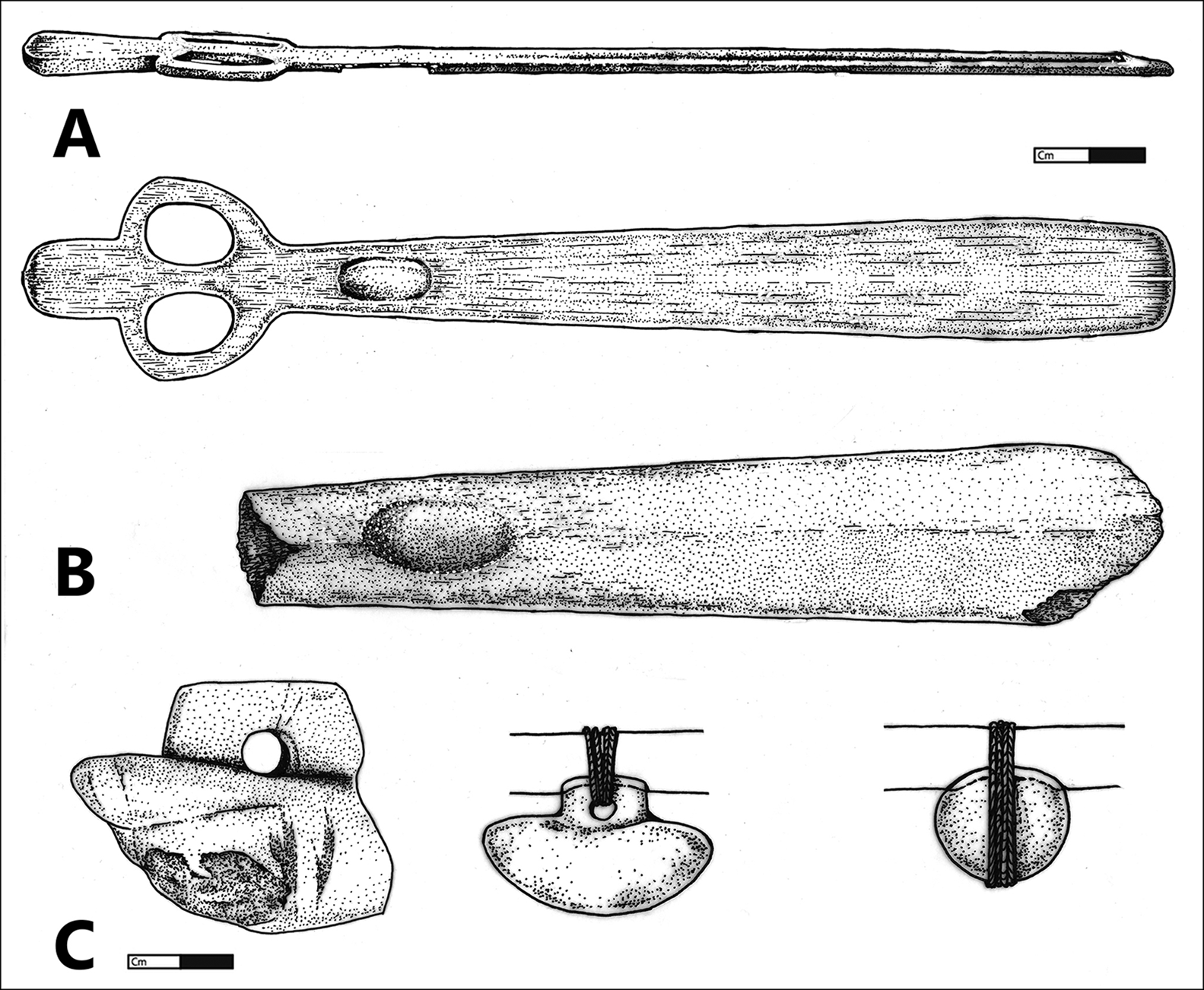
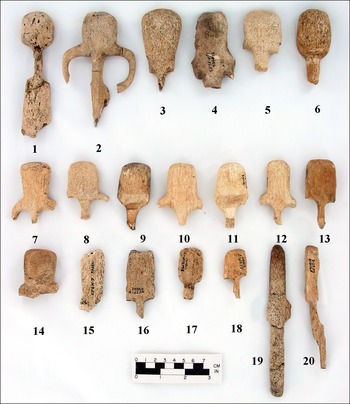
The first and most common type of atlatl from Par-Tee has a grip formed by a palm pad element and two finger loops split by a rod (Figure 3). At least 19 grips from this type of atlatl are present, along with five additional proximal body fragments from atlatls with this same grip style. These five latter items could be portions of the same atlatls represented by the grips, or they could be from separate weapons. These are morphologically similar to the grip of the Skagit atlatl described above. There are subtle variations in the grip styles documented at Par-Tee; some exhibit a palm pad that narrows towards the finger loops, while others expand or even contract in this same direction. Five of the grip and proximal body fragments have features for weight attachment, four of which comprise concave depressions that are elliptical in outline (Figure 4). The fifth has a T-shaped depression with a flat surface. The latter attachment feature may have held weights similar to those shown in Figures 2 and 4C. Although elliptical concave depressions could not have held such weights, they could have been used with simple, rounded stones.
Par-Tee atlatl grip fragments; specimen 19 is a type-three grip, and the remainder are type one (photograph by R. Losey).
Illustrations of Par-Tee type-one atlatls: A) reconstruction of a complete atlatl; B) an atlatl body fragment (specimen 538643) showing concave depression for weight attachment; C) the most complete atlatl weight from Par-Tee (541799) on the left, with middle and right illustrations showing possible attachment methods (illustration by E. Hull).

Phebus and Drucker (Reference Phebus and Drucker1979) collected at least 95 spherical to oblong cobbles from the midden at Par-Tee, which they termed ‘bolas’—stones connected with straps that are thrown at prey (Figure 5). It is possible some of these items are instead atlatl weights. The finger loops on four of the grip and proximal body fragments broke off during the use-life of the atlatls, and were subsequently reworked, leaving the palm portion connected to the body by the rod that originally split the two loops (Figure 3: specimens 1, 6, 9, 11 & 17). While three of the grip pads showed no clear evidence of originally having finger loops, we suspect that they were formerly present but were eliminated by extensive reworking. Nine probable finger-loop fragments were also found.
Spherical stones from Par-Tee; those in the bottom row are probably too large to be atlatl weights (photograph by R. Losey).

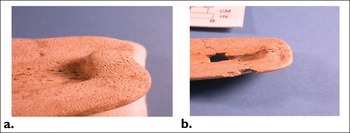
A further 32 atlatl body fragments are present in the assemblage, including six with intact hook sections, all probable parts of the atlatl type described (Figure 6). The hooks comprise peg-like elements that are 3.2–5.5mm wide and 2.6–7.3mm in height (Figure 7). Seven of the body fragments have features for weight attachments. Two such specimens have holes drilled vertically through the body, but no associated concavity for weight attachment is present. The remaining five have concave sections without drilled holes, three being oval in outline, and two sub-rectangular. Seven body sections more distal from the grips exhibit shaft grooves that extend back to the hook. The upper faces of six body fragments display multiple drilled dots along their edges, and one body fragment has short incised notches along the midline of its lower face (Figure 6). These dots and incised lines appear to be decorative. Figure 4A shows a reconstruction of a whole atlatl, with finger loops and attached weight.
Par-Tee atlatl body and hook fragments; drilled dot decorative elements can be seen on specimens 6, 11–13, 15 & 17 (photograph by R. Losey).

Atlatl hook fragments from Par-Tee: a) 538641; b) 541021 (photograph by R. Losey).

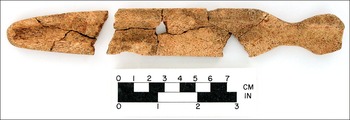
The second atlatl type consists of a single specimen, with a relatively wide shaft groove extending through the grip area, down the body to the hook; two side notches form its grip (Figure 8). The grip section is only 24.8mm wide. The atlatl shows no indication of having been equipped with a weight, and its estimated length is only approximately 0.2m. The hook comprises a short triangular point that extends 4mm above the shaft groove.
The type-two atlatl from Par-Tee (photograph by R. Losey).

The third identified type is the most tenuous and consists of fragments of only two grip sections, one of which is extensively burnt (Figure 3.19). Both have an elongated rod-like palm pad and two perpendicular projections extending from this rod, which perhaps functioned as grips. There is no indication of weights having been attached to either specimen.
Atlatl scaling
Equipment scaling involves adjusting the size of implements to make them easier for individuals of varying body size to use, but implement size might also vary for additional reasons. Atlatl hooks could vary in size in relation to the dimensions of the dart being thrown, itself dependent on the type of prey being pursued. The potential atlatl weights from Par-Tee are more difficult to use in exploring equipment scaling, as their functions cannot be directly assessed (none were found in association with atlatls), and many are fragmented. The grip sections of the type-one atlatl described above provide the most convincing evidence for equipment scaling. Reduced grip size would clearly be limiting in terms of those who could use the weapon—small grips could only be held by small hands.
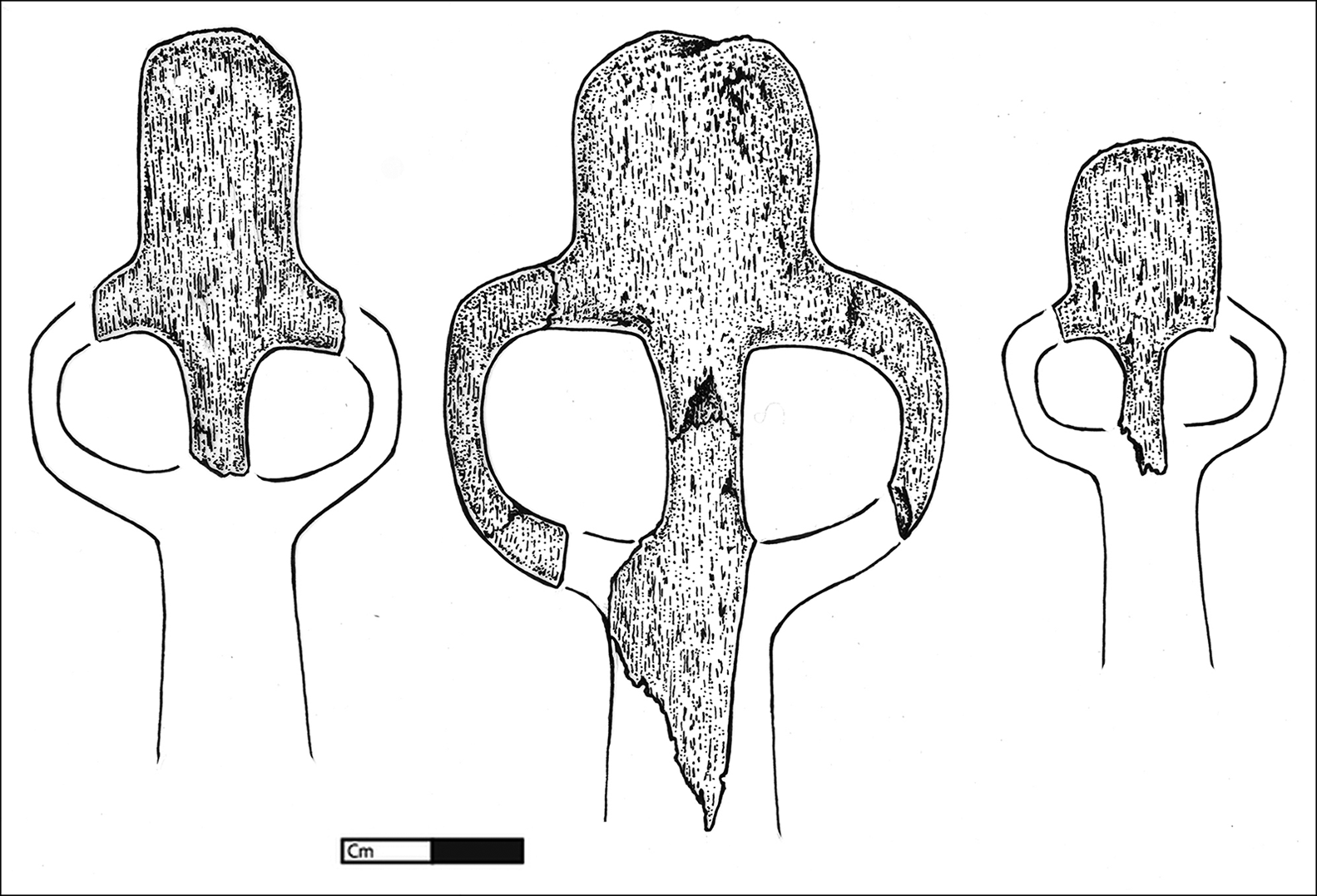
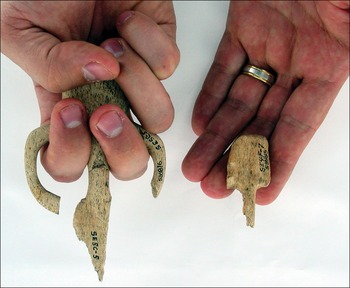
Full grip size cannot be measured for most of the Par-Tee atlatl specimens due to their fragmented states. Nearly all of the finger loops are broken off, leaving only the palm pads intact. Maximum width could be determined for 18 of the palm pads, and the mean width of these measurements is 32.2mm, with a standard deviation of 53mm. The range in widths is 23.1–41.8mm. Four of the specimens have widths over 20 per cent smaller than the mean, and two of these are 28.4 per cent below the mean. Figure 9 depicts such differences visually, with the two smallest grips flanking the most complete grip (its width is 16.2 per cent wider than the mean). Figure 10 shows the two specimens from the right side of Figure 9 in the hands of the lead author; the right specimen is far too small for his hand.
The most complete Par-Tee type-one atlatl grip (centre 536816), and the two smallest grip fragments (left 541034; right 536815) (illustration by E. Hull).

Type-one atlatl grips (536816 and 536815) in the hands of the lead author (figure by the authors).

This variability in atlatl size probably cannot be explained by human sexual dimorphism alone. By sex, hand length differs by <10 per cent (Garrett Reference Garrett1971), stature by <12 per cent (Alexander et al. Reference Alexander, Hoogland, Howard, Noonan, Sherman, Chagnon and Irons1979) and overall body size by approximately 15 per cent (Larsen Reference Larsen2003). The smallest two grips at Par-Tee are 28.4 per cent below the mean grip size (based on palm-pad width), and over 40 per cent smaller than the largest grip in the assemblage. Presumably, the largest atlatl grips were made for adult male hands. Given that hand-size variation among adult males would not have ranged by 40 per cent, this suggests that the smaller grips were made for very small hands—most probably those of children.
The Par-Tee type-two atlatl is more difficult to assess in relation to scaling. This atlatl is shorter in length than the small specimens from the Hoko River wet/dry site and all of the type-one Par-Tee atlatls described here. There is no indication, however, that it is a smaller version of an ‘adult’-sized implement, as it is the only example of its type in the assemblage. Based on our photographs, a replica of this atlatl was carved from wood and tested by an experienced adult male atlatlist using a 1.3m-long dart (Gilsen Reference Gilsen2011). Using this replica atlatl, he was able to throw the dart nearly 30m, and, at shorter distances, penetrated a competition target, demonstrating both accuracy and power. The user described the atlatl as “difficult to hold”, but based on its overall effectiveness, suggested it was not a “toy” (Gilsen Reference Gilsen2011: 68). While far from conclusive, this leaves open the possibility that the original weapon was constructed for use by an adult.
Discussion
‘Enskilment’ is an apt description for the process of becoming adept at using the atlatl, including its use in complex tasks, such as hunting. To make effective use of an atlatl in hunting, the user would have accurately and forcefully to propel a dart to strike prey at a distance. Given the implement's comparatively lower accuracy, compared to a bow, atlatl hunting for many types of prey, at least sometimes, required the coordination of multiple hunters. Finding and approaching an animal involved intimate knowledge of the landscape and the behaviours and tendencies of prey animals. Spiritual preparations were also probably considered essential. While these aspects of atlatl hunting were probably discussed, described and planned by hunters, the repeated engagement in these activities must have been far more effective at building skills. To take a modern analogy, one can participate in class lectures to learn about a sport such as tennis and its rules, but it is only by repeatedly being on court, swinging the racquet and competing against others that one becomes a skilled player.
In many contemporary foraging societies, becoming a competent hunter takes considerable time, often beginning at some point in childhood and extending into adulthood (Bock Reference Bock, Hewlett and Lamb2005). Development of atlatl hunting skills, like those required for craft production, would have required extended experience, meaning that individuals would have started handling these implements in hunting and play at a young age, probably pre-adolescence. Beyond variation in experience, children also differ from adults in terms of body size, strength, endurance and dexterity (Bird & Bliege Bird Reference Bird and Bird2000). As a result of these differences, completing a task, particularly a complex one, with adult-sized tools can be difficult for children. To address this issue, equipment can be, and often is, scaled down to reduce these difficulties and increase the ability of children to learn how to use such equipment successfully. We propose that the smallest atlatl grips at Par-Tee are the result of such processes.
There are many potential reasons for the miniaturisation of material culture; for example, as models for the construction of full-sized objects, visual devices in storytelling and non-functional model toys (Koch Reference Koch1975). At Par-Tee, however, the scaling of atlatls for enskilment purposes is a more probable explanation. First, creating an atlatl out of whalebone, regardless of the weapon's size, was time-consuming and required considerable craftsmanship. Why fashion a model out of bone when material that was far easier to work, such as red cedar (Thuja plicata), was readily available in the local area? Second, during the early historic period, size scaling is attested for some children's objects. Among Salish groups to the north, small bows and arrows were used by boys, some as young as five to six years of age (Haeberlin & Gunther Reference Haeberlin and Gunther1930: 65; Underhill Reference Underhill1945: 132; Smith Reference Smith1984: 44), while young girls were given small matting needles for weaving baskets (Gunther Reference Gunther1927: 238). Some children also practised paddling skills in the surf using canoes just large enough to support them on the water (Swan Reference Swan1966: 14). Hunting, weaving and canoeing are all complex tasks that were critical for daily life, and the process of mastering these skills clearly started in early childhood. Finally, similar equipment scaling for enskilment purposes appears to be evident at Ozette, a 300-year-old village on the Washington State coast. This site has yielded numerous perishable materials, including several small-scale bows and arrows and a miniature weaving loom (Koch Reference Koch1975; Gleeson Reference Gleeson1980). All of these items were probably repeatedly handled and utilised by children in order to accrue the skills necessary to use them successfully.
Perhaps most importantly, equipment scaling has been empirically shown to improve the learning and performance of complex tasks among children, particularly in sports (Buszard et al. Reference Buszard, Reid, Masters and Farrow2016). Using smaller tennis racquets, scaled-down balls or playing on smaller courts and fields, for example, increases children's engagement in such sports, presumably because they are more often successful in completing tasks (Elliot Reference Elliott1981; Farrow & Reid Reference Farrow and Reid2010; Buszard et al. Reference Buszard, Reid, Masters and Farrow2016). Shorter and lighter tennis racquets also increase improvement and performance, as children are able to wield them more easily (Buszard et al. Reference Buszard, Farrow, Reid and Masters2014). Furthermore, studies have demonstrated that the scaling of equipment to body size leads to improved functional movement patterns, by which children are more often able to perform technical actions correctly (Burton et al. Reference Burton, Greer and Wiese1992; Buszard et al. Reference Buszard, Reid, Masters and Farrow2016).
The Par-Tee atlatls were made during what appear to have been the last few centuries of the widespread use of these weapons on the northern Oregon Coast; they were perhaps employed alongside the newly introduced bow and arrow. Their unusually high abundance at Par-Tee—they are more numerous here than at any other site on the west coast of North America—is difficult to explain. Most atlatls were probably made of wood, and therefore do not survive in most archaeological settings. Although the use of whalebone for atlatls at Par-Tee has facilitated their survival at this location, the reason for the repeated selection of bone for the crafting of these weapons is unknown. The choice to employ whalebone cannot be explained by differential access to this material alone, as bones from these animals could have been found whenever they washed ashore. Furthermore, it is unclear whether the use of whalebone improved the performance of atlatls compared to other types of locally available material. Perhaps this use of whalebone represents unique practices of marking status through the use of the body parts of truly powerful animals. Alternatively, this could have been a means of indicating close relations to, or high regard of, these animals among the inhabitants of Par-Tee, who appear to have sometimes hunted whales.
This research indicates the potential for future research on enskilment on the Northwest Coast, particularly with regard to weaving, woodworking and canoeing, all of which were complex daily tasks in this region. Equipment scaling may have been utilised in the learning of all of these tasks, and evidence of this should be visible in other Northwest Coast artefacts, if we are willing to search for it. More broadly, archaeological research on enskilment continues to be remarkably rare, and this is a missed opportunity. High levels of skill were required for an array of past practices, and a better understanding of how these skills emerged and were acquired will surely prove insightful on a wide range of social issues.
Acknowledgements
Funding for data collection was provided by the National Museum of Natural History, Smithsonian Institution, Washington D.C. We are grateful for assistance provided by Dale Croes and the late Kenneth Ames.