Introduction
The Adriatic Sea subregion within the Mediterranean Sea is considered an essential foraging ground for the loggerhead sea turtle Caretta caretta (Linnaeus, 1758; Almpanidou et al., Reference Almpanidou, Tsapalou, Chatzimentor, Cardona, Claro, Hostetter, Kaska, Liu, Mansui, Miliou, Pietroluongo, Sacchi, Sezgin, Sözbilen and Mazaris2022), the most common sea turtle species present in the Mediterranean Sea (Margaritoulis et al., Reference Margaritoulis, Argano, Baran, Bentivegna, Bradai, Camiñas, Casale, De Metrio, Demetropoulos, Gerosa, Godley, Haddoud, Houghton, Laurent, Lazar, Bolten and Witherington2003). Indeed, in the neritic area of the northern Adriatic Sea (<200 m) both juveniles and adult loggerhead sea turtles, most of them arriving from Greek rookeries, can easily access benthic food resources and they are permanent or at least seasonal residents (Lazar et al., Reference Lazar, Margaritoulis and Tvrtković2004; Casale et al., Reference Casale, Affronte, Scaravelli, Lazar, Vallini and Luschi2012; Luschi et al., Reference Luschi, Mencacci, Vallini, Ligas, Lambardi and Benvenuti2013). Furthermore, the western part of the basin (average depth of ~30 m) is a highly productive area that is strongly influenced by the inter-annual freshwater discharges of the Po River, which represent the main source of nutrients in the whole basin and sustains a high biodiversity community that is important for the trophic interactions of sea turtles (Lazar et al., Reference Lazar, Gracan, Katic, Zavodnik, Jaklin and Tvrtkovic2011; Casale et al., Reference Casale, Broderick, Camiñas, Cardona, Carreras, Demetropoulos, Hochscheid, Kaska, Lazar, Margaritoulis, Panagopoulou, Tomás and Türkozan2018). However, the northern Adriatic Sea area is among the most exploited and affected by cumulative impacts on a global scale (Lejeusne et al., Reference Lejeusne, Chevaldonné, Pergent-Martini, Boudouresque and Pérez2010; Ramírez et al., Reference Ramírez, Coll, Navarro, Bustamante and Green2018), and it is subject to both direct and indirect human-related threats.
The high density of sea turtles along with intense fishing activities in the area are considered to drive the highest sea turtle bycatch rates in the whole Mediterranean by bottom trawling (Lucchetti and Sala, Reference Lucchetti and Sala2010; Casale, Reference Casale2011; Lucchetti et al., Reference Lucchetti, Pulcinella, Angelini, Pari, Russo and Cataudella2016), trammel, and gillnets (Lucchetti et al., Reference Lucchetti, Vasapollo and Virgili2017). This is a serious matter of concern due to high mortality rates and gas embolisms caused by interactions with fisheries (Tomás et al., Reference Tomás, Gozalbes, Raga and Godley2008; Franchini et al., Reference Franchini, Valastro, Ciccarelli, Trerotoli, Paci, Caprio, Salvemini, Lucchetti and Di Bello2021). Certainly, other anthropogenic threats also include marine debris and pollution, boat strikes, and habitat degradation, which are a matter of concern too for the conservation of this species (Casale et al., Reference Casale, Affronte, Insacco, Freggi, Vallini, Pino D'Astore, Basso, Paolillo, Abbate and Argano2010, Reference Casale, Broderick, Camiñas, Cardona, Carreras, Demetropoulos, Hochscheid, Kaska, Lazar, Margaritoulis, Panagopoulou, Tomás and Türkozan2018). Whilst quantifying and describing the effects of such threats at sea is rather difficult to achieve for logistical constraints, monitoring coastal strandings represents a more feasible approach and a cost-effective solution. Accordingly, a proper monitoring programme of stranded sea turtles can provide a fair picture of the situation at sea, delivering useful information about interaction with marine debris (Domènech et al., Reference Domènech, Aznar, Raga and Tomás2019), migration patterns (Tolve et al., Reference Tolve, Casale, Formia, Garofalo, Lazar, Natali, Novelletto, Vallini, Bužan, Chelazzi, Gaspari, Fortuna, Kocijan, Marchiori, Novarini, Poppi, Salvemini and Ciofi2018), as well as delineate areas of high risk (Dimitriadis et al., Reference Dimitriadis, Mazaris, Katsanevakis, Iosifakis, Spinos, Kalli, Sourbès, Ghinis, Kapellaki, Mpeka, Evagelopoulos and Koutsoubas2022). Therefore, a good strategy to inform the policy-making process about the effects of anthropogenic activities on marine protected species is to collect and analyse data on stranding events under a monitoring programme like the one described here. For this reason, we present here the results of a four-year monitoring programme (2019–2022) of stranded loggerhead sea turtles along the coast south of the Po River delta, an area within a key foraging ground for this species.
Materials and methods
Data collection
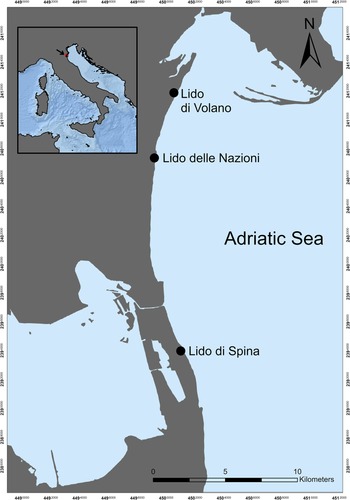
The stranding records were collected from Lido di Volano (FE) to Lido di Spina (FE) from 2019 to July 2020, accounting for 23 km of coastline (Figure 1). Due to operational constraints, starting from July 2020 until the end of 2022 the monitored area was resized down to 13 km from Lido delle Nazioni (FE) to Lido di Spina (FE). Therefore, once averaged over the year, the monitored coastline was 18 km during 2020. Overall, averaging over the four years, the monitored coastline was 17 km. This aspect was carefully considered during the data analysis to correct for any bias (e.g. calculation of the number of strandings•km−1; see next paragraph). According to a well-defined protocol, during beach patrolling or upon notification from citizens and the local coast guard, sea turtles were located, identified, and visually assessed by skilled biologists. For each stranded sea turtle, the following parameters were recorded: (i) species identification (ii) GPS coordinates, (iii) date and time, (iv) if possible, sex, (v) curved carapace length (CCL, notch to tip, cm) and width (CCW, cm), (vi) external signs of traumas (e.g. boat collision, entanglement in marine debris), visible infection, or parasites, (vii) if dead, decomposition state, and (viii) presence of flipper tags (communication to the organization which applied tags was done upon tag recovery). For loggerhead sea turtles larger than 70 cm of CCL, the sex was determined by assessing the tail length, with the assumption that, above 70 cm, a turtle with a short tail is more likely to be a female than an immature male (Casale et al., Reference Casale, Freggi, Basso and Argano2005). Therefore, a cut-off between adults and sub-adults was set at 70 cm CCL. Sea turtles larger than 70 cm were considered adults, those in the range 60–70 cm were considered sub-adults and those smaller than 60 cm were considered juveniles (Casale et al., Reference Casale, Mazaris, Freggi, Vallini and Argano2009, Reference Casale, Mazaris and Freggi2011).
The study area south of the Po River delta, within the region of Emilia-Romagna (Italy). The map shows the coast monitored during the four-year period. The inset shows the position of the study area relative to Italy and the Adriatic Sea

From June 2020, sea turtles that were found alive and debilitated or by-caught in the local trawl fishery were recovered at the local first aid centre in Porto Garibaldi (FE) and then transferred within 12 h to the closest (distance, <30 km) rehabilitation centre located in Marina di Ravenna (RA), in compliance with the Italian National Guidelines (ISPRA, 2013). Stranded carcases in optimal conservation status were delivered to a local public institute (‘Istituto Zooprofilattico Sperimentale della Lombardia e dell'Emilia Romagna’) for necropsies.
Data analysis
First, the dataset was explored with a visual approach (i.e. boxplots, scatterplots, and Q–Q plot) as a routine step of quality control before applying any statistical analysis. Then, Shapiro–Wilk and Bartlett's tests were applied to further check that assumptions for parametric tests were met. Finally, one-way ANOVA and t-test were used for comparing CCL among years and between sexes, respectively. Upon rejection of the null hypothesis in the ANOVA, Tukey's Honestly Significant Difference (HSD) test was applied as a post hoc test.
The absolute number of strandings, number of strandings•km−1, and distribution of CCL were calculated according to the stranding records (i.e. sea turtles found on the beach) along the monitored coast. In this regard, due to a resizing during July 2020, the kilometres used to calculate the overall number of strandings•km−1 in 2020 were averaged, resulting in 18 km of monitored coast during 2020. The statistical and data analysis, as well as data visualization, was performed within the R environment (R Core Team, 2021). The geographical maps were created with ESRITM ArcGIS Pro (v. 2.8.0) using the European Terrestrial Reference System 1989 and Lambert azimuthal equal-area coordinate reference system.
Results
Overall records and causes of death
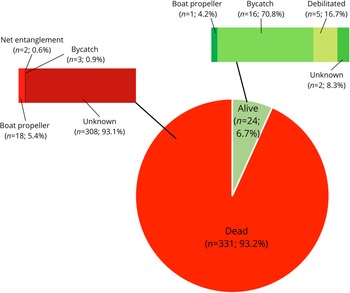
A total of 355 sea turtles were registered from 2019 to 2022, of which 336 (94.6%) were found stranded on the beach and 19 (5.3%) were captured as direct bycatch of the local trawl fishery (Figure 2). Out of 355 records, 24 sea turtles were rescued alive: 16 as direct bycatch from the local trawl fishery, 5 were stranded and severely debilitated, 1 was hit by a boat propeller, and 2 were stranded for unknown reasons (Figure 2). A total of 331 sea turtles were recorded as dead (Figure 2). The cause of death could be determined with relatively high confidence only for a small number of cases, which included boat propeller strikes (n = 18), net entanglement (n = 2), and direct bycatch in the local trawl fishery (n = 3). The rest of the sea turtles were absent from any external clear sign of trauma, injury, infection, or parasites. Flipper tags recovery was low (n = 5), and their origin was Tunisia (n = 1) and Italy (n = 4; Emilia-Romagna and Puglia). Turtles with available CCL–CCW records were a total of 326. The most common species was the loggerhead sea turtle Caretta caretta (n = 354), with only one individual green sea turtle Chelonia mydas (CCL = 56 cm). For this reason, all downstream analysis refers to strandings of loggerhead sea turtles.
Numbers and percentages of dead and alive loggerhead sea turtles recorded during the monitoring programme from 2019 to 2022 in the area south of the Po River delta. The cause of death that could be determined with relatively high confidence as well as the unknown causes are displayed for the two groups.

Trends in stranding events
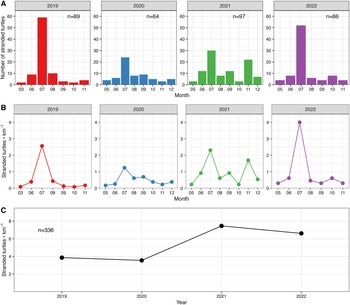
The month with the highest number of records was July for all four years (Figure 3A), a trend that mirrored the number of stranded turtles•km−1 (Figure 3B). Indeed, during July, between 1.2 and 4 stranded turtles•km−1 were recorded, with the only exception of one peak during November 2021 that reached 1.7 stranded turtles•km−1 (Figure 3B). The months of June, August, and September showed lower records than July, although they tended, on average, to remain higher than the rest of the year (Figure 3A-B). The overall number of stranded turtles•km−1 was 6.6 in 2022 and 7.5 in 2021, much higher values than that of 2019 (3.9) and 2020 (3.8) (Figure 3C).
Strandings (n = 336) of loggerhead sea turtles during the four years of monitoring activities in the area. (A) Frequency of strandings within each year and month; (B) number of strandings•km-1 within each year and month; (C) overall number of strandings•km-1 for each year.

Distribution of curved carapace lengths
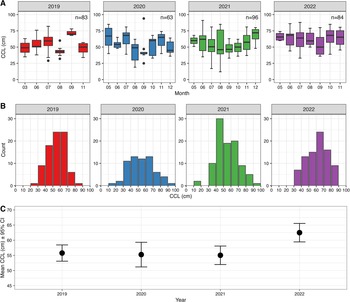
The distribution of CCL mainly reflected large juveniles and sub-adults and showed a higher variability during warmer months (June, July, and August), with a noticeable trend of increasing sizes from September (n = 12, average CCL = 48.1 cm; 95% CI = 42.1–54.4) through December 2021 (n = 7, average CCL = 68.4 cm; 95% CI = 57.2–79.6) (Figure 4A). The CCL reflected the typical size of large juveniles and sub-adults (Figure 4B), and it was different among years (one-way ANOVA: F3,322 = 5.18; p-value = 0.001). Indeed, the year 2022 was characterized by larger stranded sea turtles (Figure 4C) according to Tukey's HSD test, which revealed larger CCL values when 2022 was compared to 2019 (95% CI of the difference: 0.98–12.47; p-adj = 0.01), 2020 (95% CI of the difference:1–13.42; p-adj = 0.01), and 2021 (95% CI of the difference: 1.91–13; p-adj = 0.0003). No other comparisons were significant at p < 0.05. The number of stranded juveniles (CCL ⩽ 30 cm) was low (n = 6; alive = 2, dead = 4).
Distribution of CCL (notch to tip, cm) of stranded loggerhead sea turtles during the four years of monitoring activities in the area (n = 326). (A) Boxplots of CCL within each year and month; (B) frequency distribution of CCL in each year; (C) mean CCL ± 95% confidence intervals for each year.

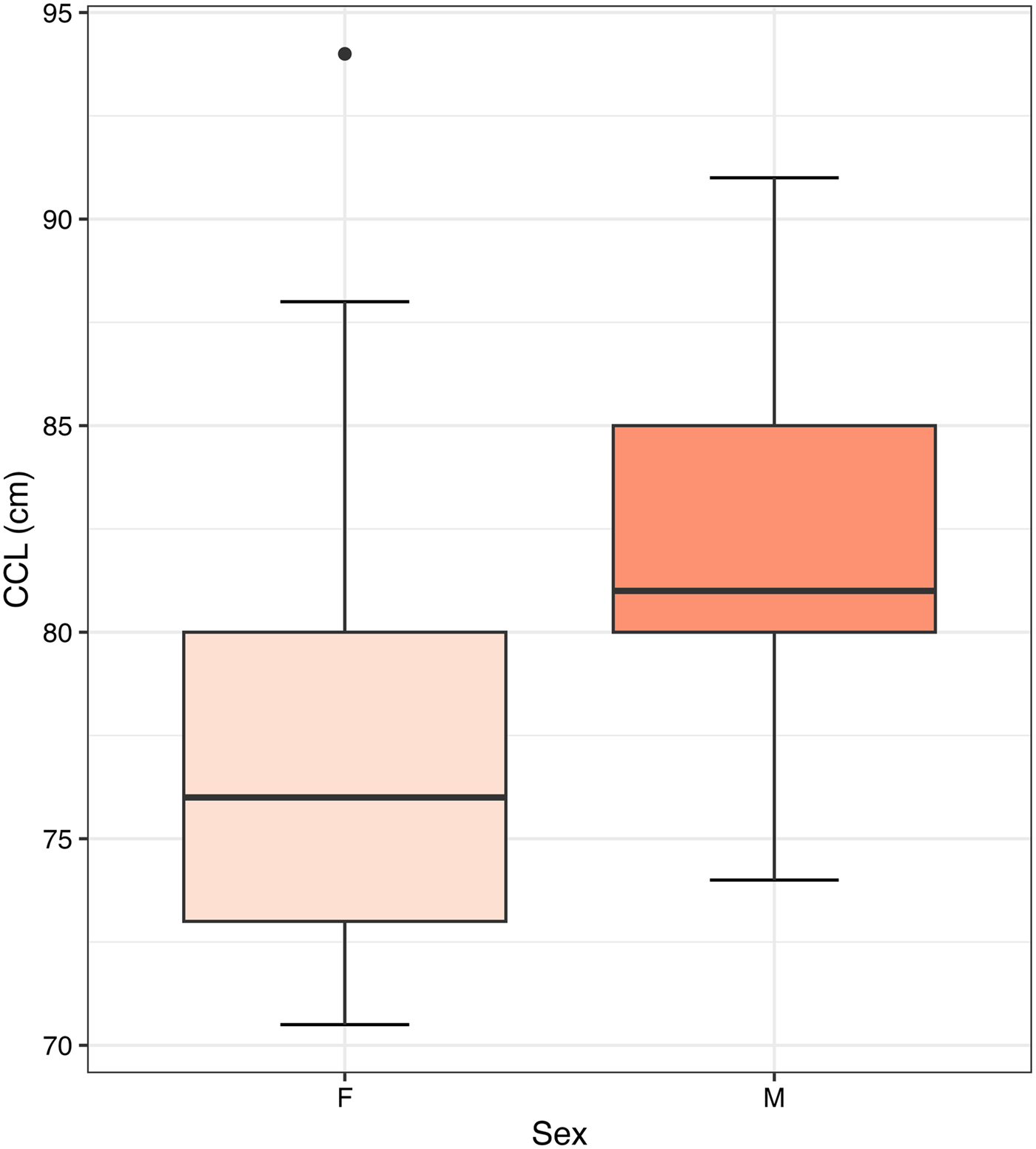
A total of 20 males and 35 females were larger than 70 cm of CCL and tail length was therefore considered to determine the sex (Figure 5). The average CCL was 77 cm (95% CI: 75.1–78.8 cm) for females and 81.8 cm (95% CI: 79.8–83.7 cm) for males, a difference of 4.8 cm (two-sample t-test: t53 = −3.46; p-value = 0.001).
Comparison of CCL (notch to tip, cm) between females (n = 35) and males (n = 20) (M) of stranded loggerhead sea turtles.

Discussion
Present results indicate that loggerhead sea turtles frequent the northern Adriatic Sea also in winter as stranding events occur throughout the year, albeit much more frequently during summer months. Large juveniles and sub-adults were recorded more frequently than adults, and July was found to be the month with the greatest number of records over the four-year period. Interaction with the trawl (bottom + midwater) fishery was hypothesized as the main cause of mortality. The potential of regular monitoring programmes to investigate interactions with direct and indirect anthropogenic stressors and to detect trends in sea turtle populations is discussed.
In the Mediterranean, the sea turtle Caretta caretta performs regular migrations from central (i.e. Libya) and central-eastern (i.e. Greece) Mediterranean rookeries to the northern Adriatic Sea (Lazar et al., Reference Lazar, Margaritoulis and Tvrtković2004; Bertuccio et al., Reference Bertuccio, Costantini, Angelini, Furii, Gobic and Abbiati2019), where shallow waters, transitional habitats, and rich benthic communities make it an ideal foraging habitat for this species. Here, both juveniles and adults were found as seasonal or permanent residents, even at low water temperatures (<12 °C) (Lazar et al., Reference Lazar, Margaritoulis and Tvrtković2004; Zbinden et al., Reference Zbinden, Aebischer, Margaritoulis and Arlettaz2008; Casale et al., Reference Casale, Affronte, Scaravelli, Lazar, Vallini and Luschi2012, Reference Casale, Broderick, Camiñas, Cardona, Carreras, Demetropoulos, Hochscheid, Kaska, Lazar, Margaritoulis, Panagopoulou, Tomás and Türkozan2018). Our results further support such findings since stranding events occurred for most of the year, although much more frequent during summer months, a finding in line with a population composed of both residents and migrating individuals. Furthermore, due to its highest number of stranded sea turtles, the month of July might represent the peak of a migratory process towards the area south of the Po River delta, although to date we cannot rule out other drivers for such increased stranding events (i.e. increased fishing effort). Notably, an increase in sea turtle strandings in summer was also observed in other areas of the Mediterranean Sea such as the southern (Bellido López et al., Reference Bellido López, Torreblanca, Baez and Camiñas2018) and eastern Spain (Tomás et al., Reference Tomás, Gozalbes, Raga and Godley2008), Rhodes Island (Corsini-Foka et al., Reference Corsini-Foka, Kondylatos and Santorinios2013), and Turkey (Başkale et al., Reference Başkale, Sözbilen, Katılmış, Azmaz and Kaska2018).
In the northern Adriatic Sea, one of the main threats to sea turtles is the fishing activity, especially the intense bottom and midwater trawling that characterise this shallow area (Fortuna et al., Reference Fortuna, Vallini, Filidei, Ruffino, Consalvo, Di Muccio, Gion, Scacco, Tarulli, Giovanardi and Mazzola2010; Lucchetti et al., Reference Lucchetti, Pulcinella, Angelini, Pari, Russo and Cataudella2016; Pulcinella et al., Reference Pulcinella, Bonanomi, Colombelli, Fortuna, Moro, Lucchetti and Sala2019; Bonanomi et al., Reference Bonanomi, Moro, Colombelli, Pulcinella and Fortuna2022). In this context, post-catch direct and potential mortality of trawling (midwater + bottom) in the northern Adriatic was estimated at 9.4% and 43.8%, respectively, that likely represented underestimates (Casale et al., Reference Casale, Laurent and De Metrio2004). Although the exact cause of death can be accurately investigated only with necroscopies, we hypothesize that the majority of strandings were the result of direct interactions with fishing activities (i.e. bycatch in the trawl fishery) since no clear external signs on the carcases suggested alternative hypothesis. Indeed, a significant percentage of stranded sea turtles may have drowned in fishing nets of the local trawl fishery and subsequently been stranded as dead (Affronte and Scaravelli, Reference Affronte and Scaravelli2001), leaving no external identifiable marks on the carcases. In addition to trawling, the set net fishery also appears to pose a substantial concern since a hot spot for entanglement was identified by Lucchetti et al. (Reference Lucchetti, Vasapollo and Virgili2017) in an area located south of the River Po delta, with mortality related to forced apnoea due to high soaking time and consequent drowning. These dynamics are further supported by recent findings that highlighted how sea turtles entrapped in static and towed nets may also develop gas embolism, which can lead to severe organ injury and death (Franchini et al., Reference Franchini, Valastro, Ciccarelli, Trerotoli, Paci, Caprio, Salvemini, Lucchetti and Di Bello2021).
From September to December 2021, a trend of stranded sea turtles of increasing size was observed, a result that is consistent with the idea of adult individuals as overwintering residents in the area during that year. However, no trends were noticed during the same months of other years, which were instead characterized by a higher presence of sub-adults. It would be interesting to explore in greater detail such year-to-year variability once a more prolonged time series becomes available, a step that will allow us to better understand sea turtle strandings in relation to environmental parameters and fishing effort, an approach recently exploited in the Adriatic Sea for fishery by-caught individuals (Pulcinella et al., Reference Pulcinella, Bonanomi, Colombelli, Fortuna, Moro, Lucchetti and Sala2019; Bonanomi et al., Reference Bonanomi, Moro, Colombelli, Pulcinella and Fortuna2022).
The number of stranded sea turtles•km−1, as well as the absolute numbers of strandings during the four years, clearly confirmed that the area south of the Po River delta is the most impacted in Italy (Casale et al., Reference Casale, Affronte, Insacco, Freggi, Vallini, Pino D'Astore, Basso, Paolillo, Abbate and Argano2010) and perhaps in the whole Mediterranean Sea (Tomás et al., Reference Tomás, Gozalbes, Raga and Godley2008; Bellido et al., Reference Bellido, Castillo, Pinto, Martín, Mons, Báez and Real2010; Corsini-Foka et al., Reference Corsini-Foka, Kondylatos and Santorinios2013; Türkozan et al., Reference Türkozan, Özdilek, Ergene, Uçar, Sönmez, Yilmaz, Kaçar and Aymak2013; Belmahi et al., Reference Belmahi, Belmahi, Benabdi, Bouziani, Darna, Bouslah, Bendoula and Bouderbala2020; Hama et al., Reference Hama, Karaica, Karaica, Rodić, Jelić, Mahečić and Jelić2020; Dimitriadis et al., Reference Dimitriadis, Mazaris, Katsanevakis, Iosifakis, Spinos, Kalli, Sourbès, Ghinis, Kapellaki, Mpeka, Evagelopoulos and Koutsoubas2022). Although the extension of the monitored area appeared to be much greater, only Karaa et al. (Reference Karaa, Jribi and Bradai2015) reported a comparable number of strandings in the Gulf of Gabes (Tunisia), the other important foraging area in the Mediterranean Sea for loggerhead sea turtles. However, for a more thorough comparison of strandings between areas, monitoring effort and proximity to urban centres should be taken into account, both aspects that affect the discoverability of sea turtle carcases (Bellido López et al., Reference Bellido López, Torreblanca, Baez and Camiñas2018; Mghili et al., Reference Mghili, Benhardouze, Aksissou and Tiwari2023). Indeed, it is critical to emphasize that monitoring activities in the present study covered a small portion of coastline – about 17 km – and the numbers presented herein represented underestimates as we are aware of other and partly overlapping monitoring programmes for which data could not be accessed. Furthermore, additional strandings are likely missing in our estimates due to intense beach cleaning activities by a local company during night-time and early morning throughout the summer season, which, to the best of our knowledge, include disposal of sea turtle carcases. Therefore, we strongly suggest that the current stranding network, data collection, and sharing policy in the area must be revised soon to achieve a better understanding of stranding dynamics as well as more precise estimates.
Promising solutions to mitigate the impact of fishing activities are represented by (1) technological innovations in fishing gears, (2) modification of towing times, and (3) dynamic spatial–temporal fishing closures. The well-known turtle excluder devices (TEDs) in bottom trawling were already tested with success in the Adriatic Sea (Sala et al., Reference Sala, Lucchetti and Affronte2011; Lucchetti et al., Reference Lucchetti, Bargione, Petetta, Vasapollo and Virgili2019) but not adopted by fishermen. Despite such tests, the lack of a widespread adoption of TEDs indicates that might not be a realistic and all-in-one solution for reducing sea turtle bycatch because of the different characteristics of the Mediterranean mixed bottom trawl fishery compared to the shrimp trawl fishery, for which they were originally designed (Lucchetti and Sala, Reference Lucchetti and Sala2010). Eventually, the adoption of TEDs can be coupled with labels that add value to fish products and raise the environmental awareness of consumers, who are generally willing to pay a premium price for the attribute of sustainability (Maesano et al., Reference Maesano, Di Vita, Chinnici, Pappalardo and D'Amico2020). Towing time is another main factor affecting mortality rate during interaction with trawling activities. For instance, Sasso and Epperly (Reference Sasso and Epperly2006) found that sea turtle mortality was different between summer and winter in a bottom trawl fishery, leading to practical solutions such as adjusting towing times depending on the season to reduce sea turtle mortality. Finally, dynamic spatial–temporal closures is another promising approach that can be more effective at reducing bycatch than classical static closure (Smith et al., Reference Smith, Tommasi, Welch, Hazen, Sweeney, Brodie, Muhling, Stohs and Jacox2021), although a good understanding of bycatch hotspot must be achieved first (Cambiè et al., Reference Cambiè, Sánchez-Carnero, Mingozzi, Muiño and Freire2013).
Overall, the findings show that monitoring stranding events provide useful insights into the geographic ranges, seasonal distribution, and life history of the loggerhead sea turtle Caretta caretta, which contribute to help conservation efforts for this species. Also, the present manuscript emphasizes a significant negative impact on loggerhead sea turtles in the area south of the Po River delta, a hot spot of stranding events. When compared to the published literature on this topic, the number of strandings of loggerhead sea turtles relative to the small stretch of the coast might be the greatest in the entire Mediterranean Sea, echoing the need of solutions to mitigate such an impact in the area. The data on loggerhead sea turtle strandings provided in the present study can thus be combined with data from satellite tracking and bycatch dynamics in the trawl fishery, allowing the identification of important areas near the Po Delta River where protection measures may produce the greatest conservation results.
Acknowledgements
The authors wish to acknowledge Dr Alessia Crosara for her valuable support during the creation and visualization of maps. The authors wish to thank Michela Fontana, Noemi Calabretti, Rebecca Montanari, Alessio Alberghini, Micaela Torresi, Chiara Cattin, Simona Doria, Greta Dotto, and Carlotta Serioli for their precious help during field activities. Also, the authors wish to thank Dr Carola Valini for her valuable support during the rescue operations of some alive sea turtles.
Data availability
The data that support the findings of this study are available from the corresponding author, upon reasonable request.
Author's contributions
All authors contributed equally to the design of the study and carried out the field work. LM drafted the manuscript, carried out the data analysis and prepared figures. AT and AF revised and provided advice on the last version of the manuscript. All authors contributed to manuscript revision and have read and agreed to the submitted version.
Financial support
This research was self-financed and received no specific grant from any funding agency, commercial, or not-for-profit sectors.
Competing interests
The authors declare no conflict of interests