In the context of stalled multilateral trade negotiations, preferential trade agreements (PTAs) have continued to proliferate, raising important trade and policy issues. Unlike in any other period since the establishment of the multilateral trading system, all important trading nations are now involved in PTA discussions of one form or another. In the midst of the recent flurry of PTA activity, this paper attempts to fill a gap in the literature by providing a comprehensive evaluation of the liberalization commitments contained in the recent wave of preferential trade agreements on services. Indeed, the trade literature has tended to limit its examination of services components of preferential trade agreements (PTAs) to the type of rules they contain and to such other characteristics as whether a GATS-type positive listing or NAFTA-type negative listing was used in undertaking commitments.
The paper hopes to make a contribution at the empirical level by comparing the commitments undertaken in PTAs with prevailing GATS commitments, as well as offers in the ongoing Doha Round negotiations so as to assess how much further access is granted under PTAs. The review of recent services PTAs should help shed light on some basic questions: do PTA commitments go further than existing GATS commitments and GATS offers and if so to what extent? What types of PTAs appear to encourage more liberalization (in terms of scheduling approaches, countries involved, etc.)? Do PTAs encourage actual liberalization, i.e. going beyond the status quo? Providing elements of answers to these questions should, in addition, allow for informed reflections on the policy implications of these PTAs, including for the Doha services negotiations and the multilateral system more generally.Footnote 1
The paper is structured as follows. Section 1 sets the stage by discussing the evolution of services PTAs in recent years as well as these agreements' approaches to services liberalization and their key features. Section 2 presents the results of our research to provide an overall picture of GATS+ commitments undertaken in the recent wave of PTAs. The paper reviews the commitments undertaken by 36 countriesFootnote 2 under mode 1 (cross-border supply) and mode 3 (commercial presence) in 32 PTAs with services commitments that have been concluded since 2000. The ‘value-added’ of PTAs is highlighted, among other things, by examining, for each country, the proportion of all services activities that are the subject of improved and new commitments in PTAs compared to GATS offers. We also make some observations about the content of the new and improved commitments in PTAs in a number of sectors and present concrete examples of actual liberalization arising from these arrangements. Section 3 concludes by summarizing the main findings and making certain observations on economic consequences and on the possible impact of preferential arrangements on the Doha services negotiations. We also suggest, in conclusion, some avenues to limit the downsides of this phenomenon and reinforce multilateralism.
1. The context
Proliferation of services PTAs
As often pointed out, the number of preferential trade agreements has increased at a great and steady pace since the establishment of the WTO in 1995. Apart from Mongolia, all Members are party to a PTA of one form or another. As of 15 September 2006, 211 notifications to the GATT/WTO have been registered under GATT Article XXIV, the Enabling Clause, and GATS Article V. Eleven hundred and eighteen (118) notifications have been received since 2000, including 88 since 2002, i.e. concurrently with the Doha Round negotiations (see Crawford and Fiorentino, 2005).Footnote 3
PTAs encompassing services are more novel. Since trade rules on services are a more recent phenomenon (the Canada–US free trade agreement in 1989 and the GATS in 1995 were key precursors), it is understandable that only 44 new PTAs have been notified under GATS Article V. However, notifications for services agreements have grown at a faster pace than others: 37 of these agreements have been notified since the start of the WTO services negotiations in 2000, of which 18 in 2005–2006 and 11 in 2003–2004, during key phases of the Doha Round. Various other agreements have been recently concluded, but are awaiting ratification (e.g. US agreements with Peru and Colombia). Others are currently under negotiation or consideration, with varying prospects for completion, e.g. US–Malaysia or ASEAN–Australia–New Zealand.
Since 2000 key traditional demandeurs in the services negotiations, such as the United States, the EC and Japan have, for the first time, engaged in (services) PTAs beyond their most immediate neighbours (i.e. Mexico and Canada for the US, other European countries for the EC). Other key players – including many developing countries – have followed suit, e.g. India, China, Australia, New Zealand, Chile, Mexico, India, Hong Kong, Switzerland, Norway, Thailand, Malaysia, Korea, and Singapore.Footnote 4 As a result, so far, many of the most important advocates of liberalization in the multilateral services negotiations are involved in services PTAs. Governments that are parties to these agreements account for more than 80% of world services trade.Footnote 5 Key absentees in this group include Pakistan and such larger African countries as South Africa or Egypt (Morocco is the only African country involved in this web of agreements). In addition, the involvement of Argentina and Brazil remains limited to Mercosur. Of course, the countries involved in these PTAs do not all have agreements amongst themselves. Services trade relations among larger players still tend to be governed by WTO commitments: the US, China, India, Japan, Brazil, or the EC have no PTA ties amongst themselves.
Another apparent feature of the recent wave of services agreements is that they most often bring together developing and developed countries; the US–Australia PTA being the only agreement between developed countries since 2000. Agreements between developing economies are more common, e.g. the agreements signed by Mexico and Chile with Central American countries. In general, trade agreements involving at least one developed country tend to include services components (exceptions include agreements notified by the EC with African and Middle Eastern countries), while the majority of trade agreements between developing countries include no services commitments, although that trend now seems to be changing.
It can also be observed that certain countries seem to have played a particularly important role in the spreading of services PTAs, if only by the number of agreements that they have signed: the US, Singapore, and Chile are party to more than five services PTAs.
Differing approaches to trade rules for services in PTAs
In assessing and comparing liberalization commitments undertaken in the recent wave of PTAs, this paper goes through agreements that are based on varying approaches to regulating services trade. While the liberalization commitments of services PTAs have not in the past been the subject of comprehensive assessments, other characteristics of services obligations contained in PTAs have in contrast been discussed extensively.
A key element that distinguishes many services PTAs is the approach to liberalization: traditionally, distinctions have been drawn on the basis of whether they follow a GATS-type or a NAFTA-type approach. The main difference between the two is that the NAFTA is based on a negative-list scheduling modality: everything is liberalized, unless otherwise indicated through lists of reservations. Reservations are typically for existing non-conforming measures (Annex 1) and for future measures (Annex 2). These agreements provide a high degree of transparency since, save for the normally limited number of Annex 2 reservations, the actual level of openness is spelled out, along with an indication of the legal/regulatory framework in place. This is in contrast to the GATS, which adopts a positive-list modality whereby the liberalization obligations only apply to the sectors listed, which themselves are subject to the limitations or conditions inscribed. Nothing specifies whether these limitations are for existing non-conforming measures or for future measures. Moreover, since only ‘measures’ are bound, no indication is given of the relevant laws/regulations, which accentuates the lack of transparency. Unlike the GATS, agreements using a negative list approach typically include a ratchet mechanism whereby any future liberalization of annex 1-type reservations is automatically locked in (see OECD, 2002b; Stephenson, Reference Stephenson2002).
The NAFTA-type and GATS-type agreements also differ in that, in the former, different modes of supply are dealt with in different chapters: disciplines for modes 1, 2, and 4 in a chapter on cross-border trade in services and disciplines relating to mode 3 as part of a chapter on investment for services and non-services activities. Further provisions on temporary movement of natural persons are also sometimes found in an additional chapter. That modes of supply be covered by different chapters makes no meaningful difference if obligations in these chapters are the same. However, that is not always the case. While both NAFTA's cross-border services and investment chapters each contain a national treatment obligation, neither contains a market access obligation as found in Article XVI of the GATS for certain non-discriminatory quantitative restrictions. NAFTA's cross-border services chapter contains a provision on non-discriminatory quantitative restrictions that is merely of a best endeavours’ basis. Investment chapters, which cover commercial presence in services, also do not include disciplines on non-discriminatory quantitative restrictions. In that regard, the GATS therefore goes further (see OECD, 2002b; Roy, Reference Roy2003). Apart from liberalization provisions, it also goes beyond GATS by subjecting mode 3 to services-wide disciplines such as domestic regulation, but NAFTA-type agreements exceed GATS-type agreements by subjecting investment in services (including mode 3) to extensive investment provisions, such as on expropriation, minimum standard of treatment, and investor-state dispute settlements procedures.
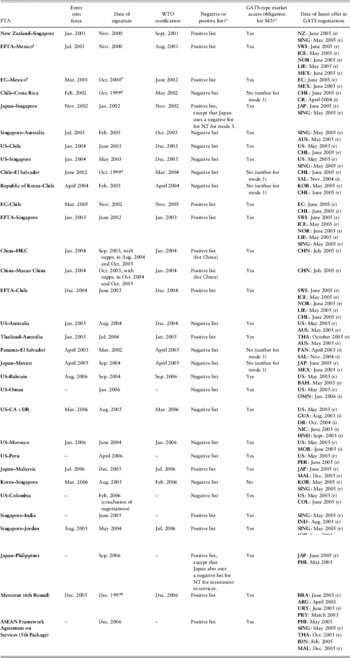
While various PTAs still follow either the NAFTA or GATS structure (e.g. the agreements involving the European Communities and EFTA follow a GATS model), a number of the PTAs reviewed in this paper have evolved into a combination of the two approaches, the aim being to achieve greater coherence between services and investment disciplines so as to avoid discrepancies in the treatment of investment in goods and services or in the treatment of trade in services under different modes of supply. Combined approaches therefore seek to ensure that services trade under all modes of supply are subject to the same core disciplines and that mode 3 is covered by generic investment disciplines (see Roy, Reference Roy2003). In such cases, mode 3 is typically subject to some obligations in both the investment chapter and the services chapter. Unlike in NAFTA, mode 3 is subject to the services chapter's disciplines on non-discriminatory quantitative restrictions, as in GATS (i.e. Article XVI). However, in addition to GATS and like in NAFTA, generic investment disciplines apply to mode 3. A number of the services PTAs reviewed in this paper have adopted variants of such a combined approach, e.g. all the recent PTAs involving the United States, the Australia–Singapore and, to some extent, the Japan–Singapore PTAs.Footnote 6 Further details are found in Table 1, which provides information on the characteristics of the agreements reviewed in this paper. In the table, the so-called combined models are those that use a negative-list scheduling modality (like NAFTA-type agreements) and include a GATS-type market access obligation for mode 3.Footnote 7
Preferential trade agreements reviewed

Notes: 1 This describes the general approach taken in the agreements, although some agreements take a different approach for financial services than for other sectors (see Part II.A of the paper).
2 These agreements only contain commitments on financial services at this time.
3 This represents the date of signature of the agreement (including services obligations), but the services commitments were negotiated afterwards.
(r)=revised offer; (i)=initial offer. Information as of 1 January 2007.
Another notable difference in terms of liberalization modalities between GATS-type and NAFTA-type or combined models relates to air transport. While services chapters of the PTAs reviewed typically carve-out key air transport services (at times along similar lines as GATS and sometimes providing for even less coverage), the investment chapters of relevant PTAs, where national treatment applies to mode 3, do not exclude any particular service sector from the outset and therefore apply to all air transport services as to any other sector, subject of course to specific reservations listed in relevant annexes.Footnote 8
Overall, PTAs appear to offer limited value added over GATS disciplines with respect to the rules areas, e.g. safeguard mechanism, disciplines on subsidies or domestic regulation.Footnote 9 Exceptions include rules found in separate chapters on telecom and financial services, additional transparency provisions, as well some sector-specific provisions relating to recognition in certain agreements, an issue that might merit further study. Most PTAs reviewed also include comprehensive sets of disciplines on government procurement, but these are not specific to services and are self-contained in their own chapter.Footnote 10 Accordingly, the most significant variance between PTAs and the GATS, as well as among PTAs, may well rest on the liberalization commitments that are undertaken, which may of course be influenced by the structure or modalities of market opening provisions, as discussed above. Oddly, this is, however, the aspect that has been less extensively explored so far.
2. Overview of the value-added of PTAs over existing GATS schedules and offers
The project and the methodology
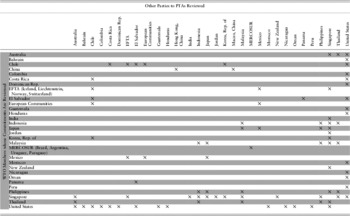
In attempting to provide a comprehensive overview of the liberalization commitments of the recent wave of PTAs, this paper has reviewed schedules and lists of reservations on services contained in 32 preferential trade agreements. It reviews all those PTAs with services commitments that have entered into force and been notified to the WTO under GATS Article V since the start of the services negotiations in 2000.Footnote 11 In addition, in order to provide more information on the ongoing flurry of services PTAs, the paper has also added some of the recent PTAs that, even if not notified, have been signed and/or ratified.Footnote 12 The agreements reviewed, along with some relevant information such as date of notification, are listed in Table 1. As highlighted in Table 2, the paper therefore reviews the PTA commitments undertaken by 36 WTO Members (counting the EC-15 as one).
Cross-tabulation of countries and PTAs

Given the relative complexity of services agreements (different modes of supply, types of barriers, and liberalization modalities), it is not an easy task to provide an overview of the state of commitments and to capture the overall extent of improvements. To assess PTA commitments, we have focused, in the first instance, on sector coverage. This captures the breadth of commitments across all services sectors, highlighting for example how many sectors have been left without any binding whatsoever. However, while improvements in the sectoral breadth of commitments represents one important way in which PTAs can go beyond GATS, another key aspect relates to the depth of commitments, i.e. the actual level of access bound for the sectors committed. In order to provide an overview of the depth of PTA commitments, we have, as a second step, identified each sector where improvements to the depth of commitments were provided, but without trying to rank or quantify the quality of each particular improvement. This allows to provide an aggregate picture of the extent to which, out of the universe of services sectors, countries have undertaken new commitments (expansion of sectoral coverage) and improved the level of bindings for already committed sectors (depth of commitments). Additional details on the depth of commitments is best provided through a country-by-country or sector-by-sector qualitative analysis.
Given the size of the task involved – matching more than a thousand pages of GATS schedules and offers and a similar amount of not readily comparable pages of PTA commitments – the paper solely looks at modes 1 (cross-border trade) and 3 (commercial presence). Mode 2 commitments are typically liberal and comparing PTA commitments under this mode might provide little additional insights. While mode 4 liberalization commitments represent high stakes for many countries, they are typically crafted along somewhat different parameters than modes 1 and 3 and are also subject to specific disciplines. This aspect was therefore left for another day as it merits a paper of its own (see OECD, 2002a). Nevertheless, modes 1 and 3 are estimated to amount to more than 80% of world services trade (see WTO, 2005).
In capturing the value-added of the recent wave of services PTAs, we felt it important to compare their liberalization commitments not only to WTO Members' existing GATS commitments, which, for the most part, were negotiated more than ten years ago, but also to services offers submitted in the Doha negotiations so far (for an overview of GATS offers, see Adlung and Roy, Reference Adlung and MartinFootnote 2005). Do PTA commitments go beyond not only GATS existing commitments, as they would naturally be expected to do, but also beyond GATS offers, and to what extent?
So as to provide the most accurate and relevant picture overall, the approach chosen was to look at each of the more than 150 sub-sectors comprising the universe of services activities to see whether, for each particular sub-sector and mode, the PTA commitments improved upon the GATS offer, either by binding a new service sub-sector (i.e. the sector was not included in the GATS schedule nor the offer or was ‘unbound’ for the relevant modes of supply) or by improving upon the GATS binding for that sub-sector (e.g. removing a limitation and therefore providing for binding at a higher level of liberalization). The research undertaken thus permits to indicate, for each Member, the proportion of total services sub-sectors improved (through either new bindings or better ones) in comparison with the GATS offer. The same exercise is done to assess the value-added of GATS offers over GATS commitments currently in force, so as to have a point of comparison in assessing the extent to which PTAs make advances. Of course, although such type of indicators provide useful information and allow for an overall snapshot for analytical purposes, they should not be used to assess, in isolation, the value of any individual country's PTA or GATS commitments. While the methodology proposed aims at providing the most accurate and comprehensive global picture, the overall quality – or value-added of commitments for the two modes of supply reviewed – also depends on the precise content of each particular commitment. These aspects, which cannot easily be summarized across agreements, are explored in the following section. More details about the methodology are found in Appendix 1.
Presentation of the results
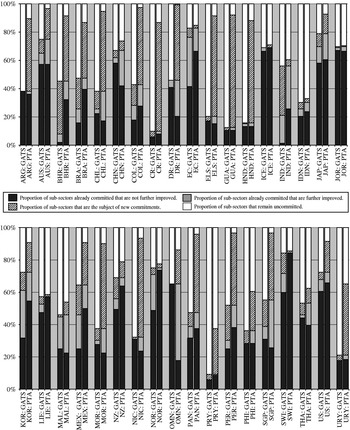
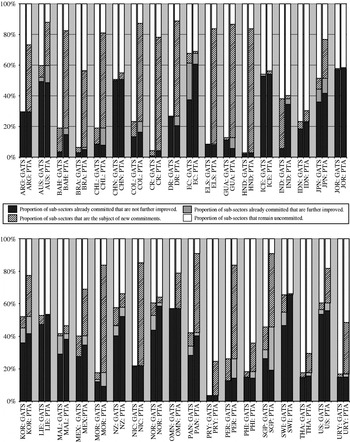
Figure 1 presents the results for each country reviewed for mode 3 while Figure 2 (found in Appendix 2) does the same for mode 1. By looking at the proportion of new and improved commitments for each country, the figures illustrate the value-added of each country's PTA commitments over their latest GATS offer.
Proportion of sub-sectors with new and improved commitments under mode 3, per WTO member (when comparing the GATS offer to the GATS schedule (‘GATS’) and the PTA commitments to the GATS offer (‘PTA’))

So as to give a point of comparison, the figures illustrate (through the bars labelled ‘GATS’), the value-added of each country's latest GATS offer over their existing GATS schedules. The bottom parts of the bars show the proportion of sub-sectors in the GATS schedule that is not improved upon by the offer. The lighter parts above represent the proportion of sub-sectors already bound in the GATS schedule that have been improved upon by the GATS offer. The striped parts further above show the proportion of sub-sectors where new commitments are proposed in the GATS offer. The upper parts of the bars represent the proportion of sub-sectors that remain uncommitted in both GATS schedules and GATS offers.
Along similar lines, the bars labelled ‘PTA’ provide an overview of how much PTA commitments add to GATS offers. The bottom parts of the bars show the sub-sectors committed in GATS schedules/offers that have not been improved through PTAs. The lighter parts above represent the sub-sectors in the GATS schedule/offer that are further improved upon by the PTA (i.e. the PTA provides a more liberal binding than in the GATS offer by, for example, not including an economic needs test or a foreign equity limitation). The striped parts further above show the sub-sectors where the PTA provides for new bindings for the relevant mode, i.e. a level of liberalization is bound where there were no commitments whatsoever in the GATS schedules/offers. The upper parts of the bars represent the proportion of sub-sectors that remain uncommitted in both GATS schedules/offers and PTAs. In other words, the ‘value-added’ of the PTAs over the GATS offers is captured in the lighter and striped parts of the bars. The bars labelled ‘GATS’ represent the ‘value-added’ of the GATS offer over the current GATS commitments in the same manner.
The results show that, overall, PTA commitments tend to go significantly beyond GATS offers in terms of improved and new bindings. The proportion of new/improved commitments is generally much greater in PTAs (compared to GATS offers) than in GATS offers (when compared to existing GATS commitments). There is, however, much diversity among the countries reviewed. Some countries exhibit spectacular improvements in their PTA commitments. Among them are countries that have signed a PTA with the United States, i.e. Bahrain, Central American countries, Chile, Colombia, Dominican Republic, Morocco, Oman, Peru, and Singapore. Most of these generally had mode 1/mode 3 bindings in their GATS schedules/offers in less than half of all services sub-sectors and have experienced giant leaps in terms of sector coverage: on average, they have PTA commitments for both modes of supply in more than 80% of all services sub-sectors.
Those with a higher number sectors already bound in their GATS schedules/offers have improved the level of binding for a good proportion of them. For example:
● Morocco has undertaken new bindings under mode 1 in 94 sub-sectors (66% of the total) and under mode 3 in 80 sub-sectors (53%). In addition, it improved a number of sector-specific commitments contained in its GATS offer: 23 under mode 3 (15%) and 12 under mode 1 (8%);
● Singapore, under mode 3, went beyond its GATS offer by improving the level of commitment in 45 sub-sectors (30%) and making new commitments in 63 sub-sectors (41%).
● The Dominican Republic, which had mode 1 commitments in its GATS schedule/offer in 26% of sub-sectors has increased this proportion to 89% in its PTA.
● Even if starting from a higher level of commitments in its GATS schedule/offer, Australia, regarding mode 3, improved the level of commitment in 27 sub-sectors included in its GATS schedule/offer (18%) and undertook new commitments in 33 sub-sectors (22%).
Examples of the types of new/improved PTAs commitments for some of these countries include:
● Australia: bindings going beyond GATS span a wide array of sectors: for example, the scope of the investment review provisions are reduced and spelled out; improved commitments on legal services, on retailing (no limitation with regard to the dispensing of pharmaceuticals), on tourism (through the removal of a commercial presence requirement for travel agencies/tour operators services), and on financial services (in particular through permitting branching for life insurance); new commitments on courier services and audiovisual services; and improved and new commitments in relation to rail transport services. Various of these improvements over GATS were contracted in Australia's PTA with the US, but not in others. Australia's PTA with Singapore also includes a number of commitments that go beyond the GATS offer, but the one with Thailand tends to simply reflect existing GATS commitments and not to include improvements that Australia has proposed in its GATS offer.
● Singapore: one of the leaders in propagating services PTAs, Singapore has followed a positive-list approach with India, EFTA, New Zealand, Japan, Jordan, and ASEAN, and a negative-list approach in its PTAs with the US, Korea, and Australia. The commitments it has taken in the latter three agreements tend to go further than the others, especially the PTA with the US and, to a lesser extent, that with Australia. There is, overall, much diversity in the commitments undertaken by Singapore in its various PTAs. Examples of PTA commitments going beyond the GATS schedule/offer include: new commitments, although with various limitations, on legal services (only for the US and Australia), including with additional explicit phase-in liberalization in the PTA with the US; new and improved commitments for various sub-sectors under ‘Business Services’; new commitments on courier services (except in the PTAs with India, Korea, Jordan, and ASEAN) and on maritime freight transport, as well as some other services relating to maritime transport; improvements to commitments on basic telecom (no ownership restriction for facilities-based services) in most PTAs; new commitments on retailing services in all PTAs, although limits attached vary; new commitments on a number of air transport services, depending on the PTA; and a number of improved commitments in financial services (e.g. removal of foreign equity limits on insurance), including explicit phase-in liberalization in PTA with the US (for Singapore's PTA strategy, see Thangavelu and Tho, Reference Thangavelu and Mun-Heng2005).
● Chile: Another heavy user of PTAs, Chile has followed a positive list approach with the EC and EFTA, and a negative list approach with Costa Rica, El Salvador, Korea, and the US. In general, Chile's commitments in PTAs improve on the country's GATS commitments in sectors such as professional services, courier services, telecommunications, construction services, financial services, maritime services, and services auxiliary to all modes of transport. Chile's PTA commitments go even further than the offer submitted to the WTO in some professions and business services (particularly with regard to mode 1). The commitments undertaken by Chile in its PTA with the US go further than the others in key sectors such as professional services; telecommunications, by allowing access to its local market; and financial services, by allowing more services to be supplied on a cross-border basis, and by allowing US insurance companies to establish as branches.
Even if not engaged in a PTA with the US, other countries, such as Mexico,Footnote 13 Panama, Japan, and Korea, exhibit significant proportions of improved/new commitments in PTAs in both modes of supply, although the extent of the improvements vary and are not as consistently spectacular. Nevertheless, for example, Mexico increased the proportion of sectors covered by mode 3 commitments from 65% in the GATS offer to 91% in PTA commitments; while Panama had less than half of sectors (42%) covered by mode 1 commitments in its GATS offer, it had committed almost all (91%) in PTAs. Of course, even if NAFTA was not reviewed in this paper, Mexico's commitments in the subsequent PTAs reviewed here might reflect in good part what had been done with the US and Canada in the 1990s. China and India also provide improvements in a notable number of sectors, although these tend to take the form of improvements to sectors already committed under GATS schedules/offers rather than new bindings, and are mostly limited to mode 3. PTA commitments of Mercosur countries, Brazil and Argentina in particular, which had relatively few GATS commitments, provide for a high proportion of new sector bindings in both modes of supply, although these new commitments at times contain a number of restrictions (e.g. audiovisual services).
In contrast, Figures 1 and 2 also show that some other countries seem to have provided for more limited proportions of new/improved bindings on modes 1 and 3 compared to GATS offers, such as Malaysia, Thailand, Indonesia, and the Philippines, or EFTA countries. Malaysia, for example, had, pursuant to its GATS schedule/offer, no mode 1 commitments in 58% of all services sub-sectors. That proportion decreased by less than 5% in its PTA commitments. Of course, it needs to be recalled that this is only one indicator of the value-added of PTA commitments that serves to highlight general trends in these two modes of supply but not to define or rank the specific quality and value of a given country's commitments. The value of PTAs as a whole may also hinge on the types of mode 4 commitments obtained from the counterparts, as well as, obviously, the overall benefits stemming from non-services aspects of the agreement.
Examples of the types of new/improved PTAs commitments for these other countries include:
● Japan: Improvements in the PTAs mostly take the form of new bindings in a number of sub-sectors, principally within ‘Transport Services’ and ‘Business Services’. Improvements to sub-sectors contained in the GATS offer include the expansion of product coverage in distribution services. The PTA with Singapore tends to have less commitments than Japan's agreements with Malaysia, the Philippines, and Mexico; the latter contained improvements that were included in the GATS offer, while the PTA with Singapore more often tends to simply reflect commitments in the GATS schedule. This may be explained by the fact that the PTA with Singapore was concluded in 2002, while those with Mexico, Malaysia, and the Philippines were signed between 2004 and 2006.
● European Communities: the PTA with Chile, which was signed in 2002, tends to include, in many cases, commitments at a lower level than what had been offered in the GATS negotiations afterwards. Areas where the PTA goes further pertain to certain improvements – often limited to certain Member States – in relation to research and development services, legal services, distribution, maritime transport, and telecommunications.
● India: Starting from a low level of bindings in its existing GATS schedule for these two modes (less than a quarter of sectors bound under mode 3 and less than 10% for mode 1), various new sectoral bindings were proposed in GATS offers. GATS+ commitments in the PTA with Singapore essentially take the form of improvements in relation to mode 3 for sectors already committed in the GATS schedule/offer. Many of these improvements took the form of the removal of the requirement for foreign investors with prior collaboration in the sector to obtain approval from the Foreign Investment Promotion Board. This requirement, which was included in virtually all the sub-sectors offered by India, has, except for construction and distribution, been removed from the PTA. In addition, very specific improvements are also made in financial services, for example, three Singapore banks are allocated a separate quota of 15 branches over four years, over and above the quota for all foreign banks. On the other hand, it can be noted that some commitments in the PTA are worse than the offer. In telecommunications, for instance, the foreign equity limitation for voice mail, on-line information and database retrieval, and enhanced/value added services is 51%, even if a higher percentage had been offered in the Doha services negotiations.
● United States: While they do not provide for spectacular deviations, PTA commitments go beyond the GATS schedule/offer in a number of sectors. In financial services, new commitments are undertaken under mode 1 for insurance intermediation and with respect to certain portfolio management services. Other GATS+ commitments include new commitments on repair and maintenance of vessels, on certain port-related activities, as well certain improvements in relation to air, road, rail, and auxiliary transport services. PTAs also provide, among other things, for new commitments on R&D services. However, the US reserves the right to adopt or maintain any measure that is not inconsistent with its obligation of market access under GATS (Article XVI). Such carve-out, which however does not apply to financial services, may significantly reduce the value of some of the US' GATS+ commitments, especially in Mode 1. The US essentially uses the same list of reservations (Annex 1 and Annex 2) in all its PTAs, except in relation to cable television and maritime-related services, where some PTA partners get better treatment than others. Like the GATS offer, PTAs have not made headway in some of the most difficult areas for the US, in particular key maritime transport services.
Overall, while much diversity was found, the overview suggests that many PTAs go well beyond GATS offers in terms of sector coverage (i.e. commitments in new sub-sectors), but also levels of commitments, as suggested by the proportion of sub-sectors where commitments in GATS schedules/offers were improved. Many PTAs have gone a long way to correct the generally low level of sector coverage in Members' existing GATS commitments and the modest quality of offers in the Doha Round. In the case of mode 3, the average proportion of all sub-sectors subject to market access and national treatment commitments for the countries reviewed went from 50% in the GATS offers to 81% in PTAs. For mode 1, sector coverage similarly jumped from 35% to 68%. Furthermore, the occurrence of significant GATS+ commitments in PTAs is not limited solely to countries of a certain level of development or those of a certain size, or even to countries that are parties to PTAs involving developed countries.
From Figures 1 and 2, we see that the general trend of PTA commitments going significantly beyond GATS offers is relevant for both modes of supply. The only exceptions are India and China, which have tended to concentrate their PTA efforts on mode 3 more than cross-border supply.
From this overview, it also appears that negative-list agreements have yielded greater proportions of new/improved liberalization bindings, although this is due in good part to the fact that the US, which consistently uses this approach, has been involved in PTAs with countries that have exhibited strong results. Those countries – mentioned above – that have on average shown a lesser proportion of new/improved commitments in PTAs have all used a positive-list scheduling approach. This is not to say, however, that all positive-list agreements have led to lesser commitments than negative-list ones. For example, China's commitments in its agreements with Hong Kong and Macao, based on a positive-list, provides for many improvements that appear to provide for concrete new commercial opportunities, in particular in professional services, audiovisual, construction, distribution, and in maritime, air, road and auxiliary transport services (see also Antkiewicz and Whalley, Reference Antkiewicz and John2005). One can nevertheless note that some countries that have concluded agreements of both types, such as Singapore and Australia, have undertaken greater commitments in the negative-list ones.
In terms of sector focus, the review of commitments suggests that value-added of PTAs is fairly widespread across sector groupings. In sectors such as audiovisual, postal-courier, distribution, maritime transport, and auxiliary transport, a good number of countries reviewed undertook commitments for the first time through PTAs. In others sectors, such as financial services and telecommunications, where most countries reviewed had at least some commitments in their GATS schedules/offers, the PTA advances naturally took the form of improvements to existing commitments (more than half of countries reviewed went further than their GATS offers in these sectors). PTAs provide for advances both for sectors that had tended to attract less offers in the GATS (e.g. audiovisual, road, rail, postal-courier), as well as for sectors that already had been more popular targets in GATS offers, e.g. professional, financial services. One exception is health services, where PTA commitments do not appear to go very significantly beyond what is contained in GATS offers.
Significance of new and improved commitments in selected sectors
A closer look at a number of sectors (i.e. financial services, distribution, audiovisual, telecommunications, education, and professional services) highlights that, even if there is diversity in terms of the commitments taken by different Members within each sector, overall the new and improved sectoral bindings in PTAs provide for significant levels of openness and well exceed the offers made in the context of the Doha Round in terms of the depth of commitments. This is illustrated by the fact that commitments secured in PTAs generally match or even exceed the objectives sought by WTO Members in their plurilateral requests for these sectorsFootnote 14 and that PTAs often induce, as explored in the next section, ‘real’ liberalization. These trends hold both for the selected sectors that are the subject of a high number of multilateral commitments (e.g. financial services, telecommunications) as well as for those that have tended to attract less WTO commitments, such as audiovisual, distribution, and education.Footnote 15 The assessment of the level of access provided through the GATS+ commitments also underscores the stark difference between the commitments adopted by countries that signed agreements with the US – where the depth of commitments secured seems greater – and those that did not.
In the case of financial services, some PTAs have excluded the sector from its coverage (e.g. Chile–El Salvador, Chile–Costa Rica, Chile–Korea), while others have promised to review the situation after the entry into force of the PTA (e.g. Chile–EFTA). Other PTAs include the sector within the scope of the agreement, but have nevertheless avoided making liberalization commitments for the time being (e.g. AFAS), or have promised to include the sector in the schedules of commitments in future rounds of negotiation (e.g. Thailand–Australia). Commitments under PTAs have prioritized the liberalization of supply through commercial presence. Foreign equity limitations have been generally barred from these agreements, with the exceptions of India, Malaysia, Morocco, and Thailand.Footnote 16 Some progress has been made with regard to the elimination of restrictions on the form of legal entity through which foreign financial institutions can access local markets, although subsidiaries continued to be preferred over branches by some developing countries participating in these PTAs. On the other hand, with only few exceptions (basically the US PTAs and the Panama–El Salvador PTA), the agreements reviewed have not led to very significant improvements in bindings for cross-border trade in financial services.
The US is the only trading partner that has made significant progress in eliminating restrictions on the juridical form of financial services suppliers, by prompting important commitments to allow branching in Chile (life and non-life insurance), Australia (non-life insurance), El Salvador (all insurance services), Honduras (all insurance services), Colombia (insurance and banking), Costa Rica (insurance), Dominican Republic (direct insurance and reinsurance), Guatemala (insurance and banking), Morocco (life and non-life insurance), and Nicaragua (insurance). The same goes for cross-border supply of financial services, where countries signing agreements with the US have all gone beyond the requirements of the WTO Understanding on Commitments in Financial Services in this area by adding commitments on the cross-border supply of insurance intermediation (broking and agency) and of portfolio management services by asset management firms to mutual funds. Overall, PTA commitments largely match the commitments sought at the WTO in the plurilateral request for the sector, both for commercial presence and cross-border supply.
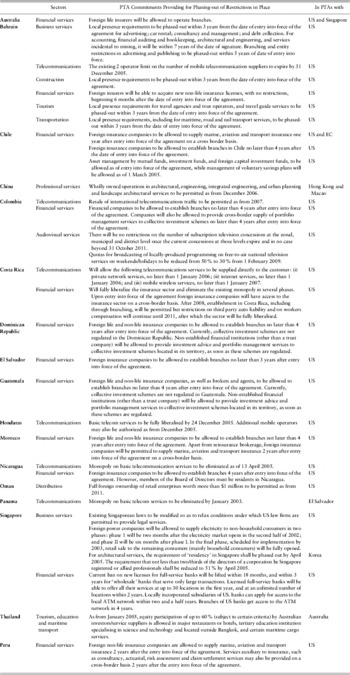
Although benefiting from the sound basis provided by the far-reaching commitments already made at the WTO, which were the result of the most successful sectoral negotiation so far, PTA negotiations on telecommunications have certainly allowed the gap between the commitments and the actual practice to close, which had continued to evolve towards further liberalization after the 1997 multilateral negotiations. Most of the countries examined made commitments in their respective PTAs, covering all telecommunications services (both basic and value added services), and with fewer limitations than those listed at the WTO. For example, the cross-border supply of basic telecommunication services has been generally bound with no limitations in the PTAs examined, with only a few exceptions (e.g. China, Costa Rica, India). In some of these cases, improvements on the multilateral commitments appear quite significant, e.g. Chile allowed US suppliers access to its market for local basic services; in Colombia, resale of international telecommunication traffic will be permitted as of 2007; Nicaragua and Honduras will completely eliminate the exclusivity for their respective incumbents by the end of 2005; Bahrain will eliminate the two-operator limit on the number of mobile telecommunication suppliers by the end of 2005; Panama had committed to eliminate its monopoly on basic telecommunication services by January 2003.
In the case of the sectors with fewest multilateral commitments (audiovisual, distribution, and education), PTAs have brought a number of significant advances in terms of new commitments, which are also in contrast with the limited results achieved so far through Doha Round offers. Most of those advances take the form of commitments taken by some developing countries that had no – or only limited – commitments at the WTO.
In distribution, a number of countries which had no GATS commitments in the sector (nor had made offers except for one) such as Bahrain, Chile, Colombia, Costa Rica, Dominican Republic, El Salvador, Guatemala, Honduras, Morocco, Nicaragua, Paraguay, and Uruguay undertook PTA commitments across all aspects of distribution services (retailing, wholesale trade, franchising, commission agents' services). Except for the two Mercosur countries, these new commitments provide either for full openness (Guatemala, Chile, Nicaragua) or for a few circumscribed limitations. They are exempt from the barriers felt to be most important for this sector, such as limitations to foreign equity participation, economic needs tests, and broad and numerous product exclusions. In addition, a number of developing countries, which already had some GATS commitments in the sector, made significant improvements to their bindings in the sector, including China, Singapore, Brazil, and Thailand.
In the case of audiovisual services, traditionally a difficult sector in multilateral negotiations, PTAs have provided for significant advances. Not surprisingly, most advances are found in the agreements signed with the US, which is the main demandeur and home to leading international suppliers. Each of the US's PTA partners, all of which had no audiovisual commitments at the WTO (nor offers for all except one), have undertaken commitments in the various areas of audiovisual services, i.e. movie-related, TV and radio-related, and sound recording, although often with many limitations. In general, the commitments undertaken by the US's PTA partners tend to have less restrictions attached to their commitments in movie-related services (production, distribution, projection) and sound recording than in services related to TV and radio. While a few of the US PTA partners have maintained market access restrictions in relation to movie-related services (apart from discriminatory subsidies, which are typically permitted in US-type agreements), none of these PTAs allows the imposition of restrictions on the number of cinema theatres or their level of foreign equity participation. More restrictions, including content quotas, are maintained in relation to services relating to television and radio, although more liberal access is often granted where the US likely has more interests, e.g. satellite TV, foreign programming for cable TV, and interactive audio/video services. Overall, PTA commitments secured through US PTAs generally exceed the objectives sought by the group of WTO demandeurs on audiovisual services in their plurilateral request, which does not even touch upon TV- and radio-related services. Certain commitments undertaken by Members not party to PTAs with the US also include notable improvements over those undertaken or offered in the GATS (e.g. China, Korea, Mexico, and Panama). Not surprisingly, in agreements having the European Communities as partner, the sector has even been excluded from the scope of the services chapter.
Some significant improvements have been recorded in education services, another sensitive sector that has attracted a relatively low number of GATS commitments and offers. Most GATS+ commitments in the sector have been undertaken by countries that have contracted a PTA with the US. All of these countries, many of which had no or only very limited GATS bindings on education, undertook better education commitments in their PTAs than in their GATS schedules/offer. For example, a few (El Salvador, Guatemala, and Oman) took PTA commitments across all five education sub-sectors without limitations.Footnote 17 Others also took PTA commitments across all education sub-sectors without restriction other than a reservation allowing to maintain existing or to undertake new restrictions in relation to public education.Footnote 18 Countries falling within this group include Bahrain, Colombia, Dominican Republic, Morocco, Nicaragua, and Peru. PTA commitments undertaken by some countries that have not negotiated with the US also provide for improvements (e.g. Argentina, Brazil, Paraguay, Thailand, and Panama), although of a more modest nature overall. PTA commitments for a good number of the countries reviewed tend to meet the objectives of the WTO plurilateral request; namely, full commitments in private ‘higher education’ and private ‘other education services’ both for mode 1 and 3.
With respect to professional services, developing countries that have signed PTAs with the US often took new/improved commitments in architecture, engineering and accountancy services with no or few limitations, although there are exceptions (e.g. Morocco which has nationality requirements; El Salvador and Costa Rica have residency requirements; Nicaragua requires to supply accounting services through a local firm). Commitments on legal services (e.g. host country law), as well as on medical and dental services, tend to provide for less openness. With few exceptions, commitments on medical and dental services are often qualified by a reservation allowing future restrictions on health to the extent that these are social services maintained or established for a public purpose/interest. GATS+ commitments for other developing countries tend to be more limited overall, although they still improve over GATS offers. For example, India improved upon its GATS schedule/offer in various sub-sectors, although it left legal services uncommitted; Panama took new and improved commitments under mode 3 across all professions, but left mode 1 uncommitted; China relaxed various limitations under mode 3, including for legal, and medical, and dental services; Argentina and Uruguay undertook a number of new bindings without limitations for either modes, in a wide array of professional services; Brazil also made a number of improvements, in particular through new bindings without limitations under mode 1. For developed countries, there are fewer improvements overall as they often start from a higher level of bindings in the GATS.
Actual services liberalization across sectors
It is very difficult to identify with exactitude the extent to which all the trade agreements reviewed lead to real liberalization, i.e. to the removal of applied restrictions. In their PTAs, some countries might have bound the status quo, i.e. the applied regime, or less. Others might have decided, in some instances, to withdraw certain restrictions and, accordingly, not to list them as reservations or limitations in the agreement. Agreements do not indicate whether the level of openness guaranteed was already applied, or not, before the agreement came about, and since when. One could only ascertain the level of actual liberalization induced by trade agreements by going through the laws and regulations of each country so as to compare the applied regime before and after the conclusion of the agreements.
Having said that, trade agreements will sometimes specifically provide for the phasing-out of applied restrictions over time. Although it is possible that, in some cases, the trade agreement itself might not be directly responsible for such liberalization – since governments might have decided on a liberalization timetable prior to the bilateral negotiations and simply used the PTA to lock in such a timetable – in a way such commitments may be considered as ‘evidence’ of actual liberalization. Indeed, whether prompted or not by the agreement itself, the country will now have to stick to that liberalization timetable and, therefore, liberalization will ensue. The PTAs reviewed contain a number of such phase-out commitments. Table 3 lists a number of examples. One notes that the group of countries assuming such commitments is fairly widespread. Most phase-out commitments have been contracted by countries as part of a PTA with the United States, although not exclusively. Financial services and telecommunications are the sectors that seem to have attracted most of these cases, although other sectors are also represented. Finally, for those countries that are party to more than one of the reviewed PTAs, it appears that the phasing-out commitments had sometimes not been undertaken with all negotiating partners.
Examples of commitments providing for the phasing-in of liberalization

3. Conclusion: implications and what to do about multilateralism?
How much further than the GATS?
This paper assessed the extent to which liberalization commitments in the recent wave of PTAs go further than the GATS. Overall, preferential agreements have provided important advances when compared to GATS schedules and more surprisingly, GATS offers. Many PTAs provide for a high proportion of new bindings in sectors that had remained uncommitted and improved bindings in sectors that were already committed in the GATS schedules/offers. These advances are further underscored by what would appear to be deeper and more meaningful commitments.
Firstly, countries that have used negative-list approaches have bound at least the existing level of openness/restrictions for the large majority of sectors. Such predictability is key in attracting investment, but is also important for cross-border trade: it locks-in existing openness and pre-empts protectionism in this fast expanding area (see Mattoo and Wunsch-Vincent, Reference Mattoo and Sacha2004). Binding the status quo also has the advantage of putting the negotiations directly on a better footing to achieve some real liberalization, instead of losing time negotiating away the margin between commitments and the applied regime. In addition, the comparison of GATS and PTA commitments has also highlighted that PTAs using a negative-list approach tend to yield a bigger proportion of GATS+ commitments. This is due in good part to the fact that the US always uses such an approach. All those PTAs that tended to show lesser proportions of new/improved commitments used a positive-list approach. Secondly, a closer look at the PTA commitments suggests that key advances have been made regarding the depth of commitments, as illustrated by the number of pre-liberalization commitments and the fact that in many cases the GATS+ commitments secured in PTAs roughly match or exceed the objectives of plurilateral requests for relevant sectors. In addition, the high number of PTA improvements on existing GATS bindings suggest either that the commitments in the schedule/offer did not reflect the applied regime or, if they did, that the improved PTA commitments induced actual liberalization and new commercial opportunities.
The review of agreements also suggests that the US is getting very important services commitments from its PTA partners and that it consistently obtained better commitments than others from the same countries. The US has obtained very significant access in various services where its industry sees particular interest, e.g. financial services, express delivery, distribution, audiovisual.
The general picture of improvement tends to confirm the relatively limited breadth and depth of commitments in the GATS and in offers, but also goes against some expectations that PTAs offered little more than the GATS. The picture is nevertheless nuanced, as there are areas where the value-added of PTAs is more limited. For one, a number of the countries that are not involved in PTAs with the US – although not all – appear to provide for a more limited set of GATS+ commitments. Second, a number of the larger countries – especially the developed ones – tend not to go as far beyond GATS as many of the smaller economies, especially developing ones. This might be explained by the imbalance between negotiating partners and by the fact that at least some of the larger countries, particularly developed ones, have less room to improve their GATS schedule/offer than others, at least for the two modes of supply reviewed here. This can also suggest that smaller and developing countries, when negotiating with larger and/or developed countries, perceive their gains as lying in other areas, likely preferential access in goods trade. Third, as a result, the most protected services activities in larger, especially developed countries, remain, despite some improvements on the fringes, largely unaffected by PTAs, e.g. audiovisual for EFTA and the EC, maritime transport and certain professional services for the US, and cross-border trade in a number of financial services for a variety of countries. Fourth, as noted at the outset, while most of the largest countries have become involved in services PTAs, they do not have PTAs amongst themselves (i.e. China, US, Japan, EC, India, Brazil). To this day, the multilateral system still remains the main avenue for these countries for resolving services trade issues and negotiating future disciplines.
Costs of PTAs and implications for the multilateral trading system
These findings lead us to make a number of observations in relation to possible implications of this phenomenon, in particular for the multilateral trading system.
There are a number of reasons why preferential arrangements in services could potentially be less harmful than in goods trade. One reason is that reducing barriers to trade does not lead to a loss of revenue as is the case for tariff reductions (Jansen, Reference Jansen2006). Another one is that the nature of services regulations is such that once removed for one country, many services restrictions will not continue to be applied to others, at least beyond the short term. Indeed, many services restrictions are embedded in regulatory regimes and governments will often not put in place different regulatory regimes for different supplier countries. While the propensity to extend de facto the preferences granted in PTAs to others is likely greater, a number of measures – especially the more restrictive ones and in particular for mode 3 – can nevertheless easily be applied on a preferential basis: foreign equity limits and restrictions on establishment (e.g. limits on the number of suppliers through ENTs on the granting of licenses).
Preferential deals can bring benefits to participants by allowing them to undertake important reforms leading to the removal of costly domestic restrictions. Those countries that have negotiated with the United States may have used domestic support flowing from preferential goods access to the US market to overcome resistance to reforming protective policies in some services areas. Nevertheless, the findings of this paper beg the question as to why countries undertook such commitments in PTAs and not in the GATS? First, the political impetus often driving bilateral trade agreements might have helped in overcoming important impediments to multilateral services liberalization, i.e. the resource implications for smaller countries of negotiating disciplines in such a complex and far-reaching area (four different modes, many different types of trade barriers, etc.) and the institutional resistance and/or disengagement from those many non-trade ministries responsible for services trade policy-making (see Adlung and Roy, Reference Adlung and Martin2005; Jara and Domínguez, Reference Jara and Carmen2006). Second, services exporters might perceive their commercial gains more clearly in the relatively more simple bilateral deals in comparison with multilateral negotiations with more than a hundred countries, especially if they get preferential access over their competitors from other service-exporting countries. This added simplicity in terms of the identification of export interests is also likely to be attractive to political representatives. Third, disappointment with the Doha services negotiations, as well as concerns about free-riding, might have encouraged some countries to use PTAs to meet their desire to bind an applied regime of openness or encourage some further reforms.
Preferential trade agreements are sometimes depicted as having no significant downsides since, for parties to these, some liberalization is better than none. However, services PTAs can also have significant costs:
(1) Preferential access in services can engender important costs for non-parties because it may provide lasting advantages to first movers that might be hard to reverse through subsequent extension of access to other countries. This results from the limited number of suppliers that can naturally operate in certain services markets (e.g. financial services, telecoms); location-specific sunk costs of production are important in many sectors (see Fink and Mattoo, Reference Fink and Aaditya2004). Unlike for goods, subsequent extension of the preferences to other countries with more efficient producers might not necessarily be sufficient for these to enter the market occupied by the suppliers benefiting from first-mover advantages.
(2) Preferential access in services as a result of PTAs likely occurs more often than might be expected or detected: the amount of discretion sometimes involved in the granting of licenses makes it difficult to assess whether decisions directly result, or not, from PTA commitments, especially for activities where there are no GATS commitments whatsoever. Such advantages can be a factor that makes PTAs more interesting for participants and that helps explain why the proliferation of PTAs sometimes appears like a competitive race.
(3) Concerns in the goods area about a spaghetti (or noodle) bowl of multiple and differing rules of origin do not arise to the same extent in services. Rules of origin in services PTAs are often liberal: anyone established in a party's territory – even if owned by foreigners – benefits from the PTA, except in special circumstances.Footnote 19 A notable exception relates to the agreements signed by China where the rules of origin are more stringent, e.g. the need to have had substantive business operations in the country for at least three years. In services, the costs associated with the complexity arising from differing regulations might relate not so much to rules of origin but rather to the levels of market access granted. Not only are market access commitments in services much more complex than tariff lines, but the review of PTAs has highlighted that certain countries take different commitments in different PTAs. The review also revealed that some countries had, in some instances, listed restrictions in their PTAs that they had not scheduled in their GATS schedules.
(4) Another possibly important – although more difficult to assess – consequence of the proliferation of PTAs relates to its implications for future liberalization at the multilateral level, where, it is generally agreed, gains would be greater than through preferential deals. Gains from multilateralism flow, among other things, from multilateralizing the liberalization undertaken bilaterally, but also from addressing restrictions that cannot be (agricultural subsidies) or at least have not yet been (remaining restrictions of the largest economies) dealt with at the bilateral or plurilateral levels. In many ways, the extent of PTA advances over GATS offers raises questions about the role and relevance foreseen for the GATS.
● For one, it may well be that the negotiations of PTAs, which are human-resource-intensive, have to some extent diverted resources and attention away from the Doha services negotiations (see US General Accounting Office, 2004). Many of those countries that have made the most new and improved commitments in their PTAs appear to be countries that have, in comparison, made rather modest offers, often to supplement already modest GATS commitments. In that respect at least, this seems to contradict the so-called domino theory (whereby freer trade in PTAs would eventually lead to further liberalization at the multilateral level). One can hope that this gap results from diverted attention/resources that are temporary and that the ‘domino’ effect will have an impact with some delay, but there are also risks that this does not materialize as smaller countries wish to preserve the preferred access that they obtained to larger markets, such as the US's. However, PTAs, once implemented, also generate vested interests that want to maintain their preferential access, although possibly more so in the goods area (see Crawford and Fiorentino, Reference Crawford and Roberto2005).
● Furthermore, some of those that have made impressive qualitative jumps in their PTA commitments continue to take defensive positions in the multilateral setting, e.g. invoking limited resources or other difficulties to justify limited offers or engagement in the services negotiations. There is a clear disconnect between practice and discourse.
● In addition, given the large gap between PTA commitments and GATS offers for a number of countries, one wonders whether the ongoing PTA hyper-activity has not incited some Members to make minimal offers so as to have further negotiating chips (i.e. bindings) to offer in various PTA negotiations. Some may have thought that they would have been pressured to go beyond an ambitious offer because a PTA partner would expect to get more than would be given to non-parties. One can therefore wonder whether those services offers in the Doha Round that are far from matching PTA services commitments result not only from tactical considerations across Doha negotiating areas, but also from attention/resources diverted to PTAs, tactical considerations leading countries not wanting to lose negotiating chips, and/or the strength of vested interests wanting to prevent an erosion of preferences.
● There is a risk that the success of certain big demandeurs in obtaining significant commitments in PTAs reduce somewhat their appetite for multilateral negotiations on services. While the services market access package that they can hope to get through the WTO is still large because there are many important WTO economies with which it does not have PTAs, the size of these potential ‘gains’ naturally diminish with each PTA that is concluded. This may be accentuated if the success of certain big demandeurs incites other key trading powers to join or intensify the PTA race out of concerns that competitors are gaining important market access at their expense. Further, the more countries offer services commitments in PTAs, the less they might use these as bargaining chips in the WTO so as to convince services exporter countries to address agricultural subsidies. In other words, by offering at the WTO what they have offered in PTAs, wouldn't developing countries get much more in return?
How to reinforce multilateralism
What might be the solutions to try to ensure that the downsides of PTAs are minimized and that multilateralism is reinforced? It goes without saying that the possible distortion and complexity arising from the diversity of different liberalization schedules would be reduced if levels of bindings were improved at the multilateral level. There is ample room to manoeuvre across the WTO membership. So as to provide impetus to the negotiations, those involved in PTAs could conditionally offer a level of services commitments closer to the one they agreed to in PTAs. For the WTO membership as a whole, including those Members that have not been so involved yet in preferential services arrangements, the extent of GATS+ commitments in PTAs provides a glimpse of positive outcomes that could emerge from the Doha Round, in contrast with the gloomy picture transpiring from offers on the table so far.
Furthermore, much more transparency should be sought through the WTO.Footnote 20 Firstly, with a view to provide an impetus to ongoing GATS negotiations, more could be done, in line with this paper (but also for other modes of supply), to look into the content of the GATS+ commitments of PTAs in relevant sectors. Secondly, a more ambitious proposal would focus on providing better surveillance of the implementation of the preferential agreements. A proper transparency mechanism regarding implementation would aim to provide a clearer picture as to whether the access granted was being implemented on a non-preferential basis or not, de jure and de facto. More than a general notification exercise, a more appropriate model might rather be along the lines of China's transitional review mechanism, according to which China has an obligation to provide information on policies affecting trade in services (e.g. changes to laws and regulations, state of play of licensing applications), information which is subsequently reviewed by Members in the specialized WTO bodies overseeing the issues at hand.Footnote 21 The same obligation could be imposed on WTO Members having signed PTAs including services obligations and commitments. Only with such kind of information would it be possible to better assess any possible trade diversion since disaggregated trade statistics, by sub-sector, mode of supply and trading partner, are hard to come by in services. For example, information could be provided on the number of licenses – and the nationality of the suppliers that have applied for them – that had been accepted or rejected in a given sector.
After all, if PTAs are to reinforce the multilateral system through ‘competitive liberalization’ and WTO Members are committed to multilateral rules, greater transparency can only be beneficial.
Appendix 1: Details about the methodology
● In producing estimates for each country, we have compared the commitments undertaken in all services sub-sectors, in the light of the Services Sectoral Classification List (MTN.GNS/W/120), as well as the GATS Annex on Financial Services, the maritime model schedule for maritime auxiliary services, and the GATS Annex on Air Transport Services.
● The universe of services sectors has been split up so as to permit the most precise assessment: 152 sub-sectors for mode 3 and 142 for mode 1. Some sub-sectors were excluded from our comparison of commitments under mode 1 because they appear of quite limited relevance or simply not technically feasible, e.g. building cleaning, storage warehousing. This aimed to ensure that results did not overestimate the improvements made in negative-list agreements, where all sectors are liberalized unless provided otherwise. Overall, reviewing each country's existing GATS commitments, GATS offer, and PTA commitments for each sub-sector for these two modes of supply amounts to more than 30,000 observations.
● When presenting country-specific data summarizing advances made through PTAs (see figures 1 and 2), we have compared, for each particular sector, the commitments included in the latest GATS offer with the best commitments undertaken in any of the PTAs to which the country was party. In compiling data on the proportion of new/improved commitments in PTAs, we did not factor in situations where PTA commitments fall short of GATS schedules/offers.
● The paper only reviews improvements over GATS schedules/offers in relation to liberalization obligations (i.e. market access and national treatment) and not improvements with regard to additional commitments (Article XVIII of the GATS).Footnote 22 MFN provisions and exceptions were similarly not reviewed.
● Improvements to horizontal commitments (limitations applying to all scheduled sectors) were also assessed. However, in the Figures, we did not automatically reflect such improvements in all sub-sectors so as not to overestimate the number of sectors whose levels of bindings were improved. We nevertheless did take horizontal limitations into account in order to ensure that differences between bindings in GATS and in PTAs were not simply a matter of whether a restriction was listed in horizontal or sectoral sections. The large majority of PTA commitments reviewed did not provide for improvements to horizontal commitments. Those that did – notably Australia, Chile, Honduras and New Zealand – only provided ‘horizontal’ improvements in relation to mode 3.
● This overview only assesses whether new bindings have been included in PTAs or existing ones improved. A new commitment/binding occurs when a bound level of access is given for a sub-sector that had not previously been subject to the liberalization obligations (e.g. it was not included in the schedule/offer) or for a particular mode of supply that had been left ‘unbound’. An improved commitment is when the level of binding/commitment for a particular sub-sector and mode is made more liberal: either one goes from a partial commitment (i.e., a commitment with some market access limitation) to a full commitment (i.e., a commitment without any market access limitation) or from a partial commitment to a better partial commitment (i.e., with lesser limitations). The overview does not attempt to rank or quantify the value of the specific commitments undertaken.
● Assessing the extent to which PTAs provide for new and improved bindings necessarily involves a degree of value judgement, especially when comparing commitments framed under a positive-list approach and others under a negative-list one. Therefore, the overview does not in any way amount to a legal evaluation of commitments.
Appendix 2
Proportion of sub-sectors with new and improved commitments under mode 1, per WTO member (when comparing the GATS offer to the GATS schedule (‘GATS’) and the PTA commitments to the GATS offer (‘PTA’))

Abbreviations
Country Abbreviations in Figures 1 and 2
- ARG:
Argentina
- AUS:
Australia
- BHR:
Bahrain
- BRA:
Brazil
- CHL:
Chile
- CHN:
China
- COL:
Colombia
- CR:
Costa Rica
- DR:
Dominican Republic
- EC:
European Communities (15)
- ELS:
El Salvador
- GUA:
Guatemala
- HND:
Honduras
- ICE:
Iceland
- IDN:
Indonesia
- IND:
India
- JAP:
Japan
- JOR:
Jordan
- KOR:
Republic of Korea
- LIE:
Liechtenstein
- MAL:
Malaysia
- MEX:
Mexico
- MOR:
Morocco
- NZ:
New Zealand
- NIC:
Nicaragua
- NOR:
Norway
- OMN:
Oman
- PAN:
Panama
- PER:
Peru
- PHI:
Philippines
- PRY:
Paraguay
- SGP:
Singapore
- SWI:
Switzerland
- THA:
Thailand
- URY:
Uruguay
- US:
United States