Tropical cyclones, variously defined as hurricanes, typhoons, and cyclones, are meteorological depressions or low-pressure weather systems that develop from atmospheric disturbances over the warm waters of the tropical oceans. Tropical cyclones or hurricanes produce destructive winds, inundating rains, and storm surges that are frequently accompanied by floods, tornadoes, and landslides.Reference Malilay1 Reference Williams2
The United States ranks first in the number of annual tropical cyclone impacts: an average of 12 tropical cyclones per year strike the continental United States, Puerto Rico, the US Virgin Islands, and Pacific jurisdictions.3 According to the National Oceanic and Atmospheric Administration, the United States has been in an increased cycle of hurricane activity since 1995, and this trend is predicted to continue for another 10 to 20 years.4 Each year (1998-2007) during hurricane season (June 1-November 30), hurricanes account for approximately 12 deaths (range 0-1016, including Hurricane Katrina deaths) and $5 billion in damages to property and infrastructure annually.5
Although cumulative hurricane mortality for the United States for the period 1900-2004 was approximately 15 000, half of these deaths occurred in 1900 when the unnamed hurricane (the deadliest natural disaster in US history) killed 7200 citizens in Galveston, Texas.Reference Shultz, Russell and Espinel6 From 2005 to 2008 (August), 2 tropical storms (Erin and Edouard) and 4 hurricanes (Rita, Humberto, Dolly, and Gustav) made landfall in Texas,Reference Roth7 accounting for an average of approximately 34 deaths per year (range 0-139; unpublished data). September 13, 2008, Hurricane Ike, a category 2 on the Saffir-Simpson Hurricane Wind Scale storm with maximum sustained winds of 110 mph, made landfall near Galveston, Texas. Ike produced a damaging, destructive, and deadly storm surge across the upper Texas and southwestern Louisiana coasts resulting in 74 hurricane-related deaths statewide.8 Ike likely will be the third costliest natural disaster in the United States, behind Hurricane Katrina and Hurricane Andrew.8 Thirty-four Texas counties were declared disaster areas by the Federal Emergency Management Agency9; 15 counties were under mandatory evacuation orders. This article presents statewide mortality data from Texas medical examiners (MEs), justices of the peace (JPs; coroners), forensic centers, public health officials, and hospitals. The objective of the investigation was to provide statewide information that would be used to characterize the number of deaths attributed to Ike, describe the cause of deaths and relation to Ike, and identify strategies to prevent or reduce future hurricane-related mortality.
METHODS
Development of Hurricane Mortality Surveillance
There is no state ME in Texas; as such, Texas uses a mixed ME and JP system to investigate and report unnatural deaths from any causes (eg, suicide, occurred without medical attendance, or unknown cause of death). In June 2008, the Texas Department of State Health Services (DSHS) and the Centers for Disease Control and Prevention (CDC), provided 2 training workshops on disaster-related mortality to selected local, regional, and state public health staff. Based on the CDC's disaster-related mortality surveillance form and recommendation,10 DSHS developed a state-specific surveillance form to enhance the timely reporting of disaster-related deaths and established a Disaster Death Tracking Strike (DDTS) team.11 The form collects preliminary information such as demographic characteristics, circumstances, causes, dates of deaths, and the relation to the disaster.
Although there is no universally accepted definition, hurricane-related deaths have been defined as those attributed to the effects of a hurricane, both direct and indirect.Reference Combs, Quenemoen, Parrish and Davis12 Based on DDTS surveillance guidelines, Ike-related deaths were defined as any death that was directly or indirectly related to Ike among evacuees, residents, nonresidents, or rescue personnel in the declared disaster counties, counties along the Texas Gulf coast, or counties known to have evacuation shelters from September 8, 2008, through October 13, 2008. Deaths classified as “directly related” included any death caused by the physical forces of the hurricane, such as wind, rain, or floods, or by direct consequences of these forces, such as structural collapse or flying debris. Deaths classified as “indirectly related” were any deaths caused by conditions that occurred because of the anticipation or actual occurrence of the hurricane. These conditions included the loss or disruption of usual services (eg, utilities, transportation, environmental protection, medical care, police/fire), personal loss, and disruption of lifestyle such as temporary displacement or property damage. Deaths that occurred from natural causes were considered indirectly related if physical or mental stress before, during, or after the storm resulted in exacerbation of preexisting medical conditions and contributed to death. Deaths classified as “possibly related” were deaths in the targeted surveillance areas for which the cause or manner of death was undetermined or pending and information indicated that the storm may have caused or exacerbated a situation leading to death.
Data Collection and Analysis
The DDTS team at DSHS in Austin coordinated active Ike-related mortality surveillance in 44 counties that were either in the path of the storm or sheltered evacuees from September 8 to October 13, 2008. During the Ike response, MEs, JPs, epidemiology response teams from the Health Service Regions, local health departments, and practitioners were provided the case definition and reporting form and encouraged by DSHS to report all hurricane-related deaths. Completed forms were faxed or e-mailed to the DDTS team. In addition, the DDTS team used triggering sources (eg, newspaper, internet news alert, Southeast Texas Forensic Center) to identify other potential Ike-related deaths.
Ike-related mortality data reported by the MEs and JPs included the age, sex, ethnicity, race, date of death, county of death, description of the incident, probable cause of death, probable manner of death, and information describing the circumstance of death. Based on this information, investigators made a determination of the cause, manner, and relation of the deaths to Ike and also classified whether each death was before, during, or after hurricane landfall.
Data Entry and Analysis
Data were entered in a secured access database and imported into Epi Info (US Department of Health and Human Services, CDC, Atlanta, GA) and analyzed at both DSHS and CDC.
RESULTS
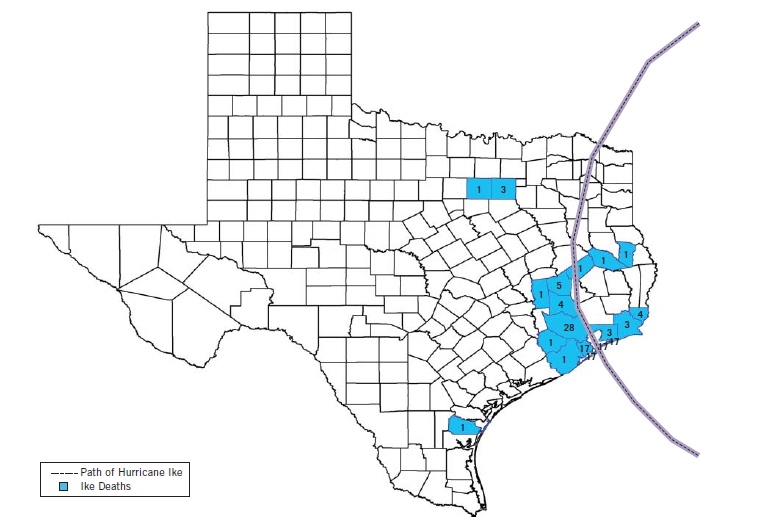
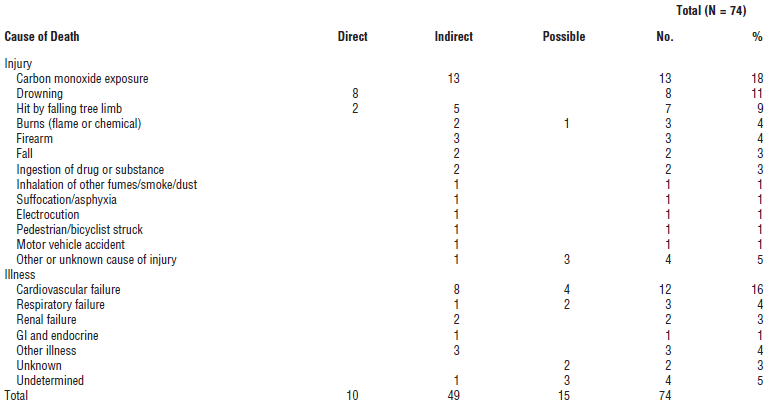
The active mortality surveillance identified 74 deaths in Texas as directly (10 [14%]), indirectly (49 [65%]), or possibly (15 [22%]) related to Ike from September 8, 2008, through October 13, 2008 (Table 1). Deaths occurred in 16 of the 44 counties covered by the surveillance. The majority of deaths occurred in Harris and Galveston counties (28 [38%] and 17 [23%], respectively [Figure 1]).The deceased ranged in age from younger than 1 year to 85 years, with an average age of 46 years (median 50 years); 70% were male.
Number of deaths related to Hurricane Ike (directly, indirectly, possibly) by County, Texas, September-October 2008

Number of Deaths and Their Relation to Hurricane Ike, by Cause of Death, Texas, September 8–October 13, 2008

When determining the cause of the 74 deaths, 47 (64%) resulted from injuries, 23 (31%) from illnesses, and 4 (5%) were undetermined. Carbon monoxide poisoning (18%), drowning (11%), and hit by falling tree (9%) were the leading causes of injury-related deaths. Cardiovascular failure (16%) was the leading cause of illness-related deaths. Regarding the manner of death of the 74 deaths, 33 (45%) were classified as resulting from unintentional injuries (accident), 20 (27%) from natural causes, 5 (7%) from suicide, 12 (16%) pending, and 4 (5%) undetermined.
When classifying deaths as either directly (n = 10) or indirectly (n = 49) related to the hurricane, the number of indirectly related deaths outnumbered deaths directly by nearly 5:1. All of the deaths directly related to the storm were caused by injuries, primarily drowning; 2 people died of blunt force trauma from being hit by falling tree limbs. Deaths indirectly related to the hurricane were associated with a wide range of injuries and natural causes (Table 1). Carbon monoxide poisoning was responsible for 13 (27%) of the indirect deaths; these were most often related to the inappropriate use of gas generators or use of charcoal grills (for cooking) inside a residence.
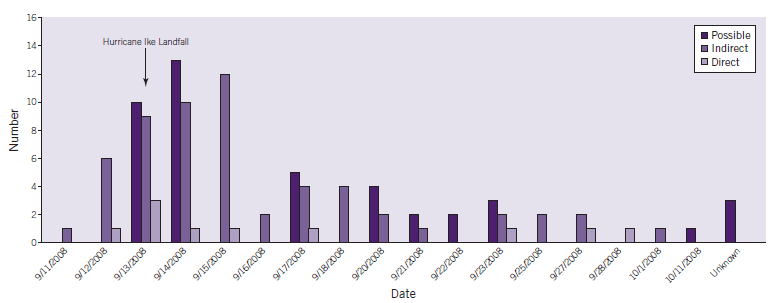
The majority (90%) of hurricane-related deaths occurred after hurricane landfall on September 13 (Figure 2). Seven deaths (10%) occurred during prestorm hurricane preparedness and evacuation activities. Among these deaths, 1 was a 10-year-old boy who was struck and killed by a falling tree limb that was cut down in preparation for the hurricane, and another was a 52-year-old man who was electrocuted when he drilled into live wiring while reinforcing his roof with additional screws. One of the 8 drowning incidents occurred 9 hours before hurricane landfall; a 19-year-old man was struck by storm surge waves and swept from a jetty into the Gulf of Mexico about 200 mi from eventual hurricane landfall. One of the 74 Ike-related deaths was work related; a 24-year-old male employee of a utility company was killed 4 days after the storm during the poststorm recovery period, when he was hit by a falling tree while clearing debris from power lines.
Number of deaths related to Hurricane Ike (directly, indirectly, and possibly), by date, in 44 Texas counties, September-October 2008

COMMENT
Mortality surveillance following natural or human-made disasters is important in determining the magnitude, manner, cause, and circumstances of disaster-related death. An understanding of attributable factors and the relation between disasters and mortality is critical for promoting improvements in public health preparedness planning and mitigation efforts.13
The mortality surveillance system was useful because it identified and characterized hurricane-related deaths. It defined the relation of the deaths to the hurricane (ie, direct or indirect), which was not possible using another system. DSHS prepared a daily report that contained updated information on the number of deaths and leading causes of mortality. The surveillance data showed carbon monoxide poisoning due to improper generator use as the leading cause of death after Hurricane Ike, a finding that helped to identify priority prevention messages needed during the recovery phase. These daily surveillance reports provided situational awareness to DSHS, state emergency management officials, and CDC's Emergency Operation Center and was extremely helpful in responding to media inquiries. Such use demonstrated the importance of actively exchanging mortality information during a public health emergency and also served as an early-warning alert system to detect mortality patterns where public health action may be initiated.
In Texas, the disaster mortality surveillance system associated with Ike indicated that injury directly or indirectly related to the hurricane was the leading cause of death, which is consistent with reported deaths associated with previous hurricanes.13 14 Reference Ragan, Schulte, Nelson and Jones15 This investigation continues to highlight the improper use of gas-powered generators associated with fatal carbon monoxide poisonings.Reference Van Sickle, Chertow and Schulte16 17 DSHS issued statewide press releases on carbon monoxide poisoning and prevention within 1 day of hurricane landfall and again on day 3, and regional staff distributed carbon monoxide poisoning prevention materials at ice and water distribution locations. In response to the early identification of carbon monoxide poisonings by local health officials in Harris County, the city of Houston and Harris County public health officials undertook joint and broad prevention efforts including disseminating press releases (in English and Spanish) and distributing fact sheets to residents and evacuees about the hazards posed by the improper placement of generators in indoor settings. Public health officials in Galveston distributed 6000 flyers containing carbon monoxide poisoning and prevention information.
The present report also highlights the danger of drowning during hurricanes, even in locations that are far from anticipated storm landfall. Hurricane-related drowning is associated with the sinking of boats during storms, increased surf or wave conditions at beaches and around jetties, and vehicle use during heavy rains.Reference Yale, Cole, Garrison, Runyan and Ruback18 Because there was 1 work-related death reported, utility employees should be reminded of the precautions they need to take during hurricane response.
In addition, the findings in this report suggest the need to establish an active mortality surveillance system before hurricane landfall in areas close to the predicted hurricane track or evacuation route. Seven deaths occurred before Ike made landfall, leading to the suggestion that public education on preventing injuries associated with hurricane preparedness activities need to be strengthened. High-population areas close to hurricane tracks are at risk. In this report, the 2 most heavily populated counties along Ike's path (Figure 1), Harris County (3 400 578 people) and Galveston County (250 158 people),19 accounted for nearly two thirds (45 [61%]) of the deaths. Public health messaging on hurricane preparedness activities, proper use of gas generators, and safe cleanup and recovery activities in targeted areas such as counties with high population density or close to the storm track will be crucial in reducing future hurricane-related deaths. We recommend future analytical epidemiological investigations of hurricane-related deaths to identify pertinent risk factors (eg, language differences, environmental) and a comparison of this active mortality surveillance system with passive surveillance systems such as normal death registration process (ie, vital statistics).
The findings in this report are subject to a number of limitations. First, there is no universally accepted standard definition of a hurricane-related death. This lack may lead to over- or underreporting, because the classification of a direct, indirect, or possible hurricane-related death is based on individual judgment, the availability of information, and the circumstances of death. Second, information on some of the deaths was incomplete. Third, an unknown number of deaths directly or indirectly attributable to the hurricane may have been missed, particularly those indirectly attributable to the hurricane that occurred outside of the investigation's geographical and temporal scope.Reference De Ville de Goyet20
Hurricane-related deaths are preventable. In the United States, before the implementation of warning, evacuation, and shelter systems, drowning from storm surge accounted for an estimated 90% of hurricane-attributable mortality.Reference Alexander21 22 Improvements in hurricane forecasting and well-devised evacuation and shelter procedures have shifted hurricane mortality trends.23 Public health agencies can use the surveillance results from Ike to promote improvements in hurricane preparation, warning, and response activities. Local, regional, state, and federal health agencies, medical examiners, justices of the peace, and other partners should continue to collaborate to improve the capacity to track deaths during the hurricane season.
CONCLUSIONS
Defining the relation of death to hurricanes using an active mortality surveillance system is possible. The active mortality surveillance form used after Ike provided valuable daily information to DSHS, state emergency management officials, and the CDC regarding the characteristics of deaths in the state. Most of the Ike-related deaths resulted from injury (directly or indirectly related) such as carbon monoxide poisonings and drowning and may have been preventable by educating the public about such risks.
Author Disclosures:
The author reports no conflicts of interest.
Acknowledgments: The findings in this report are based, in part, on contributions by participating medical examiner offices in Harris County, Galveston County, Dallas County, Nueces County, and Webb County; justices of the peace; Southeast Texas Forensic Center; hospitals; local health departments; and regional epidemiology response team members and central office staff at the Texas Department of State Health Services. We thank them for their contributions.