Introduction
Previous research on the Dutch variant of assertive community treatment (ACT), Function ACT (FACT), showed increased symptomatic remission rates compared to care as usual (CAU) (Bak et al. Reference Bak, Van Os, Delespaul, De Bie, Campo, Poddighe and Drukker2007; Drukker et al. Reference Drukker, Maarschalkerweerd, Bak, Driessen, Campo, De Bie, Poddighe, Van Os and Delespaul2008a). Because FACT aims at increasing the continuity of care, an association between FACT and health care use may be hypothesized.
FACT teams are delivering service for the total group of patients diagnosed with severe mental illness (SMI) in a region while ACT only covers the 20% of the most severely ill subgroup (Van Veldhuizen, Reference Van Veldhuizen2007). SMI is best characterized as a complex combination of psychiatric, somatic and social needs and the burden is high (Kessler et al. Reference Kessler, Aguilar-Gaxiola, Alonso, Chatterji, Lee, Ormel, Ustun and Wang2009; Drukker et al. Reference Drukker, Bak, Campo, Driessen, Van Os and Delespaul2010). FACT combines two approaches within one multidisciplinary, recovery-oriented team: (a) individual case management and home visits for ‘extensive’ care SMI patients who are mostly stable and (b) shared caseload with ‘intensive’ full ACT approach for patients with more needs. The latter group receives care according to ACT directives including daily reviews in staff meetings. When, over time, the care needs of these patients change, they remain in the same multidisciplinary team (continuity of care). Compared to ACT, FACT is a more versatile and comprehensive care system with continuity of care as an important component. The FACT teams are in charge when patients are in the community and in hospital, and make decisions regarding admissions and discharge from hospital (Van Veldhuizen, Reference Van Veldhuizen2007). Thus, FACT teams serve a diverse population of SMI patients with various levels of need for care. On the other hand, ‘classic’ ACT serves only those SMI patients who are in crisis or have the highest needs for care. As intensive care patients need more guidance than more stable patients do, the average frequency of contacts in a FACT team is lower and the number of patients per team is higher than in an ACT team (CCAF, 2011).
Thus, FACT guidelines predict a different pattern of psychiatric care consumption than CAU. If FACT brings about an overall rise in psychiatric care consumption, the beneficial effects may not be cost effective. However, FACT also aims at keeping patients in extensive care to prevent future hospital days.
Treatment of SMI outpatients varies widely within Europe and alternatives of in-patient care such as FACT have been proposed, but research on these alternatives is lacking (Lasalvia & Tansella, Reference Lasalvia and Tansella2010). Although FACT was developed for the Dutch mental health care system, it has been noted that its features may also be applicable to other countries (Bond & Drake, Reference Bond and Drake2007). In fact, new Belgian guidelines advise FACT as the standard mode of treatment delivery for SMI patients (SCEM Conference Services, 2011). In Italy, clinical principles comparable to those underlying FACT (outpatient treatment and case management) are guiding treatment delivery (Lora et al. Reference Lora, Bezzi and Erlicher2007, Grigoletti et al. Reference Grigoletti, Amaddeo, Grassi, Boldrini, Chiappelli, Percudani, Catapano, Fiorillo, Perris, Bacigalupi, Albanese, Simonetti, De Agostini and Tansella2010).
An important ingredient of FACT is monitoring; professional carers regularly assess, among others, severity of symptoms and need for care. They use this information in the patient's treatment plan that prescribes the level of psychiatric health care consumption. In CAU, there is no such assessment, but a hypothetical index assessment date can be copied from the FACT patient after matching (see Method section).
Patients at different stages of illness may respond differently when current needs are assessed to plan treatment (Drukker et al. Reference Drukker, Van Dillen, Bak, Mengelers, Van Os and Delespaul2008b). Patients new in care have acute severe psychopathology and low insight, but a relatively intact social network and employment status. Patients in persistent care, however, are more likely to formulate care needs as a result of lack of treatment response and chronic social complications.
The present paper assesses differences in health care use between FACT and CAU in the year after the index assessment date compared with the year before. We expected that results would depend on treatment status at baseline as described previously (Drukker et al. Reference Drukker, Van Os, Dietvorst, Sytema, Driessen and Delespaul2011). Furthermore, using the year before and the year after an assessment, transitions of health care use over time were modelled, using methods derived from cost-effectiveness analyses (Sonnenberg & Beck, Reference Sonnenberg and Beck1993; Detsky et al. Reference Detsky, Naglie, Krahn, Naimark and Redelmeier1997; Naimark et al. Reference Naimark, Krahn, Naglie, Redelmeier and Detsky1997; Briggs et al., Reference Briggs, Claxton and Sculpher2007).
Methods
The cumulative needs for care monitor (CNCM) database
In the FACT region (population 200 000), in the far South-east of the Netherlands, the CNCM monitors treatment in the course of routine care. CNCM data are cumulatively stored and include multiple assessments per patient on needs for care, psychopathology, well-being and global assessment of functioning split into its psychopathology (GAF-p) and impairment (GAF-i) components (American Psychiatric Association, 1994) for all patients in the region, living both inside and outside hospital. The CNCM is described in more detail elsewhere (Drukker et al. Reference Drukker, Bak, Campo, Driessen, Van Os and Delespaul2010).
Psychiatric case registers (PCR)
PCR register mental health care consumption of all mental health service users in a region. One of the four Dutch PCRs is active in the FACT region (Drukker et al. Reference Drukker, Bak, Campo, Driessen, Van Os and Delespaul2010). CNCM and PCR data were matched anonymously at the level of individual patients using an encrypted identification code provided through a secure internet connection. This procedure ensures that patient material can be linked to the same person (>99% certainty) without being able to trace information back to specific persons.
The PCR registering mental health service consumption in the three provinces in the North of The Netherlands (hereafter: NN, population 1.7 million) was used as a control region, as availability of psychiatric care, level of urbanicity and ethnic diversity (low levels of immigration) are similar to that of South Limburg but FACT was not yet in place at the time. Patients from NN were matched with FACT patients (see below).
Treatment status at the first mental health contact after 1 July 2004 (hereafter: treatment status at baseline) was based on PCR data and included three categories: subjects were in care on this date (persistent); they had never been in care (new patients) or were not in care in the 365 days before this date, but had care before that time (new episode).
Subjects and matching
CNCM and PCR data were matched (for more details, see Drukker et al. Reference Drukker, Van Os, Dietvorst, Sytema, Driessen and Delespaul2011) to identify which FACT patients had a CNCM assessment between 1 July and 31 December 2004 and what care they used before 1 July 2004. These patients were matched with NN-controls (CAU), using propensity score nearest-neighbour-matching with replacement. Propensity scores were based on the following continuous variables: number of days between 1 January 1999 and 1 July 2004 that patients received (inpatient or outpatient) care, number of hospital days between 1 January 1999 and 1 July 2004, date of start mental health care episode in 2004 in days since 1 January 1960 and age, as well as the following categorical variables: gender and treatment status at baseline. All FACT patients were matched with the NN patient with the nearest propensity score as well as those with the two second nearest scores, aiming at making matching groups consisting of one FACT and three CAU patients. However, if more CAU patients had the same propensity score, all were included in the matching group.
For each matching group, the assessment date of the FACT patient was copied to the CAU patients as a hypothetical index date had the CNCM been in place in NN. Days in hospital, outpatient contacts and number of days in day care in the year before and in the year after this date were obtained from the PCR and used to obtain change scores.
In the matching procedure, 112 matched groups with complete data were identified, varying from 3 to 10 patients, of which 1 or 2 were FACT patients. A total of 114 FACT and 330 CAU patients were in the final dataset. Eighty-nine percent of the FACT patients met criteria for SMI or moderate mental illness as defined previously (Drukker et al. Reference Drukker, Bak, Campo, Driessen, Van Os and Delespaul2010).
Statistical analysis
Patients (level 1) were clustered in matched groups (level 2). Therefore, data were subjected to multilevel linear regression analysis (hereafter regression model), which is ideally suited for the analysis of this type of data (Snijders & Bosker, Reference Snijders and Bosker1999).
Changes in care consumption (after minus before) were the dependent variables in the regression model. Region (FACT or CAU) and treatment status at baseline (no care before 2004; new episode; or persistently in care) were included as well as the interaction term between region and treatment status at baseline. Treatment status at baseline was recoded into dummies with persistent as the reference category. When any of the interaction dummies was statistically significant (alpha was set at .1), the Stata Lincom procedure was used to calculate regression coefficients of region for all categories of treatment status at baseline.
Methods derived from cost-effectiveness research
Patients were categorized according to their health care use in a year: all-year inpatient, short-term inpatient, sheltered housing or outpatient only. In cost-effectiveness analyses, these mutually exclusive categories are referred to as ‘health states’. Although patients were categorized based on their most intensive health care use, they also used other types of health care (e.g. average use of outpatient care was higher in patients in the short-term inpatient health state than in patients in the outpatient health state). Average health care use and functioning per health state were obtained from the data. Column proportions in a cross-tabulation of health care use in one year by health care use in the next year can be seen as transition rates between health states and can be used to model cohort migration over 5 years, in analogy with methods from cost-effectiveness analysis (Sonnenberg & Beck, Reference Sonnenberg and Beck1993, Detsky et al. Reference Detsky, Naglie, Krahn, Naimark and Redelmeier1997, Naimark et al. Reference Naimark, Krahn, Naglie, Redelmeier and Detsky1997, Briggs et al. Reference Briggs, Claxton and Sculpher2007).
Results
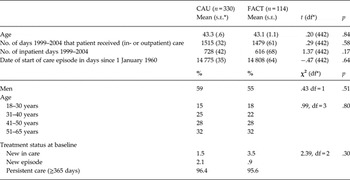
After matching, the variables age, gender, and other background and baseline characteristics were distributionally similar between CAU and FACT patients (Table 1, characteristics of the total patient group before and after matching, see Drukker et al. Reference Drukker, Van Os, Dietvorst, Sytema, Driessen and Delespaul2011).
Characteristics of FACT patients and their CAU controls

*s.e., standard error; df, degrees of freedom.
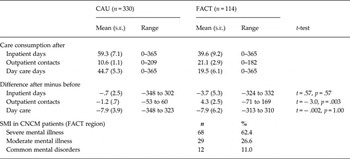
The interaction term between region and treatment status at baseline was not large or statistically significant in any of the regression models (χ2 = .09, df = 2, p = .95; χ2 = 3.63, df = 2, p = .16; χ2 = .07, df = 2, p = .97). After the index date, FACT patients received on average four more outpatient contacts, while in CAU this was 1 less (Table 2). After controlling for clustering in matched groups, results showed that FACT patients on average received 5.3 more outpatients contacts (p = .004, 95% CI: 1.68–8.82) than patients in CAU. Hospital days and day care days did not differ (β = −2.9 and −.68, respectively).
Care consumption

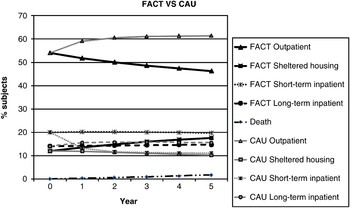
Cohort migration in Fig. 1 shows that, in FACT, the proportion of patients in the long-term inpatient health state was lower than in CAU, whereas the proportion in the short-term inpatient health state was higher. In addition, the proportion in the outpatient health state was lower and in the sheltered-housing health state was higher. However, similar to the real data (note this paragraph presents a cost-effectiveness model), total outpatient health care use combined across all health states showed an increase, while total inpatient care showed a decrease.
Cohort migration

Cost effectiveness
Because of the increase in outpatient care, costs are €8000, higher over 5-year in FACT than in CAU. In addition, the cohort migration model showed a decrease in functioning (GAF) in FACT compared with CAU. Thus, CAU is dominant.
Discussion
Data showed that patients in FACT used five more outpatient contacts per year than CAU. The difference between FACT and CAU is both the assessment itself and its use in FACT treatment. When the use of the assessment alone was evaluated, there was interaction between region and treatment status at baseline (Drukker et al. Reference Drukker, Van Os, Dietvorst, Sytema, Driessen and Delespaul2011). In new-episode patients the assessment was associated with an average increase of 13 outpatient contacts in the year after (excluding the FACT-region) (Drukker et al. Reference Drukker, Van Os, Dietvorst, Sytema, Driessen and Delespaul2011). Apparently, these patients are more likely to express their needs than new patients with low insight. On the other hand, needs that remain in persistent patients, such as lack of treatment response and chronic social complications, may not lead to more health care use. In the present paper, outpatient care increased (5 days) for all patients in the year after the assessment. When including the non-significant interaction term regionXtreatment status at baseline in the regression model for reasons of comparison, this increase was mainly apparent for new patients (26 contacts) and in persistent patients (five contacts). Thus, while a previous paper showed that assessment potentially increase outpatient care consumption in new-episode patients (Drukker et al. Reference Drukker, Van Os, Dietvorst, Sytema, Driessen and Delespaul2011), the present paper shows that the addition of FACT-treatment increases outpatient care consumption in all patients.
The cohort migration model (Fig. 1) predicted more short-term and less long-term inpatient care in the FACT group. Patients with short-term inpatient care use more outpatient care than the outpatient group. Presumably this was the cause of the observed higher level of outpatient care in the FACT patients. In addition, that FACT teams encourage sheltered housing supported by the cohort migration model. To the degree that these patients were in the outpatient care group before sheltered-housing solutions were implemented, the decrease in the outpatient care group in the cohort migration model would be explained. There may be other explanations for the increase in sheltered housing in the FACT region over two consecutive years (as used to model cohort migration), compared to the control region. However, because we compared psychiatric health care consumption before the FACT assessment date with psychiatric health care consumption after this date, we controlled for differences between the two regions. Health care policy did not aim at increasing availability of sheltered housing, while the provision of sheltered housing is not within the remit FACT.
Cost effectiveness
Because of an increase in outpatient care, the cost-effectiveness model showed that costs seem €8000, higher over 5-year in FACT than in CAU. Although previous results showed an increase in remission in FACT, the present cohort migration model showed a decrease in functioning (GAF). However, functioning data were obtained only from the CNCM data and were not available from the control region. Therefore, the validity of the cost-effectiveness model with respect to the health outcomes could not be verified. Although this model shows that CAU is dominant, this may be different when studying remission or other health outcomes. In addition, the model uses health outcome per health state and health state is defined based on health care use. Possibly, remission, functioning and other health outcomes differ between FACT and CAU within health states and the model cannot capture such differences. Therefore, future studies should collect data on health outcomes such as functioning and remission in at least two consecutive years, so that health states can be based on outcomes rather than on health care use. In that case, a real cost-effectiveness analysis can be performed. Secondly, the observed difference of €8000, over 5 years should be considered with care, given assumptions underlying cost-effectiveness models. The cost-effectiveness model included costs of psychiatric health care use (inpatient, outpatient, sheltered housing and day care) and somatic health care costs.
Methodological issues
Originally, data were matched to study differences in psychiatric health care use between the total CNCM region and the control region. For the present paper, a subset of the CNCM patients who were treated in FACT were selected as well as their CAU controls.
Both CNCM and FACT aim at including all patients in a region and not only the most severe subgroup, like in ACT. In ACT research, only the most severe cases would have been included and they would have improved as a result of regression to the mean. On the other hand, the present paper showed that FACT successfully aims at keeping less severe patients in care. Future research should keep in mind that as a result average severity of symptoms and functioning may be better in the FACT group.
Declaration of Interest
We gratefully acknowledge the financial support of the PCR by the ministry of Health, Welfare and Sport. The authors declare that they have no competing interests.