Introduction
Several mechanisms have been identified by which plant seeds are dormant when shed (Baskin and Baskin, Reference Baskin and Baskin2004). In physical dormancy, seeds are dormant due to impermeability of the seed or fruit coat to water, acquiring germinability only when this barrier is overcome (Rolston, Reference Rolston1978). Sixteen families are known to have species with physical dormancy (Baskin et al., Reference Baskin, Baskin and Li2000, Reference Baskin, Baskin and Dixon2006), of which the legume family (Fabaceae) is the largest and most important. Seed impermeability in legumes is also often termed ‘hard-seededness’, impermeable seeds being referred to as ‘hard seeds’ (Taylor, Reference Taylor2005).
Baskin and Baskin (Reference Baskin and Baskin2001) outlined several theoretical scenarios in which seed dormancy is an adaptive feature. In one of these, dormancy serves to prevent germination when conditions are unfavourable for seedling establishment, and it is this scenario that is considered to pertain to physical dormancy the most. Physically dormant species usually have defined germination periods in well-suited seasons, such as at the start of the warm season in typically temperate conditions (Roberts and Boddrell, Reference Roberts and Boddrell1985; Van Assche et al., Reference Van Assche, Debucquoy and Rommens2003), or after the hot summer in Mediterranean climates (Norman et al., Reference Norman, Cocks, Smith and Nutt1998, Reference Norman, Cocks and Galwey2005). Physical dormancy is indeed important relative to other dormancy types in vegetations that are subject to distinctly dry and wet seasons, which are unfavourable and favourable for establishment, respectively. In a second scenario, the benefit of dormancy is in the timing of germination, so that fitness of the resulting plant is maximized. Indeed, several studies on various species have shown an increased seed production in either early-, or late-germinated plants within seasons (listed by Baskin and Baskin, Reference Baskin and Baskin2001). Thirdly, dormancy may act to reduce the risks associated with temporal habitat instability by forming soil seed-banks that persist over several years (Venable and Brown, Reference Venable and Brown1988; Snyder, Reference Snyder2006). It should be noted, however, that these scenarios are not mutually exclusive.
In legumes, water impermeability of seeds is acquired through dehydration during seed ripening (Quinlivan, Reference Quinlivan1971). Water at first evaporates through the seed coat, but as the internal moisture content drops, the coat becomes impermeable, and further evaporation occurs via the seed hilum. The hilum then acts as a unidirectional valve that allows evaporation when external conditions are dry, but prevents water from entering when conditions are moist (Hyde, Reference Hyde1954).
Legume seeds are normally shed in this water-impermeable, dormant state (Taylor, Reference Taylor2005). However, studies that considered legume seed impermeability at the plant level indicated that seeds are sometimes permeable to water, thus non-dormant at maturity. Several treatises on Trifolium subterraneum, for instance, included the initial proportion of dormant seeds as a variable of interest. Nichols et al. (Reference Nichols, Cocks and Francis2009) recorded about 60% of the seeds to be permeable at harvest in their experiment, while Smith (Reference Smith1988) noted proportions from 18 to 91% for various line–year combinations 10 d after harvest. Piano et al. (Reference Piano, Pecetti and Carroni1996) and Taylor (Reference Taylor2005) reported similar findings. Cowan et al. (Reference Cowan, Marshall and Hides1997) investigated initial seed impermeability in other, non-geocarpous clover crops grown in controlled conditions and reported levels < 10% permeable in T. repens and T. nigrescens, but higher levels in T. occidentale (up to 61%). The initial degree of dormancy has, however, more rarely been described for natural populations. In a New Zealand pasture system, Chapman and Anderson (Reference Chapman and Anderson1987) found about 25% of the seeds in T. repens to be non-dormant. Although not tested, some of these studies attributed the incidence of permeable seeds to coincidently high levels of moisture during seed maturation (due to rainfall, poor soil drainage or extended irrigation), which would prevent the seeds from drying, and thus from becoming dormant.
Although it might be an important phenomenon in natural populations, this intra-specific variation has never been dealt with explicitly by plant ecologists. In this study, we therefore raise and address the following three questions concerning legume non-dormancy. (1) To what extent do wild plants show variation in initial non-dormancy? (2) To what extent is this variation genetic? (3) What significance, if any, do non-dormant seeds have for plant fitness? In white clover (Trifolium repens L.), we therefore recorded the degree of initial impermeability in wild populations. We secondly performed a greenhouse experiment to determine how humidity and plant genotype affect the attribute in this species. Finally, we assessed experimentally the relative importance of permeable and impermeable seeds in contributing to plant establishment and reproduction.
White clover is a widespread legume that can be found in various habitats; most frequently in conditions that are grazed, mown or kept open otherwise (Burdon, Reference Burdon1983). It is a perennial species, the main mode of regeneration of which is through the production of stolons. Yet yearly, new recruits are added to populations through seeding (Barrett and Silander, Reference Barrett and Silander1992). The inflorescence is a racemose head containing about 30 flowers, each of which usually yields a three- to six-seeded pod. When a flower is pollinated, the pedicel recurves and allows for an easy indication that seed development has started (Hyde et al., Reference Hyde, McLeavey and Harris1959). Developing seeds become viable some days before acquiring dormancy (about 16 and 24 days after pollination, respectively; Hyde et al., Reference Hyde, McLeavey and Harris1959). For determining the proportion of dormant seeds, it is therefore important to collect seeds sufficiently late (in effect, at least 24 d after pollination).
Materials and methods
Impermeability and viability testing
To determine the initial proportion of impermeable (to viable) seeds for a given head, all seeds were dissected from the head the day after collection. Seeds were tested for water impermeability by placing them on filter paper (Whatman GF/A, 90 mm; Whatman International Ltd, Maidstone, Kent, UK) in Petri dishes with 3.5 ml of water at 22°C, and recording them for 3 d. If a seed is permeable, it imbibes water and swells, or germinates (ISTA, 2008). Imbibed seeds were subsequently submersed in a tetrazolium solution (1.0%) to test for viability (Peters, Reference Peters2000). At the end of the 3-day period, all remaining impermeable seeds were superficially cut with a scalpel near the distal end of the cotyledons to make them permeable, and tested for viability.
Field occurrence of impermeability
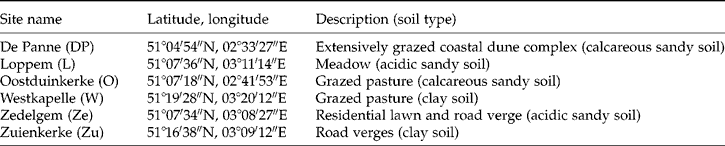
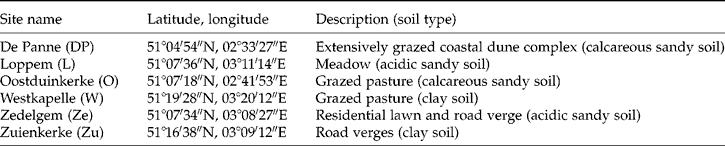
In July 2008, we selected white clover plants at six sites in the westernmost province of Belgium (Table 1). At each site we randomly selected 10 (20 at one site) flowering patches that were at least 10 m apart. We marked 6–10 heads per patch by tying colourful strings to the peduncles. Collections were performed 26 d later. Priority in marking was given to heads in which all flower pedicels were recurved, but had not yet turned colour. Otherwise, heads were allowed to have at most four flowers not yet recurved (although this was rarely the case; these flowers could slightly bias impermeability proportions due to incomplete development at collection). Some patches were lost during the period from marking to collection (for example, due to grazing), and we eventually analysed 107 heads from 59 patches for seed viability and water impermeability. Since densities of white clover genotypes can be high at small scales (Cahn and Harper, Reference Cahn and Harper1976), no inference on individual clones can be drawn from this part of the study.
Description of the sites at which the degree of initial impermeability in mature white clover inflorescences was recorded
To check whether seed impermeability is related to environmental humidity, we consulted climatological statistics for the seed-ripening period from the ten weather stations nearest to the six-site centroid (Malcorps, Reference Malcorps2008; stations of the Belgian Royal Meteorological Institute, all within 100 km from the centroid).
Genotype by humidity
To assess whether variation in the proportion of impermeable seeds from heads is caused by differences in humidity, or by different genotypes, we conducted an experiment under controlled climatic conditions.
In May 2008, we isolated nine adult plants from three natural sites. The distances between plants within sites were at least 30 m to make sure they were genetically distinct. They were grown in a glasshouse, and cuttings were propagated from them. In May 2009, after open pollination by wild insects, six ramets from each of these clones (54 plants in total) were transferred to environmentally controlled greenhouses for ripening. Since physical dormancy is a feature of the seed coat, it is maternally determined; therefore, no controlled hand-pollination was needed. Two ramets per clone were allowed to ripen under one of three levels of relative air humidity (RH), denoted as ‘wet’ (median relative humidity 99.9%, minimum 89.0%), ‘mesic’ (median 94.3%, minimum 61.1%) and ‘dry’ (median 78.3%, minimum 46.5%); RH was recorded by two loggers per treatment, 9300 measurements per logger. Since the desiccation of developing seeds, and with it, the acquisition of water impermeability, is an irreversible response to decreases in moisture, it is important to note that the minimum might be a better measure for humidity than the median.
After ripening in the greenhouses, heads were collected from each ramet (105 in total, 25–32 d after translocation from the glasshouse), and their seeds were tested for impermeability and viability.
Performance of permeable versus impermeable seeds
Once dormancy is broken, germination requirements are usually readily met in white clover. Seeds that are non-dormant when shed in autumn are consequently expected to germinate that same season. Dormant seeds, on the other hand, usually germinate in spring (Roberts and Boddrell, Reference Roberts and Boddrell1985; Van Assche et al., Reference Van Assche, Debucquoy and Rommens2003). In a field-sown experiment, we compared the field performance of non-dormant (autumn-germinating) and dormant (spring-germinating) seeds in germination, seedling establishment and first-year flowering.
The experiment was set up on the boundary of a sward and fallow vegetation in a nature reserve (Doeveren; 51°07′33″N, 3°11′13″E). The sward represented a habitat suitable for white clover: it was mown twice a year and was dominated by Lolium perenne, Poa pratensis and white clover. The fallow was former arable land, at mid-successional stage ( ± 75 cm vegetation height; saplings were lacking at the scale of the experiment). It was dominated by Juncus effusus and Holcus lanatus. Being a light-demanding species, this habitat is not optimal for adult white clover though potentially encountered by young plants, as germination itself is considered independent of light (Van Assche et al., Reference Van Assche, Debucquoy and Rommens2003).
We harvested seeds for the experiment in the vicinity of the site in summer 2008, and separated permeable from impermeable seeds. The installation of plots (see below) consisted of sod-cutting a turf of 50 × 50 × 10 cm, turning it upside down (to make it free from competition), then sod-cutting the central 30 × 30 cm again and replacing it by a mixture of sand and potting soil (1:1 volume). After the introduction of seeds, plots were caged to exclude herbivores (1.25 mm mesh).
In order to appropriately compare establishment from autumn- and spring-germinating seeds, it is necessary to determine the exact timing of natural spring germination at the site. Along the sward–fallow boundary, we delimited five blocks, each comprising one plot in the sward and one in the fallow. Each of these plots was provided with 20 dormant seeds in autumn (1 October). They were buried superficially ( < 1 cm) in open plastic tubes (13 mm diameter) to facilitate retrieval, and seedling emergence was monitored on a monthly basis. At the end of the study period, we exhumed the non-germinated seeds and determined their viability.
We installed six blocks, each comprising two plots in the sward and two in the fallow, alternating with the blocks of the former experiment. Within each of these vegetation/block-combinations, one plot, chosen randomly within the pair, was provided with freshly imbibed seeds in autumn (representing naturally non-dormant seeds; sown on 5 September; 26 seeds per plot). The other plot was provided with imbibed seeds that had been artificially scarified in the following spring (mimicking naturally dormancy-released seeds; the sowing date was therefore determined by the previous experiment and was set to 15 April; 26 seeds per plot). Scarification of the latter was performed by nicking the seed coat near the cotyledons the day before sowing. Seeds were buried superficially, and seedling emergence and survival were monitored monthly. The reproductive output from these recruits was recorded by counting the number of inflorescences produced during the summer of 2009. In August, we additionally marked ten heads from both the sward and the fallow (chosen randomly), and collected them 35 d later to test the seeds for viability and impermeability.
We manually controlled for weeds within plots throughout the study. Four control plots without introduced seeds were monitored for external contamination (one at each end of the set-up); however, no background germination occurred. Temperature and relative humidity were recorded hourly at ground level by loggers.
Statistical analyses
To test whether mean proportions of impermeable to viable seeds from heads differed significantly between the six sites studied, a generalized linear model (Kutner et al., Reference Kutner, Nachtsheim, Neter and Li2005) was constructed in which site was entered as a fixed factor, and patch as a nested random factor. A Spearman rank correlation was performed to test for an interdependence between the number of viable seeds in a head and the proportion of impermeable seeds.
To test whether humidity and genotype affected impermeable seed proportions, we used a generalized linear model on the data from the greenhouse experiment. The proportion of impermeable to viable seeds from heads was the response variable. Humidity was entered as a fixed factor (three levels), the clones as a random factor (nine levels), and their interaction as a random factor. By considering the variance that is due to the clones relative to the total (phenotypic) variance, a measure termed the ‘clonal repeatability’ was determined (Falconer and Mackay, Reference Falconer and Mackay1996). This measure can include some environmental effects (those that are transmitted from the original plant to all derived ramets), but sets the upper limit for the trait's broad-sense heritability, which is the proportion of the phenotypic variation that represents genotypic variation.
For the experiment on dormancy loss, we tested the effect of the vegetation (sward versus fallow) on seed germination using a generalized linear model. As this experiment employed repeated measurements of plots over time, the within-plot correlation among the subsequent dates of monitoring was accounted for (marginal model; Fitzmaurice et al., Reference Fitzmaurice, Laird and Ware2004). For the second experiment (initially non-dormant versus dormancy-released seeds), we disconnected seed germination from seedling survival: germination was given by the first census (baseline), while survival was given by the subsequent censuses corrected for the baseline. Germination percentage was treated in a generalized linear model, with vegetation (sward versus fallow) and sowing date (autumn versus spring, representing the non-dormant and dormant seeds, respectively) as fixed effects. Seedling survival was treated in a general linear model with the same effects as well as an assumedly linear effect of time; monitoring dates accounted for within-plot correlation among repeated measurements. For the proportion of dormant (to viable) seeds from heads, a comparison between both vegetation types was made using a simple generalized linear model.
All statistical analyses were executed using SAS 9.2 (SAS Institute Inc., Cary, North Carolina, USA).
Results
Field occurrence of impermeability
The summer of 2008 proved relatively wet compared to previous summers. Precipitation levels in July reached 0.8–1.6 times the July means of the weather stations, which were ‘normal’ anomalies for most stations (Malcorps, Reference Malcorps2008). In August, precipitation amounted to 1.1–2.3 times the August means, which was classified as ‘abnormal’ for most stations, meaning that similar or higher precipitation levels are, on average, observed once every 6 years.
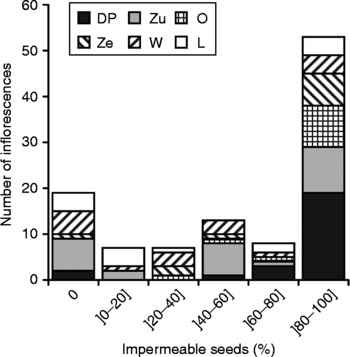
From 107 inflorescences, we obtained 6536 seeds that proved viable (on average 61 per head, standard deviation = 38). No less than 35% of these seeds imbibed water during the 3-day test period (mostly during the first night). The proportion of permeable seeds varied greatly among heads (Fig. 1): some heads only contained permeable seeds, others only contained impermeable seeds, and others contained intermediate levels of both. This range from 0 to 100% was observed at all but one site; site means were nevertheless significantly different (P = 0.030), ranging from 46 to 87%. In some heads, we observed vivipary as seedlings emerged in or from pods.
Frequency distribution of the proportion of impermeable (to viable) seeds held within mature white clover inflorescences (n = 107). Different shading refers to the six sites studied; see Table 1 for abbreviations.

There was no significant correlation between the number of seeds from heads and their impermeable proportions (P = 0.343).
Genotype by humidity
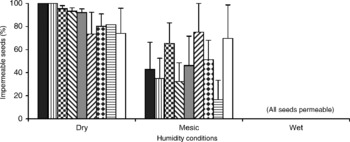
Humidity had a marked effect on seed impermeability (Fig. 2; P = 0.003). Heads that ripened under wet conditions contained only permeable seeds, while those that ripened under dry conditions contained few permeable seeds. The mesic treatment yielded intermediate levels of both. A test of the variance parameters indicated that the clone-by-humidity interaction did not significantly differ from zero (P = 0.160). After its omission, the very low (yet significant; P = 0.042) clonal variance component yielded a clonal repeatability (and maximal broad-sense heritability) estimate of 0.025. The observed phenotypic variation thus almost purely represented phenotypic plasticity within genotypes.
The proportion of impermeable (to viable) seeds held within mature white clover inflorescences in relation to humidity and genotype (average ± SE). Each shading refers to one of nine genetically distinct clones. Ramets of these were grown under either dry [minimum relative air humidity (min. RH) 46.5%], mesic (min. RH 61.1%) or wet (min. RH 99.9%) conditions.

There was a significant correlation between the number of seeds from heads and their impermeable proportions: higher seed numbers coincided with higher fractions of dormant seed (P < 0.001).
Performance of permeable versus impermeable seeds
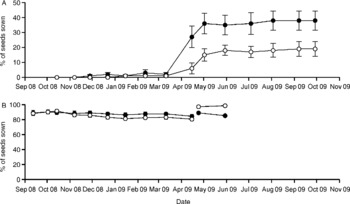
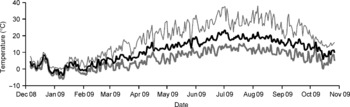
Of the 200 dormant seeds that were introduced in the field experiment, 58 (29%) emerged during the study (Fig. 3A), with a clear upsurge between mid-March and mid-April. March 15 was the first day on which the temperature range spanned the 6–15°C interval in each vegetation (Fig. 4), giving further support to these numbers as a cue for germination in the species (see Van Assche et al., Reference Van Assche, Debucquoy and Rommens2003). Significantly higher germination percentage was observed in the sward than in the fallow (P = 0.043). We retrieved 129 of the ungerminated seeds at the end of the study, which all proved to be alive and dormant.
(A) The percentage of emerged seedlings from dormant seeds that were sown in autumn 2008 (average ± SE). Closed dots, sward vegetation; open dots, fallow vegetation. (B) The percentage of emerged seedlings from non-dormant seeds that were sown in autumn (left set of lines), and from scarified seeds that were sown in following spring (right set of lines; average ± SE). Closed dots, sward vegetation (the outlier plot is not included, see text); open dots, fallow vegetation.

Daily minimum, mean and maximum temperatures recorded at the study site (bold grey, black and thin grey lines, respectively). Data is from the sward vegetation.

Germination percentage was high for both the autumn- and spring-sown, non-dormant seeds in both vegetation types (Fig. 3B). One sward plot was lost because of damage to the seedlings by an unidentified invertebrate. Despite the high germination, significant effects of vegetation (fallow>sward, P = 0.025), sowing date (spring>autumn, P = 0.012) and their interaction (P = 0.014, the outlier plot excluded) were seen, since germination of the spring-sown seeds in the fallow was nearly complete. Seedling survival proved to be high as well. For the autumn-sown seeds, the effect of time, or in other words, winter mortality, was nevertheless significant (Fig. 3B, P = 0.001). No effect of vegetation was found (P = 0.792), nor of its interaction with time (P = 0.186).
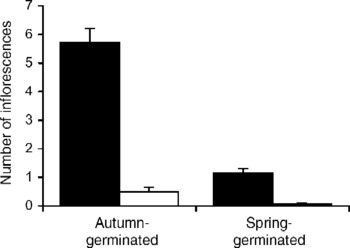
Although we did not quantify vegetative regeneration of the recruits, stolon growth appeared markedly faster in the sward than in the fallow. For the autumn-germinated plants, stolon growth commenced in winter and was so extended by April that it became too difficult to discriminate between intertwined individuals in plots. For the spring-germinated plants, stolon growth was even more rapid, and within 2 months censuses were ceased for the same reason. Due to this marked head start in growth, plants from autumn-germinated seeds developed inflorescences sooner, and, eventually, more of them, than plants from spring-germinated seeds in the same vegetation (Fig. 5). Being a suitable habitat for adult white clover, the sward yielded more flowers per individual than the fallow.
The average number of inflorescences produced per individual plant during summer 2009 ( ± SE). Closed bars, sward vegetation; open bars, fallow vegetation. The plants correspond to those from Fig. 3B.

During the period from marking inflorescences of these recruits to fruit collection in summer 2009, the minimal relative humidity recorded at ground level was 34.7% (median 89.1%) in the sward and 70.0% (median 96.5%) in the fallow. The newly ripened seeds were markedly dormant: of the 1566 viable seeds tested (from 20 heads), only 93 (6%) were permeable. For most heads, over 95% of the seeds were impermeable (range: 38–100%), with no significant difference between vegetation types (P = 0.498).
Discussion
In normal summer conditions, white clover develops seeds of which the great majority are water impermeable at maturity. However, if environmental conditions during seed ripening are relatively wet, such as during the summer of 2008, a significant proportion of seeds are prevented from becoming dormant. Since climatological records indicate similar anomalies to occur once every 6 years or so, we suggest that legume populations (from higher latitudes or altitudes, for example) are confronted with non-dormancy more often than is generally assumed.
As humidity conditions can vary through space and time even at small scales, the variation witnessed in initial seed permeability most likely reflects such microclimatic variation. The position of a ripening head relative to surrounding foliage (own or alien), for instance, will be a major determinant for its level of dormancy in the field, in combination with the prevailing weather conditions. Larger-scale patterns are then likely to be found when consistently associated with such conditions (e.g. short, sunlit, versus high, dense vegetations). In legume cultivation, sufficient attention should accordingly be given to homogenize and follow humidity conditions at the level of the inflorescences, where a sufficient degree of drying should be ensured to obtain good seed yields (cf. Clua and Gimenez, Reference Clua and Gimenez2003; Taylor, Reference Taylor2005). Although humidity at ground level during seed ripening in the fallow vegetation approximated the moist treatments from the greenhouse, dormant seeds were produced. We assume this is due to small-scale differences, as humidity was not measured at the height of inflorescences (where the minimal humidity presumably approached that of the sward).
In our opinion, non-dormant seeds have been overlooked in demographic studies on legumes. For instance, Chapman (Reference Chapman1987) reported a germination peak in autumn and a smaller one in spring from fallen heads in a set of temperate pasture populations of white clover. Although not indicated by the author, these peaks very likely represent initially permeable and impermeable seeds, respectively (cf. Chapman and Anderson, Reference Chapman and Anderson1987). In the lawn population studied by Barrett and Silander (Reference Barrett and Silander1992), autumn- and spring-germinated seedlings were recorded, too, the former associated with an increase in the number of worm cast mounds. Unfortunately, no details are provided on characteristics of flowering and seeding, and it is thus not clear whether the autumn cohort comes from occasionally germinated dormant seeds, or from newly produced non-dormant seeds. In a demographic study on a meadow population of red clover (Trifolium pratense), Sakanoue (Reference Sakanoue2002) also reported two cohorts, and actually concluded the population to be mainly derived from autumn-germinated seeds. He attributed the occurrence of autumn germination to the timing of haymaking before the development of dormancy (Sakanoue, Reference Sakanoue2004), although it seems likely that at this high-rainfall site mature seeds that were prevented from becoming dormant contributed as well.
Above, we introduced several scenarios in which seed dormancy is an adaptive feature. In the first, dormancy serves to prevent germination in unfavourable conditions for seedling establishment. In our field experiment, however, we found that non-dormant and dormant seeds had equally high chances of establishing. In the second scenario, the merit of dormancy is to maximize seed production of the resulting adult. In our experiment, however, non-dormant seeds yielded more flowers than dormant seeds. Although the seeds of this species are modally dormant, dormancy does not seem adaptive under each of the scenarios in our study system. How could this apparent paradox be explained?
Supposing that non-dormancy is beneficial over dormancy, our results show that selection for non-dormancy would be restricted since the trait's heritability is nearly zero. A similar situation was found by Arthur et al. (Reference Arthur, Gale and Lawrence1973) for Papaver dubium. In this species, autumn-germinated recruits were more successful in the population than spring-germinated recruits, but the very low heritability of timing of germination prevents selection of the former. Although in our greenhouse experiment, genotypic variation did not contribute to phenotypic variation, this does not necessarily mean that the attribute is independent of genetic mechanisms, however (Pigliucci, Reference Pigliucci2001). In forage lupins (Lupinus spp.), for instance, a recessive allele has been identified which results in 100% permeable seed proportions at maturity (Arrieta et al., Reference Arrieta, Besga and Cordero1994; Boersma et al., Reference Boersma, Buirchell, Sivasithamparam and Yang2007). Permeable-seeded lines are also known for Lens (Ladizinsky, Reference Ladizinsky1985), Vicia (Ramsay, Reference Ramsay1997) and Ornithopus (Taylor, Reference Taylor2005) but, to our knowledge, not for Trifolium.
However, there are other potential benefits linked to dormancy, such as the escape from crowding or sib competition, or the spreading over several seasons of risks associated with germination (Venable and Brown, Reference Venable and Brown1988). The latter scenario in particular has received much attention, especially for annuals in ‘risky’ environments. Annual legumes from the Mediterranean, for instance, are well known to form seed banks with high levels of seed carry-over between years (Russi et al., Reference Russi, Cocks and Roberts1992; Ehrman and Cocks, Reference Ehrman and Cocks1996; Norman et al., Reference Norman, Cocks and Galwey2005). Trifolium is considered to originate from the Mediterranean basin and many annuals constitute its basal clades (Ellison et al., Reference Ellison, Liston, Steiner, Williams and Taylor2006), suggesting that such long-term dormancy might be ancestral in the genus. Most of the dormant seeds in our field experiment also did not germinate in their first year. In more marginal environments such as the subtropics, perenniation in white clover may not occur every year (Blaser and Killinger, Reference Blaser and Killinger1950). As the addition of new seedling recruits then becomes particularly important, we would expect the risk-reducing aspect of its dormancy to be of increased significance in these conditions.
Moreover, it can be expected that permeable legume seeds are relatively susceptible to fungal attack both before and after dispersal (cf. Roy et al., Reference Roy, Keith and Andrews1994). This is possibly less relevant for predation by arthropods, which mostly attack immature seeds for egg deposition (for instance, seed weevils; Freeman, Reference Freeman1967), but data for this are lacking. Although high proportions of permeable seeds did not coincide with low numbers of viable seeds in the field, such a relationship was found in the greenhouse. Here, we used insecticides to control spider mite infection on the leaves and stems, but not fungicides, which has probably given increased chances for fungi to infest seeds within this dense aggregation of plants.
Dormancy can also be closely linked to dispersal in legumes: when ingested by herbivores, water-impermeable seeds survive the digestive tract, while permeable seeds do not (Suckling, Reference Suckling1952; Janzen, Reference Janzen1981; Gardener et al., Reference Gardener, McIvor and Jansen1993; Fukuda et al., Reference Fukuda, Yoshida, Onoue, Matsumoto and Meguro1998). This direct, positive effect of dormancy on fitness has recently been suggested as a system for studying endozoochory-imposed evolution (D'hondt and Hoffmann, Reference D'hondt and Hoffmann2011). But although variation in this trait can be substantial – a prerequisite for natural selection to occur – its use for these aims is limited due to the low heritability.
Moreover, we cannot expect our field experiment to have given us an unbiased representation of natural white clover establishment, as this was a one-year/one-site study and involved experimental manipulations such as the reduction of competition and herbivory. The estimates of winter mortality in the study of Barrett and Silander (Reference Barrett and Silander1992), for instance, were much higher than ours. As these authors have shown, even small-scale differences relating to site attributes and plant condition can affect winter performance. Yet, demographic studies such as those described above support the notion that real populations do, at least in some cases, effectively show establishment from autumn-germinated, initially non-dormant seeds.
Acknowledgements
We would like to thank the Flemish Marine Institute for providing us greenhouse accommodation, as well as the managers of terrains used for this study (Agency of Nature and Forest, Réserves Naturelles de France, Natuurpunt vzw, Gerard Stroo, Franky Danneels). Indispensable help came from Frank Broucke, Leen De Laender, Nathasja De Couck and Valerie Verstraeten. Bram D'hondt and Rein Brys are fellows at the Research Foundation – Flanders (FWO).