Drawing on the insights of Nelson Polsby, Noël Coward, Nancy Mitford, Montesquieu, and Tatu Vanhanen, we argue for the importance of temperature as an explanatory variable. Nelson Polsby (Reference Polsby1986) has largely credited air-conditioning with both the economic development of the South in the post-World War II period, and Florida's growth as the nation's retirement capital. Nancy Mitford, following up on intuitions of George Orwell in “Keep the Apsidistra Flying,” has called attention to the peculiarities of Love in a Cold Climate (Reference Mitford1949). And, of course, who can forget Noël Coward's legendary observation that only “mad dogs and Englishmen go out in the midday sun” (Coward Reference Coward1931).Footnote 1 Relatedly, Montesquieu observed long ago that liberal republicanism has yet to be successful in hot climates. Building on this insight, Vanhanen (Reference Vanhanen2004) uses contemporary data to demonstrate that countries with high temperatures have low levels of democratization (a correlation between a nation's mean temperature and its Vanhanen index of democracy of −.57)—a fact which, if fully appreciated, might have countered US efforts to impose democracy on Iraq during the 2000s.Footnote 2
The particular focus of our present research is on the relationship between temperature and political participation. Here, we look at the relationship between temperature and voter turnout in the United States, and between temperature and the decision to adopt Election Day Registration (EDR). In addition, we offer a new and intriguing empirical finding about the link between temperature and longevity that nicely complements earlier work on longevity-inducing features of holding high political office (Wuffle, Brunell, and Koetzle Reference Wuffle, Brunell and Koetzle1997).
TEMPERATURE AND TURNOUT
The National Voter Registration Act of 1993 (NVRA) mandated states' adoption of measures to make registration easier.Footnote 3 Although not incorporated into the NVRA's focus on motor voter and agency-based registration procedures, EDR may be seen as lowering citizens' turnout barriers more than any other reform because it permits both registration and turnout at the apex of the political campaign on election day (Brians and Grofman Reference Brians and Grofman1999; Brians and Grofman Reference Brians and Grofman2001). We may identify three different “waves” of EDR adoption, the first before and the next two after the passage of the NVRA. “Wave 1” states adopted EDR prior to the 1976 presidential election.Footnote 4 “Wave 2” came into play in the 1996 election, while “Wave 3” occurred just before the 2008 election.
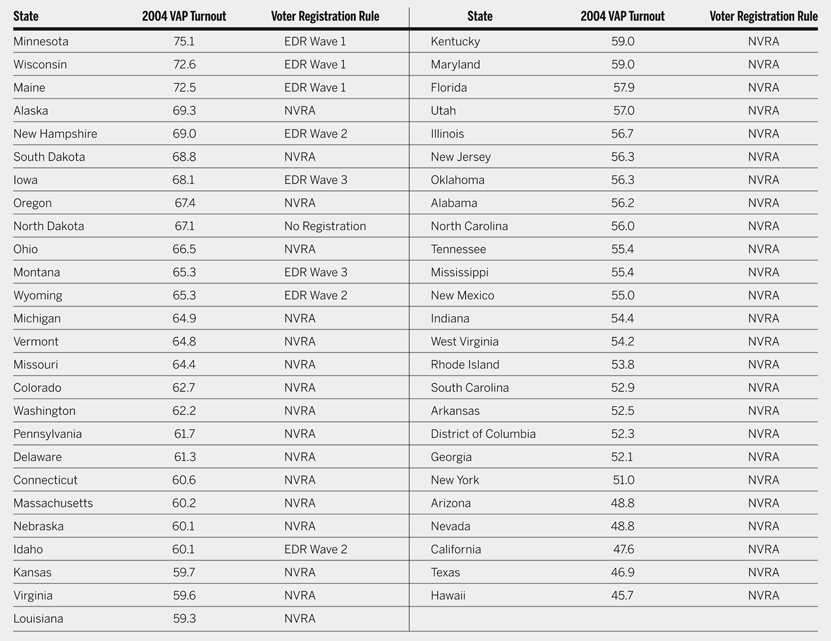
Table 1 shows 2004 turnout levels of states with and without EDR. In summarizing the findings of table 1, a political scientist might conclude that (1) EDR leads to higher turnout, and (2) states in the North are more likely to adopt EDR.
Voter Turnout and Voter Registration Laws in 2004

Source: Aggregate, state-level turnout of the voting age population was computed from official state turnout data (Federal Election Commission 2005) and Census Bureau estimates of the Voting Age Population (Bureau of the Census 2004).
Note: This table uses VAP, because VEP is not available for individual states in 1972 (a comparison year used in other research [Brians 2011]). We use 2004 data to demonstrate that even before adopting EDR, Iowa and Montana were high turnout states. VAP = voting age population; VEP = voting eligible population.
The direct inspiration for this article comes from an observation by students in the second author's freshman US government and politics course who, after eyeballing the data in table 1, suggested, on the one hand, that colder climates lead to higher turnout and, on the other hand, that colder states were especially likely to adopt EDR. In the first part of this article we statistically test the accuracy of each of these two claims.
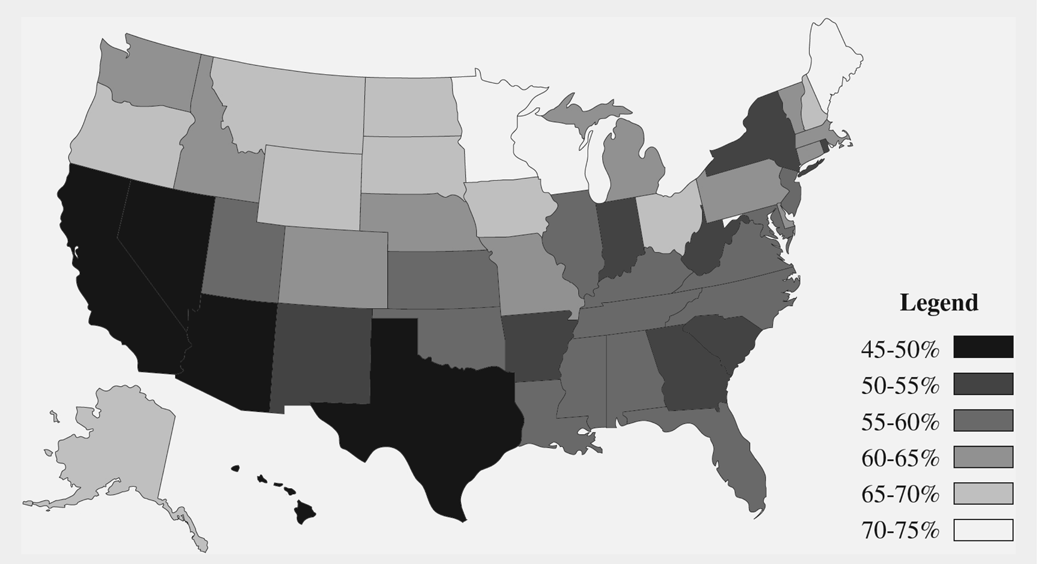
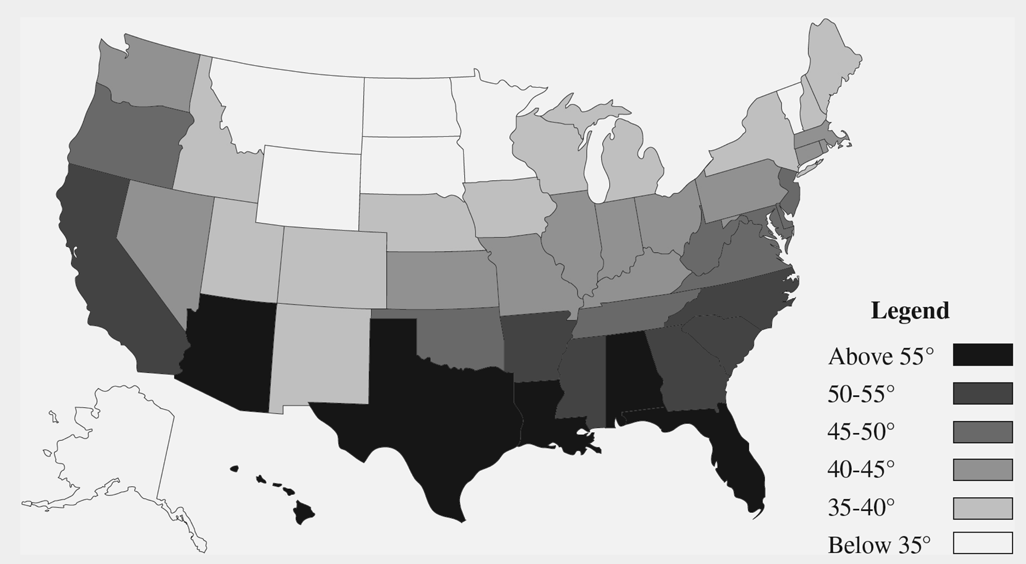
We get an intuitive sense of the relationship between temperature and turnout by comparing figure 1 with figure 2. The first map categorizes states by turnout level in 2004;Footnote 5 the second map classifies states by their mean November temperature (averaged over two decades).Footnote 6 Because we have selected map legend coding having a similar intensity scale, the continuity between the two maps is visually apparent: Those living in colder states are more likely to vote.
Map of States' Voting Age Population Turnout in November 2004
Source: Aggregate, state-level turnout of the voting age population was computed from official state turnout data (Federal Election Commission 2005) and Census Bureau estimates of the Voting Age Population (Bureau of the Census 2004).

Map of States' Mean Temperature in November
Source: These data were gathered in each state's capital, and obtained from the National Weather Service.

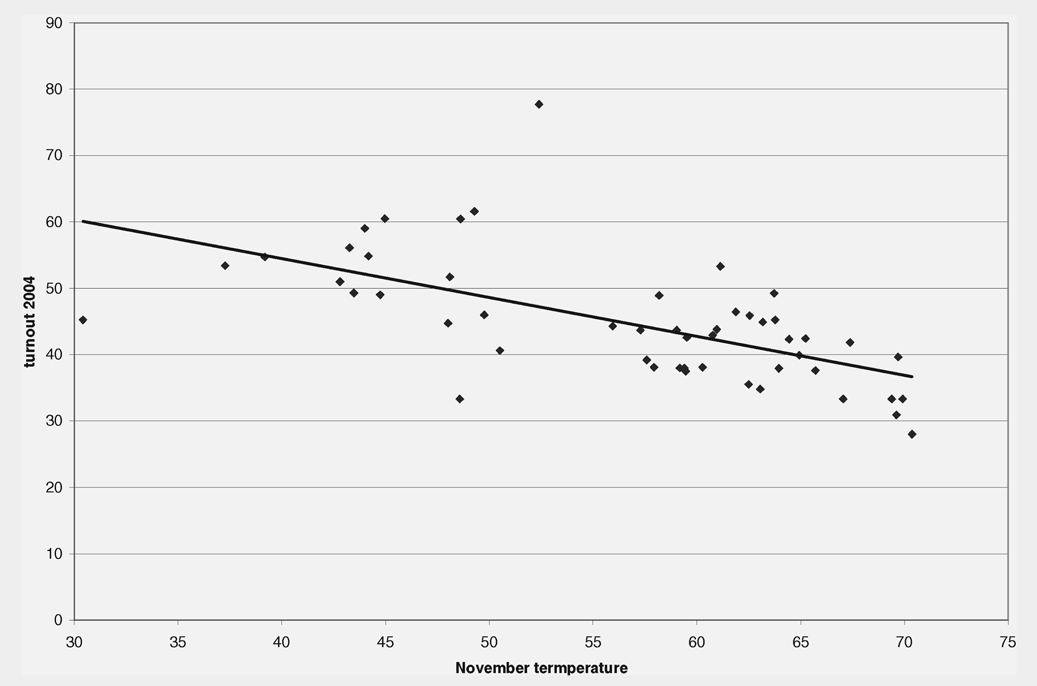
The scatter plot in figure 3 compares 2004 turnout with mean November temperature by state. The associated bivariate regression generates an adjusted R2 of .47 (p = .00000002).Footnote 7 It would appear that a three-point increase in mean temperature level (Fahrenheit) converts to about a one-point decrease in turnout.
State Level Turnout in 2004 versus Mean Temperature in November
Source: Aggregate, state-level turnout of the voting age population was computed from official state turnout data (Federal Election Commission 2005) and Census Bureau estimates of the Voting Age Population (Bureau of the Census 2004), with temperature data gathered in each state's capital and obtained from the National Weather Service.

EXPLAINING THE ADOPTION OF EDR
The nine states that adopted EDR in any of the three waves, or like North Dakota which has no voter registration requirement, average a 34.3 degree temperature in November, as compared to 48.8 degrees in the 41 other states and the District of Columbia.Footnote 8 This 14 degree temperature difference is significant at the p = .0001 level.Footnote 9 Moreover, none of the hottest states in the country has adopted EDR. Indeed, taking EDR adoption as the dummy dependent variable, and using just November temperature as the independent variable in a bivariate logistic regression, the result is statistically significant at the p = .007 level (with a Nagelkerke pseudo R2 of .57).
THE THIRD WAVE OF EDR ADOPTION
Building on Daryl Bem's (Reference Bem2011) seminal experimental evidence for the existence of ESP and precognition, one of our ancillary contributions is to show how states that had not yet adopted EDR in 2004, but were just about to (the Third Wave of EDR adoption) nonetheless behaved as if they already had. Looking at table 1, we see that, ca. 2004, all three of the Third Wave EDR states already had among the dozen highest turnout levels of any of the states, demonstrating conclusively that anticipation of future policy change to a more turnout-friendly institutional environment can raise a state's turnout level. Indeed, when we look at the high turnout levels in these same three states as early as 1972, we see clear evidence for an active type of political precognition at work, because it is hard to imagine how in 1972 citizens in these states could otherwise have anticipated that the state would be adopting EDR by 2008.
THE EFFECT OF TEMPERATURE ON LONGEVITY
Having shown that temperature has a strong effect on voter turnout, it occurred to us to examine, in a similar fashion, the impact of temperature on other variables. Because we had handy a data set with state level life expectancy, we regressed that variable on state level temperature. To our delight (but not our surprise), we found a strong correlation, an adjusted R2 value of .40 (p = .000001), between life expectancy and temperature. For every five-degree (Fahrenheit) increase in a state's mean November temperature, life expectancy in the state was decreased by one year.
DISCUSSION
Our goal was to build on the insights of Montesquieu and others to show the importance of a long-neglected variable, temperature, and we believe we have succeeded in that goal. Our evidence is compelling: across US states, both voter turnout and life expectancy are higher in cold climates. Of course, the reader may be skeptical that temperature is the real explanatory factor for EDR adoption, or for high turnout, or for greater life expectancy. For example, Keillor (Reference Keillorn.d.) has proposed that cultural factors linked to the number of Scandinavians in a state may determine political behavior.Footnote 10 However, getting the causality straight is beyond the scope of the present essay;Footnote 11 rather ours is the much more modest goal of conclusively demonstrating the power of the temperature variable.Footnote 12