Introduction
Soybean, Glycine max ((Linnaeus, 1735) Merrill, 1917), is an important crop for many countries, and several species of caterpillars have adversely affected soybean yields from Argentina to the southeast United States (Hoffmann-Campo et al., Reference Hoffmann-Campo, Oliveira, Moscardi, Gazzoni, Corrêa-Ferreira, Lorini, Borges, Sosa-Gómez, Corso, Panizzi, Maredia, Dakouo and Mota-Sanches2003). Among these pests, the velvetbean caterpillar, Anticarsia gemmatalis (Hübner) (Lepidoptera: Noctuidae), is one of the most important species (Panizzi & Corrêa-Ferreira, Reference Panizzi and Corrêa-Ferreira1997). More recently, however, outbreaks of other species, such as the soybean looper Pseudoplusia includens (Walker) (Lepidoptera: Noctuidae), have become more common as a consequence of the inappropriate use of pesticides and the consequent reduction of different biocontrol agents, which had usually prevented outbreaks of this caterpillar (Carmo et al., Reference Carmo, Bueno and Bueno2010; van Lenteren & Bueno, Reference van Lenteren and Bueno2003). To address this problem and maximize agricultural production, pest-control programs must take an interdisciplinary and multidisciplinary approach, integrating different control methods that are less harmful to humans, to the environment and to beneficial arthropods, but are still able to manage the target pest (Carmo et al., Reference Carmo, Bueno and Bueno2010).
One of the tactics that has shown good results in biological control programs, particularly for pests of the order Lepidoptera, is the release of egg parasitoids (Parra & Zucchi, Reference Parra and Zucchi2004). Among these parasitoids, wasps of the genus Trichogramma (Hymenoptera: Trichogrammatidae) have shown promising results (Bueno et al., Reference Bueno, Parra and Bueno2009). Trichogramma spp. have additional advantages, such as easy rearing on alternative hosts, which allow them to be used in inundative releases for the control of key pests of several crops (Parra & Zucchi, Reference Parra and Zucchi2004).
The success of biological control programs with Trichogramma spp. releases, however, depends basically on the dispersal ability and the parasitization rate of parasitoid wasps in the field. Determining the dispersal ability of Trichogramma spp. in the field is important for developing effective release techniques. A potential biocontrol agent should have pronounced host searching and dispersal ability (Smith, Reference Smith1996). Not only does dispersal ability ensure that the parasitoid will be well distributed within the field but also reduce the releasing labor since fewer release points per area will be needed (Wright et al., Reference Wright, Hoffmann, Chenus and Gardner2001; Bourchier & Smith, Reference Bourchier and Smith1996).
Therefore, the objective of this study was to evaluate the percentage of A. gemmatalis and P. includens eggs parasitized after the release of Trichogramma pretiosum (Riley) (Hymenoptera: Trichogrammatidae) at different densities and the field dispersal capacity of the parasitoid, in order to develop an effective biological control program against the soybean caterpillars.
Material and methods
The trials were carried out in a fully randomized experimental design at the Embrapa Field Station, state of Goiás, Brazil. Two trials were carried out under greenhouse conditions, aiming at studying the required number of parasitoids that should be released in order to achieve an appropriate control level of the pests. A third trial was carried out under field conditions in order to evaluate the dispersal ability of T. pretiosum and, thus, determine the required number of release sites per area. In all these trials, a strain of T. pretiosum collected in Rio Verde County, Goiás, which was later designated as T. pretiosum strain RV was used. This strain (voucher specimen number TP-17) was deposited at the ‘Núcleo de Desenvolvimento Científico e Tecnológico em Manejo Fitossanitário de Pragas e Doenças, NUNEMAFI’, Federal University of the state of Espírito Santo, Brazil. The strain was selected for the trials because it was the most efficient strain of T. pretiosum in controlling P. includens (Bueno et al., Reference Bueno, Parra and Bueno2009).
Cultures of the parasitoid and hosts
Cultures of T. pretiosum were established as described by Bueno et al. (Reference Bueno, Parra and Bueno2009). Eggs of the factitious host Anagasta kuehniella (Zeller) (Lepidoptera: Pyralidae) were glued on cardboard and rendered nonviable by exposing them to ultraviolet light and then offered for parasitism for 24 h. Newly emerged parasitoids were used either for trials or for maintaining cultures.
Cultures of P. includens and A. gemmatalis were kept under controlled environmental conditions (25±2°C temperature; 70±10% RH; and 14:10 h photoperiod (L:D)) in the laboratory. The caterpillars were reared on the artificial diet proposed by Greene et al. (Reference Greene, Leppla and Dickerson1976), and adults were fed with a 10% honey/water solution.
Appropriate number of T. pretiosum to release per host egg
The required density of T. pretiosum per egg of each insect pest was determined through the release of variable numbers of T. pretiosum in relation to a given number of eggs of P. includens and A. gemmatalis. An independent trial was carried out for each pest species under greenhouse conditions, using a fully randomized experimental design with seven treatments (0, 1.6, 3.2, 6.4, 12.8, 25.6 and 51.2 T. pretiosum females per egg of each insect pest) and nine replications.
The eggs of the pests were obtained from laboratory rearing and were exposed to the treatments inside iron-framed cages (40 cm×40 cm×120 cm) covered with voile fabric. A cultivar ‘Conquista’ soybean plant, at the R4–R5 reproductive stage (Fehr et al., Reference Feher, Caviness, Burmood and Pennington1971), was placed inside each of these cages; and, on each plant, a white cardboard card, containing ten eggs each, was attached to the upper, middle and lower portion of the plant canopy, for a total of 30 eggs of the pest per plant. Then, a variable number of 48, 96, 192, 384, 768 or 1536 female parasitoids were released, representing exactly the proportion of 1.6, 3.2, 6.4, 12.8, 25.6 and 51.2 parasitoids per egg of each pest species. No parasitoid was released in the control treatment.
The parasitism was allowed to proceed for 24 h, and the eggs were then collected and maintained in Petri dishes at 25°C, until the eggs darkened and the parasitoids emerged, for subsequent evaluation. The parameters evaluated were parasitism (%) per part of the plant canopy (upper, middle and lower) and total percent parasitism per plant. The data were submitted to regression analysis, relating the number of T. pretiosum females per egg of each pest species and percentage of parasitism (SAS Institute, 2001).
Dispersal capacity of T. pretiosum on the soybean crop
The dispersal capacity of T. pretiosum was determined under field conditions with three concentric circles with 5 m, 10 m and 15 m radius and six replications. Concentric circles, where only the artificial infestation was performed, were also established. These groups of concentric circles were set 200 m apart from each other. This allows the correction of the natural parasitism in relation to the areas of release, using the formula of Abbott (Reference Abbott1925).
The field was sowed with the cultivar ‘Conquista’, an important soybean cultivar in Brazil, with 0.50 m between rows and 0.20 m within-row spacing. The concentric circles were installed at the R4–R5 crop reproductive stage by demarcating 5 m, 10 m and 15 m radius in the soybean field. Eight soybean plants within the first circle (5 m) and 24 and 40 soybean plants within the two subsequent circles (10 m and 15 m, respectively) were infested with 20 eggs of P. includens per plant (Sá et al., Reference Sá, Parra and Silveira Neto1993). The caterpillar P. includens was used because it is presently the most important caterpillar that attacks soybeans at the reproductive stage in Brazil and in South America in general (Bueno et al., Reference Bueno, Parra and Bueno2009). This is the stage in which the parasitoids would probably have more difficulty in locating the eggs, due to the size of the fully developed plant, therefore representing the worst-case scenario for biological control using egg parasitoids (Bueno et al., Reference Bueno, Parra and Bueno2009; Gontijo et al., Reference Gontijo, Margolies, Nechols and Cloyd2010).
After the artificial infestation, a single release of newly emerged T. pretiosum adults was performed in the evening at the center of each plot (group of concentric circles). The adults of T. pretiosum used for the releases were reared in the laboratory in eggs of A. kuehniella. The parasitoids were taken to the field in small containers, containing honey for parasitoid feeding. These containers were placed among the plant leaves, and inclined to avoid wetting by rain. The eggs of P. includens were exposed to parasitism for 24 h. After that period, the eggs were collected, placed in Petri dishes, and maintained in an environmentally controlled incubator (25°C temperature; 60±10% RH; and 14 h photophase) until the adult parasitoids emerged.
A regression analysis among parasitism was performed as a function of the release density. A regression analysis was also used to establish the mathematical relation between dispersal radius and parasitism (SAS Institute, 2001). The natural predation (%) of the artificially infested eggs was computed using the following formula: P(%)=(I–F×100)/I, where I=total artificially infested eggs, F=total eggs collected after parasitoid release and P=predation.
The mean distance of dispersal (MD) and the area of dispersal of the parasitoid (s2) in the soybean crop were determined using the model proposed by Dobzhansky & Wright (Reference Dobzhansky and Wright1943), according to the equations: s2=[∑(r3×i/a)/∑(r×i/a)+C/2π] and DM=[∑(r2×i/a)/∑(r×i)+C/2π)], where s2=variance and indicates the area of dispersal, MD=mean distance of dispersal (m), r=distance from the center to the traps, a=number of traps per circle, C=mean number of parasitized eggs per trap, in the central circle and i=total parasitized eggs in each circle.
Results
Appropriate number of T. pretiosum to be released per host egg
When the eggs of the pests were attached to the lower portion of the plant canopy, the regression analysis between the percentage of parasitism and density of T. pretiosum females released (number of parasitoid per egg of the pest) showed a quadratic effect for both pest species studied (A. gemmatalis (y=−0.8076+5.3348x−0.0779x2) and P. includens (y=−0.7153+4.4197x−0.0476x2) where ‘y’ is the percentage of parasitism and ‘x’ is the density of parasitoids). The maximum values obtained for the parasitism, at that portion of the plant, were 78.8% and 90% of the eggs of A. gemmatalis and P. includens, respectively. This maximum parasitism rate was reached at the densities of 25.6 T. pretiosum females per A. gemmatalis egg and 51.2 T. pretiosum females per P. includens egg (fig. 1a, b). However, the percentage of parasitism was very similar between the densities of 25.6 and 51.2 T. pretiosum females per host egg (fig. 1a, b).
Parasitism (%) in eggs of A. gemmatalis and P. includens after the release of different densities of T. pretiosum per host egg placed at (a, b) the lower, (c, d) median and (e, f) upper portions of soybean plants canopy at the reproductive stage (R4–R5).

Regarding the pest eggs attached to the middle portion of the plant canopy, the results of the regression analysis were similar to those obtained for the lower portion of the plant canopy for A. gemmatalis (y=−9.4032+3.8587x−0.0404x2) and P. includens (y=−7.804+2.6833x−0.0141x2) and were also best explained by the quadratic function (fig. 1c, d). The highest parasitism rate (79.9%) in eggs of A. gemmatalis was obtained at the density of 51.2 T. pretiosum females per pest egg, very close to the parasitism obtained at the density of 25.6 T. pretiosum females per A. gemmatalis egg (75.8%) (fig. 1c). This result was somewhat different from that obtained with P. includens eggs. The maximum rate of P. includens parasitism (90%) was obtained with the release of 51.2 T. pretiosum females per pest egg, which was higher than the parasitism (68.9%) that occurred when 25.6 T. pretiosum females were released per P. includens egg (fig. 1d).
Similarly to the results for the middle part of the plant canopy, at the upper plant portion, the highest parasitism (%) was also found at the densities of 25.6 and 51.2 T. pretiosum females per A. gemmatalis egg (y=−9.998+3.0665x−0.0254x2), and at the density of 51.6 T. pretiosum females per P. includens egg (y=−3.0707+0.8152x+0.0092x2) (fig. 1e, f). The highest parasitism (71.3%) in eggs of A. gemmatalis was obtained at the density of 25.6 T. pretiosum females per pest egg (fig. 1e). In contrast, the maximum P. includens parasitism at the upper portion of the plant canopy (61.7%) was obtained with the release of 51.2 T. pretiosum females per pest egg, while only 36.7% parasitism occurred when 25.6 T. pretiosum females were released per P. includens egg (fig. 1f).
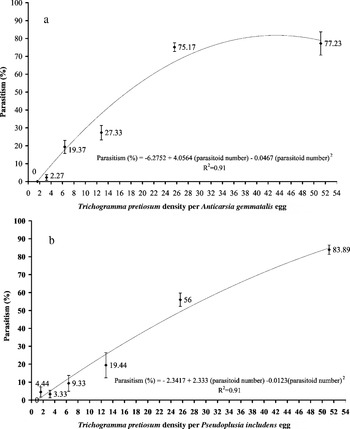
Taking into account the percentage of parasitism in the whole plant, regardless of the plant canopy fraction in which the eggs were positioned, the highest parasitism (%) was also found at the densities of 25.6 and 51.2 T. pretiosum females per A. gemmatalis egg (y=−6.2752+4.0564x−0.0467x2), and at the density of 51.6 T. pretiosum females per P. includens egg (y=−2.3417+2.333x−0.0123x2), both showing a quadratic effect (fig. 2a, b). The highest parasitism (77.23%) in eggs of A. gemmatalis was obtained at the density of 51.2 T. pretiosum females per pest egg but similar to the parasitism of 25.6 T. pretiosum females, which was 75.17% (fig. 2a). The maximum P. includens parasitism (83.89%) was obtained with the release of 51.2 T. pretiosum females per pest egg, while only 56% of parasitism occurred when 25.6 T. pretiosum females were released per P. includens egg (fig. 2b).
Mean parasitism (%) in eggs of (a) A. gemmatalis and (b) P. includens placed on soybean plants at the reproductive stage (R4–R5) after the release of different densities of T. pretiosum per host egg.

Dispersal capacity of T. pretiosum on the soybean crop
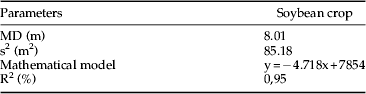
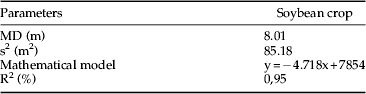
These results show that the parasitism of T. pretiosum in eggs of P. includens decreased linearly (y=−4.718x+7854, where ‘y’=% parasitism and ‘x’= the distance (m) from the release site) as the pest eggs were farther from the parasitoid release sites. Based on the model of Dobzhanski & Wright (Reference Dobzhansky and Wright1943), the mean radius of T. pretiosum action and the area of the parasitoid dispersal on the soybean crop, in relation to the eggs of P. includens, were 8.01 m and 85.18 m2, respectively (table 1).
Mean distance (MD) and area of dispersion (s2) with the respective models and coefficient of determination (R2) for T. pretiosum strain RV in eggs of P. includens on the soybean crop.
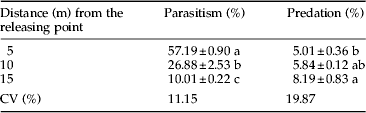
The parasitism rates at 5 m, 10 m and 15 m differed statistically from each other, being highest in the eggs placed at the smallest circle (57.19%, 26.88% and 10.01% at 5 m, 10 m and 15 m, respectively). Inversely, egg predation was higher in the eggs placed at the larger circles, being 8.19% at 15 m, statistically similar to 10 m (5.84%) and different from 5 m (5.01%) (table 2).
Mean values (±SE) of T. pretiosum parasitism in eggs of P. includens placed at different distances from a central site of the parasitoid release in a soybean cropped field.
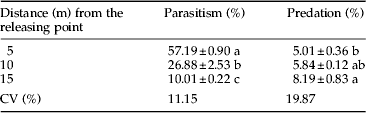
Means followed by the same letter within the column are not statistically different from each other by the Tukey test (P>0.05).
Discussion
Considering the results for the percentage of parasitism that occurred under the releases of different densities of T. pretiosum per host egg, the proportion of 25.6 female parasitoids per pest egg should be considered as the appropriate number of T. pretiosum to be released on commercial soybean fields in order to achieve adequate management of P. includens and A. gemmatalis. However, it is important to consider that this data refers to the parasitism capacity of T. pretiosum in the first 24 h after the release. T. pretiosum longevity varies at temperature rage of 19°C and 31°C, respectively (Bueno et al., Reference Bueno, Parra and Bueno2009). Thus, the importance of the parasitism capacity after the first 24 h could be studied in future researches.
The parasitism of A. gemmatalis eggs was high in all portions of the plant canopy with the release of 25.6 female parasitoids per pest egg. The results obtained, in most cases, were similar to those achieved with the release of 51.2 T. pretiosum females per pest egg. Furthermore, if the oviposition habit of A. gemmatalis (laying eggs on the entire plant) is considered, that density of parasitoids is perfectly capable of locating their hosts. Consequently, when the percentage of parasitism on the whole plant is considered, regardless of the position where the eggs were attached, the parasitism observed with the release of 25.6 female parasitoids per egg (75.17%) was close to the percentage of parasitism recorded with the release of twice that number (77.23%), although it is less expensive.
Regarding P. includens, the density of 25.6 T. pretiosum females might also be considered appropriate, although the parasitism obtained by the release of the highest density (51.2 parasitoid female per pest egg) was higher when the eggs were attached to the middle and upper portions of the soybean plant canopy. The soybean looper can occur singly or be associated with the velvetbean caterpillar on the soybean crop, whose lower portion showed similar results for the density of 25.6 and 51.2 parasitoids per pest egg of P. includens. Thus, the density of 25.6 T. pretiosum per egg would be more suitable, mainly considering the control costs, which would be reduced by using a low parasitoid density without reducing the effectiveness of control. It is worth emphasizing that during the development of a control strategy, the cost of its use is of paramount importance and must be taken into consideration. Usually, soybean growers will adopt a new pest-control strategy only if either the cost is lower or the results are better than the most commonly used and accepted control strategy. In this context, biological control must be competitive with chemical control in terms of price, since the latter is a relatively cheap and widely used control strategy among soybean growers in Brazil and worldwide.
Some other studies have demonstrated the suitable proportion of Trichogramma sp. releases on different crops, but none was related to soybeans. For fruit crops, releases ranging from 70,000 to 3.8 million parasitoids per hectare have been recommended (Glen & Hoffmann, Reference Glen and Hoffmann1997; Mills et al., Reference Mills, Pickel, Mansfield, Mcdougall, Buchner, Caprile, Edstom, Elkins, Hasey, Kelley, Krueger, Olson and Stocker2000). For the control of Tuta absoluta (Meyrick) (Lepidoptera: Gelechiidae) on tomatoes, the proportion of 6.4 parasitoids per egg of the pest attained parasitism rates of 87% of the pest eggs (Parra & Zucchi, Reference Parra and Zucchi2004). Differently from these reports in the literature, our results indicated that the proper parasitoid density required to control soybean lepidopteran pests is 25.6 parasitoid females per host egg. This definition of the appropriate amount of parasitoids to be released in soybean fields is crucial, since among the main factors affecting the parasitism decrease is superparasitism, which may occur when an excessive number of parasitoids per host egg is released (Reay-Jones et al., Reference Reay-Jones, Rochat, Goebel and Tabone2006; Martel & Boivin, Reference Martel and Boivin2004).
Using simulation models, Knipling (Reference Knipling, Ridgway and Vinson1977) found that, surprisingly, the release of increasing numbers of parasitoids per unit of area leads to a reduction in the efficiency of Trichogramma sp. This occurs because, as parasitoid density increases, the chance that an individual parasitoid will find an egg to parasitize is reduced.
Other factors affecting the efficiency of biological control agents that could explain the different numbers of parasitoids required for each agro-ecosystem are reported in the literature, such as the structure or architecture of the crop plant, for example (Gontijo et al., Reference Gontijo, Margolies, Nechols and Cloyd2010). Plant architecture is related to the spatial arrangement and dimensions of branches, stems and leaves at a specific plant developmental stage (Cloyd & Sadof, Reference Cloyd and Sadof2000). Architectural traits that affect natural enemies include plant size (Thorpe, Reference Thorpe1985; Cloyd & Sadof, Reference Cloyd and Sadof2000), leaf number (Stamp & Browers, Reference Stamp and Browers1993; Cloyd & Sadof, Reference Cloyd and Sadof2000) and plant surface area (Burbutis & Koepke, Reference Burbutis and Koepke1981; Maini & Burgio, Reference Maini and Burgio1990). Since soybeans are commonly sown in narrow row spacing (0.4 m to 0.5 m between rows) with 11 to 16 plants per linear meter; at the reproductive stage, when the plant canopy is fully developed, the parasitoid needs to search through more foliage in its attempt to find the host egg, and therefore a larger number of parasitoids is required. Conversely, if T. pretiosum is released to control pests of the order Lepidoptera, when the soybean foliage is smaller (early vegetative growth stages), the required density of parasitoids to be released might be lower. However, further research is needed to verify this hypothesis.
The lowest rate of parasitism found in the eggs positioned farthest from the releasing site, as recorded in the T. pretiosum dispersal-capacity trial, might also be explained by the large size of the crop foliage at the reproductive stage. Under these conditions, the parasitoids probably needed to overcome more obstacles to reach the eggs positioned 15 m distant from the release sites. It is important to stress, however, that the host eggs were exposed to parasitism for only 24 h. The parasitism in those farthest sites might have required a longer time to allow the parasitoid to locate, reach and parasitize the egg. However, the highest parasitism capacity of T. pretiosum strain RV occurs during its first 24 h after emergence (Bueno et al., Reference Bueno, Parra and Bueno2009). Hence, the parasitoids that can reach the host egg after that period might have had their parasitism capacity already lessened.
The reduction in egg parasitism rate with the increase in the distance from the egg to the parasitoid release site is higher in crops that have a dense canopy, such as soybeans. Similar results were reported for T. nubilale (Ertle & Davis) and T. maidis (Pintureau & Vogelé) (Hymenoptera: Trichogrammatidae) on corn (maize) (Kanour Jr & Burbutis, Reference Kanour and Burbutis1984; Bigler et al., Reference Bigler, Bieri, Fritschy and Seidel1988) in agreement with this statement.
Different from the dispersion capacity observed for T. pretiosum in soybean fields in our results, Chapman et al. (Reference Chapman, Kuhar, Schultz and Brewster2009), studying the dispersal capacity of T. ostriniae in potato fields, observed that this species dispersed rapidly over large distances, successfully moving throughout a 0.4-ha area of potatoes and reproducing at 45 m from the releasing point four days after the release. Chapman et al. (Reference Chapman, Kuhar, Schultz and Brewster2009) results are similar to what was reported for the same parasitoid species in sweet corn by Wright et al. (Reference Wright, Hoffmann, Chenus and Gardner2001). The differences from our results to the literature might be due to both the different studied species, but more probably are due to the differences in crop architecture and plant density in the field. Soybean plants are taller than potato plants and are sowed in a higher density than sweet corn, for example. Therefore, soybean plants might represent a bigger obstacle for the parasitoid to overcome in order to disperse or offer more sheltering places for the pest eggs, which makes it more difficult for the Trichogramma sp. to find its host.
The parasitoid release method and its uniformity of distribution within a given area are the main factors affecting control efficiency (Mills et al., Reference Mills, Pickel, Mansfield, Mcdougall, Buchner, Caprile, Edstom, Elkins, Hasey, Kelley, Krueger, Olson and Stocker2000). The results presented here demonstrate that the required number of parasitoid release sites on the soybean crop, determined by the effective radius of dispersal is 117 sites per hectare in order to guarantee a homogeneous distribution of the parasitoid T. pretiosum strain RV within the area treated and within 24 h after release and, consequently, provide a high parasitism rate as well as a high control efficiency of the pest in the soybean field.
In conclusion, these results show that an effective biological control program using T. pretiosum strain RV in soybean fields must ensure the release of 25.6 parasitoids per host eggs, divided into 117 sites per hectare, to successfully control the caterpillars A. gemmatalis and P. includens. It might be argued that these trials were carried out under the worst-case scenario, in a highly developed plant canopy, a situation that might not always exist in a soybean field. It is true that within the soybean agro-ecosystem, the changes in the plant leaf mass at different phenological stages, as well as the variations in temperature during the crop cycle, may affect the ‘searching’ behavior of the parasitoid, therefore influencing their dispersal and parasitism rates, which consequently may decrease under extreme conditions (Biever, Reference Biever1972). Nowadays, however, the great challenge to biological control in the soybean crop is the management of insect pests that occur during the soybeans’ reproductive stages. Such pests are not easily controlled by chemical insecticides, as in the case of the soybean looper P. includens. At that crop stage, the pesticides do not adequately cover the entire plant canopy and, consequently, do not properly reach the pest. Thus, these experiments were intentionally performed under environmental conditions that are highly unfavorable for the T. pretiosum egg-parasitizing behavior, since certainly the soybean growers would more rapidly accept new control strategies that have been tested against these IPM challenges.
Different distances from the release site may cause variability in the parasitism rate on a given crop, as a consequence of the biological characteristics of the parasitoid, for example its flight ability and/or characteristics inherent in the crop, which can function as a physical barrier and, therefore, impede the dispersal of the parasitoids. Therefore, these variations depend on both the type and developmental stage of the crop studied and on the biological characteristics of the parasitoid chosen. These two statements combine to validate the important findings reported here. Further research, emphasizing the economic threshold involving the proper time for parasitoid releases in soybean fields, is still needed since the usual threshold levels based on percentage of defoliation were designed specifically for use in chemical control, where pest outbreaks are reduced more rapidly than are reductions caused by egg parasitoids.
Acknowledgements
The authors would like to thank Embrapa Soja for the support provided and Daniel R. Sosa-Gomez, PhD, Maria C.O. Neves, PhD and Mariângela Hungria da Cunha, PhD, Embrapa Soja for critically reviewing the manuscript. Thanks are also extended to ‘Coordenação de Aperfeiçoamento de Pessoal de Nível Superior (CAPES)’ and to ‘Conselho Nacional de Desenvolvimento Científico e Tecnológico (CNPq)’ for the supporting grants (process 23038.035744/2008-89 and process 470165/2010-3), and to Janet W. Reid, PhD, JWR Associates, for the English revision. This paper was approved for publication by the Editorial Board of Embrapa Soja as manuscript 09/2010.