Introduction
The transition period is a time of rapid change in the metabolism of the high-producing dairy cow. The onset of milk production increases the demand for several nutrients like glucose and amino acids. Simultaneously, daily nutrient intake is insufficient to meet demands for milk production and energy balance is negative (Van Saun, Reference Van Saun1991; Bell et al., Reference Bell, Sleptis and Ehrhardt1995). Due to depressed feed intake at the end of gestation, the period of negative energy balance often starts prior to calving (Van den Top et al., Reference Van den Top, Wensing, Geelen, Wenting, Van’t Kloster and Beynen1995). The level of non-esterified fatty acids (NEFA) increases in plasma as a consequence of body fat mobilization (Ford, Reference Ford1959; Reid and Collins, Reference Reid and Collins1980) and leads to hepatic lipidosis. Fatty liver is a metabolic disorder that affects 25% to 30% of the high-producing dairy cows in Hungary (Tiran et al., 2003). High liver fat content adversely affects health (Hill et al., Reference Hill, Reid and Collins1985), depresses milk production and is associated with reproductive problems (Reid, Reference Reid1982; Gerloff et al., Reference Gerloff, Herdt and Emery1986). Earlier studies (Reid et al., Reference Reid, Collins, Baird, Roberts and Simmons1979; Smith et al., Reference Smith, Hippen, Beitz and Young1997) proved that the major cause of fat accumulation was impaired triglyceride output from the liver resulting from the decreased very low density lipoprotein (VLDL) secretion.
Choline, a component of phospholipid and methyl donor, plays an essential role in VLDL synthesis and thereby contributes to fat export from the liver. Earlier studies (Piepenbrink and Overton, Reference Piepenbrink and Overton2000; Pinotti et al., Reference Pinotti, Baldi and Dell’Orto2002; Cooke et al., Reference Cooke, Silva Del Río, Caraviello, Bertics, Ramos and Grummer2007) suggested that high-producing cows may be choline deficient around parturition, which adversely affects liver functions, especially the synthesis and secretion of VLDL. Higher choline supply may increase milk production (Erdman and Sharma, Reference Erdman and Sharma1991; Hartwell et al., Reference Hartwell, Cecava and Donkin2000; Pinotti et al., Reference Pinotti, Baldi, Politis, Rebucci, Sangalli and Dell’Orto2003) but this response is strongly influenced by other nutrients such as protein and methionine (Emmanuel and Kennelly, Reference Emmanuel and Kennelly1984; Hartwell et al., Reference Hartwell, Cecava and Donkin2000; Brüsemeister and Südekum, Reference Brüsemeister and Südekum2006). However, other authors did not find any difference in milk yield of the cows in response to choline supplementation (Piepenbrink and Overton, Reference Piepenbrink and Overton2003; Janovick Guretzky et al., Reference Janovick Guretzky, Carlson, Garrett and Drackley2006).
Dietary choline is degraded rapidly by the rumen microorganisms (Neill, Reference Neill1979; Sharma and Erdman, Reference Sharma and Erdman1989); hence, supplementation with choline (conveniently as its salt, choline-chloride) is not an effective way to increase choline supply. Therefore, rumen-protected forms of choline have been developed to deliver choline to the small intestine for absorption.
The aim of the present study was to determine the effect of rumen-protected choline (RPC) supplementation on milk production, body condition and choline content of milk as an indicator of choline availability in periparturient dairy cows.
Material and methods
Animals and management
The experiment was conducted on the Dairy Farm of Milkmen Ltd., Paks, Hungary. Thirty-two multiparous Holstein dairy cows were used. The animals were previously synchronized to decrease the length of calving period. Cows were loose-housed in groups on straw bedding. The groups were kept in pens in the same building in concordant environmental conditions. Fresh feed was offered as ad libitum total mix ration (TMR) once daily before calving at 0600 h and twice daily after calving at 0600 and 1800 h. Daily amounts of TMR were adjusted to ensure a 10% feed refusal to achieve the ad libitum feed intake of the groups. Cows had unlimited access to water and were milked twice daily at 0530 and 1730 h. The housing and sampling protocols were in agreement with the European Union guidelines (86/609/EEC) and were accepted by the Committee of Animal Welfare in the Hungarian Ministry of Agriculture (Reg. number: DK-38/2/2003).
Experimental design and treatment
Thirty-two cows were assigned to one of two groups (RPC group – with RPC supplementation, and control group – without RPC supplementation) 28 days before the expected calving. The groups were balanced for parity (3.31 ± 1.22 v. 3.31 ± 1.28, respectively; mean ± s.d.), body condition score (BCS; 4.01 ± 0.38 v. 4.05 ± 0.39, respectively; mean ± s.d.) and previous lactation performance (9478 ± 1736 v. 9474 ± 1687 kg, respectively; mean ± s.d.).
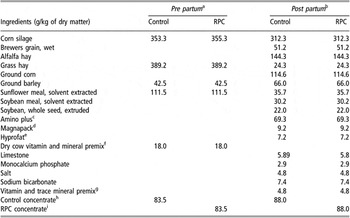
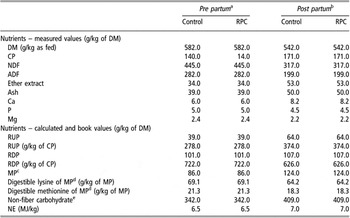
Cows were offered the experimental feed from day 21 before calving until day 60 after calving. The ingredient and nutrient composition of the two diets are summarized in Tables 1 and 2. The diets were balanced according to the guideline of NRC (2001). The daily diet of the RPC group was supplemented with 100 g of RPC from day 21 until calving and 200 g of RPC from calving until day 60 of lactation. RPC was administered as Norcol-25® (Nordos Italy, 37012 Bussolengo, Italy). This product is manufactured by a fat encapsulation technique, which was designed to protect choline from ruminal degradation, but allows its release for intestinal digestion and absorption. In an earlier study conducted by rumen-cannulated adult ewes in our laboratory, the stability of this product was measured as 20.4% in an 8 h incubation period (Elek and Husveth, Reference Elek and Husveth2007). Norcol-25® contains 25% choline in a chemical form of choline-chloride; hence RPC supplementation provided 25 and 50 g of choline in the pre-partum and post-partum periods, respectively. The RPC product was blended with ground corn (90% corn and 10% Norcol-25®) and was administered as 1 kg topdress before calving and 2 kg topdress after calving.
Ingredient composition of diets

RPC = rumen-protected choline.
aFrom 21 days before calving until calving.
bFrom calving until 60 days of lactation.
cProcessed soybean meal (rumen-undegradable protein = 72%, AG processing Inc., Omaha, NE, USA).
dCa-salt of palm fatty acids (Norel & Nature S.A., Madrid, Spain).
eFractionated palm triglyceride (Provimi, Rotterdam, The Netherlands).
fComposition: 60 g/kg of Ca, 55 g/kg of P, 3600 mg/kg of Zn, 4800 mg/kg of Mn, 1320 mg/kg of Cu, 30 mg/kg of Co, 73 mg/kg of I, 36 mg/kg of Se, 661 500 IU vitamin A/kg, 200 000 IU vitamin D/kg, 9850 mg vitamin E/kg.
gComposition: 20 000 mg/kg of Zn, 14 000 mg/kg of Mn, 5000 mg/kg of Fe, 4000 mg/kg of Cu, 40 mg/kg of Co, 220 mg/kg of I, 100 mg/kg of Se, 15 00 000 IU vitamin A/kg, 425 000 IU vitamin D/kg, 7500 mg vitamin E/kg.
hComposition: 925 g/kg of ground corn and 75 g/kg of hyprofat.
iComposition: 900 g/kg of ground corn and 100 g/kg of norcol-25.
Nutrient composition of diets

DM = dry matter; RPC = rumen-protected choline; RUP = rumen-undegradable protein; RDP = rumen-degradable protein; MP = metabolizable protein; NE = net energy.
aFrom 21 days before calving until calving.
bFrom calving until 60 day of lactation.
cMetabolisable protein was calculated using the model of NRC (2001).
dDigestible lysine and methionine in MP were calculated using the model of NRC (2001).
eNon-fiber carbohydrate was calculated from the equation: NFC = 1000 − (CP + ether extract + ash + NDF).
The diet of the control group did not contain any choline supplementation but the other ingredient and nutrient composition was identical with the RPC group. The RPC product contained 75% fat, which provided extra energy for the RPC group. To compensate this higher fat intake, the control diet was supplemented with 75 and 150 g of fractionated palm triglyceride (Hyprofat; Provimi, Rotterdam, The Netherlands). The fat supplementation was blended into 0.925 and 1.850 kg ground corn and was fed as 1 and 2 kg topdress before and after calving, respectively.
Collection of samples and analyses
Samples of TMR were collected weekly for analysis. The TMR samples were analyzed for CP (AOAC, 1997), NDF (Van Soest et al., Reference Van Soest, Robertson and Lewis1991), ether extract (AOAC, 1997) and ash (AOAC, 1997) by OMMI Laboratory (Budapest, Remény u., Hungary). The dry matter (DM) content of the TMR samples was determined weekly by drying at 60°C for 48 h in a forced-air oven. Dry matter intake (DMI) of the groups was calculated daily by difference between feed DM offered and feed DM refused. The DMI data were grouped weekly and these weekly subsets were evaluated statistically.
Body condition was scored on a 1 to 5 scale (1 is thin and 5 is obese) (Wildman et al., Reference Wildman, Jones, Wagner, Boman, Troutt and Lesch1982) at −21, 7, 35 and 60 days of lactation. Scoring was made by the same person at each sampling time.
The individual daily milk production was recorded daily and milk samples were taken at both the morning and afternoon milking by the Tru Test (Auckland, New Zeland) milk meter on days 7, 35 and 60. Morning and evening milks were mixed in representative proportions and were homogenized by vortexing them for 30 s. The homogenized samples were divided into two equal parts. One sample was frozen and stored for fat and protein analysis. Following melting and homogenization (vortexing for 30 s) of the samples, fat was determined by the method of Folch et al. (Reference Folch, Lees and Sloane-Stanley1957). The lipid phase of samples was extracted by a 2 : 1 mixture of chloroform–methanol. In the second step, the filtrate was separated from non-lipid structures by washing it with water. The nitrogen content of samples was measured by the Kjeldahl method (Helrich, Reference Helrich1990). Milk crude protein was estimated as N (%) × 6.38.
The other sample was freeze-dried and stored frozen at −18°C for milk choline analysis. Milk choline was determined by the enzymatic method of Woollard and Indyk (Reference Woollard and Indyk2000). Briefly, 5 g of freeze-dried sample was digested by 30 ml of 1.0 M hydrochloric acid at 70°C for 3 h to release the majority of bound choline. After cooling, pH was adjusted with 50% NaOH to 3.5 to 4.0. The hydrolysate was diluted to 50 ml with water and filtered. The residual choline from phospholipids was cleaved with phospholipase D (Sigma Type VI, P-8023, from Streptomyces chromofuscus, 150 unit/mg, unit definition: 1 unit liberates 1.0 μmol choline from l-α-phosphatidyl choline/h at pH 5.0 at 30°C; Sigma-Aldrich, St Louis, USA). Free choline reacted with choline oxidase (Sigma C-5896, from Alcaligenes species, 10 unit/mg, unit definition: 1 unit forms 1.0 μmol H2O2 with oxidation of 1 μmol choline to betaine aldehyde/min at pH 8.0 at 37°C; Sigma-Aldrich) liberating hydrogen peroxide. In the presence of peroxidase (Sigma Type I, P-8125, from horseradish, 80 unit/mg, unit definition: 1 unit forms 1.0 mg purpurogallin from pyrogallol in 20 s at pH 6.0 at 20°C; Sigma-Aldrich), phenol is oxidized, forming a chromophore with 4-aminoantipyrine (Sigma A-4382; Sigma-Aldrich). Absorbance of this compound was measured at 505 nm. Choline level was calculated as choline hydroxide by the mean of a standard solution prepared by dissolving 523 mg of choline bitartarate (Sigma C-2654; Sigma-Aldrich) in 100 ml of water, which was equal to 2500 μg/ml choline hydroxide solution. The five-point standard curve (50, 100, 150, 200 and 250 μg/ml choline hydroxide equivalent) was prepared by further diluting the standard solution in water. This method measures the total choline in milk: free choline plus choline bound as acetylcholine, phosphatidylcholine, lysophosphatidylcholine, sphingomyelin and glycerophosphocholine.
Statistical analyses
Thirty cows completed the experiment. One cow from each group developed severe mastitis approximately in the 5th week and were removed from the experiment. Their remaining data were treated as missing values. One cow from the control group and two from the RPC group suffered from mastitis immediately after calving, but recovered within 7 days. Their milk production data were analyzed as missing values.
The data were analyzed by the GLM procedure of SPSS 9.0 (SPSS software for Windows, release 9.0, SPSS Inc., Chicago, IL, USA). First, data were tested by the Kolmogorov–Smirnov test for normal distribution. ANOVA were performed on normally distributed data using dietary treatment as a fixed main effect and sampling time as repeated measures. In case of normal distribution, Levene’s test was used to verify the homogeneity of variances. Statistical significant differences were determined at P < 0.05; however, 0.05 < P < 0.10 indicated a trend for differences between treatments.
Results
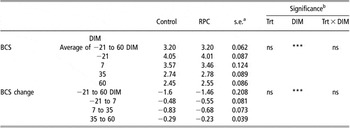
Both groups had high BCS before calving with some severely overconditioned cows. BCS was significantly (P < 0.001) affected by days in milk (DIM) (Table 3). Condition loss was rapid in both groups from 7 to 35 days after calving, which were −0.83 and −0.68 in the control and RPC groups, respectively. Neither BCS nor BCS change was altered by RPC supplementation (Table 3).
Effect of RPC on BCS and change of BCS

RPC = rumen-protected choline; DIM = days in milk; BCS = body condition score.
aPooled s.e.
bTrt = treatment effect; DIM = effect of days in milk; Trt × DIM = treatment effect and DIM interaction.
*P < 0.05; **P < 0.01; ***P < 0.001.
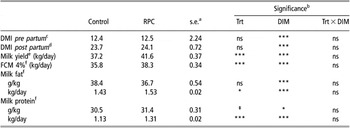
RPC supplementation did not alter significantly the DMI of the cows during either the pre-partum or the post-partum periods (Table 4). RPC supplementation had a significant (P < 0.001) effect on milk production during the entire period of the experiment (Table 4). Milk yield was increased by 4.41 kg/day and as an outcome 4% fat-corrected milk (FCM) was increased by 2.5 kg/day as an average during the first 60 days of lactation. Milk fat content was not altered significantly by RPC supplementation. As a consequence of 11.9% higher milk yield of RPC-treated cows, fat yield improved by 0.1 kg/day (P < 0.05; Table 4). Milk protein concentration tended to be increased as a response to RPC (P < 0.10; Table 4). Protein yield was 0.18 kg/day higher (P < 0.001) in the RPC group as the combined effect of higher milk yield and higher protein concentration.
Effect of RPC supplementation on milk production and milk composition

RPC = rumen-protected choline; DIM = days in milk; DMI = dry matter intake.
aPooled s.e.
bTrt = treatment effect; DIM = effects of days in milk; Trt × DIM = treatment effect and DIM interaction.
cCorresponds to dry matter intake from 21 days pre partum until calving.
dCorresponds to dry matter intake from calving until 60 days in milk.
eCorresponds to samples through 60 DIM.
fCorresponds to samples on days 7, 35 and 60 after parturition.
‡Approaching significance (P < 0.10).
*P < 0.05; **P < 0.01; ***P < 0.001.
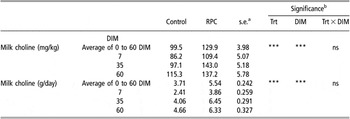
RPC supplementation significantly increased milk choline concentration and yield (P < 0.001) during the whole period of the experiment (Table 5). Total choline concentration in milk was increased (P < 0.001) by DIM; and 12.6% and 30.7% increases were observed between 7 and 35 days of lactation in the control and RPC groups, respectively (Table 5). The overall increase with the duration of lactation was 33.0% in the control group and 25.4% in the RPC group between 7 and 60 days of lactation. Choline yield was also positively affected by DIM; 68.5% and 67.1% increases (P < 0.001) were observed in the control and RPC groups, respectively, between 7 and 35 days of lactation. The milk choline yield reached the maximal level at day 35 of lactation and did not change significantly between 35 and 60 days.
Effect of RPC on milk choline content and choline yield

RPC = rumen-protected choline; DIM = days in milk.
aPooled s.e.
bTrt = treatment effect; DIM = effects of days in milk; Trt × DIM = treatment effect and DIM interaction.
*P < 0.05; **P < 0.01; ***P < 0.001.
Discussion
Condition loss indicates intensive mobilization of body tissue (mostly fat) during the first few weeks of lactation (Van Saun, Reference Van Saun1991; Bell et al., Reference Bell, Sleptis and Ehrhardt1995; Hartwell et al., Reference Hartwell, Cecava and Donkin2000). The large degree of condition loss may be explained by the high BCS pre partum, which has already been described in earlier papers (Garnsworthy and Topps, Reference Garnsworthy and Topps1982; Van den Top et al., Reference Van den Top, Wensing, Geelen, Wenting, Van’t Kloster and Beynen1995). The lack of the effect of RPC on BCS and BCS change is in agreement with Hartwell et al. (Reference Hartwell, Cecava and Donkin2000). However, Hartwell et al. (Reference Hartwell, Cecava and Donkin2000) found a tendency for BCS losses to be greater with RPC supplementation when fed a high rumen-undegradable protein (RUP) diet pre partum. The RUP level (39 g/kg of DM) in this experiment during the pre-partum period was similar to the low-RUP diet (40 g/kg of DM) in the experiment of Hartwell et al. (Reference Hartwell, Cecava and Donkin2000) and significantly lower than the high-RUP diet (62 g/kg of DM).
The similar DMI of the control and RPC-supplemented cows is in agreement with several earlier studies (Erdman and Sharma, Reference Erdman and Sharma1991; Hartwell et al., Reference Hartwell, Cecava and Donkin2000; Piepenbrink and Overton, Reference Piepenbrink and Overton2003; Pinotti et al., Reference Pinotti, Baldi, Politis, Rebucci, Sangalli and Dell’Orto2003; Zahra et al., Reference Zahra, Duffield, Leslie, Overton, Putnam and LeBlanc2006). However, in our trial, the DMI of RPC-supplemented cows was numerically higher than for the group not receiving supplementary choline, but this difference did not show any statistical significance.
The significant increases in milk yield and FCM yield in RPC-treated cows of our experiment are in line with the observations of Erdman and Sharma (Reference Erdman and Sharma1991) and Pinotti et al. (Reference Pinotti, Baldi, Politis, Rebucci, Sangalli and Dell’Orto2003); however, Piepenbrink and Overton (Reference Piepenbrink and Overton2003) reported no significant milk yield response when cows received RPC supplementation. The increase in milk yield in our trial exceeded the improvement reported in any other earlier study, which may be explained by the higher average pre-partum body condition (BCS ⩾ 4.00) of the cows compared to other studies. This observation is supported by the report of Zahra et al. (Reference Zahra, Duffield, Leslie, Overton, Putnam and LeBlanc2006), who similarly found 4.4 kg/day increase in milk yield when RPC was supplemented to cows with BCS ⩾ 4.00.
Milk fat concentration was not altered by RPC treatment in this and in several earlier experiments (Bauchart et al., 1998; Deuchler et al., Reference Deuchler, Piperova and Erdman1998). However, Erdman and Sharma (Reference Erdman and Sharma1991) reported a quadratic response of milk fat concentration to RPC, with a decrease when RPC was added at 0.78 g/kg of DM and increases at 1.56 and 2.34 g/kg RPC supplementations. In our experiment, the milk yield response was higher than in earlier studies. This may explain the lack of response in milk fat concentration. Similar to earlier trials, RPC increased fat yield by 7% as an effect of higher milk yield. Piepenbrink and Overton (Reference Piepenbrink and Overton2003) and Pinotti et al. (Reference Pinotti, Baldi, Politis, Rebucci, Sangalli and Dell’Orto2003), respectively, reported 8.2% and 20.0% improvement in fat yield in the RPC-supplemented group. Theoretically, choline contributes to fatty acid transport in blood and it may enhance the availability of fatty acids for milk fat synthesis. Choline is incorporated also in phospholipid membranes around fat globules, hence higher choline supply may increase fat yield. The design and sampling of our experiment does not provide the opportunity to judge these or other possibilities.
Milk protein concentration and protein yield were not affected by RPC supplementation in earlier studies (Hartwell et al., Reference Hartwell, Cecava and Donkin2000; Piepenbrink and Overton, Reference Piepenbrink and Overton2003; Pinotti et al., Reference Pinotti, Baldi, Politis, Rebucci, Sangalli and Dell’Orto2003). In these experiments, RPC was administered in a lower amount (12 to 20 g/day) than in ours. However, Erdman and Sharma (Reference Erdman and Sharma1991) measured a quadratic relationship of milk protein content with increasing dietary RPC concentration. In our experiment, a tendency for higher milk protein concentration and a 15.9% improvement of protein yield were detected. Choline is a source of methyl groups and acts also as a methyl donor in transmethylation reactions. In this function, choline and methionine metabolism are closely related. Emmanuel and Kennelly (Reference Emmanuel and Kennelly1984) found that 28% of the absorbed methionine is used for choline synthesis in lactating goats. The first limiting amino acid on corn, soybean meal, corn silage and alfalfa-based diets is usually methionine (Schwab et al., Reference Schwab, Bozak, Whitehouse and Mesbah1992; Rulquin et al., Reference Rulquin, Pisulewski, Vérité and Guinard1993). Armentano et al. (Reference Armentano, Bertics and Ducharme1997) supplemented the diet of lactating cows with 10.5 g/day rumen-protected methionine and found a 1 g/kg increase in milk protein concentration and a 42 g increase in protein yield, although no milk yield response was reported. In our trial, methionine was the first limiting amino acid. The calculated concentration of digestible methionine in the metabolizable protein was 18.3 g/kg, which was slightly below the recommendation of NRC (2001), might be resulting in a limited milk protein synthesis. Additional RPC may decrease the utilization of methionine for choline synthesis; consequently, more methionine is available to support milk protein synthesis in the mammary gland.
Milk choline concentration and choline yield increased for both groups with increasing time after calving. A similar increase in milk-free choline was found by Newbold et al. (Reference Newbold, Bleach, Aikman and Beever2005). The diet in their experiment did not contain any choline supplementation and the milk choline concentration and yield were measured over the period from 15 until 90 DIM. The authors reported an 82% increase in milk choline concentration and a 117% increase in choline yield between 15 and 30 DIM. Bitman and Wood (Reference Bitman and Wood1990) studied the concentration of phospholipids in milk on days 3, 7, 42 and 180 of lactation. An increase was reported between 3 and 7 days, but a steady decline was observed between 7 and 180 DIM, which might be a consequence of significantly decreasing milk fat concentration. The phospholipid fraction of milk fat was continuously increased during the first 42 days of lactation, but free choline unfortunately was not measured in their experiment. The rapid increase in milk choline found in our experiment during the first few weeks of lactation verifies the limited availability of choline and phospholipids around parturition. The RPC-supplemented group showed higher milk choline concentration and higher milk choline yield than the control group. The higher choline yield of the RPC cows is a result of the elevated milk choline concentration and higher milk yield. The higher milk choline level and yield provides evidence that choline in the experimental RPC product escaped ruminal fermentation, absorbed from the small intestine and improved the choline supply of the cows. The recovery rate of RPC in milk was 3.7%. This is within the range of the results of Deuchler et al. (Reference Deuchler, Piperova and Erdman1998), who calculated 2% to 4% recovery of choline when infused abomasally or fed as RPC.
Conclusions
Feeding RPC did not alter BCS, DMI and milk fat concentration during the periparturient period; however, it positively affected milk yield, milk fat yield, protein yield and tended to increase protein concentration. Milk choline concentration and choline yield increased for both groups over the early post-partum period. RPC supplementation significantly increased both milk choline concentration and choline yield, indicating better choline supply to these cows.