Implications
The yellowtail tetra Astyanax altiparanae is a characin fish largely distributed in Neotropical regions. As a small-sized intertidal spawner, this species is a promising candidate for laboratory and aquaculture technologies including polyploidy, chimerism and nuclear transplantation. However, the first step for such kind of studies is to establish a protocol for in vitro fertilization (IVF) at laboratory conditions. In this work several factors affecting gamete quality were evaluated, and the findings will collaborate for an effective protocol for IVF in this species.
Introduction
In vitro fertilization (IVF) is a key factor for biotechnology in fish. Studies regarding chromosome-set manipulation, embryology, transgenesis, nuclear transplantation and chimerism requires a precise fertilization timing for successful manipulation (Tanaka et al., Reference Tanaka, Takahashi and Ueno2009; Yasui et al., Reference Yasui, Fujimoto and Arai2010, Reference Yasui, Fujimoto, Sakao, Abe, Yamaha and Arai2011). The timing for gamete activation is necessary for those techniques because manipulation must take place within a few minutes after fertilization (Nam et al., Reference Nam, Choi and Kim2004; Yasui et al., Reference Yasui, Fujimoto and Arai2010). For induction of polyploid fish, temperature or pressure shocks must be applied before the first cell cleavage few minutes after gamete activation (Piferrer et al., Reference Piferrer, Beaumont, Falguiere, Flajshans, Haffray and Colombo2009). Techniques that requires embryo (i.e. embryology, chimerism) or gamete manipulation (intracytoplasmic sperm injection, cryopreservation, nuclear transplantation, transgenesis) must also be performed in an adequate time post-fertilization (Lin et al., Reference Lin, Long, Chen and Hopkins1992; Poleo et al., Reference Poleo, Denniston, Reggio, Godke and Tiersch2001; Lee et al., Reference Lee, Huang, Ju, Yang and Lin2002; Liu et al., Reference Liu, Yu, Ye, Zhou, Wang, Tong and Wu2002; Sun et al., Reference Sun, Chen, Wang, Hu and Zhu2005). In this regard, sperm sampling is the first critical stage to develop such biotechniques. Fish sperm is well known to be immotile in the seminal plasma but the ionic content of the external media triggers its motility assuring subsequent fertilization (Coward et al., Reference Coward, Bromage, Hibbitt and Parrington2002; Cosson, Reference Cosson2004). In small fish (i.e. laboratory fish), sperm is generally sampled with urine contamination that also initiates motility. Such a problem is critical for IVF because the duration of sperm motility is short for most species (1 to 2 min) and then sperm quality decreases rapidly in urine contaminated samples (Dreanno et al., Reference Dreanno, Suquet, Desbruyères, Cosson, Le Delliou and Billard1998; Perchec-Poupard et al., Reference Perchec-Poupard, Paxion, Cosson, Jeulin, Fierville and Billard1998). Additionally, if the initiation of sperm motility is not controlled, the fertilization timing and consequently the biotechniques cannot be developed successfully. Then, it is necessary to develop physiological media for sperm sampling in order to re-immobilize the contaminated sperm. Later, the immobilized sperm may be activated properly during IVF. In addition, short-term preservation (i.e. refrigerated storage) is another procedure necessary for later use of the gametes at adequate moment for fertilization.
In this study, we used the yellowtail tetra (Astyanax altiparanae) as a model fish. This species presents small size (8 to 14 cm) and may be bred through the year (intertidal spawner). Such characteristics are interesting for laboratory (aquarium) systems. Though the yellowtail tetra is used for aquaculture purposes, fingerlings are generally produced by natural (spontaneous) or semi-natural spawning (induced maturation followed by spontaneous spawning), and IVF is not fully developed.
Considering the aspects above, the aim of this work was to establish laboratory procedures to improve semen quality and gametes short-term storage of the yellowtail tetra, including: (1) gamete sampling, (2) optimizing sperm quality and (3) gamete storage for future application in chromosome and embryo manipulation for this species.
Material and methods
All the procedures were performed in line with the Guide for the Care and Use of Laboratory Animals in Sao Paulo University.
Induced maturation, gamete sampling and fertilization
Adult broodstock of yellowtail tetra A. altiparanae were obtained at Chico Mendes Institute of Biodiversity Conservation, Sao Paulo State, Pirassununga, Brazil. These fish were previously sampled at Mogi Guassu river (21.925706 S, 47.369496 W) and then maintained in earthen ponds or aquariums. Fish were induced to spawn using a single dose of Ovopel® (Interfish Ltd., Budapest, Hungary) [(D-Ala6, Pro9-NEt) – mGnRH+metoclopramide] (3 mg/kg for male and female fish) or carp pituitary gland (3 mg/kg for male and female fish) and then maintained in a 200 l-tank at 25°C to 30°C. Gametes were sampled 8 to 12 h afterwards, depending on the temperature and ovary development. Sperm was collected at 7 to 12 h depending on water temperature. Fish were anesthetized with menthol at 0.1 mg/l and the genital area was carefully dried. Sperm sampling was achieved by stripping and the sperm was immediately collected in the papilla using a 1000 µl-Eppendorf micropipette (Eppendorf, Hamburg, Germany). The sampled sperm was transferred to a 1.5 ml tube containing 300 µl of modified Ringer solution (128.3 mM NaCl, 23.6 mM KCl, 3.6 mM CaCl2, 2.1 mM MgCl2) and homogenized by gently pipetting. This solution, chosen based on our previous observation, maintain the sperm of A. altiparanae motile up to 3 days at 2°C to 3°C. After each sampling, we measured immediately the sperm motility and the sperm concentration using hemocytometer. For evaluation of sperm motility, 1 µl of diluted sperm was pipetted on a microscope slide previously coated with 0.1% bovine serum albumin and the sperm was activated by a 30-fold dilution with distilled water. Then, we evaluated the total motility, progressive motility and duration of progressive motility using the same criteria of our previous studies (Fujimoto et al., Reference Fujimoto, Yasui, Yoshikawa, Yamaha and Arai2008; Yasui et al., Reference Yasui, Arias-Rodriguez, Fujimoto and Arai2008, Reference Yasui, Arias-Rodriguez, Fujimoto and Arai2009, Reference Yasui, Fujimoto and Arai2010).
Egg sampling and gamete activation followed the previous procedures with the loach (see Fujimoto et al., Reference Fujimoto, Kataoka, Sakao, Saito, Yamaha and Arai2006). Oocytes were stripped on a plastic Petri dish (90 mm diameter) covered by a polyvinylidene chloride film (saran wrap). For fertilization, 50 to 100 µl of sperm was pipetted on the oocytes and homogenized by gentle hand mixing. Gamete activation was performed by addition of hatchery water (~5 ml/10 000 oocytes). After 2 min (period of duration of sperm motility), the eggs were transferred to another Petri dish without the plastic film containing ~50 ml of water for incubation. Incubation was performed in biochemical oxygen demand (BOD) incubators set at 26°C. After gamete activation, fertilization rates at blastula stage (~3 hpf), hatching rates and percentage of normal and abnormal larvae were measured (~16 hpf).
Effects of maturation inducers on sperm quality
In this experiment, we evaluated the effects of two spawning inducers on sperm quality. Adult male fish (n=4) were injected with Ovopel® [(D-Ala6, Pro9-NEt) – mGnRH+metoclopramide] (3 mg/kg) or carp pituitary gland (3 mg/kg). Both hormones were diluted in a 0.9% NaCl solution. As control groups, fish were injected only with a 0.9% NaCl solution. After injection with Ovopel®, carp pituitary gland and 0.9% NaCl, the male fish were placed in a 125-l aquarium with temperature set at 27°C at dark conditions. Sperm was sampled 10 h afterwards and parameters of motility and sperm concentration were evaluated. For this experiment we used four male fish for each treatment.
Presence of female and hormonal treatment on sperm quality
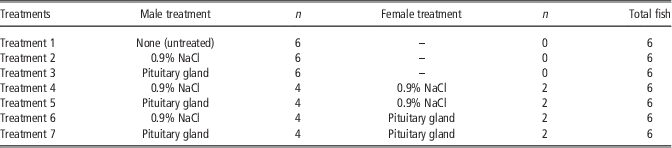
Here we evaluated the effects of carp pituitary gland (3 mg/kg) and the presence of the female upon the sperm quality. We used seven treatments as shown in Table 1. We used the same stock density at six fish per tank for all treatments, including male and female fish. Fish were maintained in a fiberglass tank with a constant water flow at 28°C. After 8 h, male fish from treatments T6 and T7 started spawning behavior (male fish following the female fish across the tank). Then, all the female fish from treatments T4, T5, T6 and T7 were removed to avoid natural spawning. At that moment, the female fish from treatments T6 and T7 were ovulating and promptly released oocytes after gently stripping. For each treatment, we evaluated the sperm concentration and motility parameters as shown above. For this experiment we used four male fish for each treatment.
Treatments for evaluation of induced spawning and the presence of female fish on sperm quality

In treatment 1, we used untreated male fish (not injected). For other treatments, we injected both physiological medium (0.9% NaCl) or pituitary gland (3 mg/kg for female fish dissolved in 0.9% NaCl). Sperm from four male fish from each treatment was analyzed.
Short-term storage of sperm
First, we evaluated six different kind of semen extenders to immobilize and maintain the sampled sperm. Sperm from eight male fish presenting progressive motility above 85% were mixed, and diluted 10-fold in the six extenders, as follow: modified Ringer solution (128.3 mM NaCl, 23.6 mM KCl, 3.6 mM CaCl2, 2.1 mM MgCl2), Kurokura’s solution (128.4 mM NaCl, 2.7 mM KCl, 1.4 mM CaCl2, 2.4 mM NaHCO3, Kurokura et al., Reference Kurokura, Hirano, Tomita and Iwahashi1984), Cyprinid extender (76 mM NaCl, 70.4 mM KCl, 2 mM CaCl2, 1 mM MgSO4, 2.4 mM NaHCO3 – modified from Lahnsteiner et al., Reference Lahnsteiner, Berger and Weismann2003), Dulbecco’s Phosphate Buffer solution calcium and magnesium-free (Sigma, St. Louis, USA), Eagle’s-MEM solution (Sigma), and Hank’s saline solution (137 mM NaCl, 5.4 mM KCl, 0.25 mM Na2HPO4, 0.44 mM KH2PO4, 1.3 mM CaCl2, 1 mM MgSO4, 4.2 mM NaHCO3). After dilution, the samples were stored at 2.5°C and the sperm motility was measured daily as described above.
The best extender was selected based on the experiment above. To improve gamete storage ability, we evaluated five treatments: treatment 1 (control): extender; treatment 2: extender with antibiotics (100 μg/ml of streptomycin and 100 IU of penicillin); treatment 3: replacement of supernatant extender (50%) each 4 days and re-suspension of sperm; treatment 4: addition of oxygen to the tube (daily); treatment 5: combination of all treatments above (addition of antibiotics, replacement of supernatant each 4 days and addition of oxygen). Storage ability was evaluated based on sperm parameters as in the previous experiment.
Short-term storage of eggs
Different temperatures were evaluated for short-term storage of eggs in vitro. Eggs from three female fish were stripped on a plastic Petri dish (90 mm diameter) covered by a polyvinylidene chloride film (saran wrap). The oocytes from each female were divided into four Petri dishes (all containing polyvinylidene chloride film) and the egg mass was covered by a small piece (~50×50 mm) of plastic film in order to prevent dehydration. The Petri dishes were stored at 5°C, 10°C, 15°C and 20°C in BOD incubators. Aliquots of about 120 eggs were fertilized at 0, 30, 60, 90 and 120 min of storage, and then checked the fertilization at blastula stage (~3 hpf) and hatching rates (~16 hpf). The number of normal and abnormal larvae was also counted as percentages of hatched larvae.
Statistics
Data are shown as mean±s.d. All experiments were performed in triplicates using different gamete sources. Data were checked for normality using the Liliefor test, and then compared using ANOVA followed by Tukey’s multiple range test. All statistical analysis were performed using the software Statistica v10 and the significance was set at P⩽0.05.
Results
Effects of maturation inducers on sperm quality
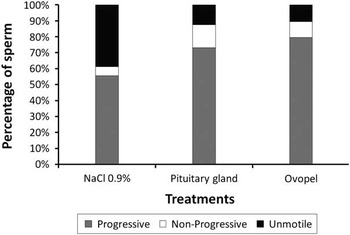
Induced spermiation did not increase the progressive motility of the sperm (Figures 1, P=0.1598). The use of carp pituitary gland and Ovopel gave rise to motility levels of 73.1±4.0% and 79.5±5.5%, respectively. Control groups injected with 0.9% NaCl showed a motility of 55.6±27.2%. Sperm concentration was not affected by induced spermiation (P=0.5160). In control group sperm concentration was 1.0×10¹⁰±7.0×10⁸ spermatozoa/ml. The same parameter was 6.2×10⁸±3.9×10⁸ spermatozoa/ml for fish treated with pituitary gland and 6.3×10⁸±2.1×10⁸ spermatozoa/ml for Ovopel. The duration of sperm motility was shorter (54.0±7.7 s) in control when compared with carp pituitary gland (92.8±15.5 s, P=0.0031) and Ovopel (86.5±10.6 s, P=0.0090).
Effect of induced spermiation upon the sperm motility of Astyanax altiparanae using Ovopel (3 mg/kg) and carp pituitary gland (3 mg/kg) in comparison with 0.9% NaCl (control). Sperm motility are expressed as progressive motility, non-progressive motility and immotile spermatozoa. Progressive motility had no significant differences within treatments (P<0.1598).

Presence of female and hormonal treatment on sperm quality
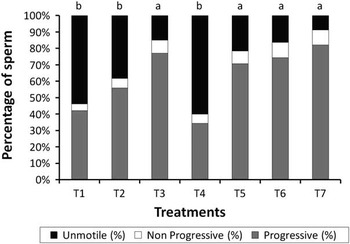
As shown in Figure 2, the progressive sperm motility was significantly lower (P=0.0018) within untreated male fish (T1=42.13±26.1%), male fish injected with 0.9% NaCl (T2=55.9±14.5%), and when male fish and female fish were injected with 0.9% NaCl (T4=34.3±12.4%). Hormonal treatment increased significantly the sperm motility in all conditions, with the male fish kept separately (T3=77.1±15.1%), with non-induced female fish (T5=70.6±15.1%) or induced female fish (T7=82.1±4.3%). Interestingly, male fish injected with 0.9% stored with induced female fish presented increased sperm motility at 74.4±7.4% (T6).
Effect of hormonal treatment and the presence of female fish upon the sperm motility of Astyanax altiparanae (see Table 1). Sperm motility are expressed as progressive motility, non-progressive motility and immotile. Asterisks indicates significant differences within treatments by the Tukey multiple range test (P<0.05).

The duration of progressive motility was lower (P=0.0365) in the treatments without hormonal treatment (T1=55.2±9.5 s, T2=43.6±11.5 s, T4=42.3±3.2 s), but when an induced female was kept together, the duration of progressive motility was increased (T6=82.0±15.2 s). Induced male fish presented increased progressive motility when kept separately (T3=105.6±19.9 s) or with non-induced (T5=68.3±13.0 s) or induced female fish (T7=98.0±14.0 s). Sperm concentration did not show a clear correlation with treatments (P=0.1573, data not shown).
Short-term storage of sperm
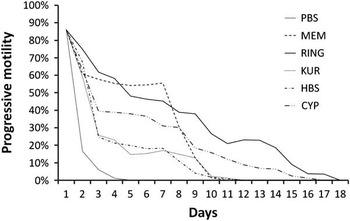
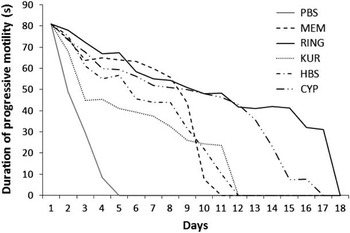
The extenders used to dilute the sperm presented different storage ability (Figure 3). Sperm motility decreased rapidly with 2 days of storage in Dulbecco’s PBS, and the sperm remained motile for only 4 days. Hank’s saline, Kurokura’s solution, cyprinid extender decreased rapidly the sperm motility during the first 3 days of storage, but the sperm was still viable if stored from 10 to 16 days. Eagle’s MEM kept the sperm motility in good conditions until 7 days of storage, and from this point the motility decreased rapidly until 10 days of storage. Sperm motility presented a linear decrease in Ringer solution and the storage ability remained until 18 days. Duration of progressive motility was also decreased when the sperm motility was decreased (Figure 4). Based on the results above, Ringer solution was chosen for other experiments with sperm.
Progressive sperm motility of yellowtail tetra Astyanax altiparanae after refrigerated storage. Sperm samples were diluted 10-fold using six extenders and then maintained at 2.5°C. Motility parameters were then measured daily. Our results demonstrate that sperm of yellowtail tetra presented motility until 18 days when diluted in modified Ringer solution.

Duration of progressive sperm motility of yellowtail tetra Astyanax altiparanae after refrigerated storage. Sperm samples were diluted 10-fold using six extenders and then maintained at 2.5°C. Motility parameters were then measured daily. Our results demonstrate that sperm of yellowtail tetra presented motility until 18 days when diluted in modified Ringer solution.

Optimization of sperm storage
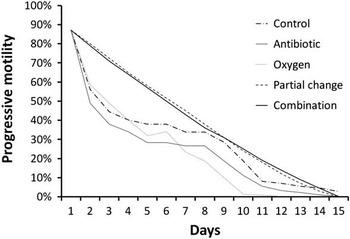
As observed on Figure 5, the use of oxygen and antibiotics decreased the storage ability of sperm when compared with control group in which only Ringer solution was used. Partial change of the extender and a combination of all treatments maintained the sperm motility better than control group, although the duration of storage was similar in those treatments (about 15 days).
Optimization of refrigerated storage of sperm of yellowtail tetra Astyanax altiparanae. Sperm samples were diluted 10-fold using Ringer solution and stored at 2.5°C. For evaluation of storage conditions, additives as oxygen, antibiotics, partial change of the supernatant and a combination thereafter (oxygen+antibiotics+partial changes) were evaluated.

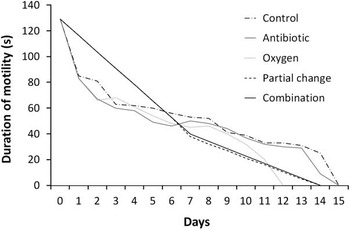
The duration of progressive motility was also decreased with the storage conditions (Figure 6).
Duration of progressive sperm motility of yellowtail tetra Astyanax altiparanae after short-term storage. Sperm samples were diluted 10-fold using Ringer solution and stored at 2.5°C. Additives as oxygen, antibiotics, partial change of the supernatant and a combination thereafter (oxygen+antibiotics+partial changes) were evaluated.

Short-term storage of eggs
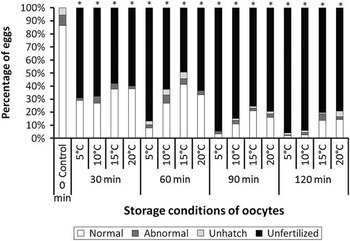
Storage of the oocytes decreased the fertilization ability in all conditions when compared with controls, which were fertilized just after gamete sampling (Figure 7). However, no significant differences were found within the stored samples, and ranged from 4.1±5.3% (120 min at 5°C) to 50.6±36.2%.
Development of Astyanax altiparanae after short-term storage of oocytes. Oocytes were incubated at 5, 10, 15 and 20°C and aliquots (120–150 oocytes) were fertilized at 30, 60, 90 and 120 min. Control group was fertilized immediately after oocyte sampling (no storage). After fertilization, the embryos were incubated at room temperature (24–26°C). Fertilization was measured at blastula stage (3 hpf), and the percentages of normal and abnormal larvae were measured after hatching (16 hpf). Fertilization rates decreased significantly in all treatments when compared with control groups.

Considerable variation was found in results from each treatment. The percentages of normal and abnormal larvae did not show a clear relationship within treatments.
Discussion
Semen quality and gametes short-term storage of yellowtail tetra was optimized in the present study. Regarding the sperm, hormonal treatments and the presence of female fish improved the sperm quality. We observed that induced spermiation is suggested in this species because of increase on sperm motility, although the sperm concentration is decreased. Interestingly, we found that ovulating female or hormonal treatments are both efficient to induce spermiation in this species. In laboratory studies, hormonal treatments is suggested to increase sperm motility. After sampling, the sperm of the yellowtail tetra was kept under refrigerated storage for several days when diluted in Ringer solution. Additionally, partial change of the extender was effective to improve the storage ability. Theoretically, extenders dilute the sperm, reducing the viscosity, maintain the pH, increase the oxygen availability and improve the accuracy for measuring the sperm motility (Billard and Cosson, Reference Billard and Cosson1992). However, dilution of sperm using extenders may improve (Billard et al., Reference Billard, Cosson, Noveiri and Pourkazemi2004; Fauvel et al., Reference Fauvel, Boryshpolets, Cosson, Wilson Leedy, Labbe, Haffray and Suquet2012) or even decrease (Jing et al., Reference Jing, Huang, Bai, Tanguay and Dong2009; He et al., Reference He, Zhao, Lu, Yan, Huang and Dong2012) the maintenance of sperm, suggesting a species-specific relationship. Although the addition of oxygen and antibiotics improved the storage ability in some species (Brown and Mims, Reference Brown and Mims1995; Bencic et al., Reference Bencic, Krisfalusi, Cloud and Ingermann2000), and in the yellowtail tetra the combination of both treatments improved the sperm storage. For most of aquaculture species, undiluted sperm is used for fertilization. On the other hand, in the yellowtail tetra the utilization of extenders is essential for sperm sampling and storage due to very low volume and urine contamination. It suggests that our procedures of gamete sampling and storage are essential for artificial fertilization in this species. Considering those aspects, the best extender selected in our work will have an important role in this species including (1) gamete sampling as an immobilizing media, (2) increase of accuracy during measuring the sperm motility, (3) improvement of sperm usage under refrigerated storage, and (4) standardization of the timing for fertilization.
In all treatments, we observed highly variable results. For instance, the duration of sperm motility, concentration and other sperm parameters were different in our experiments, even when we used the same procedure (sperm sampling and storage in Ringer solution). Similarly, the storage ability of the sperm using Ringer solution varied from 16 to 18 days. Those results indicate that sperm quality is highly variable between individuals of this species.
Regarding the storage of the oocytes, only changing storage temperatures gave rise to highly variable and poor results. Such data did not result in applicable procedures for hatchery or laboratory studies. In general, warm-water species presents low storage ability after ovulation (Rizzo et al., Reference Rizzo, Godinho and Sato2003; Nguenga et al., Reference Nguenga, Teugels, Legendre and Ollevier2004). Better storage are found in some cold-water species including salmonids (Barrett, Reference Barrett1951; Withler and Morley, Reference Withler and Morley1968; Poon and Johnson, Reference Poon and Johnson1970; Jensen and Alderdice, Reference Jensen and Alderdice1984; Babiak and Dabrowski, Reference Babiak and Dabrowski2003; Niksirat et al., Reference Niksirat, Sarvi, Mojazi Amiri and Hatef2007), sturgeons (Billard et al., Reference Billard, Cosson, Noveiri and Pourkazemi2004; Sohrabnezhad et al., Reference Sohrabnezhad, Kalbassi, Nazari and Bahmani2006), flatfishes (Suquet et al., Reference Suquet, Chereguini, Omnes, Rasines, Normant, Souto and Quemener1999) and walleye (Dietrich et al., Reference Dietrich, Dabrowski, Arslan, Ware and Van Tassell2012) although it is dependent on species and storage conditions (Rothbard et al., 1996; Linhart et al., Reference Linhart, Gela, Rodina and Rodriguez-Guitierrez2001; Yasui et al., Reference Yasui, Fujimoto and Arai2010). Based on our results, we conclude that oocytes from yellowtail tetra cannot be stored successfully, although other procedures may be used in future works including solutions with additives that may improve storage ability as was observed in the other warm-water fish such as the tilapia (Harvey and Kelley, Reference Harvey and Kelley1984).
Considering our data of storage of oocytes and sperm, we also conclude that sperm may be stored for several days under refrigeration although the viability of oocytes decreases rapidly after ovulation. The sperm may be sampled and stored several hours before the oocyte sampling, and this procedure is important because the timing for ovulation varies according to the female and environmental conditions. In addition, oocyte viability decreases quickly after sampling, and then it is important to collect the sperm before the oocytes. Such information is essential to develop all procedures for artificial insemination in the yellowtail tetra by optimizing gamete handling including gamete sampling and storage. Several important information are necessary for fish biotechnology and those information are not fully understood even in well studied fish like the zebrafish in which a protocol for sperm sampling and artificial fertilization was improved recently (Hagedorn and Carter, Reference Hagedorn and Carter2011). This study is the first step for future works involving IVF in yelowtail tetra.
In conclusion, the gamete quality was optimized using the following procedures: induced spermiation with carp pituitary gland or Ovopel® and dilution and storage of sperm using modified Ringer solution. Such procedures may facilitate the application of IVF in the yellowtail tetra under laboratory conditions.
Acknowledgments
The authors are grateful to Sao Paulo Research Foundation (FAPESP) for the financial support of this research (Young Investigators Award Grant #2010/17429-1 and Young Researcher Scholarship #2011/11664-1). They also acknowledge CEPTA-ICMBio for gently provide the facilities and experimental fish.