Introduction
Attenuated positive symptom syndrome (APSS) is a clinically meaningful diagnosis (Fusar-Poli et al. Reference Fusar-Poli, Borgwardt, Bechdolf, Addington, Riecher-Rossler, Schultze-Lutter, Keshavan, Wood, Ruhrmann, Seidman, Valmaggia, Cannon, Velthorst, De Haan, Cornblatt, Bonoldi, Birchwood, McGlashan, Carpenter, McGorry, Klosterkotter, McGuire and Yung2013; Goulding et al. Reference Goulding, Holtzman, Trotman, Ryan, Macdonald, Shapiro, Brasfield and Walker2013), identifying individuals who are showing attenuated, psychotic-like pathology (e.g. unusual thoughts and beliefs, suspiciousness, perceptual abnormalities) resembling the prodromal (pre-psychosis) phase of schizophrenia and other psychotic disorders. Identified prospectively, attenuated psychotic symptoms predict substantially elevated risk for transition to psychosis in young people within 12–24 months of baseline compared with normal and help-seeking controls (HSC) (Yung et al. Reference Yung, Phillips, Yuen, Francey, McFarlane, Hallgren and McGorry2003; Cannon et al. Reference Cannon, Cadenhead, Cornblatt, Woods, Addington, Walker, Seidman, Perkins, Tsuang, McGlashan and Heinssen2008; Ruhrmann et al. Reference Ruhrmann, Schultze-Lutter, Salokangas, Heinimaa, Linszen, Dingemans, Birchwood, Patterson, Juckel, Heinz, Morrison, Lewis, Graf von Reventlow and Klosterkotter2010; Brucato et al. Reference Brucato, Masucci, Arndt, Ben-David, Colibazzi, Corcoran, Crumbley, Crump, Gill, Kimhy, Lister, Schobel, Yang, Lieberman and Girgis2017). Furthermore, APSS symptoms are themselves associated with substantial distress and poor functioning, including suspiciousness, deficits in emotion awareness and regulation, social anhedonia, impaired cognition, and poor tolerance of normal stress, among other clinical problems (Miller et al. Reference Miller, Zipursky, Perkins, Addington, Woods, Hawkins, Hoffman, Preda, Epstein, Addington, Lindborg, Marquez, Tohen, Breier and McGlashan2003b ; Addington et al. Reference Addington, Cornblatt, Cadenhead, Cannon, McGlashan, Perkins, Seidman, Tsuang, Walker, Woods and Heinssen2011, Reference Addington, Liu, Buchy, Cadenhead, Cannon, Cornblatt, Perkins, Seidman, Tsuang, Walker, Woods, Bearden, Mathalon and McGlashan2015; Cornblatt et al. Reference Cornblatt, Carrion, Addington, Seidman, Walker, Cannon, Cadenhead, McGlashan, Perkins, Tsuang, Woods, Heinssen and Lencz2012; Kimhy et al. Reference Kimhy, Gill, Brucato, Vakhrusheva, Arndt, Gross and Girgis2016), supporting clinical significance regardless of subsequent diagnostic outcome.
The prodromal phase of schizophrenia and other psychoses is typically preceded by premorbid signs and symptoms of pathology. As a proxy for the psychosis prodrome, the APSS diagnosis offers an opportunity to examine the relationship between premorbid and prospectively identified ‘putatively prodromal’ (APSS) symptoms and further enhance psychosis prediction.
Poor social adjustment in childhood and adolescence is well documented as a principal and clinically meaningful characteristic of the premorbid (i.e. pre-prodromal) phase of schizophrenia (Kraepelin, Reference Kraepelin1919; Strauss & Carpenter, Reference Strauss and Carpenter1972; Bailer et al. Reference Bailer, Brauer and Rey1996; Mueser & Bellack, Reference Mueser, Bellack, Mueser and Tarrier1998; Hafner et al. Reference Hafner, Maurer, Loffler, an der Heiden, Hambrecht and Schultze-Lutter2003; Addington & Addington, Reference Addington and Addington2005). Furthermore, pre-APSS social maladjustment predicts baseline severity of attenuated positive, negative, and disorganized symptoms in individuals meeting APSS criteria (Tarbox et al. Reference Tarbox, Addington, Cadenhead, Cannon, Cornblatt, Perkins, Seidman, Tsuang, Walker, Heinssen, McGlashan and Woods2013; Lyngberg et al. Reference Lyngberg, Buchy, Liu, Perkins, Woods and Addington2015) and predicts transition from APSS to psychosis, over and above most APSS symptoms (Cannon et al. Reference Cannon, Cadenhead, Cornblatt, Woods, Addington, Walker, Seidman, Perkins, Tsuang, McGlashan and Heinssen2008; Tarbox et al. Reference Tarbox, Addington, Cadenhead, Cannon, Cornblatt, Perkins, Seidman, Tsuang, Walker, Heinssen, McGlashan and Woods2013).
However, predictive associations between social maladjustment and APSS symptoms have not been tested in controls. Thus, it is unknown if premorbid social maladjustment predicts APSS symptom severity independent of whether APSS diagnostic criteria are met (i.e. in participants regardless of diagnostic group), which would negate utility for improving prediction in APSS-diagnosed individuals.
In contrast, predictive associations between premorbid social maladjustment and subsequent APSS symptoms, observed only when the APSS diagnosis is present, would indicate relevance to the APSS diagnosis and psychosis risk prediction. Conversely, associations between premorbid social adjustment and APSS symptoms, observed only in the absence of the APSS diagnosis, would suggest low risk for APSS and in turn, predict low risk for psychosis (Fusar-Poli et al. Reference Fusar-Poli, Cappucciati, Rutigliano, Schultze-Lutter, Bonoldi, Borgwardt, Riecher-Rossler, Addington, Perkins, Woods, McGlashan, Lee, Klosterkotter, Yung and McGuire2015).
This cross-sectional study used prediction analysis to examine the effect of premorbid social maladjustment on severity of attenuated psychotic-like positive, negative, disorganized, and general symptoms in APSS-diagnosed and HSC participants. To evaluate diagnostic relevance, these associations were tested in a combined APSS/HSC sample and in the separate APSS and HSC groups. This study had two aims. (1) To determine if premorbid social maladjustment predicts severity of attenuated psychotic-like symptoms independent of the APSS diagnosis and (2) to identify APSS-specific predictive associations.
Method
Participants
Participants are 232 individuals (156 APSS and 76 HSC) aged 14–30. They represent the subset of participants enrolled in the 2-year, multi-site prospective study ‘Enhancing the Prospective Prediction of Psychosis’ (PREDICT) (Addington et al. Reference Addington, Piskulic, Perkins, Woods, Liu and Penn2012, Reference Addington, Liu, Perkins, Carrion, Keefe and Woods2017) that met criteria for the current study. The PREDICT study was conducted at the University of Toronto, University of North Carolina, and Yale University. Study protocols and informed consents were reviewed and approved by the ethical review board (Institutional Review Board, IRB) at each site.
Eligibility criteria
Eligibility for the PREDICT study was determined by comprehensive clinical assessment conducted by a clinical psychologist or psychiatrist at each site. Eligibility criteria for all individuals admitted to the study were reviewed during weekly conference calls chaired by J. Addington.
Inter-rater reliability and agreement with gold-standard expert ratings was determined at the start of the study by having all interviewers submit ratings on mock Structured Interview for Prodromal Syndromes (SIPS) interviews for comparison with gold-standard ratings and diagnoses provided by expert interviewers. One hundred percent agreement with expert interviewers on diagnosis and at least 80% agreement for symptom presence on these interviews were required.
Inclusion criteria
Psychosis risk
Psychosis-risk participants met diagnostic criteria for APSS alone or APSS plus Genetic Risk and Deterioration (GRD) based on the Criteria of Prodromal Syndromes (COPS). Per COPS criteria, diagnosis of APSS requires new onset or worsening in the past 12 months of a non-psychotic (attenuated), clinically significant level of disturbance in positive symptoms: unusual thought process/ideas, suspiciousness, grandiosity, perceptual abnormalities, or disorganized communication. Diagnosis of GRD requires either a diagnosis of schizotypal personality disorder plus at least a 30% drop in functioning on the Global Assessment of Functioning (GAF) scale in the past 12 months or the participant having a first-degree relative with a psychotic disorder (Miller et al. Reference Miller, McGlashan, Rosen, Somjee, Markovitch, Stein and Woods2002, Reference Miller, McGlashan, Rosen, Cadenhead, Cannon, Ventura, McFarlane, Perkins, Pearlson and Woods2003a ; McGlashan et al. Reference McGlashan, Walsh and Woods2010). For the current study, APSS diagnosis was required for inclusion in the psychosis-risk group to maintain a focus on clinical risk symptoms (v. risk primarily due to genetic effects). Diagnostic agreement among raters on the distinction between attenuated and psychotic levels of intensity on the positive symptom items was excellent (κ = 0.90).
Help seeking
HSC participants are individuals who responded to recruitment advertisements and presented with apparent prodromal symptoms at phone screen, but did not meet COPS diagnostic criteria for any psychosis-risk syndrome upon administration of the full SIPS interview. To minimize confounds of genetic risk factors, HSC participants with a family history of psychosis were excluded from the current study.
Exclusion criteria
PREDICT exclusion criteria for psychosis risk and HSC participants were: (1) current or lifetime Diagnostic and Statistical Manual of Mental Disorders, Fourth Edition (DSM IV) Axis I diagnosis of a psychotic disorder or bipolar disorder; (2) non-psychotic, psychiatric disorder, or substance use to which the diagnostic psychosis-risk symptoms can be attributed; (3) current or lifetime central nervous syndrome disorder that may contribute to, or confound, psychosis-risk symptoms; (4) >16 weeks of lifetime cumulative treatment with an antipsychotic medication; (5) antipsychotic medication use in the past week or ongoing need for treatment with an antipsychotic medication; and (6) IQ <65.
As noted, to minimize confounding effects of genetic risk factors, the present study further excluded individuals with a family history of psychosis unless also meeting criteria for APSS. Individuals without premorbid social maladjustment data were also excluded.
Assessment
The following assessments were administered to all participants at baseline.
The SIPS 4.0 (Woods et al. Reference Woods, Addington, Cadenhead, Cannon, Cornblatt, Heinssen, Perkins, Seidman, Tsuang, Walker and McGlashan2009; McGlashan et al. Reference McGlashan, Walsh and Woods2010) was used to assess severity of psychosis-risk symptoms and establish diagnosis of a psychosis-risk syndrome (e.g. APSS, GRD) per COPS criteria. The SIPS interview includes collection of developmental and family history from parent/guardian (or participant if aged 18 or above) and functional assessment (GAF). SIPS interviews were administered to participants by expert interviewers with established inter-rater reliability.
Symptoms were rated by the interviewers using the Scale of Prodromal Symptoms (SOPS) contained within the SIPS. SOPS symptom ratings are determined from SIPS interview data based on information provided by the participant themselves, interviewer interaction with the participant, and observed behavior. The SOPS is comprised of 19 symptom scales across four symptom domains: positive (five scales), negative (six scales), disorganized (four scales), and general (four scales) (see Table 3). SOPS symptoms are rated on a 0 (none) to 6 (most severe) scale with extensive anchors for each scale point for each symptom. On all SOPS scales, a rating of ‘3’ or higher indicates clinical significance. Unstandardized baseline severity ratings for all positive, negative, disorganized, and general SOPS symptom scales, and summed ratings for each symptom domain, were utilized in the current study.
COPS criteria for diagnosis of a psychosis-risk syndrome are determined using SOPS ratings and collateral information from all available sources (including developmental history provided by parent/guardian). Diagnosis of APSS, required in the current study for inclusion in the psychosis-risk group, is determined from the SOPS-positive symptom scales (unusual thought content, suspiciousness, grandiosity, perceptual abnormalities, and disorganized communication), with at least one of these symptoms rated 3, 4, or 5 indicating clinically significant disturbance below a psychotic level of intensity (rating of 6) that either started or worsened in the past 12 months. SOPS ratings and diagnosis of psychosis-risk syndrome based on COPS criteria were verified on weekly consensus diagnosis calls by expert clinicians. Detailed information regarding psychometric properties of the SOPS scales are available (Miller et al. Reference Miller, McGlashan, Rosen, Somjee, Markovitch, Stein and Woods2002, Reference Miller, McGlashan, Rosen, Cadenhead, Cannon, Ventura, McFarlane, Perkins, Pearlson and Woods2003a ; Hawkins et al. Reference Hawkins, McGlashan, Quinlan, Miller, Perkins, Zipursky, Addington and Woods2004; Lencz et al. Reference Lencz, Smith, Auther, Correll and Cornblatt2004; McGlashan et al. Reference McGlashan, Walsh and Woods2010).
Premorbid social maladjustment (social withdrawal, poor peer relationships) was evaluated using the Premorbid Adjustment Scale (PAS; Cannon-Spoor et al. Reference Cannon-Spoor, Potkin and Wyatt1982; Brill et al. Reference Brill, Reichenberg, Weiser and Rabinowicz2008). The PAS is an interview-based, retrospective evaluation of social and academic functioning from age 5 years up to 6 months prior to the onset of prodromal symptoms (in this case, 6 months prior to onset of the first positive symptom rated 3 or higher on the SOPS). Items on the PAS are interviewer-rated on a 0–6 scale based on participant report and available collateral information, with ‘0’ indicating absence of maladjustment and higher ratings representing greater deficits. Up to four developmental periods are assessed [childhood (age 5–12), early adolescence (age 13–15), late adolescence (age 16–18), and adulthood (age 18 and above)], depending on participant age and age of prodromal symptom onset. The PAS has established predictive and concurrent validity (Brill et al. Reference Brill, Reichenberg, Weiser and Rabinowicz2008).
For the current study, mean, unstandardized PAS social maladjustment ratings were derived for childhood, early adolescence, and late adolescence. Mean social maladjustment ratings represent a combination of social withdrawal and poor peer relationships. Adult ratings, available for a limited subset of participants, were not used to further guard against overlap with prodromal symptom onset.
Diagnoses of co-morbid Axis I disorders were established at baseline using the Structured Clinical Interview for DSM-IV (SCID-I) (First et al. Reference First, Spitzer, Gibbon and Williams1995).
IQ exclusion criteria of <65 was determined at baseline using the vocabulary, information, arithmetic, block design, and digit-symbol coding subtests from the Wechsler Adult Intelligence Scale (WAIS-III) or Wechsler Intelligence Scale for Children (WISC-III).
Analysis
Univariate group comparisons on demographic and psychiatric diagnostic variables were tested using χ2, t test, and correlation analyses. Univariate group comparisons on PAS social and SOPS positive, negative, disorganized, and general symptom scale ratings were performed using t test analysis. Significant effects (p < 0.05) were considered in subsequent analyses as indicated below.
Given age and sex effects observed in premorbid and prodromal phases of psychotic disorders, group by age and group by sex interaction effects on premorbid social maladjustment (PAS ratings) and psychosis-risk positive, negative, disorganized, and general symptom ratings (SOPS ratings) were tested in the combined (APSS and HSC) sample using two-factor analysis of variance.
Predictive associations between child, early adolescent, and late adolescent premorbid maladjustment ratings and prodromal symptom severity scores were tested using Curve Fit regression analysis in SPSS 21. Linear, quadratic, and cubic models were evaluated. The Curve Fit function employs listwise deletion of missing values resulting in sample size differences across analyses. Analyses were conducted first in the combined sample (APSS + HSC) and then in the APSS and HSC groups individually.
Given the number of SOPS symptom scales, predictive associations between premorbid maladjustment and SOPS symptoms were evaluated using Bonferroni correction for multiple tests. Significance threshold was determined separately for each domain: positive (0.05/5 scales = 0.010), negative (0.05/6 scales = 0.008), disorganized (0.05/4 scales = 0.013), and general symptoms (0.05/4 scales = 0.013), and for all 19 symptom scales (0.05/19 scales = 0.003). Correction was not applied in the case of the four-symptom domain-summed scores.
All statistical analyses were conducted in SPSS 21 and Minitab 17.
Interpretation of quadratic and cubic associations
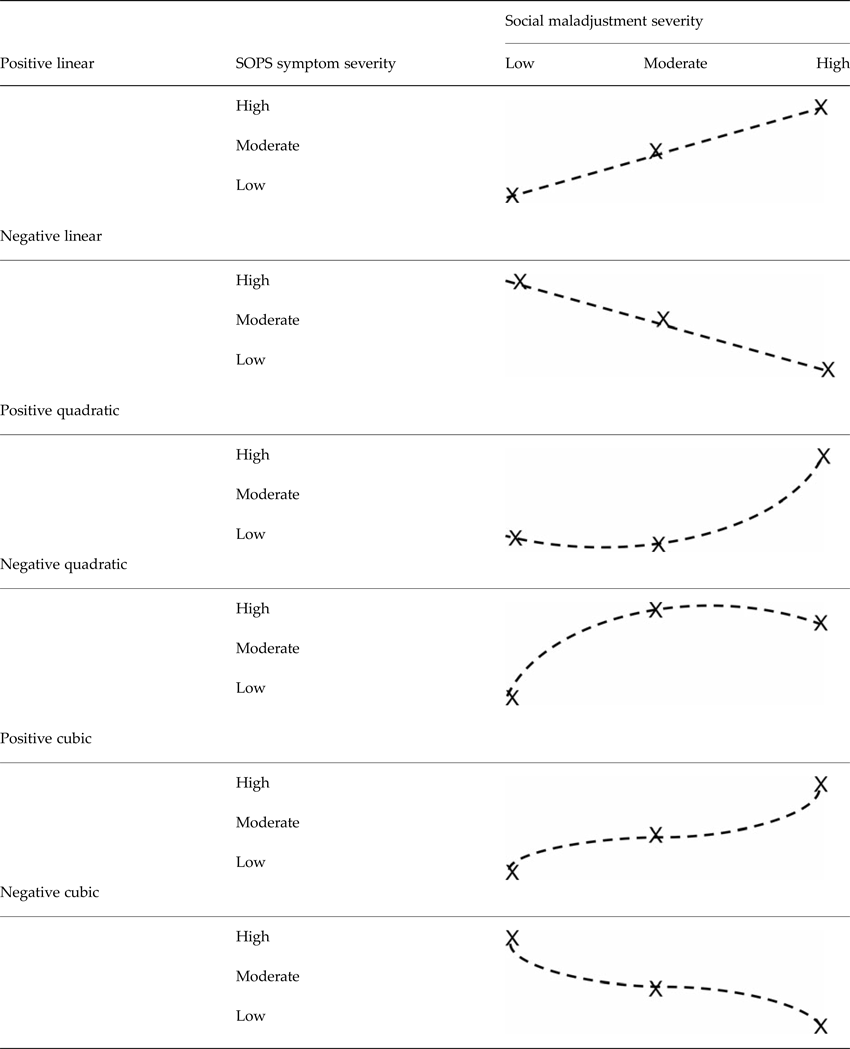
As with linear models, quadratic and cubic models describe SOPS symptom severity as a function of severity of premorbid maladjustment. However, in quadratic and cubic models, predicted direction and rate (slope) of change in symptom severity is not consistent across levels of maladjustment. Examples of linear, quadratic, and cubic associations are illustrated in Table 1. In the case of the current sample, score distributions tended to be positively skewed, and this is reflected in Table 1 and the following interpretation guidelines.
Illustration of linear, quadratic, and cubic associations

Positive quadratic
At low (less severe) levels of maladjustment, an increase in maladjustment severity rating predicts a low rate of change or a decrease in psychosis-risk symptom severity score (negative association). At higher levels of maladjustment, an increase in maladjustment predicts greater symptom severity (positive association). As such, symptom severity is predicted to be at its lowest when maladjustment is rated at low-to-moderate severity.
Negative quadratic
At lower levels of maladjustment, an increase in severity rating predicts a faster increase in symptom severity score compared with higher levels of maladjustment. At higher levels, an increase in maladjustment has less of an effect on symptom score and may show a negative association toward the high end of the maladjustment scale. As such, symptom severity is predicted to peak at moderate levels of maladjustment.
Positive cubic
When maladjustment ratings are at the low or high ends of the scale, maladjustment and symptom severity are positively associated such that an increase in maladjustment rating predicts an increase in symptom severity score. Conversely, intermediate maladjustment ratings show a negative, or weak positive, association with symptom severity, depending on quadratic and linear effects.
Negative cubic
In the case of a negative cubic association, low and high maladjustment ratings are negatively associated with symptom severity, such that an increase in maladjustment predicts a decrease in symptom severity score. Conversely, moderate maladjustment ratings show a positive, or weak negative, association with symptom severity, again depending on quadratic and linear effects.
Results
Participants
The current sample (n = 232) consists of 156 APSS and 76 HSC participants. A total of 154 APSS participants met criteria for APSS alone; two met criteria for both APSS and GRD. Four psychosis-risk participants were excluded as they met criteria for GRD alone, and 17 HSC participants were excluded due to a family history of psychosis.
HSC participants did not meet psychosis-risk syndrome criteria for the following reasons: (1) long-standing, stable attenuated positive symptoms present at the current level longer than 1 year (n = 42); (2) new positive symptoms were present, but did not meet severity and/or frequency criterion (n = 28); (3) only negative symptoms were present (n = 4); and (4) positive symptoms were present, but clearly due to another disorder (n = 2).
PAS ratings for childhood social maladjustment were available for all APSS (n = 156) and HSC (n = 76) participants, and early adolescent social maladjustment ratings were available for all but two APSS participants (n = 154) and all HSC participants. Late adolescent social maladjustment ratings were available for 116 APSS and 61 HSC participants.
Demographic effects and co-morbid diagnoses
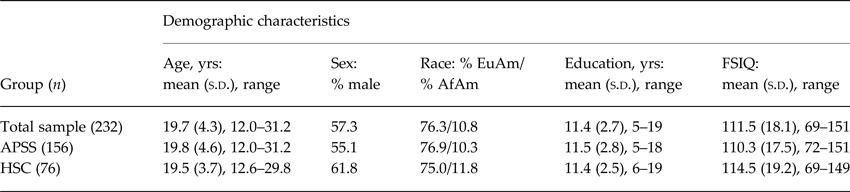
The APSS and HSC participants were well matched, showing no group differences in baseline age, sex, race, education, or IQ (Table 2). Frequency of lifetime major depressive disorder (MDD) was greater among APSS participants compared with HSC participants (p = 0.019). There were no group by lifetime MDD interaction effects on SOPS or PAS ratings. Groups did not differ on any other SCID-I diagnosis including alcohol and substance use disorders.
Sample demographic characteristics at baseline

APSS, attenuated positive symptom syndrome; HSC, help-seeking controls; yrs, years; s.d., standard deviation; EuAm, European American; AfAm, African American; FSIQ, Full Scale IQ Score; FSIQ n/group: total=184, APSS=133, HSC=51; education n/group: total=229, APSS=154, HSC=75.
Effects of age and sex on psychosis-risk symptoms
There were no group by age or group by sex interaction effects on SOPS ratings. There was a significant main effect of age on (diminished) ideational richness (p = 0.001), odd behavior or appearance (p = 0.010), and trouble with focus and attention (p = 0.039), with participants who were younger at baseline rated as more symptomatic. There was a significant main effect of sex, with males rated more symptomatic than females on grandiose ideas (p = 0.004), (diminished) expression of emotion (p = 0.005), (diminished) experience of emotion and self (p = 0.037), and bizarre thinking (p = 0.033), and females rated more symptomatic than males on dysphoric mood (p = 0.004) and impaired tolerance to normal stress (p = 0.010).
Effects of age and sex on premorbid maladjustment
No group by age or group by sex interaction effects on PAS ratings were identified. There was a significant main effect of age with participants who were younger at baseline reporting greater social maladjustment in late adolescence (p = 0.005). No main effect of sex was present.
Given that no interaction effects were identified, results of these analyses indicate that effects of baseline age and sex on SOPS and PAS symptom ratings were equivalent across groups.
Univariate symptom and maladjustment group comparisons
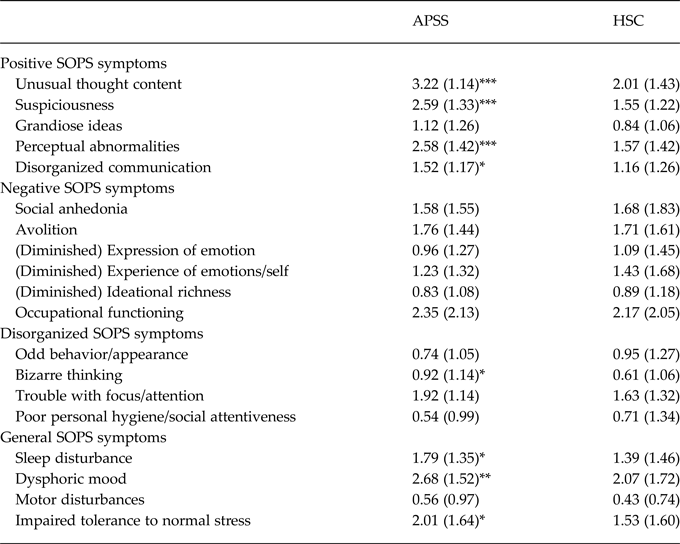
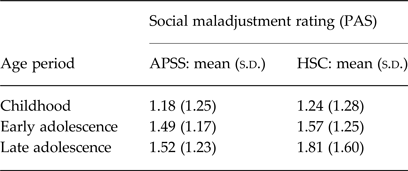
Consistent with study design, the APSS group presented with significantly greater baseline pathology than the HSC group on four of the five positive psychosis-risk symptoms: unusual thought content (p < 0.001), suspiciousness (p < 0.001), perceptual abnormalities (p < 0.001), and disorganized communication (p = 0.032). The APSS group also showed significantly greater pathology on bizarre thinking (p = 0.046), sleep disturbance (p = 0.041), dysphoric mood (p = 0.006), and impaired tolerance to normal stress (p = 0.036). The APSS and HSC groups did not differ on baseline severity of negative symptoms or severity of premorbid social maladjustment at any age. SOPS and PAS mean ratings and univariate results are provided in Tables 3 and 4, respectively.
Mean SOPS ratings: APSS v. HSC
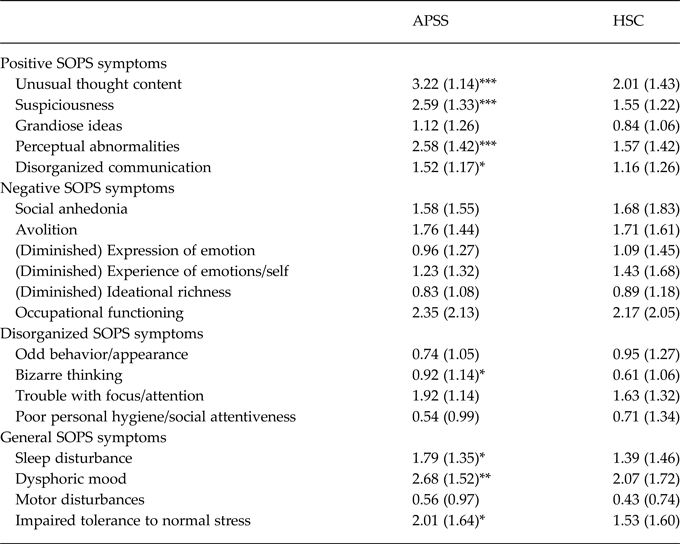
APSS, attenuated positive symptom syndrome; HSC, help-seeking controls; APSS n = 156, CHR n = 76; CHR > HSC: ***p ⩽ 0.001, **p ⩽ 0.01, *p ⩽ 0.05.
Standard deviation shown in parentheses.
Mean PAS social maladjustment ratings by age: APSS v. HSC
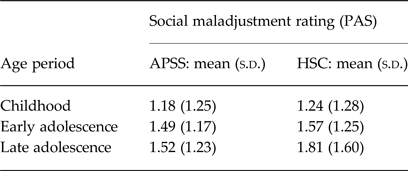
PAS, Premorbid Adjustment Scale; APSS, attenuated positive symptom syndrome; HSC, help-seeking controls; childhood: APSS n = 156, CHR n = 76; early adolescence: APSS n = 154, CHR n = 61; late adolescence: APSS n = 116, CHR n = 61; all group comparisons n.s.
Standard deviation shown in parentheses.
Premorbid social maladjustment and prediction of SOPS symptom severity
Results of prediction analyses are presented next and in Tables 5–8. For each of the four SOPS symptom domains, results for individual scale scores are presented for the combined APSS and HSC sample first and are then broken down by participant group. Results for individual scales that survived Bonferroni correction by symptom domain are presented in the text (positive: p ⩽ 0.010; negative: p ⩽ 0.008; disorganized: p ⩽ 0.013; general: p ⩽ 0.013). All results significant at p ⩽ 0.050 (i.e. uncorrected) are shown in the tables, and results significant after Bonferroni correction by domain and for 19 tests are indicated. Results for domain summed scores are also provided in the tables to aid across-study comparisons. Positive linear associations between premorbid social maladjustment and SOPS severity scores can be presumed unless otherwise noted.
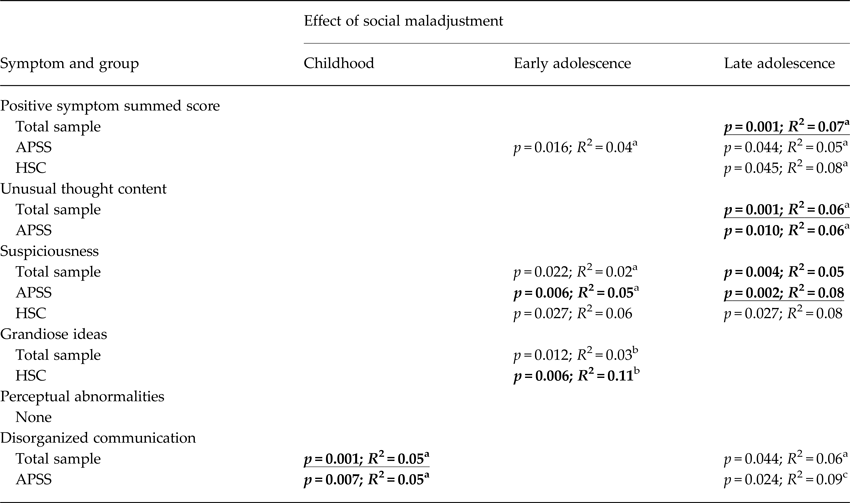
Prediction of SOPS positive symptoms by age of social maladjustment
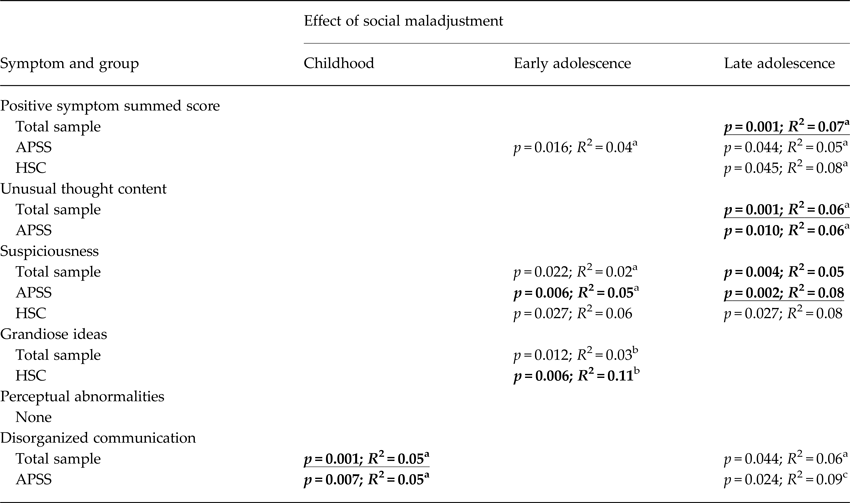
APSS, attenuated positive symptom syndrome; HSC, help-seeking controls.
Note: Associations presumed positive linear unless otherwise noted. Superscript notations for non-linear associations: a=negative quadratic, b=positive cubic, c=negative cubic. Underline=significant following Bonferroni correction for 19 tests (p ⩽ 0.003). Bold=significant following Bonferroni correction for positive symptom domain (five tests, p ⩽ 0.010). Plain text=no correction (p ⩽ 0.050). Correction not applicable to the summed score; however, the same bold and underline notations are used for ease of comparison.
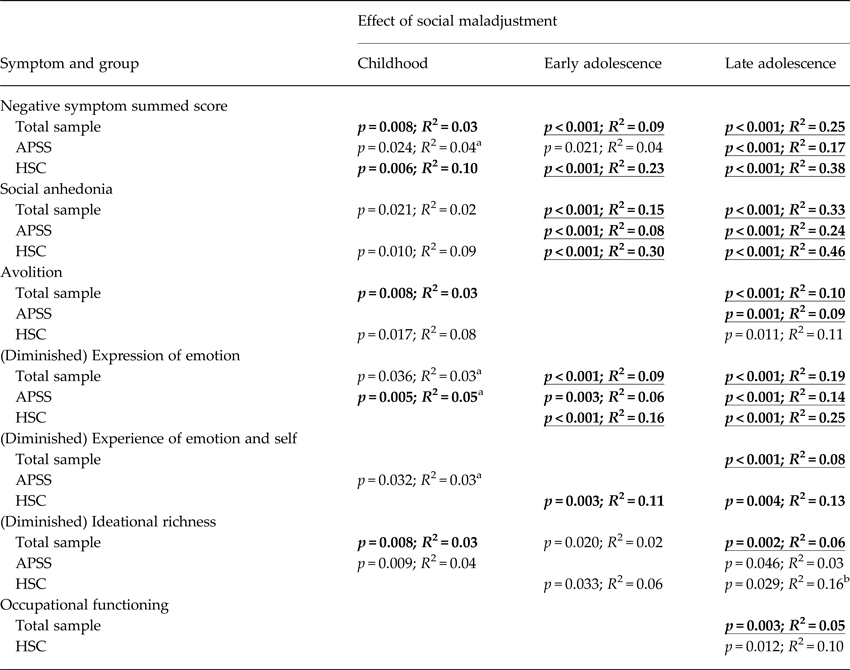
Prediction of SOPS negative symptoms by age of social maladjustment

APSS, attenuated positive symptom syndrome; HSC, help-seeking controls.
Note: Associations presumed positive linear unless otherwise noted. Superscript notations for non-linear associations: a=negative quadratic, b=positive cubic. Underline=significant following Bonferroni correction for 19 tests (p ⩽ 0.003). Bold=significant following Bonferroni correction for negative symptom domain (six tests, p ⩽ 0.008). Plain text=no correction (p ⩽ 0.050). Correction not applicable to the summed score; however, the same bold and underline notations are used for ease of comparison.
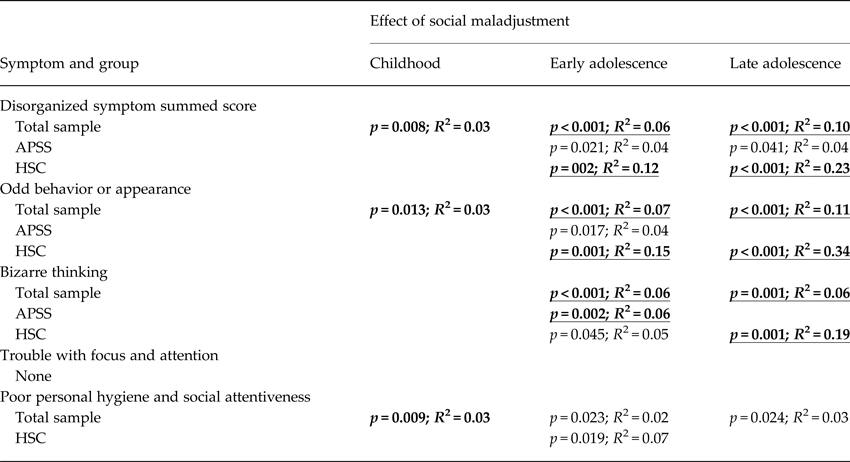
Prediction of SOPS disorganized symptoms by age of social maladjustment
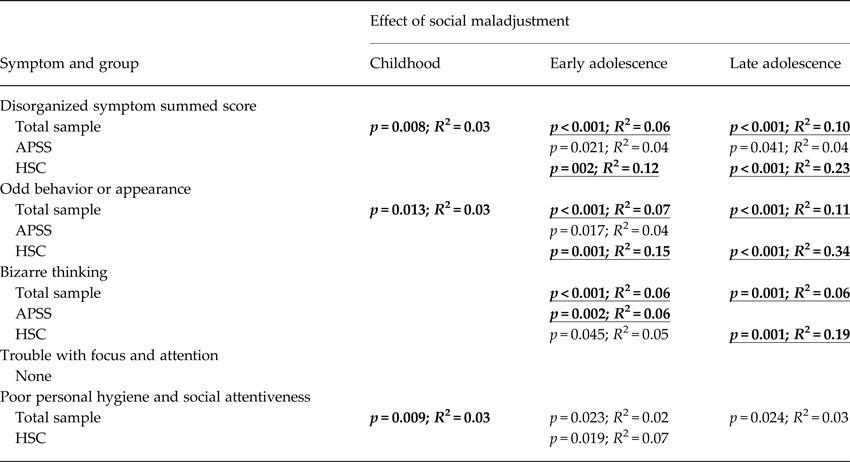
APSS, attenuated positive symptom syndrome; HSC, help-seeking controls.
Note: All associations are positive linear. Underline=significant following Bonferroni correction for 19 tests (p ⩽ 0.003). Bold=significant following Bonferroni correction for disorganized symptom domain (four tests, p ⩽ 0.013). Plain text=no correction (p ⩽ 0.050). Correction not applicable to the summed score; however, the same bold and underline notations are used for ease of comparison.
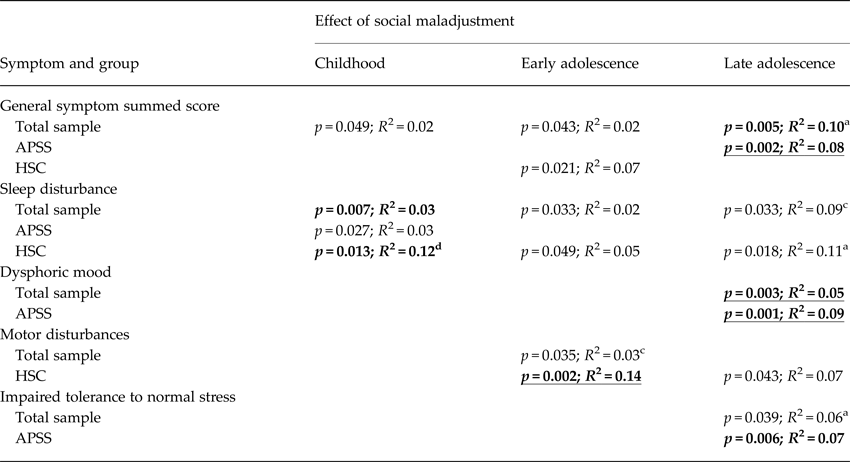
Prediction of SOPS general symptoms by age of social maladjustment

APSS, attenuated positive symptom syndrome; HSC, help-seeking controls.
Note: Associations presumed positive linear unless otherwise noted. Superscript notations for non-linear associations: a=negative quadratic, c=negative cubic, d=positive quadratic. Underline=significant following Bonferroni correction for 19 tests (p ⩽ 0.003). Bold=significant following Bonferroni correction for general symptom domain (four tests, p ⩽ 0.013). Plain text=no correction (p ⩽ 0.050). Correction not applicable to the summed score; however, the same bold and underline notations are used for ease of comparison.
Positive symptom scales
Combined sample
Childhood social maladjustment predicted severity of disorganized communication (R 2 = 0.05; negative quadratic). Late adolescent social maladjustment predicted unusual thought content (R 2 = 0.06; negative quadratic) and suspiciousness (R 2 = 0.05).
APSS and HSC groups
In APSS participants, childhood social maladjustment predicted severity of disorganized communication (R 2 = 0.05; negative quadratic). Early and late adolescent social maladjustment predicted suspiciousness [early: R 2 = 0.05 (negative quadratic), late: R 2 = 0.08]. Late adolescent maladjustment also predicted unusual thought content (R 2 = 0.06; negative quadratic).
In HSC participants, early adolescent maladjustment predicted severity of grandiose ideas (R 2 = 0.11; positive cubic).
Negative symptom scales
Combined sample
Childhood social maladjustment predicted severity of avolition (R 2 = 0.03) and ideational richness (R 2 = 0.03). Early adolescent maladjustment predicted social anhedonia (R 2 = 0.15) and diminished expression of emotion (R 2 = 0.09). Late adolescent social maladjustment predicted all negative symptoms: social anhedonia (R 2 = 0.33), avolition (R 2 = 0.10), diminished expression of emotion (R 2 = 0.19), diminished experience of emotion and self (R 2 = 0.08), diminished ideational richness (R 2 = 0.06), and poor occupational functioning (R 2 = 0.05).
APSS and HSC groups
In APSS participants, child, early adolescent, and late adolescent social maladjustment predicted severity of diminished expression of emotion [child: R 2 = 0.05 (negative quadratic), early: R 2 = 0.06, late: R 2 = 0.14]. Early and late adolescent maladjustment predicted social anhedonia (early: R 2 = 0.08 and late: R 2 = 0.24); late adolescent maladjustment also predicted avolition (R 2 = 0.09).
In HSC participants, both early and late adolescent social maladjustment predicted severity of social anhedonia (early: R 2 = 0.30, late: R 2 = 0.46), diminished expression of emotion (early: R 2 = 0.16; late: R 2 = 0.25), and diminished experience of emotion and self (early: R 2 = 0.11; late: R 2 = 0.13).
Disorganized symptom scales
Combined sample
Child, early adolescent, and late adolescent social maladjustment each predicted odd behavior or appearance (child: R 2 = 0.03, early: R 2 = 0.07, late: R 2 = 0.11). Child maladjustment also predicted poor personal hygiene/social attentiveness (R 2 = 0.03). Social maladjustment in early and late adolescence also predicted bizarre thinking (early: R 2 = 0.06, late: R 2 = 0.06).
APSS and HSC samples
In the APSS sample, early adolescent social maladjustment predicted severity of bizarre thinking (R 2 = 0.06).
In HSC participants, early and late adolescent social maladjustment predicted odd behavior or appearance (early: R 2 = 0.15, late: R 2 = 0.34). Late adolescent maladjustment also predicted bizarre thinking (R 2 = 0.19).
General symptom scales
Combined sample
Child social maladjustment predicted sleep disturbance (R 2 = 0.03), and late adolescent maladjustment predicted dysphoric mood (R 2 = 0.05).
APSS and HSC samples
In APSS participants, social maladjustment in late adolescence predicted severity of dysphoric mood (R 2 = 0.09) and impaired tolerance to normal stress (R 2 = 0.07).
In the HSC sample, child social maladjustment predicted sleep disturbance (R 2 = 0.12; positive quadratic), and early adolescent maladjustment predicted motor disturbances (R 2 = 0.14).
Discussion
This study used prediction analysis to examine the association between premorbid child, early adolescent, and late adolescent social maladjustment (social withdrawal and poor peer relationships) and positive, negative, disorganized, and general psychosis-risk symptoms in a sample of clinical high-risk (APSS) and HSC participants. This study had two aims: (1) to determine if premorbid social maladjustment predicts severity of attenuated psychotic-like symptoms, independent of the APSS diagnosis, and (2) to identify APSS-specific predictive associations.
Independence from the APSS diagnosis is supported when there is a significant effect of premorbid social maladjustment on APSS symptom severity in the combined APSS–HSC sample and the effect is present in either both or neither diagnostic group when evaluated independently. A significant effect of maladjustment on symptom severity in the APSS group, and not in the HSC group, indicates an APSS-specific predictive association, i.e. only present in those individuals at clinical high risk for psychosis. Conversely, a significant effect in the HSC group, but not APSS participants, indicates association with the absence of APSS diagnosis and low risk for psychosis. Note that due to the low frequency of PAS ratings above ‘4’ in the current study, interpretations of results when PAS ratings are in this range are tentative.
Developmental stability and change are important considerations when interpreting predictive associations (Haas & Sweeney, Reference Haas and Sweeney1992; Tarbox & Pogue-Geile, Reference Tarbox and Pogue-Geile2008; Horton et al. Reference Horton, Tarbox, Olino and Haas2015). Effects that persist or strengthen across two or more periods of development are particularly persuasive and noteworthy from a developmental liability standpoint. Conversely, predictive associations observed in childhood, but not in subsequent developmental periods, can instead reflect effects of, for example, normal maturation, change in population base rate, prediction of different pathology over time (heterotypic continuity), or resolution of pathology.
Diagnosis-independent effects
Not surprisingly, results of the current study best support a strong predictive, positive association between early social maladjustment and negative symptoms (Table 6). Furthermore, the effects of premorbid social maladjustment on symptom severity strengthened across development, and these associations were present in both APSS and HSC participants and therefore independent of the APSS diagnosis.
Early and late adolescent social maladjustment were particularly strong predictors of social anhedonia and diminished expression of emotion. By late adolescence, social maladjustment accounted for 33% and 19% of the variance in baseline social anhedonia and diminished expression of emotion, respectively. Significant, albeit weaker, predictive associations were identified between child and late adolescent social maladjustment and diminished ideational richness and between late adolescent maladjustment and worse occupational functioning at baseline.
These associations support the presence of shared underlying effects: genetic and/or environmental factors contributing to both early social maladjustment and each of these negative symptoms. APSS-diagnostic independence further indicates that these shared factors do not contribute to psychosis liability as characterized by APSS diagnostic criteria. However, shared variance does not imply that premorbid social maladjustment and these negative symptoms are entirely redundant constructs. Premorbid social maladjustment, social anhedonia, diminished expression of emotion, and diminished ideational richness have each been identified as important predictors of psychosis (Kwapil, Reference Kwapil1998; Cannon et al. Reference Cannon, Cadenhead, Cornblatt, Woods, Addington, Walker, Seidman, Perkins, Tsuang, McGlashan and Heinssen2008; Alderman et al. Reference Alderman, Addington, Bearden, Cannon, Cornblatt, McGlashan, Perkins, Seidman, Tsuang, Walker, Woods and Cadenhead2015). Current results do not rule out significant unshared (independent) genetic and/or environmental effects that contribute unique variance to psychosis prediction models.
Results do not support diagnosis-independent associations between early social maladjustment and positive, disorganized, or general symptoms. Childhood maladjustment did predict poor hygiene and social inattentiveness; however, these associations were not evident at later periods of development, possibly due to normal maturation, population base rate, heterotypic continuity, or resolution of pathology as discussed above.
APSS-specific effects
Significant effects of premorbid social maladjustment on symptom severity, uniquely present among participants subsequently diagnosed with APSS, were identified for all four symptom dimensions. Foremost, for positive symptoms (Table 5), late adolescent social maladjustment predicted unusual thought content, and both early and late adolescent social maladjustment predicted suspiciousness. Late adolescent social maladjustment accounted for 6% of the variance in baseline severity of unusual thought content, with a non-linear (negative quadratic) association providing the best fit. Specifically, late adolescent PAS ratings between 0 and 4 predicted clinically significant unusual thought content (SOPS rating ⩾3), with each one-point increase in PAS rating predicting a modest increase in severity. Late adolescent PAS ratings above ‘4’ were associated with non-clinically significant levels of unusual thought content (SOPS rating <3) and results suggest a negative association. However, as noted above, this finding is tentative given the low frequency of maladjustment ratings above ‘4’.
Both early and late adolescent social maladjustment predicted baseline severity of suspiciousness, accounting for 5% and 8% of the variance, respectively. For early adolescence, a non-linear (negative quadratic) association with suspiciousness provided the best fit. Specifically, for PAS ratings below ‘4’, increased severity of early adolescent maladjustment predicted increased suspiciousness at baseline, although not to a clinically significant level. PAS ratings of ‘4’ or above did not predict further increase in suspiciousness and results (tentatively) suggest a negative association. For late adolescence, the association was more straightforward: increased social maladjustment predicted a linear increase in suspiciousness across the range of the PAS.
APSS-specific prediction of unusual thought content and suspiciousness is particularly noteworthy given that these two positive symptoms are central to the APSS diagnosis and are key predictors of psychosis in APSS youth (Cannon et al. Reference Cannon, Cadenhead, Cornblatt, Woods, Addington, Walker, Seidman, Perkins, Tsuang, McGlashan and Heinssen2008, Reference Cannon, Yu, Addington, Bearden, Cadenhead, Cornblatt, Heinssen, Jeffries, Mathalon, McGlashan, Perkins, Seidman, Tsuang, Walker, Woods and Kattan2016; Addington et al. Reference Addington, Liu, Buchy, Cadenhead, Cannon, Cornblatt, Perkins, Seidman, Tsuang, Walker, Woods, Bearden, Mathalon and McGlashan2015; Carrion et al. Reference Carrion, Cornblatt, Burton, Tso, Auther, Adelsheim, Calkins, Carter, Niendam, Sale, Taylor and McFarlane2016; Brucato et al. Reference Brucato, Masucci, Arndt, Ben-David, Colibazzi, Corcoran, Crumbley, Crump, Gill, Kimhy, Lister, Schobel, Yang, Lieberman and Girgis2017). Furthermore, unusual thought content and suspiciousness are observed in relatives of schizophrenia patients (Katsanis et al. Reference Katsanis, Iacono and Beiser1990; Ingraham, Reference Ingraham, Raine, Lencz and Mednick1995; Tarbox & Pogue-Geile, Reference Tarbox and Pogue-Geile2011) supporting association with genetic liability to schizophrenia. Identifying positive symptoms of suspiciousness and unusual thought content in the context of pre-APSS social maladjustment may therefore strengthen psychosis prediction algorithms (Cannon et al. Reference Cannon, Yu, Addington, Bearden, Cadenhead, Cornblatt, Heinssen, Jeffries, Mathalon, McGlashan, Perkins, Seidman, Tsuang, Walker, Woods and Kattan2016).
In addition to positive symptoms, APSS-specific effects of maladjustment were also observed for negative, disorganized, and general symptom domains. Late adolescent social dysfunction predicted avolition (Table 6), dysphoric mood, and impaired tolerance to normal stress (Table 8). Oddly, bizarre thinking (Table 7) was associated with early adolescent social dysfunction in the APSS group, but with late adolescence in the HSC group. APSS-specific effects of childhood social dysfunction on diminished expression of emotion and disorganized communication were observed, but these associations appear not to persist into adolescence.
HSC-specific effects
Effects unique to HSC participants were also observed. Odd behavior or appearance and diminished experience of emotion and self were predicted by both early and late adolescent social maladjustment. By late adolescence, social maladjustment accounted for 34% and 13% of the variance in baseline odd behavior or appearance and diminished experience of emotion and self, respectively. Early adolescent maladjustment also predicted baseline severity of grandiose ideas and motor disturbances, but neither effect was significant at late adolescence. Likewise, childhood maladjustment predicted sleep disturbance at baseline, but this association was not observed later in development.
Associations specific to the HSC group indicate low risk for transition to psychosis. These results posit that, for example, a young person with a history of poor social adjustment in adolescence presenting with odd behavior/appearance or diminished experience of emotion/self, absent APSS-specific symptoms (e.g. unusual thought content, suspiciousness), is less likely to be prodromal for psychosis compared with someone with a history of poor social adjustment plus unusual thought content or suspiciousness.
Limitations
Given that some participants were too young to provide data on late adolescent social adjustment (leading to lower sample sizes for that age period) and use of listwise deletion for Curve Fit analysis, power to detect some effects may have been limited. A conservative threshold for significance was also applied, although more relaxed criteria would not substantially alter the results.
Second, as described above, collateral sources of information (e.g. parent, teacher) are not used to evaluate the presence of psychosis-risk symptoms. This is intentional in the design of the SIPS, in which SOPS ratings are determined by expert interviewers based on information provided by the participant themselves and observed behavior. However, the presence of COPS diagnostic criteria for a psychosis-risk syndrome (e.g. APSS) is determined using information from all available sources, including developmental history provided by parent/guardian. SIPS interview data were presented on weekly consensus diagnosis calls and SOPS ratings and COPS diagnostic criteria were reviewed by expert clinicians.
Third, premorbid social adjustment data were obtained retrospectively, and reporter recall bias cannot be ruled out. To the extent present, recall bias could artificially inflate association between premorbid social maladjustment and APSS symptoms, particularly in APSS-diagnosed participants. If so, strength of associations specific to the APSS diagnosis may be overestimated and those specific to the HSC sample may be underestimated in this study. Predictive and concurrent validity of the PAS has been established in adult psychosis patients (Brill et al. Reference Brill, Reichenberg, Weiser and Rabinowicz2008), and use of the PAS in the current sample has the advantage of assessing individuals who are close in age to the developmental periods of interest and who are not psychotic.
Fourth, it is unknown if any HSC participants were later diagnosed with APSS. However, this is unlikely as most HSC participants had low-grade, long-standing and stable symptoms at baseline. These symptoms may have met APSS criteria at some point in the past, but it is unlikely these symptoms would show the significant increase in severity and/or frequency required to again meet criteria.
Conclusions
This study evaluated premorbid social adjustment and symptoms associated with elevated risk for psychosis in APSS-diagnosed and HSC participants. Use of a combined APSS–HSC sample, in addition to individual group analysis, is an important strategy for identifying predictive associations specific to psychosis-risk and refining APSS as a diagnostic category.
Results show that poor ‘premorbid’ social adjustment is associated with attenuated psychotic-like pathology, but these effects are not necessarily indicative of high risk for psychosis (i.e. APSS diagnosis). Predictive associations between social maladjustment and APSS symptoms that are independent of the APSS diagnosis are unlikely to be useful for prediction of psychosis in APSS-diagnosed individuals.
Analyses did identify effects dependent on the presence or absence of the APSS diagnosis. Adolescent social dysfunction predicted unusual thought content, suspiciousness, avolition, dysphoric mood, and impaired tolerance to normal stress exclusively in participants with the APSS diagnosis. These associations are thus specific to (APSS-defined) psychosis risk, with applications for improving prediction in APSS-diagnosed individuals. Specificity to the absence of APSS diagnosis was also observed (odd behavior/appearance, diminished experience of emotions and self), offering important information on pathology in low-risk participants. Although specific symptom associations need to be replicated, this study offers a method for improving risk identification while ruling out low-risk individuals.
Acknowledgements
This work was supported by National Institute of Mental Health grants: U01 MH066134-02 to J. Addington, U01 MH066069-04 to D. Perkins, and U01 MH066160 to S. Woods.
Declaration of Interest
None.
Ethical Standards
The authors assert that all procedures contributing to this work comply with the ethical standards of the relevant national and institutional committees on human experimentation and with the Helsinki Declaration of 1975, as revised in 2008.