Introduction
Bamboo (Poaceae, subfamily Bambusoideae) is a group of broadly distributed large grasses, including more than 100 genera and at least 1400 species. They contribute to both traditional and developing technologies needed to provide important resources throughout the world. Bamboo are used for human and animal food, fuel, pharmaceuticals, building materials, chemicals and also provide wildlife habitat, stream bank stabilization and erosion controlReference Hunter1–Reference Ben-Zhi, Mao-Yi, Jin-Zhong, Xiao-Sheng and Zheng-Cai5. In addition, the potential importance of bamboo as a biofuel and means for carbon sequestration has received recent attentionReference Lobovikov, Lou, Schoene and Widenoja6, Reference Scurlock, Dayton and Hames7.
The collection of temperate bamboo germplasm was initiated in the USA during the late 19th and early 20th century by the USDA with most of the research directed toward wood, pulp and forage productionReference Adamson, White and Hawley8–Reference Sturkie, Brown and Watson10. When funding for bamboo research dwindled in the 1960s and 1970s, research waned and existing stands were either lost or moved into custodial collections. Subsequent research and development of commercial bamboo-based enterprises in the USA have been mainly directed toward smaller-scale operations such as ornamental and zoological horticulture, and niche markets such as poles and shoots.
Bamboo, a well-known source of food for pandas (Ailuropoda melanoleuca and Ailurus fulgens), is also consumed by a wide variety of wild animals including ungulates, primates, rodents and insectsReference Babaasa11–Reference Zheng17. Many species of bamboo are also employed as pasture or fodder throughout the world. For example, bamboo has been offered to cattle (Bos spp.) and sheep (Ovis spp.) in JapanReference Roder, Gratzer and Wangdi18–Reference Paudel, Tiwari and Abington20, cattle and yaks (Bos grunniens) in BhutanReference Roder, Gratzer and Wangdi18, gayals (Bos frontalis) in PakistanReference Huque, Rahman and Jalil19, dairy cattle and buffalo (Bubalus spp.) in NepalReference Paudel, Tiwari and Abington20, Reference Hayashi, Shah, Shah and Kumagai21, goats (Capra spp.) and cattle in AfricaReference Asaolu, Odeyinka, Akinbamijo and Sodeinde22–Reference Ayre-Smith24.
However, bamboo has received only modest attention in the USA as forage for livestock, despite historical precedents. The vast acreages of native bamboo (Arundinarea spp.), encountered by European settlers, served as habitat for native birds and animals and were indicative of rich alluvial soilsReference Isagi, Kawahara and Kamo25, Reference Kleinhenz and Midmore26. These canebrakes were valued as pasture but easily destroyed by overgrazing and now exist only as remnant populationsReference Platt and Brantley27. Research conducted during the mid 20th century, on rangelands of the southeastern USA, confirmed native cane to be of acceptable quality for livestock, but best grazed conservatively together with other foragesReference Smart, Matrone, Shepard, Hughes and Knox9, Reference Dawkins, Mcmillin, Phelps, Gebrelul, Beyer and Howard28–Reference Lu30. Limited information is available about the nutritive value and potential use as forage of other temperate, non-native bamboos such as those in the genus Phyllostachys Reference Nelson, Keller and Cheeke31, Reference Greenway32. This may be due in part to the preconception that bamboo grows only in tropical regions, availability of alternative forages and ecological concerns about the risks associated with introduction of non-native plant species.
The bamboo genus Phyllostachys contains a number of commercially important species including some that can remain winter green and survive temperatures as low as −28°C. Phyllostachys are a running- or spreading-type of bamboo, characterized by a monopodial rhizome system that runs horizontally under the ground, and form groves of evenly spaced culmsReference Isagi, Kawahara and Kamo25. Mean total biomass in stands of monopodial bamboo was reported to be near 145 t ha−1 with about 57% allocated above groundReference Lobovikov, Lou, Schoene and Widenoja6, Reference Kleinhenz and Midmore26. Above ground production was most rapid in young (<3 years) stands reaching an estimated 6–9 t ha−1 yr−1 with about 5–15% in leaf mass and a leaf area index (LAI) approaching 12Reference Sturkie, Brown and Watson10, Reference Hayashi, Shah, Shah and Kumagai21–Reference Smith, Idowu, Asaolu and Odunlami23. Bamboo leaves are likely to contain much higher concentrations of nutritionally important components such as non-structural carbohydrates and protein, as well as minerals such as phosphorus and potassium, compared to other plant partsReference Li, Werger, During and Zhong33.
Upright, cold-hardy bamboo capable of remaining green throughout Appalachian winter conditions could be a useful source of forage for small ruminants such as goats, while providing materials for other products that could increase or diversify small-farm income opportunities and improve ecosystem integrity. Production of meat goats is one of the fastest-growing livestock enterprises in the USA because of rising product demand from ethnic populationsReference Dawkins, Mcmillin, Phelps, Gebrelul, Beyer and Howard28. In contrast to cattle and sheep, goats are opportunistic browsers often preferring herbage near the top of forage plantsReference Luginbuhl, Green, Poore and Conrad29, Reference Lu30. However, we know little about bamboo survival, growth requirements, productivity or nutritive value for livestock under Appalachian hill-land conditions. Therefore, we established plantings of several species of cold-hardy temperate bamboo, including one species native to West Virginia, with the objective of determining the potential nutritive value for goats at different times of the year.
Materials and Methods
Bamboo and sites
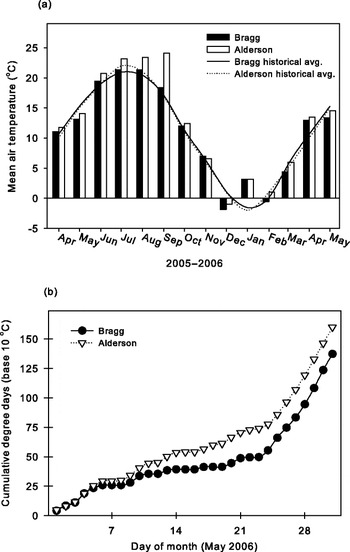
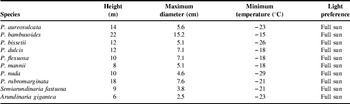
Plantings of non-native, cold-hardy bamboo including Phyllostachys aureosulcata, Phyllostachys bambusoides, Phyllostachys bissetii, Phyllostachys dulcis, Phyllostachys flexuosa, Phyllostachys mannii, Phyllostachys nuda, Phyllostachys rubromarginata and Semiarundinaria fastuosa were acquired from the USDA-ARS temperate bamboo germplasm center at Byron, GA in April of 2001 or purchased from commercial nurseries in 2002. We also collected specimens of native bamboo, Arundinaria gigantea from several locations in West Virginia in 2002 (Table 1). All species were chosen for their potential to survive winter temperatures characteristic of most of West Virginia that include USDA hardiness zones five (−10 to −20°F or −23 to −28°C) and six (0 to 10°F or −18 to −23°C). Clones were acclimated in a greenhouse, planted at two field locations and maintained with periodic applications of balanced fertilizer (14-14-14). The bamboo were not grazed during this study. Soils at the first location, near Bragg, West Virginia (37.80 N, 80.97 W, elevation 850 m), are a mixture of fine loamy, mixed, mesic Typic Hapludults and loamy-skeletal, siliceous, active, mesic Typic Dystrudepts. Soils at the second location, near Alderson WV (37.70 N, 80.66 W, elevation 550 m) are a mixture of fine-loamy, mixed, active, acid, mesic Fluvaquentic Endoaquepts and fine-loamy, mixed, superactive, mesic Oxyaquic Fragiudalfs. The lower-elevation Alderson site has a slightly warmer average growing season than the Bragg site (Fig. 1a).
(a) Mean air temperature and (b) cumulative degree-days for Bragg and Alderson sites.

Bamboo species information.

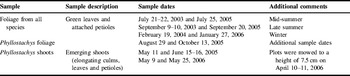
Average composition of temperate bamboo foliage (green leaves and attached petioles) was determined from grab samples collected from all species in late July (mid-summer) and mid-September (late summer) 2003 and 2005 and winter (February and January) 2004 and 2006 (Table 2). Additional samples of Phyllostachys foliage were collected, on August 29, and October 13, 2005, to provide more details about intraseasonal patterns of forage composition and possible site effects. Emerging shoots (elongating culms+leaves and petioles) were collected from Phyllostachys species on May 11 and June 15–16, 2005 and on May 9 and May 25, 2006 to compare the composition of young shoots to more mature foliage. Bamboo plots were mowed to a height of about 7.5 cm on April 10–11, 2006, about 4 weeks before sampling. All samples were dried (55°C) in a forced-air oven, ground (Wiley mill, 1 mm sieve) and stored in a freezer (−21°C) until analysis.
Sample dates for temperate bamboo foliage and shoots.

Chemical analyses
Total carbon (C) and nitrogen (N) concentration were determined by dry combustionReference Nelson, Sommers, Sparks, Page, Helmke, Loeppert, Soltanpour and Tabatabai34 with a FlashEA 1112 NC Analyzer (CE Elantech, Lakewood, NJ). Total N data were multiplied by a factor of 6.25 to estimate the crude protein (CP). Total non-structural carbohydrates (TNC) were determined by an automated hydrolysis methodReference Denison, Fedders and Tong35. Acid detergent fiber (ADF) was determined by the procedures of Van Soest et al.Reference Van Soest, Robertson and Lewis36 using an ANKOM 200 Fiber Analyzer (Ankom Technology Corp., Fairport, NY). Acid detergent lignin (ADL) was determined by subjecting ADF residue to 72% sulfuric acid. Cellulose was calculated by subtracting ADL from ADF. Ash content was determined on 0.5 g samples and reported as the percentage of total plant dry matter remaining after combustion in a muffle furnace at 525°C for 3 h. We used the values from total C, N, TNC and the ADL to calculate C:N, TNC:CP and lignin:N ratios.
Statistical analyses
The influence of species and season on the composition of bamboo leaves was determined with SAS 9.2 and PROC MIXED (SAS Institute, Cary, NC) using a model that contained both fixed (species) and random (side) effects and treated sample dates as repeated measuresReference Littell, Milliken, Stroup and Wolfinger37, 38. In other analyses, intraseasonal trends and intersite differences, within the genus Phyllostachys, were analyzed for leaf samples, collected monthly from June to October 2005 and in January 2006, by considering individual species as independent replicates (n=8) and sample dates as repeated measures. Finally, we compared Phyllostachys shoot composition in early May 2005 to that in early May 2006 and composition in early May 2006 to that in late May 2006.
For all analyses, assumptions of data normality were evaluated and appropriate data transformations identified with SAS/ASSIST. Covariance structures were selected to minimize Akaike's Information Criterion. Pairwise comparisons of means were adjusted by the Tukey–Kramer method assuming a value of 5% as the minimum criterion for significance. Values indicated in text and graphs are the arithmetic mean, ±standard error of the mean, expressed on a dry matter basis.
Results
All species of bamboo were able to withstand Appalachian winter temperatures during the period 2001–2006 and retain some green leaves even in late winter. The experiment was terminated and all bamboo killed with the application of Roundup Ultra® [N-(phosphonomethyl) glycine; Monsanto, St. Louis, MO] applied at 26.4 ml l−1 in June 2006.
Composition of cold-hardy bamboo
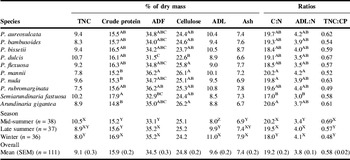
Total leaf C, averaging 48.1±0.1%, did not vary among bamboo species or with season. However, there was a significant (P⩽0.05) main effect of species or season on the other foliage characteristics (Table 3).
Nutritive value of foliage from cold-hardy bamboo speciesFootnote 1.

1 Samples of green leaves and petioles were collected during mid-summer (July 21–22, 2003 and July 25, 2005), late summer (September 9–10, 2003 and September 20, 2005) and winter (February 19, 2004 and January 27, 2006) from two locations. Data are for total non-structural carbohydrate (TNC), crude protein (CP) (calculated as N%×6.25), acid detergent fiber (ADF), cellulose, acid detergent lignin (ADL), ash, total carbon (C) and nitrogen (N). Within each column, superscript letters denote significant Tukey–Kramer adjusted differences among species or seasons (P⩽0.05).
TNC of leaves, with an overall mean of more than 9%, varied with season, decreasing from 10.5% in late July to 8% in the winter. CP averaged nearly 16% across all species and seasons with the highest content observed for S. fatuosa and the lowest content observed for P. nuda, P. mannii and A. gigantea (Table 3). CP varied little during the summer growing season but increased during winter.
ADF (mean 34.5%) varied among species and with season. Among species, P. dulcis contained the lowest concentration of ADF, whereas P. mannii and P. rubromarginata contained the highest. Mean ADF increased from late July to late September but remained unchanged in mid-winter. Cellulose varied among species, being least in P. dulcis and greatest in P. mannii, P. flexuosa and A. gigantea, and was the only variable that did not vary with time, remaining at nearly 25% throughout the year. Average ADL, approaching 10%, did not vary among species, but increased with each successive sampling. Similarly, the ash content (mean 7.4%) did not vary among species, but increased from late July to mid-winter.
The ratios of total C:N (mean 19) and ADL:N (mean 4) varied with species and season. In both instances, lowest average values were observed for S. fastuosa, but the range among species was narrow. Average C:N ratios decreased from July to winter, whereas ADL:N ratios increased from July to September. The ratio, TNC:CP, is thought to link nutritionally important indicators of energy and protein in herbageReference Neel, Feldhake and Belesky39. Clear differences among the various bamboo species were not apparent but ratios decreased from early to late season reflecting the increased N content of herbage.
Intra-seasonal and site patterns in Phyllostachys foliage
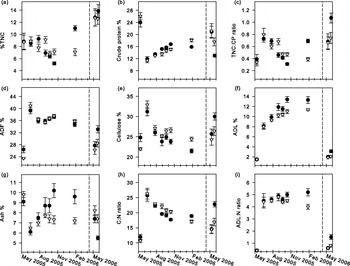
Seasonal and site variations for some Phyllostachys leaf characteristics were observed during the 2005–2006 season. TNC decreased at both sites during the 2005 growing season, most clearly at the Alderson site, declining from 8.6% in June to 5.2% in October, compared to 8.9 and 7.1% at the Bragg site (Fig. 2a). Concentrations of TNC remained constant at the Bragg site through late January but TNC increased at the Alderson site, reaching levels comparable to the previous June.
Seasonal trends of (a) TNC, (b) CP, (c) ratios of TNC:CP, (d) ADF, (e) cellulose, (f) ADL, (g) ash, (h) total C:N and (i) ADL:N in shoots and leaves of Phyllostachys spp. growing at two sites (Alderson • and Bragg ▿). Values (combined species, means±SEM) are from entire shoots collected on May 11 (n=3–7) and June 15–16 (n=6–8) 2005 and on May 9 (n=7) and May 25 (n=7–8) 2006. Leaves (including petiole) were sampled in 2005 on July 25 (n=8), August 29 (n=7–8), September 20 (n=8) and October 13 (n=8) and in 2006 on January 27 (n=6–8). Bamboo plots were mowed to a height of about 7.5 cm on April 10–11, 2006 (dashed line).

Crude protein in bamboo leaves increased during the growing season, from about 11.5% at both sites in June 2005 to between 15 and 17%, by mid-October (Fig. 2b). CP was slightly higher at Alderson during most part of the year, but meaningful differences between the sites were evident only in October and January. Highest values of foliage CP were observed at the Bragg site during winter 2005, whereas CP remained relatively constant at Alderson, from fall through January 2006.
Seasonal patterns of TNC:CP ratios resembled those observed for TNC, declining from mean values in June, at the Alderson and Bragg sites, of 0.73 and 0.81, respectively, to 0.31 and 0.47, in October (Fig. 2c). Ratios declined slightly at the Bragg site, from October through January, but increased at the Alderson site to 0.69, close to June values. Differences between sites were observed in August and October (Bragg>Alderson) and January (Alderson>Bragg).
Concentrations of ADF in bamboo leaves decreased at both sites, from about 40% in June to 35% in January 2006 (Fig. 2d). Although about 2% higher at the Bragg site, cellulose content in bamboo leaves decreased at both sites from 32% in June to 22.7% by January (Fig. 2e). Unlike ADF and cellulose, ADL, increased from 8% in June at both sites, to about 11 and 13% for Bragg and Alderson sites, respectively, in October and January (Fig. 2f).
Ash content of leaves increased at the Alderson site from about 6% in June to about 10% in October and January (Fig. 2g), but did not vary at the Bragg site, and remained nearly 7% throughout the season. Differences between the two sites became greater as the season progressed, peaking in October.
The C:N ratios of bamboo leaves decreased from 25 in June to 18–19 in January (Fig. 2h) with differences between the sites evident in October samples. In contrast, ADL:N ratios changed a little during the year (mean 4.6), with site distinctions detected only in January (Fig. 2i).
Phyllostachys shoots
The composition of young Phyllostachys shoots (culms and leaves) was distinct from more mature leaves, and could vary quickly with time as they elongated and segregated more distinctly into component elements such as culms, petioles and leaves.
The concentrations of TNC, measured in early May, were higher in 2006 than in 2005, but did not differ between the two sites (Fig. 2a). A similar pattern, observed for TNC:CP ratios, was attributable to these increased values of TNC (Fig. 2c). Mean shoot TNC (12.7±0.9%) and TNC:CP ratios (0.67±0.08%) in early May 2006 were comparable to winter foliage values at the Alderson site but higher than those at the Bragg site.
With these exceptions, the composition of bamboo shoots, measured in early May 2005 and 2006 did not vary between years or sites. CP in shoots (22.5±1%), was about twice that of leaves (Fig. 2b). Mean ADF (26.4±0.7%), cellulose (24.6±0.6%), ADL (1.8±0.1%), C:N (13.4±0.7%) and ADL:N ratios (0.53±0.04%) in shoots were lower than leaves (Figs. 2d–f,h,i). The ash content of shoots was comparable to bamboo leaves (8.4±3%, Fig. 2g). By late May 2006, only 2 weeks after initial measurements, CP and ash content in shoots decreased, while TNC, ADF, cellulose and ADL in young shoots increased. Greatest changes in nutritive value were observed in plants growing at Alderson, a relatively warm site that accumulated 40–50% more growing degree-days than the Bragg site between the two sampling dates (Fig. 1b).
Discussion
The values of TNC observed for bamboo leaves in this study are only about 50% of the more than 200 mg g−1 reported for Phyllostachys pubescens Reference Li, Werger, During and Zhong33, but they compare reasonably to other Appalachian silvopasture forage speciesReference Belesky, Neel and Ruckle40, Reference Belesky, Chatterton and Neel41. Concentrations of TNC in bamboos have been reported to be highest in leaves>branches⩾rhizomes⩾stems⩾roots with rapid spring growth of new shoots corresponding to reduced concentration of TNC in the rhizomesReference Li, Werger, During and Zhong33. Although TNC generally declined during the growing season (Table 3), high amounts of TNC and CP were observed at the Alderson site during winter and at both sites in Phyllostachys shoots in spring (Fig. 2a,b).
Mean concentrations of CP in bamboo leaves (Table 3) compare well with those from recent studies of Phyllostachys Reference Nelson, Keller and Cheeke31, Reference Greenway32, Reference Wiedower, Hansen, Bissell, Ouellette, Kouba, Stuth, Rude and Tolleson42, and with values for Arundinarea Reference Smart, Matrone, Shepard, Hughes and Knox9. Although lower than the range reported for some leguminous browse speciesReference Addlestone, Mueller and Luginbuhl43 and Paulownia Reference Mueller, Luginbuhl and Bergmann44, bamboo leaf CP was comparable to other temperate browse species consumed by goatsReference Nastis and Malechek45–Reference Turner and Foster47. Concentrations of CP in Phyllostachys leaves were an order of magnitude greater than expected in mature culmsReference Dierenfeld, Hintz, Robertson, Van Soest and Oftedal13, Reference Wiedower, Hansen, Bissell, Ouellette, Kouba, Stuth, Rude and Tolleson42. High CP in Phyllostachys shoots, in excess of 20% dry weight, were consistent with values commonly reported for edible bamboo shoots48, Reference Satya, Bal, Singhal and Naik49.
The balance of TNC:CP suggests that bamboo foliage can meet the maintenance or growth needs of goats50, Reference Luo, Goetsch, Nsahlai, Sahlu, Ferrell, Owens, Galyean, Moore and Johnson51. The TNC:CP quotients of bamboo ranged from about 0.35 to 0.8 and were slightly greater than cool-temperate grasses managed for forage productivity and nutritive value in silvopastureReference Lu30, Reference Turner and Foster47.
Although the levels of TNC and CP observed in young culms (shoots) infer a high forage nutritive value, significant grazing of elongating shoots would likely have adverse impacts on stand productivity and sustainability by consuming new growth and thus preventing the formation of new leaves, and also because young bamboo culms (shoots) can break easilyReference Liese and Weiner52. Shoots also have considerable economic value as a fresh crop to supply food-grade produce to various niche markets. The differences between early and late May 2006 indicated that shoot composition changes rapidly as culms mature. Similar short-term (<14 days) decreases in protein content and increases in fiber content were reported in edible bamboo shootsReference Nirmala, David and Sharma53 and are associated with the mobilization of stored carbohydrates from rhizomes and translocation of nutrients from senescing to developing leaves and rootsReference Li, Werger, During and Zhong33, Reference Tripathi and Singh54, Reference Tripathi, Singh and Singh55.
Concentrations of ADF, cellulose and lignin were higher in these bamboo species than in leaves of other potential browse species including Paulownia Reference Mueller, Luginbuhl and Bergmann44, locust (Robinia spp.), mimosa (Albizia julibrissin)Reference Addlestone, Mueller and Luginbuhl43, autumn olive (Elaeagnus umbellata), multiflora rose (Rosa multiflora) or honeysuckle (Lonicera japonica)Reference Turner and Foster47. Ash content in bamboo leaves and shoots (Table 3, Fig. 2g) was similar to published valuesReference Dierenfeld, Hintz, Robertson, Van Soest and Oftedal13, 48 and was expected to be about 3–4 times higher than in mature culms or rhizomes. The ash content of bamboo is composed of silica together with metals such as calcium and potassiumReference Li, Shupe, Peter, Hse and Eberhardt56.
Bamboo leaves contain a number of biologically active components with potential health benefitsReference Lu, Ren, Zhang and Gong57, Reference Lu, Wu, Tie, Zhang and Zhang58. However, some parts of the bamboo, notably the shoots may also contain toxic compounds, such as oxalic acid and cyanogenic glycosidesReference Satya, Bal, Singhal and Naik49, Reference Etsuko, Nobuyauki and Toshiharu59, Reference Haque and Bradbury60. Some bamboo species (e.g. Bambusa vulgaris from Brazil) have been reported to contain unidentified compounds toxic to horsesReference Barbosa, de Oliveira, Duarte, Riet-Correa, Peixoto and Tokarnia61. Unlike other browse species or plants that have been considered as candidates for biofuel production, such as hybrid poplars (Populus spp.), bamboo is unlikely to contain significant amounts of polyphenolic plant secondary compounds such as tannins that can affect the forage nutritive valueReference Moore, Barry, Cameron, Lopez-Villalobos and Cameron46, Reference Ayers, Barrett and Cheeke62, Reference Mandal63.
Bamboo may help mitigate the effects of gastrointestinal nematodes (GIN), such as the barberpole worm (Haemonchus contortus), a major parasite of small ruminants in the southern USA. In contrast to cattle and sheep, goats are browsers that prefer to graze plants from the top downReference Luginbuhl, Green, Poore and Conrad29. However, when browse is scarce, goats will graze traditional grasses and legumes in pastures contributing to problems with GIN control. In infected animals, adult female GIN shed eggs, which pass onto pastures with livestock feces. Under favorable conditions, larvae hatch, crawl up forage into the grazed horizon, and are consumed as livestock graze. Larvae are more concentrated in lower levels of the plant canopyReference Niezen, Charleston, Hodgson, Miller, Waghorn and Robertson64. Goats have very poor tolerance of GIN loads, having evolved to avoid larvae by browsing above the infested layers. The detrimental effects of GIN are exacerbated because of increased resistance of GIN to chemical anthelminticsReference Zajac and Moore65. By providing a source of browse with a higher grazed horizon at critical times, bamboo may help reduce infection with GIN, especially Haemonchus Reference Silangwa and Todd66, Reference Zajac67.
Temperate bamboo seem particularly well adapted to the heterogeneous mosaic of light and soil conditions that characterize Appalachian silvopastures because they can adapt morphologically to low-light conditions. More importantly, some genera are able to physiologically integrate environmental heterogeneity by translocation of photosynthetic assimilates and nutrients, such as N, from zones of relatively high availability to biomass located in zones of relative paucity, primarily via translocation through rhizomes, thus stabilizing productivityReference Ayers, Barrett and Cheeke62–Reference Niezen, Charleston, Hodgson, Miller, Waghorn and Robertson64. In the present study, decreasing C:N ratios in foliage during the winter season were associated with increasing concentrations of leaf-N, indicative of acclimation to retain photosynthetic capacity accompanied by reallocation of non-structural carbohydrate from leaves to culms.
Adaptation of temperate bamboo will require further research to develop management strategies that effectively incorporate controlled grazing to maintain the productivity and sustainability of temperate silvopastoral grazing systemsReference Sharrow, Buck, Lassoie and Fernandez68. Too little grazing may result in competition between bamboo and overstory trees for resources, such as light or waterReference Banana and Tweheyo69, Reference Gratzer, Rai and Glatzel70. In addition, some species of Phyllostachys are thought to contain allelopathic substances, such as phenolic acids, that could interfere with the growth of other forage speciesReference Chou71. Conversely, overgrazing can damage bamboo by reducing culm density or size, and damage or hamper regeneration of tree speciesReference Roder, Gratzer and Wangdi18, Reference Platt and Brantley27, Reference Prasad72. However, controlled grazing, especially with browsers such as goats, alone or together with cattle, may contribute to sustained pasture productivity by maintaining desirable botanical composition of forage species, controlling undesirable invaders and promoting regeneration of tree speciesReference Roder, Gratzer and Wangdi18, Reference Luginbuhl, Green, Poore and Conrad29, Reference Darabant, Rai, Tenzin, Roder and Gratzer73, Reference Luginbuhl, Harvey, Green, Poore and Mueller74.
Cold-hardy bamboo species seem capable of retaining green foliage and nutritive value throughout winter months, a time when few other green fodder options are available. The upright growth habit of bamboo makes this fodder accessible to livestock even under snow conditions and could help reduce initial GIN loadings in goats in the spring. High potential for biomass production, coupled with the possibility of photosynthesis early and late in the growing season, suggest that in addition to serving as a source of forage for livestock, bamboo could be managed as an effective carbon sinkReference Lobovikov, Lou, Schoene and Widenoja6, Reference Gratani, Crescente, Varone, Fabrini and Digiulio75; or a source of raw material for biofuel, pulp wood or fresh shoot productionReference Diver76.
More research is needed to expand the nutritional database beyond the few bamboo examined in this study and to establish criteria for selecting from among species with comparable nutritive qualities. In addition to selecting a suitable species, successful integration of bamboo into small ruminant production systems will also require cultural recommendations, tailored to local conditions, needed to establish forage bamboo, maintain its productivity and quality, and manage its growth. Potential concerns about invasiveness of monopodial bamboo, such as Phyllostachys, may be allayed by known control strategies including barriers, cultivation, spraying or intentional overgrazingReference Czarnota and Derr77, but these may be costly and result in unwanted environmental consequences. Thus, decision support tools are needed to help identify and compare economic and environmental consequences of bamboo-based enterprises, in order to adopt prudent measures that protect the environmentReference Davis, Cousens, Hill, Mack, Simberloff and Raghu78.
Acknowledgements
The authors thank J. Harrah, T. Robertson, J. Ruckle and D. Ruckle for their excellent analytical and field assistance.