Implications
Colostrum plays a fundamental role in the immunization of newborn ruminants. Artificial rearing is a common method used in dairy farms, increasing the amount of milk for processing. The aim of this study was to feed newborn lambs colostrum with two different IgG concentrations and to compare these animals to natural dam fed lambs. This study showed that administration of 8 g of immunoglobulin g/kg BW at birth, equally divided into three colostrum meals (2, 14 and 26 h), achieved higher circulating immunoglobulin G concentration when compared to the natural rearing treatment, although both artificial rearing groups decreased BW after birth.
Introduction
The relationship between colostrum and the survival of newborn ruminants has been long characterized (Argüello et al., Reference Argüello, Castro, Capote, Tyler and Holloway2004; Castro et al., Reference Castro, Capote, Bruckmaier and Arguello2011; Abdou et al., Reference Abdou, Marichatou, Beckers, Dufrasne and Hornick2014). In fact, colostrum contains a complex mixture of proteins that actively participate in the protection of the neonate (passive immune transfer (PIT)) against pathogens and other postpartum environmental challenges (Bendixen et al., Reference Bendixen, Danielsen, Hollung, Gianazza and Miller2011). Moreover, colostrum has diverse components such as fat, lactose, vitamins or minerals that have high nutritional importance (Ontsouka et al., Reference Ontsouka, Bruckmaier and Blum2003; Lérias et al., Reference Lérias, Hernández-Castellano, Suárez-Trujillo, Castro, Pourlis and Almeida2014; Hernández-Castellano et al., Reference Hernández-Castellano, Almeida, Ventosa, Coelho, Castro and Argüello2014b).
In particular, colostrum plays an important role in newborn lambs, because they are born hypogammaglobulinemic, due to the complexity of the synepitheliochorial ruminant placenta, which does not allow sufficient transfer of immunoglobulins from the dam to the fetus (Hernández-Castellano et al., Reference Hernández-Castellano, Almeida, Castro and Argüello2014a). In addition, it has been described that lambs not fed colostrum in the first hours of life are more susceptible to diseases and mortality (Ahmad et al., Reference Ahmad, Khan, Javed and Hussain2000; da Nobrega et al., Reference da Nobrega, Riet-Correa, Nobrega, de Medeiros, de Vasconcelos, Simoes and Tabosa2005; Nowak and Poindron, Reference Nowak and Poindron2006).
Nowadays, there is an increase in the number of high-production dairy farms, where lambs are reared under an artificial feeding system. In such cases, lambs are bottle-fed colostrum and milk replacer in order to increase the amount of milk available for processing (Demiroren et al., Reference Demiroren, Shrestha and Boylan1995; Napolitano et al., Reference Napolitano, Pacelli, Girolami and Braghieri2008; David et al., Reference David, Bouvier, Ricard, Ruesche and Weisbecker2014), thus simplifying animal management (Emsen et al., Reference Emsen, Yaprak, Bilgin, Emsen and Ockerman2004).
As it has been described by several authors, goat kids need to be fed an amount of colostrum equivalent to 4 g of IgG/kg of BW, divided into three meals before 48 h after birth, in order to make an appropriate PIT (Castro et al., Reference Castro, Capote, Alvarez and Arguello2005; Morales-delaNuez et al., Reference Morales-delaNuez, Castro, Moreno-Indias, Juste, Sánchez-Macías, Briggs, Capote and Argüello2009; Moreno-Indias et al., Reference Moreno-Indias, Morales-delaNuez, Hernandez-Castellano, Sanchez-Macias, Capote, Castro and Arguello2012). No references about the amount of colostrum required by newborn lambs reared under artificial conditions have been found. As it is essential to obtain adequate immunoglobulin concentrations in the blood (O’Doherty and Crosby, Reference O’Doherty and Crosby1997; Quigley et al., Reference Quigley, French and James2000; Christley et al., Reference Christley, Morgan, Parkin and French2003), this knowledge has high relevance for the survival of the lambs.
Although the transfer of immunoglobulins (IgG and IgM, mainly) is a key factor for host defense against pathogens, a wider range of colostrum components, such as the complement system proteins, have been suggested to contribute to the early protection of the neonate (Smith and Foster, Reference Smith and Foster2007; Hernández-Castellano et al., Reference Hernández-Castellano, Argüello, Almeida, Castro and Bendixen2015a). The complement system activity – comprising the total (TCA) and alternative (ACA) pathways – plays an important role in host defense mechanisms against infectious microbes, because it is involved in specific and non-specific immunity (Rodríguez et al., Reference Rodríguez, Castro, Capote, Morales-delaNuez, Moreno-Indias, Sanchez-Macias and Arguello2009; Hernández-Castellano et al., Reference Hernández-Castellano, Morales-delaNuez, Sánchez-Macías, Moreno-Indias, Torres, Capote, Argüello and Castro2015b). There are few studies about the complement system activity in sheep and lambs, with the exception of the study published by Hernández-Castellano et al. (Reference Hernández-Castellano, Morales-delaNuez, Sánchez-Macías, Moreno-Indias, Torres, Capote, Argüello and Castro2015b) and Hernández-Castellano et al. (Reference Hernández-Castellano, Moreno-Indias, Morales-delaNuez, Sánchez-Macías, Torres, Capote, Argüello and Castro2015c), as these studies are based on an old determination technique (Oswald et al., Reference Oswald, Lantier and Bourgy1990).
The aim of this study was to investigate the BW and immune status of lambs reared under natural conditions and lambs reared under artificial conditions fed two different colostrum amounts (4 g IgG/kg of BW at birth and 8 g IgG/kg of BW at birth) and milk replacer.
Material and methods
The present study was performed in the Department of Animal Science of the Universidad de Las Palmas de Gran Canaria in the Canary Islands (Spain) on 60 single partum lambs of the Canary breed (30 males and 30 females). As dams were estrous-synchronized, all lambs were born in the same period. Animal procedures were approved by the Ethics Committee of the University.
Animal health status was monitored during the experimental period (for diarrhea, parasites or fever), and the animals were found to be healthy throughout the experimental period.
Milk feeding period
At birth, animals were equally divided by sex and then randomly divided into three different groups. The natural rearing (NR) group was composed of 20 lambs, which suckled colostrum directly from their dams. The other 40 lambs were divided into two groups (20 lambs each) and were housed in artificial rearing rooms. Each room had central heating (20°C) and 0.3 m2 floor space per lamb. Lambs were bottle-fed a sheep colostrum pool that was previously pasteurized at 63°C for 30 min according to Trujillo et al. (Reference Trujillo, Castro, Quevedo, Arguello, Capote and Guamis2007). Artificially reared lambs received colostrum amount equivalent to 4 g of IgG/kg of BW at birth (C4 group) or 8 g of IgG/kg of BW at birth (C8 group) divided into three meals at 2, 14 and 24 h after birth. Colostrum meals were always thawed and heated at 37°C according to Argüello et al. (Reference Argüello, Castro, Capote, Gines, Acosta and Lopez2003). Colostrum IgG and IgM concentrations (64.37 and 5.61 mg/ml, respectively) were determined using commercial ELISA kits (Bethyl laboratories, Montgomery, TX, USA), using a purified sheep IgG or a purified sheep IgM as the standard curve.
During the milk feeding period (from birth to 10 kg of BW), NR lambs were raised with dams and had free access to dam milk until the weaning period. Artificially reared lambs (C4 and C8) received a commercial milk replacer at 16% (w/w; MR group, Bacilactol Corderos y Cabritos, Saprogal, La Coruña, Spain; 95.5% dry matter, 23.6% CP and 22.7% ether extract, air-dry powder basis). These groups were fed ad libitum (37°C) using nipple buckets twice a day (0800 and 1700 h).
Weaning period
Animals from the three studied groups started the weaning period when they reached 10 kg BW (30.70, 34.45, 34.20 days after birth in NR, C4 and C8 groups, respectively). The weaning period lasted for 30 days in the studied groups. During this period, animals had free access to starter feed (18% CP and 3.4% ether extract), alfalfa hay and water. Lambs from the NR group were seperated from dams and placed in a pen for 30 days. Ewes were milked once a day (0900 h). From day 0 to 8 of weaning, lambs had access to ewes twice daily (1000 h after milking and 1700 h), reducing this access to once a day (1700 h) from day 9 to 15. After this, lambs had no more access to the ewes. Artificial rearing groups (C4 and C8) were fed half liter of milk replacer twice a day from day 0 to 8 (1000 and 1700 h), reducing the intake to once daily from day 9 to 15 (1700 h). During the rest of the weaning period, animals did not receive milk replacer.
BW recording and sample collection
Animals were weighed before each blood extraction, and the results are expressed in kg (MOBBA, Barcelona, Spain; accuracy, 5 g). During the milk feeding period, blood samples were collected at 2 h after birth (day 0), and then blood samples were collected at day 1, 2, 3, 4, 5 and 20 after birth. Another sample was taken when each animal reached 10 kg BW. During the weaning period, samples were obtained every 5 days until the end of the experimental period. Blood samples were collected before morning feeding from the jugular vein in 2.5-ml tubes with K3EDTA. Blood was centrifuged at 2190×g for 5 min at 4ºC (Hettich-Zentrifugen, Universal 32 R, Tuttlingen, Germany), and the plasma was stored at −80°C until analysis.
To determine blood plasma IgG and IgM concentrations, commercial ELISA kits (Bethyl Laboratories) were used, using purified sheep IgG and IgM as the standard curves. Results are expressed in mg of immunoglobulin/ml of plasma.
Complement system activity (total complement activity, TCA and alternative complement activity, ACA) was measured by the hemolytic rate according to a novel technique described by Moreno-Indias et al. (Reference Moreno-Indias, Morales-delaNuez, Hernandez-Castellano, Sanchez-Macias, Capote, Castro and Arguello2012) and Hernández-Castellano et al. (Reference Hernández-Castellano, Morales-delaNuez, Sánchez-Macías, Moreno-Indias, Torres, Capote, Argüello and Castro2015b) in goat kid blood serum and lamb blood plasma, respectively. In this technique, a DGHB++ buffer (Hepes Gelatin Veronal Buffer with Ca++ and Mg++: 5 mM HEPES, 71 mM NaCl, 0.15 mM CaCl2, 0.5 mM MgCl2, 2.5% (w/v) glucose, 0.1% (w/v) gelatin, pH 7.4) is used to measure total complement system activity, and DGHB-Mg-EGTA buffer (4.2 mM Hepes, 59 mM NaCl, 7.0 mM MgCl2, 2.08% (w/v) glucose, 0.08% (w/v) gelatin, 10 mM EGTA, pH 7.4) is used to measure the alternative pathway. For total complement system activity, rabbit red blood cells and lamb plasma were both diluted to 5% in DGHB++; 100 µl of each was then mixed in a microtiter plate and incubated at 37°C for 1 h. Cells were removed by centrifugation (2500×g, 5 min, 4°C), and supernatant absorbance was measured at 405 nm using a microplate reader (Model 680; BioRad microplate reader, Hercules, CA, USA). Complete hemolysis was achieved by mixing the cells with distilled water (100 µl), and spontaneous lysis was produced by mixing the diluted rabbit red blood cells with DGHB++. Complement-induced hemolysis of rabbit red blood cells by the test sera was calculated using the following formula: [(A405 sample−A405 spontaneous lysis)/(A405 complete hemolysis−A405 spontaneous lysis)]×100. The same protocol was performed with DGHB-Mg-EGTA buffer to measure the alternative pathway.
Statistical analyses
Statistical analyses were performed using SAS Version 9.00 (SAS Institute Inc., Cary, NC, USA). As it was described by Brujeni et al. (Reference Brujeni, Jani, Alidadi, Tabatabaei, Sharifi and Mohri2010) and Ciupersescu (Reference Ciupersescu1977), sex was not taken into consideration to simplify the analysis, because no influence was detected. The SAS PROC MIXED procedure for repeated measures was used to evaluate the fixed effect of rearing system, time and the interaction between both effects (rearing system×time) on plasma IgG and IgM concentrations, complement system activity and BW evolution of lambs from birth to weaning. When significant by ANOVA (P<0.05), differences between means were identified using the Tukey–Kramer test.
Results and discussion
Milk feeding period
Figure 1 shows the BW, IgG and IgM concentrations and complement system activity in the NR, C4 and C8 groups during the colostrum and milk feeding period. Focusing on BW development, NR group values increased from birth BW by day 3 and continued to increase until 10 kg BW was achieved. Nevertheless, BW in C4 and C8 did not increase during the first 5 days after birth (P>0.05), increasing at day 20 and at the end of the milk feeding period (P<0.05). No differences among groups were observed at birth (P>0.05); however, the NR group showed greater BW than the C4 and C8 groups during the rest of the experimental period (P<0.05). Differences observed among groups could be related to the amount of colostrum and milk consumed, as well as the differences between milk and milk replacer composition. As has been described in lambs (Murphy et al., Reference Murphy, Loerch, McClure and Solomon1994; Napolitano et al., Reference Napolitano, Cifuni, Pacelli, Riviezzi and Girolami2002), food restriction could reduce the average daily gain of animals from the C4 and C8 groups, resulting in lower BW.
BW, IgG and IgM concentrations, TCA and ACA evolution in the NR (n=20), C4 (n=20) and C8 (n=20) groups during colostrum and milk feeding periods. NR=natural rearing; C4=4 g of IgG/kg of BW at birth; C8=8 g of IgG/kg of BW at birth. TCA=total complement activity; ACA=alternative complement activity. *End means the end of milk feeding period and the start of weaning period when animals reached 10 kg of BW. NR, C4 and C8 finished the feeding period and started the weaning period at 30.70±6.05, 34.45±5.75, 34.20±6.62 days, respectively. Data shown in this figure can be viewed in the Supplementary Table S1.

All the groups (NR, C4 and C8) had a very low IgG concentration in blood plasma at birth, probably from maternal origin through the placenta, as has been referenced by Castro et al. (Reference Castro, Capote, Bruckmaier and Arguello2011). After the first colostrum intake, this concentration rapidly increased in the NR, C4 and C8 groups at 1 to 2 days after birth (16.79, 5.81 and 17.74 mg of IgG/ml, in NR, C4 and C8 groups at day 1 after birth, respectively, P<0.05). After this, IgG concentration decreased until the end of the milk feeding period (5.22, 2.18 and 5.62 mg of IgG/ml, in NR, C4 and C8 groups, respectively, P<0.05). No differences were observed among groups at birth. During the rest of the milk feeding period, IgG concentration was lower in lambs from the C4 group compared to the NR and C8 groups (P<0.05). Moreover, no differences were observed in IgG concentrations between NR and C8 groups during this period (with the exception of day 4, P=0.049). In contrast to these findings, Firat et al. (Reference Firat, Ozpinar and Erhard2003) appreciated differences in the milk feeding period between lambs raised under natural and artificial conditions, describing that lambs raised under artificial rearing systems had generally lower plasma IgG concentrations than lambs raised under natural conditions. As these authors have described, the use of a commercial colostrum supplement to feed lambs reared under artificial conditions could affect the immune concentration in blood. In addition, when only artificial rearing groups (C4 and C8) were compared, it was noted that plasma IgG concentrations did not increase according to the provided colostrum IgG concentration, showing that lambs from the C8 group had approximately three times higher plasma IgG concentrations compared to the C4 group. The higher colostrum IgG provided to C8 lambs compared to C4 lambs could reduce the degradation rate of immunoglobulins produced during the digestion process, allowing the absorption of a higher percentage of IgG in its native structure by C8 lambs. A similar absorption pattern has been observed in lambs (Halliday and Williams, Reference Halliday and Williams1979), goat kids (Castro et al., Reference Castro, Capote, Alvarez and Arguello2005; Rodríguez et al., Reference Rodríguez, Castro, Capote, Morales-delaNuez, Moreno-Indias, Sanchez-Macias and Arguello2009) and calves (Muller and Ellinger, Reference Muller and Ellinger1981; Quigley et al., Reference Quigley, Kost and Wolfe2002). In contrast to these results, Moretti et al. (Reference Moretti, Kindlein, Pauletti and Machado-Neto2010), using a fixed colostrum volume (250 ml), fed lambs either bovine colostrum (115.7 mg of IgG/ml) or ovine colostrum (48.1 mg of IgG/ml). Because of the differences in both colostrum IgG concentrations, Moretti et al. (Reference Moretti, Kindlein, Pauletti and Machado-Neto2010) concluded that IgG absorption by the enterocytes is limited and, therefore, is non-proportional to the IgG present in the colostrum. Nevertheless, these authors used different colostrum conditions compared to the ones used in the present study (fixed volume with two different IgG concentrations v. fixed IgG concentration and fixed total IgG provided to the lambs). This fact could explain the greater IgG concentrations seen in the blood plasma of lambs from the C8 group compared to lambs from the C4 group. Finally, it has been described that lambs fed bovine colostrum run the risk of developing anemia (Winter, Reference Winter2011), and the use of caprine colostrum as an alternative way to feed lambs in early life has been recommended (Hernández-Castellano et al., Reference Hernández-Castellano, Morales-delaNuez, Sánchez-Macías, Moreno-Indias, Torres, Capote, Argüello and Castro2015b).
A similar evolution was observed in the case of IgM concentration in blood plasma, although this immunoglobulin was not detectable at birth in any of the studied groups. A rapid increase of IgM in blood plasma was seen in NR, C4 and C8 lambs 1 to 2 days after birth (1.63, 0.35 and 2.84 mg of IgM/ml, in NR, C4 and C8 groups at day 1 after birth, respectively, P<0.05). Despite double colostrum feeding in the C8 group (based on the provided IgG amount) compared to the C4 group, the IgM concentration was much higher in the C8 group than in the C4 group during this period. After that, IgM concentrations in blood plasma decreased until the end of the milk feeding period in the NR and C8 groups. Nevertheless, the C4 group had increased IgM concentrations at day 20 (P<0.05) and at the end of the milk feeding period (P<0.05). According to previous findings, Nonnecke et al. (Reference Nonnecke, Waters, Goff and Foote2012) observed a rapid increase in plasma IgG and IgM concentrations after colostrum intake in calves, with a decrease in these concentrations with age. The colostrum-deprived calves, in contrast, had very low or undetectable plasma IgG and IgM concentrations, followed by an age-related increase of IgG and IgM concentrations, suggesting endogenous production of these immunoglobulins. During this period, a similar evolution was only observed in the IgM concentration, probably because this is the first immunoglobulin produced by the organism (Ehrenstein and Notley, Reference Ehrenstein and Notley2010). When differences among groups were analyzed, it was noticed that the C8 group reached a greater IgM concentration at 1 to 3 days compared to the NR group. During these days, the lowest IgM concentration was obtained by the C4 group. No references have been found about the IgM absorption rate in lambs. As described for IgG absorption, a higher IgM amount provided to C8 lambs may produce a proportional lower IgM degradation compared to C4 lambs, and therefore a higher absorption of intact IgM by the enterocytes. In addition, no differences among groups were observed at day 20 and at the end of the milk feeding period. As described above, the endogenous production of IgM by the C4 group, related with the deficient colostrum intake, could produce an increase in IgM concentrations in this group. As a consequence, the C4 group obtained similar results to the NR and C8 groups at that time.
No evidence of any detectable complement system activity was observed at birth in the three studied groups (NR, C8 and C4). Conversely, this activity increased in all the groups during the entire study period, although a different rate was observed. In the case of the NR group, lambs had earlier complement system activation, which was greater compared to the C4 and C8 groups at 1 to 3 days. Despite the fact that colostrum freezing for storage does not affect immunoglobulin concentration in newborn ruminants (Holloway et al., Reference Holloway, Tyler, Lakritz, Carlson, Tessman and Holle2002; Argüello et al., Reference Argüello, Castro, Capote, Gines, Acosta and Lopez2003), other colostrum components could be affected by the freezing process (Ramírez-Santana et al., Reference Ramírez-Santana, Pérez-Cano, Audí, Castell, Moretones, López-Sabater, Castellote and Franch2012). As was described before, the C4 and C8 groups were fed colostrum from a frozen pool that may cause reduction of some complement components present in colostrum. Moreover, dam milk contains some complement system components that are not present in milk replacer. In a similar way, Castro et al. (Reference Castro, Acosta, Nino, Vivas, Quesada, Capote and Arguello2008) showed the importance of dam milk in earlier complement system activation compared to milk replacer feeding. Nevertheless, no differences were observed between the C8 and NR groups at day 4, showing that the C8 group had an earlier complement system activation than the C4 group, perhaps because of the greater amount of colostrum received by the C8 group. This fact may produce an earlier activation, because colostrum contains high amounts of complement system components (Wheeler et al., Reference Wheeler, Hodgkinson, Prosser and Davis2007). Despite the fact that lambs from the C4 group showed lower TCA and ACA during most of this period, no differences among groups were observed at the end of the milk feeding period. In addition, ACA seems to be the most important pathway in the three groups, as was described by Hernández-Castellano et al. (Reference Hernández-Castellano, Morales-delaNuez, Sánchez-Macías, Moreno-Indias, Torres, Capote, Argüello and Castro2015b) and Castro et al. (Reference Castro, Acosta, Nino, Vivas, Quesada, Capote and Arguello2008) in newborn lambs and newborn goat kids, respectively.
Weaning period
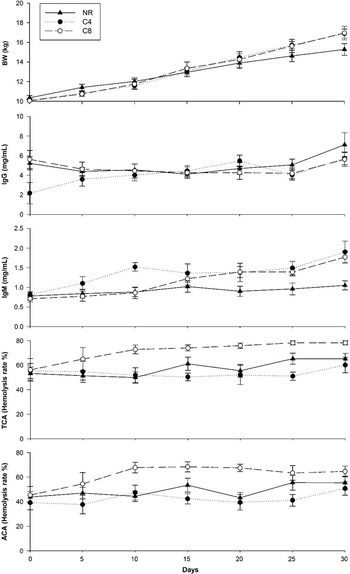
Figure 2 shows the BW, IgG and IgM concentrations and complement system activity (TCA and ACA) in the NR, C4 and C8 groups during the weaning period. With reference to BW development, lambs from the NR, C4 and C8 groups increased their BW during this period. No differences were observed among groups, although lambs from the C4 and C8 groups showed a greater BW than lambs from the NR group at day 25 (15.72, 15.63 and 14.62 kg, in C4, C8 and NR, respectively, P<0.05) and day 30 (16.89, 16.95 and 15.28 kg, in C4, C8 and NR, respectively, P<0.05). It has been described by Napolitano et al. (Reference Napolitano, Cifuni, Pacelli, Riviezzi and Girolami2002) that lambs raised with dams suffer greater stress by separation during the weaning period than animals from artificial rearing systems, resulting in a decrease in the final BW. In addition, al-Sabbagh et al. (Reference al-Sabbagh, Swanson and Thompson1995) showed that lambs born with low BW showed compensatory growth before weaning compared to lambs with high BW. This fact explains the negative correlation between the weight of the lamb at birth and the final weaned lamb weight, as described by those authors. Despite the lower weight of the NR group at the end of the weaning period, no differences in the BW at birth were detected between the three studied groups (NR, C4 and C8).
BW, IgG and IgM concentrations, TCA and ACA evolution in the NR (n=20), C4 (n=20) and C8 (n=20) groups during the weaning period. NR=natural rearing; C4=4 g of IgG/kg of BW at birth; C8=8 g of IgG/kg of BW at birth. TCA=total complement activity; ACA=alternative complement activity. Data shown in this figure can be viewed in the Supplementary Table S2.

Regarding IgG concentration, lambs from the NR and C8 groups showed slight decreases (P<0.05) in plasma IgG concentration in some specific time points of weaning. Nevertheless, both groups showed an increase in these values at the end of this period (7.11 and 5.62 IgG/ml in NR and C8, respectively, P<0.05). In contrast, the values from the C4 group never decreased, reaching the maximum value at 30 days. Regarding differences among groups, lambs from the NR and C8 group exhibited greater IgG concentrations than animals from the C4 group at the beginning of weaning period (5.22, 2.18, 5.62 mg/ml in NR, C4 and C8 groups, respectively, P<0.05). The consequences of a low colostrum administration, in the case of C4, may have probably persisted at that time. In spite of this fact, no differences among groups were observed during the rest of the weaning period. As described above, the reduction of colostrum intake in C4 could produce an earlier IgG synthesis compared to the NR and C8 groups, as was described by Nonnecke et al. (Reference Nonnecke, Waters, Goff and Foote2012). This fact could explain the increase of IgG in lambs from C4 group during this period.
Conversely to the evolution observed in IgG concentration, IgM concentrations increased in the NR, C4 and C8 groups during the entire period (P<0.05). At the beginning of weaning (0 and 5 days), no differences were observed among groups, probably because at that time lambs from all the studied groups (not only C4 group) were able to produce IgM, the earliest immunoglobulin synthesized by the immune system (Ehrenstein and Notley, Reference Ehrenstein and Notley2010). In addition, and in spite of no differences being observed among groups at 15 days, C4 and C8 groups showed greater values than the NR group during the rest of the period. It has been demonstrated that stress produces a decrease in IgM concentrations in the blood (Matos-Gomes et al., Reference Matos-Gomes, Katsurayama, Makimoto, Santana, Paredes-Garcia, Becker and Dos-Santos2010). The stress produced by dam separation in the NR group probably caused the differences observed among groups during the end of the weaning period.
During weaning, all the groups showed an increase in both complement system pathways (TCA and ACA), although different evolutions were observed. In general, the C8 group showed greater complement system activity (TCA and ACA) than the NR and C4 groups during the entire period (P<0.05). Nevertheless, all the studied groups showed a similar TCA (65.06%, 60.05% and 78.10% of hemolysis in NR, C4 and C8 groups, respectively, P<0.05) and ACA (55.40%, 50.77% and 64.65% of hemolysis in NR, C4 and C8 groups, respectively, P<0.05) at the end of the weaning period. Unfortunately, the complement system activity during weaning has not been deeply described in ruminants (cow, sheep and goat). Nevertheless, Oswald et al. (Reference Oswald, Lantier and Bourgy1990) described the complement system activity (TCA and ACA) in lambs, showing a similar evolution to present results, although different values were described, probably due to differences in the analytical techniques used.
In conclusion, lambs that received an amount of colostrum equivalent to 8 g of IgG/kg of BW equally divided into three meals at 2, 14 and 24 h after birth were able to reach similar IgG and greater IgM concentrations in blood than lambs reared under natural conditions during the first few days after birth. Lambs from the NR system obtained greater complement system activity than those from the artificial rearing system during the same period. At the end of weaning (60.70, 65.20, 65.45 days after birth in NR, C4 and C8 groups, respectively), lambs from the artificial rearing system showed greater BW and IgM concentrations and similar IgG concentrations and complement system activity compared to lambs reared under natural conditions. However, this study shows that not only the colostrum amount but also the management during the milk feeding and weaning periods, such as stress produced by dam separation or milk quality and suckling frequency, can affect the final immune status of lambs.
This study reveals important information about the amount of colostrum required by newborn lambs reared under artificial conditions in order to reach similar immune values to those reared under natural conditions.
Acknowledgments
Author L.E. Hernández-Castellano acknowledges the financial support from the Formación del Profesorado Universitario (FPU) program (Ministry of Education, Madrid, Spain). The authors also acknowledge Heather Robertson for her help in the grammar revision of this manuscript.
Supplementary Material
For supplementary material referred to in this article, please visit http://dx.doi.org/10.1017/S175173111500110X