Introduction
The family Triglidae comprises a large group of marine fishes, widely distributed from tropical to temperate waters worldwide. The species recognized (~125) of this family are characterized mainly by the presence of a pectoral fin with the lower three rays free and enlarged. This family is divided into three subfamilies: Prionotinae, Pterygotriglinae, and Triglinae (Nelson et al., Reference Nelson, Grande and Wilson2016).
In the Southwest Atlantic, three species of the subfamily Prionotinae have been recorded (Kuczynski and Cassia, Reference Kuczynski and Cassia1976; Figueiredo and Menezes, Reference Figueiredo and Menezes1980), namely Bellator brachychir (Regan, 1914), Prionotus nudigula Ginsburg, 1950, and Prionotus punctatus (Bloch, 1793). When fresh, B. brachychir exhibits an orange colouration and is characterised by a dorsal fin with 11 spines and 11 rays, a pectoral fin with 12 rays, and an opercular membrane devoid of scales (Figueiredo and Menezes, Reference Figueiredo and Menezes1980). In contrast, species of the genus Prionotus typically exhibit a dorsal fin with 10 spines and 12–13 rays, a pectoral fin with 13–14 rays, and an opercular membrane covered with scales (Figueiredo and Menezes, Reference Figueiredo and Menezes1980). In particular, P. punctatus has a preanal length corresponding to approximately 50% of the total length. When fresh, its pectoral fins exhibit a cobalt blue spot, and the mouth reaches the anterior edge of the orbit. In contrast, P. nudigula has a preanal length of less than 50% of the total length and its mouth does not reach the anterior edge of the orbit (Figueroa, Reference Figueroa2019).
Of the species previously referenced, B. brachychir exhibits the most limited southern distribution, with its known range extending to the coast of Uruguay (Figueiredo and Menezes, Reference Figueiredo and Menezes1980). In contrast, P. nudigula is the species that reaches higher latitudes, and its distribution has extended as far south as Golfo San Jorge (between 44°S and 47°S) in central Patagonia over the last few decades (Bovcon et al., Reference Bovcon, Cochia, Góngora and Gosztonyi2011; Góngora et al., Reference Góngora, Núñez, Cochia and Bovcon2023). However, there is a record further south that extends to the Rio de Gallegos estuary, Santa Cruz Province, Argentina (51°37′S 69°12′W) (Caille et al., Reference Caille, González, Gosztonyi and Ciocco1997).
Jaureguizar et al. (Reference Jaureguizar, Waessle and Guerrero2007) reported that P. nudigula inhabits the coastal shelf system with wider depth ranges, lower bottom temperatures, and higher bottom salinity compared to P. punctatus, which inhabits environments influenced by estuarine waters of the Río de la Plata. Both Prionotus species showed seasonal variations in their distribution, mainly related to the outflow of water from the Río de la Plata (Jaureguizar et al., Reference Jaureguizar, Waessle and Guerrero2007).
The Bluewing searobin P. punctatus is a medium-sized (to 450 mm maximum total length recorded by Teixeira and Haimovici, Reference Teixeira and Haimovici1989) demersal fish that inhabits shallow-to-moderate depths (De São Clemente et al., Reference De São Clemente, Costa and Martins2014). It is distributed from Belize and southern Jamaica to Argentina (Miller and Richards, Reference Miller and Richards1978). Jaureguizar et al. (Reference Jaureguizar, Waessle and Guerrero2007) reported the previous southernmost records for P. punctatus, captured during spring off the coast of Mar Chiquita (37°40′S), Argentina. Although it is not a commercially important species, it is a significant component of demersal fisheries off the coast of Brazil (Andrade, Reference Andrade2004). The objective of this work is to report the presence of P. punctatus in Bahía Engaño (43°22′S 65°03′W) in Chubut Province waters, central Patagonia, Argentina, in order to expand knowledge of its distribution.
Materials and methods
On 17 January 2020, during the monitoring of the bottom trawl fishery for Patagonian shrimp Pleoticus muelleri (Bate, 1888), a specimen of the family Triglidae was incidentally caught and subsequently identified in the laboratory as Prionotus punctatus (Bloch, 1793) according to the characters proposed by Figueroa (Reference Figueroa2019). The specimen was caught by trawl at 43°14′58″S and 64°43′14″W at a depth of 48 m (Figure 1). Morphometric measurements of total length, standard length, pre-anal distance, pectoral distance, head length, eye diameter, upper jaw length, snout length, pectoral fin length, body depth, caudal peduncle depth and caudal peduncle length were recorded using a caliper (accuracy 0.02 mm) in accordance with the methodology proposed by Figueroa (Reference Figueroa2019). Finally, the specimen was fixed in 10% formalin and deposited in the ichthyological collection of the Instituto de Investigación de Hidrobiología, Facultad de Ciencias Naturales y Ciencias de la Salud, Universidad Nacional de la Patagonia San Juan Bosco, Trelew, Argentina (identification code UNPSJB ICT-2020/3).
Location map of Prionotus punctatus (red dot) within Bahia Engaño (blue line), Chubut Province, Argentina.

Results
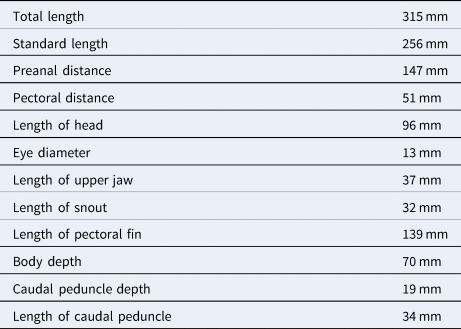
The specimen of P. punctatus had a total length (TL) of 315 mm and a preanal length of 147 mm (46.7% of total length). Other morphometric measurements are given in Table 1. When fresh, the pectoral fins were of a cobalt blue colour (Figure 2). Ventrally, the junction of the gill membranes is in front of the line that joins the mouth commissure, and the mouth reaches the anterior edge of the orbit. These characters are mentioned by Figueroa (Reference Figueroa2019) as identifying the species. This new record extends the known distribution of P. punctatus by 5.5°S latitude and 900 km south of the previous southernmost record.
Morphometric measurements of specimen Prionotus punctatus UNPSJB ICT-2020/3

Specimen of Prionotus punctatus (UNPSJB ICT-2020/3), photographed on the deck of the fishing vessel after capture.

Discussion
From a biogeographical perspective, the species of fishes of the Argentine (Bonaerensean district) and Magallanic (Patagonian district) Ichthyogeografic Province converge in the coastal waters of Bahía Engaño (Balech and Ehrlich, Reference Balech and Ehrlich2008). This suggests that the coastal zone of Chubut Province represents an ecotone between both biogeographical regions (Galván et al., Reference Galván, Venerus and Irigoyen2009; Bovcon, Reference Bovcon2016). The confluence between the Argentine and Magellanic Provinces makes central Patagonia an excellent site to detect shifts in species distributions due to changes in temperature or oceanographic conditions (Galván et al., Reference Galván, Bovcon, Cochia, González, Lattuca, Ocampo Reinaldo, Rincón-Díaz, Romero, Vanella, Venerus, Svendsen, Helbling, Narvarte, González and Villafañe2022).
Saraceno et al. (Reference Saraceno, Martín, Moreira, Pisoni, Tonini, Helbling, Narvarte, González and Villafañe2022) reported that the sea surface temperature in Patagonia has increased up to 48°S, and fish and marine invertebrates are known to respond to ocean warming by shifting their distribution, generally to higher latitudes and deeper waters (Cheung et al., Reference Cheung, Watson and Pauly2013). This phenomenon, in which species respond to increases in seawater temperature by moving poleward, is known as temperate tropicalization (Bianchi and Morri, Reference Bianchi and Morri2003). The biogeographic analyses of new species recorded in central Patagonia in recent decades suggest that the distributional shifts are mainly due to the arrival of species expanding from the north, accounting for between 24 and 30 tropical–subtropical species (Bovcon et al., Reference Bovcon, Cochia, Góngora and Gosztonyi2011, Reference Bovcon, Cochia, Trobbiani, Belleggia, Jacobi, De Wysiecki, Figueroa and Irigoyen2022; Galván et al., Reference Galván, Bovcon, Cochia, González, Lattuca, Ocampo Reinaldo, Rincón-Díaz, Romero, Vanella, Venerus, Svendsen, Helbling, Narvarte, González and Villafañe2022).
This new record of a tropical–subtropical species, added to other species of tropical–subtropical lineage already recorded in central Patagonia, add further evidence on the ongoing of the tropicalization that could be occurring in the Patagonian Sea, Southwest Atlantic. Consequently, this record, together with the presence of P. nudigula, allows us to extend the distribution of the genus Prionotus of tropical lineage southward in the waters of the Patagonian Sea and to add a new taxon to the ichthyofauna of the coastal zone of central Patagonia, Chubut Province, Argentina.
Data
Data will be available on request.
Acknowledgements
The authors would like to express their gratitude to David E. Galván and Lucia C. Marino for their invaluable contributions during the editorial process of this article. Additionally, they extend their appreciation to the editor and reviewer who provided constructive feedback, enhancing the quality of this article.
Author Contributions
Jacobi K. J. wrote and edited the article, and prepared the map and images. Navoa X. and Cochia P. D. contributed to the writing and editing of the article. Bovcon N. D. supervised the work and participated in the editing of the article.
Financial Support
This article has no specific financial support, it has been carried out with the authors' own resources. All authors are affiliates of Consejo Nacional de Investigaciones Científicas y Técnicas (CONICET), which finances each author's specific research.
Competing interest
The authors declare none.