Introduction
There is increasing concern about the proportion of former Armed Forces personnel in prison and on probation (NAPO, 2008; Howard League for Penal Reform, 2011; MacManus et al., Reference MacManus, Dean, Jones, Rona, Greenberg, Hull, Fahy, Wessely and Fear2013). Data from the Ministry of Justice and Ministry of Defence have shown that ex-military personnel form the largest occupational group in prison and on probation and are more likely to be convicted of violent or sexual offences than offenders who have not served in the military (DASA, 2010; Short et al., Reference Short, Dickson, Greenberg and MacManus2018). Around 20 000 (10%) of the regular strength of the UK Armed Forces leave every year. Most of the current generation of service leavers make successful transitions back into civilian life. However, some will develop mental health and alcohol problems (Goodwin et al., Reference Goodwin, Wessely, Hotopf, Jones, Greenberg, Rona, Hull and Fear2015; Rona et al., Reference Rona, Jones, Hull, MacManus, Fear and Wessely2015) and some will find themselves involved in the Criminal Justice System (CJS), which can have a negative impact on their lives, the lives of their families and society (MacManus et al., Reference MacManus, Fossey, Watson and Wessely2015a).
Recent robust UK research found that combat exposure and post-deployment mental health problems, such as PTSD, anger problems and alcohol misuse, are risk factors for violent offending by military personnel (MacManus et al., Reference MacManus, Dean, Al Bakir, Iversen, Hull, Fahy, Wessely and Fear2012, Reference MacManus, Dean, Jones, Rona, Greenberg, Hull, Fahy, Wessely and Fear2013, Reference MacManus, Rona, Dickson, Somaini, Fear and Wessely2015b). We do not, as yet, have data on risk factors for general offending among UK military personnel after they have left service or data on factors that may reduce the risk of offending, and in particular among those with mental health problems. Research using US Iraq and Afghanistan War era veterans found that, consistent with research on general populations, younger age, male gender, prior history of arrest, alcohol/drug misuse and PTSD were associated with higher risk of breaking the law, but not combat exposure or TBI (Elbogen et al., Reference Elbogen, Johnson, Newton, Straits-Troster, Vasterling, Wagner and Beckham2012a). US research has also identified a range of psychosocial factors which reduced the risk of violence by US military veterans (Elbogen et al., Reference Elbogen, Johnson, Wagner, Newton, Timko, Vasterling and Beckham2012b). Stable living situation, the perception of having control over one's life, perceiving positive social support and having money to cover basic needs were linked to reduced odds of physical aggression. Similar research has not yet been undertaken in the UK and data on such protective factors for general offending is lacking internationally.
An independent review on behalf of the Secretary of State for Justice into ‘Former Members of the Armed Forces in the Criminal Justice System’ has highlighted the need for national guidance on the needs and management of former Armed Forces personnel in the CJS and greater mental health support (MacManus et al., Reference MacManus, Fossey, Watson and Wessely2015a). The development of such national guidance must be based on research evidence on the pathways to offending among ex-military personnel and the factors that could be identified and targeted by interventions to reduce offending. We can build on the existing evidence base for ‘what works’ to reduce reoffending in the general offender population (Ministry of Justice, 2014), but particular challenges in the management of former Armed Forces personnel in the CJS might arise from their experiences in the military, during deployment, from associated mental health problems and from the socio-economic effects of transitioning from the military life into civilian life (Phillips, Reference Phillips2014). Identification of the risk and protective factors for offending in this population is key to designing new or adapting existing interventions.
This study aimed to use data from a large representative sample of UK military personnel which has been linked with the Ministry of Justice national criminal records to describe patterns of offending among military personnel after they leave service and examine the mental health risk factors, as well as the social and economic factors which may protect against offending in this population. We hypothesised that mental health problems such as PTSD, symptoms of common mental disorder (CMD), alcohol misuse and aggressive behaviour would be positive predictors of offending. A further hypothesis was that socio-economic factors such as stable accommodation, financial stability, employment and relationship stability would be associated with a reduced risk of offending in the presence of mental health problems.
Methods
Study design and participants
This data linkage study utilised a randomly selected sample of UK military personnel actively serving in the UK Armed Forces at the time of selection into the study (Hotopf et al., Reference Hotopf, Hull, Fear, Browne, Horn, Iversen, Jones, Murphy, Bland, Earnshaw and Greenberg2006; Fear et al., Reference Fear, Jones, Murphy, Hull, Iversen, Coker, Machell, Sundin, Woodhead, Jones, Greenberg, Landau, Dandeker, Rona, Hotopf and Wessely2010). There have been two phases of recruitment and data collection: phase 1 (2004–2006) and phase 2 (2007–2009) (Hotopf et al., Reference Hotopf, Hull, Fear, Browne, Horn, Iversen, Jones, Murphy, Bland, Earnshaw and Greenberg2006; Fear et al., Reference Fear, Jones, Murphy, Hull, Iversen, Coker, Machell, Sundin, Woodhead, Jones, Greenberg, Landau, Dandeker, Rona, Hotopf and Wessely2010). Phase 1 included a random sample of 17 689 participants, some of whom had been deployed to Iraq between 18 January and 28 June 2003 and some who were trained but had not deployed to Iraq at that time (Hotopf et al., Reference Hotopf, Hull, Fear, Browne, Horn, Iversen, Jones, Murphy, Bland, Earnshaw and Greenberg2006). At phase 2, an additional random sample of 6628 personnel, who were newly recruited to the military after the beginning of the study (termed the replenishment group) and were eligible for deployment, were added to the sample of participants followed up from phase 1 to ensure that the demographic characteristics of the current UK Armed Forces were reflected in the study. A further random sample of 1789 personnel, who had been deployed to Afghanistan, was added in response to the UK commitment to the military operation in Afghanistan. Special Forces personnel were excluded as, for security reasons, we could not know the names and addresses of SF personnel.
In total, 13 856 participants completed the questionnaire at phase 1, phase 2 or both phases; 3872 at phase 1 only (58.1% response rate), 6427 completed a questionnaire at both phase 1 and phase 2 (68.4% response rate at phase 2); 2663 respondents from the replenishment sample (40.2% response rate) and 894 respondents from the Afghanistan sample (50.1% response rate) (for diagrammatic illustration please see online Supplementary Fig. S1). In total, 5386 were identified via military records as having left-service at the time of the data-linkage (31 July 2011). Of these, 2277 reported that they had left service at the point of completion of the phase 2 questionnaire, of which 1763 had been regular personnel.
Procedures
Information on socio-demographics, pre-military experiences and behaviour, military experiences (including deployments and combat exposure), and health and behaviour post-deployment was collected by self-report questionnaire (Hotopf et al., Reference Hotopf, Hull, Fear, Browne, Horn, Iversen, Jones, Murphy, Bland, Earnshaw and Greenberg2006; Fear et al., Reference Fear, Jones, Murphy, Hull, Iversen, Coker, Machell, Sundin, Woodhead, Jones, Greenberg, Landau, Dandeker, Rona, Hotopf and Wessely2010). Mental health was assessed using a range of screening tools and the variables were defined as follows: symptoms of CMD in the past month using a cut-off score of four or above on the General Health Questionnaire-12 (GHQ-12) (Goldberg et al., Reference Goldberg, Gater, Sartonius, Ustun, Piccinelli, Gureje and Rutter1997). CMDs are defined as depressive non-psychotic symptoms, anxiety and somatic complaints that affect the performance of daily activities, incorporating depressive and anxiety disorders (Goldberg and Huxley, Reference Goldberg and Huxley1992); cases of probable PTSD in the last month using a cut-off score of 50 or above on the 17-item National Centre for Posttraumatic Stress Disorder (PTSD) Checklist (PCL-C), and 30–49 for sub-threshold PTSD (Blanchard et al., Reference Blanchard, Jones-Alexander, Buckley and Forneris1996); alcohol misuse in the last year using a score of ⩾16 on the World Health Organization's Alcohol Use Disorders Identification Test, AUDIT (Babor et al., Reference Babor, Higgins-Biddle, Saunders and Monteiro2001; Fear et al., Reference Fear, Iversen, Meltzer, Workman, Hull, Greenberg, Barker, Browne, Earnshaw, Horn, Jones, Murphy, Rona, Hotopf and Wessely2007). A validated measure of aggression (Bleise et al., Reference Bleise, Wright, Adler and Thomas2004) was used to score frequency of reported verbal, property, or physical aggression or number of threats of physical violence in the past month (never, once, 2–4, ⩾5) based on the stem ‘In the past month, how often did you’: get angry at someone and yell or shout at them; get angry with someone and kick or smash something, slam the door, or punch the wall; get into a fight with someone and hit the person; and threaten someone with physical violence. The total of the scores for each response was the aggression score for the past month.
At phase 2, those who reported that they had left service were asked a range of questions related to their circumstances since leaving. The questions included: debt problems (Do you have problems paying money owed), accommodation (current living arrangements: self-owned; permanent private; permanent public; temporary), employment (status at time of questionnaire completion), relationship status (current marital status; married/long-term partner/single) and relationship satisfaction (Has separation been discussed in the past year). For the purposes of statistical analyses, both accommodation (permanent/temporary) and relationship status (long-term/single) were collapsed into binary variables.
The cohort data was linked to the Ministry of Justice Police National Computer (PNC) database (ACPO, 2012). This is the UK wide criminal offence database which records ‘standard list’ offences (includes all indictable offences and certain summary offences; ACPO, 2012). Offences dealt with by military police are recorded in military criminal records and transferred to the PNC database if they are recordable offences, i.e. any offence punishable by imprisonment, plus a number of non-imprisonable offences (ACPO, 2012).
The cohort database was linked with the PNC database using a matching process based on surname, forename, initials, gender and date of birth. Only automatic matches were accepted. Linkage provided the date of charge for the offence, type of offence and outcome of offence(s) for each individual with a criminal record. Convictions, cautions, reprimands and warnings (including juvenile) were all considered as ‘offences’. Offences were categorised based on their legal descriptions: (1) interpersonal violence, (2) other aggressive behaviours (such as dangerous driving, criminal damage), (3) sexual offences (divided into violent and non-violent), (4) drug- and alcohol-related offences, (5) other offences (such as motoring offences not included in 2). The offences were classed according to when they were committed (e.g. pre-military, in-service and post-service). In service, military criminal records were not accessed. Offences committed in service are routinely communicated with the Ministry of Justice for record in the PNC.
Statistical analyses
Participants' offences from pre-service until the end of follow-up (31 July 2011) are described. The proportion of different types of offenders per person years at risk are graphically displayed across the different time periods from pre-service to in-service to post-service. The observation period for the analyses of risk factors for offending among veterans began at the date of questionnaire completion and continued until the participant committed an offence, died or follow-up ended (right censored). Varying time at risk was accounted for using Cox regression modelling (Therneau and Grambsch, Reference Therneau and Grambsch2013). Nelson Aalen plots confirmed the data conformed to the assumption of proportional hazards. A number of potential confounding factors, such as socio-demographic and military characteristics and pre-military offending, were identified. Factors independently associated with both exposure and outcome (at the 5% level) were included in the adjusted multivariable Cox regression models.
The impact of mental health and behaviour problems and a range of socio-economic factors on the risk of subsequent general offending among veterans was explored. These analyses were restricted to regular personnel as only those who had been in regular service were asked to complete the questions at phase 2 pertaining to their socio-economic circumstances after leaving service. Potential confounders were included simultaneously in adjusted multivariable Cox regression models.
In order to test whether socio-economic factors were protective in the presence of mental health risk factors for offending, we carried out further analyses. We created a combined mental health risk variable (high risk consisted of the presence of one or more of the mental health risk factors in Table 2, an aggression problem was categorised as present with a score of 6 or more) and explored the impact of each of the socio-economic factors when included in a Cox regression model with the mental health risk factor variable.
Hazard ratios, 95% confidence intervals and two-sided p values are presented. Weights were created to account for sampling fractions and response rates (MacManus et al., Reference MacManus, Dean, Jones, Rona, Greenberg, Hull, Fahy, Wessely and Fear2013). All analyses were performed in STATA MP (version 12.0) using survey commands.
Ethical approval was provided by the National Research Ethics Service, King's College Hospital Research Ethics Committee, MoJ, MoD and the UK Criminal Records Office (ACRO).
Results
The full sample consisted of 5386 (41.0%) participants who had left service by the end of the follow-up period (date of data linkage 31 July 2011) out of 13 856 participants in the entire cohort study. The ex-serving participants had a median age of 42.0 years (IQR 33.0–47.6) at the end of follow-up, 4424 (91.5%) were of regular status, and 3105 (41.35%) had been deployed in Afghanistan or Iraq. Participants were predominantly male [4742 (88.7%)], had served in the Army [3374 (60.3%)] as opposed to the Royal Air Force [1131 (22.3%)] or the Naval Services [881 (17.4%)], and were of non-officer rank [4437 (82.4%)]. In total, 2326 (46.1%) participants had achieved an education level of high school equivalent or lower. The sample spent a median length of time of 9.69 years (IQR 3.91–22.0) in military service, and median age at enlistment was 19.5 years (IQR 17.5–23.8).
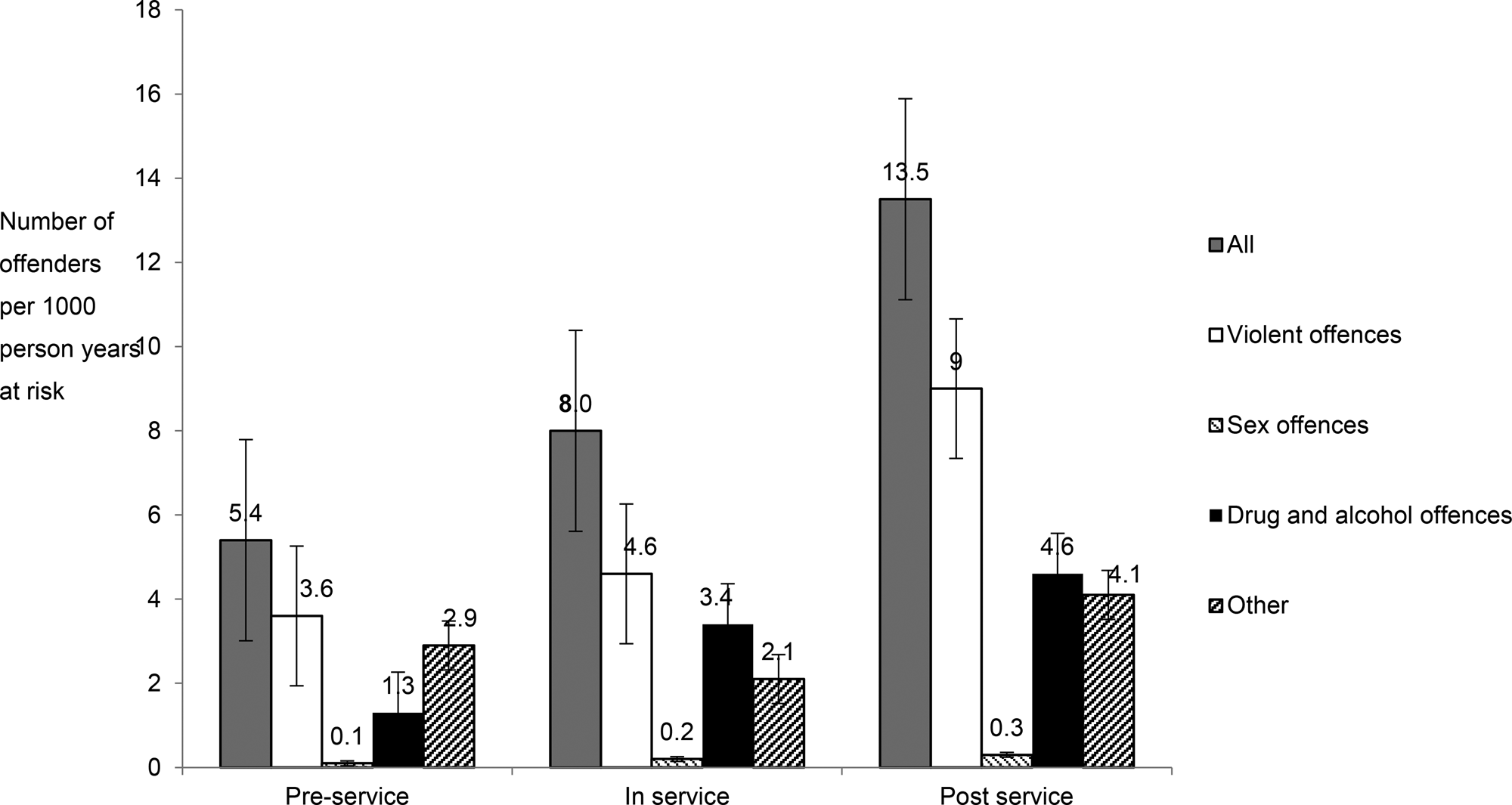
Of the 5386 ex-serving participants, 915 (18.9%) of 4741 men and 29 (4.8%) of 645 women committed one or more offences during their lifetime. Approximately 6.1% (356) of participants had committed any kind of offence prior to joining the military. Six hundred and twenty (66.1%) of those who had offended in their lifetime had committed a violent offence and 198 (20.9%) had committed a serious violent offence. The rate of offending changed over time among the entire cohort (number of participants who offended in that time period per person years at risk) from pre-enlistment to in-service to post-service (see Fig. 1). More participants offended per person years at risk in the post-service period than in the pre-enlistment or in-service periods. The proportion of all types of offenders increased though the greatest increase was seen in violent offending. Median follow-up time after leaving the military was 4.35 years (IQR 2.54–6.21). Post-service, 315 (6.1%) ex-serving personnel committed an offence. Of those who offended post-service, 210 (69.1%) committed a violent offence, 36 (10.8%) committed a serious violent offence, 106 (30.0%) a drug- or alcohol-related offence and six (1.6%) a sex offence. Eighty-five (26.2%) of those who offended after leaving the military had offended prior to enlisting in the military and 154 (49.3%) had committed an offence whilst still serving.
Offending among all participants during the pre-service, in-service and post-service periods, expressed as number of offenders per person years at risk.

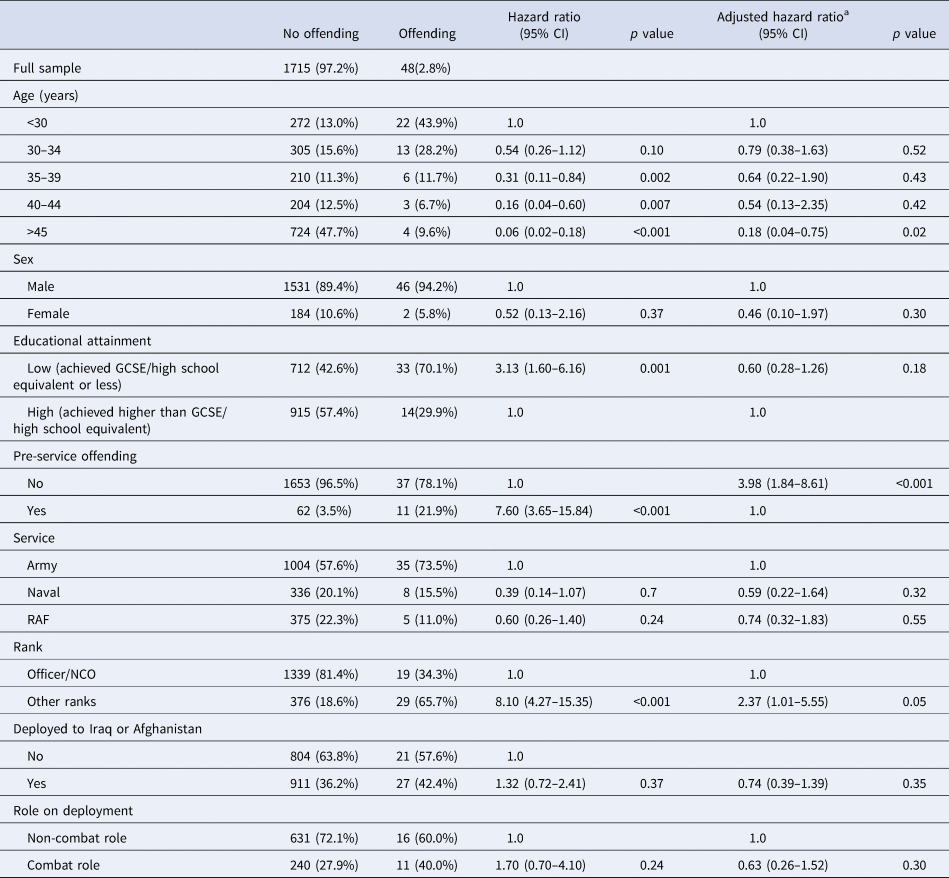
At phase 2 of questionnaire data collection, 1763 reported that they had left regular service. They completed questions relating to their mental health and socio-economic situation at that point in time. Table 1 shows the socio-demographic and military factors associated with subsequent offending in veterans who reported having left service by phase 2. Age, lower educational attainment, pre-service offending and lower rank were significant predictors of offending on univariable analyses. On multivariable regression, age, pre-service offending and rank remained significant predictors of offending among veterans.
Social and demographic factors associated with offending in veterans

Sample includes regulars and reservists who reported to have left service at phase 2 data collection. Data are number (%), unless otherwise indicated. Numbers are unweighted counts, percentages and hazard ratios are adjusted to take into account sample and response weights. Sum of the cells might differ from the total because of missing data.
a Adjusted for age (continuous), educational attainment, pre-service offending and rank.
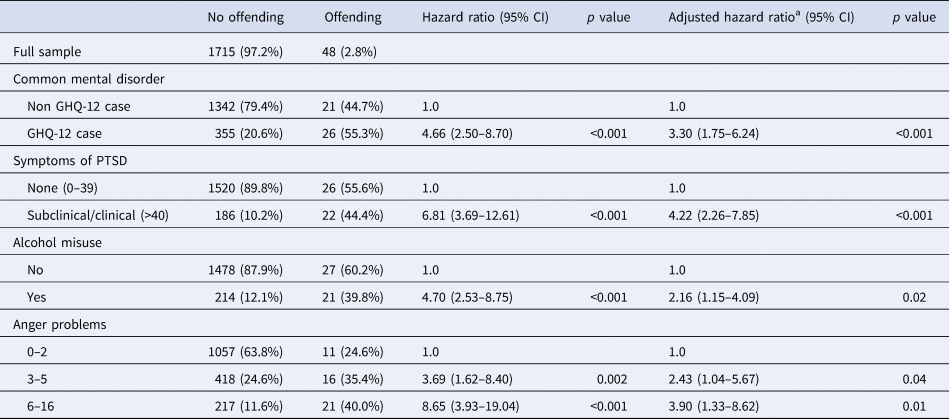
After adjustment for confounders identified in Table 1 (i.e. age, rank and pre-service offending), reporting of subthreshold or probable PTSD, symptoms consistent with caseness on our measure of CMD, aggression problems and alcohol misuse were all significantly associated with offending in veterans (see Table 2).
Mental health factors associated with offending among veterans

Data are number (%), unless otherwise indicated. Numbers are unweighted counts; percentages and hazard ratios are adjusted to take into account of sample and response weights. Sum of the cells might differ from the total because of missing data. GHQ-12, General Health Questionnaire-12; PTSD, post-traumatic stress disorder.
a Adjusted for age (continuous), pre-service offending and rank.
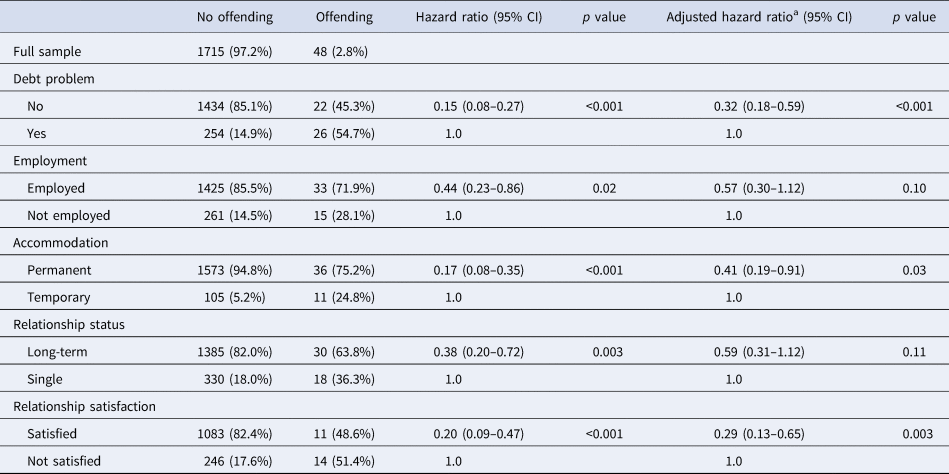
Socio-economic factors that were associated with offending were debt, employment status, accommodation status, relationship status and relationship satisfaction. After adjusting for confounding variables (identified in Table 1), absence of debt, accommodation stability and relationship satisfaction were all statistically significantly associated with reduced offending among UK military veterans (Table 3).
Socio-economic factors associated with offending among veterans.

Data are number (%), unless otherwise indicated. Numbers are unweighted counts and percentages and hazard ratios are adjusted to take into account of sample and response weights. Sum of the cells might differ from the total because of missing data.
a Adjusted for age (continuous), pre-service offending and rank.
In order to test whether these socio-economic factors (i.e. absence of debt, accommodation stability and relationship satisfaction) were protective in the presence of mental health risk for offending, we created a combined mental health risk variable [high risk consisted of the presence of one or more of the mental health risk factors in Table 2 (an ‘aggression problem’ was categorised as a score of 6 or more)] and explored the protective effect of each of the socio-economic factors when included in a Cox regression model along with the mental health risk variable. In the absence of any socio-economic factors in the model, there was a strong association between the mental health risk variable and veteran offending (HR 11.65, 95% CI 4.95–27.40; p ⩽ 0.001; aHR 6.63, 95% CI 2.74–16.10; p ⩽ 0.001). When each potential protective socio-economic factor was separately added to the model, we found that absence of debt (HR 0.30, 95% CI 0.16–0.56; p ⩽ 0.001), accommodation stability (HR 0.25, 95% CI 0.12–0.50; p < 0.001) and relationship satisfaction (HR 0.37, 95% CI 0.16–0.84; p = 0.02) were statistically significantly associated with a reduction in offending, but not employment (HR 0.65, 95% CI 0.34–1.27; p = 0.21). After adjusting for significant confounding factors from Table 1, absence of debt and relationship satisfaction continued to show a statistically significant protective effect (aHR 0.53, 95% CI 0.28–0.98; p = 0.04; aHR 0.44, 95% CI 0.20–0.99; p = 0.05, respectively), although accommodation stability (aHR 0.47, 95% CI 0.21–1.04; p = 0.06) demonstrated protective effects with borderline statistical significance.
Discussion
The results from this study show that the rates of all types of offending among military personnel increase after leaving service with violent offending being the most prevalent. In line with our previous work on violent offending (MacManus et al., Reference MacManus, Dean, Al Bakir, Iversen, Hull, Fahy, Wessely and Fear2012, Reference MacManus, Dean, Jones, Rona, Greenberg, Hull, Fahy, Wessely and Fear2013), offending prior to joining the military was a strong predictor of offending after leaving the military. Personnel who had served in the Army, in a lower rank with lower levels of educational attainment, were more likely to offend. Self-reported post-service subthreshold or probable PTSD, CMD, alcohol misuse and problems with aggression were found to be strong predictors of offending behaviour post-service. The results also suggest that post-service socio-economic factors such as absence of debt, stable housing and relationship stability can play a protective role in reducing the risk of offending among those with mental health problems.
Given what we know about patterns of offending among military personnel (MacManus et al., Reference MacManus, Dean, Jones, Rona, Greenberg, Hull, Fahy, Wessely and Fear2013), it is no surprise that offending increases after leaving service. We have previously shown that young men join the military at a median age of 19, which is the peak age for offending in the general population (MacManus et al., Reference MacManus, Dean, Jones, Rona, Greenberg, Hull, Fahy, Wessely and Fear2013). They are therefore in service when they are at highest risk of offending and being in the military may limit the opportunity for offending. Research by King's College London has also found that military personnel were less likely to have committed an offence in their lifetime than males of a similar age from the general population (17% of males in our military sample compared to 28% of males in the general population aged 18–65 years) (Prime et al., Reference Prime, White, Liriano and Patel2001). This finding may be explained by a lower level of non-violent offending, as we found the proportion of lifetime violent offenders was higher among our sample of military men (MacManus et al., Reference MacManus, Dean, Jones, Rona, Greenberg, Hull, Fahy, Wessely and Fear2013) than in a comparable sample from the general population (20.6% of males aged under 30 years in our military sample compared to 6.8% of males in the general population aged under 30 years) (Prime et al., Reference Prime, White, Liriano and Patel2001), and violent offending was the most common type of offending among our military sample (MacManus et al., Reference MacManus, Dean, Jones, Rona, Greenberg, Hull, Fahy, Wessely and Fear2013), which is in contrast to the pattern of offending in the general population, where non-violent offending is more prevalent than violent offending (Prime et al., Reference Prime, White, Liriano and Patel2001). In this current study of personnel who have left service, we have shown that this pattern continues. This suggests that while military service may act to limit non-violent offending, it does not contain violent offending (and may even act to increase it). In the light of the increased overall offending post-service, it is important to explore the risk and protective factors which can better inform offending reduction interventions and programmes.
Mental health problems such as PTSD, symptoms of CMD, alcohol misuse and problems with aggression after leaving service were strongly predictive of subsequent offending behaviour, with PTSD marginally showing the strongest association. This adds to previous findings of an association between post-deployment mental health and alcohol problems and violent offending (MacManus et al., Reference MacManus, Dean, Al Bakir, Iversen, Hull, Fahy, Wessely and Fear2012, Reference MacManus, Dean, Jones, Rona, Greenberg, Hull, Fahy, Wessely and Fear2013; Elbogen et al., Reference Elbogen, Johnson, Wagner, Sullivan, Taft and Beckham2014), and highlights the persistent impact of mental health on behavioural outcomes among those who have left service, over and above the risk associated with socio-demographic and military factors. Few studies have explored the link between mental health problems and criminal offending among ex-military personnel. One study from the USA, using a self-report measure of involvement with the CJS, showed a link between PTSD and general criminal offending among an ex-serving military sample (Elbogen et al., Reference Elbogen, Johnson, Newton, Straits-Troster, Vasterling, Wagner and Beckham2012a). The present study advances this research by using official criminal records as an objective measure of criminal offending in a large representative sample of UK ex-military personnel and by exploring the association with a wider range of mental health problems. There is a growing international evidence base for the impact of aspects of military service, such as combat, on the mental health of service personnel and hence their risk of offending (Killgore et al., Reference Killgore, Cotting, Thomas, Cox, McGurk, Vo, Castro and Hoge2008; Fear et al., Reference Fear, Jones, Murphy, Hull, Iversen, Coker, Machell, Sundin, Woodhead, Jones, Greenberg, Landau, Dandeker, Rona, Hotopf and Wessely2010; Thomas et al., Reference Thomas, Wilk, Riviere, Mcgurk, Castro and Hoge2010; Elbogen et al., Reference Elbogen, Johnson, Newton, Straits-Troster, Vasterling, Wagner and Beckham2012a, Reference Elbogen, Johnson, Wagner, Sullivan, Taft and Beckham2014; MacManus et al., Reference MacManus, Rona, Dickson, Somaini, Fear and Wessely2015b). There is an argument, in the light of the Armed Forces Covenant (The Ministry of Defence, 2015) in the UK, that there is a responsibility to ensure that appropriate support and treatment is provided for serving and ex-service personnel with mental health needs to ensure they do not suffer a disadvantage as a result of military service. In the UK, the National Health Service is primarily responsible for mental health care for veterans, with additional services provided by the charitable sector. The charitable sector provides the bulk of veteran-specific welfare support. Our findings highlight the need for more coherent pathways into mental health, social, welfare and employment support for veterans who are in contact with the CJS.
This study found that certain post-service social and economic factors, such as financial stability, stable housing and relationship satisfaction, were associated with a reduced risk of offending in this ex-service population. The transition from military to civilian life can be challenging, and some ex-military personnel struggle to manage aspects of life which were previously managed for them. By considering these social and economic factors as potential protective factors in the presence of mental health risk, the present study showed that they are associated with a statistically significant or borderline significant reduction in the risk of offending in the presence of high mental health risk. These findings add to the findings of Elbogen et al. who found that similar factors reduced the risk of violence among US military veterans who carried the burden of other risk factors such as exposure to combat trauma and PTSD (Elbogen et al., Reference Elbogen, Johnson, Wagner, Newton, Timko, Vasterling and Beckham2012b).
The limitations of this study include the likelihood that use of the PNC database underestimates the rate of known offending because it only records offences that come to the attention of the police (ACPO, 2012). The matching process used only automatic matches to reduce the potential for false positives leading to further likelihood of underestimation of offending.
There is currently a lack of evidence as to ‘what works’ to reduce offending among ex-military personnel. Findings from the current study confirm that they are vulnerable to the same risk factors for offending as those in the general population, but that the pattern of offending is different with a greater preponderance of violent offending than non-violent offending. Results also indicate that mental health and alcohol problems are associated with increased risk of offending post-service and that socio-economic factors are important to consider in efforts to reduce the risk of offending behaviour, thus presenting key targets for offending reduction work. These findings have implications for service planning for veterans in the UK. Clear pathways into mental health and alcohol treatment and welfare support must be prioritised. At a time of greater fragmentation of services than ever before, high levels of comorbidity within this population (Iversen et al., Reference Iversen, van Staden, Hughes, Greenberg, Hotopf, Rona, Thornicroft, Wessely and Fear2011) and the fact that the social and welfare needs are often enmeshed with mental health needs means this will not be easy. There must be better cross-working between government, statutory and third sector agencies if the ambitions of the Military Covenant are to be upheld.
Supplementary material
The supplementary material for this article can be found at https://doi.org/10.1017/S0033291719003131.
Conflict of interest
The UK Ministry of Defence funded the cohort study data collection. The data linkage was undertaken as part of a research fellowship funded by the Medical Research Council. DM, HD, SW, NF, MJ, LH, HB and RS are currently employed by King's College London. The authors' work was independent of the UK Ministry of Defence, which had no role in the analysis, interpretation or decision to submit this paper. We have disclosed the paper to the Ministry of Defence at the point we have submitted it for publication. SW is a trustee of the Veteran charity Combat Stress.