INTRODUCTION
Maize (Zea mays) is an important crop for feeding the increasing population of Ethiopia (Worku et al. Reference Worku, Tuna, Nigussie, Deressa, Nigussie, Tanner and Twumasi-Afriyie2002). North-western Ethiopia contributes almost a quarter of the total maize area and production in Ethiopia. However, common bean production is very limited, having only 1/17th and 1/13th of the country's total area covered and quantity produced, respectively (CSA 2015), indicating poor integration of common bean in the maize-based cropping system of north-western Ethiopia.
In sub-Saharan Africa, continuous cropping of maize has led to soil fertility depletion and subsequent low crop yields (Gichuru et al. Reference Gichuru, Bationo, Bekunda, Goma, Mafongonya, Mugendi, Murwira, Nandwa, Nyathi and Swift2003). The sub-Saharan Africa population is growing exponentially and the area must fulfil the population's food and nutrition requirements. Hence, one strategy for increasing productivity is to intensify land use (Matusso et al. Reference Matusso, Mugwe and Mucheru-Muna2014). Smallholder farmers in East Africa are undergoing a profound transition from cereal-based subsistence farming to mixed enterprise, market-oriented agriculture (Woomer et al. Reference Woomer, Lan'gat and Tungani2004). Maize–bean intercropping is common where the risk of total crop failure due to environmental constraints is high (Prasad & Brook Reference Prasad and Brook2005), to improve income and food production per unit area (Woomer et al. Reference Woomer, Bekunda, Karanja, Moorehouse and Okalebo1997; Mukhala et al. Reference Mukhala, De Jager, Van Rensberg and Walker1999), and to improve family nutrition (Mukhala et al. Reference Mukhala, De Jager, Van Rensberg and Walker1999). Maize–bean intercropping reduced the risk of crop failure that resulted from terminal moisture deficit, as bean matures early relative to maize. Variation in maturity of the component crop species is a major consideration with intercropping (Seran & Brintha Reference Seran and Brintha2010). Bhatnagar & Chaplot (Reference Bhatnagar and Chaplot1991) reported a 55% increase in productivity for maize–legumes intercrop compared with the sole crops (SCs). Tana & Mulatu (Reference Tana and Mulatu2000) and Workayehu & Wortmann (Reference Workayehu and Wortmann2011) also reported the agronomic importance and economic feasibility of maize–common bean intercropping in Ethiopia.
The cereal-based cropping systems in Ethiopia is less efficient compared with intercropping (Bogale et al. Reference Bogale, Debele, Gebeyehu, Tana, Geleta, Workayehu, Nigussie, Tanner and Twumasi-Afriyie2002) due to continuous cropping. In addition, maize–common bean intercropping is a recent practice in north-western Ethiopia and there is limited information on maize–common bean intercrop productivity in the region. More research-based information is needed to enhance cereal production systems in rain-fed tropical areas (Ahmed & Rao Reference Ahmed and Rao1982) and intercropping systems offer clear potential (Matusso et al. Reference Matusso, Mugwe and Mucheru-Muna2014). Spatial arrangement of the component crops has been shown to play a significant role in maize–legume productivity (Woomer et al. Reference Woomer, Lan'gat and Tungani2004).
In north-western Ethiopia, land is scarce due to high population pressure, and soil fertility is depleted as a result of continuous cereal mono-cropping. Fertilizer recommendation studies for maize have focused mainly on pure maize stands. Tadesse et al. (Reference Tadesse, Liben, Assefa, Marie, Ermiase, Akalu, Melaku, Tadesse and Tilahun2007) recommended application of 128 kg nitrogen (N) and 40 kg phosphorus (P) per ha to maximize net returns with SC maize in the Dera area of north-western Ethiopia. Despite the exciting possibility of N transfer from the intercropped legume to the cereal, research results have indicated that the contribution is likely to be small (Stern Reference Stern1993). As a result, an adequate N supply for the cereal must be achieved through mineral N fertilizer (Siame et al. Reference Siame, Willey and Morse1998). Intercrop planting arrangement (IPA) of the component crops and use of N and P needs to be optimized to maximize yield and/or profitability from maize–common bean intercropping. Therefore, the objective of the current study was to determine combinations of IPA with N and P fertilizer rates that optimize maize–common bean intercrop productivity and profitability in north-western Ethiopia.
MATERIALS AND METHODS
The study sites
The experiment was conducted at two major maize growing locations in north-western Ethiopia in the 2012 and 2013 crop growing seasons (mid-June to mid-November). The experimental sites were on Nitisols of Mecha, a recently established research station (11°23·344′N and 37°06·478′E, 1982 m asl) and South Achefer, on-farm site (11°20·436′N and 36°56·339′E, 2021 m asl).
The experimental sites of Mecha and South Achefer were located about 3 and 1·5 km south of their district towns Merawi and Durbete, respectively, where meteorology stations were available. Secondary daily weather data (rainfall and temperature) of the experimental period for both experimental sites were collected in the north-western Ethiopia meteorology station office at Bahir Dar, Ethiopia. Specific growth stages (GS) of maize and common bean were recorded during the growing season. GS for maize are given according to Zadoks et al. (Reference Zadoks, Chang and Konzak1974) and GS of common bean were determined based on Schwartz et al. (Reference Schwartz, Brick, Harveson and Franc2004). Soil samples just before sowing of the experiments were collected at five points in two diagonal directions at a depth of 0–0·4 m using a soil augur from each experimental field and composite samples were prepared. The soil samples were air dried, crushed and sieved through a 2 mm sieve and analyzed for texture, pH, organic carbon (C), total N and available P. For determination of total N, the crushed sample was sieved through a 0·5 mm sieve. Soil texture was determined using the hydrometre method (Gee & Bauder Reference Gee, Bauder and Klute1986) and soil pH was measured using a pH metre (H2O 1:2·5). Available P was determined using the Bray method (Bray & Kurtz Reference Bray and Kurtz1945) and organic C was determined using the Walkley and Black method (Heanes Reference Heanes1984). Total soil N was measured using micro-Kjeldahl method (Bremner & Mulvaney Reference Bremner, Mulvaney, Page, Miller and Keeney1982).
Treatments and experimental design
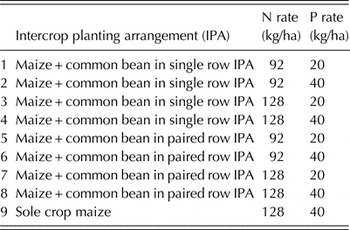
Treatments consisted of two IPA (single row of common bean between maize rows, and paired rows of common bean between paired rows of maize), two rates of N (92 and 128 kg/ha) and two rates of P (20 and 40 kg/ha), applied on maize rows only, which were arranged in factorial combination. No fertilizer was applied to common bean. Sole crop maize with recommended fertilizer of 128/40 kg N/P/ha at a spacing of 0·75 × 0·30 m was used as a control treatment. Therefore, there were a total of nine treatments (Table 1).
Treatment combinations for the maize–common bean intercropping experiment

N, nitrogen; P, phosphorus.
Treatments were laid out in a randomized complete block design with three replications. Sole crop common bean fertilized with the recommended rate of 41/20 kg N/P/ha at spacing of 0·4 × 0·1 m was included to calculate the land equivalent ratio (LER), resulting in a total of 2 × 30 plots. Both maize and common bean were planted on the same date, between 18 and 25 June according to the farmers’ planting dates, and crops were harvested between 27 September and 5 October for common bean and 25 November and 10 December for maize. For the intercrop treatments, an additive intercrop series was used with 100% of maize relative to its SC stand and 40% of common bean relative to its SC stand (Woomer et al. Reference Woomer, Lan'gat and Tungani2004). The plots were 6·0 × 3·0 m. Maize row spacing was 0·75 m with single row IPA, and 0·50 and 1·125 m for within and between paired rows, respectively, with paired row IPA. The common bean rows were 0·375 m away from maize rows. Intra-row spacing was 0·3 and 0·1 m for maize and common bean, respectively (Fig. 1).
Experimental field layout for intercrop planting arrangement in comparison to sole crop maize.

Experimental materials and procedures
The crop varieties were BH540 (average maturity period 145 days) for maize and Chore (average maturity period 95 days) for common bean. At planting, urea (46% N) and di-ammonium phosphate (DAP, 18% N, 20% P) were band-applied with one-third of N and all P under maize furrows of both SC and intercrop and mixed thoroughly with the soil (Tilahun et al. Reference Tadesse, Assefa, Liben and Tadesse2013). The remaining two-thirds N in the form of urea was side-dressed to the maize rows during GS 18–22 (eight leaves unfolded to main shoot and two tillers) (Zadoks et al. Reference Zadoks, Chang and Konzak1974). Similarly, 41 kg N and 20 kg P/ha were applied for SC common bean at planting. No fertilizer was applied to the intercropped common bean. Two seeds per hill for each crop species (8·8 seeds/m2 for sole and intercropped maize, 50 seeds/m2 for sole common bean and 20 seeds/m2 for intercropped common bean) were placed manually in the furrow, and thinned to one plant at 3 weeks after planting. Weeds were controlled by hand hoeing and hand pulling as required.
Data collection and measurements
Maize grain yield was determined from whole plants (n = 24) in the middle four rows of 1·8 m length. Ten randomly sampled ears were used to determine kernels/ear. Thousand kernel weight (TKW) of maize was determined from randomly sampled grains. Maize plant height and above-ground biomass yield were determined at physiological maturity from ten randomly sampled maize plants out of the 24 plants. Biomass was weighed 3 weeks after sun drying with average air temperature of 28°C.
For the common bean component, grain yield was determined from whole plants (n = 54) in the middle three rows of 1·8 m length. Yield-related traits of common bean (pods and seeds/plant, above-ground biomass, plant height) were determined from ten randomly sampled plants out of the 54 plants. Grain moisture content was measured using a grain moisture tester (Dickey-John Multigrain, USA) and final grain yield was adjusted to 12·5% for maize and 10% for common bean.
Evaluation of system productivity
Intercrop productivity was determined in two ways; LER (Willey Reference Willey1979) and maize equivalent yield (MEY) (Verma & Modgal Reference Verma and Modgal1983). Land equivalent ratio is the amount of land required in sole cropping to obtain the same yield as in the intercrop. It is determined by:
 $$LER = (Y_{{\rm MB}} /Y_{\rm M} ) + (Y_{{\rm BM}} /Y_{\rm B} )$$
where Y MB is intercrop maize grain yield (t/ha), Y M is SC maize grain yield (t/ha), Y BM is intercrop common bean grain yield (t/ha) and Y B is SC common bean grain yield (t/ha). Maize equivalent yield is the sum of maize yield in the intercrop system and the converted common bean yield, and was compared with SC maize yield. Maize was the main crop, therefore, yield of the common bean in the intercrop system was converted to maize yield by multiplying the common bean yield with common bean/maize price ratio:
 $$MEY = Y_{{\rm MB}} + (Y_{{\rm BM}} \times P_{\rm B} /P_{\rm M} )$$
where P B is price of common bean grain/kg and P M is price of maize grain/kg.
Nitrogen use efficiency of maize
Nitrogen use efficiency as partial factor productivity (PFP) of applied N was calculated (Cassman et al. Reference Cassman, Dobermann and Walters2002):
 $$PFP_{\rm N} = Y_{\rm N} /F_{\rm N} $$
where PFP N is PFP of applied N (kg grain/kg N applied), Y N is crop yield (0% moisture) with applied N (kg/ha) and F N is amount of N applied (kg/ha).
Data analysis
Data analysis for intercrop experiments was conducted using the GLM (general linear model) procedure of SAS version 9.4 (SAS Institute 2013) for each site and year. Finally, the data were combined over sites and years since values for error mean square of the two sites were homogeneous (Gomez & Gomez Reference Gomez and Gomez1984). In the combined analysis, year was considered as a random variable and sites as fixed variable. Crop characteristics that showed significant differences (P < 0·05) were further tested using single degree of freedom orthogonal contrasts to determine the significance of each factor.
Partial budget analysis
Economics of the intercropping system was analyzed following a partial budget procedure (CIMMYT 1988) at three scenarios based on the existing trend in increasing cost of production. Three cost/price ratios for each N, P and labour cost as N cost/kg divided by maize grain price/kg of 6, 9 and 13; P cost/kg divided by maize grain price/kg of 11, 18 and 25; and labour cost/man-day divided by common bean grain price/kg of 5, 8 and 11 were assumed based on costs increased to 60 and 120% compared with the current situation. Fertilizer cost for DAP of US$ 0·69/kg and urea US$ 0·56/kg (US$ 1 is equivalent to 21·65 Ethiopian Birr), from 2013, were used as the basis for determination of P cost (US$ 2·36/kg) and N cost (US$ 1·22/kg). The labour cost during 2013 was US$ 1·85/man-day (US$ 51·73/ha). Labour costs included costs for planting, harvesting, threshing and cleaning grain required for the intercropped common bean. In addition, common bean seed cost (US$ 0·37/kg) as planting material was included as the variable cost. Mean price of the maize grain (US$ 0·21/kg) and common bean grain (US$ 0·37/kg) for the 3 months from December to February of the year 2013/14 were considered.
Cost/price ratios were calculated, keeping maize and common bean grain prices constant while cost of N increased to US$ 1·96 and 2·69/kg, that of P increased to US$ 3·77 and 5·18/kg, and cost of labour increased to US$ 2·96 and 4·06/man-day. The net returns were calculated by deducting the variable costs of N, P, labour and seed from the gross return. Marginal rate of return for each treatment was calculated by deducting the net return of the treatment from the SC maize and then dividing by the cost change of the treatment relative to cost of SC maize.
RESULTS
Weather conditions and soil physical and chemical properties of the experimental sites
The total rainfall was 1298, 1386 and 1098 mm during maize growing seasons at South Achefer (2012), Mecha (2012) and Mecha (2013), respectively (Fig. 2 a). The amount of rainfall during the growing seasons was about 75–85% of the total annual rainfall for the year, indicating that the sites have a mono-modal rainfall pattern. There was moisture deficit during GS70 to 89 (milk to dough development) of maize from October to mid-November 2012 at Mecha that adversely affected maize grain filling (Fig. 2 a), whereas during common bean growing seasons rainfall of 1141, 1336 and 1034 mm was received for the respective locations (Fig. 2 b). During the crop growing seasons, minimum temperatures ranged from 10 to 14°C at Mecha and 12 to 14°C at South Achefer, while the maximum temperatures ranged from 24 to 28°C at both sites (Fig. 2).
Temperature and rainfall distribution during the growing cycle of maize (a) and common bean (b) at South Achefer and Mecha experimental sites. Rainfall and temperature data for 2013 were not available at South Achefer. Minimum (min) and maximum (max) temperatures of the 2 years were very similar, so were averaged over years (2012 and 2013) at Mecha. The four categories of days after planting representing the four growth stages of maize and common bean; (a) 0–30 (germination and seedling growth; 00 – dry seed, 19–9 or more leaves unfolded), 31–96 (vegetative growth; 20 – main shoot only, 49 – tassel near to visible), 97–106 (flowering and fertilization; 50 – first tassel visible, 69 – anthesis complete), 107–145 (grain filling and maturity; 71 – caryopsis water ripe, 92 – caryopsis hard), and (b) 0–24 (emergence and early vegetative growth), 25–55 (branching and rapid vegetative growth), 56–65 (flowering and pod formation), 66–95 (pod fill and maturation).

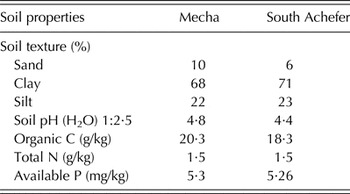
The soil analysis result indicated that the sites had clay texture with low values of pH and available P (Table 2). According to the ratings by Halm (Reference Halm1978), the soils for both sites had low available P (0–15 mg/kg). According to Tadesse et al. (Reference Tadesse, Haque and Aduayi1991), the soils are very strongly acid (<4·5) at South Achefer and strongly acid (4·5–5·2) at Mecha, organic C was moderate (15–30 g/kg), and total N content was high (1·2–2·5 g/kg) at both sites (Table 2).
Selected soil properties of the Mecha and South Achefer experimental sites at the time of planting*

N, nitrogen; P, phosphorus.
* Values for soil properties were mean of the two planting seasons (2012 and 2013).
Grain yield and yield-related traits
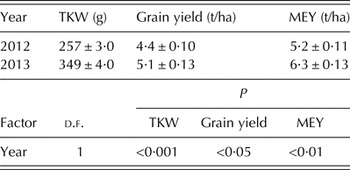
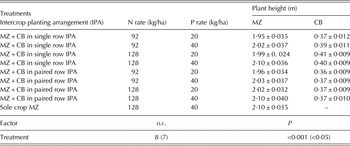
Year significantly affected maize TKW (P < 0·001) and grain yield (P < 0·05), with high values in 2013 compared with 2012 (Table 3). Treatment significantly affected plant height of maize (P < 0·001) and common bean (P < 0·05) (Table 4) but other yield-related traits were not affected. Single or paired row IPA with 128/40 kg N/P/ha and the SC significantly increased maize plant height compared with the other intercrop treatments, with the lowest being on single row IPA with 92/20 kg N/P/ha (Table 4). Yield-related traits of maize were highest on SC maize. Thousand kernel weight of maize ranged from 291 g in single row IPA with 92/20 to 318 g in SC maize. Values for maize biomass and kernels/ear ranged from 14·01 to 17·59 t/ha and 343 to 396 kernels/ear, respectively, with highest value for SC and lowest for single IPA with 92/40 kg N/P/ha applied.
Effect of year on maize thousand kernel weight (TKW), grain yield and maize equivalent yield (MEY) under maize–common bean intercropping in north-western Ethiopia

Values were means of two sites, three replications and nine treatments (±s.e., n = 54).
Plant height of maize (MZ) and common bean (CB) as affected by planting arrangement, applied nitrogen (N) and phosphorus (P) under MZ–CB intercropping in north-western Ethiopia

Values were means of two sites, 2 years and three replications (±s.e., n = 12).
Numbers in bracket in the degree of freedom and level of significance stands for the CB.
The highest plant height of common bean was recorded on single row IPA with 128/20 and 128/40 kg N/P/ha and the lowest on paired row IPA with 92/20 kg N/P/ha (Table 4). The contrast test indicated application of N fertilizer on maize affected plant height of common bean significantly (P < 0·05), increasing from 0·37 to 0·39 m in response to increased N application from 92 to 128 kg N/ha which was applied in maize rows. Relatively the highest biomass yield (1·23 t/ha), number of pods/plant (ten) and number of seeds/plant (55) of common bean occurred with single row IPA with 128/20 kg N/P/ha applied compared with other intercrop treatments.
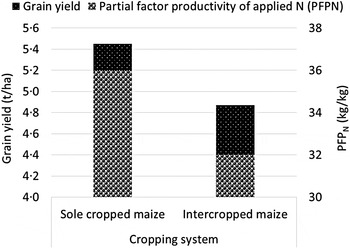
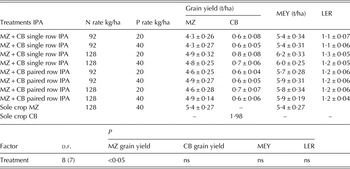
Averaged over sites and years, maize grain yield was significantly (P < 0·05) affected by treatments with highest grain yield for SC maize relative to most of the intercrop treatments, the lowest being on single row IPA with 92/20 and 92/40 kg N/P/ha (Table 5). Paired row IPA with 92/40 kg N/P/ha increased maize yield compared with single row IPA with 92/40 kg N/P/ha (Table 5). The contrast test indicated that intercropping reduced maize grain yield significantly (P < 0·05), by 11% compared with SC at the 128/40 N/P rates (Fig. 3). Similar to yield-related traits, the highest grain yield of common bean was also obtained from single row IPA with 128/20 kg N/P/ha applied (Table 5). Common bean was an additive crop in the intercrop system (40% SC), therefore, the intercrop common bean yield was lower by far and not comparable to its SC yield.
Effect of cropping system on maize grain yield and partial factor productivity of applied N (PFPN) under maize–common bean intercropping in north-western Ethiopia. Data were combined over sites (South Achefer and Mecha) and years (2012 and 2013).

Effect of intercrop planting arrangement (IPA), applied nitrogen (N) and phosphorus (P) on grain yield, land equivalent ratio (LER) and maize equivalent yield (MEY) under maize (MZ)–common bean (CB) intercrop in north-western Ethiopia

ns, not significant.
Values were means of two sites, 2 years and three replications (±s.e., n = 12).
Number in bracket in the degree of freedom stands for the CB.
Maize–common bean intercrop productivity
Land equivalent ratio was more than unity in all intercrop treatments that ranged from 1·1 to 1·3 (Table 5). The highest LER was recorded for the single row IPA with 128/20 kg N/P/ha. Although there was yield reduction of component crops relative to their respective SC, maize–common bean intercropping was 20% more productive as measured from LER in the 128/40 kg N/P/ha treatment applied. Maize equivalent yield was significantly (P < 0·01) affected by year, and higher in 2013 compared with 2012 due to higher yield of maize in 2013. Maize equivalent yields were highest for most of the intercrop treatments relative to SC maize. The highest MEY was achieved for the intercrop treatment of single row IPA with 128/20 kg N/P/ha that corresponds with higher value of LER (Table 5).
Maize N use efficiency
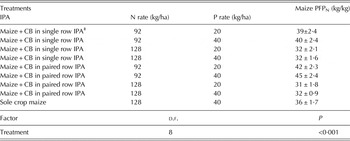
Maize PFPN was significantly (P < 0·001) affected by treatment (Table 6). Paired row IPA with 92/40 kg N/P/ha increased PFPN by 13% (+5 kg/kg) relative to single row IPA with 92/40 kg N/P/ha. Single row IPA with 92/20 kg N/P/ha increased PFPN by 22% (+7 kg/kg) relative to single row IPA with 128/20 kg N/P/ha; similarly single row IPA with 92/40 kg N/P/ha increased PFPN by 25% (+8 kg/kg) relative to single row IPA with 128/40 kg N/P/ha (Table 6). Maize PFPN of the intercrop maize was significantly (P < 0·05) lower than SC maize at 128/40 kg N/P/ha (Fig. 3).
Interactions effect of intercrop planting arrangement (IPA), nitrogen (N) and phosphorus (P) applied on maize partial factor productivity of applied N (PFPN) under maize–common bean (CB) intercropping in north-western Ethiopia

Values were means of two sites, 2 years and three replications (±s.e., n = 12).
Economic returns from maize–common bean intercrop
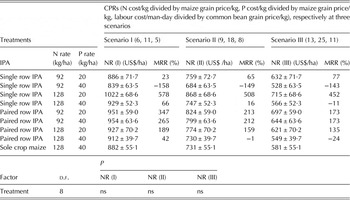
Intercropping of maize–common bean in single row IPA with 128/20 kg N/P/ha, paired row IPA with 92/20 kg N/P/ha, paired row IPA with 92/40 kg N/P/ha, and paired row IPA with 128/20 kg N/P/ha were most profitable with high net returns and marginal rate of returns relative to SC maize (Table 7). The financial advantage ranged from 5% (US$ 45·64 /ha) in paired row IPA with 128/20 kg N/P/ha to 16% (US$ 139·91 /ha) in single row IPA with 128/20 kg N/P/ha compared with SC maize at current cost price ratios N cost/kg divided by maize grain price/kg, P cost/kg divided by maize grain price/kg, and labour cost/man-days divided by common bean grain price/kg of 6, 11 and 5, respectively. Intercropping in single row IPA with 92/40 kg N/P/ha, single row IPA with 128/40 kg N/P/ha, and paired row IPA with 128/40 kg N/P/ha were not economically feasible as cost price ratio of N cost/kg divided by maize grain price/kg, P cost/kg divided by maize grain price/kg, and labour cost/man-days divided by common bean grain price/kg increased to 13, 25 and 11, respectively.
Net return (NR) and marginal rate of return (MRR) from maize–common bean intercropping as affected by planting arrangement, applied nitrogen (N) and phosphorus (P) in north-western Ethiopia

Values were means of two sites, 2 years and three replications (±s.e., n = 12).
CPRs, cost price ratios, including N cost to maize price, P cost to maize price, and labour cost to common bean price; IPA, intercrop planting arrangement; ns, not significant.
DISCUSSION
The lower maize TKW, and consequently lower grain yield and MEY during the 2012 growing season could be attributed to the moisture deficit experienced in grain filling to maturity stage from October to mid-November 2012 at Mecha, which adversely affected maize grain filling. The non-significant difference for most yield-related traits of maize in response to applied N and P might be due to competition from common bean for fertilizer applied to maize. The lowest plant height on single row IPA with 92/20 kg N/P/ha compared with SC maize and other intercrop treatments might be due to competition of the component crops for the limited N application. The competition between maize and common bean was probably high for N, especially at early GS since only one-third of N was applied to maize at time of planting and no fertilizer was applied to common bean, to encourage nodulation. Plant height increased by 0·14 m on single row IPA with 128/40 kg N/P/ha applied compared with the single row IPA with 92/20 kg N/P/ha.
The highest yield and yield-related traits of common bean in single row IPA integrated with 128/20 kg N/P/ha was most likely due to better benefit from the high N rate of single row IPA, probably because common bean would take up N from two adjacent maize rows, 0·375 m away, in contrast to paired rows where a common bean plant would take up N only from one maize row, 0·375 m away. Siame et al. (Reference Siame, Willey and Morse1997) reported the ability of common bean to take up fertilizer N applied to maize rows 0·6 m away. Siame et al. (Reference Siame, Willey and Morse1998) & Cardoso et al. (Reference Cardoso, Nogueira and Ferraz2007) reported that significant increases in yield of common bean in response to N applied to maize rows were due to inefficient N2 fixation of common bean. Other studies have shown that common bean did not respond to applied N when nodulation and fixation were good (Pineda et al. Reference Pineda, Kipe-Nolt and Rojas1994).
Averaged over sites and years, the lower intercrop maize yields compared with SC maize could be attributed to competition for nutrients, especially N, between the component crops. Lower intercrop maize yield in comparison to SC maize yield were also reported for maize–common bean intercrops (Siame et al. Reference Siame, Willey and Morse1998; Cardoso et al. Reference Cardoso, Nogueira and Ferraz2007). The results in maize grain yield when IPA integrated with N and P fertilizers indicated the importance of applying appropriate fertilizer rates in accordance to IPA. Yield increased by 14% on paired row IPA with 92/40 kg N/P/ha relative to single row IPA with 92/40 kg N/P/ha. The yield increase in paired row compared with single row IPA might be due to lower competition of common bean for N nutrients in paired than single rows. Mucheru-Muna et al. (Reference Mucheru-Muna, Pypers, Mugendi, Kung'u, Mugwe, Merckx and Vanlauwe2010) reported that paired row IPA, when combined with adjusted nutrient inputs, resulted in superior crop yield relative to the single row IPA in maize–common bean, maize–cowpea (Vigna unguiculata) and maize–groundnut (Arachis hypogaea) intercrops.
Land equivalent ratio was more than unity for all intercrop treatments, which indicates maize–common bean intercrop was productive. The highest productivity of the maize–common bean intercrop relative to SC maize has been verified for other parts of Ethiopia (Tolessa Reference Tolessa1994; Wortmann et al. Reference Wortmann, Schnier and Muriuki1996; Tana & Mulatu Reference Tana and Mulatu2000). Maize equivalent yield was highest for the intercrop treatments and a yield advantage of 14% (0·79 t/ha) was obtained from single row IPA with 128/20 kg N/P/ha relative to SC maize. The highest MEY for the intercrop treatments compared with SC maize was due to the additional common bean yield obtained from the intercrop treatments. The reduced intercropped maize yield compared with the SC maize was compensated by the additional yield of common bean in the intercrop system. This additional yield of common bean is of great benefit to farmers for improved nutrition, as a source of cash and for sustainability of the cropping system. The highest MEY in the intercrop treatments was consistent with Cardoso et al. (Reference Cardoso, Nogueira and Ferraz2007), who found reduced intercrop maize yield but higher MEY relative to SC maize in maize–common bean intercrop system.
On the same nutrient rate, paired row IPA increased PFPN compared with single row IPA which might be due to less competition for nutrients between the component crops in paired row IPA than single row IPA. Woomer et al. (Reference Woomer, Lan'gat and Tungani2004) also reported reduced below-ground competition among component crops in paired compared with single arrangements. The higher N use efficiency in paired row IPA compared with single row IPA is in agreement with the findings of Woomer et al. (Reference Woomer, Lan'gat and Tungani2004), who reported 46% greater N use efficiency of maize in paired row IPA compared with single row IPA under maize–common bean intercropping. Maize PFPN was lower for the higher N rate compared with lower N rate, which might be due to greater N losses from higher N rate than the lower N rate. Decreases in N use efficiencies at higher rates were also reported by Wortmann et al. (Reference Wortmann, Tarkalson, Shapiro, Dobermann, Ferguson, Hergert and Walters2011) & Kaizzi et al. (Reference Kaizzi, Byalebeka, Semalulu, Alou, Zimwanguyizza, Nansamba, Musinguzi, Ebanyat, Hyuha and Wortmann2012). Maize PFPN was lowest on intercrop maize compared with SC maize at fertilizer rate of 128/40 kg N/P/ha, which might be due to common bean competition for N in the intercrop. In line with the result, Wortmann et al. (Reference Wortmann, Schnier and Muriuki1996) also reported that maize–common bean intercropping did not improve the efficiency of fertilizer use.
The highest financial advantage from the single row IPA with 128/20 kg N/P/ha was due to high productivity of the component crops. In agreement with the current results, Bogale et al. (Reference Bogale, Debele, Gebeyehu, Tana, Geleta, Workayehu, Nigussie, Tanner and Twumasi-Afriyie2002) reported that the application of 92/30 kg N/P/ha in single row IPA of maize–common bean intercropping was recommended. Siame et al. (Reference Siame, Willey and Morse1998) reported for any level of N used, the overall net returns were greater from maize–common bean intercropping than from sole maize and concluded that, whatever level of N used, the economics of sole maize are improved by adding a bean intercrop. Economic feasibility of maize–common bean intercrop system was also reported by Cardoso et al. (Reference Cardoso, Nogueira and Ferraz2007), in particular when common bean was inoculated with Rhizobium. Workayehu & Wortmann (Reference Workayehu and Wortmann2011) also reported the profitability of maize–common bean intercropping as compared with SC production.
CONCLUSIONS
Maize–common bean intercropping in single row IPA with 128/20 kg N/P/ha applied on maize rows was the most profitable relative to SC maize and other intercrop treatments with a financial advantage of 16% over SC maize. Therefore, farmers can benefit financially by practicing maize–common bean intercrop in maize-based cropping. The current study indicated high common bean demand for N in a maize–common bean intercrop system, and therefore the productivity of maize–common bean intercrop can be further maximized by optimizing N requirements of common bean to minimize below-ground intercrop competition and enhance complementarity with maize.
Financial assistance for the field research and laboratory work was provided by SIMLESA project (Sustainable Intensification of Maize-Legume Cropping Systems for Food Security in Eastern and Southern Africa). A Borlaug LEAP Fellowship sponsored travel to University of Nebraska-Lincoln, USA for data analysis and advisory support. The Amhara Agricultural Research Institute, specifically Adet Agricultural Research Center, facilitated the research.