Although research about couple violence refers generally to adult couples, many studies have confirmed its early existence in dating relationships, providing very variable data about the prevalence of the phenomenon, which ranges between 12% and 95%, depending on the type of violence analyzed and the sample studied (Archer, Reference Archer2000; Sears, Byers, & Price, Reference Sears, Byers and Price2007; Straus, Reference Straus2004). Chan, Straus, Brownridge, Tiwari, and Leung (Reference Chan, Straus, Brownridge, Tiwari and Leung2008) in a multinational study (15,927 university students from 21 countries) found that about 26% of students had been victimized and 30% of the international sample had physically assaulted a dating partner in the previous 12 months, although there were large differences between countries.
In general, research has outlined that psychological violence is more prevalent than physical violence. Whereas 81% may be displaying psychological violence, 12% may be displaying physical violence (Foshee & Matthew, Reference Foshee and Matthew2007). While psychological violence should be the predominant focus of attention in this field, physical violence is the most frequent target of research as it is easier to assess. We consider it necessary to use alternative instruments to the Modified Conflict Tactic Scale (m-CTS; Neidig, Reference Neidig1986) in which behaviors of psychological maltreatment -considered more difficult to assess due to its greater complexity- hardly appear (Jackson, Reference Jackson1999).
With regard to gender differences, both sexes perpetrate and sustain aggressions in dating relationships: one topic that has caused controversy. On one side of the debate, researchers have argued that violence in these relations is bidirectional (Gonzalez & Santana, Reference González and Santana2001; O’Leary & Slep, Reference O’Leary and Slep2003; Straus, Reference Straus2004), with contradictory data about who exerts a type of violence more frequently (for a review, see Shorey, Cornelius, & Bell, Reference Shorey, Cornelius and Bell2008). On one hand, some studies have found that women exert more mild physical violence and more psychological violence than men. Also, women report experiencing higher rates of sexual violence in dating relationships (Chan, Reference Chan2012; Foshee & Mathew, Reference Foshee and Matthew2007; Hokoda, Martin del Campo, & Ulloa, Reference Hokoda, Martín del Campo and Ulloa2012; O'Leary, Slep, Avery-Leaf, & Cascardi, Reference O’Leary, Slep, Avery-Leaf and Cascardi2008). On the other hand, other studies show opposite results, as for females experiencing more severe forms of physical and sexual violence (Champion, Wagoner, Song, Brown, & Wolfson, Reference Champion, Wagoner, Song, Brown and Wolfson2008; Marquart, Nannini, Edwards, Stanley, & Wayman, Reference Marquart, Nannini, Edwards, Stanley and Wayman2007; Wolitzky-Taylor et al., Reference Wolitzky-Taylor, Ruggiero, Danielson, Resnick, Hanson, Smith and Kilpatrick2008), including emotional and economic abuse (Rey-Anacona, Mateus-Cubides, & Bayona-Arévalo, Reference Rey-Anacona, Mateus-Cubides and Bayona-Arévalo2010), or finding no gender related differences (Antônio & Hokoda, Reference Antônio and Hokoda2009; Katz, Kuffel, & Coblentz, Reference Katz, Kuffel and Coblentz2002). Moreover, there has been found that the results of dating violence studies depend on the operationalization of the concept “teen dating violence”. Therefore, depending on the definition of “teen dating violence” rates for female and male may vary to a great extent (Hamby & Turner, Reference Hamby and Turner2012). Also, they tend to show higher rates of victimization among women. One explanation for this discrepancy in the literature is that studies vary greatly in the methodology, in the conceptualization of abuse and in the instruments used to assess it, a fact that ought to make researchers reflect.
Adding to this discussion, Johnson (Reference Johnson1995) has pointed out the difference between violence perpetrated by men to women (“patriarchal terrorism” or gender violence) and the “common couple violence” that can be bidirectional or unidirectional. The first type of violence differs from the other kinds as it represents a pattern of control and subjugation of women by virtue of being women (Johnson & Leone, Reference Johnson and Leone2005). Both of Johnson’s types of violence can coexist in any setting. However, few studies have understood this issue and taken it into account. As such, most research in this arena has reduced understanding to the mere distinction between unidirectional or bidirectional violence. O'Leary et al. (Reference O’Leary, Slep, Avery-Leaf and Cascardi2008) found that approximately 94% of males and females reported that psychological aggression was mutual and that approximately 65% of physically aggression was also mutual. Straus (Reference Straus2008) reported that bidirectional violence rates varied between 48% and 60%. Moreover, a significant proportion of studies have been carried out taking into account only the presence - and not always the frequency - of the violent acts, therefore ignoring critical aspects such as the context, motivation or consequences of victimization. Therefore, we should know what exactly it is being measured when male and female experiences of violence in dating relationships are compared (Sebastián et al., Reference Sebastián, Ortiz, Gil, Gutiérrez, Hernáiz and Hernández2010).
Another field of interest concerns representativeness of violent behaviors assessed by an instrument or test, as test results can be biased, potentially over-representing a particular type of violence. Such is the case of many instruments which only assess physical assaults, omitting important psychological aspects such as control, isolation, devaluation, blame, dominant behaviors, threats, intimidation, emotional blackmail or jealousy. Representativeness may also be compromised by using instruments with few items (e.g. Haynie et al., Reference Haynie, Farhat, Brooks-Russell, Wang, Barbieri and Iannotti2013). Finally, it is essential to mention that when consequences of violence are examined, gender related differences are shown as the impact is more detrimental for women than for men in terms of both physical and psychological harm (Follingstad, Wright, & Lloyd, Reference Follingstad, Wright and Lloyd1991; Haynie et al., Reference Haynie, Farhat, Brooks-Russell, Wang, Barbieri and Iannotti2013, Jackson, Reference Jackson1999).
Furthermore, we argue that it is important for research to identify participants' perceptions of their partner's violence. For instance, behaviors classified as violent (shoving, insulting, slapping...) may not be perceived as such by young adults, but instead may be attributed to their partner's personality or momentary stress, especially in the case of psychological violence (González-Ortega, Echeburúa, & Corral, Reference González-Ortega, Echeburúa and Corral2008; Samaniego & Freixas, Reference Samaniego and Freixas2010). Violent behaviors may be even justified in certain conditions (for example, a girl slaps her boyfriend because of a comment made) (Sears et al., Reference Sears, Byers and Price2007; Straus, Reference Straus2004), rendering frequency rates lower than they actually are. There is some tolerance towards violence in young couples that may make it difficult to understand and identify it as maltreatment - both for the victim and for the perpetrator and even for their social milieu.
In Spain, many studies have reported similar results about the prevalence of dating violence. A macro-level survey carried out by the Ministry of Health, Social Services and Equality in 2010 with a sample of 11,020 students, concluded that 13.1% of the males reported having perpetrated maltreatment, while 9.2% of the females reported having sustained dating violence (Diaz-Aguado & Carvajal, Reference Diaz-Aguado and Carvajal2011). Both perpetrators and victims reported that the most frequent behaviors were attempting to control one’s partner and isolating one’s partner from his or her friends.
Rodríguez-Franco et al. (Reference Rodríguez-Franco, López-Cepero, Rodríguez-Díaz, Bringas, Estrada, Antuña and Quevedo-Blasco2012) with a sample of 709 females aged between 16 and 21 years, found that 71% had suffered technical maltreatment, that is, they had suffered some kind of violence which they did not consider or identify as maltreatment. Furthermore, studies with Spanish samples have concluded that 22.1% of university students have physically assaulted their partners (Corral & Calvete, Reference Corral and Calvete2006) and that more than 7% of teenagers of both sexes have hit or shoved their partners at least once (González & Santana, Reference González and Santana2001).
Muñoz-Rivas, Graña, O’Leary, and González (2007a) studied 1,886 university students and found that 29.5% of men and 32.3% of women had sustained some form of physical aggression in the last year. In another study (n = 2416) these authors found sex related differences. Whereas severe violence was exerted mainly by men, moderate violence was more habitually displayed by women. Moreover, more than 90% of their sample reported verbal aggression, with 95.3% of girls displaying this, compared to 92.8% of boys (Muñoz-Rivas, Graña, O’Leary, & Gonzalez, Reference Muñoz-Rivas, Graña, O’Leary and González2007b). Similar results were obtained by Fernández-Fuertes et al. (Reference Fernández-Fuertes, Orgaz and Fuertes2011) who reported that 95% of their sample admitted having perpetrated or sustained verbal aggressions in dating relationships.
With regard to sexual aggression, Ortega, Ortega, & Sánchez (Reference Ortega, Ortega and Sánchez2008) provided evidence suggesting that 48% of their sample displayed it, while 66.5% sustained sexual violence. Muñoz-Rivas, Graña, O’Leary, and González (Reference Muñoz-Rivas, Graña, O’Leary and González2009) found that 35.7% of the boys sample and 14.9% of the girls sample displayed some form of sexual violence; whereas, the rates for victimization were 21.1% for males and 25.1% for females. Graña, Rodríguez, and Peña (Reference Graña, Rodríguez and Peña2009) found also that gender influenced both the interception and slope of sexual violence perpetration and victimization, where males reported higher rates of perpetration (22.1% versus 12%) and where girls reported higher rates of victimization (14.3% versus 18, 2%). Most of the studies that analyze gender differences show that boys exert higher rates of sexual violence perpetration than girls (Foshee, Reference Foshee1996, Hokoda et al., Reference Hokoda, Martín del Campo and Ulloa2012; O´Keefe, Reference O´Keefe1997; Wekerle & Wolfe, Reference Wekerle and Wolfe1999). However, other studies show the opposite situation. Chan et al. (Reference Chan, Straus, Brownridge, Tiwari and Leung2008) conducted a multinational study that showed practically no difference between boys and girls in sustaining sexual violence; although boys from all countries showed higher frequency rates of perpetration than girls. The median rates for perpetrating sexual coercion was 20% and for sustaining sexual coercion 24%.
Studies addressing jealous behavior in the dating violence arena are infrequent and are not always based on real life behaviors (e.g. Hansen, Reference Hansen1985). The results on jealousy are varied and contradictory. Some studies have found no difference between boys and girls on perpetration nor on victimization (Hokoda et al., Reference Hokoda, Martín del Campo and Ulloa2012); while other researchers have found that girls are less jealous than boys (Kasian & Painter, Reference Kasian and Painter1992), or the opposite: that women show higher rates of jealous behaviors perpetration and not victimization behaviors (Gonzalez, Munoz-Rivas, Peña, Gámez, & Fernández, Reference González, Muñoz-Rivas, Peña, Gámez and Fernández2007). In another study of the aforementioned authors, girls reported “Being jealous of another boy /girl” to a greater extent than boys (72.3% versus 63.7% respectively), and they also reported higher rates when asked if their partner had been jealous of another boy/girl. However, boys on this sample report higher rates than girls when asked if their partner had accused them of maintaining other parallel relationships (Muñoz-Rivas et al., 2007a), which may show a pattern of mutual accusations.
Few studies have been carried out taking into account the age of couples. The few studies that have analyzed this variable conclude that the prevalence of dating violence increases with age (Hokoda et al., Reference Hokoda, Martín del Campo and Ulloa2012; Wolitzky-Taylor et al., Reference Wolitzky-Taylor, Ruggiero, Danielson, Resnick, Hanson, Smith and Kilpatrick2008).
Based on the above findings, the goals of the current research are to (a) analyze the prevalence of dating violence among Spanish youth and how frequently various types of violent acts occur and (b) analyze gender differences in violent behaviors. The present research compares results to those of previous studies. Novel aspects of this study are: (a) the use of the mean difference to study the frequency of the behaviors and not only their presence (the vast majority of research uses the dichotomy presence/absence of a behavior to analyze rates of dating violence, which we understand can bias the results. This research therefore makes use of quantitative indicators and not only categorical ones), (b) the use of the contingency coefficient, which indicates the strength of the relation, (c) the study of age as a mediator in the patterns of violence, (d) the inclusion of jealously in the analysis in order to obtain a more in-depth approach, and (e) the chi-square test recoded three responses as presence (sometimes, often, and very often) or absence of the violent behavior, in contrast to other studies that included very seldom in the category, thereby increasing the prevalence). We understand the importance of a behavior that has been done only once or very infrequently to be different from behaviors that are performed frequently (including low frequency). Moreover, some behaviors may occur in a given context, enabled by circumstances, and not related to a general personality trait. Taking this into consideration we hypothesized that our results will not be increased indiscriminately.
Method
Participants
Participants in this study included 579 students from five public high schools in a region of Madrid: 319 girls and 260 boys. The criteria we used was: a) participants should have or have had at least one dating relationship, b) participants should range in age from 12 to 22.
Parental consent was obtained for the child’s participation by signing a consent form from either the AMPA (parents’ association) or by the Head of Studies. Most parents provided written consent. All were informed that the questionnaire was entirely anonymous. In some cases, mainly with teens under 14, the head of studies sent this information via post, so every parent would be informed and could decide whether to consent to their child’s participation in the study. Throughout the study, younger teens had the opportunity to ask their tutors questions or talk to them about the subject. Participation in the investigation was voluntary and anonymous.
The sample was distributed as follows: 418 participants were enrolled in Compulsory Secondary Education, 101 were in “Bachillerato” (last two years of high school, which are not mandatory), and 60 were enrolled in Intermediate or Higher Professional Training. The average age was 16.11 years (SD = 1.92). No significant differences were found between the age at which boys and girls had their first dating relationship with an average age of 12 years (SD = 2.23), nor in the number of relationships, with an average number range between 1 and 3 partners. Most participants declared they were heterosexual (94.1%).
In regards to the general characteristics of the relationships assessed on this research, 45.3% of the participants at that time were involved in a dating relationship. As for the type of relationship, 45.3% described their current relationship as stable, and 51.6% of the sample expected to continue their relationship into the future. The average length of the participants in a current relationship was 9.62 months.
Instruments and variables
A demographic questionnaire was elaborated by the research team, and it collected descriptive aspects of the sample (such as age, sex, nationality, etc.), as well as data about their relationships.
Dating violence was assessed using the Modified-Conflict Tactics Scale (m-CTS) (Neidig, Reference Neidig1986) in a 18-item self-report measuring system that assesses the way conflicts in the couple are resolved and, which specifically measures physical and verbal aggression. It has 18 bidirectional items for aggressor and victim, with a Likert-type response format ranging from 1 (never) to 5 (very often). Alpha coefficient ranges from .31 to .81 for the subscales in a Spanish population of youths (Muñoz-Rivas, Andreu, Graña, O´Leary and Gonzalez, Reference Muñoz-Rivas, Graña, O’Leary and González2007) For our sample these reliability indexes were found: .83 and .79 for physical violence perpetration and victimization –respectively - as well as .69 and .72 for verbal violence, respectively.
Psychological violence was assessed by the Dominating and Jealous Tactics Scale (Kasian & Painter, Reference Kasian and Painter1992). This scaled was employed to inform about the tactics used to establish control in dating relationships. The scale has 11 items with a Likert-type response format ranging from 1 (never) to 5 (very often) structured in two subscales: Dominant Tactics and Jealous Behavior, which are responses from the role of both the aggressor and victim. Cronbach´s Alpha coefficient for Dominating Tactics Scale was .72 and .76 for the Jealous Tactics Scale (Cano, Avery-Leaf, Cascardi, & O’Leary, Reference Cano, Avery-Leaf, Cascardi and O’Leary1998). In our findings, the coefficients obtained had been .71 for the Dominating Tactic Scale for perpetrators and .65 for victims and for the Jealous Tactics Scale .77 and .84, respectively, on the same wavelenght as the mentioned previous research
Sexual violence was assessed using the Appraisal of Sexual Aggression in Adolescents and Young Adults Scale (Muñoz-Rivas et al., Reference Muñoz-Rivas, Graña, O’Leary and González2009). This is a 5-item scale with a Likert-type response format ranging from 1 (never) to 5 (very often), which measures the frequency with which adolescents are subjected to and expose their partner to pressure or physical force to engage in unconsented sexual relations. Alpha coefficient ranges from .68 to .73. In our research, .71 was found for perpetrators and .81 for victims.
The variables analyzed in this investigation were defined as follows:
-
- Physical Violence: behaviors in which one uses their own body to inflict harm on another person. It has been defined globally as the sum of two subscales: mild violence and severe violence.
-
- Mild physical violence is defined as grabbing, slapping, shoving, or throwing an object.
-
- Severe physical violence has been defined is considered as beating up, threatening with a knife or weapon, trying to choke one's partner.
-
- Psychological Violence: Global definitions of Psychological Violence are considered as the combination and sum of three subscales: verbal violence, dominant behavior, and jealous behavior.
-
- Verbal violence: includes swearing, insults, threats, periods of aggressive silence and every other psychological opportunity to hurt one’s partner that does not include use of physical abuse/violence.
-
- Dominant behavior: refers to the behaviors used to control one’s partner.
-
- Jealous behavior: the use of tactics that involve the desire to possess and control one’s partner.
-
- Sexual Aggression: behaviors by means of which one attempts to force their partner to engage in undesired sexual relations by verbal insistence, physical threats, or threatening to break up the relationship.
Results
Data is presented concurrently and separated by sex in order to understand how the patterns of violence in dating relationships could differentially affect boys and girls and to study the global prevalence of the phenomenon. Frequency data about perpetration and victimization is also presented.
Mild and Severe Physical Violence
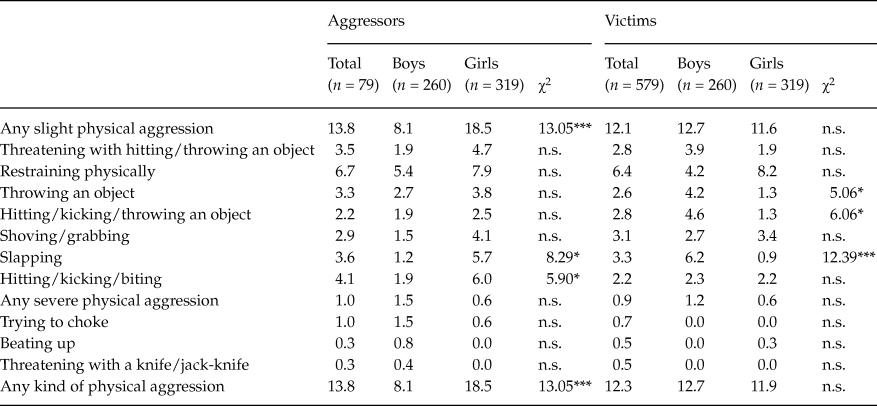
Concerning frequency data, descriptive analysis and differences between means among the study variables are reported. Table 1 shows that 13.8% of the participants admitted having exerted violence, whereas 12.3% reported having sustained it. The most frequently performed (6.7%) and sustained (6.4%) violent behavior involving mild physical violence is trying to grab the partner and, with regard to severe physical violence, trying to choke the partner (1% and 0.09%, respectively).
Prevalence of physical aggression (%)

* p < .05; ***p < .001.
Gender related differences emerged. Girls reported having exerted greater mean levels of physical violence [18.5% of the girls versus 8.1% of the boys; χ2(1) = 13.057, p < .001, contingency coefficient = .149]. Significant main effects when analyzing sustained physical violence were not found. Therefore, approximately equal proportions of boys and girls sustained physical violence. However, these results refer mainly to mild physical violence as the prevalence of severe physical violence was very low and no significant sex differences were found in our study.
With regard to mild physical violence, 12.1% of the sample reported being victims and 13.8% perpetrators. Girls reported performing this type of behavior significantly more than boys [18.5% versus 8.1%, respectively; χ2(1) = 13.057, p < .001, contingency coefficient = .149], but no significant gender-related differences were obtained in victimization. The analysis of specific items showed that slapping (5.7%) or hitting, kicking, and biting (6%), are reported significantly higher among women aggressors, whereas throwing an object at the girl (4.2%), hit or throw some object (4.6%), and being slapped (6.2%) are reported as significantly higher among victim men.
Psychological Violence
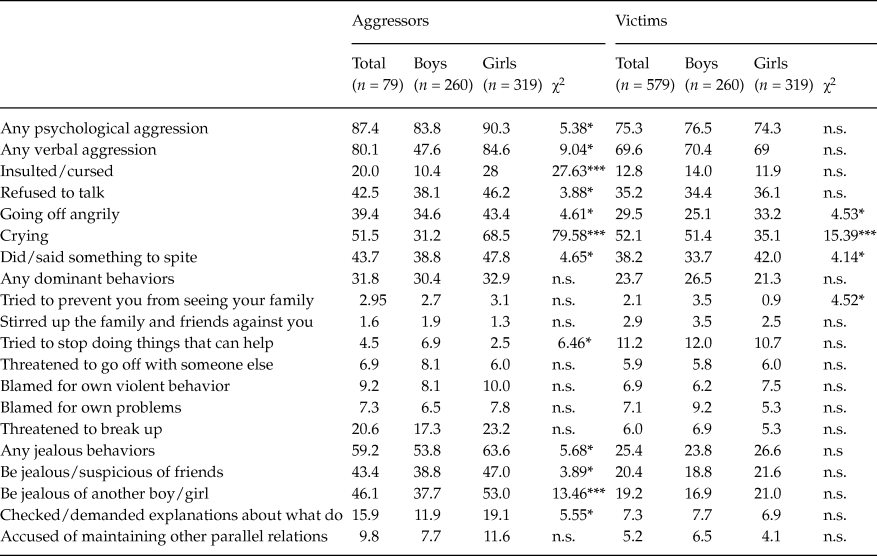
When examining rates of psychological violence, very high rates were obtained in our results: 87.4% reported having exerted it and 75.3% admitted having sustained it. Significant gender-related differences were found. Girls were much more likely to be psychologically violent than boys [90.3% versus 83.3% of the boys; χ2(1) = 5.385, p < .05, contingency coefficient = .096]. However, frequency data revealed that comparable numbers of boys and girls reported having sustained psychological violence. In other words, no significant sex-related differences were found in victimization (76.5% of the boys and 74.3% of the girls). Although, it is noteworthy to acknowledge that the rates obtained from sustaining psychological violence suggested greater rate levels comparing to other types of violence (see Table 2).
Prevalence of psychological aggression (%)

* p < .05; ***p < .001.
Verbal Violence
Verbal violence is the subtype of violence most frequently exerted (80.1%) and suffered (69.6%) by our sample. Significant gender-related differences emerged. Dating girls exerted greater levels of verbal violence than boys [84.6% versus 47.6%, respectively; χ2(1) = 9.043, p < .005, contingency coefficient = .124]. However, no significant differences were obtained in victimization.
Girls obtained higher percentages in perpetration in all test items concerning verbal violence. With regard to victimization, boys reported having suffered their partner's weeping (51.4%) to a greater extent, whereas partner's leaving the room in anger (33.2%) and saying or doing something to annoy them (42%) were behaviors sustained to a greater extent among girls by their partners.
Dominant Behavior
In comparison to the other two types of psychological violence, named as verbal violence and jealous behavior, dominant behaviors rates were found less frequent. 31.8% of the sample referred having carried out these behaviors and 23.7% reported having suffered them during their dating relationship. No significant gender-related differences were obtained neither in perpetration nor in victimization. The behavior most frequently carried out was threatening to leave the relationship (20.6%) and the behavior most frequently sustained was attempting to make their partners stop doing things that could help them (11.2%).
However, the analysis of specific behaviors concerning the scale items showed gender related differences. Such as, boys tried significantly more than girls to make their partners stop doing things that could help them (6.9%), but they also suffered because their partners would not let them see their family (3.5%) to a greater extent as girls.
Jealous Behavior
In the current sample, about 59.2% of the participants had been involved in a dating relationship in which they had exerted jealous behaviors. And 25.4% of the participants had sustained it from their dating partners. Significant gender-related differences were found in perpetration. Girls exerted jealous behaviors to a more extent than boys [63.6% of girls versus 53.8% of the boys; χ2(1) = 5.686, p < .05, contingency coefficient = .099]. However, no gender related differences were found in victimization.
The behavior most frequently perpetrated by the sample was being jealous of other girls/boys (46.1%) whereas the one most frequently sustained was being jealous and suspecting one's friends (20.4%) and being jealous of other girls/boys (19.2%).
When examining specific behaviors, significant gender related differences were found in these such items girls reported higher percentages: being jealous and suspecting one's girlfriends (38.8 versus 47%), being jealous of other girls (37.7 versus 53%) and checking out what the partner does and demanding explanations (11.9% versus 19.1%).
Sexual Violence
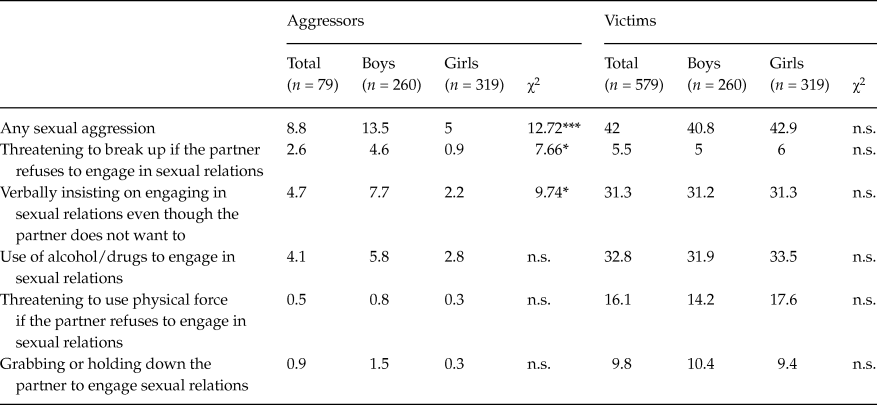
The results in this category ranged dramatically depending on whether perpetration (8.8%) or victimization (42%) was being reported. Girls and boys did differ significantly according to overall frequency (Table 3), obtaining perpetration rates of 13.5% for boys and 5% for girls. However, significant differences were obtained in the perpetration of sexual aggression, with boys reporting higher rates, χ2(1) = 12.721, p < .001, contingency coefficient = .147, but again, no differences was found in victimization where 40.8% of the boys and 42.9% of the girls reported having suffered it.
Prevalence of sexual aggression (%)

* p < .05; ***p < .001.
When analyzing specific behaviors significant gender-related differences were also found as boys obtained higher percentages of perpetration in specific behaviors as threatening to end the relationship if the partner did not engage in sexual relations with them (4.6%) and in verbal pressure to have sex despite the partner's refusal (7.7%).
Frequency of Violent Behaviors
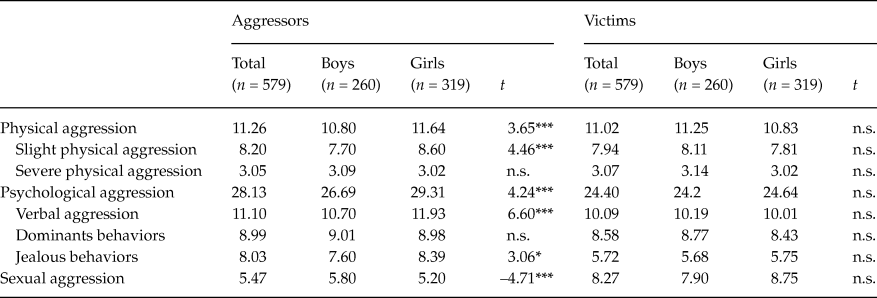
Using the chi-square and the t-test, we could verify that the data coincides when rating the presence/absence (chi-square) of a violent behavior or its frequency (t-test) in the relationship. In general terms, it is observed that the frequency of behaviors that involve perpetration of any type of violence is higher than the frequencies found in the current research relating to victimization. There is only one exception, which is sexual violence, where the frequency of occurrence is higher in victimization (with an average of 8.27) than in perpetration (with an average of 5.47). As it was the case with prevalence, behaviors considered as psychologically violent are the most frequent, both in perpetration acts (28.13) and in victimization (24.40).
Thus, as shown in Table 4, girls obtained higher means in perpetration of physical violence, t(572) = 3.651, p < .001, mild physical violence, t(564) = 4.466, p < .001, psychological violence, t(572) = 4.247, p < .001, verbal violence, t(574) = 6.608, p < .001, and jealous behavior, t(577) = 3.061, p < .05. While boys reported having perpetrated higher means of sexual violence behaviors and aggressions than girls t(391) = –4.716, p < .001. No significant gender-related differences were found in any form of violence when victimization was analyzed.
Mean of kind violence

* p < .05; ***p < .001.
Prevalence of Violent Behaviors as a Function of Age
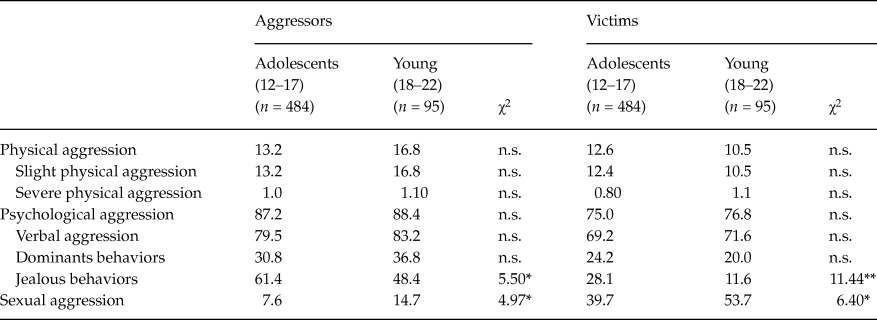
In general, when differentiating age groups of adolescents (from 12 to 17 years) (n = 484) and young adults (18 to 22 years) (n = 95), the results followed the same tendency as the preceding analyzed data: psychological violence (and, specifically, verbal violence) obtains higher percentages both in perpetration and in victimization (see Table 5).
Prevalence of dating violence by age (%)

* p < .05; **p < .01.
Our findings revealed interesting aspects about how adolescents and young adults may resolve couple conflicts. Whereas no significant differences were found in physical violence (mild and severe) or psychological violence (verbal violence and dominant behavior), significant differences were observed within jealous behavior of young adults compared to adolescents, both in perpetration [48.4% versus 61.4% of the adolescents, respectively; χ2(1) = 5.509, p < .05] and in victimization [11.6% versus 28.1% of the adolescents, respectively; χ2(1) = 11.441, p < .01]. In contrast, the group of young adults reported having perpetrated greater means levels of sexual violent behaviors compared to the younger adolescents [14.7% versus 7.6%, respectively; χ2(1) = 4.973, p < .05]. Furthermore, young adults reported to have suffered greater mean levels of sexual violence in comparison to adolescents [53.7% versus 39.7%, respectively; χ2(1) = 6.404, p < .05].
Discussion
The goal of the current research was to analyze the presence of violence in the dating relationships of adolescents and young adults in a Spanish sample. Our findings support a high prevalence of psychological violence (particularly verbal violence) as the violent behavior is the most frequently performed (87.4%) and sustained (75.3%), followed by jealous behavior, which is carried out by 59.2% of the sample and suffered by 25.4%. The results also demonstrate a high prevalence of sexual violence with 42% of the sample having sustained sexual violence. The high prevalence of these kind of violent behaviors, along with the rates found on mild physical violence (about 13%), reveal the urgent need to understand why and how adolescents and young adults (particularly women) are building relationships and may be solving conflicts by the use of violence. Perhaps the fact that these behaviors are not identified as maltreatment or violent themselves may be part of the explanation. As indicated by various authors and previous research (Ferrer, Bosch, Navarro, & Ferreiro, Reference Ferrer, Bosch, Navarro and Ferreiro2010), young adults and adolescents consider many of these violent behaviors to be a sign of true love, so their presence may be acceptable and even desirable.
Compared to other studies, our data of physical violence (perpetration and victimization) is lower than that provided by Jouriles, Garrido, Rosenfield, and McDonald (Reference Jouriles, Garrido, Rosenfield and McDonald2009) and Chan et al. (Reference Chan, Straus, Brownridge, Tiwari and Leung2008) in the International Dating Violence Study. It is possible that the inclusion of minors between 12 and 13 years of age in our study may have reduced rates (Wolitzky-Taylor et al., Reference Wolitzky-Taylor, Ruggiero, Danielson, Resnick, Hanson, Smith and Kilpatrick2008). There are also other findings suggesting lower rates, similar to the ones we found in the current research (Hayne et al., Reference Haynie, Farhat, Brooks-Russell, Wang, Barbieri and Iannotti2013). With respect to psychological violence, it is noteworthy that our findings suggest higher rates than previous research (Chan, Reference Chan2012; Rivera-Rivera, Allen-Leigh, Rodriguez-Ortega, Chavez-Ayala, & Lazcano-Ponce, Reference Rivera-Rivera, Allen-Leigh, Rodríguez-Ortega, Chávez-Ayala and Lazcano-Ponce2007; Sabina & Strauss, Reference Sabina and Strauss2008).
Another finding of our research was a large difference in the percentages between the teenagers and young adults that reported having sustained sexual violence and those who reported having perpetrated it (8.8 and 42%, respectively). It is indeed difficult to find similar results regarding low rates in perpetration and high rates in victimization. Data concerning this issue tends to be more balanced in other research (e.g. Chan, Reference Chan2012; Sabine & Strauss, Reference Sabina and Strauss2008). However, the cross-cultural study carried by Chan et al. (Reference Chan, Straus, Brownridge, Tiwari and Leung2008) which was conducted in 21 countries, also showed large differences (as significant as ours) between perpetration and sexual victimization among males and females.
Taking into consideration all of the above findings, especially the high prevalence found in dating violence, it is imperative to analyze the type of relationships teenagers and young adults are building, as we consider the rates found in the current study to be alarming. We have found a high presence of intimidating, dominant, controlling and scorned behaviors and attitudes that are expressed, probably with little awareness on part of most of the agents which has, as we see it, possible future implications.
With regard to gender-related differences between boys and girls, we found that girls perpetrate more mild physical violence, verbal violence and jealous behavior (the latter two included under psychological violence) than boys; while boys perpetrated more sexual violence than girls. This pattern of gender asymmetry may be comparable to those revealed by previous research (Chan Reference Chan2012; Hokoda et al., Reference Hokoda, Martín del Campo and Ulloa2012; Straus, Reference Straus2004). Our data found about perpetration, but not about victimization, which coincides with those of other Spanish authors (Muñoz et al., 2007a; 2007b, 2009). Our results reveal that there were significant gender differences in dating violence perpetration, whereas there were no significant gender differences found on victimization. That is, that boys and girls receive dating violence in equal proportion. Another finding of our study that ought to be noted, is the one concerning strengths of the relationships. The contingency coefficients obtained, that reflect the relationship between variables, such as violence and sex, show a weak strength, since the values ranged from .0–.1, which indicates a weak relationship, but significant. Finally, compared to the multicultural study carried out by Chan et al. (Reference Chan, Straus, Brownridge, Tiwari and Leung2008) our findings on sexual violence, disaggregated by sex, are similar to those of the Netherlands on perpetration and similar to those of Germany regarding victimization.
There may be various explanations of these global results and many questions arise: Are girls/women more violent than boys/men? Are girls more sincere in their responses? Do girls imitate masculine stereotyped behaviors? In this sense, authors have argued that girls may accept and copy the dominant and violent masculine model due to the lack of feminine models of success and recognition (Rubio, Reference Rubio2009). Violence may also involve some actions aimed to regain power, especially for women (Sears et al., Reference Sears, Byers and Price2007). Moreover, according to Pittman, Wolfe, and Wekerle (Reference Pittman, Wolfe and Wekerle2000), real abusive behavior must be differentiated from behaviors that are an expression of the main characteristics of adolescence, which should be analyzed both from boys and girls. In order to answer these questions, extended study is required, taking into consideration any developmental, contextual, motivational and personality variables involved. Other authors have argued that men tend to undervalue their own aggression, while women tend to overrate it (Dobash & Dobash, Reference Dobash and Dobash2004; Jackson, Reference Jackson1999).
According to the data found on the current study, it is necessary to reflect on three findings, although it should be noted that the sample does not consist of both partners, and therefore variations on perpetration and victimization were expected: a) the percentages found on victimization are lower than those on perpetration in all cases, except for sexual violence b) no significant gender differences were found on victimization c) the difference between rates of perpetration and victimization is higher on sexual violence and jealous behavior.
With respect to the first and second findings, we wonder whether it is easier to identify oneself as a perpetrator than as the victim, especially when violent behaviors are commonly accepted within the context of teenagers, and therefore, is easily assumed. If the fact that carrying out certain violent behaviors may not be perceived by peers as negative or violent (and therefore these behaviors may not be socially sanctioned), the adolescent may display and report violent behaviors on a questionnaire as a relatively common behavior. Therefore, violence may occur in dating relationships without an awareness of its violent meaning, as young people and teens only seem to name and perceive a relationship as violent when it involves severe physical aggression (which seldom occurs in dating violence). Moreover, victims of dating violence could not give it importance, which is reflected in lower frequency results. We could also contemplate the fact that, while it seems more desirable and socially acceptable to be a victim, in the dating teen arena, however this may not be the case. In addition, teens may be trying to obtain an image of power and aggression which makes us wonder: Are these the prevailing values of our youth? In this sense, Valls, Puigvert, and Duke (Reference Valls, Puigvert and Duque2008) found that some adolescents link attractiveness with violence and concluded that socialization processes within teenagers promotes this association. In relation to the third finding, our study suggests that there is a large difference between percentages of sexual violence perpetration (8.8%) and victimization (42%). Although it should not be forgotten that the asymmetry in some data may also be due to the fact that the sample was not composed by couples (Fernández-Fuertes et al., Reference Fernández-Fuertes, Orgaz and Fuertes2011), nonetheless, we find the difference remarkable. These results could be revealing a lack of awareness and/or sincerity in those who perpetrate sexual violence due to its negative social connotation. Another possible explanation, even in the case of jealous behavior (where our data shows 59.2% perpetration and 25.4% victimization) may be the characteristics of the sample. The fact that we found no sex differences in sexual violence victimization is consistent with other Spanish research (Ortega et al., Reference Ortega, Ortega and Sánchez2008), but not with others that conclude women are more victimized (Muñoz-Rivas et al., 2009).
The data obtained in the current investigation takes into account the presence/absence of violent behaviors as well as their frequency. As both methods have established the same conclusions, we can trust either of them to analyze our objectives, although this is a conclusion that refers only to our study.
Lastly, with regards to age, the fact that adolescents’ use of violence focus more on the use of jealousy, and young adults more on aspects related to sexuality is a novelty in this research, which warrants further study in the future.
According to our data, physical violence is present in approximately 13% of the teen and young adult dating relationships, which is not extremely alarming compared to other studies that report higher frequencies. Therefore, we consider that future investigators ought to use instruments that can assess this issue in a more reliable way, noting that instruments that focus almost exclusively on physical violence do not help to do this. On the basis of our work, we have reflected on the fact that the way in which a variable is measured and the content of the scales affect the results obtained decisively. Thus, psychological violence is more than just verbal violence; it includes aspects such as control, intimidation, domination, culpability, emotional blackmail and isolation, etc. These aspects are not included in most of the scales, and should therefore be appropriately measured and included in future research.
In the literature on dating violence, it is not easy to compare results due to methodological issues such as the objectives of the research, sample size, sample type, instruments used, types of violence examined, data collection method employed and the operational definitions of dating violence examined and defined (mild/severe violence, etc.), so the conclusions drawn about sex differences on dating violence are difficult to reach. In addition, research does not always take into account all the variables needed to analyze this issue in depth. That is, the context in which these behaviors are performed, the motives and reasons why teen dating violence occurs or the possible association of substance use etc. (for a review on these points see Shorey, Start, & Cornelius, Reference Shorey, Stuart and Cornelius2011). All of these variables may be relevant and different for each sex if measured. Indeed, this is one of the limitations of this study. Another limitation is that the sample used in the study was gathered through convenience and it consisted of middle or lower-middle class. Future studies using representative samples from different social classes and more complex designs should be carried out to further confirm and understand dating violence results.
Despite these limitations, this study has important implications for educational and health care professionals. Dating violence in adolescents and young people is a significant public health issue to address and a potential future problem in society. Prevention programs should be incorporated in the education system to help build relationships on the basis of respect and equality in a more just, equitable and healthy society.