Introduction
Aegilops umbellulata is an important diploid donor species of several polyploid Aegilops that harbour U genomes. It harbours numerous desirable traits for hexaploid wheat improvement, such as resistance to leaf rust, stripe rust (Sears, Reference Sears1956; Bansal et al., Reference Bansal, Kaur, Dhaliwal, Bains, Bariana, Chhuneja and Bansal2017), and powdery mildew (Zhu et al., Reference Zhu, Zhou, Kong, Dong and Jia2006), tolerance to salt and drought stresses (Cakmak et al., Reference Cakmak, Tolay, Özkan, Özdemir and Braun1999), and high zinc and iron content (Wang et al., Reference Wang, Yin, Tanaka, Tanaka and Tsujimoto2011). Amphidiploids between Ae. umbellulata and tetraploid/hexaploid wheats have been used as the bridge for transferring genes from Ae. umbellulata into common wheat (Zaharieva et al., Reference Zaharieva, Cortéz, Rosas, Cano, Delgado and Mujeeb-kazi2003; Zhu et al., Reference Zhu, Zhou, Kong, Dong and Jia2006; Chhuneja et al., Reference Chhuneja, Kaur, Goel, Aghaee-Sarbarzeh, Prashar and Dhaliwal2008; Hadzhiivanova et al., Reference Hadzhiivanova, Bozhanova and Dechev2012).
Amphidiploids are developed by the whole genome doubling of a hybrid between species. The doubling is conventionally developed by colchicine treatment but is more conveniently achieved by relying on unreduced gametes. Unreduced gametes, a major route for the development of polyploids in nature (Storme and Geelen, Reference Storme and Geelen2013), have been reported in haploid plants of T. turgidum ssp. durum (Jauhar, Reference Jauhar2003) and frequently occur in hybrids of T. turgidum with Triticeae species, such as Ae. tauschii, rye (Zhang et al., Reference Zhang, Liu, Zheng, Yan, Dai, Li, Jiang, Ye and Yen2010; Hao et al., Reference Hao, Luo, Zhang, Yuan, Yang, Wu, Chen, Zheng, Zhang and Liu2013, Reference Hao, Luo, Zeng, Zhang, Ning, Yuan, Yan, Zhang, Zheng, Feuillet, Choulet, Yen, Zhang and Liu2014) and Ae. longissima (Tiwari et al., Reference Tiwari, Rawat, Neelam, Randhawa, Singh, Chhuneja and Dhaliwal2008). No report describing the production of T. turgidum–Ae. umbellulata amphidiploids using this approach has been published to date.
Fluorescence in situ hybridization (FISH) has been used to identify parental chromosomes in amphidiploids, and when combined with genome in situ hybridization, can reveal alien introgressions. All 14 U chromosomes in diploid Ae. umbellulata and polyploid Aegilops species that harbour U genomes were differentiated by FISH using highly repetitive DNA sequences pSc119.2 and pAsl combined with 5S and 35S rDNA (Badaeva et al., Reference Badaeva, Friebe and Bikram1996; Kwiatek et al., Reference Kwiatek, Wiśniewska and Apolinarska2013). In another FISH assay, all 14 Ae. umbellulata chromosomes were identified using probes pSc119.2, pTa71 (the 45S rDNA clone from wheat) and (CTT)10 repeats (Mirzaghaderi et al., Reference Mirzaghaderi, Houben and Badaeva2014).
The aims of the present study were as follows: (1) development of T. turgidum–Ae. umbellulata amphidiploids via unreduced gametes and identification of amphidiploids using FISH probes; (2) evaluation of the morphological characteristics and seed traits of the new amphidiploids. These newly developed amphidiploids are the basic germplasms that could be utilized in the manipulation of beneficial genes of Ae. umbellulata.
Materials and methods
Plant materials
Three T. turgidum L. (2n = 4x = 28, AABB) lines belonging to two subspecies, namely, ssp. durum cv. Langdon, and ssp. dicoccum PI 94668 and PI 349045 and four Ae. umbellulata Zhuk. (2n = 2x = 14, UU) accessions, PI 486259, PI 554395, PI 554413 and CIae 29, were used to generate T. turgidum–Ae. umbellulata amphidiploids. A wheat line, SY95-71, which has been previously shown to be highly susceptible to stripe rust, was used as spreader and susceptible control for stripe rust disease.
Development of T. turgidum–Ae. umbellulata hybrids
All distant hybridization crosses used T. turgidum as the female parent and Ae. umbellulata as the male parent to produce T. turgidum/Ae. umbellulata F 1 hybrids. Emasculation and pollination were performed as described by Zhang et al. (Reference Zhang, Yan, Dai, Chen, Yuan, Zheng and Liu2008). Briefly, the emasculated young spikes of T. turgidum were bagged for 2 d, then the pollen grains of Ae. umbellulata were pollinated to the pistils of T. turgidum thrice in 1 d to produce F 1 hybrid seeds. No embryo rescue and no hormone treatment were used on the pollinated young embryos. The hybrid seeds were germinated on Petri dishes lined with moist filter paper and then later transplanted to the field. The chromosomes of F 1 plants underwent spontaneous doubling to produce T. turgidum–Ae. umbellulata amphidiploids without using colchicine. All the fertile triploid F 1 plants were selfed to generate amphidiploids S 1 seeds. All the S 1 seeds were cytologically examined in terms of chromosome number in the root tip cells, and only seedlings with 42 chromosomes were transplanted to the field. The amphidiploid plants were selfed to obtain S 2 seeds. The seed sets of the F 1 hybrids were counted.
Assessment of morphological characteristics
All materials were planted at the Wenjiang experimental station of Sichuan Agricultural University for at least two consecutive years from 2012 to 2016. The agronomic traits, including tiller number, plant height, spike length and stripe rust resistance, were investigated in the field based on three to five amphidiploid plants for every T. turgidum–Ae. umbellulata cross and five from each parent. Stripe rust resistance of flag leaves was recorded as described elsewhere (Wellings and Bariana, Reference Wellings and Bariana2004), when the entire spreader wheat line, SY95-71, was infected. Fifty randomly selected grains were assessed for six seed-related traits, which included seed length and width, aspect ratio, projection area, perimeter and grain weight, using an Epson Expression 11000XL scanner. The results were treated with Win SEEDLE™ 2012a (Regent Instruments, Canada).
FISH analysis
A total of 10 randomly selected seeds, five from each of the two amphidiploid plants, were germinated on Petri dishes lined with moist filter papers at 4°C for approximately 24 h, and then transferred to an incubator at a constant temperature of 23°C. The root tips were harvested when the roots reached 1–2 cm in length. The root tips were treated with nitrous oxide for 4 h, washed with 70% ethanol (Kato, Reference Kato1999), digested in a cellulase/pectinase enzyme solution (4: 2) and the resulting suspension was dropped onto slides (Komuro et al., Reference Komuro, Endo, Shikata and Kato2013).
Four probes, namely, pSc119.2, pTa-535, pTa71 (Tang et al., Reference Tang, Yang and Fu2014) and (AAC)5 (Cuadrado and Jouve, Reference Cuadrado and Jouve2010), were used for FISH following the procedure described by Hao et al. (Reference Hao, Luo, Yang, Zhang, Yan, Yuan, Zheng, Zhang and Liu2011). Three probes [pSc119.2, pTa71 and (AAC)5] were synthesized by Tsingke (Chengdu, China), whereas one probe (pTa-535) was synthesized by Sangon Biotech (Shanghai, China). DAPI (4’, 6-diamidino-2-phenylindole) was applied onto the slides as counterstain, which was followed by chromosomal observation. After capturing FISH images, the coverslips of each slide were removed, and the slides were washed for the next FISH assay. Briefly, the slides were first washed with 70% ethanol for 5 min, followed by heating in boiling 2 × SSC buffer for 5 min to remove the probes. Then, the slides were washed with distilled water, briefly rinsed with 70% ethanol and then air dried for next FISH assay (Komuro et al., Reference Komuro, Endo, Shikata and Kato2013).
Results
Production of F 1 hybrids and their selfed seed setting
Thirty-five hybrid seeds involving seven T. turgidum/Ae. umbellulata crosses were obtained from 2012 to 2014 (Table 1). Most of these germinated and produced 32 F 1 plants. All seven cross combinations were partially fertile. The seed setting number in F 1 hybrids from seven crosses varied from 3 to 124. The seed set rate of F 1 hybrid plants varied from 0.09 to 4.65%, with an average of 1.22%. The chromosome constitutions in the pollen mother cells (PMCs) of F 1 hybrid plants in three checked crosses STU2, STU4 and STU7 were 21 univalent (Table 1), suggesting that they were triploid hybrids with 21 chromosomes (n = 21).
Selfed seed set of F 1 hybrids of T. turgidum and Ae. umbellulata

a Calculated as the percentage of selfed seed set over the total number of florets.
b Not checked.
Variations of morphological and seed-related traits between amphidiploids and their parents
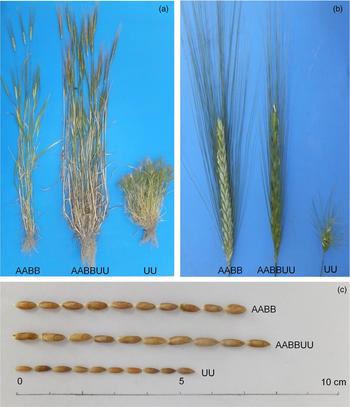
The T. turgidum–Ae. umbellulata amphidiploids showed better morphological traits than either or both of their parents (Table 2). For example, the amphidiploid plants in four of the five T. turgidum–Ae. umbellulata crosses [STU1, STU2, STU4 (Fig. 1(a)) and STU5] showed more tillers than those of the tetraploid wheat parents. The amphidiploid plants (~60–80 cm) were taller than that of Ae. umbellulata (<35 cm) but shorter than the tetraploid wheat parents (~100 cm). The spike of amphidiploids were significantly longer than Ae. umbellulata parents but similar to [STU1, STU3, STU4 (Fig. 1(b)) and STU5] or a little longer (STU2) than those of the tetraploid wheat parent. All the amphidiploids showed similar stripe rust resistance as their Ae. umbellulata or tetraploid wheat parents. However, stripe rust resistance was observed in amphidiploids using Langdon, a stripe rust-susceptible tetraploid wheat, as the female parent.
Comparison of T. turgidum ssp. Ae. umbellulata hybrid plants STU4 with their female T. turgidum ssp. dicoccum PI 94668 (AABB) and male Ae. umbellulata CIae 29 (UU) parents in plants (a), spikes (b) and seeds (c).

Comparison of morphological characteristics of T. turgidum–Ae. umbellulata amphidiploids and their parents

The T. turgidum–Ae. umbellulata amphidiploids showed excellent seed size-related traits (Table 3). For example, the projection areas for amphidiploids STU2, STU5 and STU6; the grain lengths for amphidiploids STU2, STU3, STU4 (Fig. 1(c)) and STU6; the grain width for amphidiploids STU7; the ratios of grain length to grain width for amphidiploids STU4 (Fig. 1(c)) and STU6; the grain surface perimeters for amphidiploids STU5, STU6 and STU7; and the grain weights for amphidiploids STU2, STU5 and STU7 were, respectively, better than those of their parents.
Seed traits of T. turgidum–Ae. umbellulata amphidiploids and their parents

Note: a and b indicate the data from year 2014 and 2015, respectively.
The * and ** indicate the male or female parent showing significant differences from the amphidiploids at the 0.05 and 0.01 levels. No comparison was made between the two parents of each amphidiploid.
FISH identification of parental chromosomes
The Ae. umbellulata chromosomes were differentiated by the pSc119.2/(AAC)5 and pTa71 probes (Fig. 2(a)–(d)). The pSc119.2 probe hybridized to the telomeric regions of mostly Ae. umbellulata chromosomes but pTa71 only showed significant signals on the short arms of 1U and 5U. Hybridization signals using the (AAC)5 probe were observed on all U chromosomes except for 1U and 7U. Unlike the other U chromosomes, the hybridization signals of the (AAC)5 probe on the 2U were localized near the centromeres, whereas those of the 3U were in the medial region of the short arms. Both the 4U and 5U showed strong (AAC)5 signals on the centromeres but these had different signals for pTa71, with strong signals on the telomeres of the 5US and no signal for the 4U chromosomes. The 6U (AAC)5 signals were on the interstitial sites of the short arms.
Non-denaturing fluorescence in situ hybridization of the male Ae. umbellulata parents using probes pSc 119.2, (AAC)5, and pTa 71 (a–d) and the female T. turgidum parents using probes pSc 119.2 and pTa-535 (e–g). (a) PI 428569; (b) PI 554413; (c) PI 554395; (d) CIae 29; (e) Langdon; (f) PI 94668; (g) PI 349045. The arrowheads in blue (d), red (b) and yellow (c) show the strong 1U pSc 119.2 signals on CIae 29, the additional 6U pSc 119.2 signals on PI554413, and the absence of pSc119.2 signals on PI 554395, respectively. The purple arrowhead (c) indicate the extra (AAC)5 signals on PI 554395.

Four Ae. umbellulata accessions showed polymorphic FISH signals on the 6U, 7U and 1U chromosomes (Fig. 2(a)–(d)). PI 554413 had two pairs of pSc119.2 signals on the 6UL chromosome instead of a pair of signals for the other three accessions (Fig. 2(b)). PI 554395 lost a pair of pSc119.2 signals near the telomeres of chromosome 7UL, and obtained a pair of weak (AAC)5 signals on chromosome 7US compared with those in the other four accessions (Fig. 2(c)). The 1U pSc119.2 signals of CIae 29 were much stronger than the other three accessions (Fig. 2(d)). All the A and B chromosomes of tetraploid wheat could be differentiated by probes pSc119.2 and pTa-535 (Tang et al., Reference Tang, Yang and Fu2014) but no polymeric FISH signal was detected (Fig. 2(e)–(g)).
Chromosome identification of T. turgidum–Ae. umbellulata amphidiploids
The A, B and U chromosomes of T. turgidum–Ae. umbellulata amphidiploids could be clearly distinguished by probe combinations pSc119.2/pTa-535 and pTa71/(AAC)5 (Fig. 3, and S1). After excluding the aneuploid plants at the seedling stage, all the T. turgidum–Ae. umbellulata amphidiploids showed identical chromosome compositions in all the examined seeds in both plants. For example, all the A, B and U chromosomes (2n = 6x = 42, AABBUU) from both parents were identified in the amphidiploid plants of STU4 (Fig. 3). Although no Robersonian translocation was identified by FISH analysis, the probe signals on the 1U or 5U chromosome of some amphidiploids were different from their Ae. umbellulata parents. For example, the 1U pSC119.2 signals on the telomeres of PI 554395 were weakened or lost in the 1U of amphidiploids STU2 and STU3. Similarly, the 5U pSc119.2 signals on the telomeres of PI554413 and PI428569 were, respectively, stronger than those of their amphidiploids STU5, and STU6 and STU7 (Fig. S2).
Non-denaturing fluorescence in situ hybridization of T. turgidum ssp. Ae. umbellulata amphidiploids STU4 (2n = 42 = 14 A + 14 B + 14 U) using probe combinations of pSc 119.2 and pTa-535 (a), and pTa 71 and (AAC)5 (b).

Discussion
The U genome in diploid Ae. umbellulata and polyploidy Aegilops species was considered as one of the candidate donor that expands the genetic heterogeneity of wheat (Zhang et al., Reference Zhang, Jia, Gale and Devos1998; Edae et al., Reference Edae, Olivera, Jin and Rouse2017). The amphidiploids of tetraploid/hexaploid wheat and Ae. umbellulata have been used as bridges for the direct transfer of genes from Ae. umbellulata into wheat (Chhuneja et al., Reference Chhuneja, Kaur, Goel, Aghaee-Sarbarzeh, Prashar and Dhaliwal2008). Unreduced gametes, which are regulated by a major quantitative trait on 3B in T. turgidum (Hao et al., Reference Hao, Luo, Zeng, Zhang, Ning, Yuan, Yan, Zhang, Zheng, Feuillet, Choulet, Yen, Zhang and Liu2014), play important roles in the development of Triticeae allopolyploids. The formation of unreduced gametes has been observed in haploid plants of T. durum (Jauhar, Reference Jauhar2003) and the F 1 hybrids of T. turgidum or T. aestivum with various diploid and polyploid Aegilops species other than Ae. umbellulata as far as the species out of genus Aegilops (e.g. Dasypyrum villosum) (Blanco et al., Reference Blanco, Simeone and Resta1987; Tiwari et al., Reference Tiwari, Rawat, Neelam, Randhawa, Singh, Chhuneja and Dhaliwal2008). Here, we produced triploid T. turgidum–Ae. umbellulata F 1 hybrid seeds using three T. turgidum accessions belonging to two T. turgidum species, ssp. durum and dicoccum as female parents and four Ae. umbellulata accessions as male parents without any additional strategies such as hormone treatment of the young embryos. Most of these hybrid seeds germinated and eventually developed into seedlings. The selfed seed set (percentage of selfed seeds over total number of selfed florets) of F 1 hybrid plants could be ascribed to the formation of unreduced gametes, and therefore were considered as a good index for the formation of unreduced gametes (Zhang et al., Reference Zhang, Yen, Zheng and Liu2007). The seed set rates of seven T. turgidum subspecies (ssp. dicoccon, turgidum, turanicum, dicoccoides, durum carthlicum and polonicum) with Ae. tauschii F 1 hybrid plants in 115 crosses varied from 0 to 18.57%, with an average of 5.83% (Zhang et al., Reference Zhang, Liu, Zheng, Yan, Dai, Li, Jiang, Ye and Yen2010). However, the seed set rates of the two T. turgidum subspecies (ssp. dicoccum and durum) with Ae. umbellulata F 1 hybrid plants in seven crosses (with a mean of 1.22%, range: 0.09–4.65%) were lower than those of the seven T. turgidum subspecies with Ae. tauschii F 1 hybrid plants. The low selfed seed set in most T. turgidum/Ae. umbellulata crosses may be ascribed to low frequency of unreduced gametes formation like T. durum/Ae. longissima hybrids (Jauhar, Reference Jauhar2007; Tiwari et al., Reference Tiwari, Rawat, Neelam, Randhawa, Singh, Chhuneja and Dhaliwal2008), and low viability in the pollens of triploid F 1 hybrids. Unreduced gamete formation was also occurred in triploid T. durum/Ae. longissima hybrids but no selfed seed set, which resulted from complete male sterility (Vardi and Zohary, Reference Vardi and Zohary1967).
Using the selfed seed set of partial fertile triploid F 1 plants, we obtained complete amphidiploids from seven combinations, and all parental chromosomes were verified by FISH. The results of the present study suggest that the union of unreduced gametes, which was responsible for the spontaneous doubling of chromosomes of interspecific hybrids via first-division restitution (FDR) and/or single-division meiosis (SDM) that often occurs in T. turgidum/Ae. tauschii and T. turgidum ssp. durum/Ae. longissima triploid hybrids (Tiwari et al., Reference Tiwari, Rawat, Neelam, Randhawa, Singh, Chhuneja and Dhaliwal2008; Zhang et al., Reference Zhang, Liu, Zheng, Yan, Dai, Li, Jiang, Ye and Yen2010), were also functional to produce T. turgidum–Ae. umbellulata amphidiploids. Whether the FDR, SDM or both of them were responsible for the development of T. turgidum–Ae. umbellulata amphidiploids needs to be further investigated.
The T. turgidum–Ae. umbellulata amphidiploids possess some desirable traits for genetic improvement of wheat. For example, the T. turgidum–Ae. umbellulata amphidiploids had more tillers than those of their female tetraploid wheat parents. Similarly, the T. turgidum–Ae. longissima amphidiploids (Tiwari et al., Reference Tiwari, Rawat, Neelam, Randhawa, Singh, Chhuneja and Dhaliwal2008) also had strong tillering characteristics like T. turgidum–Ae. umbellulata amphidiploids. The T. turgidum–Ae. umbellulata amphidiploids (Table 3) also showed better seed size-associated traits (grain projection areas, grain length, grain surface perimeters, grain length, grain width, grain length/width and 50-grain weight) than those of their parents. This phenomenon is also reflected in the amphidiploid seeds of T. turgidum–Ae. longissima (Tiwari et al., Reference Tiwari, Rawat, Neelam, Randhawa, Singh, Chhuneja and Dhaliwal2008). Furthermore, some T. turgidum–Ae. umbellulata crosses (e.g. STU2) exhibited better stripe rust resistance than the tetraploid parent Langdon and was highly similar to the Ae. umbellulata parents, suggesting that the stripe resistance genes/traits of Ae. umbellulata were expressed in the T. turgidum–Ae. umbellulata amphidiploids. In our previous investigation, the high-molecular weight glutenin subunits of Ae. umbellulata were also expressed in T. turgidum–Ae. umbellulata amphidiploids (Dai et al., Reference Dai, Zhao, Xue, Jia, Liu, Pu, Zheng and Yan2015). Therefore, the T. turgidum–Ae. umbellulata amphidiploids can serve as intermediate bridges for gene transfer of valuable genes/traits of Ae. umbellulata such as disease resistance, strong tillering ability, large and long seeds, and other special high-molecular weight glutenin subunits into wheat.
In summary, seven T. turgidum–Ae. umbellulata amphidiploids were produced by the unreduced gametes of T. turgidum and Ae. umbellulata triploid F 1 hybrids. The T. turgidum–Ae. umbellulata amphidiploids possess some valuable traits, such as multiple tillers, stripe rust resistance, as well as excellent seed size-related traits for wheat improvement. All the parental chromosomes in the amphidiploids could be clearly identified by FISH probe combinations of pSc119.2/pTa535 and pTa71/(AAC)5. Furthermore, four Ae. umbellulata parents showed polymorphic FISH loci on chromosomes 1U, 6U and 7U. These newly developed amphidiploids are valuable for introducing important Ae. umbellulata genes/traits to wheat.
Supplementary material
The supplementary material for this article can be found at https://doi.org/10.1017/S1479262118000254.
Acknowledgements
The Ministry of Science and Technology of China (2017YFD0100903, 2016YFD0100502), the National Natural Science Foundation of China (31771783, U1403185), the Key Fund Project of the Sichuan Provincial Department of Education (15ZA0021), and Sichuan Science and Technology Program (No. 2018HH0113 and 2018HH0130) supported this study.